Email is still one of the most reliable ways to turn interest into backers. In 2026, the campaigns that fund fast almost always have one thing in common: a clear pre-launch and launch sequence that tells the right story at the right time.
This page shows how we approach Kickstarter email marketing at BoostYourCampaign. You will see which emails matter, how often to send them, and how to connect them with your ads and landing pages so the whole funnel works together. If you want the full picture first, start with the Kickstarter marketing guide for product creators in 2026 , then come back here for the email details.
How email fits into a Kickstarter funnel in 2026
Email is the link between your ads, landing pages, and the live campaign. You pay for attention once with ads, then use email to stay in front of people for the rest of the launch.
In a simple funnel:
- Ads and organic content send people to a pre-launch landing page
- The page captures email addresses or paid reservations
- Email sequences build trust and explain the offer before launch
- On launch day, you send focused calls to back and track who converts
If any of these steps are weak, the whole system leaks. That is why we design email sequences together with the pre-launch checklist , not as an afterthought.
Welcome emails: what to send right after sign up
The welcome email is the first real contact between you and a potential backer. It should be fast, simple, and clear. You do not need a long story here, just context and the next step.
A simple welcome email framework:
- Subject line: confirm what they get for signing up
- Thank them for joining and restate the core value of the product
- Explain briefly when you plan to launch and on which platform
- Mention any early bird or reservation benefits
- Invite them to follow one simple action, such as joining a community or replying with a quick answer to a question
In our own work we often keep the welcome flow to one or two emails. The goal is to confirm that people are real and interested, and to set up the next sequence, not to sell everything at once.
Pre-launch warm up sequence: timing and content
The pre-launch warm up sequence starts once you have a steady flow of new sign ups. Its job is to move people from "this looks interesting" to "I understand the product and I want to back on day one".
A simple timing model:
- From 6 to 4 weeks before launch: 1 email per week
- From 4 to 2 weeks before launch: 2 emails per week
- Final 7 days before launch: 3 to 4 shorter emails
Typical pre-launch email themes:
- Founders story and why the product exists
- Core problem and how the product solves it
- Behind the scenes of prototyping or design
- Early feedback from testers or existing customers
- Clear explanation of early bird rewards and how to get them
These do not need to be long essays. Short, focused emails that show real progress and real people usually perform better than polished but vague messages.
Launch day email sequence: how many emails and when
Launch day is where email makes a visible difference. If you have warmed people up properly, they expect to hear from you and want to know the exact moment you go live.
A simple launch day pattern that we use often:
- Launch announcement when the campaign goes live
- Social proof update once you hit an early milestone such as 30 percent or 100 percent funded
- Recap email later in the day for people who missed the first two
These emails should be short and direct:
- Link at the top, middle, and bottom
- Clear call to back now, not just "check it out"
- Reminder that early rewards or prices are limited
If your list is large, segmenting by engagement (for example, highly engaged vs cold) can help you send more targeted messages without overwhelming everyone.
Live campaign email sequence: keeping momentum without burning people out
After launch day, email moves from "big event" to "rhythm". The goal is to keep the campaign present without turning your list into a daily promotion feed that people ignore.
A simple rhythm that works well for many campaigns:
- 1 to 2 updates per week for the first half of the campaign
- 2 to 3 updates per week in the last 7 to 10 days
Useful content for live campaign emails:
- New features, stretch goals, or add ons that just unlocked
- Progress updates with clear numbers and simple charts
- Short stories from testers, backers, or the team
- Reminders about upcoming milestones and deadlines
During the final 48 hours, it is normal to send more frequent reminders, because people expect urgency at the end of a campaign. The key is to be clear and honest about deadlines rather than trying to manufacture drama.
Kickstarter email sequence templates you can copy
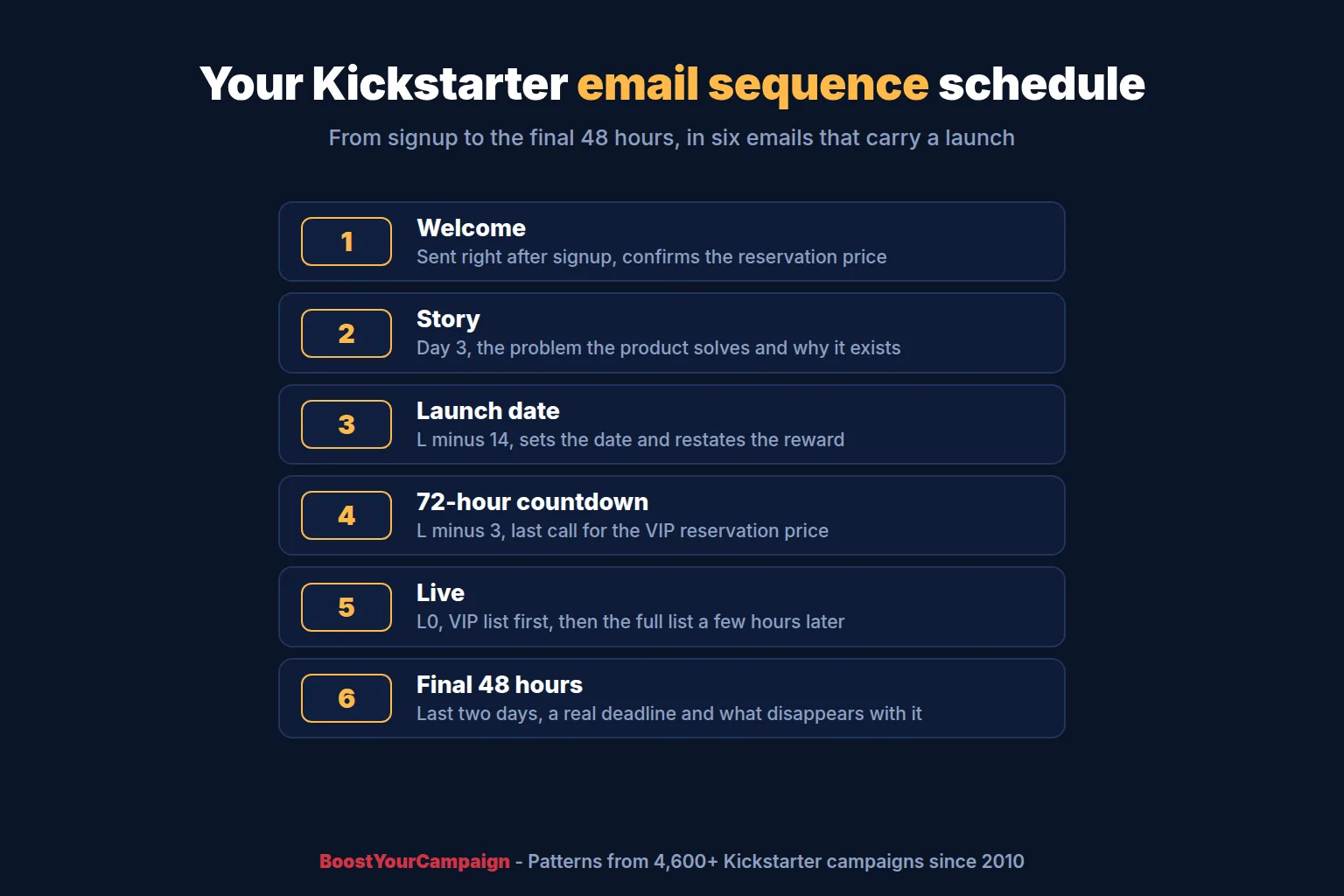
Below are seven templates that cover a full Kickstarter email sequence from signup to the final 48 hours. Copy the structure, then fill in the brackets with your own product details, dates, and prices. Keep the tone close to how you actually talk, a template that sounds like everyone else stops working the moment your list notices.
1. Welcome and reservation invite
When it sends: Immediately after someone joins your list
Subject line options: "You are on the list for [Product]" or "Thanks for joining, here is what happens next"
Thank you for joining the list for [Product]. We are building this because [core problem it solves], and we plan to launch on Kickstarter on [Launch date]. Over the next few weeks you will get a short story about why we started, a look at how the product works, and a heads up before we go live. As a thank you for joining now, you can reserve your spot at [Early bird price] with a small refundable deposit at [Reservation link]. It takes less than a minute and locks in the lowest price we plan to offer. Reply to this email with any question, a real person reads every reply.
2. The story behind the product (day 3)
When it sends: Day 3 after signup
Subject line options: "Why we are building [Product]" or "The problem that started this"
[Founder name] started [Product] after running into [core problem] and finding that every existing option was [pain point, for example too expensive or poorly made]. We spent [timeframe] testing prototypes and talking to people who deal with the same problem, and [Product] is the result. It [core benefit in one sentence]. We are launching on Kickstarter on [Launch date] because we want early supporters like you to get the best price and the most say in what ships. If you want to see where we are in development, reply and ask, we are glad to share photos before anyone else sees them.
3. Launch date announcement (L minus 14)
When it sends: 14 days before launch
Subject line options: "[Product] launches on [Launch date]" or "Mark your calendar, we go live [Launch date]"
We now have a date. [Product] launches on Kickstarter on [Launch date] at [Launch time]. Over the next two weeks we will send a short update every few days: a look at production, answers to the questions we hear most, and a reminder of the early bird price before it changes. If you reserved a spot already, you are set, we will send you a private link a few hours before everyone else. If you have not reserved yet, you can still lock in [Early bird price] at [Reservation link]. Add [Launch date] to your calendar now so the first email does not catch you off guard.
4. 72-hour countdown with the VIP price (L minus 3)
When it sends: 72 hours before launch
Subject line options: "72 hours until [Product] goes live" or "Your VIP price locks in this week"
[Product] goes live in 72 hours, on [Launch date] at [Launch time]. If you reserved your spot, your price is locked at [Early bird price] and you get early access before the public link goes out. If you have not reserved yet, this is the last window to do it, reservations close once the campaign opens and the price moves up from there. Reserving takes a small refundable deposit and about a minute at [Reservation link]. Over the next three days we will share a few final details about the reward tiers and shipping, then send your private early access link the morning we launch.
5. Launch day, we are live (L0)
Send this in two waves: a VIP version first, then a full list version a few hours later once VIP reservers have had first access.
VIP version, when it sends: Launch morning, to VIP reservers only
Subject line options: "We are live, here is your early access link" or "[Product] is live, claim your spot before it opens to everyone"
[Product] is officially live on Kickstarter. Because you reserved a spot, you get first access at [Early bird price] before we send this to the rest of our list. Your link is [Campaign link]. Reward tiers are limited, so if you want a specific size, color, or bundle, back now rather than waiting until later today. Thank you for backing this from the start, it means a lot to see the people who believed in [Product] early be the first ones in. We will keep you posted as we hit our first milestones today.
Full list version, when it sends: A few hours later, to the rest of the list
Subject line options: "We are live on Kickstarter now" or "[Product] just launched, here is the link"
[Product] is now live on Kickstarter, and thanks to our early supporters we are already at [funding percent] funded. The [Early bird price] tier is still available while supplies last at [Campaign link]. If you have been waiting for launch day, this is it, back now to lock in the best price and help us reach our first stretch goal. Every pledge in the next few hours moves us closer to unlocking [stretch goal, if any]. Thank you for following along since we announced this, we could not do this without a list of people who care about the problem we are solving.
6. 48-hour social proof update (L plus 2)
When it sends: Two days after launch
Subject line options: "[funding percent] funded, thank you" or "What backers are saying about [Product]"
Two days in, [Product] is at [funding percent] funded with [backer count] backers, and we wanted to share what people are saying. [Short quote or reaction from a real backer or comment]. Seeing real people respond to something we built quietly for months is the best part of this launch so far. If you have not backed yet, the [Early bird price] tier is still open at [Campaign link]. If you have already backed, thank you, and if you know one person who would like [Product], forwarding this email is the single most useful thing you can do for us this week.
7. Final 48 hours
When it sends: 48 hours before the campaign closes, followed by a shorter reminder in the final hours
Subject line options: "48 hours left on [Product]" or "This ends [Close date], here is what goes away"
[Product] closes on Kickstarter in 48 hours, on [Close date] at [Close time]. After that, [Early bird price] is gone and [any reward tier or bonus tied to the campaign] will not be available again until [later date or "at all"]. If you have been meaning to back this, now is the moment, [Campaign link]. We will send one more short reminder a few hours before we close, then the page locks. Thank you for following [Product] this far, whichever way you have supported us.
Cadence and timing that works
The seven templates above map onto a simple schedule. Nothing here is exotic, the value is in sending each email at the point in the campaign where it does the most work.
| Day | Audience | Goal | |
|---|---|---|---|
| Welcome and reservation invite | Day 0 | New signups | Confirm signup, invite a reservation |
| Story behind the product | Day 3 | Full list | Build trust, explain the why |
| Launch date announcement | L minus 14 | Full list | Set the date, restate the reward |
| 72-hour countdown | L minus 3 | Full list | Push last reservations, confirm the price |
| Launch day, VIP | L0, morning | VIP reservers | Give early access before the public link |
| Launch day, full list | L0, a few hours later | Non-VIP subscribers | Announce the live campaign, drive day-one pledges |
| 48-hour social proof | L plus 2 | Full list | Show momentum, reach fence sitters |
| Final 48 hours | Last two days | Full list, segmented by engagement | Close on urgency and a real deadline |
List recency matters as much as list size. Leads collected in the final 72 hours before launch tend to convert at a noticeably higher rate than older leads on the same list, since they opted in closest to the moment you ask them to back. That is not a guaranteed lift for every product or audience, but across the campaigns we have run, a focused push to grow the list in the final three days before launch has consistently paid for itself in day-one pledges.
What to write in subject lines and preview text
Subject lines and preview text decide whether your emails are even opened. For Kickstarter campaigns in 2025, direct and concrete beats clever and vague almost every time.
Principles we use when writing subject lines:
- State the main value clearly: what people will see or get
- Use real numbers when possible, such as funding milestones or time left
- Avoid clickbait and over used formulas
Examples of simple, effective subject line styles:
- "We are live on Kickstarter now"
- "Behind the scenes: how we built the first prototype"
- "72 hours left to get the early price"
- "New stretch goal unlocked at 150,000"
Preview text should support the subject line, not repeat it. Think of it as a short second chance to make people curious enough to open.
Segmenting your email list for better results
Not everyone on your list has the same level of interest. Segmenting helps you send the right level of detail to the right people and avoid unnecessary fatigue.
Simple segments that are easy to maintain:
- Highly engaged: people who open and click most emails
- Warm: people who open sometimes and clicked at least once
- Cold: people who rarely open or click
For highly engaged segments, you can send more detailed updates and ask for more actions such as sharing the campaign. For colder segments, keep messages shorter and focus on clear benefits and deadlines.
In our work at BoostYourCampaign, we always connect segmentation with ad data where possible, so we know which angles someone saw before they joined the list.
Connecting email with your ad strategy
Email marketing does not live in isolation. It should reflect what is already working in your ads and landing pages. If a certain angle performs well in Meta ads, we often build an email around the same idea to keep the message consistent.
A few practical ways to connect email and ads:
- Build emails that match the strongest ad angles and headlines
- Use your best performing ad visuals in some of your email sections
- Create retargeting audiences based on email clicks and behaviour
- Measure how different segments respond and feed that back into creative tests
If you want to see how we think about ads in more detail, read Kickstarter ads in 2025 and then plug the same logic into your email content.
Common Kickstarter email mistakes to avoid
Email is powerful, but it is also easy to misuse. A few common patterns show up often in campaigns that struggle.
- Writing only when something is urgent, instead of building a steady rhythm
- Overloading every email with all product details at once
- Hiding the call to back low on the page instead of putting it near the top
- Ignoring subject lines and preview text until the last minute
- Sending the same content to every subscriber regardless of engagement
We cover broader strategic errors in Kickstarter marketing mistakes to avoid in 2025 , but these email specific issues are worth checking before each send.
Post-campaign email: what to do after funding
Email does not stop being useful when the campaign closes. In many ways it becomes even more important. Backers expect clear, honest updates, and future launches depend on how you handle this phase.
Useful post-campaign email types:
- Thank you and next steps: what happens in the first weeks after funding
- Production and shipping updates with realistic time frames
- Opportunities to join a wait list or late pledge if relevant
- Invitations to future launches or related products once you are ready
A clear post-campaign email plan helps you move from Kickstarter to a longer term brand. We talk more about this in the Kickstarter marketing guide .
How BoostYourCampaign handles email marketing for clients
At BoostYourCampaign we treat email as a core part of the funnel, not a side task. For full service projects we write and schedule the main sequences, test subject lines, and connect email performance directly to ad and campaign data.
A typical setup for our clients includes:
- Welcome flow linked to the pre-launch landing page
- Pre-launch warm up sequence aligned with the creative strategy
- Launch day sequence with clear timing and goals
- Live campaign update rhythm mapped to key milestones
- Structured post-campaign updates so backers stay informed
In some cases we combine this with a skin in the game model where we cover ad spend in return for a kickback on funds raised. Email then becomes one of the key levers that decides how aggressive we can be with scaling.
If you want to see how this feels from the creator side, read the BoostYourCampaign reviews . If you are ready to talk about your own launch, go to the Kickstarter marketing services page and share a few details about your project.
Kickstarter email marketing agency: when to hand it off
Writing seven emails is manageable on your own. Writing them well, testing subject lines, timing each one against ad spend, and adjusting the plan on launch day while you are also running the campaign is a different job. That is where a Kickstarter email marketing agency earns its cost, especially once ads are in the mix and the landing page, the ad creative, and the email copy all need to say the same thing in the same voice.
At BoostYourCampaign we write and schedule the full sequence above as part of our full service packages, timed against the same launch date we are running ads against. We build the reservation landing page through Kickstarter landing page design , manage the ad spend that fills the list through Kickstarter ads management , and write every email in this guide specifically for your product rather than pulling from a generic template. If you already have a list and just need the emails written and scheduled, or you want the whole funnel run for you from landing page to the final 48 hours, get in touch and tell us where you are in the process.
Frequently asked questions
How important is email marketing for Kickstarter in 2026?
Email marketing is one of the main levers for a serious Kickstarter launch in 2026. Ads bring traffic, but email is where you warm people up, explain the offer, and bring them back when it matters. For many campaigns, a large share of day one backers comes from the pre-launch email list.
Which email sequences do I need for a Kickstarter campaign?
Most campaigns only need three core sequences: a welcome flow right after sign up, a pre-launch warm up series in the weeks before launch, and a focused launch and live campaign sequence once you go live.
How often should I email my list before a Kickstarter launch?
A simple pattern is one email per week from six to four weeks before launch, two emails per week from four to two weeks out, and three to four shorter emails in the final seven days before launch, as long as the content stays useful.
How many emails should I send on Kickstarter launch day?
A common approach is three emails on launch day: a launch announcement when you go live, a social proof update once you hit an early milestone, and a recap email later in the day for people who missed the first two.
What should I include in Kickstarter email subject lines?
Use direct and concrete subject lines that state the main value, mention real milestones or deadlines, and avoid vague clickbait. Simple lines like 'We are live on Kickstarter now' or '72 hours left to get the early price' often perform better than clever phrases.
How should I segment my Kickstarter email list?
A practical approach is to segment by engagement into highly engaged, warm, and cold groups. Highly engaged subscribers can receive more detailed updates, while colder segments should get shorter messages focused on clear benefits and deadlines.
What are common Kickstarter email marketing mistakes?
Typical mistakes include emailing only when something is urgent, stuffing every email with all product details, hiding the call to back low in the message, ignoring subject lines and preview text, and sending the same content to every subscriber regardless of engagement.
How does BoostYourCampaign handle email for Kickstarter clients?
BoostYourCampaign treats email as a core part of the funnel. For full service projects the team writes and schedules welcome, pre-launch, launch day, live campaign, and post-campaign sequences, tests subject lines, and connects email performance directly to ad and campaign data.
How many emails should I send before a Kickstarter launch?
Five to seven emails is a reasonable range for the pre-launch window: a welcome email, a story or founder email, a launch date announcement, a 72-hour countdown, and a launch day email at minimum. Fewer than that and a list of leads goes cold before you ask them to back. More than that without new information tends to raise unsubscribes without adding pledges. The number matters less than sending something useful each time rather than a repeated reminder to save the date.
What should a Kickstarter launch email say?
A launch email should lead with the fact that you are live, include the campaign link near the top, restate the early bird price and what it includes, and give one clear reason to act now rather than later, such as a limited reward tier or a reservation price about to end. Keep it short. People who followed a pre-launch sequence already know the story, they need the link and a reason to click it today instead of next week.
When should the countdown emails start?
Most campaigns get good results starting a countdown around 72 hours before launch, with a shorter reminder in the final hours before the campaign goes live. Starting much earlier than that tends to lose urgency, since three days out still feels far away to most subscribers. The same pattern works again at the close of the campaign: a 48-hour email, then a final short reminder a few hours before the deadline.
Ready to give your campaign the best shot?
We've helped 4,600+ creators raise over $734M since 2010. Let's pressure-test your launch plan and find the highest-leverage fixes before you go live.
Talk to an expert →