
When you hire a Kickstarter marketing agency you are not buying theory, you are buying a process. The real question is simple: what happens between the first call and the moment your campaign funds.
On this page we walk through exactly how BoostYourCampaign works with creators. No vague roadmaps, just the concrete steps, numbers, and decisions that move a campaign from idea to funded project.
If you want to see how this feels on the client side, you can read real creator experiences on our Kickstarter agency reviews page.
If you already know you want to talk, you can skip ahead to the Kickstarter marketing services overview or send us your project details.
What is Kickstarter marketing in 2025
Kickstarter marketing in 2025 is the full system that takes your project from idea to funded campaign. It covers validation, pre launch audience building, landing pages, paid ads, email sequences, PR, and post campaign follow up. The goal is not only to hit your funding target, but to build a real audience and a repeatable way to acquire customers.
What does a Kickstarter marketing agency actually do
A Kickstarter marketing agency turns your campaign into a structured funnel. The team helps you test your offer, run Meta and other ads, build and optimise landing pages, write emails, create campaign visuals, and monitor daily numbers during the live campaign. Instead of guessing what might work, you use data to decide what to scale and what to stop.
What happens before you sign anything
The work starts before a contract. On the first call we focus on three things: numbers, fit, and timing.
- Your product and category, including where it sits in the market
- Your cost of goods and realistic margin per unit
- Your funding goal, stretch targets, and timelines for production
We also talk about your marketing budget. In most cases you should plan for at least 4,600 dollars in marketing spend alongside production and logistics. That budget can be a mix of professional fees and ad spend, and for some projects we offer a skin in the game structure where we front a part of the ad spend in return for a performance based fee.
If the numbers cannot work, we say so. Sometimes that means lowering the goal, changing reward structure, or delaying launch. Sometimes it means you are not ready for performance marketing yet.
When the fit is right, we move into a short, focused validation sprint.
Phase 1: validation sprint and early audience testing
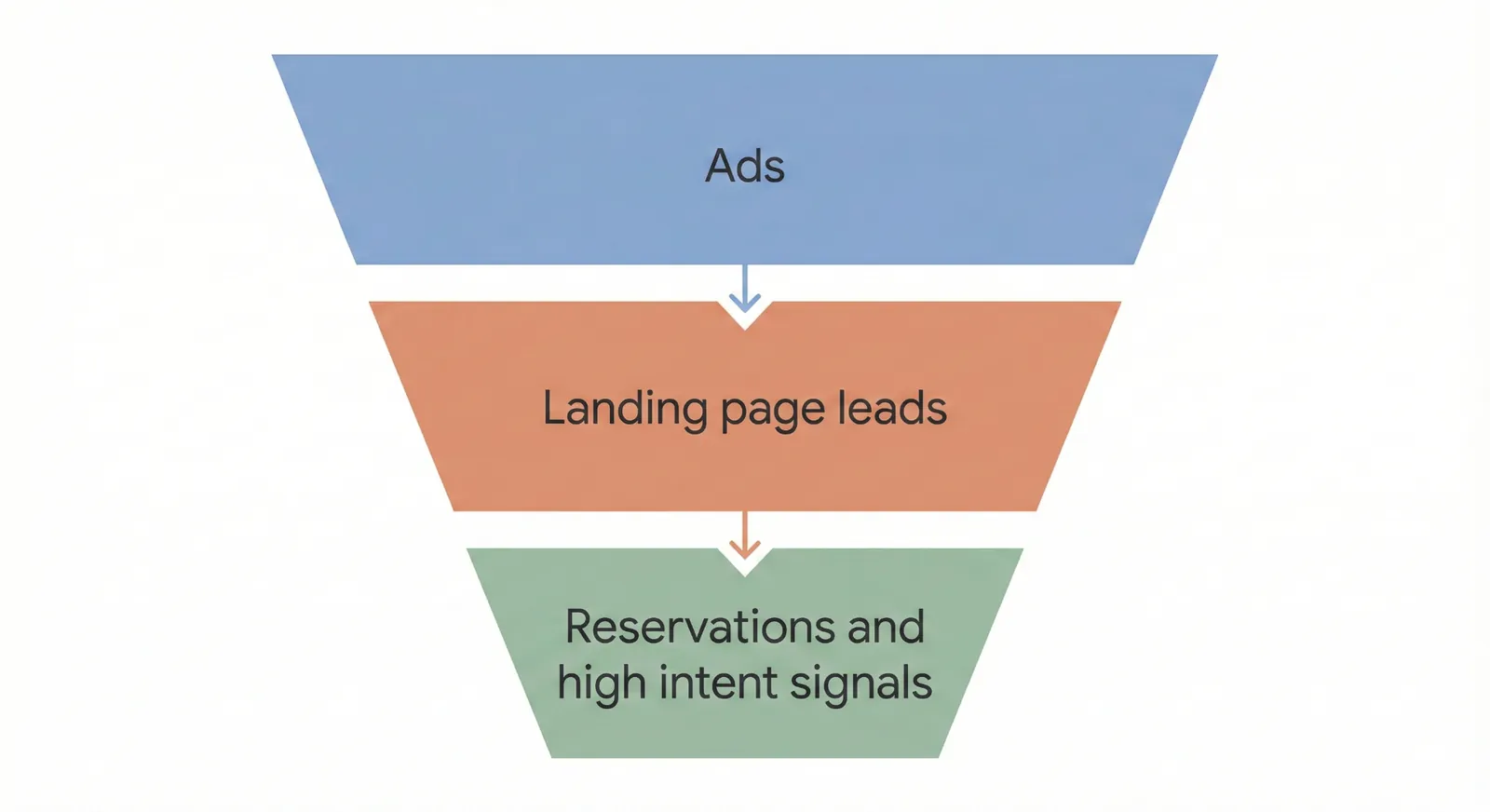
The validation sprint is where we find out if your offer can actually convert strangers into leads and future backers at a sensible cost.
Setting up the validation funnel
We start small and sharp:
- Simple but focused landing page that explains your product and offer
- Clear call to action, usually email signup or small reservation fee
- Initial Meta ad sets that test a limited set of hooks, angles, and audiences
At this stage we are not trying to scale. We are testing basic assumptions: who responds, which angles get clicks, and how much it costs to acquire a lead.
The numbers we watch in validation
During the validation sprint we look at:
- Cost per lead and how it evolves as data comes in
- Click through rate per creative and per angle
- Early intent signals like reservation rate or reply rate to emails
If numbers are off, we adjust the offer, price framing, or creative and test again. If they remain off after real effort, we advise you to pause or rework your plan instead of pouring money into a weak setup.
For a deeper look at how we think about ads during these phases you can read Kickstarter ads in 2025.
Phase 2: pre launch list building and warm up
Once the validation sprint shows that your offer and audience can work, we move into list building. This is where momentum is built long before launch day.

Scaling from tests to real volume
We keep what worked in validation and scale it up:
- More creatives built on winning angles and visual patterns
- More structured campaigns inside Meta so budget flows to what works
- Higher daily ad spend as long as cost per lead stays within a healthy range
The goal is to turn a small pool of promising data into a real audience that is ready for launch.
Email sequences and warm up
While the list grows, we do not let it go cold. We set up:
- Welcome emails that explain the product and what backers can expect
- Launch countdown emails as you get closer to the date
- Occasional proof based updates such as prototypes, behind the scenes, or press
The aim is simple. When you press launch, you do not open to silence, you open to a group of people who already know the offer and feel involved.
Phase 3: campaign page and creative assets
In parallel with list building we build and refine the assets that will carry your campaign in public.
Campaign page structure
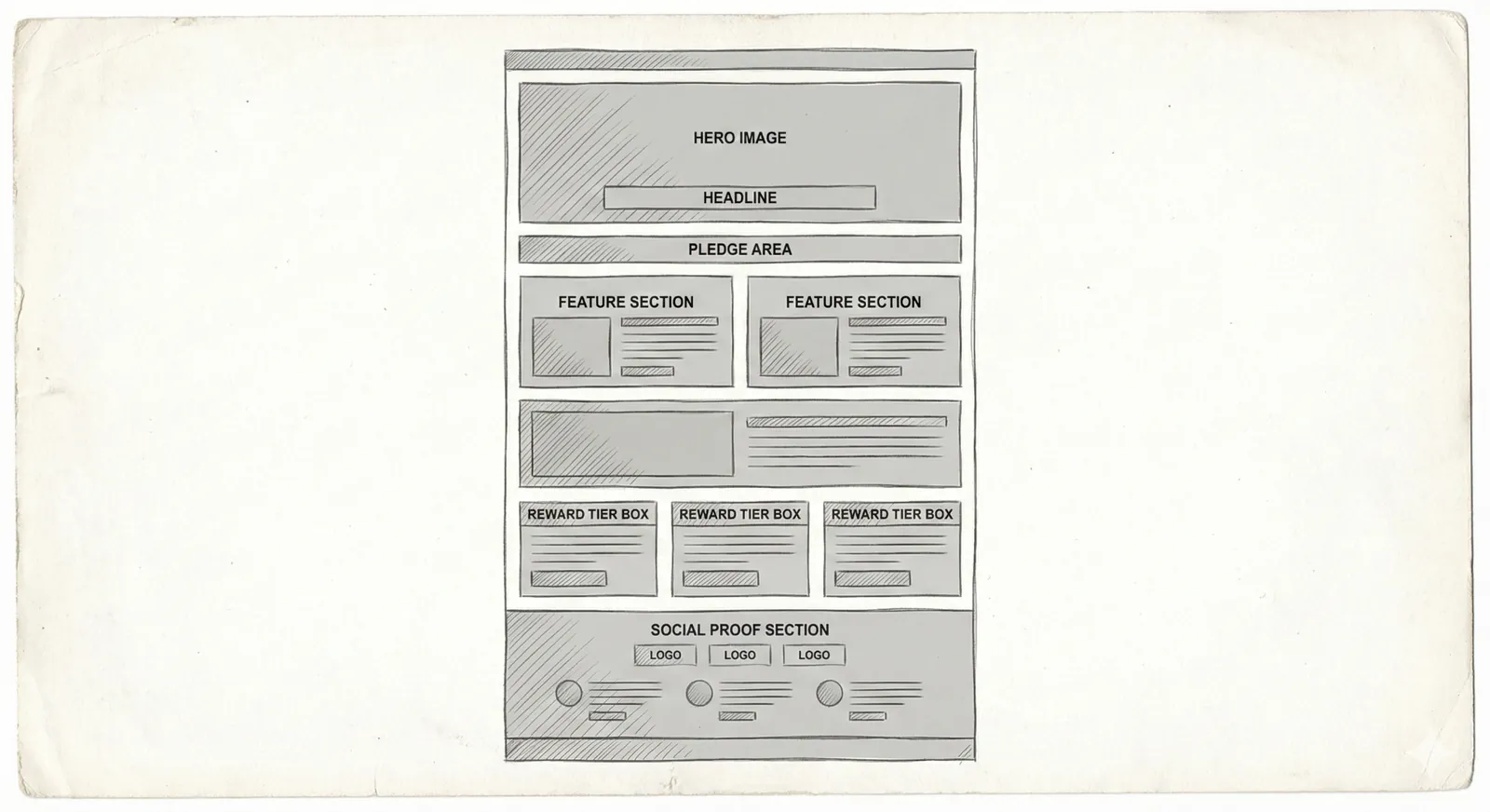
We either build your Kickstarter page from scratch or work with your existing draft. Typical elements we focus on:
- Clear top section that explains what the product is and why it exists
- Sharp benefit driven copy, not just feature lists
- Reward structure that is easy to understand and makes economic sense
- Visual hierarchy so a scanner can understand the product in seconds
- Social proof from early testers, press, or past campaigns
We constantly cross check copy and structure against your ad angles and landing pages so the story stays consistent from first impression to pledge.
Video, photography, and extra assets
Strong creative is now the default, not a bonus. If you already have high quality visuals, we help you rework them into Kickstarter ready assets.
If you are earlier stage, we can support there as well. For software projects our MVP service helps you go from concept to testable version so marketing is grounded in a real product. For physical products we can work with your team or our own studio partners to plan Kickstarter ready video and photo shoots.

The goal is not to win design awards. The goal is to give backers enough clarity and confidence to pledge.
Phase 4: launch week and early momentum
Launch week is where all the preparation is tested. The first 48 to 72 hours are critical for trust and discoverability.
Coordinated launch push
We coordinate your launch like a campaign, not a single announcement:
- Launch emails to your pre launch list, often segmented by interest or engagement
- Updated ad campaigns that now optimise for backers, not just leads
- Social media posts and content tailored to your main channels
- Optional cross promotions with other creators if it fits your category
The aim is to hit a strong percentage of your goal early, which makes it easier for later visitors to trust the project and back.
Live monitoring and quick decisions
During launch week we watch the numbers closely:
- Conversion rate from cold traffic to backer
- Conversion rate from your email list to backer
- Average pledge size and how it compares to plan
When needed, we adjust copy, images, or rewards quickly. Small moves early can have a large impact on the rest of the campaign.
Phase 5: live campaign optimisation and mid campaign plateaus
After the initial spike, most campaigns face a quieter middle period. This is where ongoing optimisation matters.
Ad and funnel optimisation
For ads and funnels we:
- Shift budget toward ad sets, audiences, and creatives that are bringing in profitable backers
- Cut or pause weak combinations so they do not drain your budget
- Test new angles based on questions, comments, and backer feedback
We track cost per acquisition, return on ad spend, and how each channel contributes to your total funding.

Keeping the campaign alive for humans
Metrics matter, but backers are not dashboards. During the live phase we also:
- Plan and publish campaign updates with real substance
- Announce stretch goals when they make sense for your margins and timelines
- Answer questions clearly to reduce friction and uncertainty
This mix of data driven decisions and straightforward communication is a big part of what clients mention in their BoostYourCampaign reviews.
Phase 6: after the campaign and long term marketing
A funded campaign is a milestone, not the finish line. You leave Kickstarter with more than money. You leave with an email list, ad audiences, and creative that has been tested in the wild.
Post campaign options
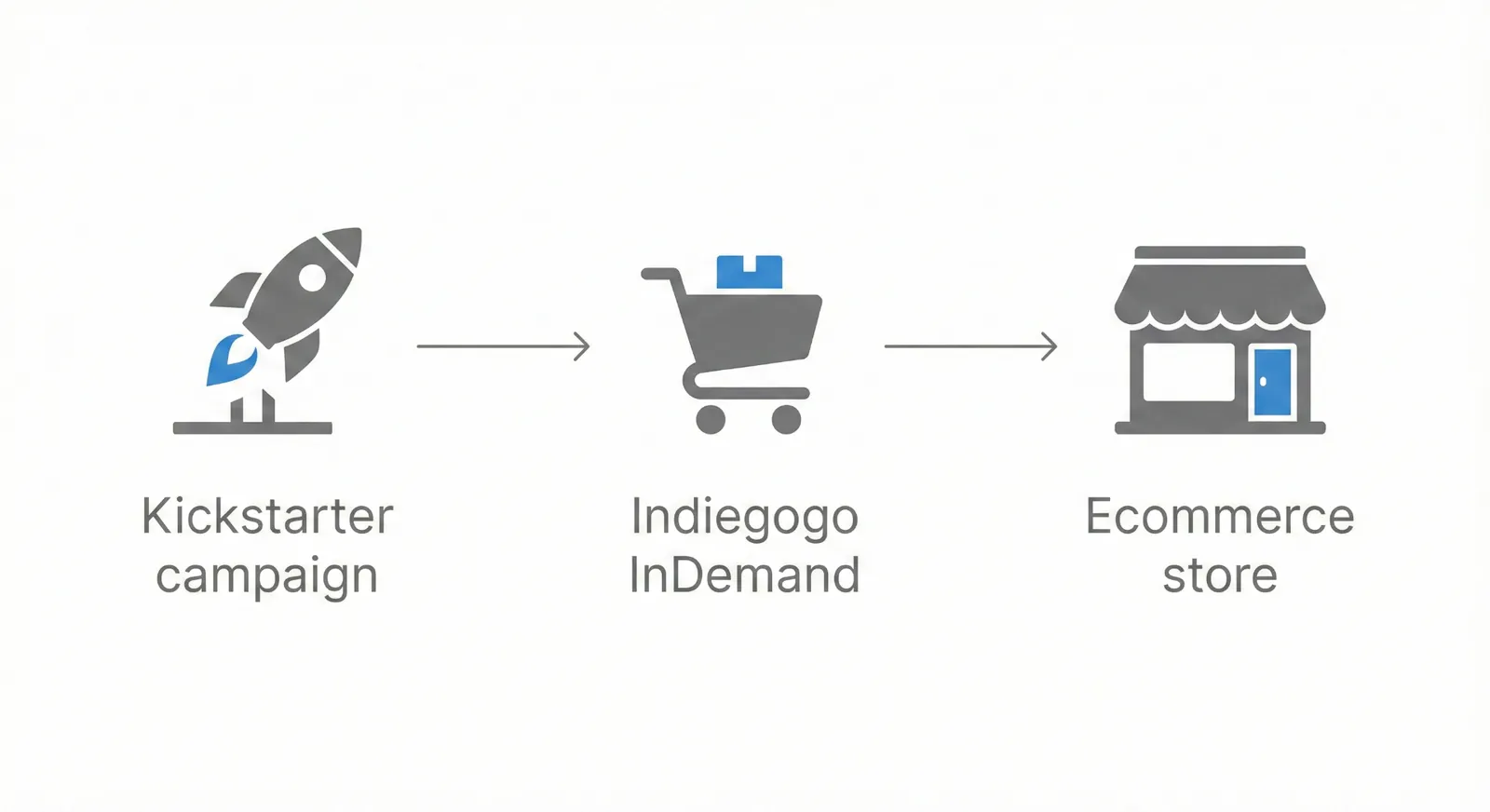
Depending on your product and plans, next steps can include:
- Moving to Indiegogo's Late Pledge (formerly called InDemand)
- Launching a direct to consumer store on Shopify or similar platforms
- Setting up always on ads that reuse proven angles and creatives
We help you think through which path makes sense based on demand, margins, and your capacity.
Why this process repeats across campaigns
Many teams come back for second or third launches. The reason is simple. The same structure that works for the first campaign can be refined and reused for later products, often with better results since you already have a warm audience and a stronger brand.
On the client reviews page you will find teams who worked with us across multiple campaigns and categories.
Frequently asked questions about Kickstarter marketing
What is Kickstarter marketing
Kickstarter marketing is the set of strategies that bring qualified visitors to your campaign and turn them into backers. It includes validation, pre launch list building, paid ads, landing pages, emails, PR, and social media. Instead of hoping that organic traffic finds you, you use a controlled system to drive demand.
Do I really need Kickstarter marketing services or can I do it myself
You can run a campaign on your own, but the risk is much higher if you have no experience with ads, funnels, or email. Professional Kickstarter marketing services help you avoid common mistakes, set realistic goals, and use proven systems. Many creators choose a done for you partner when they are working with real budgets and tight timelines.
What is the best Kickstarter marketing agency model
The best model depends on your risk tolerance and budget. Some agencies charge only fixed retainers. Others, like BoostYourCampaign, combine professional fees with performance linked upside where they contribute ad spend and share in the results at the end of the campaign. The key is clear scopes, transparent reporting, and aligned incentives.
How much should I budget for Kickstarter marketing in 2025
For most product campaigns, a serious starting point is a few thousand dollars for professional support plus a separate ad budget. Lightweight or hobby projects can spend less, but if you want to validate properly and scale with confidence, you should treat marketing as part of your product cost, not an afterthought.
When should I start marketing my Kickstarter campaign
A good rule of thumb is to start 8 to 12 weeks before your target launch date. That gives enough time for validation, list building, creative work, and fixing anything that does not convert. If you are closer than that, you can still run a campaign, but you will have less room for testing and optimisation.
What are the most important Kickstarter marketing channels
For most campaigns, the core channels are Meta ads, landing pages, and email. PR, influencers, TikTok, and social media add reach and credibility, but they work best when the core funnel is already performing. Without a working paid funnel and email list, extra channels tend to be noisy rather than profitable.
How do I know if my Kickstarter marketing is working
You track a small set of numbers. Before launch, that is mainly cost per lead and the quality of your email list. During the live campaign you focus on conversion rate from lead to backer, cost per acquisition, and daily pace toward your goal. If these metrics are healthy, you can scale. If they are off, you adjust the offer, creative, or targeting.
Where can I see real reviews of Kickstarter marketing agencies
For BoostYourCampaign you can see detailed client experiences and outcomes on our dedicated reviews page. Third party review sites and Reddit threads can be useful as extra context, but they are often incomplete or lack hard numbers. Our reviews page focuses on real projects, clear expectations, and what working together actually feels like.

Next step: talk to us about your Kickstarter launch
If you are planning a Kickstarter or Indiegogo campaign and want a partner who handles the full marketing process, the next step is simple.
- Visit the Kickstarter marketing services overview to see what is included
- Then fill out the contact form and share a few details about your product, margins, and goal
We will review your information, look at the numbers, and come back with a clear yes, no, or not yet with concrete steps to fix the gaps.
Ready to give your campaign the best shot?
We've helped 4,600+ creators raise over $734M since 2010. Let's pressure-test your launch plan and find the highest-leverage fixes before you go live.
Talk to an expert →