Kickstarter marketing agency pricing 2026: costs, ad spend, and budgets
If you are trying to price a Kickstarter marketing agency in 2026, you are usually asking two questions at once: (1) what will I pay the agency, and (2) what will I spend on ads and creative to get funded and scale. This guide gives you practical ranges, common pricing models, and budget rules that stop you from underfunding marketing or overspending before you have proof.
If you want the full launch system (not just budgets), start here: Kickstarter marketing: complete guide for product creators. If you want creator feedback first, use: BoostYourCampaign reviews.

Quick overview
How much does a Kickstarter marketing agency cost in 2026?
In 2026, most agencies charge using one of three models: a monthly retainer, a performance-based fee (often paired with a retainer), or a hybrid that combines retainers with a revenue share. The right model depends on your budget, your risk tolerance, and how strong your offer economics are. You should also plan for separate costs like ad spend and creative production.
How much ad spend do I need for Kickstarter in 2026?
Ad spend depends on your category, price point, and how efficient your funnel is, but a practical floor for controlled testing is usually a few thousand dollars across pre-launch and early live testing. If you cannot commit at least $4,500 total marketing budget, you can still launch, but you will rely more on organic reach and luck than predictable growth.
What you are actually paying for
Creators often compare agencies like they are buying "ads management." That is how budgets get wasted. The real cost is the team and the system behind your launch.
A serious Kickstarter marketing partner should cover four workstreams:
- Pre-launch validation and list building: testing angles, building the funnel, and proving demand.
- Conversion work: campaign page structure, offer clarity, reward logic, proof assets.
- Paid acquisition and optimisation: managing ads across pre-launch and live phases with decision rules.
- Reporting and decisions: weekly direction, not dashboards you never read.
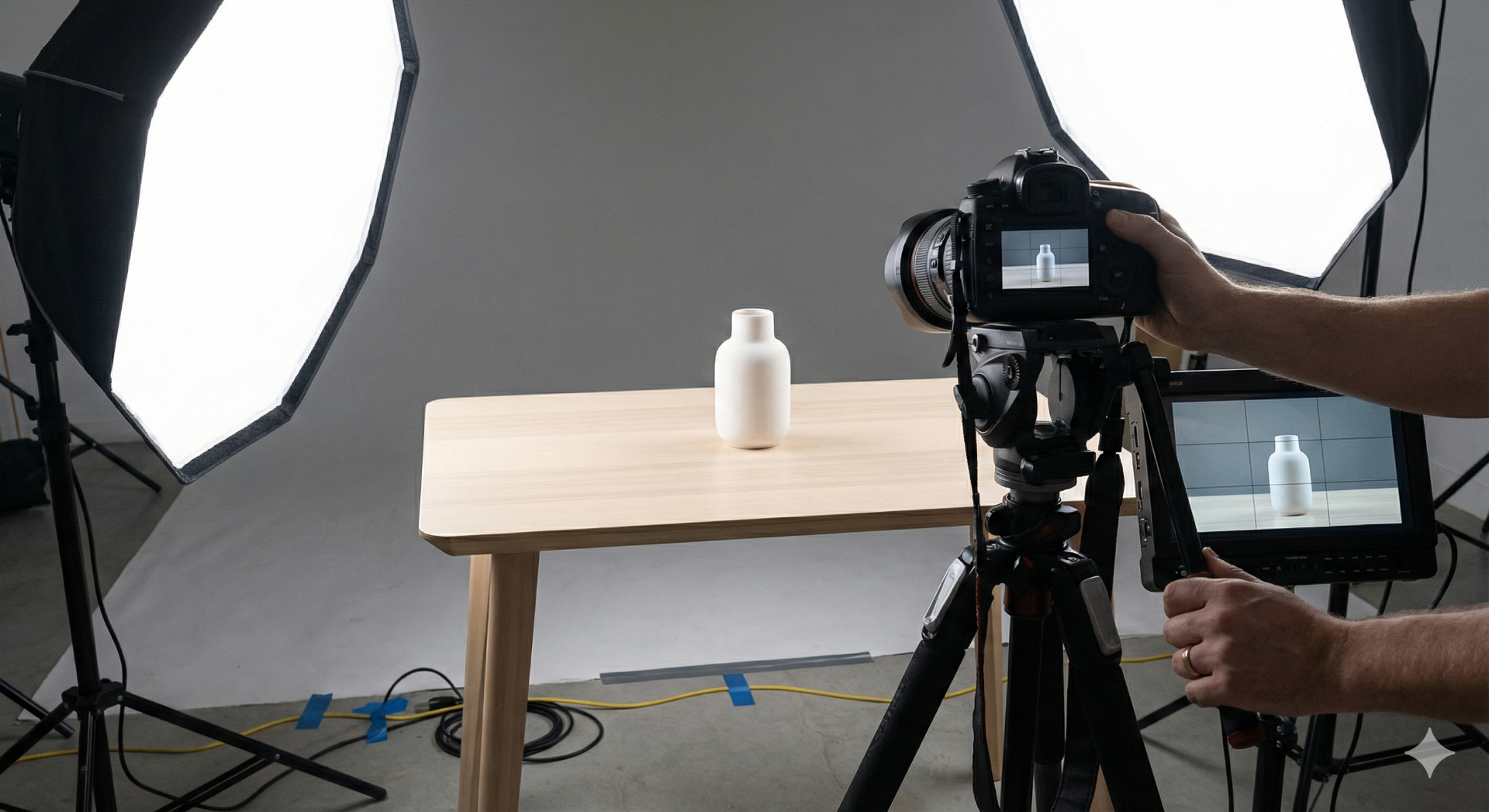
At BoostYourCampaign, this includes in-house creative. We run video and product photography from our own studios in the US and Europe, so production stays aligned with the funnel and ad testing.
Kickstarter marketing agency pricing models in 2026
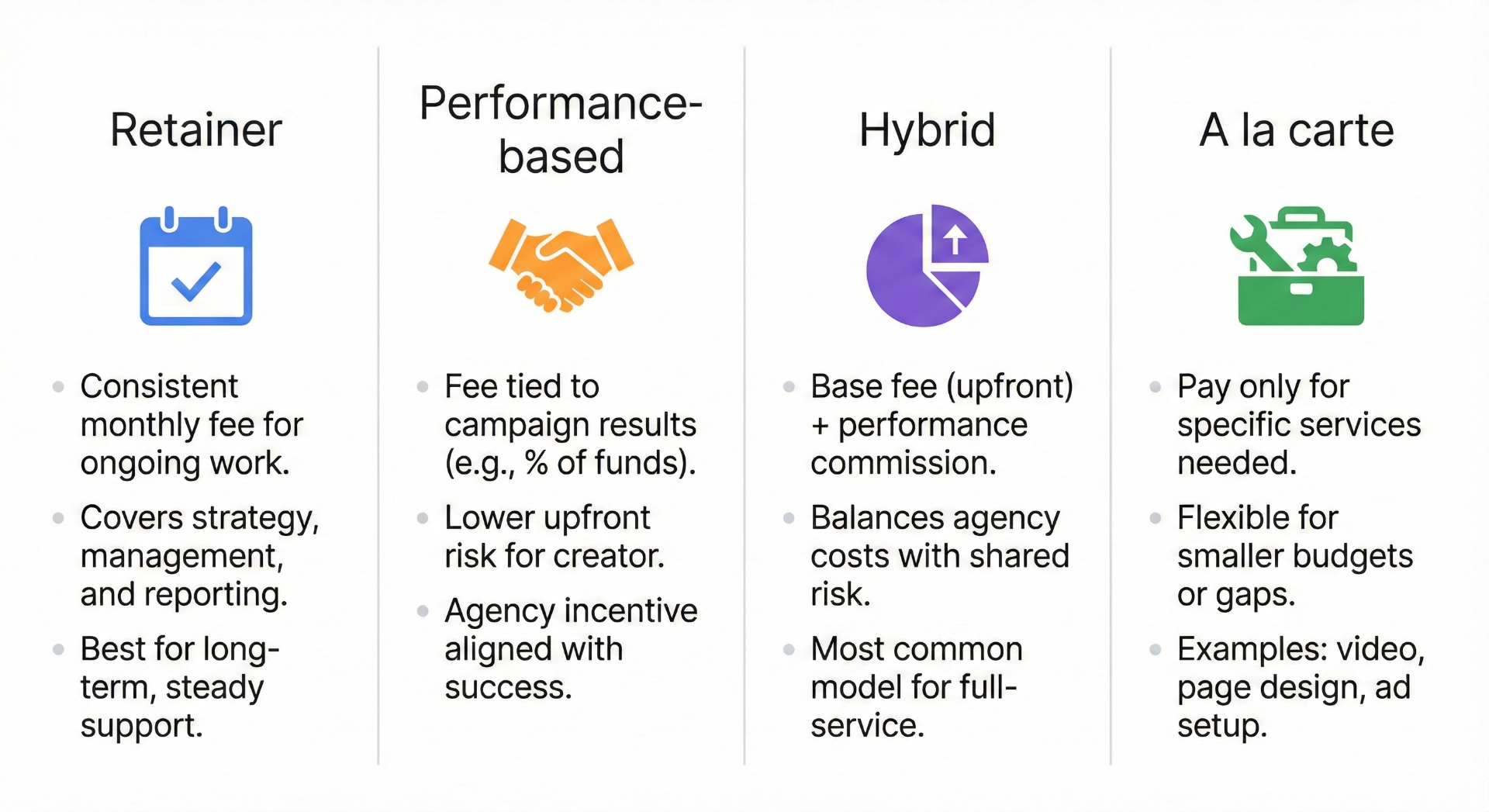
Model 1: monthly retainer
This is the most common model. You pay a fixed monthly fee for management, strategy, and execution.
- Best for: creators who want predictable costs and full control of ad spend.
- Risk: agencies get paid whether the campaign performs or not, so you must demand a clear testing plan and reporting rhythm.
Model 2: performance-based (skin-in-the-game)
In a skin-in-the-game model, the agency invests alongside you, often by covering some ad spend and getting paid via a kickback on sales at the end of the campaign. This aligns incentives, but it is not a fit for every project.
- Best for: campaigns with strong margins, clear demand signals, and realistic scale potential.
- Risk: if your economics are weak, you will either not qualify, or you will be forced into goals and offers that do not match reality.
Model 3: hybrid (retainer + performance)
This is common for teams that do real work but still want alignment. You pay a smaller base fee, plus a performance component when results hit targets.
- Best for: creators who want alignment but also want a team that can staff the work properly.
Model 4: a la carte services
This is where you buy one thing only, like ads management, PR outreach, or a landing page. It can work, but it often fails because the funnel breaks elsewhere.
- Best for: teams with strong internal marketing capacity who need one specialist function.
- Risk: you pay for traffic while the page and offer still do not convert.
Budgeting rules that keep you safe
Rule 1: start with break-even cost per backer
You need one number before you decide anything: what you can afford to pay to acquire a backer and still profit after fees, shipping, and taxes. If an agency does not ask for your margin early, they are guessing.
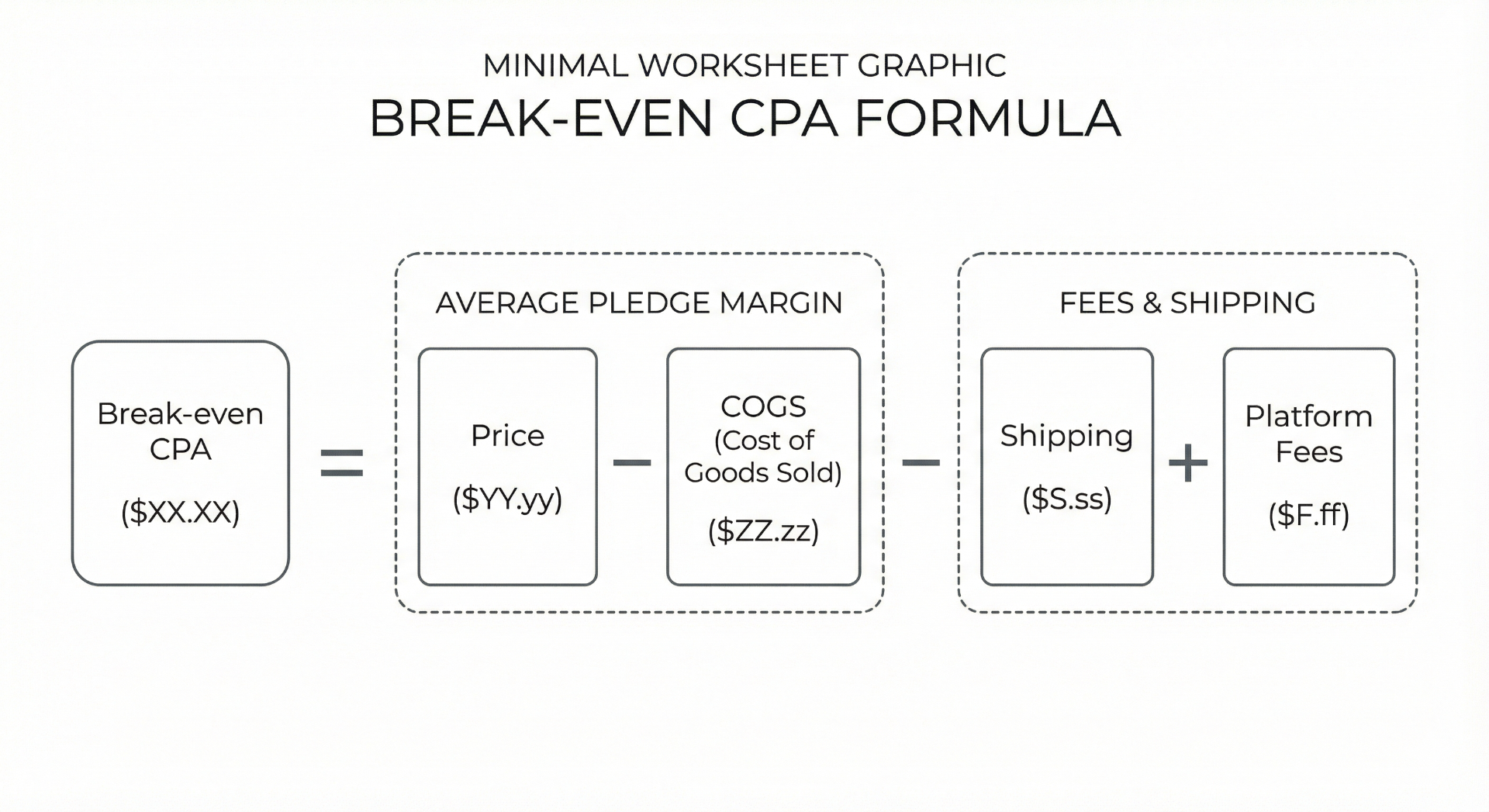
Rule 2: separate "proof budget" from "scale budget"
Most waste happens when creators spend scale money before they have proof.
- Proof budget: what it takes to test angles and confirm lead quality in pre-launch.
- Scale budget: what it takes to push what already works during launch and the live phase.
Rule 3: do not underfund pre-launch if your goal is to fund fast
Kickstarter rewards early traction. If you want to fund early, you need a list and a plan to mobilise it. That is why the pre-launch phase is a real budget line, not a "nice to have."
Rule 4: do not spend on high production before the message is clear
Video and photos should remove doubt and show proof. They do not fix unclear positioning. The order matters: message first, then production.
What is a realistic total marketing budget in 2026?
There is no universal number that fits every project, but there is a practical reality: controlled marketing starts when you can fund a real test and then scale what wins.
A practical baseline rule for serious launches:
- Minimum: $4,500 total marketing budget (agency + ads + essentials) if you want a partner-led, proof-first approach.
- Better: enough runway to test multiple angles in pre-launch and then scale during the first live weeks.
If your budget is below that minimum, focus on tightening the offer, building organic traction, and running smaller validation tests. The full done-for-you model becomes harder to justify unless the team is also absorbing risk.
What should be included in the fee
Pricing is only meaningful when you know what is included. Here is the deliverables checklist you should expect.
Included for a serious pre-launch
- angle map and testing plan (what we test first and why)
- landing page and tracking setup
- pre-launch ad creative testing (multiple hooks, multiple angles)
- email capture strategy and launch-day activation plan
- weekly reporting with decisions and next actions

Included for a serious live campaign
- daily or near-daily optimisation during key windows
- creative refresh cadence and production plan
- plateau plan (new proof, new hooks, new angles)
- budget reallocation rules (what gets spend, what gets cut)
Included for post-campaign growth
- transition plan to Shopify and or Amazon
- retention flows and list segmentation plan
- paid traffic shift plan (what changes after Kickstarter)
Want to see what working together feels like from real creators? Use: BoostYourCampaign reviews.
How BoostYourCampaign thinks about pricing
We price around outcomes and workload, not around buzzwords. We will look at your margins and goal before recommending a path. If your economics are strong and the offer can scale, we can structure an engagement that includes skin-in-the-game on ads. If not, we default to a model that protects you from burning budget before proof exists.
If you are still planning the full system, read: Kickstarter marketing: complete guide for product creators.
Next step: get your numbers ready before you talk to any agency
If you want a fast, useful conversation with any serious partner, bring these inputs:
- retail price and expected average pledge
- landed cost per unit (including packaging)
- shipping and taxes assumptions
- funding goal and what it actually needs to cover
- timeline (target launch month)
- what proof exists today (prototype, renders, engineering status, testimonials)
Then use this page as a filter. If you want creator feedback first, start at: https://www.boostyourcampaign.com/reviews.