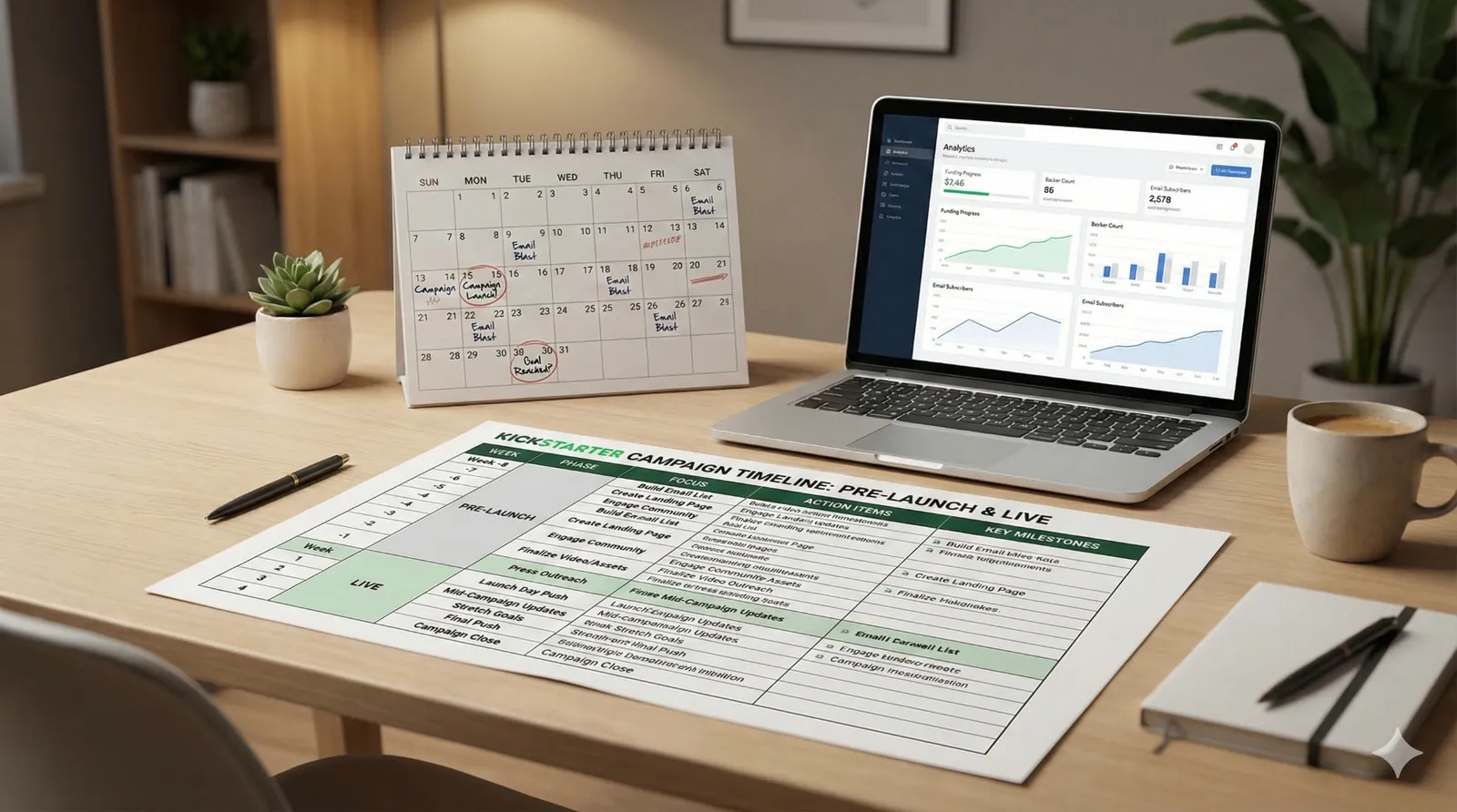
If you are working with a serious Kickstarter marketing agency, plan on 8 to 12 weeks for a clean pre-launch, then a 30 to 35 day live campaign, followed by post-campaign growth. You can do it faster, but the tradeoff is usually higher ad costs, weaker conversion, and less proof on the page.
If you are building the full launch system (not just a schedule), start here: Kickstarter marketing: complete guide for product creators . For creator feedback and outcomes, see BoostYourCampaign reviews .
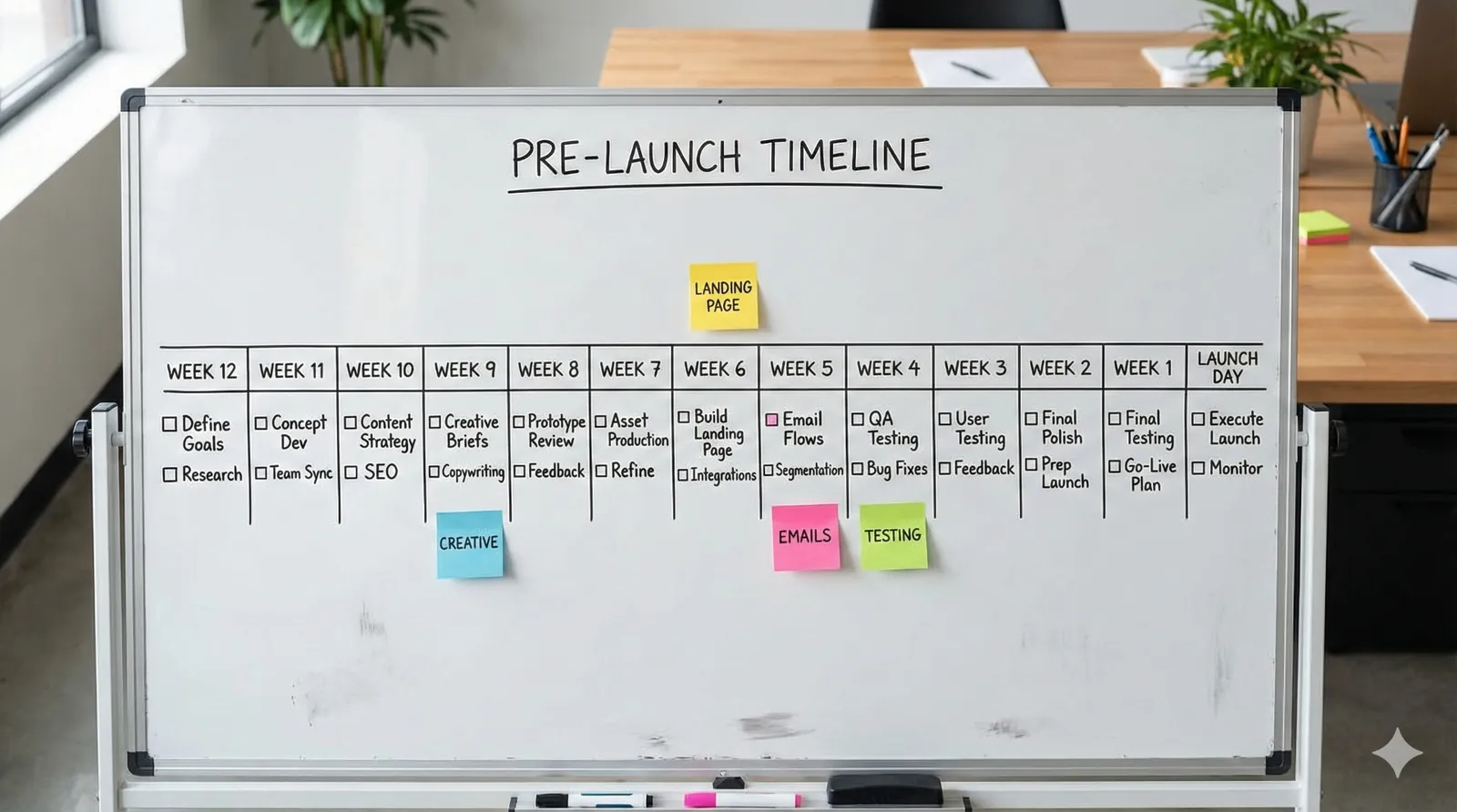
The agency timeline (the version we use at BoostYourCampaign)
This is the standard sequence we run when the goal is predictable conversion, not just "going live."
Weeks 12 to 10 before launch: validation and offer math
- Define the target customer and the single core promise of the product.
- Confirm margins, shipping assumptions, and a funding goal that does not kill conversion.
- Build the draft offer ladder (early bird, main bundle, best value bundle).
- Set up tracking, events, and reporting so decisions are based on data.
Weeks 10 to 8 before launch: pre-launch funnel build
- Build or rebuild the landing page for one job: turn cold traffic into leads.
- Create the lead magnet or incentive (if used), plus follow-up emails.
- Draft the campaign narrative structure so the page and video share one message.
Weeks 8 to 6 before launch: creative production (ads + page + video)
- Film proof: demo, founder story, problem, before/after, credibility, manufacturing status.
- Produce ad creative designed for testing, not just a "brand video."
- Lock the page section order and write the first full campaign draft.
Note: video and photo are handled in-house at BoostYourCampaign (US and Europe studios), so the creative timeline is easier to control.
Weeks 6 to 4 before launch: testing and iteration
- Run pre-launch ads to test hooks, angles, and lead conversion cost.
- Kill weak creatives fast and scale what holds performance.
- Adjust pricing, bundle positioning, and page structure based on data and objections.
Weeks 4 to 2 before launch: launch prep
- Finalize the campaign page, FAQs, risk section, and reward ladder.
- Build the launch email sequence and live campaign update plan.
- Prepare launch-day ad sets, budgets, and rule-based scaling thresholds.
Final 14 days: lock deliverables and remove risk
- Final creative exports for ads and the campaign page.
- Final QA for tracking, pixel events, and analytics dashboards.
- Confirm customer support coverage and response timing for launch week.
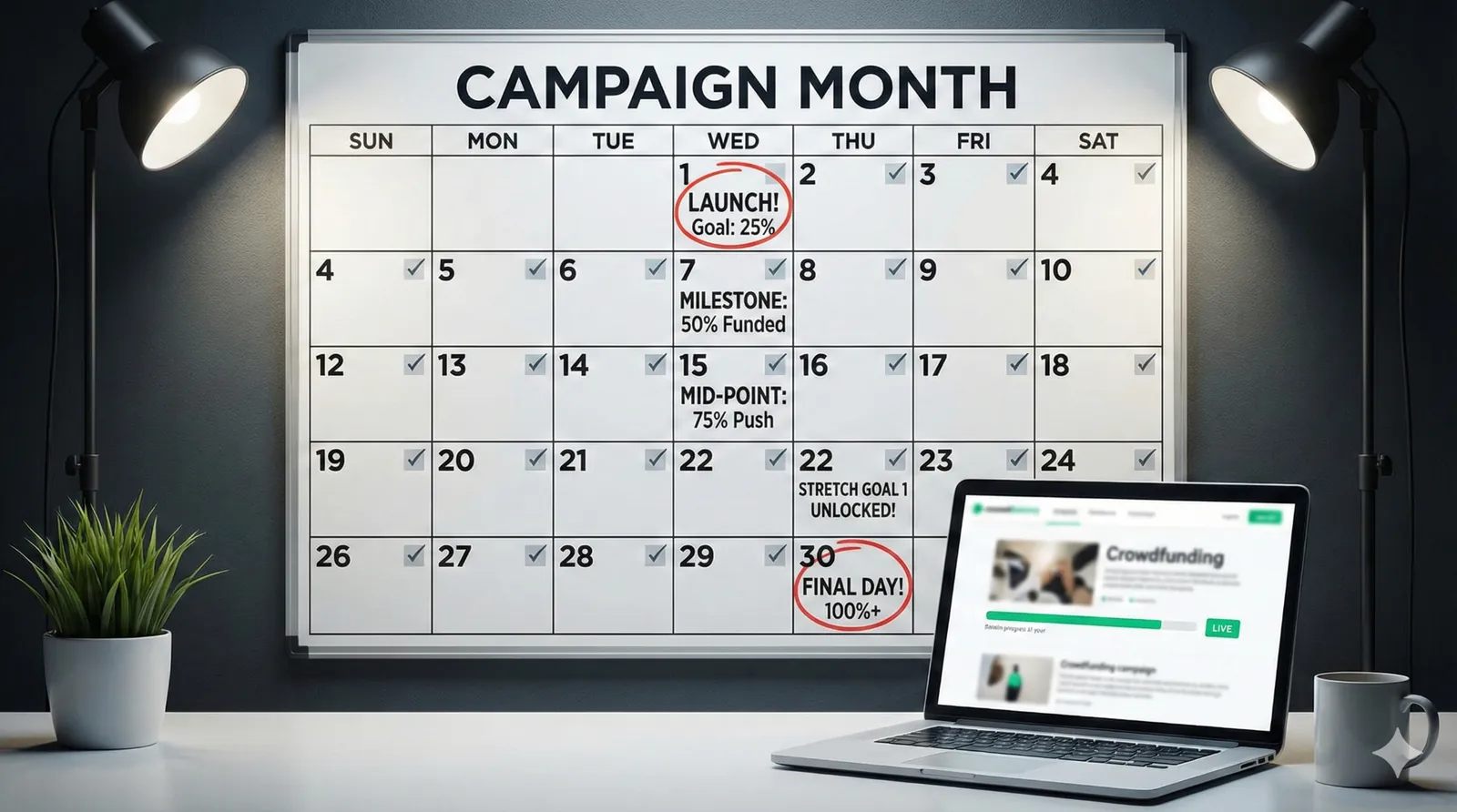
Launch week and live campaign timeline
Days 1 to 3: hit traction fast
- Drive the warm list first (email, retargeting, warm audiences).
- Watch conversion rate, CPA, and pledge size by reward tier.
- Make page edits based on real objections coming in.
Days 4 to 14: stabilize and scale
- Scale winners, rotate creatives before fatigue kills performance.
- Improve AOV with bundle positioning and simple upsell logic.
- Publish updates that remove purchase friction (shipping clarity, timeline, proof).
Days 15 to 30: keep momentum and manage volatility
- Introduce new angles and fresh creatives, not just higher budgets.
- Use scarcity honestly (limited early bird, limited add-ons) when it is real.
- Protect CPA with rules, not feelings.
Fast-track timeline (4 to 6 weeks)
This is only for creators who can move fast and already have strong assets. If you want a fast-track, expect fewer rounds of testing and a tighter creative slate.
- Week 1: offer math, page outline, tracking setup, creative plan
- Week 2: landing page live, first ads live, first video shoot block
- Week 3: iterate ads and page, lock reward ladder, build email sequence
- Week 4: final campaign build, final creative exports, launch prep
- Optional weeks 5 to 6: extra testing and creative iterations (recommended)
Decision rules (so you pick the right timeline)
- If your product is hardware and you do not have a working prototype, do not rush. Build proof first.
- If you have never run paid traffic, assume you need more time for testing and iteration.
- If your funding goal is high and margins are tight, timeline matters more because CPA volatility becomes dangerous.
- If you want a predictable launch day, you need pre-launch volume and conversion proof, not just "followers."
Want a timeline built around your product?
If you want a real schedule with owners, deadlines, and what needs to be ready each week, start with a short strategy call. You can also review outcomes and how we work here: BoostYourCampaign reviews .
Frequently asked questions
How long does Kickstarter marketing take in 2026?
Most product creators need 8 to 12 weeks for pre-launch work (validation, funnel build, creative production, testing), then a 30 to 35 day live campaign. Complex hardware often needs 12 to 16 weeks.
How Long Does a Kickstarter Campaign Take?
A 4 to 6 week timeline can work if the product is ready, the offer is clear, and you can produce proof on camera fast. The tradeoff is less testing and usually higher risk on ad performance.
When should I start pre-launch marketing?
Start 8 to 12 weeks before launch if you want time to test messaging, build a list at a sustainable cost, and iterate the page and creative. Start earlier (12 to 16 weeks) for complex products or high funding goals.
What happens during launch week with an agency?
Launch week focuses on driving warm traffic first, monitoring conversion and CPA daily, making fast page edits based on objections, and scaling what performs while rotating creative to avoid fatigue.
Can I do a fast-track Kickstarter launch timeline?
Yes, but only if you already have strong assets and can move fast. A fast-track timeline compresses testing and creative iterations, which increases risk. It is best for simple products with clear proof and pricing.
Ready to give your campaign the best shot?
We've helped 4,600+ creators raise over $734M since 2010. Let's pressure-test your launch plan and find the highest-leverage fixes before you go live.
Talk to an expert →