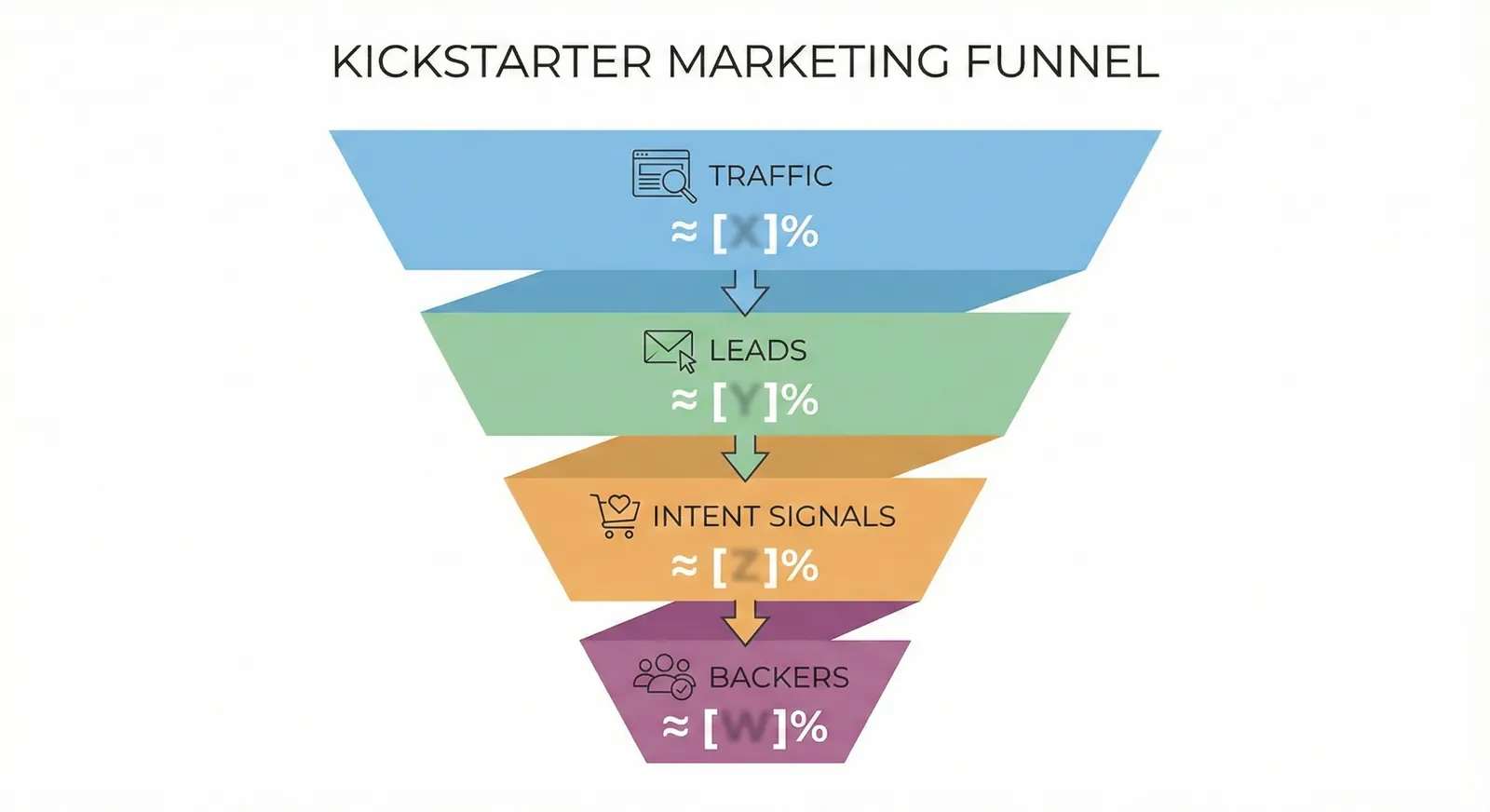
BoostYourCampaign uses clear numbers to decide when to scale, hold, or pause Kickstarter ads so you do not gamble your budget. Every test, every creative, and every decision is tied back to cost per lead, cost per backer, and your real margin.
Quick overview
How does BoostYourCampaign use data in Kickstarter marketing?
We treat data as the filter between ideas and spend. We start with small test budgets, measure cost per lead, click through rate, and early intent signals, then scale only what clears agreed thresholds. If an angle or audience does not hit the numbers, we cut it, even if we like the idea on paper.
Which metrics matter most for your Kickstarter ads?
The core metrics are cost per lead, lead to backer conversion rate, cost per acquisition, average pledge value, and how these line up with your margin and funding goal. We also track click through rate, landing page conversion, and email engagement so we know whether problems sit in the ads, the page, or the offer.
Why we are strict about data and ad performance
Most creators see ad spend as a necessary risk. We treat it as controlled testing. You bring your product, margins, and goal. We bring the system that tells us when it makes sense to push and when it is better to stop.
This is also why we insist on fit checks and proper planning. If the numbers cannot work on paper, no clever creative will fix it. Our client reviews often mention this direct approach as the biggest relief.
For a broader view of the full process from pre-launch to live campaign, see our Kickstarter marketing guide for product creators in 2025.
What we measure in pre-launch validation
Before we talk about big budgets, we run a focused pre-launch validation sprint. The goal is simple: prove that we can acquire leads at a cost that leaves room for profit once those leads turn into backers.
Key metrics in the validation phase
- • Cost per lead (CPL): how much you pay for each email or reservation.
- • Click through rate (CTR): whether the creative and angle grab attention.
- • Landing page conversion rate: how well the page turns clicks into leads.
- • Reservation or intent rate: how many leads raise their hand for early bird or VIP access.
- • Email engagement: open and click rates on early sequences.
We do not chase "cheap traffic". We want people who are likely to back at a price that fits your margin and funding goal.
When we move from validation to scale
We move from small tests to larger spend when three things line up:
- • CPL sits inside the range we defined together based on your margin.
- • Landing page and reservation rates show real intent, not just curiosity.
- • Email engagement is strong enough to justify a strong day one.
If at least one of these is weak, we adjust offer, creative, or targeting instead of forcing spend. If the numbers stay weak after honest effort, we advise you not to scale. That advice can save you more than any ad tweak.
For a step by step breakdown of what to prepare before this stage, you can use our Kickstarter pre-launch checklist for product creators in 2025.
How we track performance during pre-launch scale
Once we see healthy validation numbers, we scale pre-launch. This is where creative volume increases and more audiences are tested, but the rules stay disciplined.
Metrics we watch while scaling pre-launch
- • CPL stability: whether cost per lead stays inside the agreed band as spend rises.
- • Angle performance: which hooks and messages keep winning, and which drop off.
- • Audience quality: which interests, lookalikes, or custom audiences bring the best leads.
- • Lead depth: reservations, survey completion, or replies that show real commitment.
If CPL spikes when budget increases, we do not "hope it will settle". We pull back, move spend to better performing ad sets, or refresh creative with what the winners have in common.

What we track once your Kickstarter is live
When the campaign goes live, the main metric shifts from cost per lead to cost per backer. Leads, clicks, and opens still matter, but they only matter in relation to actual pledges.
Core live campaign metrics
- • Lead to backer conversion rate: how many pre-launch leads actually pledge.
- • Cost per acquisition (CPA): how much you pay per new backer.
- • Average pledge value: average revenue per backer, including add-ons and upsells.
- • Return on ad spend (ROAS): revenue from tracked backers compared to ad spend.
- • Daily funding pace: how each day compares to the path needed to reach your goal.
These numbers tell us whether to stay steady, push harder, or slow down. We combine platform data with Kickstarter dashboard data and your margin structure, so decisions match reality, not vanity metrics.
For more detail on typical budgets and what these numbers mean in practice, see Kickstarter marketing cost and budget in 2025.
Our decision rules: scale, hold, or pause
At BoostYourCampaign we use simple, explicit rules so neither side is guessing. Exact thresholds depend on your category and margin, but the logic stays consistent.
When we scale ad spend
- ✓ CPL and CPA are consistently inside the agreed profitable range.
- ✓ Lead to backer conversion is strong enough to hit your goal at that cost.
- ✓ Average pledge value stays stable or improves when new traffic comes in.
- ✓ Daily funding pace keeps you on track or ahead of target.
In these cases we increase budgets in controlled steps, not in one big jump. We watch what happens after each change and lock in the gains before pushing further.
When we hold steady
- ⏸ Numbers are acceptable but fragile, for example strong days and weak days mixed together.
- ⏸ Key creatives are fatiguing and need replacements ready.
- ⏸ Platform changes or tracking issues make data less clear for a short period.
During a hold, we keep spend where it is, refine creative, and clean up tracking so we can make the next move with confidence.
When we pause or cut campaigns
- ✕ CPL or CPA stay above the agreed limit over a meaningful amount of spend.
- ✕ Conversion rates do not respond to page, offer, or creative changes.
- ✕ Margin becomes too thin for further scaling, even if top line revenue looks good.
Sometimes the best decision is to protect your budget and regroup. If that happens, we explain why in plain language and show the numbers that led to the call.

How we report data to you
Data is only useful if you can see it and understand it quickly. Our reporting is built around clear dashboards and short, focused summaries instead of long spreadsheets.
What you see in regular updates
- • Top level numbers: spend, leads, backers, revenue from ads, and ROAS.
- • Breakdowns by angle, audience, and creative so you see what really drives results.
- • Simple explanations of what we changed, what worked, what did not, and what we will try next.
We prefer direct conversations over vague reports. You always know which numbers we are chasing and how they connect to your funding goal.
For a broader picture of what working together feels like, including communication and cadence, see our Kickstarter marketing FAQ in 2025.
Why this approach matters for serious campaigns
A serious Kickstarter is not about a lucky spike. It is about a controlled process from first test to final day. Using data this way helps you:
- ✓ Avoid burning money on ads that feel exciting but do not convert.
- ✓ Spot problems early in the funnel instead of when the campaign is almost over.
- ✓ Leave the campaign with audiences, creatives, and numbers you can reuse beyond Kickstarter.

If you want to see how this looks in real campaigns, you can scroll through BoostYourCampaign reviews and case stories.
Next step: talk to us about your numbers
If you are planning a Kickstarter or Indiegogo campaign and want a team that treats your ad budget like their own, the next step is simple.
- • Review our Kickstarter marketing services to see the full scope of work.
- • Read a few client reviews to see how this approach feels in practice.
- • Fill out the contact form with a few details about your product, margin, and goal.
We will look at your situation, share what the numbers suggest, and tell you honestly whether we can help.
Frequently asked questions
What metrics matter most when you run Kickstarter ads?
The most important metrics are cost per lead, lead to backer conversion rate, cost per acquisition, average pledge value, and how those numbers line up with your margin and funding goal. CTR and landing page conversion matter because they explain where in the funnel things break.
How long does the validation phase usually take?
Validation is usually a short, focused sprint rather than a long campaign. In most cases we get useful numbers within a few days of consistent traffic, enough to decide whether to move to scale or rework the offer.
Do you ever stop a campaign early because of data?
Yes. If CPL and CPA stay above the agreed limits after serious testing, or if conversion rates do not respond to changes, we will recommend slowing or stopping spend. Protecting your budget is more important than spending for the sake of activity.
Can good creative fix weak margins?
Strong creative helps, but it cannot fix a product that has no room left in the margin. This is why we start with fit checks and budget planning before we scale. The numbers have to make sense before ads can do their job.
How transparent are you about ad performance?
We share the same dashboards we use internally and walk you through the numbers in plain language. You see what is working, what is not, and what we plan to test next. There are no hidden campaigns or unexplained decisions.
What should I prepare before we talk about data and budget?
Have your cost of goods, target retail price, expected average pledge value, and a rough funding goal ready. Combining these with our data templates gives a clear view of what is realistic. Our pre-launch checklist can help you organise this.
Ready to give your campaign the best shot?
We've helped 4,600+ creators raise over $734M since 2010. Let's pressure-test your launch plan and find the highest-leverage fixes before you go live.
Talk to an expert →