
Many creators ask the same question before they launch a serious campaign on Kickstarter or Indiegogo: how much should I actually budget for marketing. Not just design, not just video, but the full system that takes you from idea to funded campaign.
This page gives a straight answer. No fantasy numbers, no magic guarantees, just a clear breakdown of what serious campaigns spend in 2026, how that money is allocated, and how to think about return on that budget.
If you want the broader strategy view first, start with our Kickstarter marketing guide for product creators in 2026 . This article zooms in on the money side only.
How much does Kickstarter marketing cost in 2026
For a product that you want to turn into a real business, a realistic Kickstarter marketing budget in 2026 usually starts at around 4,600 to 10,000 dollars for professional support, plus a separate ad budget that can range from a few thousand dollars to several tens of thousands of dollars, depending on your goals and margins. Ultra lean or hobby projects can spend less, but the success rate drops sharply once you cut corners on validation and traffic.
What are the main pieces of a Kickstarter marketing budget
The main pieces include: strategy, validation, and funnel setup; pre-launch list building and ad spend; creative production and campaign assets; ongoing management during the live campaign; and a buffer for pivots, stretch goals, and overfunding opportunities.
The exact number depends on your category, margins, funding goal, and how much risk you want to take. What matters most is that marketing is treated as part of the product cost, not something you try to squeeze in at the last minute.
The main pieces of a Kickstarter marketing budget
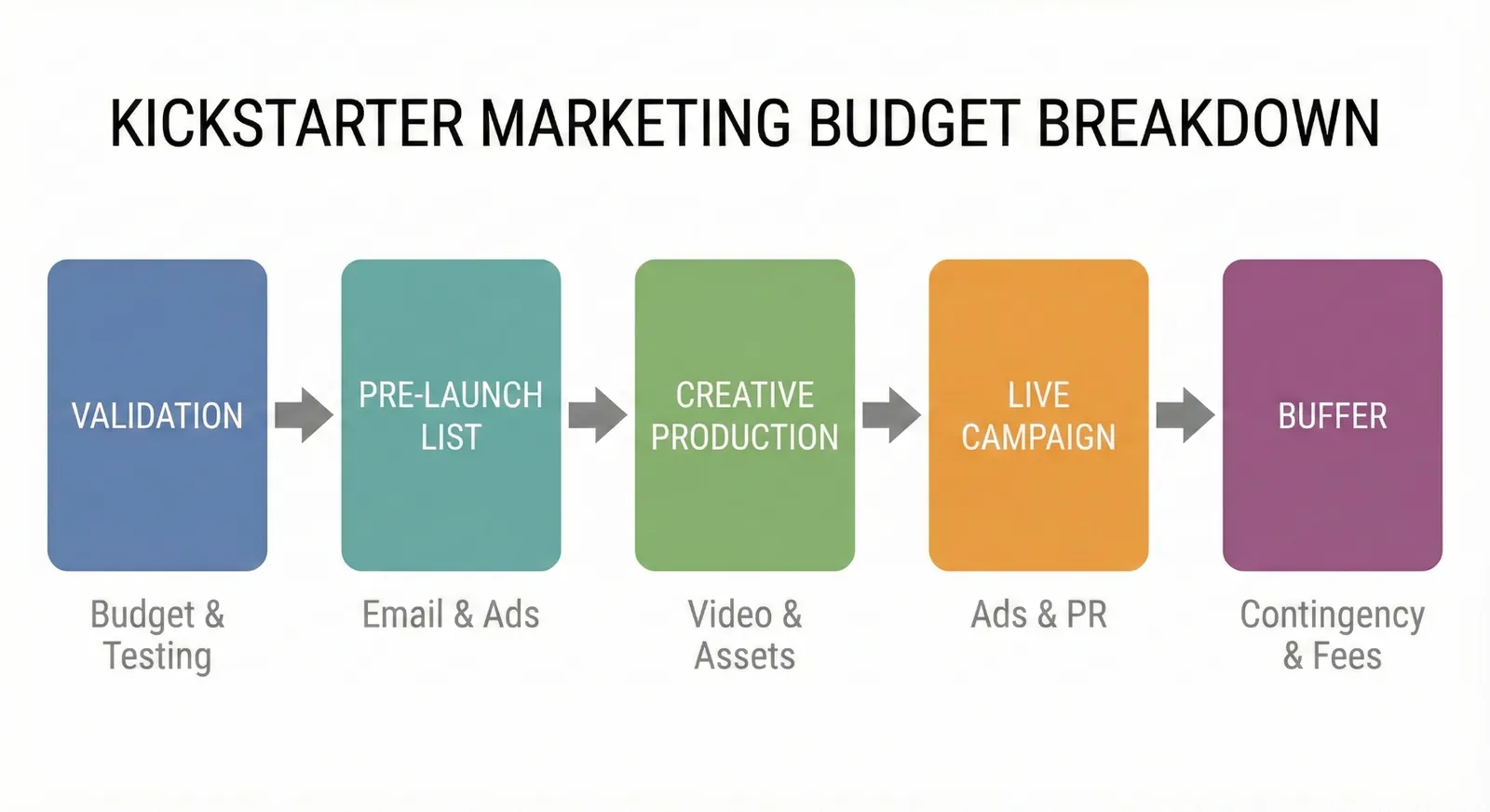
Instead of focusing on one big number, it is easier to understand Kickstarter marketing costs by looking at the main pieces that make up your budget.
1. Strategy, validation, and funnel setup
This is the part where you work with a team to design the offer, build your first landing page, set up tracking, and run initial validation ads. The goal is simple. You want proof that you can acquire leads at a cost that still leaves room for profit once those leads become backers.
Good validation work saves you from scaling a broken funnel. It is usually a smaller part of the total budget in absolute terms, but it has the highest impact on whether the rest of your spend will make sense.
2. Pre launch list building and ad spend
Once the basic funnel is working, you need to bring in real people. Most serious campaigns put a meaningful share of their budget into Meta ads and other traffic sources during the pre launch phase. This is where you build the email list and, if you use them, a reservation or deposit list.
The budget here is driven by two things: your cost per lead and how many warm people you want on your list by launch day. Our article on Kickstarter ads in 2025 goes deeper into how these numbers behave in different categories.

3. Creative production and campaign assets
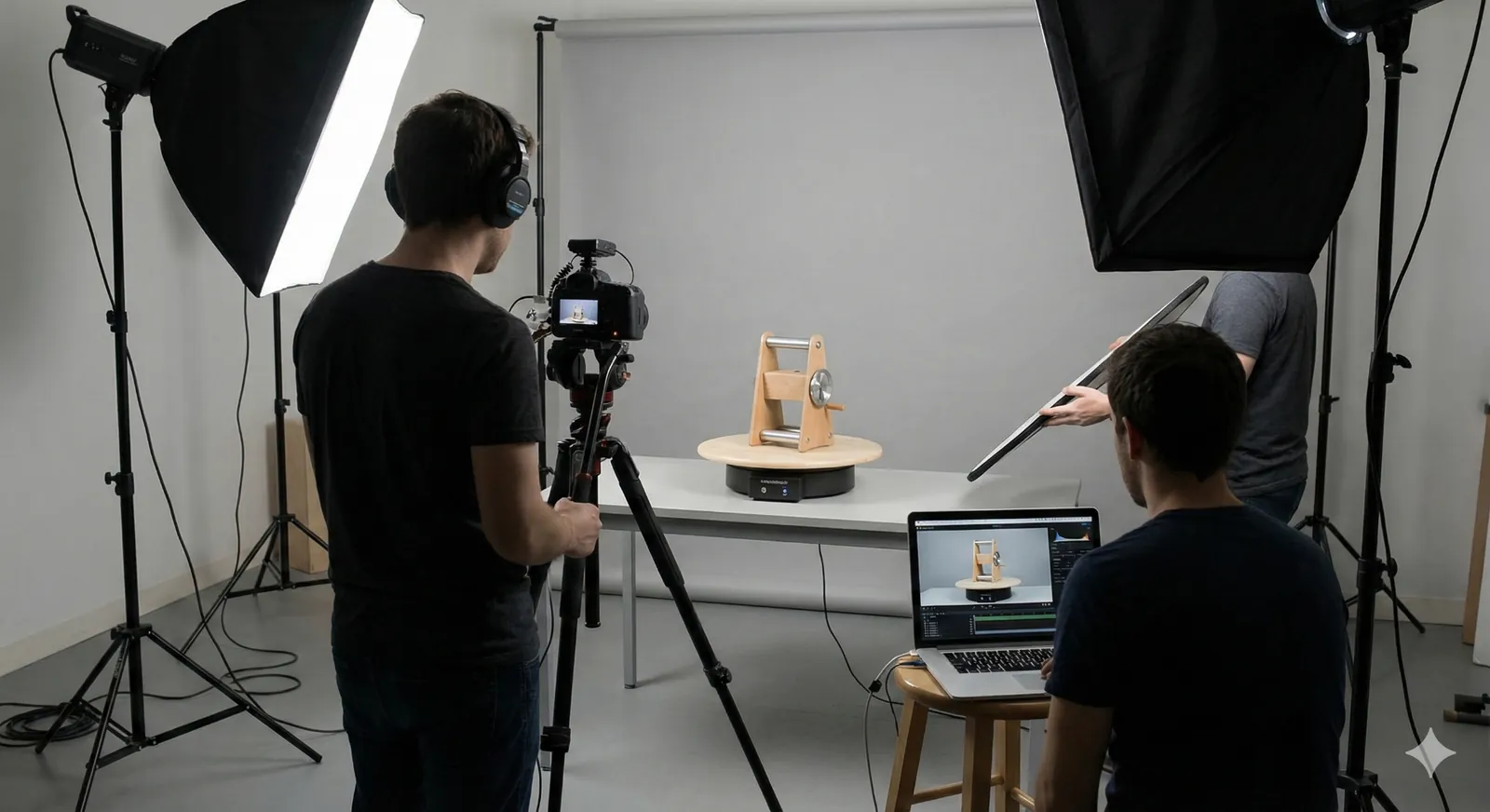
Even the best media buying cannot fix weak creative. You need a clear campaign video, strong product photos, lifestyle shots, and graphics that make the page easy to read. Some creators handle this in house, others hire agencies or studios.
At BoostYourCampaign we often work with your existing assets, then point out what is missing. For many physical products, additional photography or a sharper edit of the video is the difference between a page that looks "nice" and a page that actually converts. For software projects we sometimes start earlier with our MVP service so there is something real to show.
4. Ongoing management during the live campaign
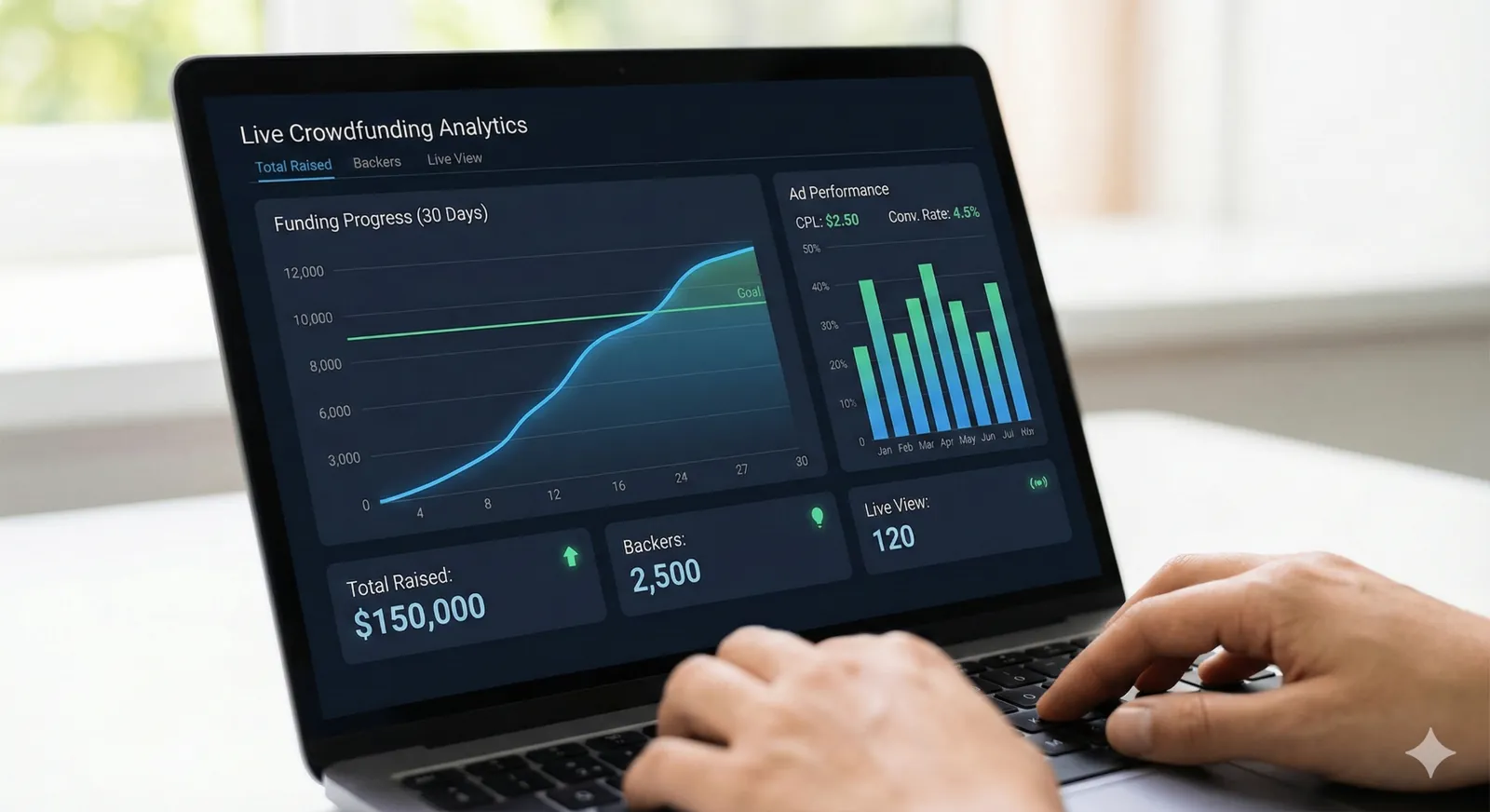
Once you go live, the work shifts from list building to acquiring backers at a sustainable cost. This includes running and adjusting ad campaigns, monitoring cost per acquisition, testing new creatives, updating the page, and sending meaningful campaign updates.
In this phase you are paying for thinking and decision making as much as for execution. It is where a specialist team can often recover several times their fee by cutting losing ideas quickly and scaling what works.
5. Buffer for pivots, stretch goals, and overfunding
The last part of the budget is not tied to a specific line item. It is a buffer. Campaigns that start strong often find new opportunities during the live phase, from stretch goals to new ad angles. If you spend the last dollar on launch day, you leave no room to take advantage of those opportunities.
Typical Kickstarter marketing budget ranges
Every project is different, but most serious campaigns fall into a few broad ranges. These are not quotes or offers, just working examples to help you think in the right ballpark.
Lean but serious campaigns
These are often first time creators with a clear product and limited capital, but a real intent to build a business, not just a one off product. A common pattern is:
- Professional fees in roughly the 4,600 to 8,000 dollar range
- Ad budget in the 3,000 to 10,000 dollar range
- Extra spend for video or photography if existing assets are not usable
This range can work for smaller funding goals and categories where cost per lead is lower, for example certain tabletop games or simpler consumer products.
Growth focused campaigns
Here you are working with higher funding goals, more ambitious production runs, or products with higher price points. A common pattern might look like:
- Professional fees in the mid to upper four figure range, depending on scope
- Ad budget starting in the low five figures, with room to scale if numbers are strong
- Dedicated spend for creative testing and extra assets during the campaign
These campaigns often target multiple hundreds of thousands in funding or more. The higher marketing budget is justified by the margin and the long term value of a strong launch.
Why "no budget" is almost always the wrong answer
It is tempting to try to save money by skipping pre launch ads or professional support, especially if you have invested heavily in product development. The problem is that this shifts all the risk onto launch day. Without marketing data you are hoping that organic traffic or platform features will save you.
Creators who have been burned on their first campaign often come to us for a relaunch. The story is usually the same. Great product, no structured marketing, and a painful lesson that "if you build it, they will come" does not work in a crowded marketplace.
How BoostYourCampaign structures costs and risk
There are many models in the market. Some agencies charge only fixed retainers. Others try to work only for a success fee. Most serious partnerships sit somewhere in the middle.
At BoostYourCampaign we use a mix of professional fees and performance linked upside. On suitable projects we will also put our own money into ad spend and receive a kickback on the results at the end of the campaign. This keeps both sides aligned. If the numbers do not work, neither side wins.
We talk openly about how this feels in practice and what clients experience on our BoostYourCampaign reviews page . You will find projects that raised modest five figure amounts and others that went well into six and seven figures. The common thread is structure, not luck.
If you want to see how this fits into the full service, read how BoostYourCampaign's Kickstarter marketing services work from first call to funded .
Allocating your Kickstarter marketing budget across the timeline
Knowing the total number is useful, but you also need to decide when to spend what. A simple way to think about it is to divide your marketing budget into three phases.
Phase 1: validation
In this phase you spend a relatively small amount on landing page setup and test ads. The goal is to answer basic questions. Does the positioning make sense. Are people clicking. Can you collect leads at a cost that will make sense later.
If the numbers are terrible, you adjust or stop. Losing a few hundred or a few thousand dollars early is painful, but much better than wasting a full launch budget on a funnel that never worked.
Phase 2: pre launch scaling
Once you have validation, you move into higher spend. Most of the pre launch ad budget and a large share of the creative work happens here. You are building a list, testing angles, and preparing for a launch that starts with momentum instead of silence.
This is also where it is useful to have a team who has seen hundreds of campaigns. Small shifts in headline, creative, or offer can move cost per lead enough to decide whether aggressive scaling is safe.
Phase 3: live campaign and beyond
In the live phase you are spending in shorter cycles. You look at the daily numbers, move budget between ad sets, and adjust creatives. You might also invest in new content, such as gifs, comparison graphics, or product photos that answer questions backers keep asking.
The very end of the campaign and the weeks after it close are often the most neglected. There is still value in using remaining budget to prepare for post campaign sales, email flows, and the shift to an online store.
How to judge if a quote for Kickstarter marketing is fair

Creators often collect quotes from several agencies or freelancers and end up with very different numbers. To work out if a quote is fair, it helps to look beyond the total and ask a few practical questions.
- What is included in the fee, and what is not
- Who pays for ad spend and who controls the budget
- How does the partner get rewarded if the campaign over performs
- How often do you receive numbers, not just comments
- What happens if the early data is weak, do they stop, adjust, or keep spending
A lower fee is not always cheaper if the process is weak. A higher fee is not always better if it is not linked to clear deliverables and a real track record. Our own structure and expectations are described in detail in the Kickstarter marketing guide and on the BoostYourCampaign reviews page .
Frequently asked questions about Kickstarter marketing costs
What is a realistic Kickstarter marketing budget for a first campaign
A realistic budget for a first serious campaign usually starts around 4,600 dollars for professional work plus a separate ad budget. The ad budget can be lower or higher depending on your goal and margins, but if you aim for a proper validation phase and a warm launch list, it is difficult to do meaningful work with only a few hundred dollars.
How much should I spend on ads for my Kickstarter campaign
There is no fixed rule, but many teams treat pre launch ad spend as a percentage of their target revenue. The important part is that ad spend is tied to clear metrics like cost per lead and conversion to backer. If the numbers work, there is a case to scale. If they do not, you stop or adjust instead of throwing more money at a broken funnel.
Can a Kickstarter marketing agency work on a small budget
Some agencies can help at lower budget levels, but there is a point where it is hard to do serious work if there is no room for testing and iteration. At BoostYourCampaign we prefer to work with creators who can commit at least a few thousand dollars to the overall marketing effort so that we can run a real process, not just a quick review.
Is it worth paying for Kickstarter marketing if my goal is small
If your goal is very small and you mostly want to validate an idea or reach a local audience, you may choose to handle marketing yourself. If you want to turn the project into a long term business or reach a global audience, professional support can save you from expensive mistakes and increase your odds of reaching and exceeding your goal.
How do I avoid wasting money on Kickstarter marketing
The best protection against waste is a structured validation phase and clear stop rules. That means testing your offer with a smaller budget first, tracking the right metrics, and being willing to change the offer or pause the launch if the data is poor. Working with a partner who is willing to tell you 'not yet' is more valuable than one who promises easy wins.
Is it risky to let an agency pay for ads in exchange for a share of results
Any performance based model has trade offs. If a partner puts their own money into ad spend, they will also want clear say over creative and strategy. The upside is that incentives are aligned, since both sides benefit when the campaign performs. The key is a clear agreement on percentages, caps, and who decides what happens when numbers change.
Where can I see real results from Kickstarter marketing campaigns
You can see detailed examples of campaigns supported by BoostYourCampaign, including funding amounts and what went well or nearly broke, on our client reviews and results page. It gives a more honest view than a list of logos, and it will help you decide if our way of working fits the way you want to launch.
Next step: talk through your numbers with a specialist
If you are planning a Kickstarter campaign and want to know what a realistic marketing budget would look like for your product, the simplest step is a short conversation. We can look at your margins, goal, and timeline, then tell you what is realistic and what would be wishful thinking.
Get a realistic budget estimateInclude a few lines about your product, your current assets, and your rough launch date.
Ready to give your campaign the best shot?
We've helped 4,600+ creators raise over $734M since 2010. Let's pressure-test your launch plan and find the highest-leverage fixes before you go live.
Talk to an expert →