Both platforms are all-or-nothing since Gamefound bought Indiegogo and both charge 5% plus processing. Kickstarter has the bigger audience; Indiegogo has wider European payments and Stretch Pay. Your pre-launch list decides the result.
Most Kickstarter vs Indiegogo comparisons still online were written for a platform that no longer exists. In July 2025 Gamefound, the tabletop crowdfunding platform, bought Indiegogo. On 16 October 2025 Indiegogo moved onto Gamefound's technology, and the biggest difference between the two platforms disappeared overnight: Indiegogo retired flexible funding, so both platforms are now all-or-nothing. The choice in 2026 turns on different things, and this comparison covers them as they work now.
Updated October 2026. Fees, payouts, funding models and launch rules were checked against the current Kickstarter and Indiegogo help centres. Sources are linked in each section.
Both platforms are all-or-nothing in 2026 and both charge a 5% platform fee plus payment processing, so fees no longer decide it. Choose Kickstarter for the largest audience and the strongest organic discovery, which matters most for a first campaign, games, design and creative projects. Choose Indiegogo, now run on Gamefound's technology, for its wider European payment methods, Stretch Pay instalments, guest checkout and a pledge manager built into the same platform, which suits physical products and creators selling heavily into Europe. Board games now have a third serious option in Gamefound itself. Whichever you pick, the size of your pre-launch list decides the result far more than the platform does.
What changed when Gamefound bought Indiegogo
Gamefound acquired Indiegogo in July 2025. Three months later, on 16 October 2025, Indiegogo relaunched on Gamefound's technology, and much of what creators knew about running an Indiegogo campaign stopped being true on that date. According to Indiegogo's own summary of the upgrade, the main changes were these.
- Flexible funding is gone. It was discontinued for new campaigns on 16 October 2025. Regular campaigns now launch as Fixed Funding, the all-or-nothing model Kickstarter has always used.
- Pre-launch reservations were removed. The old reservation feature did not survive the migration.
- A new pledge manager and late pledge. Both are now built into the platform. The post-campaign stage is called Late Pledge (formerly called InDemand), and it works differently from the feature that used the old name.
- A new payment stack. Payments now run through Adyen, with card payments, Apple Pay and Google Pay, plus local methods such as Klarna, iDeal, Bancontact, Blik and Trustly.
- New onboarding and a new dashboard. Creators go through business onboarding before a project can be previewed or launched.
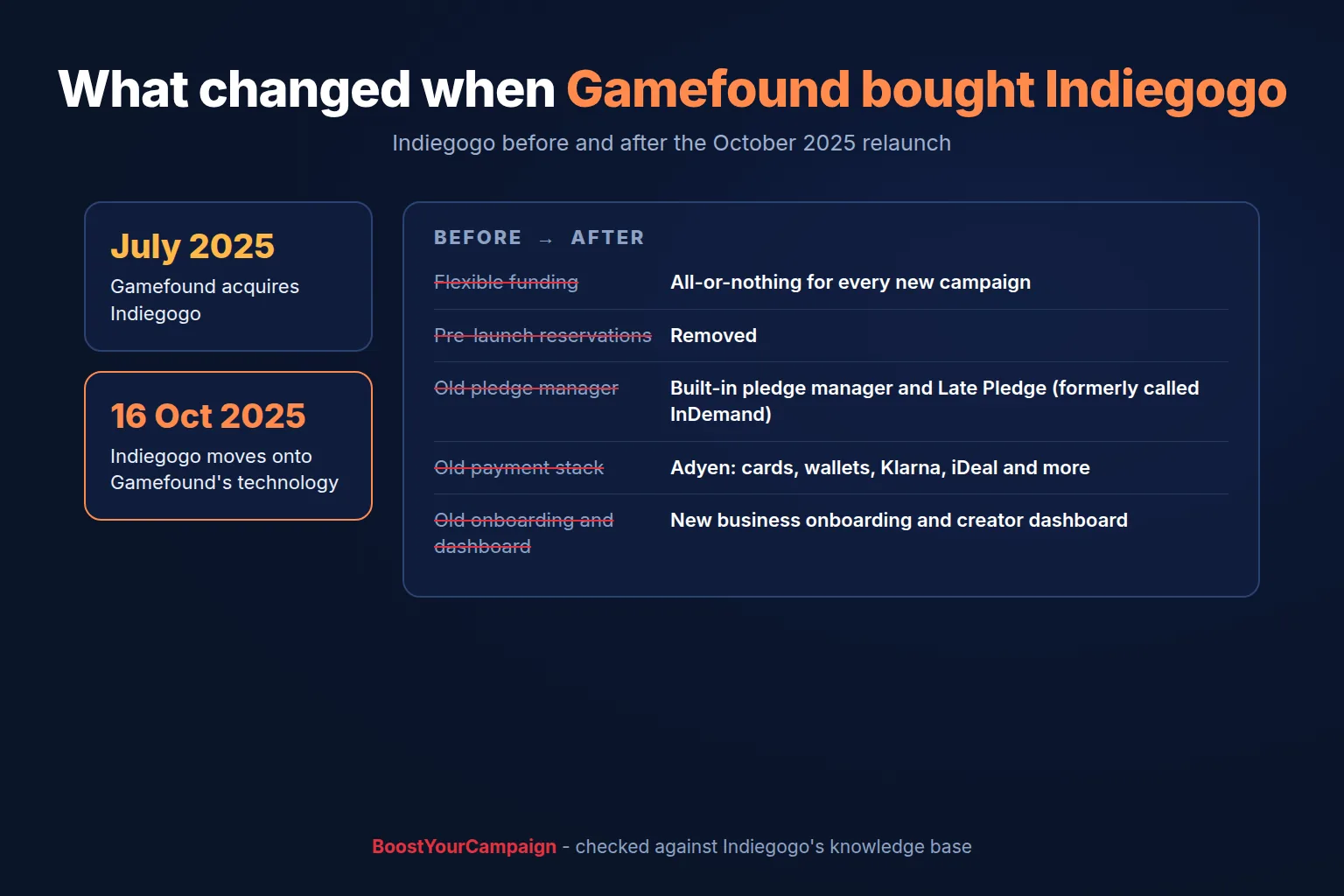
The practical effect is that the old rule of thumb, "go to Indiegogo if you want to keep the money even if you miss your goal", no longer applies. Flexible funding was the main structural reason creators chose Indiegogo, and it is gone. The decision now rests on audience, payment methods, post-campaign tools and the kind of product you are launching. Our Indiegogo support guide covers the relaunched platform in full detail.
Kickstarter vs Indiegogo at a glance
| Kickstarter | Indiegogo | |
|---|---|---|
| Owned by | Kickstarter PBC | Gamefound (since July 2025) |
| Funding model | All-or-nothing | All-or-nothing for regular campaigns, plus a separate Express Crowdfunding format |
| Platform fee | 5% of funds collected | 5% of funds collected |
| Payment processing | Roughly 3 to 5% (Stripe) | 3% + $0.20 per transaction (Adyen) |
| If you miss the goal | No fees, nobody charged | No fees, nobody charged |
| Payout | Initiated 14 days after the deadline, then 3 to 14 business days to your bank | Weekly on Fridays, starting 3 to 5 business days after the campaign ends |
| Instalments for backers | Pledge Over Time, three payments | Stretch Pay, two to ten instalments |
| Guest checkout | No, backers need an account | Yes, with only an email address |
| Pre-launch | Pre-launch page with followers | Project preview, reservations removed in the relaunch |
| After the campaign | Late pledges and a built-in pledge manager | Late Pledge (formerly called InDemand) and a built-in pledge manager |
| Audience | Largest, more than 24 million backers | Smaller, strongest in physical products and tech |
Sources: Kickstarter fees, Kickstarter payouts, Indiegogo fees, Indiegogo payouts and Kickstarter stats.
Funding models: both all-or-nothing now
On Kickstarter, a project either reaches its goal by the deadline or nobody is charged. That has never changed, and the goal and deadline both lock permanently at launch, so neither can be edited afterwards, not even by Kickstarter's support team.
On Indiegogo, every regular crowdfunding campaign launched after 16 October 2025 is Fixed Funding: miss the goal and backers are not charged and you receive nothing, including no fees. Campaigns that were live on flexible funding at the time of the migration were converted automatically, with their goals adjusted to reflect what they had already raised.
Indiegogo does have one format Kickstarter does not: Express Crowdfunding. It collects payment and shipping details at checkout instead of deferring them, so projects Indiegogo deems eligible can move to fulfillment faster. It is a separate project type, not a replacement for flexible funding, and it is offered at Indiegogo's discretion. See Indiegogo on Express Crowdfunding.
What this means for your goal: on both platforms, set it at the amount you need to deliver every reward after fees and shipping, not at the amount you hope to raise. A goal that is too high now fails outright on either platform, with nothing to fall back on.
Fees and payouts
Fees are close to identical. Both platforms take 5% of the funds collected and charge nothing if you do not fund.
Kickstarter adds Stripe's card processing, roughly 3 to 5% depending on the card and country, so budget 8 to 10% off the top. Funds are collected over a 14-day window after the deadline, the payout is initiated 14 days after the campaign ended, and it then takes another 3 to 14 business days to reach your bank, depending on the bank. In practice that means two to four weeks after the deadline. Pledge Over Time backers pay in three instalments, so only their first payment is in your first payout. The remaining instalments arrive in two further payouts, about eight and twelve weeks after the campaign ends, for projects whose first Pledge Over Time payout came on or after 15 January 2026.
Indiegogo charges payment processing of 3% + $0.20 per transaction in the project currency, so €0.20 on a euro project. Indiegogo's own worked example: a project raising $10,000 across 100 transactions pays a $500 platform fee and $320 in processing, and receives $9,180. A fifteen-day payment collection period follows the campaign, and payouts run through Adyen weekly on Fridays, starting three to five business days after the campaign ends.
The per-transaction charge means many small pledges cost proportionally more on Indiegogo. On a campaign with an average pledge of $40, the $0.20 adds half a percent. On a $250 average pledge it barely registers. Our fees guide works through the numbers for both platforms.
Audience and discovery
This is where the two platforms still differ most. Kickstarter has the largest crowdfunding audience in the world, more than 24 million backers, and the strongest organic discovery: category pages, the "Projects We Love" badge, newsletters and search inside the platform all send backers to projects that are already doing well. A first-time creator with a modest list has a real chance of picking up backers who simply found the project while browsing.
Indiegogo's audience is smaller and leans towards physical products, gadgets and tech. Its discovery works on momentum too: Indiegogo's ranking algorithm favours projects that raise quickly and keep converting, so a strong launch day helps on both platforms.
The honest conclusion for most creators: neither platform delivers enough strangers to fund a project that launches to nobody. Organic discovery multiplies early momentum, it does not create it. The campaigns that fund on day one arrive with their own pre-launch list, and that is true on both platforms. Our pre-launch guide covers how to build it.
Payments, Europe and international backers
Indiegogo has the clear advantage here since the relaunch. Its Adyen checkout offers local payment methods that many European backers prefer to cards: Klarna in Germany, Austria, the Netherlands, Belgium, Sweden and Switzerland, iDeal in the Netherlands, Bancontact in Belgium, Blik in Poland, Carte Bancaire in France, EPS in Austria, Multibanco in Portugal, MobilePay in the Nordics, TWINT in Switzerland and Trustly across several markets. Backers can also pledge as a guest with only an email address, and Stretch Pay lets them split a pledge into two to ten instalments.
Kickstarter's checkout is card-based through Stripe, including Apple Pay and Google Pay, and backers need a Kickstarter account. Its own instalment option, Pledge Over Time, splits a pledge into three payments.
Creators can launch on Kickstarter from 25 countries, with a verified identity and a bank account in the same country. If your backers are mostly in continental Europe, Indiegogo's payment coverage is a real reason to choose it. If they are mostly in the US, the UK or Australia, cards cover nearly everyone and the difference matters less. Either way, shipping into the EU from outside it is where campaigns lose money, which is why we ship European rewards from inside the EU. See our EU fulfillment service.
Launching: review, pre-launch and what locks
On Kickstarter, you build the project, submit it for review, and press the launch button yourself once it is approved. There is no scheduled launch. The pre-launch page, where people follow the project and get an email the moment it goes live, is available to first-time creators only after their project has been submitted and approved, while repeat creators can open it earlier. Tech and design projects are expected to show a working prototype. Once you launch, the goal and the deadline are fixed for good.
On Indiegogo, you complete business onboarding first, publish a project preview, then submit for launch. Review takes up to three business days, the launch date must be at least seven days after you submit, and you can keep editing the project while it is under review. If it is approved, a countdown appears on the preview page and the campaign starts automatically at the set time. See Indiegogo on launching a campaign.
Plan around both timings. On Kickstarter, leave room for review before the date you have announced to your list. On Indiegogo, the seven-day minimum and the onboarding mean you should start the setup at least two to three weeks before launch.
After the campaign: late pledges and pledge managers
Both platforms now keep selling after the deadline and run the pledge manager inside the platform, which used to need a third-party tool.
Kickstarter added Late Pledges in 2024 and its own pledge manager in 2025. Late pledges take payment immediately and cannot be cancelled or modified afterwards. The pledge manager handles add-ons, shipping and backer surveys, with SKUs generated automatically, and it charges the same 5% platform fee plus processing.
Indiegogo, on Gamefound's technology, runs three stages after a successful campaign: the fifteen-day payment collection period, then Late Pledge (formerly called InDemand), then the pledge manager. Late pledge collects pledges without defining shipping costs, while the pledge manager is where backers make final choices, add extras, give shipping details and pay outstanding amounts. These come straight from Gamefound, which built its business on pledge managers for board games.
For a project with a complex reward structure, add-ons and variants, both tools now do the job without leaving the platform. Our pledge manager and late pledges guide compares them with standalone options such as BackerKit.
Where Gamefound fits
The acquisition also made Gamefound itself a bigger part of the decision. Gamefound was built for tabletop games, and its audience is board game, miniatures and RPG backers who are used to add-ons, stretch goals and premium tiers. It charges the same 5% platform fee, all-or-nothing, with its pledge manager built in.
For a board game, the real question is often Kickstarter or Gamefound rather than Kickstarter or Indiegogo. Kickstarter still has the larger tabletop audience and the better discovery for a first campaign. Gamefound suits publishers with a following of their own and component-heavy games. Our three-platform comparison covers all three side by side, and our Gamefound marketing service covers how we run tabletop launches there.
Which platform fits your project
Choose Kickstarter when
- It is your first campaign and you want the largest audience and the best chance of organic discovery.
- Your project is a game, a design product, a book, a film or other creative work, the categories where Kickstarter's community is strongest.
- Most of your backers are in the US, the UK, Canada or Australia, where card payments cover nearly everyone.
- You want the credibility of the "Projects We Love" badge and Kickstarter's newsletters.
Choose Indiegogo when
- You are launching a physical product, gadget or piece of hardware, where Indiegogo's audience is strongest.
- A large share of your backers are in continental Europe and would rather pay with Klarna, iDeal, Bancontact or another local method than a card.
- Your average pledge is high and Stretch Pay instalments or guest checkout will help backers say yes.
- You want the campaign, late pledge and pledge manager in one system from day one.
Choose Gamefound when
- You are publishing a board game, miniatures line or RPG product and already have a tabletop following.
- The game is component-heavy, with deluxe tiers and add-ons, and backers who pledge for premium editions.
A simple way to decide
Four questions settle this for most creators.
1. What is the category? Creative work and games lean Kickstarter, hardware and gadgets can go either way, and tabletop adds Gamefound to the list.
2. How big is your own audience? Without a list of your own, Kickstarter's discovery gives you the best odds. With a strong list, the platform matters less and payment methods and post-campaign tools matter more.
3. Where are your backers? A mostly European audience is a strong point for Indiegogo's checkout. A mostly English-speaking audience points to Kickstarter.
4. How complex are your rewards? Both platforms now have built-in pledge managers, so this matters less than it did. For very complex tabletop reward structures, Gamefound's tools are the most mature.
Running Kickstarter first, then selling on
A common plan is to launch on Kickstarter for its audience and discovery, then keep selling after the deadline. Before 2024 that usually meant moving to Indiegogo's post-campaign phase. Kickstarter now has its own late pledges and pledge manager, so many creators stay on Kickstarter throughout. Gamefound also accepts external campaigns in its pledge manager and late pledge, so a project funded elsewhere can run its pledge manager there. The right choice depends on your add-ons, where your backers are and which checkout converts better for them. We help clients decide this while the campaign is still live, so the post-campaign phase opens with no gap. See our late pledge marketing service.
What decides the result on either platform
We have seen strong products stall on the "right" platform and ordinary products fund many times over on the "wrong" one. The difference is almost always the first 48 hours, and those are decided weeks earlier by the size and quality of the list you bring to launch day. A campaign that opens with a validated audience, a page that converts and ads that are already tested will fund on Kickstarter or Indiegogo. A campaign that opens to nobody will struggle on both.
That is where our work sits: validating the product and the audience before launch, building the pre-launch list with landing pages, deposits and return-backer audiences, writing and designing the page, running the ads, and shipping the rewards from our US and EU warehouses. We run campaigns on Kickstarter, Indiegogo and Gamefound, so the platform recommendation follows your numbers. See our services or talk to an expert.
Frequently asked questions
What is the main difference between Kickstarter and Indiegogo in 2026?
Audience and payments. Both are all-or-nothing and both charge 5% plus processing. Kickstarter has the larger audience and stronger organic discovery. Indiegogo, now run on Gamefound's technology, has wider European payment methods, guest checkout, Stretch Pay instalments and a pledge manager built into the same platform.
Does Indiegogo still offer flexible funding?
No. Indiegogo discontinued flexible funding for new campaigns on 16 October 2025. Regular campaigns now launch as Fixed Funding, all-or-nothing, the same model Kickstarter uses. Express Crowdfunding, a separate format that collects payment at checkout, is offered for projects Indiegogo deems eligible.
Did Gamefound buy Indiegogo?
Yes. Gamefound acquired Indiegogo in July 2025, and Indiegogo moved onto Gamefound's technology on 16 October 2025. The two platforms now share the same underlying system, including the pledge manager and late pledge tools.
Which is cheaper, Kickstarter or Indiegogo?
They are close. Both take a 5% platform fee and nothing if you do not fund. Kickstarter's card processing through Stripe runs roughly 3 to 5%. Indiegogo charges 3% + $0.20 per transaction. Indiegogo is slightly cheaper on high average pledges and slightly more expensive on many small ones.
How long does it take to get paid?
On Kickstarter the payout is initiated 14 days after the deadline and takes another 3 to 14 business days to reach your bank. On Indiegogo a fifteen-day payment collection period follows the campaign, and payouts run weekly on Fridays through Adyen, starting three to five business days after the campaign ends.
Which platform is better for a first campaign?
Usually Kickstarter, because its larger audience and organic discovery give a first-time creator the best chance of picking up backers beyond their own list. That only helps if you launch with momentum, so build a pre-launch list either way.
Which platform is better for tech and hardware?
Both work. Indiegogo's audience leans towards physical products and gadgets, and its European payment methods help if your market is Europe. Kickstarter's larger audience often wins for design-led hardware with strong visuals. Kickstarter expects a working prototype for tech and design projects.
Which platform is better for board games?
For board games the comparison is usually Kickstarter or Gamefound. Kickstarter has the larger tabletop audience and better discovery for a first campaign. Gamefound, which now owns Indiegogo, has a concentrated tabletop audience and mature pledge manager tools that suit publishers with an existing following.
Can backers pay in instalments?
Yes, on both. Kickstarter's Pledge Over Time splits a pledge into three payments. Indiegogo's Stretch Pay allows two to ten instalments.
Can I launch on Kickstarter and then sell on Indiegogo?
You can, but it is less necessary than it was. Kickstarter now has its own late pledges and pledge manager, so many creators keep selling on Kickstarter after the deadline. Gamefound's pledge manager also accepts campaigns that ran elsewhere. Decide while the campaign is still live, so the post-campaign phase starts without a gap.
What happens if I do not reach my goal?
On both platforms, nobody is charged and you receive nothing, including no fees. You can relaunch later with a lower goal or a stronger pre-launch list. Our relaunch guide covers what to change before trying again.
Do I need a prototype?
Kickstarter expects a working prototype for tech and design projects and reviews them before launch. On every platform, backers fund far more readily when they can see the product working in the video and photos.
Not sure which platform fits your project? Talk to an expert and we will look at your product, your audience and your numbers, and tell you where we would launch it.
Want results like these for your campaign?
We've helped 4,600+ creators raise over $734M. Let's pressure-test your launch plan and find the highest-leverage fixes before you go live.
Talk to an expert →Get the free 87-step launch checklist
The exact pre-launch, live-campaign and fulfillment steps we use across 4,600+ launches. Free PDF, emailed instantly.
You're in - check your inbox. Open the checklist now ->