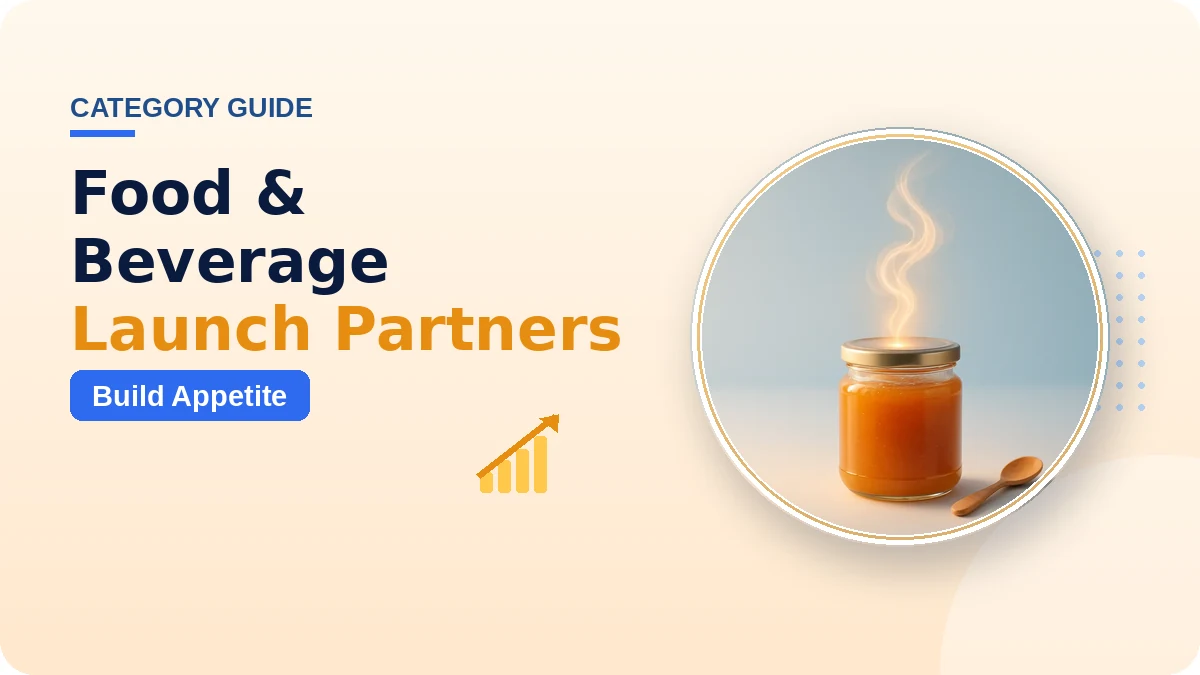
The best crowdfunding agency for a food or beverage product understands that taste and appetite sell the product, not specs - which means strong visual and sampling-led creative, real influencer instincts, and honest planning around shelf life, packaging, and food-safe shipping. Just as important is a plan for what happens after the campaign, since the real business in food is repeat purchase, not the one-time raise.
Food and beverage is one of the harder categories on Kickstarter - historically funding around 25 percent, below the platform average - not because people don't love food, but because appetite is hard to convey through a screen and fulfillment for perishable or delicate products is genuinely more complicated than shipping a gadget. An agency that treats a food launch like any other product will miss the two things that actually decide it: whether the creative makes someone crave the product, and whether the logistics plan can handle what food actually requires.
- Visual creative that feels craveable - texture, steam, close-ups, real tasting reactions
- Real sampling and influencer instincts - word-of-mouth from real tasters carries weight
- Honest handling of shelf life and packaging - planned before launch, not an afterthought
- A food-specific fulfillment answer - cold chain, food-safe packaging, realistic timing
- A plan for after the campaign - repeat purchase is the real business
Why food and beverage plays by different rules
Backers aren't buying specs, they're buying a craving - which makes visual and sensory storytelling the whole game in a way that a spec sheet or a feature list never will be. At the same time, food products carry logistics constraints most categories don't: shelf life limits how far in advance you can produce, packaging has to survive shipping without spoiling or breaking, and food-safe shipping rules out some fulfillment setups that work fine for a phone accessory. Get the creative right and the logistics wrong, and a beautifully funded campaign turns into a fulfillment nightmare.
What to demand from a food and beverage agency
- Visual creative that makes the product look and feel craveable - texture, steam, close-ups, real tasting reactions, not a sterile product shot.
- Real sampling and influencer instincts, since taste is nearly impossible to convey through specs alone and word-of-mouth from real tasters carries unusual weight in this category.
- Honest handling of shelf life and packaging in the campaign plan, not an afterthought discovered after funding.
- A fulfillment answer specific to food: cold chain if needed, food-safe packaging, and realistic shipping windows that account for spoilage risk.
- A plan for what happens after the campaign, since food businesses live or die on repeat purchase, not a single funded raise.
| Wins when | Loses when |
|---|---|
| Creative makes the product feel craveable | Product photographed like a spec sheet, not an experience |
| Shelf life and packaging planned before launch | Fulfillment figured out after the raise is already funded |
| Sampling and real tasting reactions built into the campaign | No social proof beyond the creator's own claims |
| A post-campaign repeat-purchase plan exists from day one | The campaign is treated as the whole business, not the start of one |
Regulatory and labeling requirements creators forget about
Food and beverage products carry regulatory obligations most other crowdfunding categories don't - nutritional labeling, allergen disclosure, and depending on your product and country, FDA or equivalent food-safety registration before you can legally ship to backers. These aren't optional details to sort out after funding; a campaign that collects money for a product it can't legally ship yet is a serious problem, not a minor delay. Confirm with your agency or your own counsel that labeling and any required registrations are handled before launch, not treated as a fulfillment-phase afterthought.
Cross-border shipping adds another layer specific to food: some ingredients or product types face import restrictions in certain countries, and customs officials scrutinize food shipments differently than they do a phone case. If a meaningful share of your backers are likely to be international, check restrictions for your specific product category before you promise global shipping on the campaign page - discovering an ingredient can't legally enter the EU after backers from Germany have already pledged is a bad place to find out.
Sampling and taste-testing before you ever launch
Because taste can't be conveyed through a screen, the campaigns that outperform in this category often build real taste-testing into their pre-launch process - sending samples to micro-influencers, food bloggers, or a curated list of early supporters who can generate genuine, specific reactions you can then use as social proof. Generic "delicious!" comments convince nobody; a detailed reaction describing texture, flavor balance, or how it compares to something familiar does real work on a campaign page. Build this sampling round into your pre-launch timeline, not as an afterthought once the page is already live.
Building a repeat-purchase plan before you even launch
The single biggest strategic difference between food and most other crowdfunding categories is that the crowdfunding campaign is rarely the end goal - it's the launch of an ongoing consumables business, where a customer who liked your product once should buy it again and again. Plan for this before you launch, not after: capture backer emails with repeat-purchase intent in mind, think early about subscription or reorder mechanics, and consider how the campaign's reward tiers can seed a customer base for a direct store rather than being a one-time transaction. Campaigns that treat the raise as the whole business tend to under-invest in this, then scramble to build repeat-purchase infrastructure months after the momentum has faded.
How we approach food and beverage launches
We treat the creative and the logistics as one plan, not two separate problems. That means building appetite-driven video and page visuals that make the product feel real to someone who can't taste it, alongside a fulfillment plan honest about shelf life and packaging before launch, not discovered afterward. Since 2010 we've run more than 4,600 campaigns across categories including food and beverage, and we ship rewards from our own US and EU warehouses - a real advantage for perishable or delicate products where shipping speed genuinely matters. Our food and beverage crowdfunding guide covers the tactics specific to this category.
Frequently Asked Questions
What is the best crowdfunding agency for a food or beverage product?
The best fit understands that appetite and taste sell the product, not specs - meaning strong sensory, sampling-led creative - and treats shelf life, packaging, and food-safe shipping as core planning from day one, not a problem to solve after funding. BoostYourCampaign has run food and beverage campaigns since 2010 across 4,600+ launches, with in-house US and EU fulfillment built for exactly this kind of logistics challenge.
Why do food and beverage campaigns fund at a lower rate?
Food and beverage historically funds around 25 percent, below Kickstarter's platform average, largely because appetite and taste are genuinely hard to convey through a screen, and the category carries real logistics complexity most others don't - shelf life, packaging that has to survive shipping, and food-safe fulfillment requirements. Campaigns that beat the baseline usually do it with strong sensory creative and a fulfillment plan built before launch.
How should I handle shelf life and shipping for a food campaign?
Plan it before you launch, not after you fund. Know your product's real shelf life, choose packaging that survives realistic shipping times without spoiling, and decide whether you need cold-chain logistics or standard shipping. Building this into your campaign plan up front avoids the scramble that happens when a funded campaign discovers its fulfillment plan doesn't actually work for a perishable product.
What happens after a food crowdfunding campaign ends?
The real food business usually starts after the campaign - repeat purchase, retail placement, and an ongoing store matter more long-term than the one-time raise. Plan for this from the start: capture the backer list as a foundation for repeat customers, and think about how the campaign feeds into an ongoing sales channel rather than treating it as a one-off event.
Do I need FDA approval or food-safety registration before crowdfunding a food product?
Depending on your product and country, yes - many food and beverage products require nutritional labeling, allergen disclosure, and sometimes formal food-safety registration before you can legally sell and ship to the public. Confirm this before launch, not during fulfillment; collecting pledges for a product you can't yet legally ship is a serious problem, not a minor paperwork delay.
How do I get credible taste reactions before launch if nobody's tried my product?
Send samples to a curated group of micro-influencers, food bloggers, or early supporters during pre-launch specifically to generate detailed, specific reactions you can use as social proof on the campaign page. Generic praise convinces nobody; a reaction describing texture, flavor, or a useful comparison does real persuasive work. Build this sampling round into your timeline before the page goes live, not after.
Food and beverage rewards creators who nail both the craving and the logistics, and punishes anyone who nails only one. If you want your creative and your fulfillment plan built together instead of separately, book a free strategy call.
Want results like these for your campaign?
We've helped 4,600+ creators raise over $734M. Let's pressure-test your launch plan and find the highest-leverage fixes before you go live.
Book a free strategy call →Get the free 87-step launch checklist
The exact pre-launch, live-campaign and fulfillment steps we use across 4,600+ launches. Free PDF, emailed instantly.
You're in - check your inbox. Open the checklist now ->