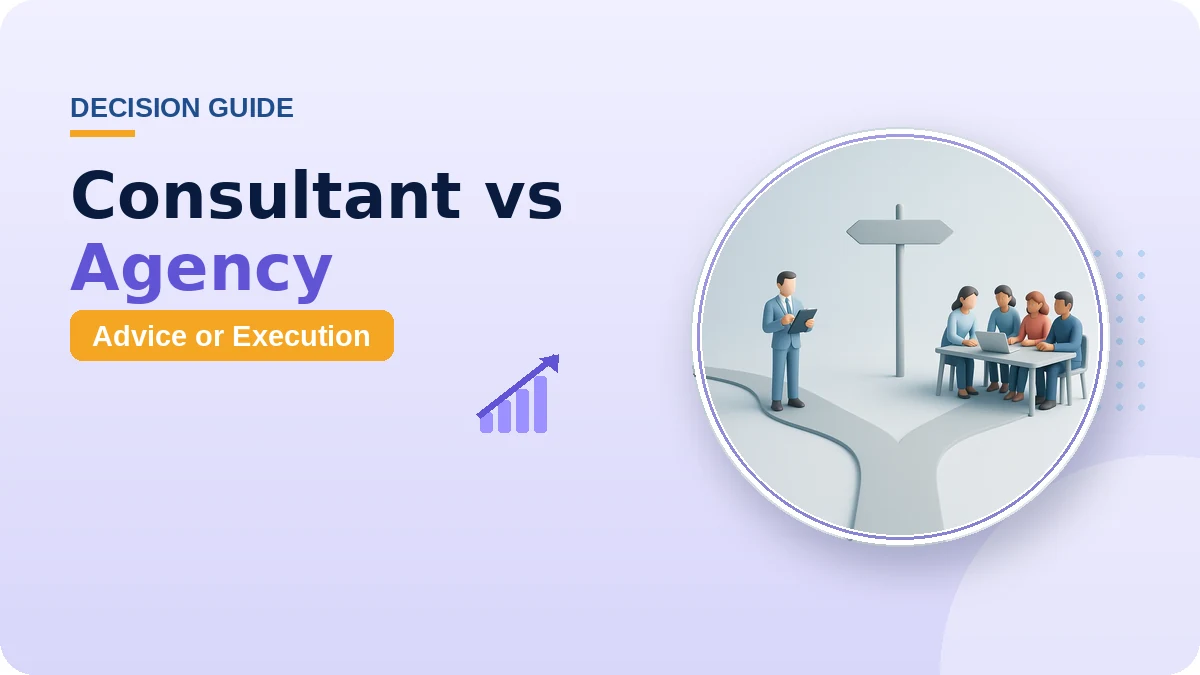
A crowdfunding consultant advises while you execute; an agency executes with you. Consultants suit experienced creators who need strategy, a second opinion, or a specific gap closed, and cost less. Agencies suit creators who need the launch built - list, ads, page, video, fulfillment - and priced as a system. The deciding question is honest capacity: if nobody on your side has time and skill to execute daily, advice alone will not launch the campaign.
Creators usually ask this as a budget question, but it's really a labor question: who is actually going to do the work? A consultant hands you a better map. An agency gets in the van and drives. Both are legitimate, both get sold as if they're interchangeable, and picking the wrong one for your situation can waste months you don't have. Below is the difference in practice, what each one costs, and when each is the right call.
What a consultant does
A crowdfunding consultant sells judgment: campaign strategy, goal setting, positioning, a review of your page and funnel, and answers when something breaks mid-campaign. Engagements are hourly or scoped, and the consultant touches nothing directly - you and your team run the ads, write the emails, cut the video, and ship the rewards. Done well, consulting compresses years of pattern recognition into a few calls. Done badly, it is expensive reassurance. The tell is specificity: a good consultant leaves you with numbers, sequences, and decisions, not vibes. We keep a full breakdown of that market in our Kickstarter marketing consultants guide.
What an agency does
An agency sells execution: the pre-launch list gets built by their media buyers, the page and video get produced by their team, the ads run under their hands during the live campaign, the press outreach goes out on their relationships, and - in our case - the rewards ship from their warehouses. You make decisions; they do the work. That is why agencies cost more and why comparing a consultant's hourly rate to an agency package misses the point: one is advice about labor, the other is the labor. What full execution includes, phase by phase, is in the agency selection guide.
| Consultant | Agency | |
|---|---|---|
| What you buy | Strategy and judgment | Execution of the full launch |
| Who does the work | You and your team | The agency's team |
| Typical cost | Hourly or scoped, low four figures common | Package fee; ours run $2,499 to $6,997 |
| Best for | Experienced creators with execution capacity | Creators who need the system built and run |
| Accountability | For advice quality | For delivery; the good ones share outcome risk |
| Fails when | Nobody has time to execute the plan | Hired too late to build the pre-launch |
Which one you actually need
- Pick a consultant if you have launched before, your team can execute daily, and you need strategy, a goal sanity-check, or a page teardown.
- Pick a consultant if one specific thing is broken - mid-campaign slump, ad account chaos - and you need a diagnosis fast.
- Pick an agency if this is your first serious launch and nobody on your side runs paid ads, builds funnels, or produces video for a living.
- Pick an agency if your time is worth more in the product: manufacturing, firmware, art - the things only you can do.
- Pick an agency with real fulfillment if you are shipping physical rewards to more than one region, because advice does not pack boxes.
The expensive mistake runs one direction far more than the other: buying advice when you needed labor. A brilliant strategy deck does not build a 10,000-person list, and launch windows do not wait while you learn media buying. The reverse mistake - paying for execution you could do yourself - costs money but usually still launches the campaign.
Questions that reveal which one you're actually talking to
Titles get used loosely in this industry, so ask directly rather than trusting the label on someone's website. Ask what specifically happens after you sign: if the answer is a series of calls, documents, and recommendations, you're talking to a consultant regardless of what they call themselves. If the answer includes a media buyer, a video producer, and a launch date they'll be actively managing, that's an agency. Ask who executes the pre-launch ad campaign day to day - a name and a role, not a vague "our team" - and ask what happens if you, the creator, simply don't have time to implement their advice that week. A consultant's plan sitting unexecuted in your inbox is a common and expensive failure mode that only becomes visible once the launch date is already close.
Red flags specific to each option
For consultants, be wary of anyone who won't show you a specific past campaign they advised on, who speaks entirely in generalities rather than numbers, or who pushes a paid course or upsell as the actual deliverable behind a consulting call. For agencies, watch for packages with no visible past campaign links, vague "we handle everything" language with no phase-by-phase breakdown of what's actually included, and any agency unwilling to share honest numbers - cost per lead, typical funding percentage by day - from campaigns they've actually run. Both problems come from the same root cause: someone selling confidence instead of a verifiable track record.
The hybrid that usually wins
In practice the best setups blend both: an agency runs the system, and its senior people function as your consultants inside the engagement - strategy calls, goal setting, honest pushback included in the package rather than billed by the hour. That is how we work. Every engagement starts with a fit-and-numbers check where we tell you plainly whether your goal, margins, and timeline hold up, and we have advised plenty of creators that they did not need us yet. Since 2010 and 4,600+ campaigns, the launches that go smoothest are the ones where strategy and execution live in the same room. If the numbers work, we also put skin in the game on the ad spend - detail in our cost guide.
Frequently Asked Questions
What is the difference between a crowdfunding consultant and an agency?
A consultant advises - strategy, goal setting, page reviews - while you and your team execute everything. An agency executes: its team builds the pre-launch list, produces the page and video, runs the ads, and in some cases ships the rewards. Consultants cost less because you are buying judgment, not labor. The right choice depends on whether your side has the time and skill to do the daily work.
How much does a crowdfunding consultant cost?
Most charge hourly or per scoped engagement, commonly landing in the low four figures for a meaningful block of strategy work, far below full agency execution. As a comparison point, our agency packages run $2,499 to $6,997 and include the strategy layer a consultant would bill for separately. Judge either by specificity: real numbers and sequences, verifiable past campaigns, and honesty about what they do not know.
Can I use both a consultant and an agency?
You can, and occasionally a neutral second opinion on an agency's plan is worth paying for. But a good agency already includes senior strategy in the engagement, which makes a separate consultant redundant most of the time. Where a hybrid genuinely helps is diligence: a short consulting engagement to pressure-test your goal and margins before committing to a full agency package.
Is a consultant enough for a first-time Kickstarter creator?
Only if you or your team can execute what the consultant prescribes: paid ads, funnel building, email sequences, video production, and daily live-campaign management. First-time creators usually underestimate that labor, follow the plan halfway, and lose the launch window. If nobody on your side does this work professionally, execution help beats advice - the reasoning is laid out in is an agency worth it.
How do I tell if someone calling themselves a "consultant" is actually going to execute anything?
Ask directly what happens after you sign. If the deliverable is calls, documents, and recommendations you implement yourself, that's consulting regardless of the title. If a media buyer, video producer, or launch manager is actively doing the work on a specific timeline, that's agency-level execution. Titles in this industry are used loosely enough that the actual scope of work matters more than the label.
What's a warning sign when evaluating either option?
For both, vagueness is the tell. A consultant who won't name a specific past campaign or speaks only in generalities, or an agency with no visible past campaign links and no phase-by-phase breakdown of what's included, are both selling confidence rather than a verifiable track record. Ask for real numbers - cost per lead, funding percentage by day - from something they've actually done before.
Buy advice when you have hands; buy hands when you have none. Be honest about which one describes your team, and either choice will serve you. If you want the fit-and-numbers check we start every engagement with - which doubles as a free consulting session - book a strategy call and we will tell you which side of this line you are on.
Want results like these for your campaign?
We've helped 4,600+ creators raise over $734M. Let's pressure-test your launch plan and find the highest-leverage fixes before you go live.
Book a free strategy call →Get the free 87-step launch checklist
The exact pre-launch, live-campaign and fulfillment steps we use across 4,600+ launches. Free PDF, emailed instantly.
You're in - check your inbox. Open the checklist now ->