A crowdfunding fulfillment service stores your production run, packs each backer's reward exactly as pledged, ships it through the right carrier for that backer's country, and usually runs the pledge manager data that tells the warehouse who gets what. Cost is never one number - expect a receiving fee per pallet or carton, storage of roughly $20-40 per pallet per month (or $0.50-1.50 per bin), pick-and-pack of roughly $2-4 per order plus a per-item charge for kitted rewards, packaging materials, and postage that runs 3-5 times more once a parcel crosses a border. For a 2,000-backer campaign, all-in fulfillment commonly lands in the $15-25 per backer range before you factor in international postage, and the single biggest lever on that figure is whether every parcel ships from one country or from a warehouse inside each region your backers live in.
Every fulfillment company will tell you it ships boxes. Almost none of them will tell you the part that actually matters for crowdfunding: it is not the same job as fulfillment for an ecommerce store, and treating it that way is where most funded campaigns give their margin back. A crowdfunding campaign delivers one enormous wave of orders instead of a steady daily trickle, ships to backers who pledged eight to fourteen months earlier and may have moved twice since, and kits multi-item reward tiers with add-ons that were still being sold weeks after the shipping line on the campaign page was locked. We are BoostYourCampaign. Since 2010 we have worked on 4,600+ campaigns and helped raise $734M+, with a 4.9/5 score across 300+ verified reviews, and fulfillment is the part of that work almost no other marketing agency touches - we own physical warehouses in the US and the EU and ship rewards ourselves instead of handing you off to a subcontractor once the campaign ends. This guide covers what a crowdfunding fulfillment service actually does, real pricing ranges for kickstarter fulfillment services, the US/EU warehouse decision, customs and VAT, how to choose a crowdfunding fulfillment company, and where our own setup fits if you would rather have one team run the marketing, the video, and the shipping.
What a crowdfunding fulfillment service actually does
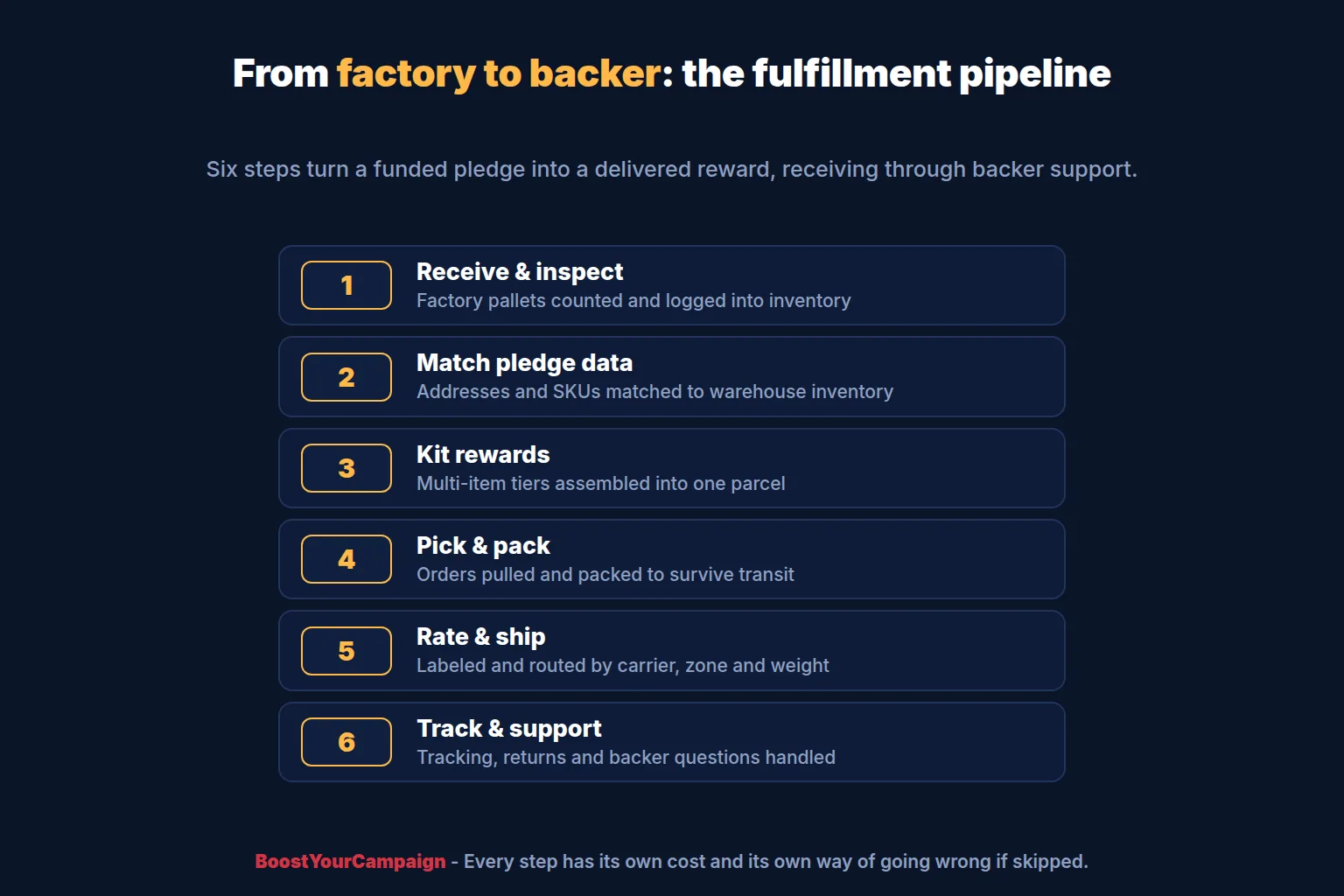
Fulfillment is a chain, not a single service, and every link has its own cost and its own way of going wrong. Here is what it covers end to end, from the moment your production run leaves the factory to the moment a backer opens the box.
- Receiving from the factory. Containers or pallets arrive at the warehouse, get counted against the packing list, checked for shipping damage, and logged into inventory before anything else can happen. A miscount here follows the whole campaign.
- Inventory management. The warehouse tracks quantity by SKU - base reward, each add-on, each variant and color - and flags when a component is running low before it becomes a stockout on the shipping floor.
- Pledge-manager data integration. Addresses, reward tiers, add-ons, and late pledges exported from BackerKit, Pledgebox, or the platform's own tool have to match the warehouse's SKU list exactly, or kitting errors follow.
- Kitting multi-item rewards. Most reward tiers are not one item. A deluxe pledge might combine a base unit, two add-ons, and a promo item that all need to ship together as one correctly matched parcel.
- Pick and pack. Staff pull the right items for each order, pack them to survive transit, and seal the parcel - the labor-heavy step that most per-order fees are built around.
- Carrier selection and rating. Each parcel gets rated by weight, dimension, and destination zone across whichever carriers the warehouse works with, then labeled and handed off.
- Tracking and notifications. Backers get a tracking number and status updates, which cuts down the "where is my reward" support volume that floods a creator's inbox otherwise.
- Returns and backer support. Damaged, lost, refused, and undeliverable parcels get investigated and reshipped, and backer questions about their order get answered by someone who can actually see the warehouse system.
Skip any one of those steps and the gap does not disappear - it shows up later as a support ticket, a reshipment, or a backer comment on the campaign page that other backers can see. If pledge managers are new to you, our pledge manager and late pledges guide covers how that data actually flows into a warehouse.
Why crowdfunding fulfillment is not the same job as ecommerce fulfillment
General 3PLs are built for ecommerce, and ecommerce is a steady drip: a few hundred orders a day, every day, from a customer who ordered last week and gave a current address. Crowdfunding fulfillment is the opposite pattern on every count, and a warehouse that has not shipped a campaign before usually learns this the expensive way.
One giant wave instead of a daily trickle. A campaign that funds in April might not ship until October, then move two thousand orders out the door in a two- to four-week window. That is a warehouse staffing and packaging-supply problem an ecommerce-only 3PL rarely plans for, because its normal week looks nothing like it.
Add-ons and variants stacked on top of a base pledge. A backer's order is rarely one SKU. It is a base reward plus whatever add-ons they bought during the campaign or the post-campaign pledge manager window, in whatever color or size variant they picked - which turns a simple pick into a kitting job multiplied across every order.
An international backer mix from day one. A typical Kickstarter or Indiegogo campaign ships to backers in twenty or more countries on the first day of fulfillment, not after a slow multi-year expansion the way most ecommerce brands scale internationally. That means customs, VAT, and cross-border carrier accounts all have to be solved before the first parcel goes out, not built up gradually.
Backers who pledged a year earlier. Someone who backed your campaign in month one and finally receives their reward in month twelve has often moved, changed their email, or forgotten which reward tier they even chose. Address hygiene and clean re-verification before shipping matter more here than in almost any other fulfillment context.
None of these problems are unsolvable. They are just different from what a general 3PL optimizes for day to day, which is why the choice of fulfillment partner and the pricing model both need to account for the pattern, not just the per-order fee on a rate card.
What crowdfunding fulfillment actually costs
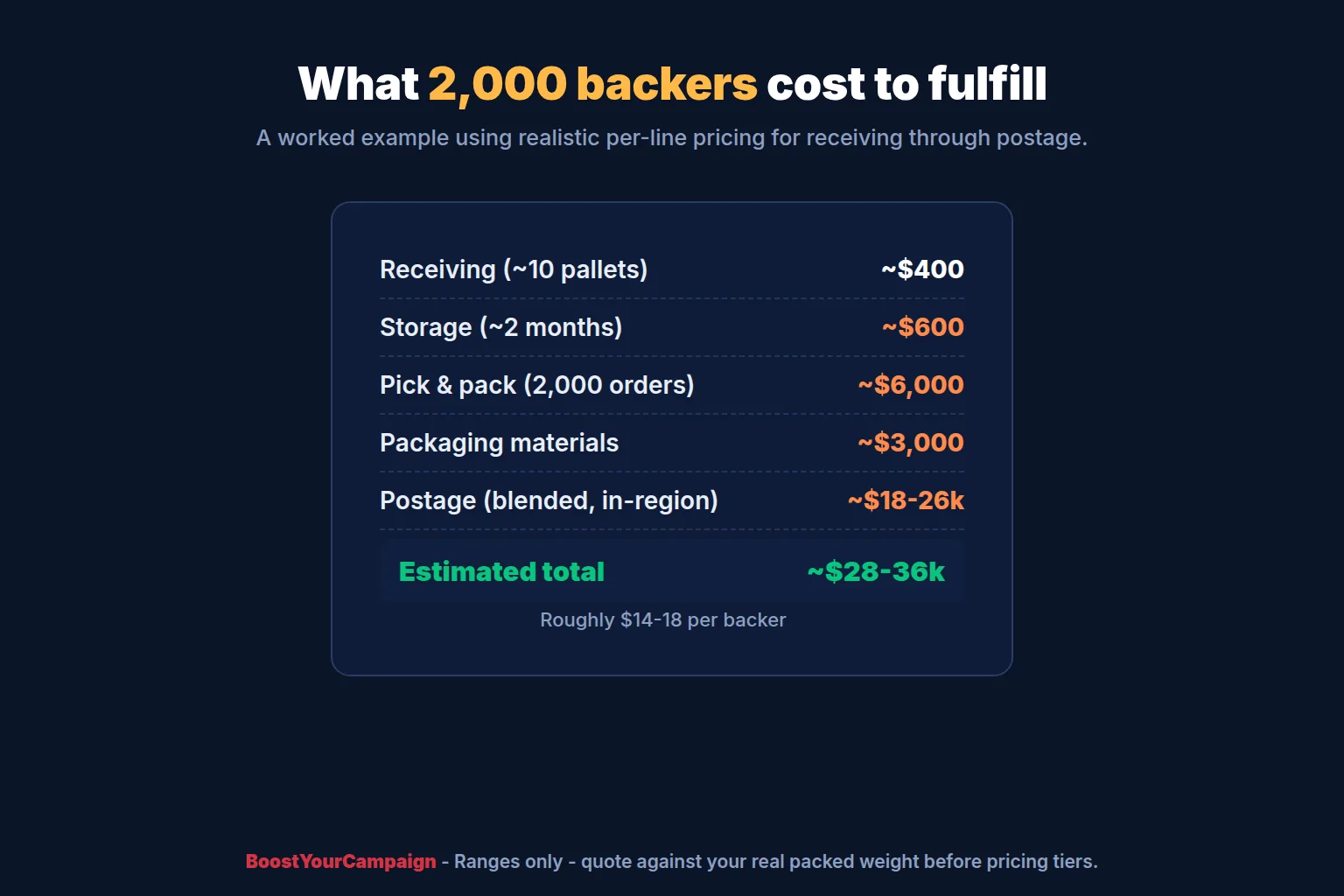
Fulfillment pricing is a stack of line items, not a flat quote, and every provider bundles them slightly differently. Here is what each line typically covers and a realistic range for each.
- Receiving. A per-pallet or per-carton fee to unload, count, and log your production run into inventory - commonly a flat fee per pallet, sometimes folded into the first month of storage.
- Storage. Roughly $20-40 per pallet per month, or $0.50-1.50 per bin per month for smaller product, charged for however long the run sits before it ships.
- Pick and pack. Roughly $2-4 per order for a single-item pledge, plus a per-item add-on charge (commonly $0.50-1 per extra item) for kitted rewards with multiple pieces.
- Packaging materials. The mailer, void fill, and any inserts, usually $0.50-3 per order depending on box size and fragility.
- Postage. The single largest and most variable line, driven entirely by weight, dimension, and destination - covered in detail in the next section.
Here is a worked example for a 2,000-backer campaign, using a mid-weight product with a mix of domestic and international backers and a moderate reward-tier complexity:
| Line item | Basis | Estimated cost |
|---|---|---|
| Receiving | ~10 pallets at roughly $40/pallet | ~$400 |
| Storage | ~2 months at roughly $30/pallet/month | ~$600 |
| Pick and pack | 2,000 orders at roughly $3/order | ~$6,000 |
| Packaging materials | 2,000 orders at roughly $1.50/order | ~$3,000 |
| Postage (blended, in-region warehouses) | 2,000 parcels, mixed domestic and cross-border | ~$18,000-26,000 |
| Rough total | - | ~$28,000-36,000 |
That lands somewhere around $14-18 per backer before postage variability, and can run several dollars higher per backer if the product is heavier or the international share is larger. Treat every number here as a range to quote against your actual packed weight, not a promise - a real quote from a partner who has seen your reward tiers is the only number worth pricing shipping charges against. Our companion piece on Kickstarter shipping costs breaks the postage line down further by weight and zone.
The US and EU warehouse question
This is the single decision that moves the pricing table above more than any other line item, and it is the reason we built our own warehouses instead of routing every parcel through one hub. International parcels typically cost 3-5 times what a domestic parcel of the same weight costs, because they cross a border, change carrier networks, and often clear customs individually rather than as a single bulk shipment.
Picture an $8 domestic US parcel. Ship that same product internationally from a US-only warehouse and the postage commonly climbs to roughly $25 for a Canadian backer, $35 for a UK backer, $40 for an Australian backer, and $50 or more for a backer in parts of Asia. Multiply that gap across a few hundred international backers and it is real money leaving the campaign's margin, not a rounding error.
| Backer location | Typical parcel cost from a US warehouse |
|---|---|
| US domestic | ~$8 |
| Canada | ~$25 |
| UK | ~$35 |
| Australia | ~$40 |
| Parts of Asia | ~$50+ |
The fix is bulk freight, not parcel-by-parcel shipping. Move 500 units in one freight shipment to a warehouse already inside the EU and that shipment commonly costs around $2,000 total. Spread across 500 backers that works out to roughly $4 per unit in freight, against a savings of roughly $15-25 per parcel on postage alone once those backers ship domestically from the EU warehouse instead of internationally from the US. For most campaigns with a meaningful EU backer share, that freight cost pays for itself well before the first hundred parcels go out.
Customs, VAT, and the paperwork nobody plans for until it is late
Cross-border shipping is not just expensive - it comes with paperwork that determines whether a parcel clears customs in two days or sits for two weeks with a backer refreshing the tracking page. A few basics matter enough to plan before launch rather than after.
- The US de minimis exemption ended in 2025. Low-value imports into the US that once cleared duty-free no longer do, which changes the math for any campaign shipping into the US from outside it and needs to be priced into the shipping line, not discovered at the border.
- EU IOSS covers parcels under EUR 150. The Import One-Stop Shop scheme lets a creator or fulfillment partner collect VAT at the point of pledge and remit it through one return, so the parcel clears without the courier collecting VAT again at the door. Above that value, the parcel goes through standard import procedures instead.
- An EORI number is required to import into the EU commercially. Without one, a bulk freight shipment into an EU warehouse can stall at customs before it ever reaches the shelf.
- DDP vs DDU changes who pays, and when. Delivered Duty Paid means duties and VAT are collected up front and the backer never sees a surprise bill. Delivery Duty Unpaid means the courier collects from the backer at the door - which reads as a broken promise on a reward they already paid for.
Getting this wrong does not usually kill a campaign outright. It shows up as a wave of support tickets right when the campaign should be enjoying its best goodwill, from backers asking why their tracking says "held at customs" or why they owe an unexpected fee. Our crowdfunding customs documentation guide and EU shipping, VAT, and customs guide both go deeper on the paperwork itself.
How to choose a fulfillment partner
Whoever you work with, judge any partner on the same concrete points, and treat vague answers as the warning sign they are.
- Where are your warehouses, and can you fulfill domestically in both the US and the EU?
- What is your receiving fee, storage rate, and pick-and-pack fee, in writing, not a verbal estimate?
- Have you actually shipped a crowdfunding campaign before, with its one-wave order pattern, or only steady ecommerce volume?
- How do you handle VAT, duties, EORI registration, and DDP vs DDU for cross-border backers?
- Do you integrate directly with the pledge manager, or does someone have to re-key address and SKU data by hand?
- How do you rate shipping - by real zone and weight, or a flat guess that overcharges close backers and undercharges distant ones?
- What happens with damaged, lost, and undeliverable parcels, and who eats that cost?
- Can you support reships and continued sales once the initial fulfillment window ends?
A partner who has shipped real campaigns answers those questions with specific numbers and specific systems. A partner who talks in generalities about "international capability" has usually not been tested by a two-thousand-parcel wave with a hard delivery promise attached to it.
Comparing your fulfillment options
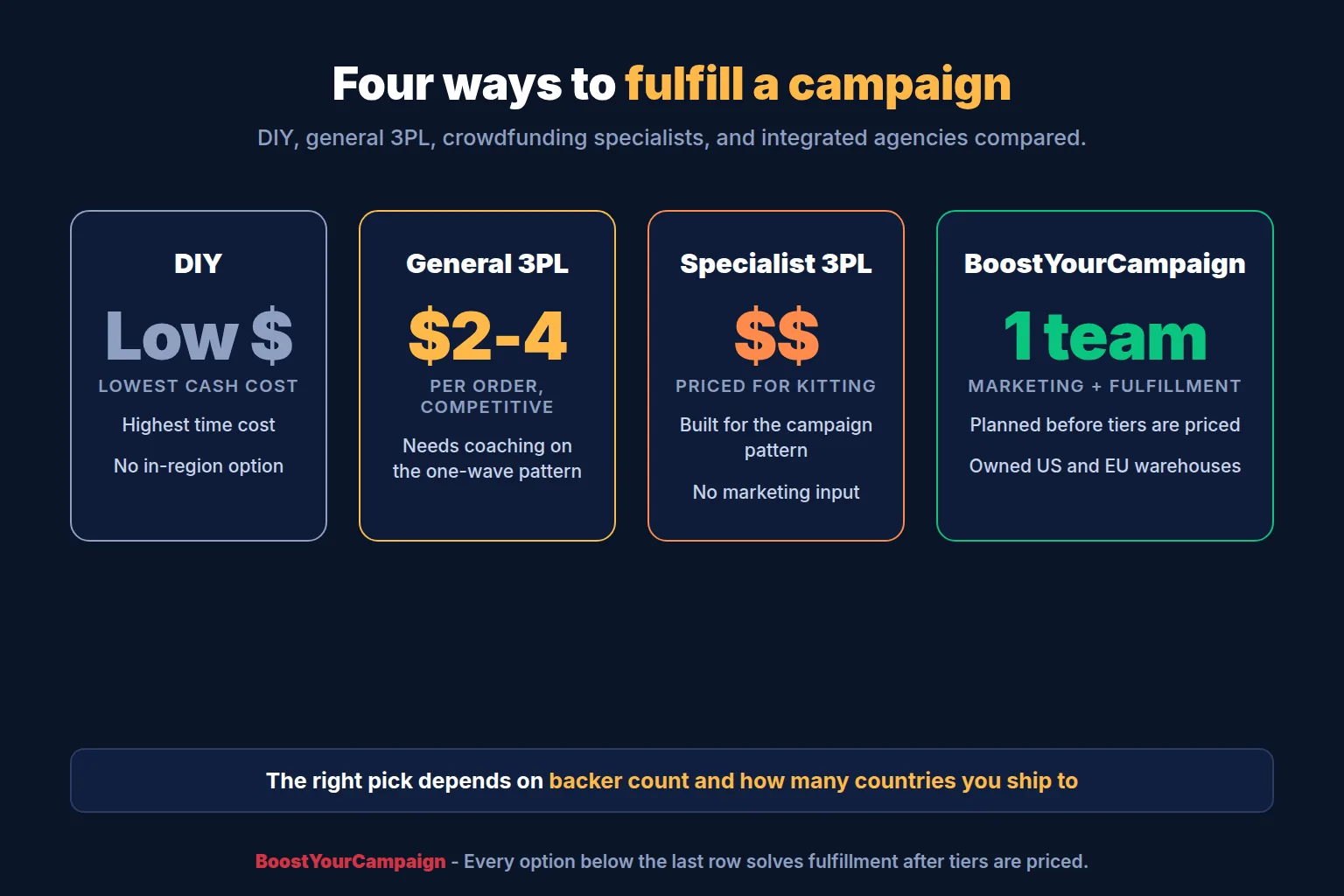
There are four real paths for fulfilling a funded campaign, and each fits a different situation. None of them is wrong in every case - the right choice depends on backer count, weight, and how many countries you are shipping to.
| Option | Cost | Best for | Watch out for |
|---|---|---|---|
| DIY (garage or spare room) | Lowest cash cost, highest time cost | Under a few hundred backers, light product | Does not scale past a small run; no in-region option |
| General 3PL | Competitive per-order fees | Creators who already know exactly what they need | Often needs coaching on the one-wave shipping pattern; may lack EU presence |
| Crowdfunding-specialist 3PL | Priced for the campaign pattern and kitting complexity | Mid-size to large campaigns with multi-item rewards | No input on marketing, reward pricing, or campaign strategy |
| BoostYourCampaign (integrated marketing + fulfillment) | Bundled with campaign services as one relationship | Creators who want fulfillment planned before reward tiers are priced | Best fit when you want one team accountable for the whole outcome |
The pattern worth noticing: every option below the bottom row solves fulfillment after the fact, once reward prices are already locked. The integrated model solves it before launch, while there is still time to change a shipping line or a reward tier before backers ever see it.
Planning your fulfillment timeline
Fulfillment planning should start before the campaign launches, not after it funds. A rough sequence that works for most campaigns: get a real shipping quote against your packed reward tiers before you price the campaign page, so the shipping line reflects an actual number instead of a guess off the base product alone. Book freight from the factory to your warehouse or warehouses with enough lead time - ocean freight commonly runs 30-45 days port to port, and that clock needs to start well before your promised delivery date, not after the campaign closes.
Once the campaign funds, the pledge manager window is where addresses, add-ons, and late pledges get locked. Give that window enough time to close cleanly and get the exported data checked against your warehouse's SKU list before kitting starts - a mismatch caught here is a five-minute fix; a mismatch caught after packing is a reshipment. Then the actual pick-pack-ship window for a few thousand orders typically runs two to four weeks depending on staffing and how complex the kits are. Build buffer into every promised delivery date on the campaign page, because a shipment that clears customs in three days one month can take two weeks the next.
How BoostYourCampaign fits
We are not a marketing agency that outsources fulfillment to whoever will take the referral fee. Marketing, video production, fulfillment, and post-campaign ecommerce all run under one roof, which matters because reward pricing, shipping charges, and fulfillment planning get decided together instead of getting handed off once the campaign funds. We operate our own warehouses in the US and the EU, so a print run can be split the way this guide describes - regional stock, domestic-style shipping on both continents, and far less customs exposure than a single-warehouse setup.
Fulfillment gets planned before reward tiers are priced, not after, because that is the only point in the process where a shipping mistake is still cheap to fix. We run the pledge manager, rate shipping by real zone and weight instead of a flat guess, and plan VAT, EORI, and DDP paperwork before launch instead of reacting to a customs hold after the fact. We work on a skin-in-the-game basis on the marketing side, investing our own money alongside the client's ad budget, so our incentives sit with the campaign's actual outcome rather than with billing regardless of how delivery goes.
Scale matters here because fulfillment mistakes repeat in predictable ways. After 4,600+ campaigns since 2010 and $734M+ raised, we have seen the common ways rewards go wrong - underpriced shipping, oversized boxes, tax handled too late, mismatched SKUs - and we plan around them before production locks rather than discovering them mid-campaign. You can read what clients say on our reviews page. And fulfillment is not where the relationship ends: your backer list and remaining stock are assets for continued sales, whether that means turning them into a Shopify store after the campaign or working through our broader ecommerce services and guide to selling after crowdfunding ends.
Before you sign with a fulfillment partner: a quick checklist
| Question | Why it matters |
|---|---|
| Do they operate a warehouse in the EU as well as the US? | A US-only warehouse turns every EU backer's parcel into an expensive, customs-exposed international shipment. |
| Is receiving, storage, and pick-pack pricing in writing? | Verbal estimates rarely survive contact with your real packed weight and order count. |
| Have they actually shipped a crowdfunding campaign's one-wave order pattern? | General 3PLs built for steady daily orders often need coaching on a compressed multi-thousand-order surge. |
| Do they handle EORI, IOSS, and DDP paperwork, or leave it to you? | Missing paperwork is what turns into a customs hold and a wave of backer support tickets. |
| Does their system integrate with your pledge manager's export? | Manually re-keyed address and SKU data is where kitting errors and reshipments start. |
| Can they support reships and continued sales after the initial window? | Fulfillment does not end when the last reward ships if you plan to keep selling. |
Frequently Asked Questions
What is a crowdfunding fulfillment service?
A crowdfunding fulfillment service stores your production run after it leaves the factory, integrates with your pledge manager to know who ordered what, kits and packs each reward, ships it through the right carrier for that backer's country, and handles the returns and support that follow. It is the operational layer between a funded pledge and a reward at the backer's door.
How much do kickstarter fulfillment services cost?
It depends on your product's weight, how complex your reward tiers are, and how many countries you ship to, so treat any single figure with caution. As a rough range, expect receiving fees per pallet, storage of roughly $20-40 per pallet per month, pick-and-pack of roughly $2-4 per order plus per-item charges for kitted rewards, packaging, and postage that is the largest and most variable line. A 2,000-backer campaign commonly lands somewhere around $14-18 per backer before international postage variability.
What makes a crowdfunding fulfillment company different from a general 3PL?
A crowdfunding fulfillment company is built around the pattern this category actually has: one enormous wave of orders instead of a steady daily trickle, multi-item kits with add-ons sold up until the pledge manager closes, and an international backer mix from day one rather than a slow expansion. A general 3PL can work, but it usually needs to be walked through that pattern since it differs from the steady order flow it is normally built for.
Should I use a US warehouse, an EU warehouse, or both?
Both, if your backer base has a meaningful EU or UK share. Shipping every parcel from a single US warehouse means international postage that commonly runs 3-5 times the domestic rate, plus customs exposure at the door. Splitting inventory into a US and an EU warehouse turns most of those parcels into cheaper, faster, domestic-style shipments, and the bulk freight cost of moving stock into the EU warehouse is almost always smaller than the cross-border postage it replaces.
What happened to the US de minimis exemption?
It ended in 2025. Low-value parcels shipped into the US that once cleared without duty no longer do, which changes the shipping and pricing math for any campaign importing rewards into the US from outside it. That cost needs to be planned into the shipping line before launch rather than discovered at the border after the campaign funds.
Do I need a pledge manager for fulfillment to work?
If you are shipping a physical product to more than a handful of backers, effectively yes. The pledge manager collects final addresses, charges for postage, sells add-ons and late pledges, and exports the data the warehouse needs to kit orders correctly. Our pledge manager and late pledges guide covers how that process works in more depth.
Why do so many funded campaigns lose money on fulfillment?
Because creators usually price reward shipping months before they see a real fulfillment invoice, and the actual cost often comes in higher once packed weight, international postage, and VAT are all accounted for. Once the campaign is funded those prices are locked, so the gap comes straight out of margin. Planning fulfillment and getting a real quote before reward tiers are priced is the fix.
Can BoostYourCampaign fulfill both Kickstarter and Indiegogo campaigns?
Yes. The fulfillment mechanics are largely the same across platforms - it is the pledge manager and post-campaign tools that differ. Our Kickstarter fulfillment guide and Indiegogo fulfillment guide cover the platform-specific details, including Indiegogo's Late Pledge (formerly called InDemand) phase for continued sales after the campaign ends.
How do I compare fulfillment companies before choosing one?
Ask each candidate the same concrete questions: where their warehouses are, whether pricing is in writing, whether they have shipped a crowdfunding campaign's order pattern before, and how they handle VAT and customs paperwork. Our crowdfunding fulfillment companies guide compares specific providers in more detail, and the board game fulfillment guide goes deeper on the heaviest, most damage-prone category if that applies to your product.
Fulfillment is the quiet half of crowdfunding, and it decides whether a funded campaign ends up profitable or painful. Plan it before you launch, price your shipping against real packed weight, and treat delivery as the start of a business rather than the end of a project. If you want a straight read on your product, your reward tiers, and how to ship them from warehouses that are already inside your backers' regions, book a free strategy call and we will tell you where you stand.
Want results like these for your campaign?
We've helped 4,600+ creators raise over $734M. Let's pressure-test your launch plan and find the highest-leverage fixes before you go live.
Book a free strategy call →Get the free 87-step launch checklist
The exact pre-launch, live-campaign and fulfillment steps we use across 4,600+ launches. Free PDF, emailed instantly.
You're in - check your inbox. Open the checklist now ->