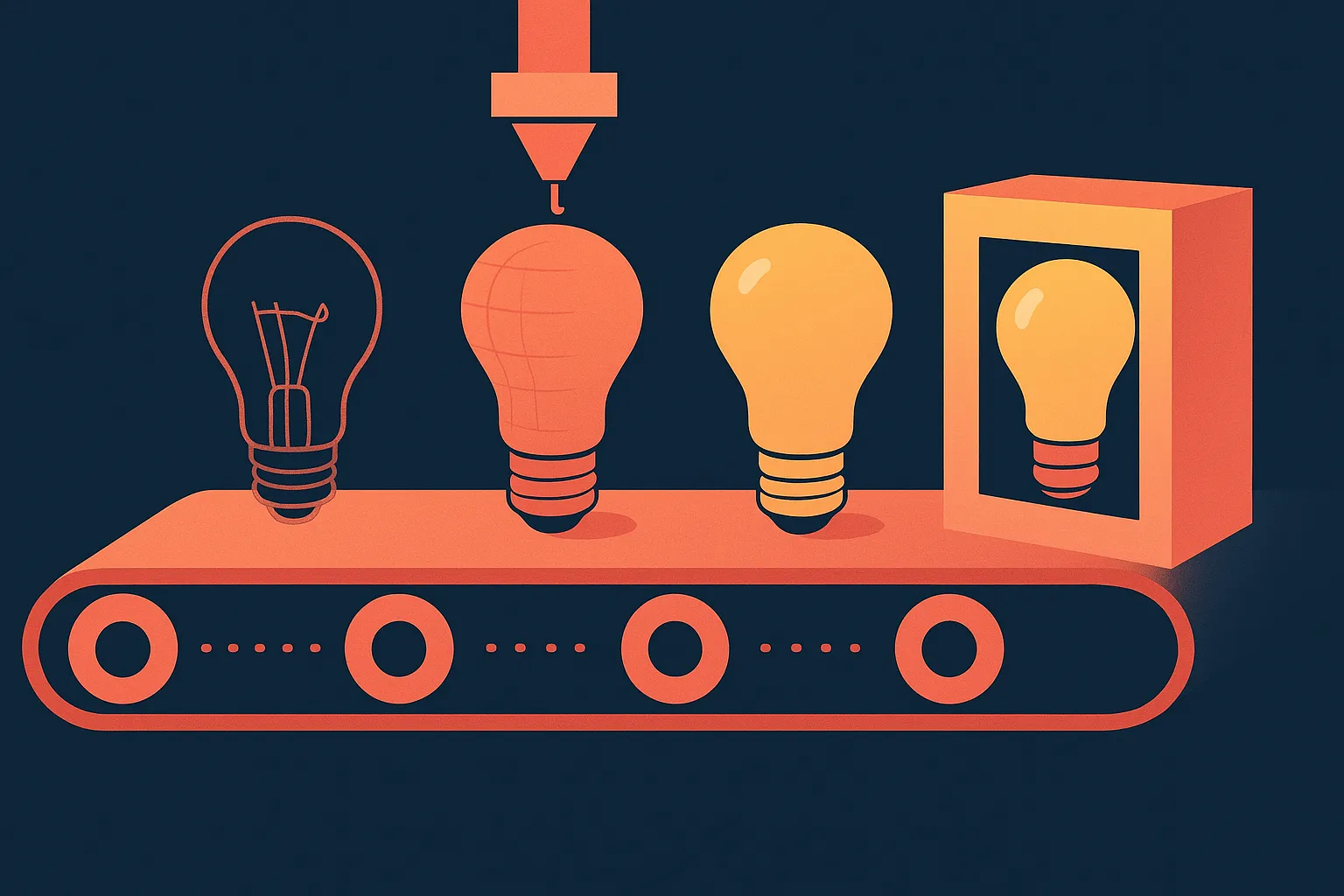
Building a product from scratch runs through five stages before a single unit reaches a customer: validating the idea for a few hundred dollars, choosing a prototyping route that matches what you are building, engineering the design so a factory can actually produce it, running an honest costing check on unit cost versus retail price, and deciding between a small pilot run and full mass production. Crowdfunding fits in as the financing step, not the starting point - it works best once you already have a working prototype and rough manufacturing numbers in hand. Skipping any of these stages is the single most common reason physical product launches, on Kickstarter or off it, run out of money mid-production.
Almost every founder who comes to us with a product idea has already skipped ahead in their head to the campaign page and the launch video. That instinct is understandable, but it is backwards. A Kickstarter campaign is a financing event that sits on top of a product that already exists in some working form. Everything that determines whether that campaign succeeds - whether you can actually deliver what you sell, at a cost that leaves room for profit - gets decided months earlier, on a workbench or in a factory quoting email, before any ad budget gets spent. This roadmap walks through that earlier stretch: validating an idea cheaply, picking the right way to build a first version, designing it so it can be manufactured, facing the real math on unit cost, and choosing how much to produce before demand is certain.
Validate the idea before you spend a dollar on tooling
Tooling, injection molds and factory setup are the most expensive and least reversible costs in building a physical product, and they are exactly the costs a founder should avoid touching until the idea has been tested against real people, not just friends and family. Validation does not require a finished product, it requires evidence that strangers will pay for what you are describing. A landing page, a render or rough prototype photo, and a small paid ad budget will tell you more in two weeks than six months of development would. So will pre-order deposits, a waitlist that converts from cold traffic, or showing a working mockup to fifty people outside your network and watching how many ask where to buy it. The goal is cheap, fast signal, not a polished product. Founders who spend $500 and three weeks finding out nobody wants the thing save themselves from spending $50,000 and a year finding out the same thing later, with tooling deposits and inventory already committed.
Choosing a prototyping route: 3D printing, CNC, or hacking together off-the-shelf parts
Once an idea has some validation behind it, the next question is how to build a first physical version cheaply enough to keep iterating. Three routes cover most hardware products, and the right one depends on the part, not personal preference.
3D printing is the default for most early prototypes because it is fast, cheap per iteration, and forgiving of design changes - you can print a revised version overnight. It is ideal for testing form and fit, less ideal for parts that need to survive real mechanical stress or a finish resembling the final injection-molded product. CNC machining costs more per part and takes longer, but it produces parts in the actual materials and tolerances a manufacturer will eventually use, making it the better choice once a design has stabilized. The third route, underrated by most first-time founders, is hacking a first version together from off-the-shelf components - repurposing an enclosure, sourcing a stock circuit board, combining parts never meant to go together. It looks less "finished" but is often the fastest way to prove a mechanism works before spending on custom tooling. Most successful hardware products move through a combination of all three: off-the-shelf hacking to prove the concept, 3D printing to iterate on form, and CNC for the final pre-production samples sent to a factory.
Software or app idea? Build an MVP instead of a full product
Not every idea that eventually launches on Kickstarter is a physical object. A meaningful share of the campaigns we work on are apps, connected hardware with a software layer, or platforms where the software is the actual product. For those, the prototyping question is different: you do not need a finished app with every feature built out, you need a minimum viable product that proves the core function works and that people will use it. Building a full-featured app before testing whether anyone wants the core function is the software equivalent of tooling an injection mold before validating demand. Our MVP development program exists for exactly this gap: a working MVP built in 4 to 6 weeks, with fixed pricing starting from $2,500, so a founder can get a real, testable product in front of users and investors instead of a pitch deck describing one. If your idea has a software component, it is worth reading through what our MVP program actually delivers before committing a full development budget to features nobody has confirmed they want yet.
Design for manufacturing: the step most first-time founders skip
A prototype that works on a workbench and a product that a factory can build at volume, consistently, at a sane cost, are two different things, and the gap between them is called design for manufacturing, usually shortened to DFM. This is where first-time founders lose months without realizing it, because a hand-built prototype tolerates fixes that mass production cannot: a part that needs extra glue, a screw that has to go in at a specific angle, a tolerance that only worked because the prototype maker eyeballed it. DFM means redesigning around what a production line can repeat thousands of times without a skilled hand correcting for it - reducing part count, choosing materials available at the volumes you need, setting tolerances a factory can hold consistently, and designing for the specific process, whether injection molding, sheet metal, or PCB assembly. The best way to shorten this stage is to get a manufacturer's engineering team looking at your design before it is finalized, since a factory that builds parts like yours every day will spot manufacturability problems in an afternoon that would otherwise surface as a failed pilot run months later. We cover how to find and vet the manufacturer who does that review in our companion guide, how to find and vet a manufacturer for your product.
The first costing reality check: unit cost versus retail price
Somewhere around the DFM stage, founders get their first real quote from a factory, and it is often the moment a product idea gets its first serious gut check. The number that matters is not the unit cost by itself, it is the unit cost measured against the price you can realistically charge. A common rule of thumb is that retail price needs to land somewhere between three and five times landed unit cost - landed meaning the part cost plus freight, duties, and any import fees, not just the number a factory quotes in isolation - to leave room for platform fees, payment processing, marketing, fulfillment and an actual margin once everything is delivered. A product that costs $18 landed and can only sell for $35 is not a product yet, it is a subsidy on every unit sold. The fix is almost never to raise the price after launch, since backers anchor hard on the number they were shown first; it is to revisit the design, material or supplier before the price is public anywhere. Sourcing country matters here too, since duties and tariff exposure change the landed cost by supplier region - our crowdfunding tariffs guide walks through how sourcing decisions affect that number for a 2026 launch.
| Factor | Small pilot run (50-500 units) | Mass production (thousands of units) |
|---|---|---|
| Unit cost | Higher per unit; tooling and setup costs spread over few units | Lower per unit once tooling is amortized |
| What it proves | Whether the design is actually manufacturable at real tolerances | Nothing new - it locks in whatever the pilot run already proved or missed |
| Risk if something is wrong | Limited: a few hundred units to rework or scrap | Severe: a design flaw multiplies across the full order |
| Typical use | Pre-launch samples, crowdfunding campaign photos and video, early reviewers | Fulfilling a funded campaign or confirmed wholesale order |
| When to commit | As soon as DFM is done and you need real units to sell | Only after a pilot run has shipped clean with no structural surprises |
Small pilot runs vs mass production: which one comes first
Almost no product should go straight from prototype to a mass production order, no matter how much pressure there is to hit a launch date. A pilot run of somewhere between fifty and five hundred units, depending on the product's complexity, is the step that turns "this should work at scale" into "this does work at scale." It uses the real production line, materials and assembly process, at a volume small enough that a mistake costs thousands of dollars instead of hundreds of thousands. Pilot units should also appear in your campaign photography and video wherever possible, since backers can tell the difference between a hand-finished prototype and a true production sample. Only after a pilot run ships clean, with no structural surprises serious enough to require a redesign, does it make sense to commit to full mass production - and that commitment should generally be tied to actual funded demand, not a hopeful forecast.
Where crowdfunding fits as the financing step
This is the part of the roadmap that clarifies what crowdfunding is actually for. It is not a substitute for validation, prototyping or DFM, and it is not where product development starts. It is the financing mechanism that turns a validated, manufacturable, correctly costed product into enough pre-orders to fund the mass production run without founders draining savings or taking on debt first. Campaigns that launch with a working pilot-run prototype, a real unit cost and a price that supports a healthy margin tend to perform very differently from campaigns that launch on renders and hope, because backers, journalists and the platform's own discovery algorithm all reward campaigns that look like a real product rather than a concept. We have run this sequence with founders since 2010, across more than 4,600 campaigns that raised over $734 million combined: campaigns that struggle almost always skipped a step in this roadmap, usually costing or DFM, under time pressure to launch. If your product is at the prototype-and-costing stage, our step-by-step Kickstarter launch guide and our breakdown of what a Kickstarter campaign actually costs to run are the natural next reads.
- Validate the idea with a landing page, ad spend or pre-order deposits before spending on tooling.
- Pick a prototyping route that matches the part: 3D printing for form, CNC for final-material samples, off-the-shelf hacking to prove a mechanism fast.
- For software or app ideas, build an MVP that proves the core function instead of a fully featured product nobody has confirmed they want.
- Run a design-for-manufacturing pass with a factory's engineering team before finalizing tooling, not after a failed pilot run.
- Cost the product on landed unit cost, including freight and duties, against a retail price with a 3x to 5x multiple.
- Order a small pilot run before committing to mass production, and use those units in your campaign photos and video.
- Treat crowdfunding as the financing step for a product that is already validated and manufacturable, not as the validation itself.
Frequently Asked Questions
How much does it cost to develop a product from scratch?
It varies by category, but early validation can often be done for a few hundred dollars in landing page and ad spend, prototyping typically runs from a few hundred to a few thousand dollars depending on complexity, and DFM plus tooling for a mass production run is usually the largest single cost, often tens of thousands of dollars for hardware with custom injection-molded parts. Software MVPs are generally cheaper and faster, with fixed-price development starting around $2,500 for a working version in 4 to 6 weeks.
Do I need a patent before I start prototyping?
Not before you start, but it is worth filing a provisional patent application before you show a working prototype to manufacturers, investors or the public, since it is relatively inexpensive and buys twelve months to develop the product further before a full application is due. Waiting until after a crowdfunding campaign is public is too late for most jurisdictions.
What is the difference between an MVP and a hardware prototype?
They serve the same purpose for different products. A hardware prototype proves that a physical mechanism, form or function works. An MVP proves that a piece of software solves the core problem it claims to solve, without every planned feature built out. Both exist to get real user feedback before committing to full-scale development, and both should be judged on whether they prove demand, not on how polished they look.
How many units should my first production run be?
Most pilot runs land somewhere between fifty and five hundred units, depending on how complex the product is and how much a mistake at that volume would cost. The goal is to prove the design works at real production tolerances, not to build inventory, so it should be just large enough to catch manufacturing problems before they scale into a full order.
Should I find a manufacturer before or after my Kickstarter campaign?
Before, ideally well before. Campaigns that launch without a manufacturing partner lined up, real unit costs and a pilot run tend to run into delivery problems once the campaign funds, because a funded deadline is the worst time to be vetting factories for the first time. Our guide on how to find and vet a manufacturer covers what to check before you sign anything.
Can crowdfunding pay for my first production run?
Yes, and that is the model most successful hardware campaigns use: crowdfunding pre-orders finance the mass production run that follows a validated pilot run, rather than founders self-funding production upfront. It works reliably when unit cost, retail price and delivery timeline are realistic going in, which is why costing and the pilot run need to happen before launch, not during it.
None of this roadmap is glamorous, and none of it fits neatly into a launch video. But every campaign we have watched deliver cleanly to backers followed some version of this sequence, and most of the ones that ran into trouble skipped a step to launch faster. If you have a validated idea or a costing question you are working through before committing to a manufacturing run, book a free strategy call and we will help you map exactly where you are on this roadmap and what comes next.
Want results like these for your campaign?
We've helped 4,600+ creators raise over $734M. Let's pressure-test your launch plan and find the highest-leverage fixes before you go live.
Book a free strategy call →Get the free 87-step launch checklist
The exact pre-launch, live-campaign and fulfillment steps we use across 4,600+ launches. Free PDF, emailed instantly.
You're in - check your inbox. Open the checklist now ->