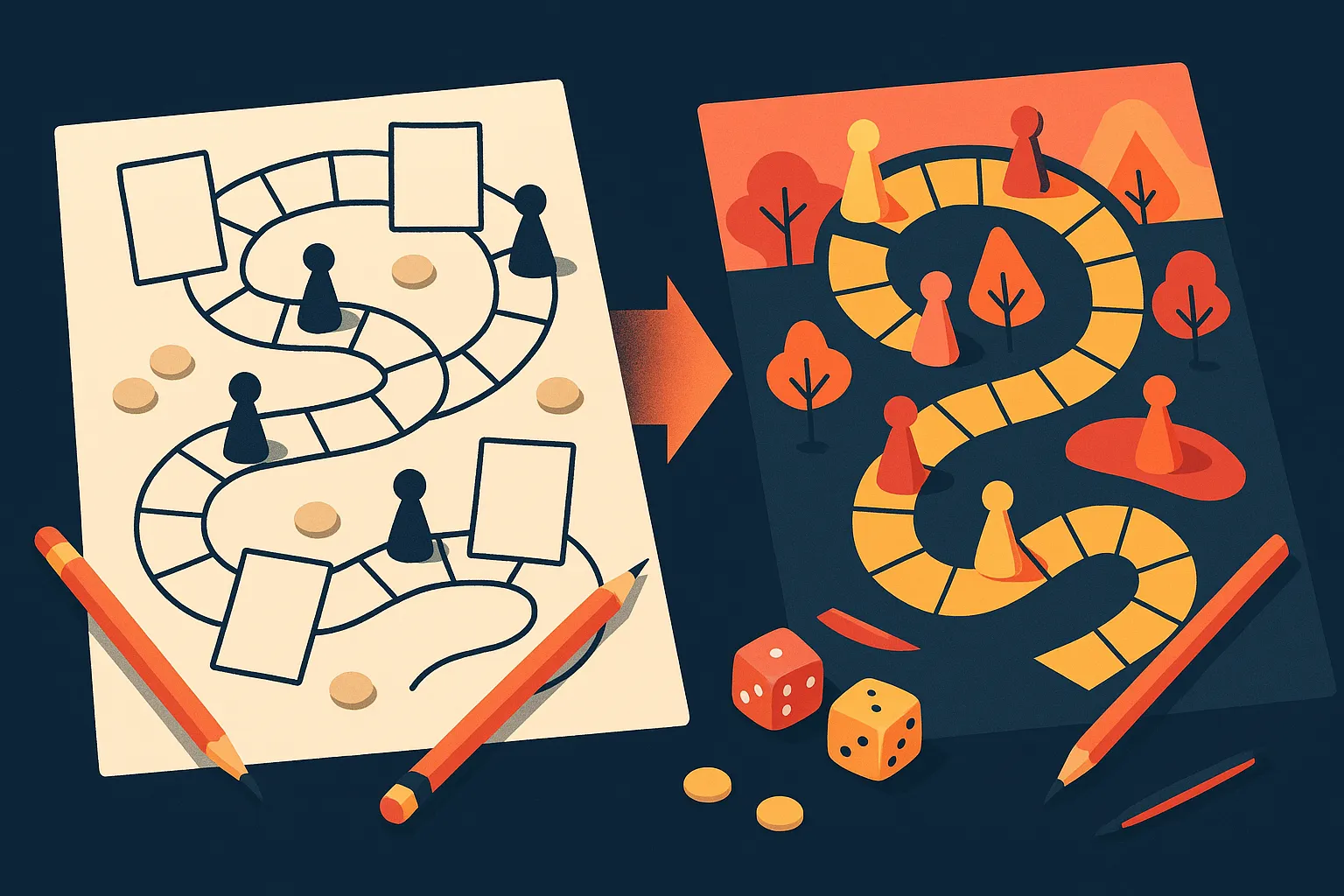
Designing a board game worth launching starts with the core loop, not the art, the box, or the theme. Build an ugly paper prototype, prove the loop is fun in dozens of kitchen-table sessions, move to blind playtesting with strangers once the rules are stable, take the game to conventions for volume and word of mouth, and only then bring in an artist and graphic designer. Every component you add from that point costs money at print, so add fewer and better ones. The rulebook is finished when a stranger can go from a sealed box to a completed game with no help from you. Design work ends and launch preparation begins once the files are signed off and the rules teach themselves.
Most guides to crowdfunding a board game start at the campaign page, the video, or the ad account. That is backwards. None of it matters if the game underneath is not actually good, and "actually good" is not a feeling you get from playing your own prototype with your own friends. It is a conclusion you earn through a specific sequence of design work: proving the core loop, stripping the prototype down to what matters, testing it on strangers, and only then dressing it up. This guide covers the earlier, less glamorous half of publishing a board game - design - and where it hands off to the launch preparation covered in our board game marketing guide.
Start with the core loop, not the theme
Every good board game has a core loop: the small cycle of decisions a player repeats turn after turn that has to be interesting on its own, stripped of theme, art, and story. Draft a card, manage a resource, take a risk, resolve a conflict, repeat. If that cycle is not fun with blank cardboard tokens and a hand-written reference sheet, no amount of theme or art will save it later, and creators who skip this step usually discover the problem only after they have spent real money on illustration.
Theme matters enormously for how the game sells, but it should be the last thing locked, not the first. Designers who fall in love with a setting before the mechanics are proven tend to bend good design decisions to fit a theme that does not actually serve the loop. Prove the loop is fun first, in the ugliest possible form, and let theme follow once you know what kind of tension the game is actually built on.
Ugly prototyping: why the first version should embarrass you
The first physical version of your game should look bad. Index cards, a printed grid, coins standing in for meeples, sticky notes as a scoreboard. This is not a shortcut you take because you cannot afford better, it is a deliberate choice, because a rough prototype is fast and cheap to change. Every hour spent polishing a component before the design is stable is an hour you will likely redo once playtesting reveals the mechanic needs to change. Designers who fall in love with a beautiful early prototype become reluctant to cut the very things that need cutting, because the sunk cost of the art feels heavier than the sunk cost of a sharpie drawing.
Iterate fast in this phase. Change a rule, play again the same day if you can. The goal is dozens of small revisions before you ever show the game to someone outside your household, because your own instincts about what needs fixing are usually right about the direction and wrong about the details, and only repeated play surfaces the details.
Playtesting has stages, and skipping one shows
Playtesting is not one activity, it is a sequence, and each stage catches problems the previous one cannot see.
Kitchen table testing comes first: friends and family, low stakes, fast iteration. This stage is for catching the big, obvious problems - a dominant strategy, a turn that takes too long, a phase nobody enjoys. Friends will not tell you everything, because they are kind and they already like you, but they will surface the loud problems quickly and cheaply.
Blind testing comes next, and it is where most designers learn the truth about their rulebook. Strangers open the box, read the rules with no help from you, and play while you sit on your hands and say nothing. Every question they ask is a hole in your rulebook. Every moment of confusion is a moment a future backer will leave a one-star comment about. A practical bar: the game should teach itself. If a stranger cannot get from a sealed box to a finished game using only the written rules, the rulebook is not done, and the rulebook is as much the product as the components are.
Convention testing is the last stage before you consider the design locked, and it does two things at once. It is the highest-volume blind testing you will get, because you can run the game past dozens of new strangers in a single weekend instead of the handful you can gather in a normal week. And it is an early word-of-mouth engine: people who love the game at a table become the first wave of your pre-launch community, the same community that later drives the follower and email numbers we cover in the marketing guide. Track two things at conventions specifically: how long setup and teaching actually take under real conditions, and whether people ask to play again. A game that is only fun once will not survive the community-driven word of mouth that tabletop crowdfunding depends on.
Component discipline: every piece costs money at print
This is the point where design and budget stop being separate conversations. Every component in the box - every unique card, every token shape, every extra die - has a marginal manufacturing cost that gets multiplied across your entire print run, forever. A "nice to have" mechanic that needs its own custom component is not a small decision, it is a decision that raises your landed cost per unit on every single copy you ever sell. Our breakdown of what it actually costs to publish a board game shows how quickly component count moves the manufacturing number.
Good component discipline means asking, for every piece in the box, whether the game would be measurably worse without it. If the answer is "it would be slightly nicer" rather than "the game would not work," that component is a candidate to cut, simplify, or replace with something cheaper that does the same job. This is not about making a cheap game. It is about making sure every dollar you spend on components is a dollar the player actually feels at the table, rather than a dollar buried in a piece nobody notices.
| Stage | Who tests | What it catches |
|---|---|---|
| Ugly prototype | You, alone or with a co-designer | Whether the core loop is fun at all, stripped of theme and art |
| Kitchen table | Friends and family | Obvious problems: dominant strategies, dead phases, pacing |
| Blind testing | Strangers, no help from you | Rulebook gaps and confusion points you cannot see yourself |
| Convention testing | Dozens of new strangers per weekend | Setup time, teach time, replay interest, early word of mouth |
When to bring in an artist and graphic designer
Bring in illustration and graphic design only after the design is functionally locked, meaning blind testers are no longer surfacing rule changes, not just after the design "feels done" to you. Hiring an artist before that point means paying to illustrate components and layouts that are still going to change, and reworking finished art is far more expensive than reworking a sharpie sketch. The one exception is a small amount of early concept art for pre-launch marketing, which is a genuinely different job from final production art and should be budgeted separately. Your box cover and thumbnail in particular have their own job to do before anyone reads a card; see our breakdown of board game art that actually converts for how to brief and budget that separately from interior card art.
Graphic design is its own hire, distinct from illustration, and it happens near the very end: laying out the rulebook so it teaches itself, templating the final cards, designing the box, and preparing print files that actually meet the manufacturer's technical specifications. This is also where a good graphic designer earns their fee by catching problems - inconsistent iconography, unreadable text at print size, a rulebook that reads fine on a screen but confuses at a real table.
Writing the rulebook: the hardest document you will write
Most designers write the rulebook last and rush it, which is backwards, because the rulebook is where a huge share of first impressions and refund requests actually come from. Write it in the order a player will experience the game, not the order the rules occurred to you while designing. Define terms before you use them. Use the same word for the same concept every time - a "resource" that becomes a "token" three pages later is a comprehension tax on every reader. Use examples with pictures wherever a rule is easy to misread, because blind testers will consistently trip on the same handful of rules, and those are exactly the rules that need a worked example.
Test the rulebook the same way you test the game: blind, with strangers, sitting on your hands. A rulebook that requires you to be in the room to explain it is not finished. It is a draft.
The handoff: where design ends and launch prep begins
Design work is done when three things are true at once: the core loop has survived dozens of sessions without needing structural changes, blind testers can teach themselves the game from the rulebook alone with no help from you, and the final component list and print files are signed off with your manufacturer. That is the handoff point. Everything after it - the pre-launch list, the campaign video, reward tiers, paid ads, the funding goal - is launch preparation, not design, and it deserves its own dedicated process rather than being squeezed in around still-unfinished rules. Our board game Kickstarter guide picks up exactly at this point and covers the full path from a signed-off design to a funded, fulfilled campaign.
- Prove the core loop is fun with blank tokens and a hand-written reference sheet before touching theme or art.
- Iterate the ugly prototype dozens of times before showing it to anyone outside your household.
- Run kitchen table tests first, then blind tests with strangers, then convention tests, in that order, not skipping a stage.
- Treat every component as a cost decision, not just a design decision - cut anything that is "nicer" rather than necessary.
- Hire an artist and graphic designer only after blind testers stop surfacing rule changes.
- Write the rulebook in play order, test it blind, and revise until a stranger needs no help from you.
- Lock the design and sign off print files before you start building the launch and marketing plan.
Frequently Asked Questions
How long does it take to design a board game worth launching?
Most solid designs take somewhere between six months and two years from first prototype to signed-off files, depending on complexity and how much testing volume you can get. Games with more moving parts and more components need more blind testing cycles, and rushing this stage is one of the most common reasons a funded campaign disappoints backers after it ships.
Do I need to finish the art before I launch a Kickstarter?
No, but the design underneath it does need to be locked. Many successful campaigns launch with a mix of finished key art and placeholder component art, as long as the box contents, core loop, and rulebook are settled. What backers cannot forgive is a game that looks finished but plays like an early prototype.
What is blind playtesting and why does it matter so much?
Blind playtesting means handing strangers a sealed box and a rulebook with no help from you and watching them play. It matters because friends unconsciously fill in rules you forgot to write down, while strangers expose every real gap. Every point of confusion in a blind test is a point of confusion a future backer will hit alone, without you in the room to explain it.
How many components should a board game have?
As few as the design genuinely needs. Every unique component adds cost at every unit of your print run, so the right number is whatever the core loop actually requires, not whatever feels generous in the box. Our cost to publish a board game guide breaks down how component count moves manufacturing cost directly.
When should I hire a professional artist for my board game?
After the design is functionally locked, meaning blind testers are no longer surfacing rule changes. Hiring earlier means paying to illustrate things that are still going to change, which is more expensive than reworking a rough sketch. A small amount of early concept art for pre-launch marketing is a separate, smaller job from full production art.
What makes a rulebook good enough to launch with?
A rulebook is ready when a stranger can go from a sealed box to a completed game using only the written rules, with no help from you. Write it in play order, define terms before using them, use consistent wording, and test it blind the same way you test the game itself. A rulebook that needs you in the room to explain it is still a draft.
Design is the part of publishing a board game that nobody sees on the campaign page, but it is the part that decides whether the campaign page is even worth building. Get the loop right, test it honestly at every stage, spend money on components with discipline, and hand off to launch preparation only once the files are actually signed off. If your design is locked and you are ready to talk about the pre-launch and campaign side, book a free strategy call and we will map out what launch prep looks like for your specific game.
Want results like these for your campaign?
We've helped 4,600+ creators raise over $734M. Let's pressure-test your launch plan and find the highest-leverage fixes before you go live.
Book a free strategy call →Get the free 87-step launch checklist
The exact pre-launch, live-campaign and fulfillment steps we use across 4,600+ launches. Free PDF, emailed instantly.
You're in - check your inbox. Open the checklist now ->