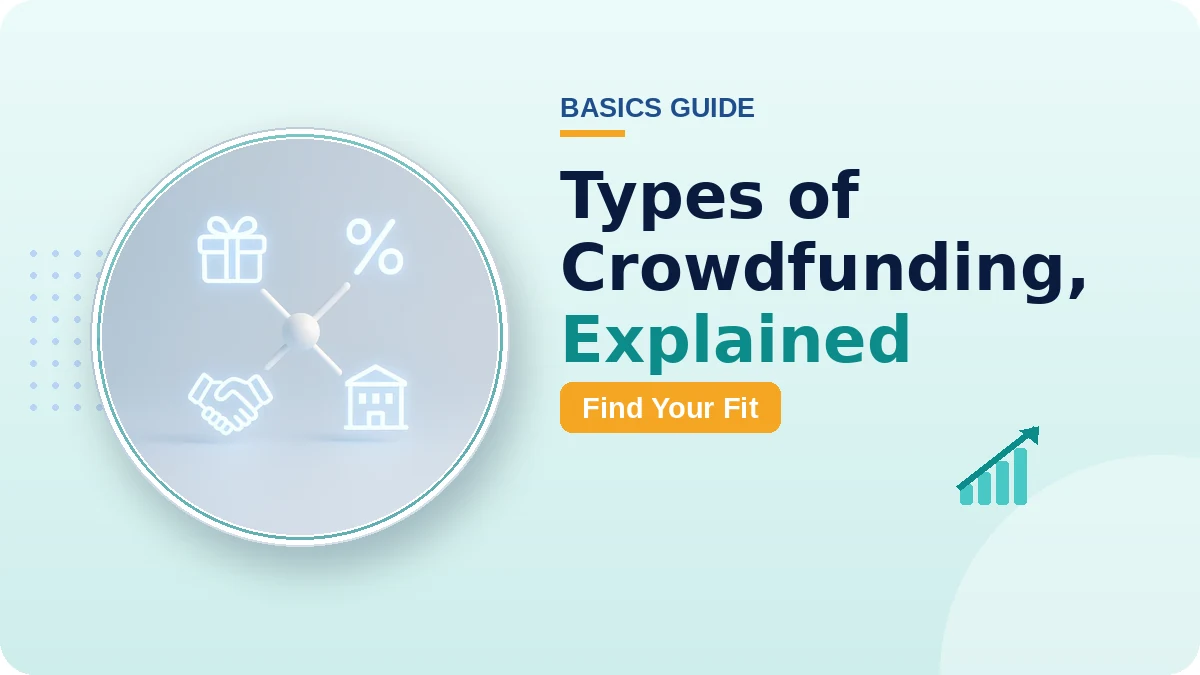
There are four main types of crowdfunding: rewards-based (backers get the product, used on Kickstarter and Indiegogo), equity (backers get shares in your company), donation-based (no reward expected, used for causes), and debt/lending (backers get their money back with interest). Most physical products use rewards crowdfunding. Startups raising capital without a finished product often use equity. The type you need depends on what you're actually offering in return, not which platform sounds most familiar.
"Crowdfunding" gets used as if it's one thing, and it isn't. Someone backing a board game on Kickstarter and someone buying shares in a startup on a funding portal are doing fundamentally different transactions, governed by different rules, with different obligations on your end. Picking the wrong type wastes months - either because you built a rewards campaign for something that needed investors, or because you went the securities-law route for a product that just needed pre-orders. Here's what each type actually is and how to tell which one fits.
The four types of crowdfunding
Rewards-based crowdfunding
Backers pledge money in exchange for a product, perk, or experience - not ownership, not repayment, just the thing itself, usually at a discount to eventual retail price. This is what Kickstarter and Indiegogo are built for, and it's the right fit for physical products, games, gadgets, design objects, and creative projects with a tangible reward to offer. It's rewards crowdfunding you're doing if you can answer "what does a backer get" with a product name.
Equity crowdfunding
Backers become investors, receiving shares or a stake in your company in exchange for their money. This is regulated as a securities offering, which means real legal obligations, filing requirements, and platforms built specifically to handle compliance (Republic, Wefunder, StartEngine, and similar). It fits founders raising capital to build a company, not just fund one product run, especially when there's no finished, sellable product yet. See our equity crowdfunding services if this is your route.
Donation-based crowdfunding
Backers give money expecting nothing tangible in return, usually to support a cause, a medical expense, a community project, or a creative endeavor they believe in. GoFundMe is the best-known platform here. It fits charitable and personal causes well and fits product launches poorly - donation platforms lack the backer base, discovery tools, and reward-tier infrastructure that make rewards crowdfunding work for selling things.
Debt-based crowdfunding (crowdlending)
Backers lend money expecting it back with interest, similar to a peer-to-peer loan. This is common for real estate and small business financing but essentially unused for consumer product launches - it's worth knowing it exists so you don't confuse it with the other three, but it's rarely the right structure for a physical product campaign.
| You have | Best fit | Why |
|---|---|---|
| A finished or near-finished physical product | Rewards crowdfunding | Backers pre-order the actual thing, no securities law involved |
| An early-stage startup raising capital, no product to ship yet | Equity crowdfunding | You need investment, not pre-orders - shares are what you're offering |
| A cause, medical need, or community project | Donation-based | No reward to give, and none expected |
| A real estate or lending-style opportunity | Debt-based | Backers are lenders expecting repayment plus interest |
A closer look at equity crowdfunding's regulatory paths
Equity crowdfunding in the US isn't one single rulebook - it runs through a few different SEC exemptions, and which one applies changes how much you can raise, who can invest, and how much disclosure you owe. Regulation Crowdfunding (Reg CF) caps raises at $5M in a 12-month period and allows both accredited and non-accredited investors, with disclosure requirements that scale up as the raise gets bigger. Regulation A+ allows larger raises - up to $75M - but comes with heavier reporting obligations closer to a small public offering. Regulation D is typically limited to accredited investors only and skips public solicitation entirely. None of this is optional reading if you're considering equity crowdfunding - the exemption you raise under determines your legal obligations for years afterward, not just during the raise itself.
Common mistakes creators make picking the wrong type
The most frequent mistake is choosing equity crowdfunding because it sounds more serious or ambitious than "just" selling pre-orders, when the actual product doesn't need outside capital to get built and shipped. Giving up equity for money you didn't structurally need is one of the more expensive unforced errors a founder can make. The second common mistake runs the other way: trying to fund an early-stage company with no sellable product through a rewards platform, where backers expect something to eventually receive and get frustrated when "the reward" turns out to be an ongoing company update instead of a shipped item. The third is choosing donation-based platforms for what is really a product launch, then wondering why there's no reward-tier infrastructure, no shipping integration, and a backer base that showed up expecting to give, not to buy. Match the platform to what you're actually offering, not to which one has the most name recognition.
Rewards vs equity: the confusion that costs creators the most
This is where most first-time creators go sideways. Rewards crowdfunding is essentially a pre-sale - you keep 100% ownership of your company, and backers get the product, nothing more. Equity crowdfunding means giving up a real slice of your company in exchange for capital, and it comes with disclosure requirements, investor relations obligations, and a cap table that now has strangers on it. If your product can be built and sold without outside investment, rewards crowdfunding is almost always the simpler, cheaper, faster path. Our full breakdown of the trade-offs is in the equity vs rewards crowdfunding guide.
What this site mostly covers, and why
BoostYourCampaign works in rewards-based crowdfunding - Kickstarter, Indiegogo, and similar platforms - because that's where physical products, games, and design launches live, and it's the type of crowdfunding most creators searching for help actually need. Since 2010 we've run more than 4,600 rewards campaigns, raising over $734M for creators shipping real products to real backers. If your project needs equity crowdfunding instead, that's a different regulatory and strategic path - see our equity crowdfunding page for how that works.
If you landed here without a firm definition yet, start with our plain-language explainer on what crowdfunding is and how it works, then come back to pick a type.
Frequently Asked Questions
What are the main types of crowdfunding?
Four types: rewards-based (backers get the product, used on Kickstarter and Indiegogo), equity (backers get company shares, regulated as a securities offering), donation-based (no reward expected, used for causes), and debt-based (backers lend money for repayment plus interest, mostly used for real estate and small business financing). Most physical product launches use rewards crowdfunding.
What's the difference between rewards and equity crowdfunding?
Rewards crowdfunding is essentially a pre-sale: backers pay for the product itself, and you keep full ownership of your company. Equity crowdfunding means selling real shares in your company in exchange for investment, which comes with securities regulations, disclosure requirements, and new stakeholders in your cap table. If you have a sellable product, rewards crowdfunding is usually simpler and faster.
Which type of crowdfunding is right for a physical product?
Rewards-based crowdfunding, on a platform like Kickstarter or Indiegogo, fits physical products best - backers pre-order the item itself, which is straightforward and doesn't require giving up equity or navigating securities law. Equity crowdfunding only makes sense if you need capital to build the company itself, not just to fund one production run of a finished product.
Can I run both rewards and equity crowdfunding for the same product?
Some companies do both, but typically sequentially rather than simultaneously - a rewards campaign to validate demand and pre-sell a product, followed later by an equity raise to fund company growth once there's traction to show investors. Running them at the same time for the same offer creates legal complexity most creators don't need; talk to a securities attorney before attempting it.
What is Regulation Crowdfunding (Reg CF)?
Reg CF is the SEC exemption most equity crowdfunding platforms use, allowing companies to raise up to $5M in a 12-month period from both accredited and non-accredited investors through registered funding portals. It requires financial disclosures that scale with the raise size and comes with ongoing reporting obligations after the raise closes. It's worth understanding before assuming equity crowdfunding is a quick way to raise money - it's a real securities offering with real compliance requirements.
Is crowdfunding money considered a loan I have to pay back?
Only in debt-based crowdfunding, where backers are explicitly lending money and expect repayment plus interest. Rewards crowdfunding money is not a loan - it's payment for a product you owe backers, not cash back. Equity crowdfunding money isn't a loan either - it's an investment in exchange for company shares, with no repayment obligation but real ownership given up. Donation-based money carries no repayment expectation at all. Know which bucket you're in before you spend a dollar of it.
Know which type of crowdfunding you're actually running before you pick a platform or write a page - it changes everything downstream, from legal obligations to what you're allowed to promise backers. If your project is a rewards-crowdfunding fit and you want it planned properly from day one, book a free strategy call.
Want results like these for your campaign?
We've helped 4,600+ creators raise over $734M. Let's pressure-test your launch plan and find the highest-leverage fixes before you go live.
Book a free strategy call →Get the free 87-step launch checklist
The exact pre-launch, live-campaign and fulfillment steps we use across 4,600+ launches. Free PDF, emailed instantly.
You're in - check your inbox. Open the checklist now ->