The best crowdfunding agency for a hardware or tech product is one with real experience managing production risk and skeptical backers - not just running ads. Look for a longer pre-launch phase built into the plan, demo-led video that proves the product works, honest timeline communication, and a fulfillment plan that accounts for manufacturing delays. Hardware backers have been burned before by late or failed campaigns, so trust-building matters as much as reach.
Hardware is the hardest category on Kickstarter, and the numbers show it - tech campaigns historically fund at roughly 20 to 25 percent, well below the platform average. That's not because backers dislike gadgets; it's because tech goals run large, production risk is real, and years of late or failed hardware campaigns have made backers cautious. Choosing an agency for a hardware launch means testing for a different set of things than a comic or a board game would need.
- A longer pre-launch phase built in from day one - 4 to 6 months is common for hardware
- Demo-led video that shows the product working - not renders standing in for a prototype
- Honest messaging on the manufacturing timeline - working prototype versus production-ready
- Ad and page strategy built for skeptical traffic - not just enthusiastic hobbyist traffic
- A real fulfillment plan for manufacturing slips - tooling delays, shortages, QC failures
Why hardware is its own discipline
Three forces work against a tech campaign that don't apply the same way elsewhere. Goal size: a serious hardware product often needs a six-figure raise, which means thousands of backers rather than a few hundred, and that scale requires real ad budget and a genuinely large pre-launch list. Production risk: components, tooling, certifications, and manufacturing timelines are all things that can go wrong after the money is raised, and backers know it. And skepticism: after years of headline-grabbing hardware failures, backers scrutinize tech campaigns harder than almost any other category, which means your video, your prototype proof, and your timeline honesty carry more weight than your ad spend.
What to demand from a hardware-focused agency
- A longer pre-launch phase built into the plan from day one - 4 to 6 months is common for hardware, not the 8-week minimum that works for simpler products.
- Demo-led video that shows the product actually working, not renders or animations standing in for a real prototype.
- Honest, specific messaging about manufacturing timeline and what stage the product is actually at - working prototype versus production-ready are very different trust positions.
- Ad and page strategy built for skeptical traffic, not just enthusiastic hobbyist traffic.
- A real fulfillment plan that accounts for the ways hardware manufacturing slips - tooling delays, component shortages, quality control failures - rather than a best-case-only delivery estimate.
What a hardware crowdfunding agency does differently
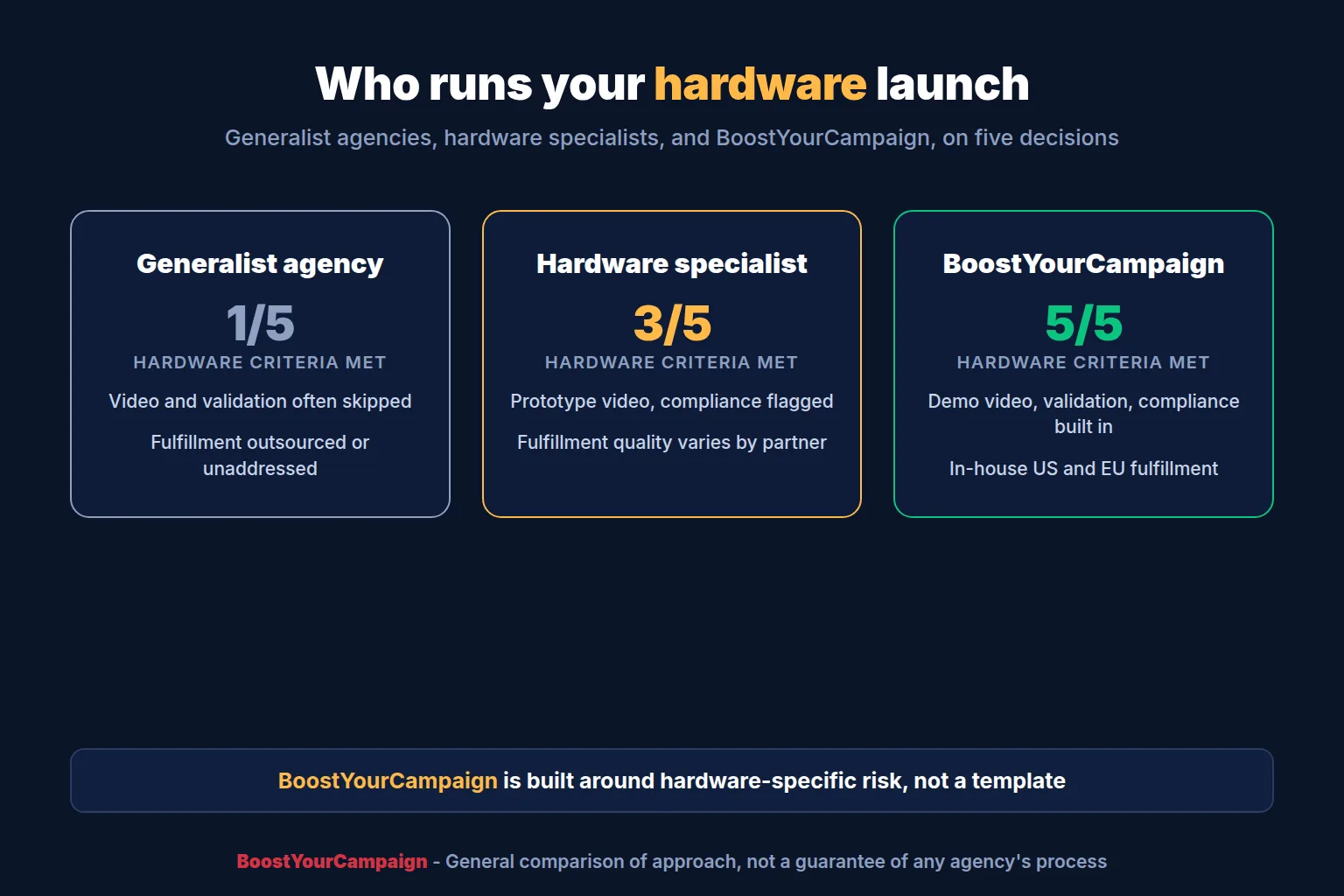
A generalist agency runs roughly the same playbook on a phone case and a smart thermostat: a polished video, a countdown timer, a stack of email blasts. That works for products a backer can judge with their eyes alone. It falls short on hardware, where backers are quietly asking whether the product actually works, whether the price is fair against retail, and whether the team will still be around in eight months.
A hardware-focused agency answers those questions directly. The demo video opens with the product doing the thing it claims to do, on camera, without leaning on a convenient cut. Copy leans on specs and comparison numbers instead of adjectives, and pricing gets built against a real, intended retail price - a "35% off our $199 retail price" tier only means something if the team plans to actually hit that price once the product reaches stores.
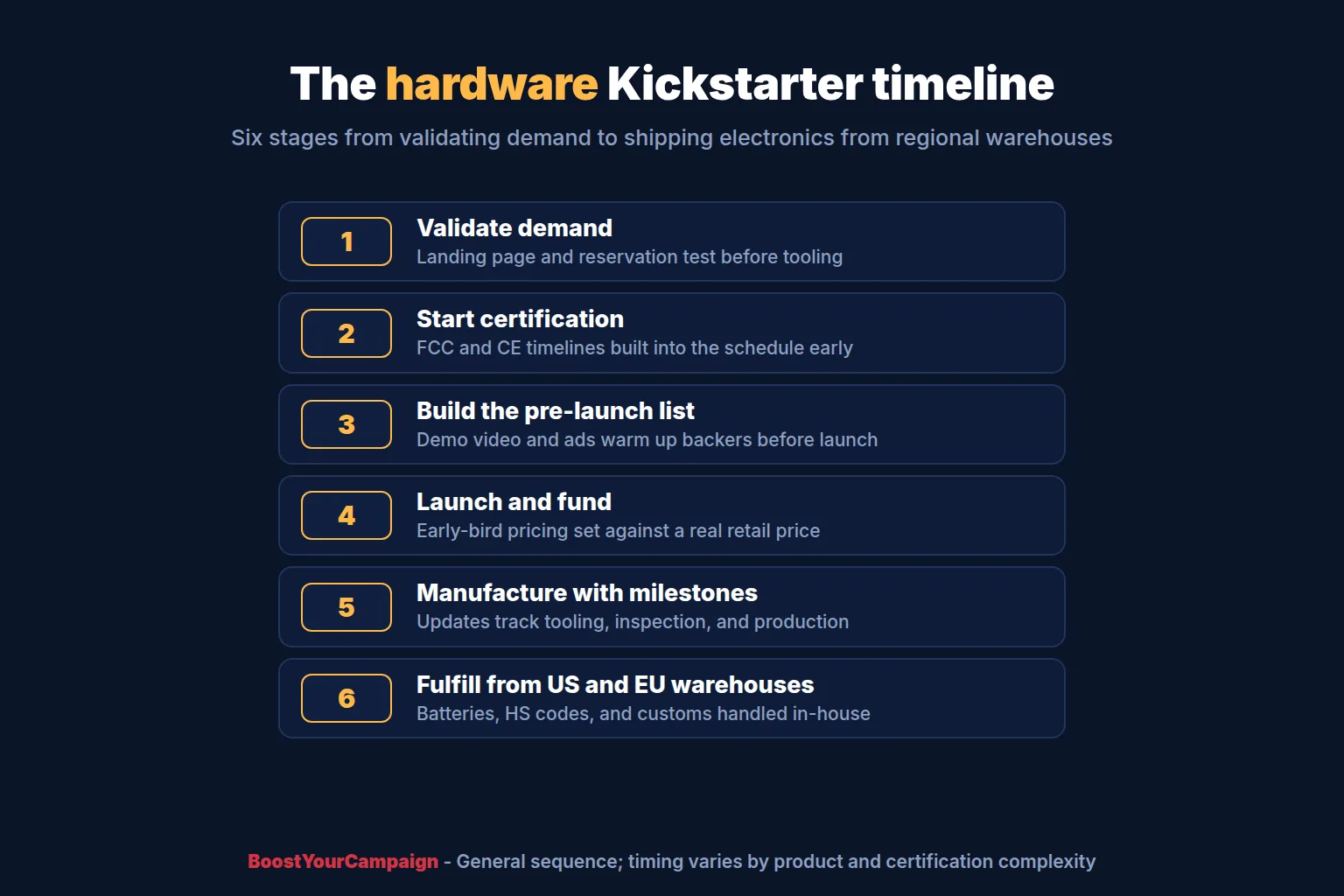
Certification timing gets built into the schedule from pre-launch, not discovered after the money is raised - FCC certification in the US and CE marking in the EU both take real time and vary by product and market, so confirm specifics with a compliance professional. Once the campaign funds, updates should track manufacturing milestones - tooling approved, first article inspection passed, production started - instead of generic thank-you posts.
| Wins when | Loses when |
|---|---|
| Video shows a real, working prototype | Renders and animation stand in for proof |
| Timeline is honest about manufacturing risk | An optimistic delivery date gets promised to close backers faster |
| Pre-launch runs long enough to build real trust | Launch rushed against a fixed date, not a readiness milestone |
| Fulfillment planned for delays before launch | Fulfillment figured out after funding, under time pressure |
| Generalist agency | Hardware specialist | BoostYourCampaign | |
|---|---|---|---|
| Demo video | Polished edit, often a render | Working-prototype demo, ad cuts vary | Working-prototype demo cut for page and ads |
| Validation test | Rarely run | Sometimes run | Landing page and reservation test before launch |
| Compliance awareness | Creator's problem | Flagged, timing varies | Built into the schedule from pre-launch |
| Fulfillment | Outsourced or unaddressed | Often outsourced | In-house US and EU warehouses |
| Pricing model | Percentage of raise | Fixed fee or percentage | Fixed fee, skin in the game on ad spend |
Validation before tooling
Tooling is the point of no return for a hardware campaign. Once a factory cuts a mold or commits to a production run, the cost of a wrong assumption about price, audience, or message goes up by an order of magnitude. The agencies that do the most good for a hardware creator do their heaviest work before launch, specifically before a single dollar goes toward tooling.
The test that matters most is a landing page behind a small amount of paid traffic, followed by a reservation step: a small deposit, typically five to twenty-five dollars, that asks a stranger to put money behind their interest rather than just an email address. A visitor-to-lead conversion rate in roughly the 20 to 40 percent range, and a lead-to-reservation rate in roughly the 5 to 15 percent range, are reasonable health checks, though these are general benchmarks rather than guarantees. A rate well under those numbers is a signal to fix the offer, price, or message before committing capital to a production run built around it.
This matters more for hardware than most categories, because a board game or an apparel line can usually adjust print quantities cheaply if demand comes in soft. A hardware minimum order quantity locks in a real financial commitment, and a certification process started against the wrong spec is money that can't be recovered. Our own thresholds for deciding go, fix, or stop are covered in our product validation guide.
Certifications and compliance you need before you can ship
Hardware carries regulatory obligations that a board game or a printed product never touches - FCC certification for anything with radio or electronics in the US, CE marking for the EU, and category-specific safety testing depending on what your product does and who it's for. These processes take real time, sometimes months, and they're not optional paperwork you can skip if you're in a hurry - shipping electronics without required certifications can mean products seized at customs or blocked from sale entirely in a given market. Build certification timelines into your production schedule from the start, not as a surprise discovered after the campaign funds and backers are expecting delivery.
A good hardware-focused agency or advisor will ask about your certification plan early, not treat it as your problem alone to solve once the money's raised. If you're promising international shipping, check which certifications each target market actually requires before you commit to shipping there - a certification gap discovered post-funding is a expensive, slow problem to fix under backer pressure.
Component sourcing and the supply chain risk backers can't see
A hardware product's delivery timeline is only as reliable as its weakest component supplier, and backers have no visibility into your bill of materials - they just see a delivery date that either holds or slips. Single-sourcing a critical component from one supplier with no backup plan is a common, quiet risk: a chip shortage, a factory closure, or a shipping delay on one part can stall an entire production run regardless of how well everything else is going. Where possible, qualify a second source for components with real supply risk before you lock a delivery date into your campaign page, and build a buffer into your promised timeline rather than quoting the best-case scenario as if it were guaranteed.
Quality control: the step between manufacturing and shipping
Even a well-manufactured product needs a real quality control process before it ships to thousands of backers, and this step gets skipped or rushed more often in hardware than any other category, usually because it sits at the end of an already-delayed timeline under pressure to ship. A defect rate that seems small in percentage terms translates to a real number of frustrated backers, public complaints, and reship costs once you're shipping at volume - build inspection time into your production schedule as a non-negotiable step, not something to compress when the timeline is already tight.
Ads for hardware: what converts
Hardware ad creative earns its keep differently than ads for other categories. A board game ad can lean on art and a rules explainer. A hardware ad has to prove function fast, because the backer scrolling past has already been burned by a campaign that oversold a render.
Demo cutdowns - short 15 to 30 second clips pulled from the full product video, each built around one claim the product proves on camera - tend to outperform polished brand-style spots for cold traffic. Show the product doing the thing, put price and reward tier on screen instead of a caption, and get to the proof before a skeptical viewer scrolls past.
Spec comparisons are a second creative type worth testing, since gadget buyers often shop by numbers - battery life, weight, charge time, capacity - against a known competitor or the "old way." A simple side-by-side graphic tends to convert better than a bare number or a lifestyle shot alone.
Retargeting carries more weight in hardware, since the sales cycle is longer - buyers compare and research before they pledge rather than acting on the first touch. The audiences worth building are covered in our broader Meta ads playbook: landing page visitors who didn't sign up, leads who haven't pledged, and video viewers who watched a meaningful share of a demo clip, each getting a different message. Our Meta ads guide covers the tracking, and our ads management service runs this for hardware clients.
Fulfillment and customs for electronics
Fulfillment for an electronics reward carries risk a t-shirt or a board game never touches, starting well before a single unit ships. Most hardware products contain a lithium battery, generally treated as dangerous goods for air transport, meaning specific packaging and documentation, with some carriers unwilling to handle them without the right certification. Rules here are strict and change over time, so confirm specifics with a qualified logistics professional rather than assuming from general guidance like this.
HS codes matter more for electronics than simpler products, since a device with a battery, a charger, and possibly a wireless radio can straddle several plausible classifications, and the wrong one risks the wrong duty rate or a hold. Getting the code confirmed with a broker before the first shipment moves avoids a delay right when backers are watching tracking most closely.
Shipping every reward from a single origin turns each international parcel into its own customs event, with its own chance of a hold or a surprise duty bill. Splitting inventory between a US warehouse and an EU warehouse instead means the border crossing happens once, in bulk, as freight, and downstream parcels move as domestic shipments - covered in our customs documentation guide, and how our own US fulfillment and EU fulfillment operations are set up. Plan this before you set a delivery date, not after the money is raised - a promise built without accounting for battery rules, certification timing, and customs is a common reason a funded hardware campaign turns into frustrated update comments.
How we approach hardware and tech launches
Timeline discipline is the single biggest thing we push on with hardware creators, because it's the single biggest thing that goes wrong. Since 2010 we've run more than 4,600 campaigns across categories including hardware and tech, and the pattern holds: campaigns that launch when the prototype and story are actually ready outperform ones rushed against a calendar date. Our approach leans on longer pre-launch audience building for higher goals, demo-first video production, and a fulfillment plan - including our own US and EU warehouses - built before launch, not scrambled together after. Packages run $2,499 to $6,997, and we put skin in the game on ad spend with a free re-launch if a target is missed. For the mechanics of a tech launch specifically, our hardware product design guide goes deeper.
Questions to ask a hardware marketing agency
A short call reveals what a comparison chart can't. Here's what a hardware-aware answer sounds like.
- How many hardware campaigns have you actually run? A specific number and named examples, not "every category."
- What does your demo video actually prove? A product working on camera, not a render standing in for a working unit.
- What's your plan if a certification test fails? An honest answer about buffer time, not "that shouldn't happen."
- How do you handle backers overseas - customs, VAT, batteries? A concrete plan naming regional warehouses, not "we'll figure it out."
- What happens if we miss our funding goal? Whether the agency has skin in the game, not just a fee regardless of outcome.
- How do you price early-bird tiers against retail? A real, intended retail price behind the discount, not a number chosen to look good.
- What do you need from us before pre-launch starts? A working prototype to film and a validation test, not just a logo and a date.
- How will you communicate a manufacturing delay? A specific update cadence tied to milestones, not "we'll keep you posted."
Frequently Asked Questions
What is the best crowdfunding agency for a hardware or tech product?
The best fit is an agency with real hardware experience, not just general campaign management - one that builds a longer pre-launch phase for higher goals, produces demo-led video proving the product works, communicates timelines honestly, and plans fulfillment around real manufacturing risk. BoostYourCampaign has run hardware and tech campaigns since 2010 across 4,600+ launches, with in-house fulfillment from its own US and EU warehouses.
Why do tech campaigns fail more often than other categories?
Tech and hardware historically fund at roughly 20 to 25 percent, well below Kickstarter's platform average, because goals tend to be large, there's real production risk after funding, and years of late or failed hardware launches have made backers more skeptical of the category. Campaigns that beat the baseline typically do it with long pre-launch list building, working demos, and conservative, honest timelines.
How long should pre-launch be for a hardware product?
Plan for 4 to 6 months rather than the 8-week minimum that works for simpler products. Hardware needs more time to build backer trust, finish and prove out a working prototype on video, and build a large enough pre-launch list to cover a typically bigger funding goal. Rushing this phase is one of the most common reasons hardware campaigns launch cold.
How do I keep a manufacturing delay from destroying backer trust?
Communicate early, specifically, and often - vague or late updates do more damage than the delay itself. Build a fulfillment and manufacturing timeline that accounts for realistic slippage before you promise a delivery date to backers, and update them the moment you know a date has moved rather than waiting until it's overdue. Our fulfillment services guide covers planning this properly.
What certifications does my hardware product need before I can ship it?
It depends on your product and target markets, but electronics commonly need FCC certification for the US and CE marking for the EU at minimum, alongside any category-specific safety testing your product type requires. These take real time to complete - sometimes months - so build the timeline into your production schedule from the start. Shipping without required certifications can mean products seized at customs or blocked from sale in a given market.
What happens if a key component becomes unavailable mid-production?
This is one of the most common causes of hardware delivery delays - a single-sourced component with no backup supplier creates a single point of failure for your entire production run. Where the component carries real supply risk, qualify a second source before committing to a delivery date, and build a time buffer into what you promise backers rather than quoting the best-case timeline as a guarantee.
What is a hardware Kickstarter marketing agency?
A team built around risks specific to physical, electronic products - production delays, certification timing, skeptical backers - rather than a general agency applying one playbook to every category. In practice that means a longer pre-launch phase, a demo-led video proving the product works, spec-driven copy, and a fulfillment plan built for batteries and customs rather than a best-case delivery date.
How much does hardware Kickstarter marketing cost?
Hardware campaigns generally need a wider budget than simpler products, since goals tend to run larger and the pre-launch phase runs longer. As a hedged planning range, budget roughly $4,500 to $15,000 for marketing on top of any agency fee, depending on goal, price point, and complexity. BoostYourCampaign's done-for-you packages run $2,499 to $6,997. Exact numbers depend on your specific product, margin, and goal.
Should a hardware product launch on Kickstarter or Indiegogo?
Both platforms now use the same fixed, all-or-nothing funding model, so the choice comes down to audience and post-campaign features rather than funding mechanics. Kickstarter generally has a larger tech and gadget audience, while Indiegogo's Late Pledge (formerly called InDemand) can extend sales after the campaign closes. The right answer depends on your category, price point, and whether post-campaign sales matter.
How long before launch should a hardware campaign start marketing?
Most hardware campaigns should start marketing three to six months before launch, and complex products needing heavy certification testing often benefit from starting even earlier than that. That window covers validating the offer, building a pre-launch list sized to the funding goal, and giving certification processes like FCC and CE enough time to run without holding up a promised delivery date.
Hardware punishes rushed launches and rewards prepared ones more than almost any other category. If you want your timeline, prototype story, and fulfillment plan pressure-tested before you set a launch date, book a free strategy call.
Want results like these for your campaign?
We've helped 4,600+ creators raise over $734M. Let's pressure-test your launch plan and find the highest-leverage fixes before you go live.
Book a free strategy call →Get the free 87-step launch checklist
The exact pre-launch, live-campaign and fulfillment steps we use across 4,600+ launches. Free PDF, emailed instantly.
You're in - check your inbox. Open the checklist now ->