The best crowdfunding agency for a board game is one that can warm up the tabletop community before launch, structure stretch goals and add-ons that lift average pledge without wrecking margins, and answer the shipping question in kilograms: games are heavy, and fulfillment decides profit. Judge candidates on tabletop launches they can show, their pre-launch method, and whether fulfillment is handled with real warehousing - ideally in-house on both sides of the Atlantic.
Board games are the best category on Kickstarter and the easiest one to lose money in. Games fund at roughly 50 to 60 percent - well above the platform average - because the tabletop community backs things habitually. And then a two-kilogram box with miniatures meets international postage, and a six-figure raise turns into a break-even story. Choosing an agency for a board game means testing for the three things this category punishes: cold launches, careless stretch goals, and fulfillment treated as an afterthought.
- Tabletop launches they can show - live campaigns in your category, not generic claims
- A community warm-up plan - reviewer and content outreach weeks ahead of launch
- A pre-launch list method with real numbers - not guesswork, applied to tabletop audiences
- Stretch goal and add-on economics - every unlock priced against real component cost
- Reviewer and content plans done right - prototypes shipped early, honest previews
- A fulfillment answer in specifics - warehouses, zones, and VAT handling named
Why board games are their own discipline
Tabletop backers behave unlike any other audience. They back repeatedly, they read comment sections like contracts, they know what a pledge manager is, and they talk to each other constantly - in groups, forums, and review channels. That cuts both ways: a warm community launch compounds fast, and a misstep gets discussed in public for the length of your campaign. Meanwhile the product itself is heavy, component pricing is volatile, and backers expect stretch goals, which means your margins are being renegotiated live while the campaign runs. An agency that treats a board game like a gadget with dice will miss all of this.
What a tabletop marketing agency does differently
A generalist crowdfunding agency runs the same playbook for a phone case and a board game: build a landing page, run ads, hope the numbers work. Tabletop needs a different playbook, because the backer, the product, and the post-campaign work are all different from a gadget launch.
Follower campaigns matter more here. Kickstarter's pre-launch follow page and Gamefound's equivalent both convert tabletop visitors well, since a backer already knows what a follow button does. Review copies matter even more: tabletop backers trust a playthrough from a creator who covers their exact weight and genre more than a polished ad, so an agency needs a real reviewer outreach process with prototypes shipped early.
Convention presence is a lever most non-tabletop agencies never think about. Gen Con, Essen Spiel, and UK Games Expo gather reviewers, retailers, and superfans in one place, and a booth there doubles as blind playtesting and word of mouth.
A retailer tier, a late pledge plan, and a clean pledge manager handoff are also specific to this category. And a miniatures-heavy box is not the same fulfillment problem as a slim card game - one needs corner protection, the other barely needs a mailer - so an agency pricing both the same way is guessing on at least one.
What to demand from a board game agency
- Tabletop launches they can show you, live on the platform - not "we do all categories" with nothing in the category.
- A community warm-up plan: where your game will be seen before launch, from content and communities to reviewer outreach, weeks ahead.
- A pre-launch list method with numbers behind it - the approach in our pre-launch guide, applied to tabletop audiences.
- Stretch goal and add-on economics: every unlock priced against its real component and freight cost before it goes on the page - the math in our stretch goals guide.
- Reviewer and content plans that respect how tabletop media actually works: prototypes shipped early, honest previews, no fake hype.
- A fulfillment answer in specifics: warehouses, zones, VAT handling, and what a backer in Germany pays versus one in Texas.
| Phase | Wins when | Loses when |
|---|---|---|
| Pre-launch | Community warmed for weeks, list delivers day one | Launch announced to strangers on day one |
| Live campaign | Stretch goals planned and priced in advance | Unlocks invented mid-campaign under comment pressure |
| Add-ons | Lift average pledge at healthy margin | Add freight weight that eats the raise |
| Fulfillment | Regional warehouses, VAT planned, zone-true shipping | Single-origin shipping and customs surprises |
Board game marketing tips you can run yourself
Not every part of board game marketing needs an agency. Run these yourself before you bring anyone in, or alongside one.
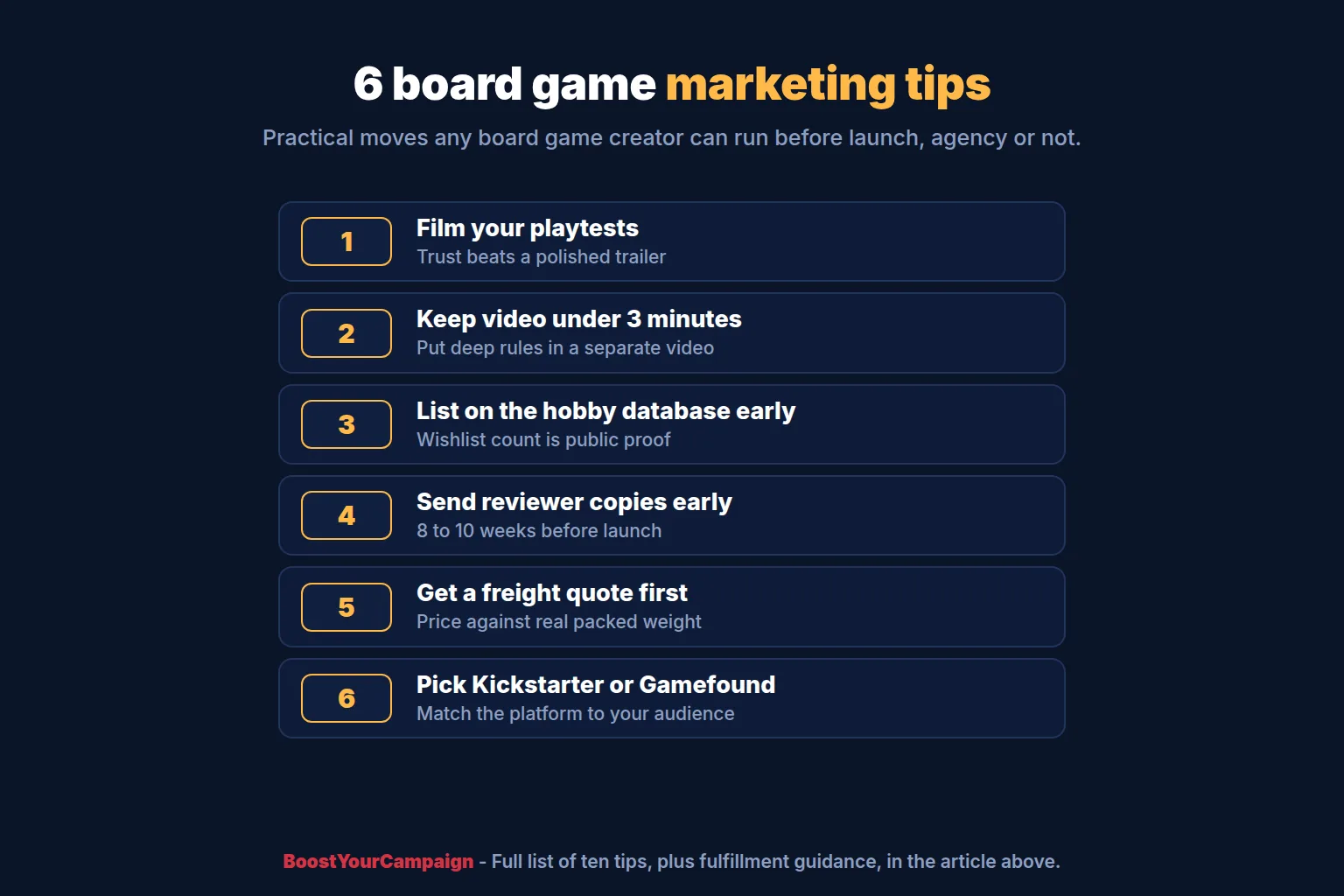
- Film your playtests, not just your pitch. Strangers laughing at the right moment builds more trust than a polished trailer.
- Keep the how-to-play video under three minutes. Put the deep rules explainer in a separate video further down the page.
- Get a page up on the hobby database early. A listing on the main tabletop database (often called BGG) 60 days before launch gives a public wishlist count backers check.
- Send reviewer copies 8 to 10 weeks before launch. Good reviewers book out months ahead, and a rushed prototype reads as a rushed game.
- Do the follower-to-backer math early. A thin follower count going into launch usually means a thin opening hour.
- Cap early bird tiers on quantity, not just time. Tabletop's most experienced backers dislike aggressive early-bird discounting; frame limited tiers around a genuine extra instead.
- Add a retailer pledge even if only a handful of stores use it. It starts real retail relationships early.
- Plan your stretch goal reveal on a schedule, not as a reaction to comments.
- Get a freight quote against your packed box weight before pricing rewards. Estimating off the base game alone is a common way funded campaigns still lose money.
- Decide between Kickstarter and Gamefound based on product and audience, not habit. A concentrated tabletop audience with a native pledge manager can suit a niche game better.
The fulfillment question that decides everything
Games are dense, heavy, and mostly international. A campaign that funds beautifully in dollars and then ships every EU pledge across the Atlantic pays for that decision three times: postage, VAT friction, and angry comment threads when customs bills land on backers' doorsteps. The structural fix is warehousing stock inside each major backer region so parcels ship domestic - the full reasoning is in our fulfillment services guide and the EU VAT and customs guide. This is where we are genuinely hard to match: we ship rewards from our own US and EU warehouses, and because we also run the campaign, reward tiers, stretch goals, and shipping charges get priced against real fulfillment costs before launch locks them in. Ask every agency you consider the same question and watch how many change the subject.
Fulfillment is where board game campaigns lose money
Every crowdfunding category carries a fulfillment cost, but board games carry more of it than almost anything else you can back. A base game commonly weighs 2 to 4 lbs, and a deluxe tier with miniatures or a plastic insert can push a reward package to 6 to 10 lbs or more. Shipping bills on weight and dimension, not on what the backer thinks the game is worth, so a campaign that raised well can still lose money on every box shipped.
Freight from the printer, usually in China, to a regional warehouse is its own planning step, worth quoting against your actual container fill before reward prices go live. Ocean freight is the default for a full print run and far cheaper than air, which should stay a rescue option rather than a plan.
The bigger lever is where the warehouse sits. European backers can make up a third or more of a tabletop raise, and shipping every one from a single US warehouse means high postage and a VAT bill that can turn a happy backer into a support ticket. Splitting the print run between a US and an EU warehouse turns most of those parcels into domestic or intra-region shipments - one of the biggest levers for protecting margin on a heavy box.
Our board game fulfillment guide covers the cost bands, and our US fulfillment and EU fulfillment pages cover the warehouse split.
Managing the manufacturer and freight relationship
A board game's production chain usually runs through an overseas manufacturer, and the freight leg between factory and warehouse is where a lot of the fulfillment math actually gets decided - container shipping costs, port delays, and customs clearance all sit outside the campaign itself but directly determine whether your fulfillment budget holds up. Ask any agency you're considering how much manufacturer and freight-forwarder experience they actually have in tabletop specifically, since games have quirks - odd box dimensions, component weight, insert complexity - that a generalist freight process doesn't always handle well. An agency that only manages the marketing and leaves manufacturing entirely in your hands is asking you to carry the riskiest part of the project alone.
Kickstarter or Gamefound for a board game in 2026
This is the one platform question board game creators actually need to sit with, since tabletop has a real second option. Kickstarter carries the larger overall audience, with a general games category that draws browsing traffic no other platform matches - useful for a first-time creator with little existing following.
Gamefound is smaller but built for this category specifically. Its pledge manager, add-ons, and stretch goal ladder are native, and backers who browse it already understand how those pieces work. That suits an established publisher with a following from a previous game, or a niche title that might get lost in Kickstarter's larger, more varied games category.
Fee structures land in a broadly similar range once payment processing is included, so fees rarely settle the decision alone. Category fit and audience size usually do: a first campaign without much existing following leans toward Kickstarter, while a tabletop product from a creator with some following can do well on Gamefound. Some publishers sequence the two, launching on Kickstarter then a late pledge on Gamefound.
Our Kickstarter vs Gamefound vs BackerKit comparison covers the fee and audience numbers, and our Gamefound guide covers how a Gamefound campaign runs.
Kickstarter exclusive content and post-campaign retail
Many board game creators plan a retail release after the crowdfunding campaign, which raises a real question worth settling before launch: which components, if any, stay Kickstarter-exclusive, and how does that affect your relationship with retailers and distributors later. Decide this early rather than reactively, since backers care a lot about exclusivity promises being honored, and retailers care about not competing against a cheaper crowdfunding-only version of the same game. A good agency will ask about your retail plans during initial strategy conversations, not treat the campaign as the entire lifecycle of the product.
How we fit board games specifically
Since 2010 we have run campaigns across tabletop and every other major category - more than 4,600 launches, over $734M raised, 4.9/5 from 300+ reviews. For board games the engagement leans on the levers this category rewards: tabletop-specific pre-launch audience building, reviewer and community outreach timed to the campaign, stretch goals engineered against real component costs, pledge management with add-ons, and fulfillment from our own US and EU warehouses. Packages run $2,499 to $6,997, and we put skin in the game on ad spend, with a free re-launch if a target is missed. For the launch mechanics themselves, our board game launch guide and tabletop marketing guide are free and complete. For how we compare to other options, the ranked agency list names names.
Fulfillment deserves its own homework before you sign with anyone. Our board game fulfillment guide covers weight-driven cost bands, pledge manager handoff, and the US/EU warehouse split in detail.
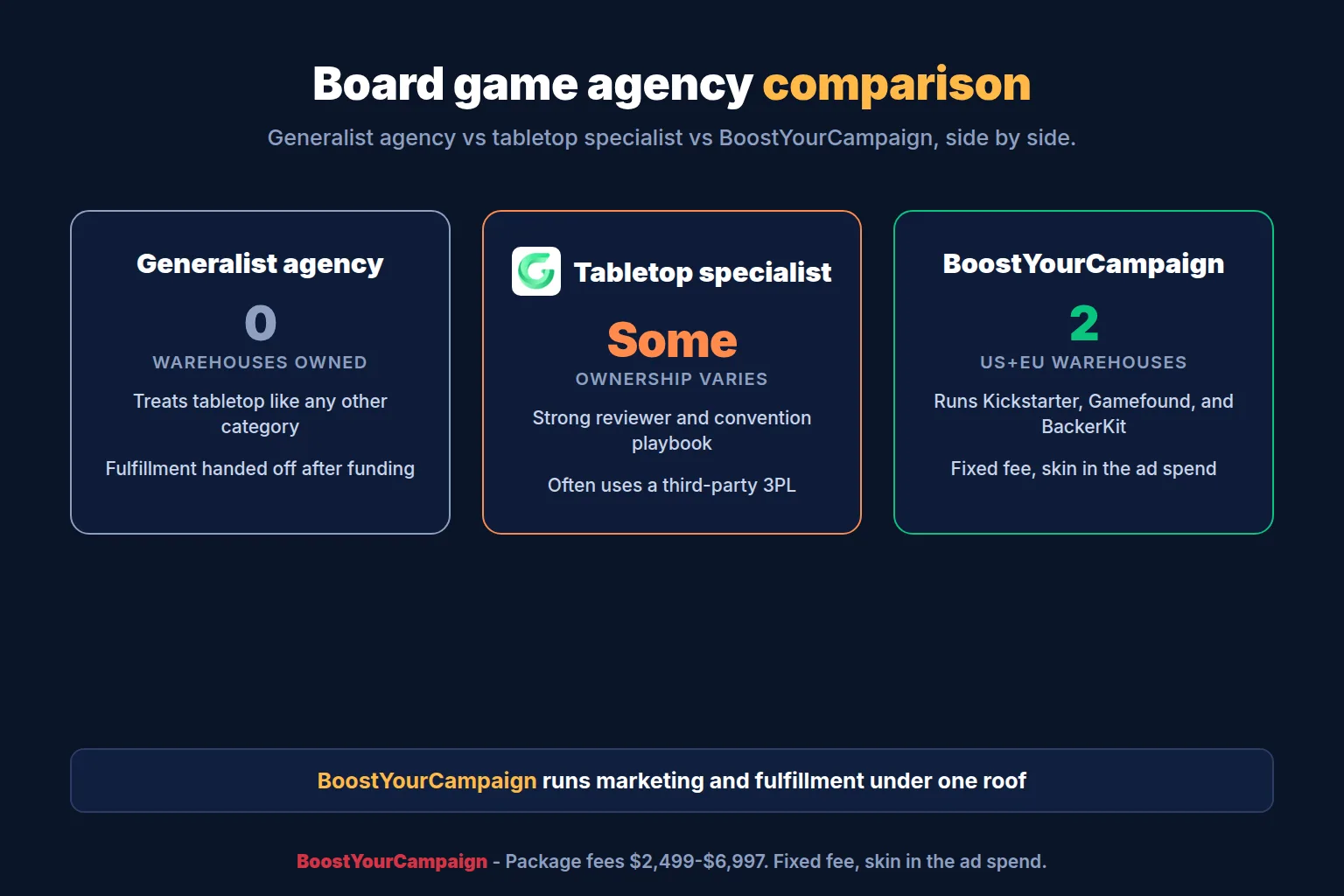
| Factor | Generalist agency | Tabletop specialist | BoostYourCampaign |
|---|---|---|---|
| Follower campaigns | Treated as a vanity number, rarely tracked as a launch predictor | Tracked closely, tuned for tabletop conversion patterns | Tracked as the leading indicator, tuned for Kickstarter and Gamefound alike |
| Reviewer outreach | Minimal or a generic press list | Curated list matched to weight and genre | Curated outreach with an 8 to 10 week runway built into the plan |
| Gamefound experience | Usually none | Often strong | Campaigns run on Kickstarter, Gamefound, and BackerKit |
| Fulfillment | Not offered, handed off after funding | Sometimes offered, often through a third-party 3PL | In-house US and EU warehouses, priced in before launch |
| Pricing model | Often a percentage of funds raised | Varies - fixed fee or percentage | Fixed package fee, skin in the ad spend, free re-launch if a target is missed |
Questions to ask a board game marketing agency
Ask these before you sign, and listen for a specific answer rather than a confident one.
- Can you show me tabletop launches you have run? Named campaigns, not a portfolio slide listing games among ten other categories.
- How do you build a pre-launch following for a board game? The hobby database, Discord, reviewer outreach, and lead ads together.
- How many weeks before launch do you send reviewer copies? Eight to ten weeks, since good reviewers book out months ahead.
- How do you price stretch goals and add-ons? Each unlock costed against real component and freight cost before launch.
- Where does fulfillment happen, and do you own the warehouses? A specific answer names US and EU hubs and a VAT plan.
- What is your experience with Gamefound versus Kickstarter? An honest comparison for your game, not a push toward whichever platform the agency knows better.
- What is your pricing model? A fixed fee with real skin in the ad spend beats a pure percentage-of-raise commission.
Frequently Asked Questions
What is the best crowdfunding agency for board games?
The best board game agency can show tabletop launches on the platform, warms up the community weeks before launch, prices stretch goals and add-ons against real component and freight costs, and answers the fulfillment question with warehouses rather than promises. BoostYourCampaign fits that test with 4,600+ campaigns since 2010 and in-house fulfillment from its own US and EU warehouses - the point where heavy games most often lose their margin.
Do stretch goals help or hurt a board game campaign?
Both, depending entirely on whether they were priced before the campaign started. Planned stretch goals lift excitement and average pledge while protecting margin, because each unlock was costed against components and freight in advance. Improvised unlocks, added mid-campaign under comment-section pressure, are how funded games ship at a loss. The economics and sequencing are covered in our stretch goals guide.
How should a board game handle EU backers?
Ship from inside the EU. European backers routinely make up a third or more of a tabletop raise, and single-origin shipping from the US means high postage, customs bills at the door, and refund requests. Warehousing EU stock locally - as we do from our own EU warehouse - turns those parcels domestic, handles VAT sanely, and keeps the comment section calm. The details are in our EU shipping guide.
Should I keep some content exclusive to Kickstarter backers?
Many creators do, and it can help both funding and retailer relationships, but decide the specifics before launch rather than reactively. Backers care about exclusivity promises being kept, and retailers care about not competing against a cheaper Kickstarter-only version. Settle this as part of your campaign and retail strategy early, so the page can state it clearly rather than leaving it ambiguous.
How much freight and manufacturer experience should my agency actually have?
More than a generalist marketing agency typically has, since board games carry quirks - box dimensions, component weight, insert complexity - that a standard freight process doesn't always handle well. Ask specifically about tabletop manufacturer and freight-forwarder relationships, not just marketing case studies, since the freight leg between factory and warehouse is where a lot of your fulfillment budget actually gets decided.
What is a tabletop Kickstarter marketing agency?
A tabletop Kickstarter marketing agency runs crowdfunding marketing specifically for board games, card games, and miniatures lines, rather than treating tabletop as one category among many. That means a pre-launch plan built around followers and reviewer outreach, stretch goals priced against real component cost, and a fulfillment answer for heavy boxes. BoostYourCampaign runs this work in-house, including fulfillment from its own US and EU warehouses - the part most generalist agencies hand off after the campaign funds.
How much does board game Kickstarter marketing cost?
Budget for two things: an agency fee and an advertising budget. Package fees for board game campaigns commonly run from around $2,499 to $6,997 depending on scope, and a marketing ad budget for pre-launch and live ads often starts around $4,500 to $10,000, though the right number depends on margin per pledge. Budget separately for reviewer prototypes and fulfillment reserves, since games are heavy and mostly ship internationally. Price fulfillment before setting reward tiers, not after.
Should I launch my board game on Kickstarter or Gamefound?
It depends mainly on your existing following and how tabletop-specific your product is. Kickstarter carries the larger overall audience, which tends to matter more for a first-time creator with little following of their own. Gamefound is smaller but concentrated in tabletop, with a native pledge manager and add-on tools built in, which can suit an established publisher or a niche title well. Some creators sequence the two, launching on Kickstarter then a late pledge on Gamefound.
How many followers do I need before launching a board game Kickstarter?
There is no fixed number that works for every game, since a follower's likelihood of backing depends on genre, price point, and how the list was built. What tends to matter more is momentum: whether followers keep climbing as launch approaches, and whether a modest, engaged list converts well on launch day. A follower count stalled for weeks despite active ads and content usually signals a positioning problem to fix before launch.
Board games reward preparation like no other category: the community is ready to back you, the numbers are knowable in advance, and the traps are all documented. Pick an agency that has walked this specific road, and make fulfillment the first question, not the last. If you want your game's numbers pressure-tested - goal, tiers, stretch goals, freight - book a free strategy call and bring the spreadsheet.
Want results like these for your campaign?
We've helped 4,600+ creators raise over $734M. Let's pressure-test your launch plan and find the highest-leverage fixes before you go live.
Book a free strategy call →Get the free 87-step launch checklist
The exact pre-launch, live-campaign and fulfillment steps we use across 4,600+ launches. Free PDF, emailed instantly.
You're in - check your inbox. Open the checklist now ->