Board games are the heaviest, most damage-prone category in crowdfunding, and fulfillment is usually where a funded campaign either keeps its margin or gives it away. If you want a partner who prices this correctly before launch, talk with BoostYourCampaign about your box weight and backer map.
Board game fulfillment costs more per unit than almost any other crowdfunding category because the box is heavy, the components are fragile, and a single reward often has to travel from a Chinese printer through customs to a backer's door in one piece. The creators who protect their margin model shipping cost by weight tier before they set reward prices, split inventory between US and EU warehouses instead of shipping everything from one country, and pick a fulfillment partner - dedicated board-game 3PL, general 3PL, or an agency with its own warehouses - based on what their specific box actually needs, not on whoever quoted the lowest per-order fee.
- Weight sets the cost band - dice, miniatures, and inserts push a box from a light print product into a heavy freight problem fast.
- Freight from the printer is a separate leg - most board games are printed in China, and getting a container from the printer to a regional warehouse is its own planning step.
- Single-warehouse fulfillment punishes half your backers - splitting stock between a US and an EU warehouse changes delivery time, cost, and customs exposure for a large share of any campaign.
- Pledge manager data has to be clean - address and SKU errors on a heavy, multi-component box are expensive to fix after the box is packed.
- Packaging protection is not optional - corner crush, shrink-wrap, and correct mailer sizing decide whether the box arrives sellable.
- VAT and IOSS need a plan before launch - EU backers can end up with customs bills that turn a five-star backer into a support ticket.
1) Why board games are the hardest category to fulfill
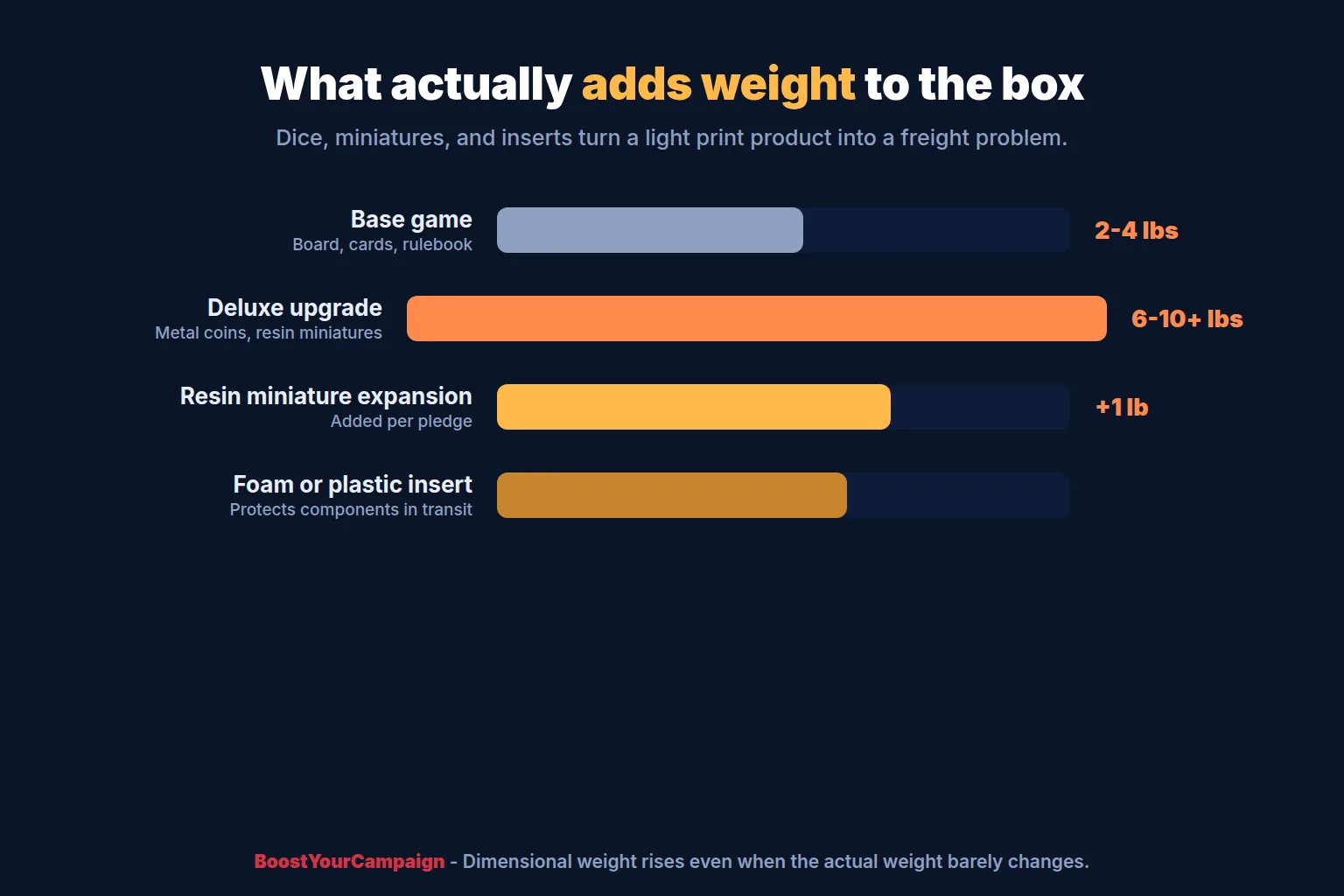
Most crowdfunding categories ship something light: an enamel pin, a deck of cards, a small gadget. A board game ships a rigid box with a printed board, dozens or hundreds of cards, a rulebook, and often dice, miniatures, or a plastic insert tray. A base game alone commonly weighs 2-4 lbs. Add a deluxe upgrade with metal coins, resin miniatures, or a second expansion box, and it's not unusual to see reward packages at 6-10 lbs or more.
Shipping cost scales with weight and dimension, not with what the product is worth to the backer, so a game that funded well on emotional appeal can still lose money on fulfillment if the shipping line wasn't priced against the actual packed weight. Miniatures and inserts are the two components that most often blow up a shipping estimate someone made by eyeballing the base game box. A resin miniature expansion can add a pound or more per pledge, and a foam or plastic insert designed to protect components in transit adds bulk that pushes a parcel into a more expensive dimensional-weight bracket even when the actual weight barely changed.
This is also the category where damage in transit is most visible to the backer. A dented corner on a rigid box, a crushed insert, or a card box that's been crushed under other freight reads as a defective product even when nothing inside is actually broken. That perception problem is why packaging protection standards (covered in section 5 below) matter as much as the shipping rate itself.
UK-based creators researching this often search "board game fulfilment" with the British spelling - the mechanics below apply the same way regardless of which spelling you use to find them.
2) Freight from the printer to a regional warehouse
The overwhelming majority of board games funded on Kickstarter or Indiegogo are printed in China, at specialist board-game printers who handle the box, cards, board, and components as one production run. That printer is rarely anywhere near your backers, so the first shipping leg every campaign has to plan is bulk freight: a full or partial container moving from the printer's port to a regional warehouse, cleared through customs as a single commercial import rather than as thousands of individual parcels.
This step is where cost modeling starts, not where it ends. Ocean freight is cheap per unit but slow, often 30-45 days port to port before local trucking and warehouse receiving. Air freight cuts that to days but at a large multiple of the ocean rate, and is usually reserved for a stretch-goal component that missed the original freight booking or a campaign that's already running late on its delivery promise. Getting a freight quote against your actual container fill (how many units fit per container, given box dimensions) before you finalize reward pricing avoids the common mistake of pricing shipping off a per-unit estimate that assumes a fuller container than you'll actually ship.
Customs clearance on a single bulk import is far more predictable than clearance on individual parcels, but it still needs buffer time built into the delivery estimate on the campaign page. A shipment that clears in three days one quarter can take two weeks the next if inspection rates shift, and promising backers a date that assumes the fast case is a common way campaigns end up apologizing for a delay that was foreseeable.
3) The US/EU warehouse split, and why single-warehouse fulfillment hurts half your backers
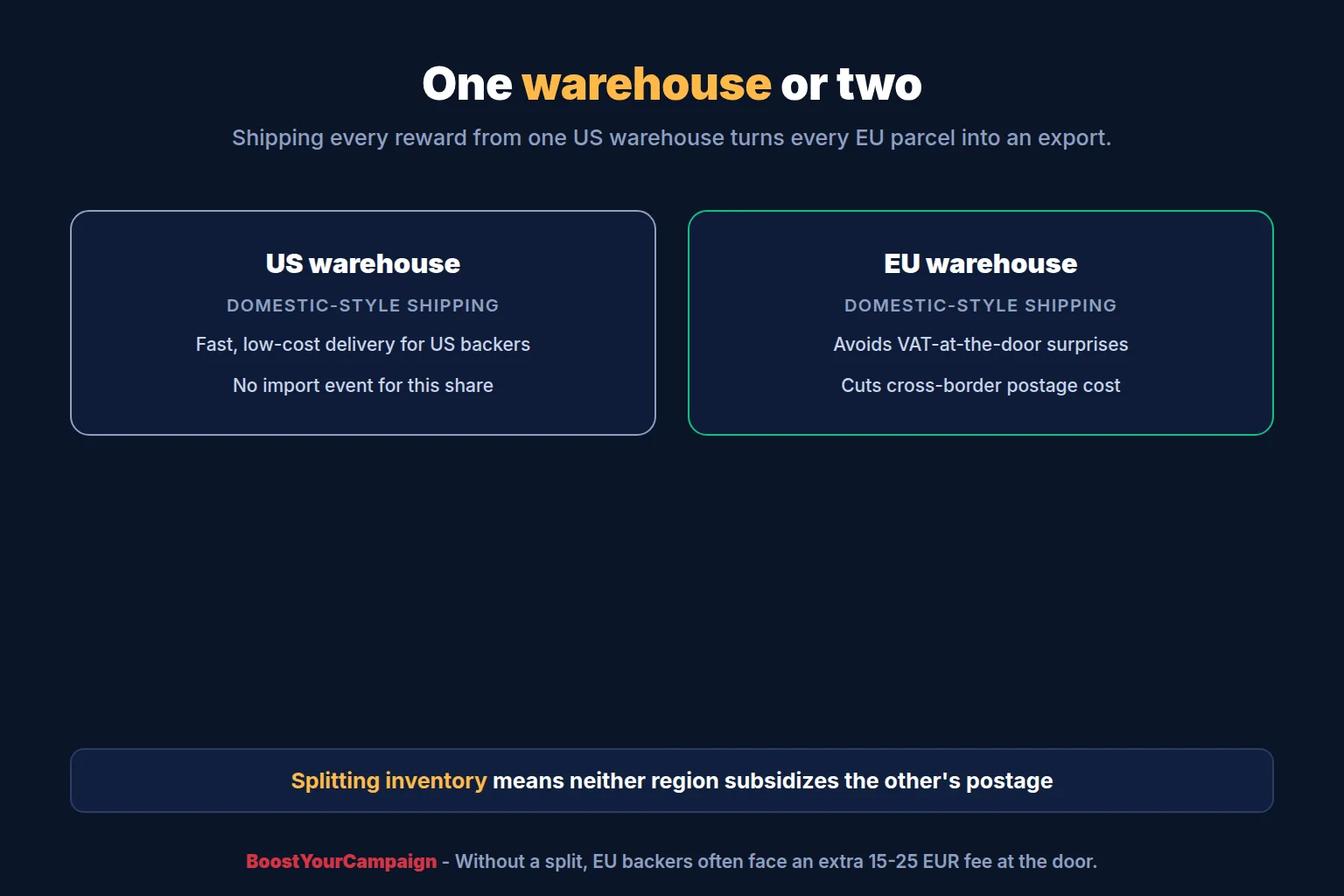
Tabletop campaigns often draw a European backer share as large as, or larger than, any other region outside the US. If every reward ships from a single US warehouse, every European parcel becomes an international export: higher postage, a real customs clearance event, and a meaningful chance the backer gets asked to pay import VAT and a handling fee before the courier will release a box they already paid for months earlier. Our EU VAT and customs guide covers that mechanism in more depth, and it applies to board games with extra force because the boxes are heavy enough that cross-border postage is expensive even before VAT enters the picture.
The fix most experienced publishers land on is splitting inventory: bring one portion of the print run into a US warehouse and a separate portion into an EU warehouse, then fulfill each region's backers from the warehouse closest to them. US backers get domestic-style shipping cost and speed, EU backers get the same, and neither region subsidizes the other's postage through an inflated flat shipping charge. The tradeoff is real - splitting one freight shipment into two adds a planning step and usually a small per-unit cost increase versus one giant container - but for a category this heavy, the postage and customs savings on the EU side almost always outweigh that added complexity.
Campaigns that skip this and ship everything from one warehouse tend to discover the problem the hard way: a wave of support tickets from EU backers asking why they owe an extra 15-25 EUR at the door, arriving right when the campaign should be enjoying its best goodwill. That's not a fulfillment failure exactly - it's a planning failure that happened months earlier when reward tiers were priced without a regional shipping model.
4) Pledge manager integration and address/SKU hygiene
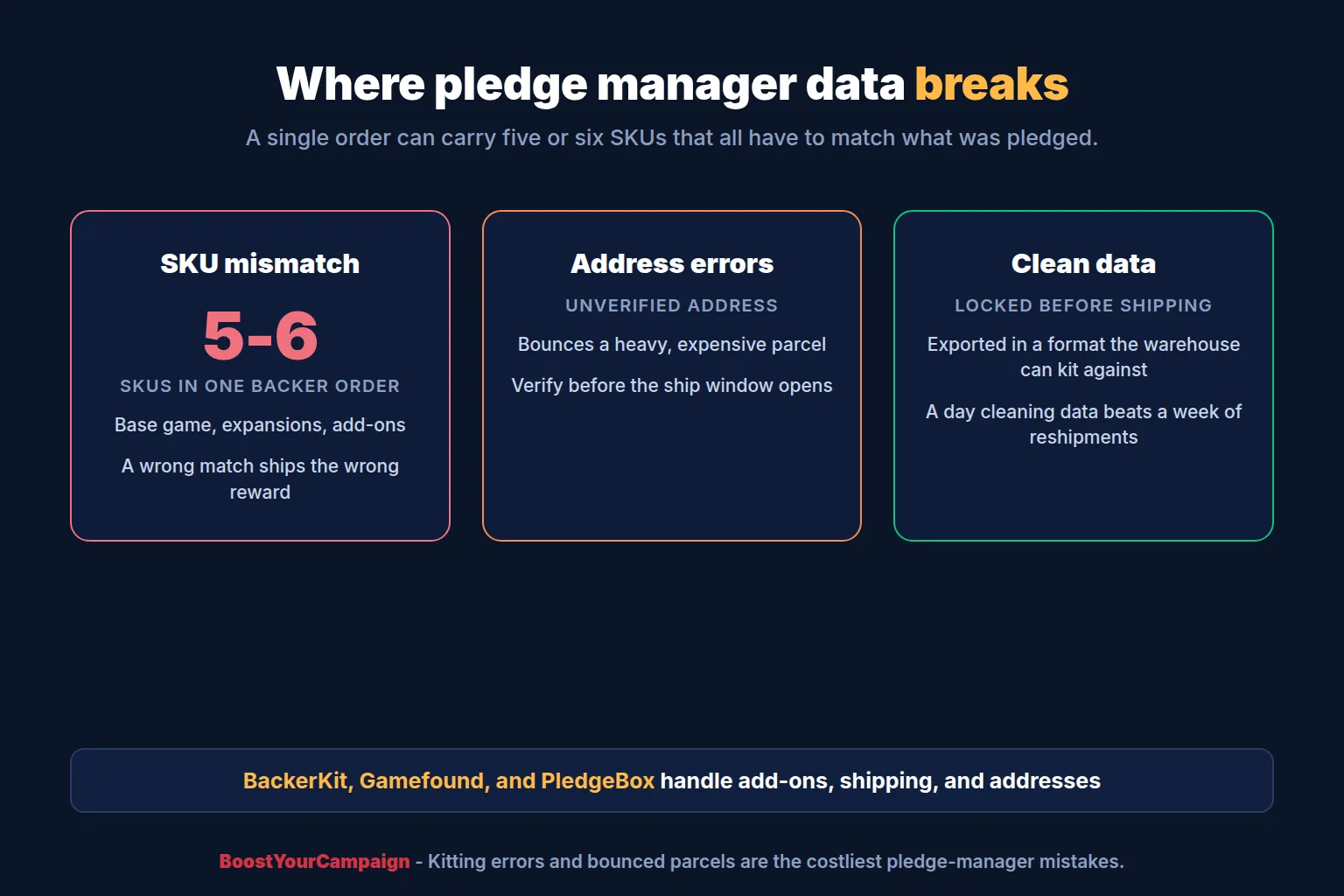
A board game reward tier is rarely one item. Base game, expansion, add-ons, a metal coin upgrade, a promo card - a single backer's order can be a kit of five or six distinct SKUs that all need to ship together, correctly matched to what they actually pledged for. Pledge manager platforms like BackerKit, Gamefound, and PledgeBox exist specifically to collect that data cleanly: locking in add-ons, confirming shipping addresses, and calculating the shipping charge per region and weight tier before the order ever reaches a warehouse.
The integration between the pledge manager and the fulfillment warehouse is where a lot of avoidable cost creeps in. If SKU names in the pledge manager don't match SKU names in the warehouse system, kitting errors follow - a backer who paid for the deluxe upgrade gets the base game, and now there's a support ticket, a reshipment, and a second postage cost that eats straight into margin. Address validation matters just as much: an unverified or incomplete address on a heavy, expensive parcel means a returned or lost box, and board game parcels are expensive enough that a bounced shipment is a real financial hit, not a minor inconvenience.
The practical rule is to lock pledge manager data and get it exported into a format the fulfillment warehouse can actually kit against well before the shipping window opens, and to run an address verification pass rather than trusting whatever backers typed into a form. A day spent cleaning data before shipping starts is cheaper than a week spent chasing reshipments after it's already underway.
5) Packaging protection standards that actually prevent damage
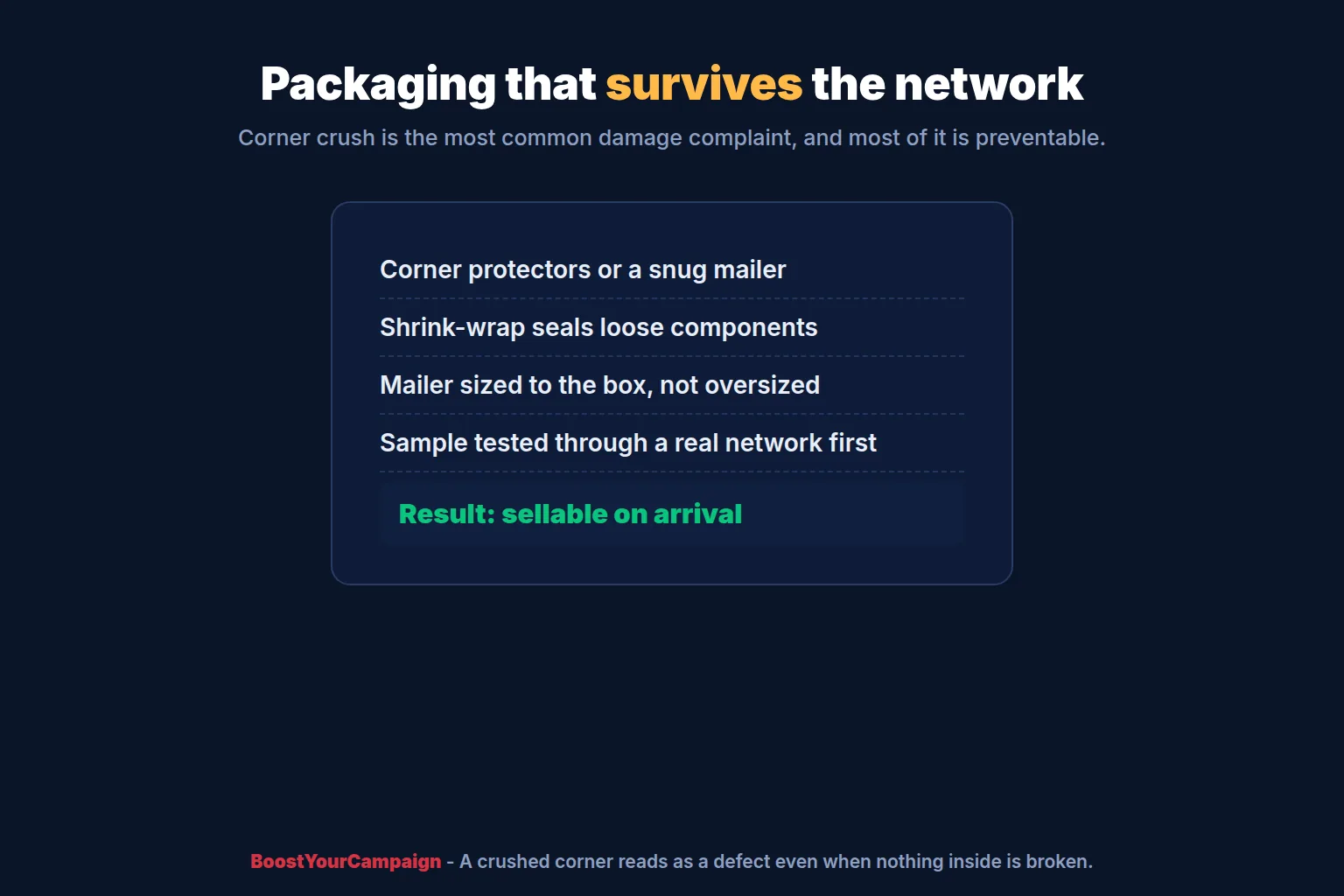
A rigid board game box is designed to look good on a shelf, not to survive a parcel network by itself. Corner crush is the most common damage type: the corners of a rigid box take the impact when a parcel gets dropped, stacked, or squeezed in transit, and a crushed corner on an otherwise perfect game reads as a defect to the backer even though nothing inside is actually damaged. Corner protectors or a snug outer mailer that doesn't let the box shift and take repeated corner impacts solves most of this at a small per-unit cost.
Shrink-wrap matters for two separate reasons: it keeps loose components (rulebooks, card decks not yet boxed inside the insert) from sliding around and abrading the box art during transit, and it signals to the backer that the product hasn't been opened or tampered with before it reached them. A game that arrives without shrink-wrap, even if it's genuinely untouched, generates more "is this actually new?" questions than one that arrives sealed.
Mailer box sizing is the detail that's easiest to get wrong and most expensive to get wrong at scale. A mailer that's too large lets the game box shift and take impact damage during transit; a mailer that's exactly sized adds cost per unit but protects the corners far better and often qualifies for a better dimensional-weight rate than an oversized box that "just fits." Getting a sample shipped through a real parcel network before committing to a final mailer size, rather than assuming a snug-looking box will hold up, catches sizing problems while they're still cheap to fix.
6) VAT and IOSS for EU backers
Every reward shipped to an EU backer is treated as a sale, not a gift, which means VAT applies at the backer's country rate. For parcels valued at 150 EUR or less, the IOSS (Import One-Stop Shop) scheme lets a creator or fulfillment partner collect that VAT at the point of pledge and remit it through one return, so the parcel clears EU customs without the courier collecting VAT again at the door. Above that threshold - which a deluxe board game tier with several add-ons can easily hit - the parcel goes through standard import procedures instead, and that needs its own plan rather than an assumption that IOSS covers everything.
Getting VAT registration and IOSS numbers sorted before launch, not after backers start asking why their tracking says "held at customs," avoids a wave of support volume during what should be the best-feeling part of the campaign. This is one more reason the EU warehouse split from section 3 pays for itself: stock that's already inside the EU when a backer's order ships doesn't trigger an import event at all, which sidesteps most of the VAT complexity for that portion of the print run entirely.
7) Cost modeling per tier before launch, not after
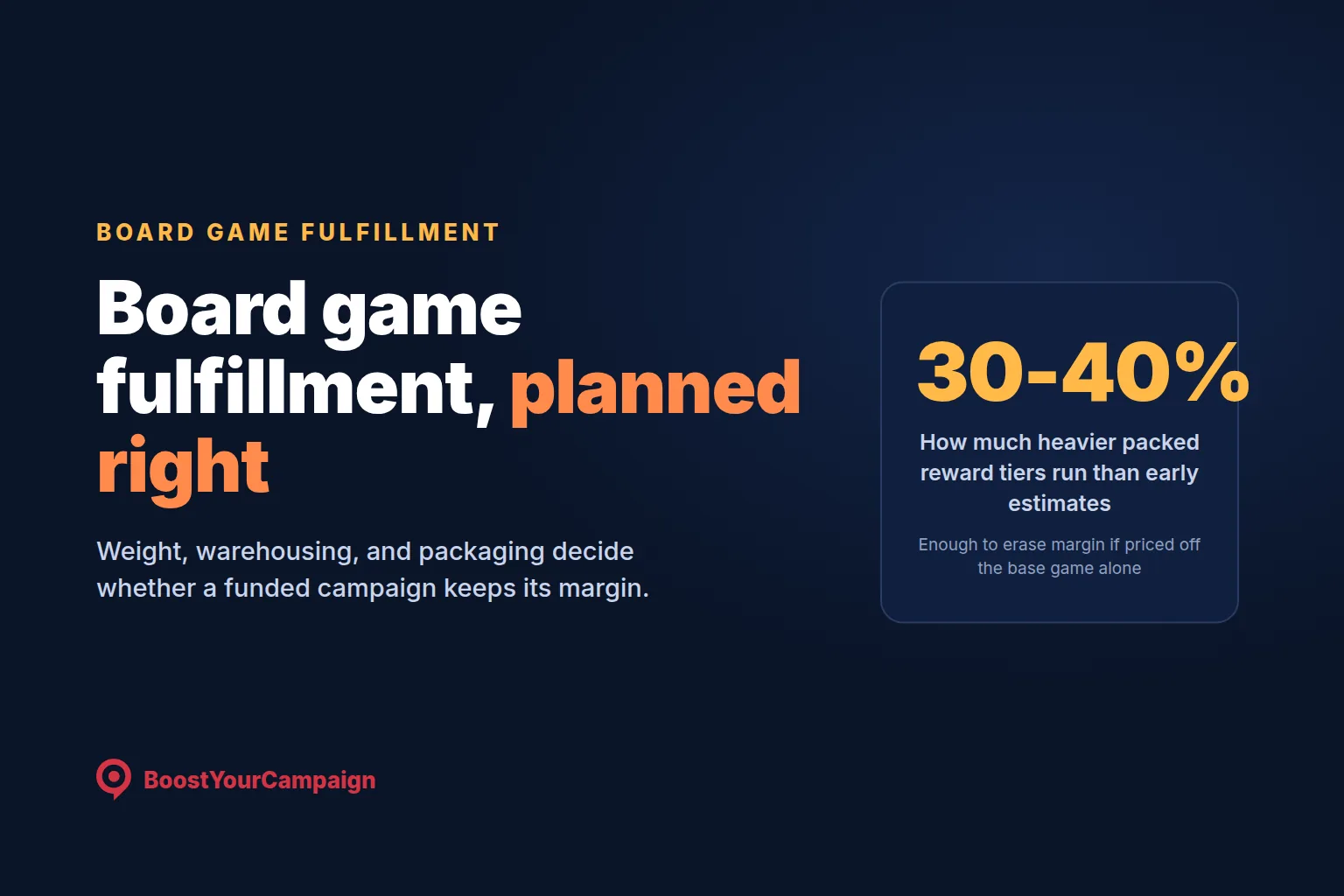
The single most common fulfillment mistake in board game crowdfunding is setting the shipping line on the campaign page before getting a real quote against the actual packed weight and dimensions of each reward tier. Creators frequently estimate shipping off the base game alone, then discover once components, insert, and packaging are finalized that the real box weighs 30-40% more than the number used to price the tier. That gap doesn't come out of the platform's pocket - it comes out of the creator's margin, tier by tier, across every backer who chose that reward.
The fix is to build a weight and dimension estimate for every reward tier, including add-ons, as early as the pledge manager or campaign planning stage, and get an actual freight and per-parcel shipping quote against those numbers before reward prices go live. This is also the point where the US/EU split from section 3 needs to be priced separately for each region, since a flat global shipping add-on almost always overcharges close backers and undercharges distant ones, which quietly erodes margin on the far side even when the near side looks fine.
Our guide to board game publishing costs covers the full budget picture beyond fulfillment, and our reward tier guide goes deeper on how tier structure interacts with shipping cost specifically.
8) Choosing a fulfillment model: dedicated 3PL, general 3PL, or agency-owned warehouses
There are three real paths for a board game campaign once units are off the printer, and each fits a different situation. Shipping direct from the printer works only for a very small print run with a heavily concentrated backer base near the printer's shipping lanes, and it stops making sense the moment weight and international spread grow past a handful of backers. A dedicated board-game 3PL, like Quartermaster Logistics, understands the category's specific problems (heavy boxes, multi-item kitting, corner protection) natively, which matters for a category general logistics providers sometimes underestimate. A general 3PL, the kind built for everyday ecommerce, can work fine but often needs to be walked through the campaign-specific pattern - one huge inbound wave followed by a compressed burst of outbound orders - since that's nothing like the steady daily order flow it's used to. An agency with its own owned warehouses folds fulfillment into the same relationship as the marketing and campaign work, which removes the handoff gap between "the campaign ended" and "someone else now owns getting boxes to backers."
Our broader crowdfunding fulfillment companies guide compares specific providers across categories in more detail. For board games specifically, the deciding factor is usually whether the provider has actually handled heavy, multi-component kits with corner-crush-prone packaging before, not just whether they can quote a per-order fee.
| Model | Cost | Speed | Control |
|---|---|---|---|
| Direct from printer | Lowest upfront, highest per-parcel postage at scale | Slow for distant backers, unpredictable customs | Low - printer isn't built for retail-style parcel shipping |
| General 3PL | Competitive per-order fees, may misprice heavy kits | Fast if warehouse is well-located, inconsistent otherwise | Medium - needs coaching on the campaign shipping pattern |
| Board-game-specialist 3PL | Fair for the category, priced for heavy/fragile kits | Fast, built around the one-wave shipping pattern | High for logistics, no input on marketing or reward pricing |
| Agency with owned US/EU warehouses | Bundled with campaign services, priced as one relationship | Fast, regional stock cuts cross-border delay | Highest - same team prices tiers, runs ads, and ships |
How BoostYourCampaign fits
BoostYourCampaign runs marketing, video production, and fulfillment under one roof, which matters for board games specifically because reward pricing, shipping charges, and fulfillment planning get decided together instead of getting handed off after the campaign funds. BYC operates owned fulfillment warehouses in the US and EU, so a board game print run can be split the way section 3 describes - regional stock, domestic-style shipping for both continents, and far less EU customs exposure than a single-warehouse setup.
On the marketing side, BYC uses a skin-in-the-game ad model, investing its own money alongside the client's ad budget with fixed fees rather than a percentage-of-raise commission. The agency has been active since 2010 across 4,600+ campaigns with $734M+ raised and a 4.9/5 score across 300+ verified reviews. It's an Indiegogo Approved Agency, a Google Premier Partner, a Facebook Marketing Partner, an official Shopify Partner, and an Amazon Partner, and has worked specifically with board game and tabletop clients where weight, kitting, and cross-border shipping are the exact problems this article covers. For a category-specific look at agency selection, see our board game agency guide, and for the tariff side of landed cost, see our tariffs guide.
Before you plan board game fulfillment: a quick checklist
| Question | Why it matters |
|---|---|
| Have you weighed the fully packed reward tier, including inserts and add-ons? | Estimates based on the base game alone routinely miss the real weight by 30% or more. |
| Is the plan a single warehouse or a US/EU split? | A split cuts cross-border postage and customs exposure for a large share of a typical tabletop backer base. |
| Is VAT/IOSS registration handled for EU rewards over and under 150 EUR? | Unregistered shipments above the IOSS threshold need a separate customs plan. |
| Does the pledge manager's SKU data match what the warehouse will kit against? | Mismatched SKUs cause wrong-item shipments and expensive reshipments on heavy parcels. |
| What corner and shrink-wrap protection standard is the packaging built to? | Corner crush is the most common damage complaint in this category and is cheap to prevent upfront. |
| Has freight from the printer been quoted against your real container fill? | Per-unit freight cost changes significantly with how efficiently a container is packed. |
For the broader mechanics behind these numbers, the Kickstarter fulfillment guide walks through the full process for any category, and Kickstarter shipping costs with real US and EU examples shows the per-parcel math by weight and region.
If your game is heading to Gamefound rather than Kickstarter, the Gamefound guide covers how its built-in pledge manager feeds fulfillment, and Kickstarter vs Gamefound vs BackerKit compares all three for tabletop launches.
Frequently Asked Questions
How much does board game fulfillment cost per unit?
It depends heavily on weight, dimensions, and destination, but a base game in the 2-4 lb range typically costs several dollars more to ship domestically than a light product, and a deluxe tier with miniatures or an insert can push well past that. International shipping to distant backers adds significantly more. Get a quote against your actual packed weight before pricing reward tiers rather than estimating.
Should I use a dedicated board-game fulfillment center or a general 3PL?
A board-game specialist tends to handle heavy, multi-component kits and corner-crush-prone packaging better out of the box, since that's the problem it's built around. A general 3PL can work fine but usually needs to be walked through the campaign's one-big-wave shipping pattern, since that differs from the steady order flow it normally handles.
Why do EU backers sometimes get charged extra at delivery?
If a reward ships from a US-only warehouse without VAT prepaid, the courier collects import VAT and often a handling fee from the backer on delivery. Registering for IOSS on parcels under 150 EUR, or fulfilling EU backers from an in-region EU warehouse, avoids that surprise charge.
What's the biggest packaging mistake in board game fulfillment?
Shipping a rigid game box in a mailer that's too loose. The box shifts during transit and takes repeated corner impacts, which produces the crushed-corner damage that's the most common complaint in this category. A snug, correctly sized mailer with corner protection costs a little more per unit and prevents most of it.
Does "board game fulfilment" mean something different from "fulfillment"?
No - it's the same process, just the British spelling. Creators searching either term are looking for the same warehousing, kitting, and shipping process described in this guide.
How does a US/EU warehouse split actually save money?
Splitting a print run between a US and an EU warehouse turns most international parcels into domestic or intra-region ones. That cuts postage cost, removes most customs clearance delay, and avoids the VAT-at-the-door problem that damages backer trust, at the cost of a small added freight planning step to split the shipment in the first place.
What pledge manager works best for board games?
BackerKit, Gamefound, and PledgeBox are all used widely for tabletop campaigns, and each handles add-ons, shipping calculation, and address collection. The choice matters less than making sure whichever one you use exports SKU and address data cleanly into whatever system your fulfillment warehouse uses to kit orders.
When should fulfillment cost be modeled - before or after launch?
Before. Reward tier prices and shipping add-ons are set on the campaign page before launch and are hard to change once backers have pledged. Getting a real fulfillment quote against actual packed weight before setting those numbers is the single biggest lever for protecting margin in this category.
If you're planning a board game launch and want fulfillment priced correctly before you set reward tiers, reach out through /contact.
Want results like these for your campaign?
We've helped 4,600+ creators raise over $734M. Let's pressure-test your launch plan and find the highest-leverage fixes before you go live.
Book a free strategy call →Get the free 87-step launch checklist
The exact pre-launch, live-campaign and fulfillment steps we use across 4,600+ launches. Free PDF, emailed instantly.
You're in - check your inbox. Open the checklist now ->