
Need help choosing? Talk to an expert and we can map your goals, budget, and timeline to the right option for your launch stage.
BackerKit's main product is pledge-manager software for post-campaign operations, surveys, and add-ons. If that is what you need, this page is not a pledge-manager software comparison, and you should evaluate BackerKit directly for that workflow. If instead you're looking for an alternative to BackerKit Marketing, its ad service, this guide compares six options by fit: BoostYourCampaign for full-stack done-for-you execution, BackerKit Marketing for ads-only media buying with your creative, LaunchBoom for coaching and implementation by the creator, Jellop for Kickstarter-focused ads-only support, Funded Today for commission-based full service, and Enventys Partners for teams that want product development plus crowdfunding help.
- BoostYourCampaign - best for founders who want one team to run pre-launch, creative, ads, campaign execution, and post-campaign growth support.
- BackerKit Marketing - best for campaigns that already have strong creative and only want ads buying on Meta and Google.
- LaunchBoom - best for creators who want a done-with-you coaching system and will execute the work themselves.
- Jellop - best for Kickstarter teams that want an ads-only partner and accept exclusivity.
- Funded Today - best for teams open to a commission-based full-service model with testing fees.
- Enventys Partners - best for founders who want product development and crowdfunding support in one relationship.
BackerKit is three products, so pick the right comparison
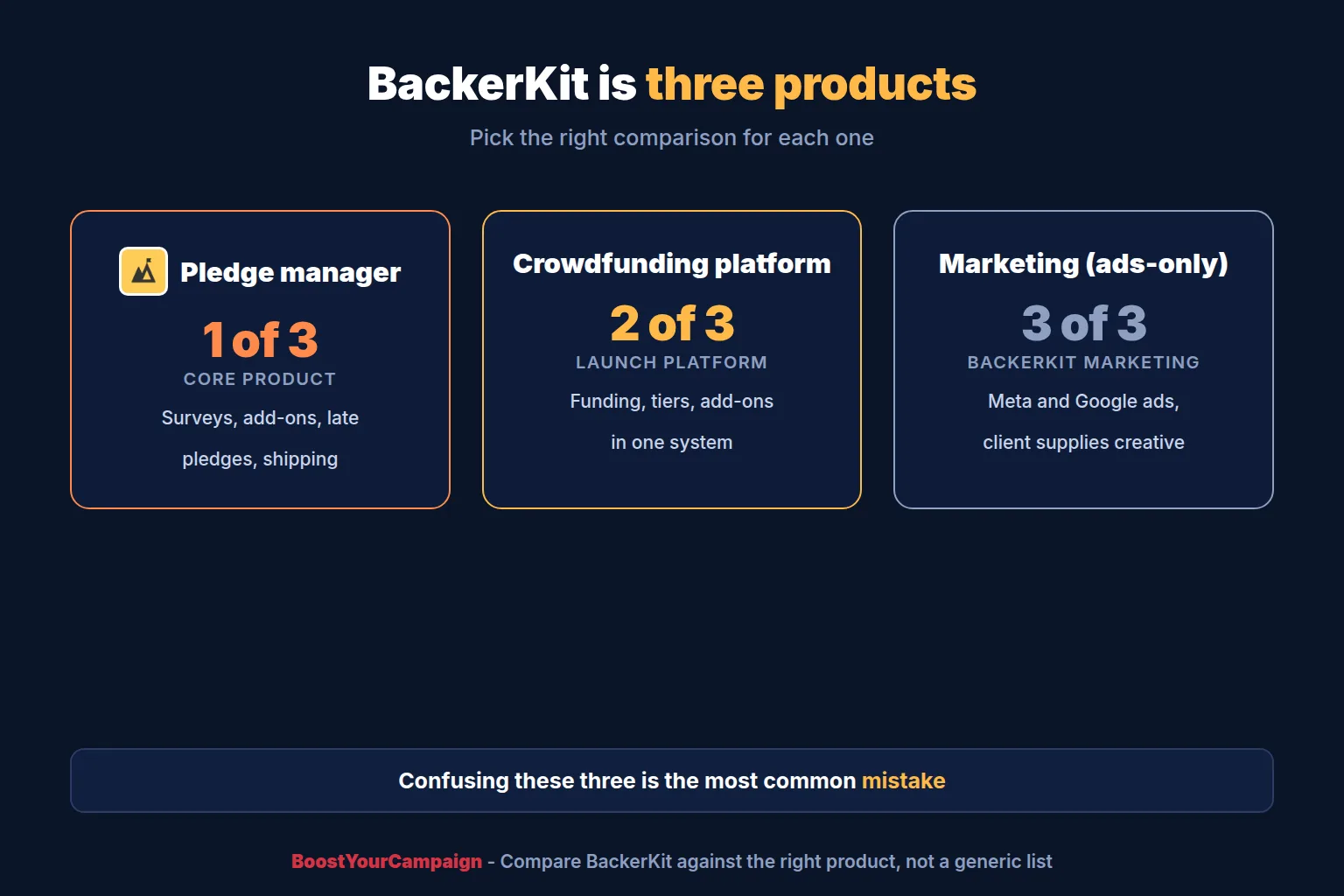
BackerKit is not one thing you compare against one thing. It is three separate products under one name, and "BackerKit alternative" means something different depending on which one you actually need.
The first is BackerKit's pledge manager software, the tool a large share of Kickstarter and Indiegogo creators already use after a campaign closes to collect shipping addresses, sell add-ons, and run surveys. This is the original BackerKit product, and it is what most searches for "is BackerKit worth it" are really asking about.
The second is BackerKit Crowdfunding, the company's own launch platform. It runs funding, pledge tiers, add-ons, and the pledge manager in one system, so a campaign never has to hand data between a crowdfunding platform and a separate pledge manager tool. It fits creators who already have an audience better than it fits a first-time creator counting on platform discovery, since BackerKit does not have anything like Kickstarter's browse traffic.
The third is BackerKit Marketing, the company's ads-only arm. It runs paid media on Meta and Google using a database of 18M+ crowdfunding backers, and it expects the client to supply creative. It is based in San Francisco and operates separately from the pledge manager and the crowdfunding platform.
Confusing these three is the most common mistake creators make when searching for a BackerKit alternative. A post-campaign survey tool, a launch platform, and a marketing team are three separate decisions. The sections below are organized around all three, so you compare BackerKit against the right thing instead of a generic list of "competitors."
1) BoostYourCampaign
BoostYourCampaign is a full-stack, done-for-you option built for teams that want demand creation handled end to end, not only ad buying. That includes pre-launch planning, ad creative production, campaign page and copy work, paid media execution, PR support, and post-campaign ecommerce plus fulfillment coordination under one roof. BYC also uses a skin-in-the-game ad model, investing its own money alongside client ad budgets.
The in-house infrastructure is broader than a typical ads-only service: owned video studios in the US and EU, plus owned fulfillment warehouses in the US and EU. BYC is an official Shopify Partner and Amazon Partner, a Google Premier Partner, and a Facebook Marketing Partner, and is also an Indiegogo Approved Agency. For earlier-stage teams, BYC offers in-house MVP development. For founders planning beyond crowdfunding, BYC has ecommerce and retail pedigree and can help with introductions to major retailers including Best Buy, where fit exists.
Track record and proof points are long-running: since 2010, 4,600+ campaigns, $734M+ raised, and a 4.9/5 average across 300+ verified reviews. Client products have gone from BYC-run crowdfunding launches to Shark Tank, with examples in press coverage, and Kevin O'Leary has shared a video testimonial available on the reviews page. Honest limitation: BYC's higher-touch, fixed-fee engagement can be more commitment than ads-only models, especially for an already-funded campaign that only wants media buying.
2) BackerKit Marketing
BackerKit Marketing is the advertising arm of BackerKit, separate from BackerKit's pledge-manager software. It runs ads on Meta and Google using a proprietary database of 18M+ crowdfunding backers. This can fit campaigns that already have proven creative assets and want specialized media buying focused on crowdfunding audiences.
The key operating model is ads-only: the client supplies creative, and BackerKit Marketing handles ad buying and optimization. It does not create ad assets, write campaign copy, design campaign pages, handle PR, or run pre-launch strategy. That narrower scope can be a benefit for teams with strong in-house production that only need performance media support. Honest limitation: if you need full demand creation from early positioning through creative development and launch planning, the ads-only format may leave major execution work on your internal team. BackerKit is based in San Francisco.
3) LaunchBoom
LaunchBoom is best understood as an education and coaching platform using a done-with-you model, not a done-for-you agency model. Creators get curriculum, templates, and coaching, then implement the system themselves. This can work well for founders who want to build internal launch skills and stay hands-on across setup and execution.
Because the creator executes, control stays with the team, and the process can be a fit for operators who value structured guidance rather than outsourced production. Honest limitation: teams with limited bandwidth or no in-house marketing execution may find the model demanding, since implementation remains on the creator side. If you are deciding between coaching-led execution and outsourced execution, this category difference matters more than brand preference. For a deeper side-by-side, see the LaunchBoom comparison or the LaunchBoom alternatives roundup.
4) Jellop
Jellop is an ads-only crowdfunding option. It is commonly associated with performance advertising during live campaigns, and it reports about 15% of attributable pledges. For teams that want a focused paid-media partner and have the rest of launch operations covered, this can be a clear fit.
Jellop's model is narrower than full-service launch support. It does not include pre-launch strategy, PR, or post-campaign support. It also requires campaign exclusivity, which can affect teams planning to split work across multiple vendors. Honest limitation: if you need one partner to handle upstream strategy, asset creation, and downstream growth, an ads-only exclusive setup may not match that operating plan. You can compare this category split in more detail at the Jellop comparison.
5) Funded Today
Funded Today is a commission-based full-service crowdfunding agency. Its pricing structure includes an upfront testing fee in the $2,500-5,000 range plus a 25-35% commission. That model can align with teams that are comfortable trading a portion of campaign revenue for service execution and are prepared for the initial testing spend.
Compared with ads-only providers, the full-service label may appeal to founders who want broader support during campaign operations. Post-campaign support is available in limited form through a separate product called Launchkit. Honest limitation: fee structure and commission percentage are central decision factors, so teams with tight margin targets should model outcomes before committing. For additional context on pricing approaches across agencies, you can review this cost guide and the side-by-side at the Funded Today comparison.
6) Enventys Partners
Enventys Partners combines product development with crowdfunding and marketing support. That combination can help founders who want one relationship spanning product-side work and go-to-market help, instead of splitting development and campaign services across separate vendors.
This positioning is often most relevant when a team is still shaping the product and also planning launch channels. Honest limitation: if your product is already finalized and your main need is pure campaign demand generation, a development-plus-marketing structure may include service areas you do not need right now. In that case, define your immediate bottleneck first, then choose a partner model that matches that bottleneck tightly.
| Agency | Model | Best for | Post-campaign support |
|---|---|---|---|
| BoostYourCampaign | Full-stack done-for-you with skin-in-the-game ad model | Teams wanting pre-launch, creative, ads, campaign execution, and post-campaign growth support in one partner | Yes - ecommerce plus fulfillment support under one roof |
| BackerKit Marketing | Ads-only (Meta + Google) using 18M+ backer database; client supplies creative | Campaigns with strong existing creative that need media buying | No pledge-manager replacement in this service; marketing scope is ads-only |
| LaunchBoom | Done-With-You education and coaching | Founders who want to execute themselves with curriculum and coaching | Creator-led execution model |
| Jellop | Ads-only; exclusivity required | Kickstarter teams seeking focused paid ads support | No pre-launch, PR, or post-campaign support |
| Funded Today | Commission-based full service with upfront testing fee | Teams comfortable with testing fee plus revenue-share structure | Limited support via separate Launchkit product |
| Enventys Partners | Product development plus crowdfunding and marketing help | Founders wanting product and campaign support in one relationship | Varies by scope |
Pledge manager alternatives
If your BackerKit question is really about the pledge manager, the survey, add-on, and shipping tool used after a campaign funds, a handful of options cover most reward structures.
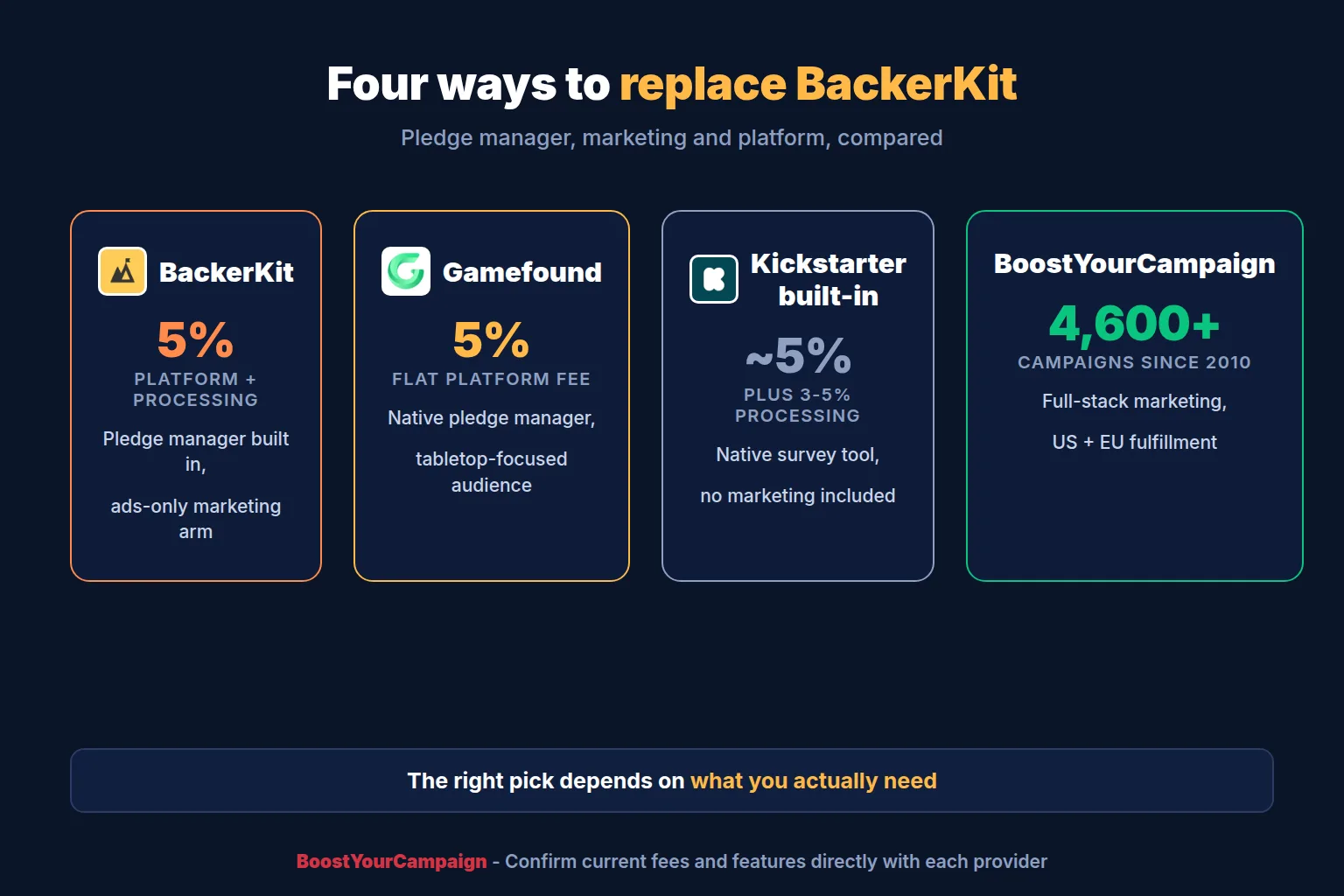
Gamefound builds a pledge manager natively into its own crowdfunding platform. Add-ons, tier upgrades, variant selection, and shipping address collection all live inside the same system a campaign ran on, with a flat 5% platform fee. It is built around tabletop games, so it fits board game campaigns especially well, and it also works as a pledge manager for a campaign that launched elsewhere and wants a relaunch or late pledge phase, given Gamefound's connection to Indiegogo.
PledgeBox is a lighter option: a per-backer fee, a simpler interface, and mid-level configuration depth for add-ons and address collection. It fits small to mid-size campaigns that want more than a bare-bones native tool without BackerKit's or Gamefound's full feature set.
Kickstarter's own built-in pledge manager collects a post-campaign survey for shipping addresses, variant selection, and add-ons directly inside the platform, with no added platform fee. It covers a single core reward with a few variants well; a bundle with many SKUs and heavy add-on revenue tends to outgrow it.
Shopify pre-orders are a different tool entirely, not a dedicated pledge manager, but a storefront a creator already controls, sometimes used to sell late pledges after a campaign closes. It does not replace add-on and survey collection the way a purpose-built pledge manager does, so confirm setup and fees with Shopify or your app of choice before treating it as a full replacement.
Our pledge manager and late pledges guide and Kickstarter pledge over time and pledge manager guide go deeper on choosing between these based on your actual reward complexity.
Marketing service alternatives
If your BackerKit question is about growth, not software, you are really comparing marketing models, and the split runs deeper than any one company's product page.
BackerKit Marketing is a tool-bundled model: ads-only on Meta and Google, using its 18M+ backer database, with the client supplying creative. That structure works when a campaign already has strong assets and only needs media buying layered on top. It does not build creative, write campaign copy, design the campaign page, run PR, or handle pre-launch strategy, so a team without those pieces already built is still on the hook for them.
An agency model is different in kind, not only in scope. BoostYourCampaign runs Kickstarter and Indiegogo ad management as one connected funnel across pre-launch lead generation, launch-window conversion, and live retargeting, built and produced from an in-house creative studio rather than depending on assets a client hands over. See Kickstarter ads management for how those phases connect, including the pixel and referral-tag tracking used to measure cost per backer even though Kickstarter itself has no native pixel.
The other structural difference is who carries the risk. BackerKit Marketing bills for ad management the way most agencies do: a fee for the work, regardless of outcome. BoostYourCampaign's skin-in-the-game model can front or share ad spend for qualifying campaigns and re-launch at its own cost if an agreed target is missed, on top of transparent published pricing. That is a meaningfully different incentive structure than paying for media buying alone, and it is worth weighing alongside scope when comparing a tool-bundled ads service to a full agency.
Platform alternatives
BackerKit Crowdfunding is not the only place to actually launch a campaign, and the platform decision is separate again from pledge manager or marketing choices.
Kickstarter remains the largest general-audience option, with roughly 23M+ backers and around 27M monthly visits driving real organic discovery for a well-positioned page, traffic that BackerKit Crowdfunding's smaller, creator-driven audience does not match. Kickstarter charges roughly a 5% platform fee plus 3-5% payment processing, and it now includes a built-in pledge manager for straightforward reward structures, covered above.
Gamefound is the tabletop-native alternative: a flat 5% platform fee, a built-in pledge manager, and an audience concentrated around board games and miniatures. In 2025 Gamefound acquired Indiegogo, and Indiegogo's October 2025 relaunch now runs on Gamefound's technology and the same flat 5% fee structure.
Indiegogo itself is worth considering separately from Gamefound, since it still has its own general-audience brand and a broader category mix than Gamefound's tabletop focus. Every new Indiegogo campaign now runs fixed, all-or-nothing funding - flexible funding was retired at the October 2025 relaunch - and its post-campaign continuation phase is called Late Pledge (formerly called InDemand).
Where BackerKit Crowdfunding tends to win is operational smoothness for a creator who already has an audience: campaign, survey, and add-ons live in one system with no handoff between a launch platform and a separate pledge manager. Where it tends to lose is discovery, since it does not have anything close to Kickstarter's browsing traffic. Our Kickstarter vs Gamefound vs BackerKit comparison walks through the fee, audience, and pledge manager tradeoffs across all three in full.
| Provider | Pledge manager | Launch marketing | Video | Fulfillment | Fee model |
|---|---|---|---|---|---|
| BackerKit | Core product - add-ons, surveys, late pledges, backer commerce flows | Separate arm (BackerKit Marketing) - ads-only Meta and Google, client supplies creative | Confirm with provider | Confirm with provider | BackerKit Crowdfunding: roughly 5% platform fee plus processing. Pledge manager fee - confirm with provider |
| Gamefound | Native, built into the platform - add-ons, variants, shipping | No marketing service - platform and pledge manager only | Confirm with provider | Confirm with provider | Flat 5% platform fee plus processing |
| Kickstarter built-in | Native survey tool - fits a single core reward with a few variants | None native - creator or agency runs ads separately; no built-in pixel | Confirm with provider | Confirm with provider | Roughly 5% platform fee plus 3-5% processing |
| BoostYourCampaign | Advises on Kickstarter, BackerKit, or Gamefound choice; fulfillment runs off that export | Full-stack done-for-you - pre-launch, creative, ads, PR | Owned video studios in the US and EU | Owned fulfillment warehouses in the US and EU | Fixed fee, with a skin-in-the-game ad co-investment option |
Questions to ask before choosing
- Are you comparing a pledge manager, a platform, or a marketing service? Name which of BackerKit's three products you need before you look at an alternative.
- Who supplies the creative? A tool-bundled ads service expects finished video and copy from you; a full agency should produce it in-house.
- Does the provider carry any risk if results fall short? A fixed fee with no provider downside differs from a skin-in-the-game or co-invested structure.
- Who runs fulfillment once the campaign funds? Software tools export order data; confirm whether the provider ships anything itself or hands off the export.
- What does the current fee structure cost? Platform, processing, and pledge manager fees shift over time, so get current rates directly from the provider.
- Does your reward structure need real configuration depth? Many SKUs and add-ons favor BackerKit, Gamefound, or PledgeBox over a native built-in tool.
- Is there a plan for late pledges after the campaign closes? Confirm whether your pledge manager supports a late pledge or continuation phase, and what it costs.
- Does the provider have a track record you can verify? Ask for reviews, case studies, or a portfolio rather than taking pricing claims at face value.
How to choose between them
- Confirm the category first: pledge-manager software vs marketing service. If you need surveys, add-ons, and backer operations, evaluate BackerKit's software directly.
- Define your execution preference: done-for-you partner, done-with-you coaching, or ads-only media buying.
- Audit your internal assets honestly: do you already have proven creatives, campaign copy, and launch page, or do you need those built for you?
- Map the timeline: if pre-launch demand generation is still missing, choose a model that includes pre-launch strategy and production.
- Model economics in advance: compare fixed-fee, commission, testing fee, and ad-spend requirements against your margin goals.
- Plan for what happens after funding: ecommerce transition, retail outreach, and fulfillment needs should be accounted for before launch.
Frequently Asked Questions
Is BackerKit a marketing agency?
Primarily, BackerKit is pledge-manager software for post-campaign backer operations, surveys, and add-ons. BackerKit Marketing is its separate ads-only arm that runs Meta and Google media buying with a proprietary database of 18M+ backers. If you need software operations, evaluate BackerKit's core product. If you need a marketing partner, compare service models carefully because they vary widely.
What is the main difference between BackerKit Marketing and BoostYourCampaign?
BackerKit Marketing is ads-only and expects the client to provide creative assets. BoostYourCampaign runs full-stack, done-for-you demand creation, including pre-launch strategy, ad creative production, campaign page and copy work, paid media, PR support, and post-campaign ecommerce plus fulfillment support. BYC also uses a skin-in-the-game ad model and has owned US and EU studios and warehouses.
If I only want coaching, which option fits best?
LaunchBoom is built around coaching and education in a done-with-you format. Your team implements the system using its curriculum, templates, and coaching support. That can be a strong fit if you want to stay hands-on and build internal launch capability.
Which option is most focused on Kickstarter ads?
Jellop operates in an ads-only model. It reports about 15% of attributable pledges and requires campaign exclusivity. It does not provide pre-launch strategy, PR, or post-campaign support.
How should I compare pricing models across these options?
Start by separating fixed-fee, commission-based, and ads-only structures. Funded Today uses a testing fee plus commission. Ads-only providers narrow scope but leave more execution on your team. Higher-touch done-for-you models can cost more than the cheapest ads-only path, so compare total workload, risk, and internal staffing before choosing.
Can one partner support product development, launch, and post-campaign growth?
Some can, with different structures. Enventys Partners combines product development with crowdfunding and marketing help. BoostYourCampaign includes in-house MVP development, full campaign marketing, and post-campaign ecommerce plus fulfillment support, with additional proof points on the press page and reviews page.
What is the best alternative to BackerKit for marketing?
It depends on what BackerKit Marketing already does for you. If your campaign has strong creative and only needs Meta and Google ad buying, BackerKit Marketing's ads-only model can fit. If you need a team to build creative, write copy, design the page, and run PR alongside ads, BoostYourCampaign is built for that broader role, with an in-house video studio, a skin-in-the-game ad model, and post-campaign ecommerce and fulfillment support under one roof.
Do I need BackerKit if I use an agency?
Not necessarily. BackerKit's pledge manager, an agency's marketing work, and where you fulfill orders are three separate layers. BoostYourCampaign works alongside whichever pledge manager a campaign chooses - Kickstarter's built-in tool, BackerKit, or Gamefound - rather than requiring one specific option, and runs fulfillment from its own US and EU warehouses off that pledge manager's export.
What is the best pledge manager alternative to BackerKit?
Gamefound is the strongest tabletop-native option, with a built-in pledge manager and a flat 5% fee. Kickstarter's built-in pledge manager works well for a single core reward with a few variants and adds no extra platform fee. PledgeBox offers a simpler interface with a per-backer fee for smaller campaigns. Shopify pre-orders can cover a post-campaign storefront but are not a dedicated pledge manager. Confirm current fees and features directly with each provider.
Can BoostYourCampaign run my pledge manager and fulfillment?
BoostYourCampaign does not operate its own competing pledge manager software. It helps decide between Kickstarter's built-in tool, BackerKit, or Gamefound based on how many SKUs and add-ons your reward structure has, then runs fulfillment itself through owned warehouses in the US and EU, working directly from whichever pledge manager's export the campaign uses.
Comparing a different starting point? See the Jellop alternatives and Funded Today alternatives roundups if one of those is your anchor instead. For a full deep dive on BackerKit specifically, read our is BackerKit worth it? review.
If you want a tailored recommendation based on your stage, asset readiness, and budget, talk to an expert.
Ready to give your campaign the best shot?
We've helped 4,600+ creators raise over $734M since 2010. Let's pressure-test your launch plan and find the highest-leverage fixes before you go live.
Talk to an expert →