Three platforms now compete seriously for tabletop, hardware, and design campaigns, and picking the wrong one costs more than a slow launch. If you want a second opinion on which fits your product before you commit a launch date, talk with BoostYourCampaign - we've launched on all three and can run fulfillment once you fund.
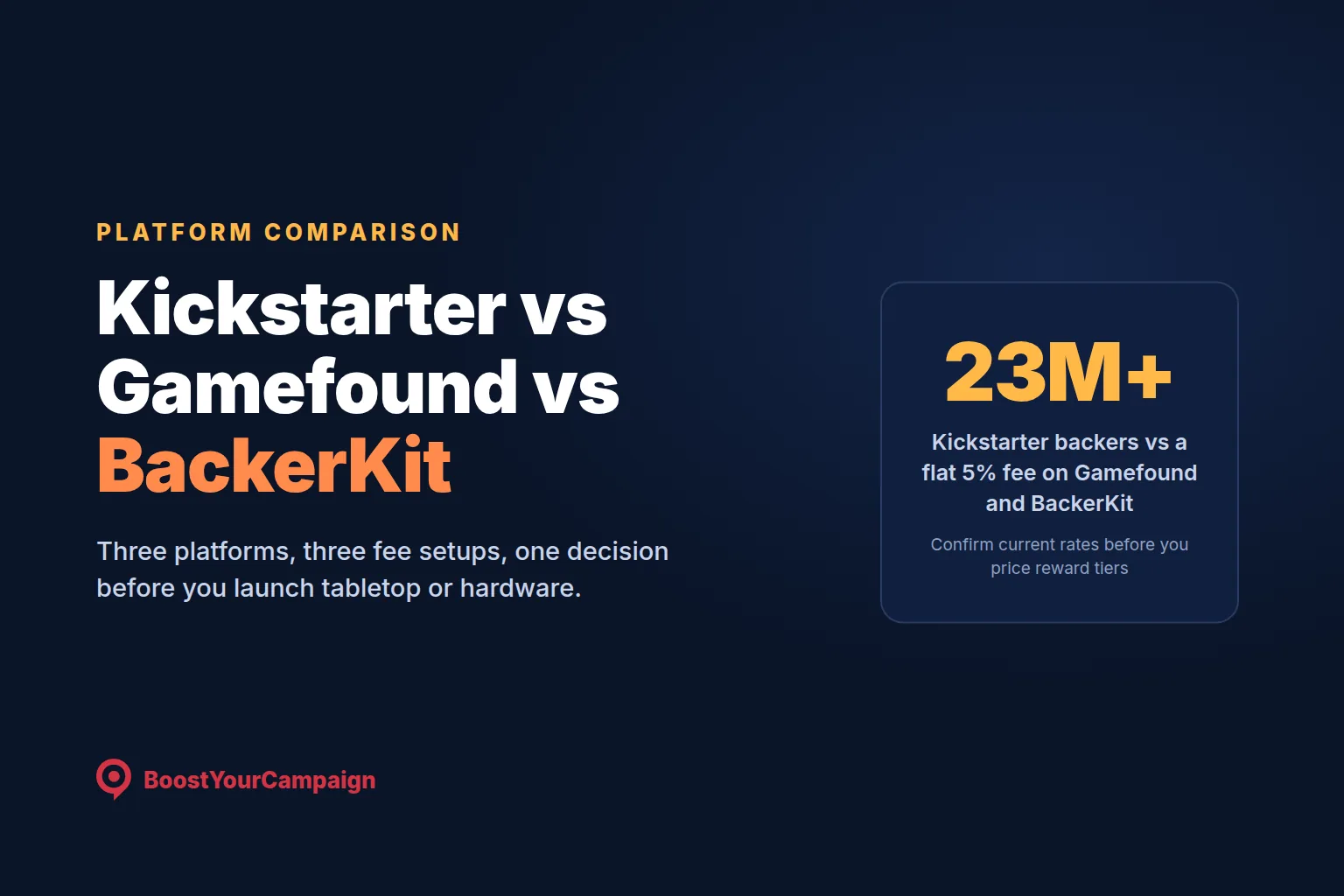
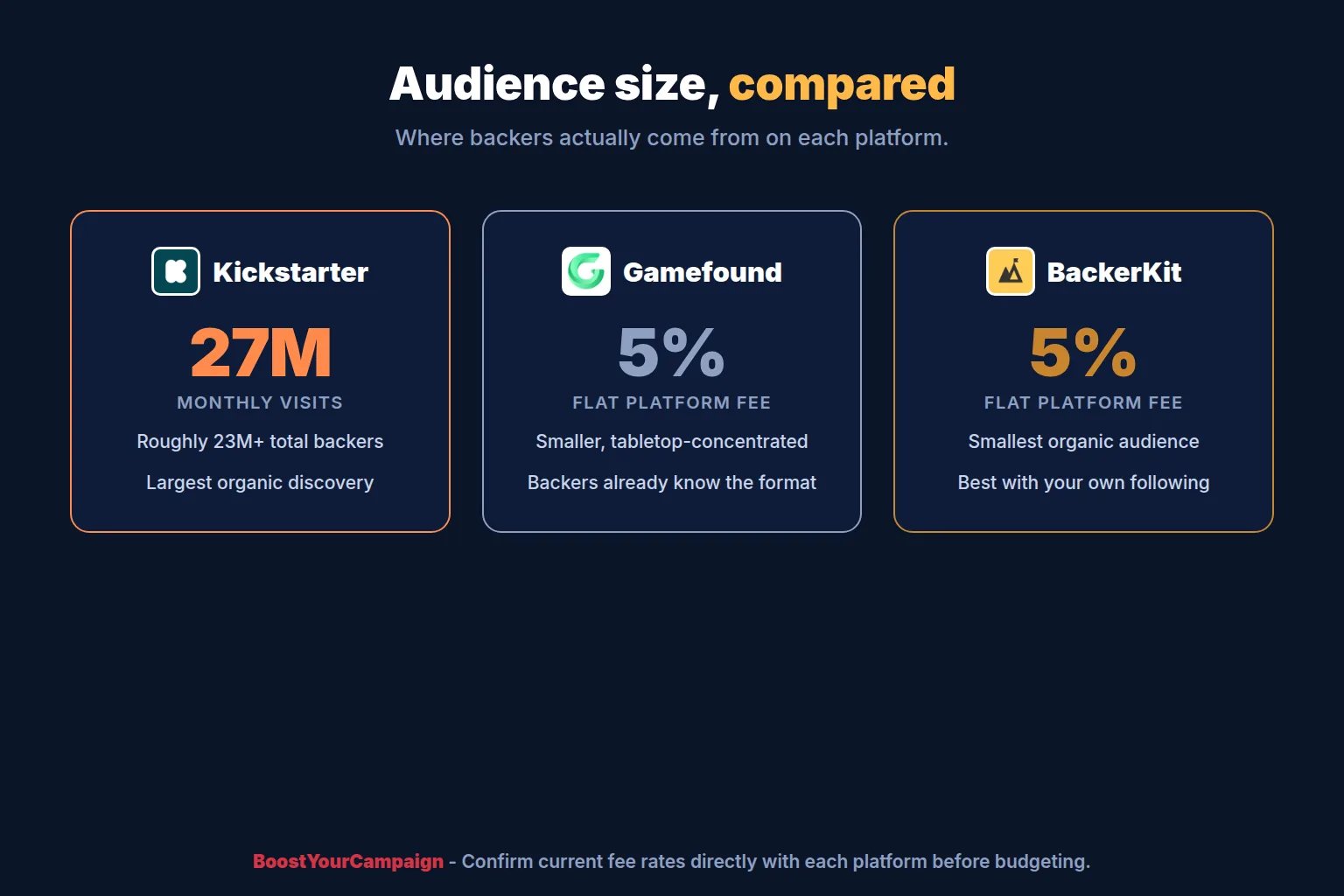
Kickstarter is the right pick for most first-time and general-audience campaigns because of its size: roughly 23M+ backers and around 27M monthly visits, which sends a well-positioned page organic pledges it didn't have to earn through ads. Gamefound fits tabletop creators who want a built-in pledge manager and a concentrated board-game audience, and it now runs Indiegogo's post-campaign phase after acquiring the company in 2025. BackerKit Crowdfunding fits creators who already have their own audience - an email list, a following, a press plan - and want the smoothest possible path from funded campaign to shipped reward. None of the three is a universal best choice; the right one depends on where your backers already are and how much of your own audience you're bringing to launch day.
- Kickstarter still has the biggest audience - roughly 23M+ backers and around 27M monthly visits means real organic discovery for a well-positioned page.
- Gamefound is tabletop-native - a pledge manager, add-ons, and stretch goals are built in, not bolted on, and the audience already expects them.
- BackerKit Crowdfunding rewards creators who bring their own audience - it's less of a discovery engine and more of a clean operating platform for a campaign you're already driving traffic to.
- Fees land in a similar range everywhere - roughly 5% platform plus 3-5% payment processing on Kickstarter, and a flat 5% platform fee on Gamefound and BackerKit Crowdfunding. Confirm current rates before you budget.
- Late pledges are common on all three - creators frequently run a primary campaign on one platform, then a late pledge phase, often adding roughly 10-20% to the original price for backers who missed the funding window.
- Category fit still matters more than the platform's total size - tabletop, hardware, design, and publishing don't all perform the same way on the same platform.
1) What each platform actually is
Kickstarter is the general-purpose crowdfunding platform. It funds games, design, technology, film, publishing, and a long list of other creative categories, and it does it at a scale nothing else in this comparison matches: roughly 23M+ backers total and around 27M monthly visits. That scale means a portion of a well-run campaign's pledges come from people browsing the platform who never heard of the project before landing on the page. Our Kickstarter vs Indiegogo comparison covers how Kickstarter stacks up against the other general-audience platform in more depth; this article focuses on the tabletop-and-hardware-specific alternatives instead.
Gamefound started as a crowdfunding platform built specifically for tabletop games. Pledge tiers, add-ons, and a built-in pledge manager were part of the product from the start rather than added later, which matters because board game campaigns almost always need those tools. In 2025, Gamefound acquired Indiegogo, and Indiegogo's October 2025 relaunch runs on Gamefound's technology stack, including the flat 5% platform fee structure Gamefound already used. That deal gives Gamefound a second, much larger general-audience platform under the same company, while Gamefound itself stays the tabletop-focused product with its own separate audience of backers who specifically browse for board games.
BackerKit Crowdfunding is the newest of the three, launched by the company that built BackerKit's pledge manager tool - the software a huge share of Kickstarter and Indiegogo campaigns already use to collect add-ons and shipping addresses after a campaign funds. Because BackerKit already owned that post-campaign layer, its crowdfunding platform is built around a smooth operational experience: campaign creation, pledge management, and fulfillment data all live in one system instead of getting handed between a crowdfunding platform and a separate pledge manager. It doesn't have Kickstarter's browsing traffic, so it fits best when a creator is bringing a real audience of their own rather than counting on platform discovery.
2) Fees: platform cut plus payment processing
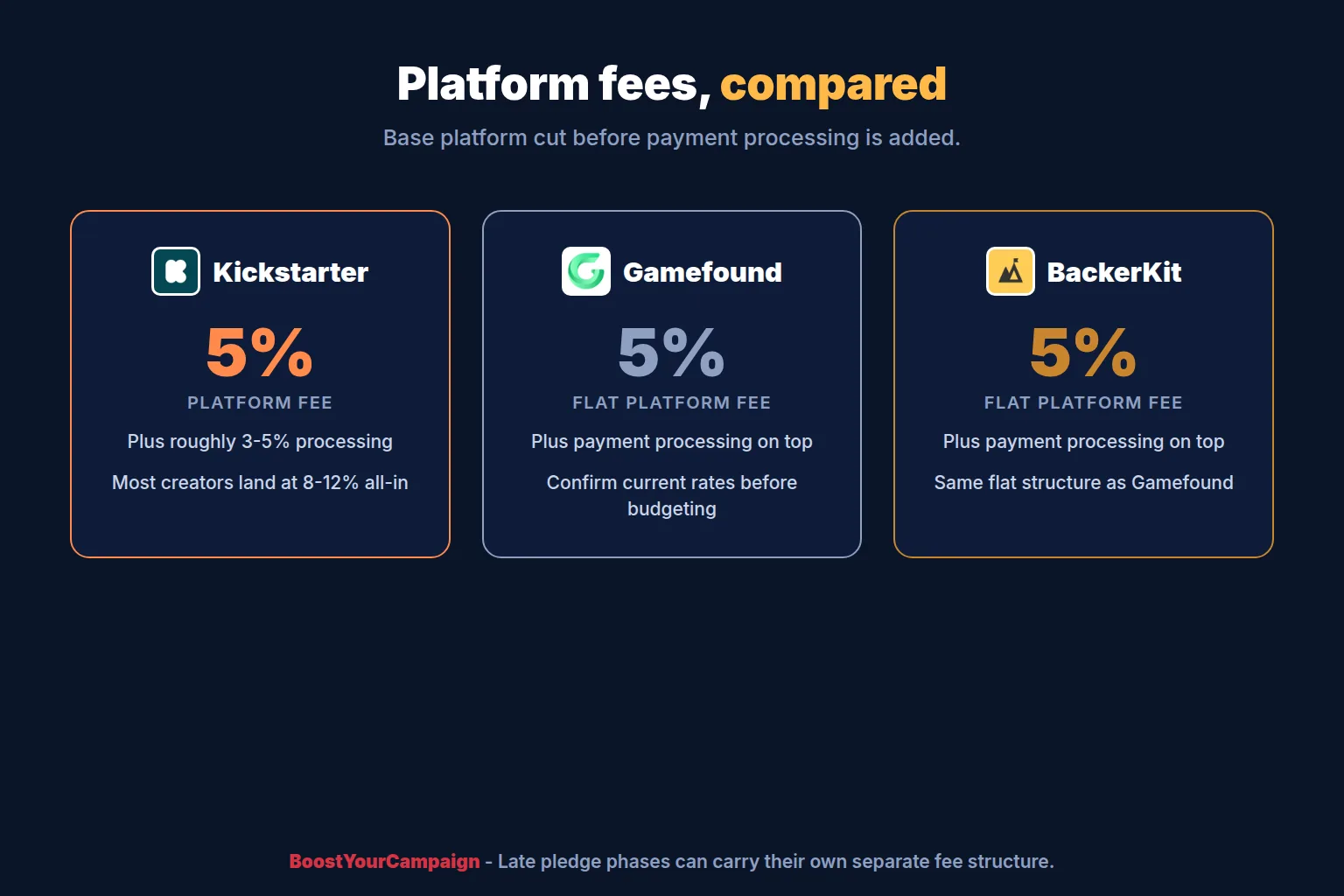
Kickstarter charges roughly 5% as a platform fee on funds raised, plus payment processing that typically runs 3-5% depending on the backer's country, currency, and card mix. Most creators end up paying somewhere in the 8-12% range once both are combined. Gamefound and BackerKit Crowdfunding both use a flat 5% platform fee, and each adds its own payment processing on top, which tends to land in a similar band to Kickstarter's once currency and card fees are counted. None of these numbers are locked in place forever - platforms adjust processing partnerships and regional rates - so confirm current rates directly with each platform before finalizing a campaign budget. Our Kickstarter and Indiegogo fee guide breaks the processing side down further, including the country-by-country variation that a global backer base can add.
The bigger fee question usually isn't the base platform rate, it's what happens after the campaign ends. A late pledge or continuation phase can carry its own fee structure, and a pledge manager used on top of a campaign - separate from Gamefound's or BackerKit's built-in tools - adds its own cost, typically a percentage of the additional revenue it processes. Budget the full post-campaign fee stack, before you set reward prices, rather than only the launch-day platform rate.
3) Audience and discovery: who actually finds your campaign
This is where the three platforms diverge the most, and it matters more than the fee percentage for most campaigns. Kickstarter's roughly 27M monthly visits include a meaningful volume of people actively browsing category pages looking for something new to back. A well-positioned page in games, design, or hardware can pick up pledges from backers who never saw an ad and never heard of the project before landing on it. That's real, unpaid distribution that neither of the other two platforms matches at the same scale.
Gamefound's audience is smaller but concentrated. Backers who specifically browse Gamefound are there because they already like tabletop games, and they tend to be familiar with pledge managers, add-ons, and stretch goals as normal parts of backing a project rather than unusual extras. That concentration matters for a board game campaign because the traffic that does arrive is already qualified, even if the total volume is lower than Kickstarter's.
BackerKit Crowdfunding has the smallest organic browsing audience of the three. It works best when a creator already has a following - an email list built over months, a social audience, a press plan, or backers from a previous project - because the platform's strength is operational smoothness, not discovery. A campaign with no existing audience launching cold on BackerKit will likely see far less unplanned traffic than the same campaign would see on Kickstarter.
The practical takeaway: if you don't have your own audience yet, weight your decision toward Kickstarter or Gamefound, where at least some backers come from platform browsing. If you already have an audience and care more about a smooth operational experience after funding, BackerKit Crowdfunding starts to make more sense.
4) Pledge managers and add-on handling
A pledge manager is the tool that lets a backer confirm their pledge tier, add extra items, choose variants like color or size, and lock in a shipping address after the campaign ends but before the reward ships. Gamefound and BackerKit Crowdfunding both build this in natively - there's no separate signup, no separate login, and no data export-import step between the crowdfunding platform and the pledge management tool. Add-ons, upgrades, and shipping calculation all live in the same system the campaign ran on.
Kickstarter has no built-in pledge manager. A campaign that runs on Kickstarter almost always needs a separate tool afterward - BackerKit's own pledge manager product is one of the most common choices, along with a handful of competitors - to collect the same information. That's an extra step and usually an extra cost, but it doesn't cancel out Kickstarter's audience advantage; most experienced creators just build the pledge manager cost into their post-campaign budget from the start.
For campaigns with a lot of add-ons and variants - which describes most board games and a large share of hardware products - a native pledge manager tends to produce cleaner data than a bolt-on tool, mainly because there's one less handoff point where SKU names or shipping addresses can get out of sync. Our pledge manager and late pledges guide covers this mechanism in detail, including how to keep SKU and address data clean enough for a fulfillment warehouse to kit against without errors.
5) Late pledges across all three platforms
A late pledge lets someone back a project after the funding window closes, usually at a price a bit above what original backers paid - commonly roughly 10-20% higher, though the exact markup is the creator's call. All three platforms support some version of this, but the mechanics differ. Gamefound's late pledge tools are built into the same pledge manager the main campaign used, so a creator can keep collecting pledges without moving to a different platform or product. Indiegogo's post-campaign phase, now running on Gamefound's technology, is called Late Pledge (formerly called InDemand) - the same underlying idea, continued collection after the original campaign ends, under Indiegogo's brand.
BackerKit Crowdfunding handles late pledges the same way it handles the main campaign: inside its own platform, using the same pledge manager and fulfillment data pipeline. Kickstarter itself has no native late pledge tool, which is one reason so many Kickstarter campaigns move to a Late Pledge phase on Indiegogo, or run their own post-campaign pre-order store once the Kickstarter campaign closes.
Whichever path a campaign takes, the fee and pricing math needs to be modeled before the primary campaign ends, not decided reactively once backer messages start asking "can I still get this?" Our pledge manager and late pledges guide walks through that math in more detail, and our guide to selling after crowdfunding covers what happens once the late pledge window itself closes.
6) Category fit: tabletop, hardware, design, and publishing
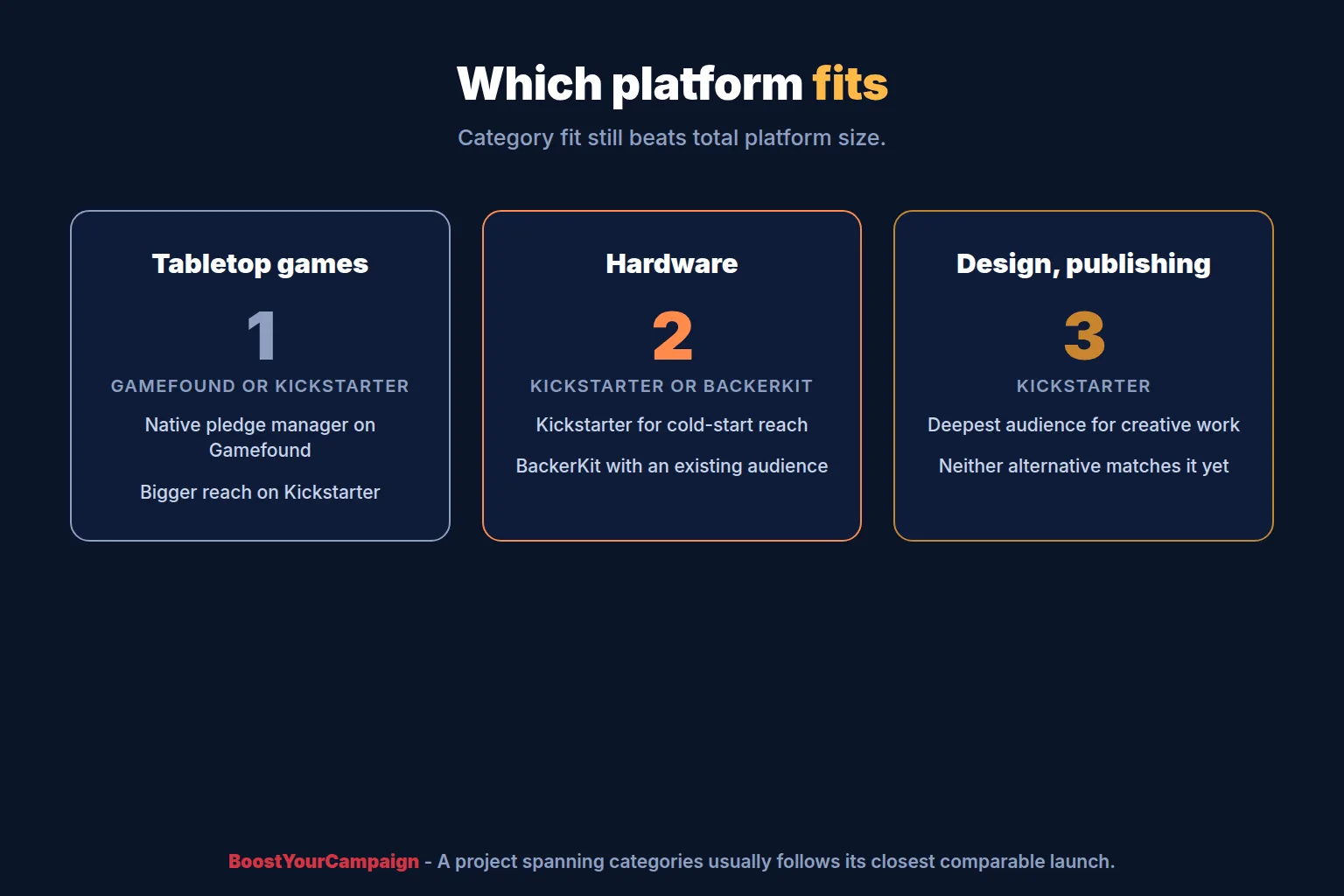
Tabletop games fit Gamefound especially well because the platform's tools and audience were both built around this category specifically. A board game with a deep add-on list and a stretch goal ladder gets native support for exactly that structure, and the backers browsing Gamefound already expect it. Kickstarter also performs strongly for tabletop, particularly for a creator's first campaign or one aiming for maximum reach, because its games category still draws a large, active audience of its own. BackerKit Crowdfunding can work for tabletop too, especially for an established publisher's second or third campaign where the audience already exists and the priority shifts to operational smoothness over discovery.
Hardware and consumer electronics tend to fit Kickstarter or BackerKit Crowdfunding better than Gamefound, since Gamefound's audience skews heavily toward tabletop even after the Indiegogo acquisition. A hardware creator without an existing audience usually does best starting on Kickstarter for the organic reach, while a hardware creator with a strong existing following can consider BackerKit Crowdfunding for a cleaner operational path.
Design and publishing projects - stationery, apparel, comics, art books - generally perform best on Kickstarter, which has the deepest and most established audience for creative, non-gadget categories. Neither Gamefound nor BackerKit Crowdfunding has built a comparable browsing audience for these categories yet, so a creator in this space without their own following should weight heavily toward Kickstarter.
7) A decision framework
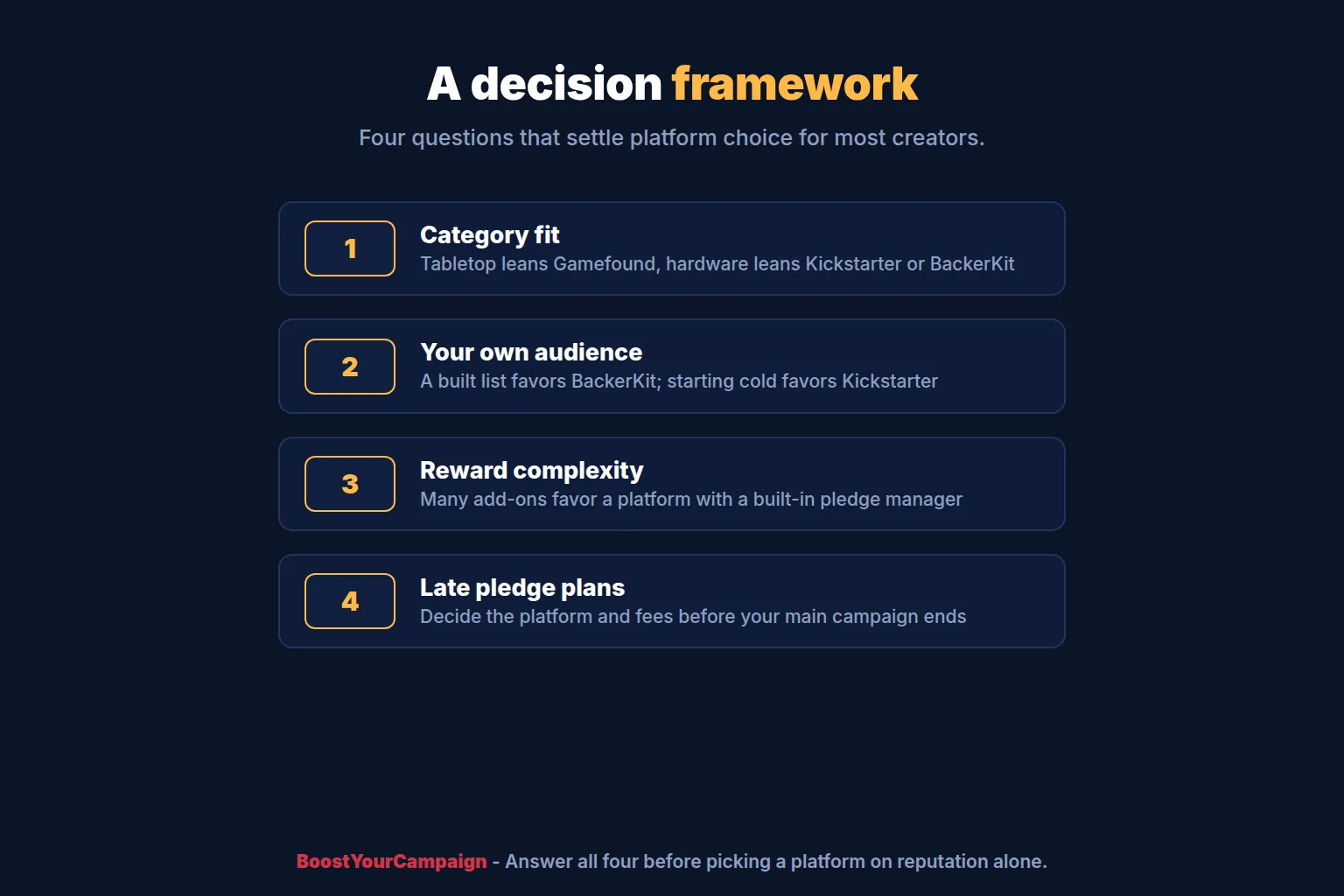
Four questions tend to settle this decision for most creators. First, what's the category? Tabletop leans Gamefound or Kickstarter, hardware and design lean Kickstarter or BackerKit Crowdfunding, and a project that doesn't fit neatly into one category usually does best where the closest comparable projects have performed well.
Second, how big is your own audience? A creator with a built email list, a social following, or a press plan already in place brings their own traffic no matter which platform they choose, which makes BackerKit Crowdfunding's operational strengths more attractive. A creator starting from zero needs platform discovery more, which points toward Kickstarter or, for tabletop specifically, Gamefound.
Third, how complex is the reward structure? A campaign with many add-ons, variants, and a stretch goal ladder benefits from a native pledge manager, which favors Gamefound or BackerKit Crowdfunding over Kickstarter's no-pledge-manager default.
Fourth, do you plan to run a late pledge phase? If yes, decide up front whether that phase stays on the platform you launched on or moves elsewhere, since the fee structure and tooling differ. Answering these four questions before launch, rather than picking a platform on reputation alone, is the single biggest lever for landing on the right one the first time.
8) Running Kickstarter first, then a late pledge on Gamefound or BackerKit
A growing number of creators, especially in tabletop and hardware, don't pick one platform - they sequence two. The pattern: launch and run the primary campaign on Kickstarter to capture its larger audience and stronger creative-project credibility, then move into a continuation phase on Gamefound or BackerKit Crowdfunding once the Kickstarter campaign closes, letting backers who missed the funding window still pledge.
This works especially well for tabletop creators, since Gamefound's pledge manager and add-on tools give the continuation phase a smoother operational experience than trying to run the same thing on Kickstarter's more limited native toolset. Hardware creators sometimes choose BackerKit Crowdfunding for the same reason, particularly if they're already using BackerKit's pledge manager for the main Kickstarter campaign and want to avoid a second handoff to a different system for the late pledge phase.
The tradeoff is the same one every combined-platform strategy faces: an extra fee layer for whichever platform hosts the continuation phase, and a second set of logistics to plan for shipping timelines and fulfillment. Run the math on expected late pledge volume before committing, and treat this pattern as a way to extend a campaign that already funded well, not as a rescue plan for one that underperformed.
| Factor | Kickstarter | Gamefound | BackerKit Crowdfunding |
|---|---|---|---|
| Audience size | Largest - roughly 23M+ backers, around 27M monthly visits | Smaller, concentrated in tabletop | Smallest organic audience, relies on creator's own traffic |
| Platform fee | Roughly 5% plus 3-5% processing | Flat 5% - confirm current rates | Flat 5% - confirm current rates |
| Built-in pledge manager | No - needs a separate tool after funding | Yes, native | Yes, native |
| Best category fit | General - games, design, film, publishing | Tabletop and board games | Any category, best with an existing audience |
| Late pledge tooling | None native - usually moves to another platform | Built in, plus Indiegogo's Late Pledge (formerly called InDemand) | Built in, same platform as main campaign |
How BoostYourCampaign fits
BoostYourCampaign has launched campaigns on Kickstarter, Gamefound, and BackerKit Crowdfunding, which matters because the right platform depends on category, existing audience, and reward complexity in ways a generic comparison can't fully capture for any one project. Having run paid acquisition and page strategy on all three, we have current data on what ad costs and conversion rates actually look like on each platform right now, beyond how they compare on paper. For a tabletop launch, our Gamefound marketing service covers the pre-launch, page, ads and pledge manager.
BYC also owns fulfillment warehouses in the US and EU, so a campaign that runs on any of these three platforms - or sequences two of them, Kickstarter then a late pledge elsewhere - gets fulfillment planned alongside the marketing and platform strategy instead of handed off separately after the campaign funds. The agency has been active since 2010 across 4,600+ campaigns with $734M+ raised and a 4.9/5 score across 300+ verified reviews, using a skin-in-the-game ad model that invests the agency's own money alongside the client's budget with fixed fees rather than a percentage-of-raise commission. For board game creators specifically, our board game fulfillment guide and Kickstarter fulfillment guide cover the logistics side of whichever platform you choose, and our BackerKit Crowdfunding guide goes deeper on that platform specifically.
Before you pick a platform: a quick checklist
- Do you already have an audience? - a built list or following changes the calculus toward BackerKit Crowdfunding; starting cold points toward Kickstarter or Gamefound.
- Is your category tabletop-specific? - Gamefound's native tools and concentrated audience fit board games particularly well.
- How complex is your reward structure? - many add-ons and variants favor a platform with a built-in pledge manager.
- Have you confirmed current fee rates? - platform and processing rates shift; get current numbers before pricing reward tiers.
- Do you plan a late pledge phase? - decide which platform hosts it and what fee structure applies before your primary campaign ends.
- Is fulfillment planned alongside platform choice? - shipping cost and timelines change depending on where your campaign runs and how backers pay.
For the broader mechanics of fulfilling whatever platform you choose, the Kickstarter fulfillment guide covers the general process, and our services page outlines how BYC's marketing and fulfillment work together end to end.
Frequently Asked Questions
Is Gamefound better than Kickstarter for board games?
It depends on your goal. Gamefound gives a tabletop-specific, concentrated audience and a native pledge manager, which suits creators who want less setup work and a backer base that already understands add-ons and stretch goals. Kickstarter gives a much larger total audience, around 27M monthly visits versus Gamefound's smaller browsing traffic, which suits creators who want maximum reach for a first campaign.
Can I run the same campaign on Kickstarter and Gamefound at the same time?
Not as identical simultaneous campaigns - most creators run a primary campaign on one platform, then a late pledge or continuation phase on the other after the first campaign closes. Running two live funding campaigns for the same product at once tends to split traffic and confuse backers about which one is the real launch.
How much does BackerKit Crowdfunding charge in fees?
BackerKit Crowdfunding uses a flat 5% platform fee, similar to Gamefound's structure, plus payment processing on top. Confirm current rates directly with BackerKit before finalizing a budget, since processing costs can vary by country and payment method.
What happened to Indiegogo after the Gamefound acquisition?
Gamefound acquired Indiegogo in 2025, and Indiegogo relaunched in October 2025 on Gamefound's technology stack, adopting the same flat 5% platform fee structure. Indiegogo's flexible funding option was retired at that relaunch in favor of fixed, all-or-nothing funding, and its post-campaign phase is now called Late Pledge (formerly called InDemand).
Which platform is best for a hardware product with no existing audience?
Kickstarter, in most cases. Its roughly 23M+ backers and around 27M monthly visits give a well-positioned hardware campaign a real shot at organic discovery, which BackerKit Crowdfunding's smaller audience and Gamefound's tabletop-focused traffic don't match for a non-gaming product.
Do Gamefound and BackerKit Crowdfunding both have built-in pledge managers?
Yes. Both platforms include pledge manager functionality natively, covering add-ons, variant selection, and shipping address collection without a separate signup or data export. Kickstarter has no native pledge manager, so campaigns there typically add a separate tool after funding.
Should I launch on Kickstarter and then move to Gamefound for late pledges?
It can work well for tabletop campaigns with genuine backer overflow - people who heard about the project but missed the funding window. Model the added fee layer and shipping timeline before committing, and treat it as extending a campaign that already funded well rather than rescuing a weak one.
Does category matter more than platform size when choosing?
For most creators, yes. A smaller, well-matched audience on Gamefound can convert better for a tabletop project than a larger but less category-relevant audience elsewhere, while a general hardware or design product usually benefits more from Kickstarter's overall scale. Match the category to the platform's actual backer base rather than its total size alone.
If you're weighing these three platforms for an upcoming launch, reach out through /contact and we'll walk through which one fits your product.
Want results like these for your campaign?
We've helped 4,600+ creators raise over $734M. Let's pressure-test your launch plan and find the highest-leverage fixes before you go live.
Talk to an expert →Get the free 87-step launch checklist
The exact pre-launch, live-campaign and fulfillment steps we use across 4,600+ launches. Free PDF, emailed instantly.
You're in - check your inbox. Open the checklist now ->