A funded Kickstarter or Indiegogo campaign hits its deadline, the countdown disappears, and most founders treat that moment like a finish line. It is not one. Search traffic, social shares, and press keep pulling visitors to the page for weeks - sometimes months - and almost none of it converts, because nobody is running the page anymore. We have run this window on hundreds of funded projects since 2010, across 4,600+ campaigns and $734M+ raised, and the pattern holds: campaigns that keep selling through Indiegogo Late Pledge (formerly called InDemand), a pledge manager, or Shopify add a meaningful share of revenue on top of the main raise, and campaigns that go quiet leave most of it behind.
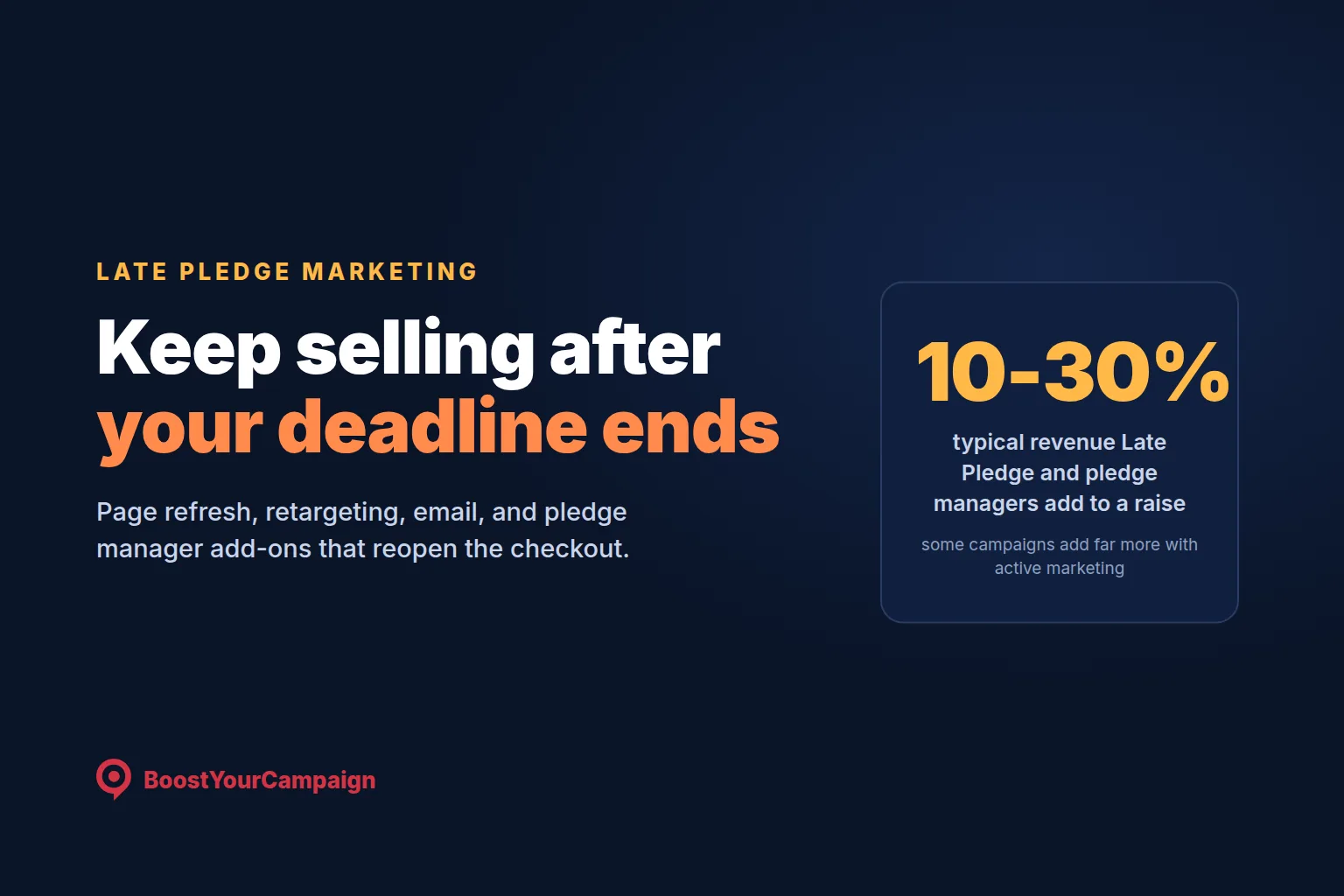
Indiegogo Late Pledge (formerly called InDemand) marketing keeps a funded campaign selling after the deadline: we refresh the page with proof, retarget visitors who did not back, email the list that missed the window, and route press and Indiegogo's own placements to a live checkout instead of a closed page. Late pledges and post-campaign add-ons commonly add 10 to 30 percent on top of the original raise, and some campaigns add far more once marketing and fulfillment are both dialed in. We run this alongside pledge manager marketing on BackerKit, Gamefound, or PledgeBox, and an owned Shopify store, whichever combination fits your platform and audience, priced as a fixed fee or a fee plus a performance layer on the extra revenue, quoted after we have seen your campaign numbers. It fits funded physical-product campaigns with real margin and stock coming; it is a weak fit for a campaign with no audience left to sell to.
What happens to demand after a campaign ends
Kickstarter and Indiegogo both keep a funded project visible after its deadline - in category listings, in search, in the sections buyers browse for "recently funded" projects - so the traffic curve does not fall to zero the moment the clock hits it. People discover your project through a friend's share a week later, a press piece that runs after launch, a YouTube review that drops the following month, and every one of those late arrivals hits a dead page if nothing is open to take their money.
Most creators stop marketing the day funding ends, assuming the job is done. It is the opposite - it is where the cheapest revenue in the whole project becomes available, because the audience, the creative, and the proof already exist. The size of the late-pledge share you actually capture depends almost entirely on whether anyone is still selling, not on luck.
The three post-campaign channels
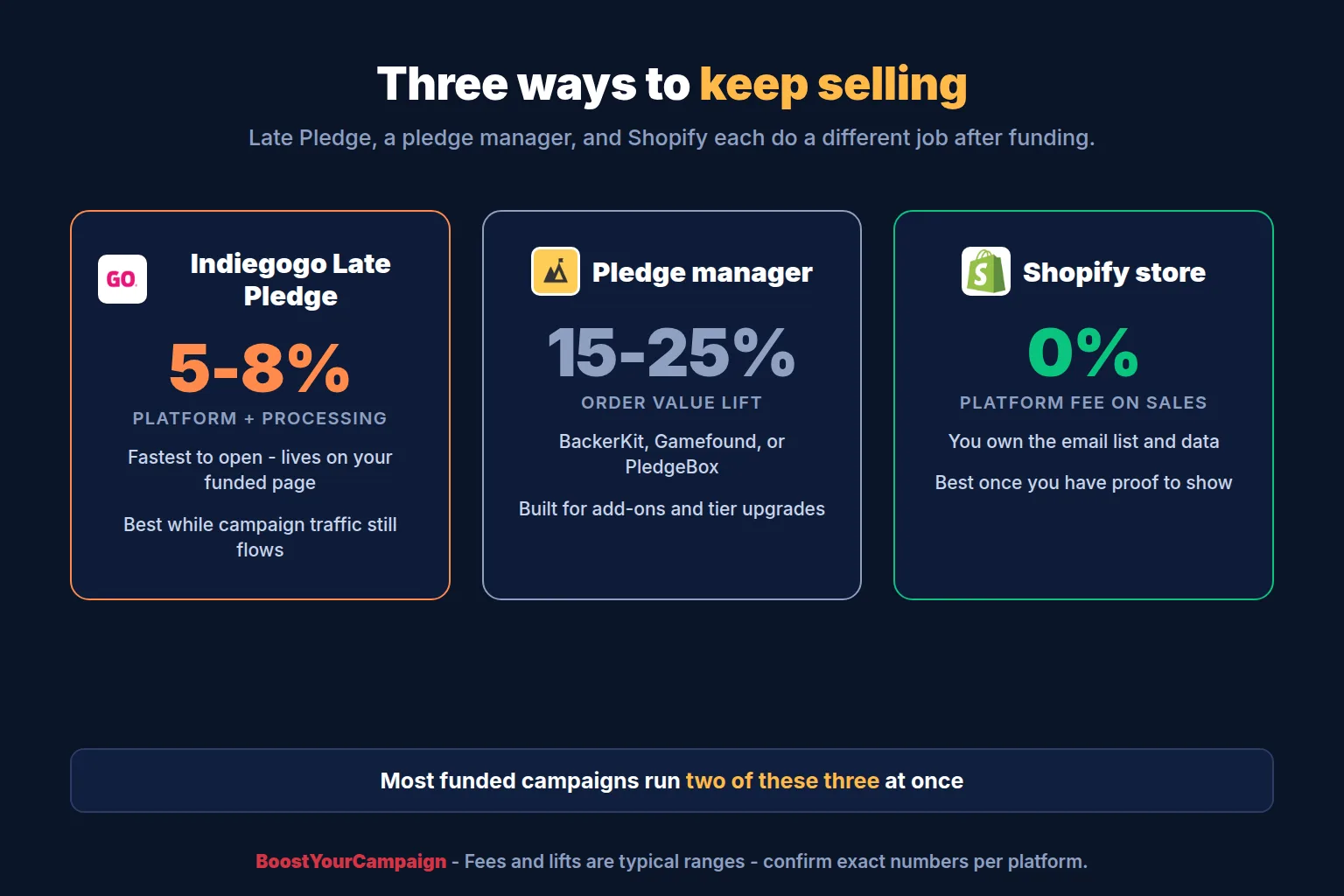
There are three real places to keep selling once a campaign funds, and they are not interchangeable. Indiegogo Late Pledge (formerly called InDemand) is the fastest to open because it lives on the page already getting traffic. A pledge manager - BackerKit, Gamefound, or PledgeBox are the most common - sits between the platform and your own site, built for the add-on and upsell work a complex reward structure needs. An owned Shopify store is the only one where you keep the full customer relationship: the email address, the purchase history, and a checkout that does not depend on a platform staying favorable to post-campaign sales. Most funded campaigns run two of the three at once rather than picking a single channel to carry the whole tail.
| Channel | Fees | Audience | Control | When to use |
|---|---|---|---|---|
| Indiegogo Late Pledge | Roughly 5% platform fee plus processing for Indiegogo-origin, higher bridging in from Kickstarter | Campaign page traffic, discovery placements, retargeted non-backers | Page and pricing; Indiegogo owns the checkout and contact detail | Fastest option, best while the page is still getting organic traffic |
| Pledge manager (BackerKit, Gamefound, PledgeBox) | Platform fee on the pre-order and add-on transaction | Existing backers plus new late pledgers from updates and email | Add-on catalog and upsell sequence; still a third-party checkout | Complex tier or add-on structure needing SKU locking and real-rate shipping |
| Owned Shopify store | Shopify plan plus payment processing only | Campaign retargeting and your email list, then cold and search traffic over time | Full - customer data, email flows, and pricing are yours | Once you have proof (photos, reviews, a tested ship date) to own the relationship |
How we run Late Pledge (formerly called InDemand)
Late Pledge does not sell itself once a campaign is funded - a live page with no traffic raises nothing. We treat it as an active marketing phase built around six moves.
Page refresh with social proof. The funded badge, backer count, update history, and strongest comments stay visible, rebuilt so a new visitor sees a proven, funded product rather than a stale listing.
Perk restructuring at a smaller discount. Deep early-bird pricing does not run forever. We retire the cheapest tiers and step Late Pledge pricing up above early-bird and below planned retail, protecting both early backers and your margin.
Retargeting the campaign visitors who did not back. Everyone who watched the video or clicked through without pledging is one of the cheapest audiences you will reach again, and Late Pledge gives them a page to land on instead of a dead link.
Email to the pre-launch list who missed the deadline. People who signed up before launch and never converted are still on your list, and a "still available, here is your second chance" sequence reaches them while the project is fresh.
Press and newsletter re-features. Coverage often runs after a campaign closes, not during it. We keep the press kit and every link pointed at the live Late Pledge page, so late coverage sends a buyer to a checkout instead of a "campaign ended" message.
Indiegogo's own placements. Category listings, discovery, and search keep sending traffic to a funded page for weeks, and we make sure that traffic lands on a page built to convert. Our Indiegogo Late Pledge guide and Indiegogo InDemand overview cover eligibility and migration in full.
Pledge manager marketing
When a campaign's reward structure has real complexity - base units, add-ons, tier upgrades, multiple variants - a pledge manager does the upsell job better than a bare Late Pledge (formerly called InDemand) page. We run four pieces on top of the manager itself.
The add-on catalog. Backers who already paid are the warmest audience in the funnel, and selling them one more thing is cheaper than acquiring a new buyer. We curate a short list of extra units, companion products, and tier upgrades rather than dumping every SKU into the store, since an uncurated catalog turns into a warehouse problem later.
The upsell email sequence. A survey reminder is also a sales moment. We sequence the messages backers already need - complete your survey, confirm your address - alongside the add-on offer, so one email closes a data gap and lifts order value.
The late pledge landing page. New buyers who missed the campaign need a dedicated entry point into the pledge manager, built around the same funded proof that works on Late Pledge, with a published close date.
Shipping charged in the manager. We hold off on final postage until the manager has a locked reward, add-ons, and a verified address, then charge real rates by weight and zone instead of the flat guess most campaigns quote up front. Our pledge manager and late pledges guide covers the survey, SKU-lock, and add-on mechanics in full.
The Shopify move
Late Pledge (formerly called InDemand) and a pledge manager both keep you inside someone else's checkout. A Shopify store is where you own the customer relationship outright, and timing matters more than the platform.
When to switch. Most campaigns get the best results opening the real store two to four weeks before rewards ship, once photos, reviews, and tested shipping rates are ready - not the week the campaign closes.
Pre-orders with delivery dates. A Shopify pre-order should hold the charge until there is a real ship date, the same discipline a good late pledge or pledge manager already applies, so a sale six weeks out does not turn into a chargeback.
Migrating backers as customers. We import backer data as orders, not customer records, using the platform's export with per-line-item SKUs turned on, so each pledge becomes one accurate order instead of a support ticket later.
Ads on the store. Campaign audiences - video viewers, page visitors, engaged ad clickers - are rebuilt as retargeting audiences before the campaign closes, ready to point at the store the day it goes live. See our Shopify store after crowdfunding guide and how to keep selling after crowdfunding.
The ads and email we run after funding
Ad accounts do not need to go quiet when a campaign closes, and email should not stop at one thank-you note. We run three layers once funding ends.
Retargeting warm audiences. Visitors who clicked through but did not pledge are cheaper to reach again than any cold audience, and the return tends to be strong because you are reminding a warm audience, not introducing the product from scratch.
Lookalikes from backers. A lookalike seeded from your backer list - people who already paid - consistently outperforms one built from page visitors alone, and it becomes the seed audience for the Shopify store and any future product.
The 30/60/90 day sequence. Days zero to thirty push the Late Pledge (formerly called InDemand) or pledge manager close-out hard: a close-out email within days of the deadline, retargeting live immediately, and a follow-up email timed to a production update. Days thirty to sixty shift messaging toward the Shopify pre-order as it opens, with shipping updates keeping the list engaged. Days sixty to ninety move toward launch-to-retail content - reviews, unboxing content, a first look at a second product - so the backer list keeps compounding.
Timeline
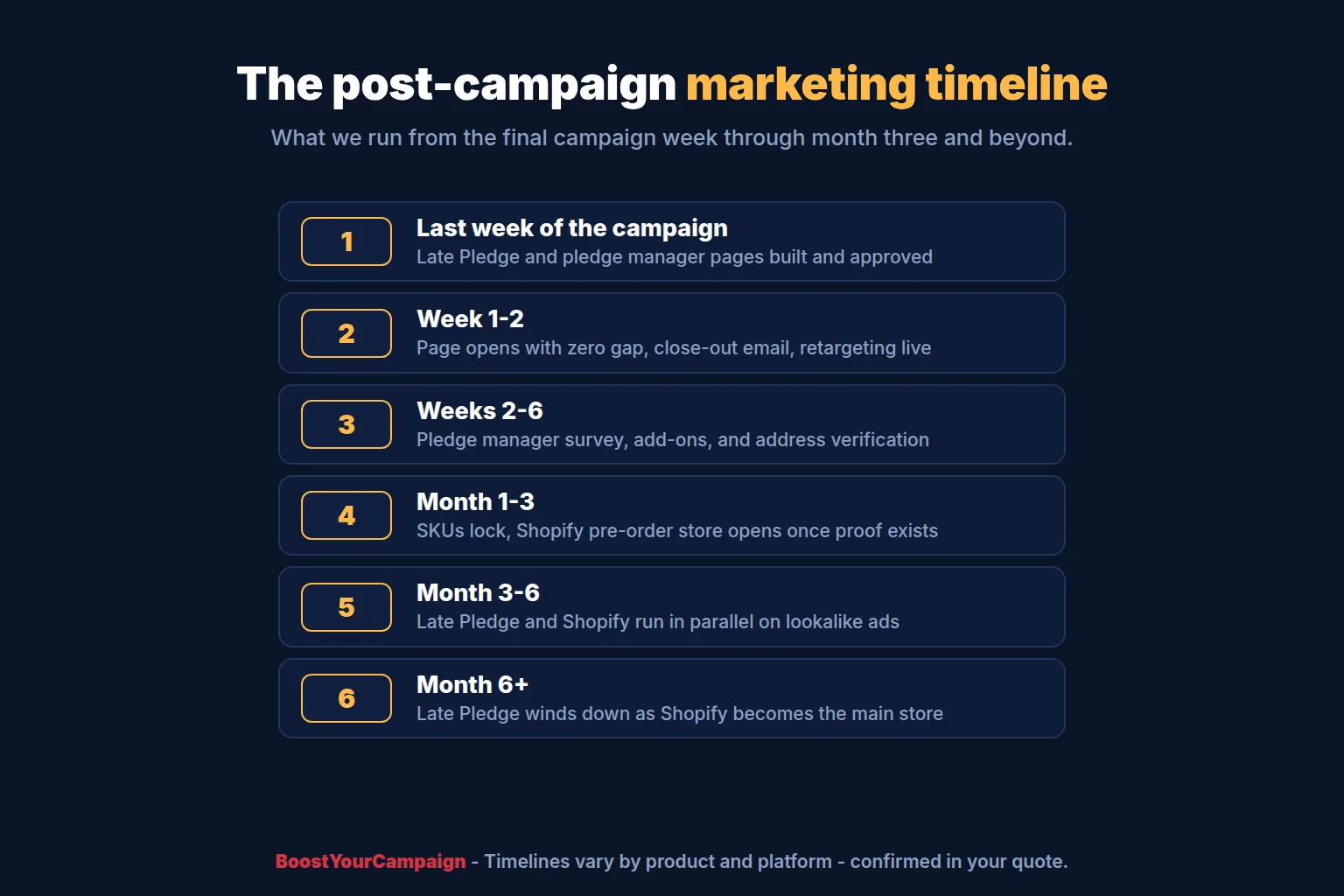
Post-campaign marketing works in phases, and each one has a different job.
| Phase | What we run |
|---|---|
| Last week of the campaign | Late Pledge (formerly called InDemand) or pledge manager page built and approved in advance, retargeting audiences saved, close-out email drafted and queued |
| Week 1-2 | Late Pledge or pledge manager opens with zero gap, close-out email sent, retargeting live, press kit and every link repointed at the live page |
| Month 1-3 | Pledge manager survey and SKU lock run their course, Shopify pre-order store opens once photos and rates are ready, backer data migrated in as orders |
| Month 3+ | Late Pledge keeps running as long as it converts - weeks to 6-12 months is typical - while the Shopify store becomes the primary channel and ads shift toward lookalikes and retail groundwork |
Pricing model
We price this the way we price ad management: a transparent fixed fee for the marketing scope, with an optional performance layer on post-campaign revenue for qualifying campaigns, so a weak-performing push costs us something too. We do not quote a number before we have seen your campaign - the raise, reward structure, and stock coming all change the scope, and a price quoted blind is a guess dressed up as an offer. For context, our published post-campaign work generally runs in the $2,499 to $6,997 range, though your quote depends on what actually funded.
Who it fits and who it does not
This fits campaigns that hit their funding goal, sell a physical product with real margin, and have stock coming - in production or close to it - so there is something to ship when extra orders arrive. It works best for creators who want to keep the audience they already paid to build rather than start from zero on a second launch.
It is a weaker fit for a campaign that did not fund, a product priced too thin to absorb further acquisition or fulfillment cost, or a project with no real traffic or list left to sell to - Late Pledge (formerly called InDemand) and a pledge manager both need an audience to work against. See our broader post-campaign growth overview for how this fits alongside the rest of what we run after a campaign closes, and read how creators describe the results in our client reviews.
What working with BoostYourCampaign looks like
Engagements move through four stages: an audit of your campaign and reward structure a week or two before the deadline, so Late Pledge (formerly called InDemand) or the pledge manager can go live with zero gap; the first two weeks, where the close-out email, retargeting, and press re-pointing fire at once; months one through three, where the pledge manager closes, SKUs lock, and the Shopify store opens once there is proof to show; and month three onward, where Late Pledge keeps running at whatever pace still converts while the Shopify store and lookalike audiences take over as the primary engine. Our Kickstarter ad management team can carry pre-launch and live-campaign ads straight into this phase, and our own US and EU warehouses mean fulfillment for every extra order runs through the operation that shipped your backer rewards - see our fulfillment and logistics page.
What we need from you: access to the ad accounts, campaign platform, and email list so reporting stays honest, confirmation of margin and stock timing so we can price add-ons and Late Pledge tiers correctly, and a founder who can turn around approvals quickly. Our services page covers how this fits alongside video, PR, and fulfillment for a larger engagement.
Frequently asked questions
What is Indiegogo InDemand and is it still available?
It is now called Late Pledge (formerly called InDemand), and yes, it is still available. Indiegogo renamed the feature, but the mechanics did not change: a funded campaign's page flips into an open-ended reward store with no forced end date, so backers who missed the window and new buyers can keep ordering.
How much can you raise with Indiegogo Late Pledge?
It varies by project, but across the campaigns we have marketed, Late Pledge commonly adds 10 to 30 percent on top of the original raise, and some campaigns have added well over 100 percent when the page kept getting active marketing and fulfillment could absorb the extra orders. The gap is almost always marketing effort and fulfillment quality, not luck.
Can a Kickstarter campaign move to Indiegogo Late Pledge?
Yes. Creators who funded on Kickstarter can apply to bring the project to Indiegogo Late Pledge, rebuild the page with assets they already have, and redirect post-campaign traffic there. Line this up while the Kickstarter is still live, so the moment it closes, ads, email, and the press kit redirect with no gap.
What are Indiegogo Late Pledge fees?
Late Pledge runs on Indiegogo's standard structure: roughly a 5% platform fee plus payment processing of about 3% and a small per-transaction charge for a campaign that launched on Indiegogo, closer to 8% combined for a Kickstarter campaign bridging in as a second channel. Confirm the exact current numbers on the platform before you launch.
Should I use a pledge manager or Late Pledge?
They are not mutually exclusive, and most well-run campaigns use both. Late Pledge is the fastest option and the best fit while your campaign page is still pulling in its own traffic. A pledge manager earns its place when your reward structure has real complexity - add-ons, tier upgrades, multiple variants - since that is what its add-on catalog and upsell tooling are built for.
When should I open a Shopify store after Kickstarter?
Most creators get the best results opening the real store two to four weeks before rewards ship, once product photos, reviews, and tested shipping rates are ready. An email-capture landing page during the campaign is fine, but holding off on live checkout until there is proof avoids launching a store with nothing but promises.
How long should post-campaign marketing run?
The first one to two weeks after close carry the bulk of the additional revenue, since that is where leftover campaign traffic and the freshest word of mouth both live. Late Pledge has no forced end date and commonly stays open a few weeks to six to twelve months, and marketing should keep pace with whichever channel - Late Pledge, pledge manager, or Shopify - carries the most volume.
Do you also handle fulfillment for late pledges?
Yes. We ship from our own US and EU warehouses, so Late Pledge and pledge manager orders both ship domestically on each side of the Atlantic instead of paying cross-border postage and customs surprises on every late order. See our Kickstarter Pledge Over Time guide for how this compares to Kickstarter's own built-in pledge manager.
If your campaign just funded and you do not want the page to go quiet, talk to an expert and we will map how Late Pledge, your pledge manager, and Shopify fit your actual numbers.
Ready to give your campaign the best shot?
We've helped 4,600+ creators raise over $734M since 2010. Let's pressure-test your launch plan and find the highest-leverage fixes before you go live.
Talk to an expert →