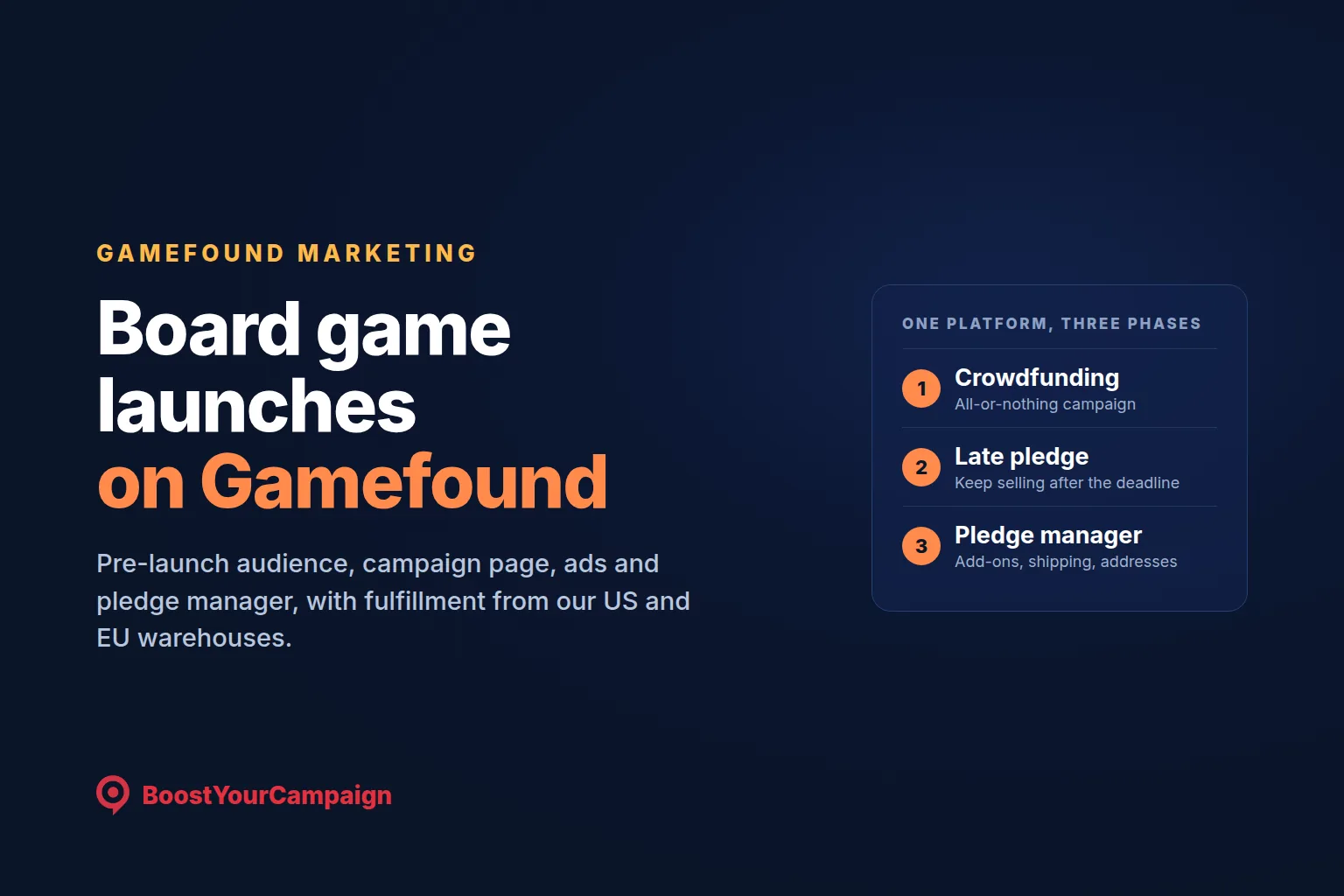
Gamefound is where a large share of tabletop crowdfunding now happens. It was built for board games, it runs the campaign, the late pledge and the pledge manager on one platform, and in 2025 it bought Indiegogo. What it does not do is bring your backers for you. The audience that funds a board game on launch day is built in the weeks before it, and that is the part of a Gamefound campaign we run. We have worked on 4,600+ crowdfunding projects since 2010 across Kickstarter, Indiegogo and Gamefound, raising more than $734M, and we ship rewards from our own warehouses in the US and the EU.
We run Gamefound campaigns for board games, card games, miniatures and tabletop accessories from pre-launch to delivery: a landing page and deposit funnel, audiences built from people who back tabletop projects, the campaign page with its pledge tiers, add-ons and stretch goals, Meta ads, outreach to reviewers and tabletop creators, the late pledge, the pledge manager, and fulfillment from the US and the EU. Gamefound charges 5% of the funds you collect plus payment processing, and nothing if the campaign does not fund. Our fee is a fixed package price quoted after we see your game, with ad spend either run from your own ad account or funded by us for a 15% kickback that is only paid if you reach your goal.
Why board games launch on Gamefound
Gamefound started as a platform for one category, and it still shows. Pledge tiers, add-ons and stretch goals are part of the default campaign structure rather than something you bolt on with a separate tool, and the backers who browse it are there for tabletop games specifically. They already know how add-ons, pledge managers and shipping calculators work, so your page spends its space selling the game instead of explaining the mechanics.
The platform also covers the months after funding. A Gamefound project moves from the campaign into a late pledge and then into the pledge manager inside the same system, where backers confirm their pledge, add extras, pick variants and pay shipping. Since July 2025 Gamefound has also owned Indiegogo, which moved onto Gamefound's technology on 16 October 2025, so the same tools now power both platforms. Our Gamefound guide covers how the platform works step by step.
Gamefound or Kickstarter for your game
This is the first question most tabletop creators ask us, and the answer depends on the audience you already have, not on which platform is "better". Kickstarter has the larger general audience and the strongest organic discovery. Gamefound has a smaller audience that is concentrated on tabletop and used to premium pledges. Many publishers run their first campaign on Kickstarter and later ones on Gamefound once they have a following of their own.
| Gamefound | Kickstarter | |
|---|---|---|
| Audience | Smaller, tabletop only, used to add-ons and premium tiers | Largest general audience, strong organic discovery |
| Funding model | All-or-nothing | All-or-nothing |
| Platform fee | 5% of funds collected plus payment processing | 5% of funds collected plus roughly 3 to 5% card processing |
| Pledge manager | Built in, same platform as the campaign | Built in since 2025, with late pledges since 2024 |
| Paying in instalments | Stretch Pay | Pledge Over Time |
| Best fit | Publishers with an existing tabletop following, premium and component-heavy games | First campaigns, broad-appeal games, creators who need discovery |
If you are still deciding, our Kickstarter vs Gamefound vs BackerKit comparison and three-platform overview go through the tradeoff in detail. We run campaigns on both, so the recommendation follows your numbers.
What we run on a Gamefound campaign
A Gamefound campaign has five phases, and each one needs different work. We plan all of them before launch so nothing is improvised once the clock is running.
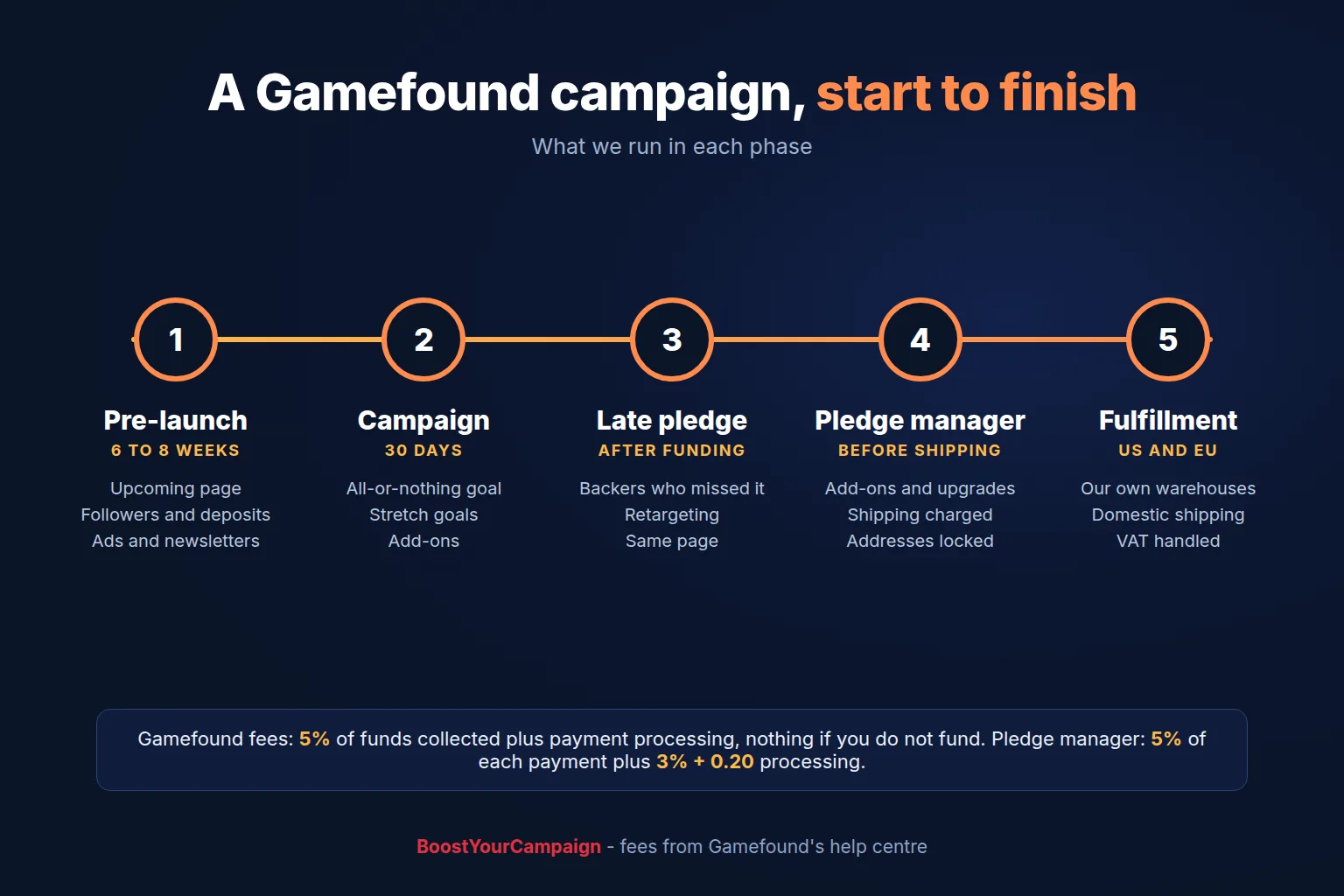
Pre-launch audience. We build a landing page with Viral Loops, where people who share your project can win a perk or an extra discount, and point targeted ads at it. A deposit page lets the most interested people reserve a pledge for a small deposit, which tells you far more about launch-day demand than an email address does. In parallel, the Gamefound Upcoming page collects followers who get notified the moment you go live.
Audiences built from return backers. The cheapest backers for a board game are people who already back tabletop projects. We build custom audiences from our previous work for relevant tabletop brands and email our own subscribed return-backer list: once with the announcement, again seven days before launch, and a final time 24 hours before you go live.
The campaign page. We write the pitch and design the page, and we structure the pledge tiers, add-ons and stretch goal ladder so they read clearly to a tabletop backer. That means fewer tiers than most first-time publishers plan, add-ons that raise the average pledge without turning into a warehouse problem, and stretch goals backers can see and understand at a glance.
Ads and outreach. We run Meta ads through the pre-launch and the live campaign, and we pixel every audience that comes in, so anyone who visits without pledging can be retargeted. We also contact reviewers, tabletop creators and press individually, with prototypes shipped early enough for honest previews to go up before launch. See our PR and media outreach page for how that side works.
Late pledge and pledge manager. After the campaign we keep the page selling to people who missed it, then run the pledge manager so backers lock their choices, add extras and pay shipping before anything is produced.
Adfound or an agency
Gamefound has its own ad tool, Adfound, and it is a reasonable option for some campaigns. According to Gamefound's help centre, Adfound runs ads on Meta platforms such as Facebook and Instagram from Gamefound's own ad accounts, so you do not need a Meta account of your own. It generates the ads from the images, videos and text you upload, handles targeting based on your project details and similar projects, and lets you choose locations to target or avoid. It charges 5 percent of the total revenue the ads bring in for campaigns promoting a crowdfunding project, late pledge or pledge manager, with no commission while a project is in the Upcoming phase.
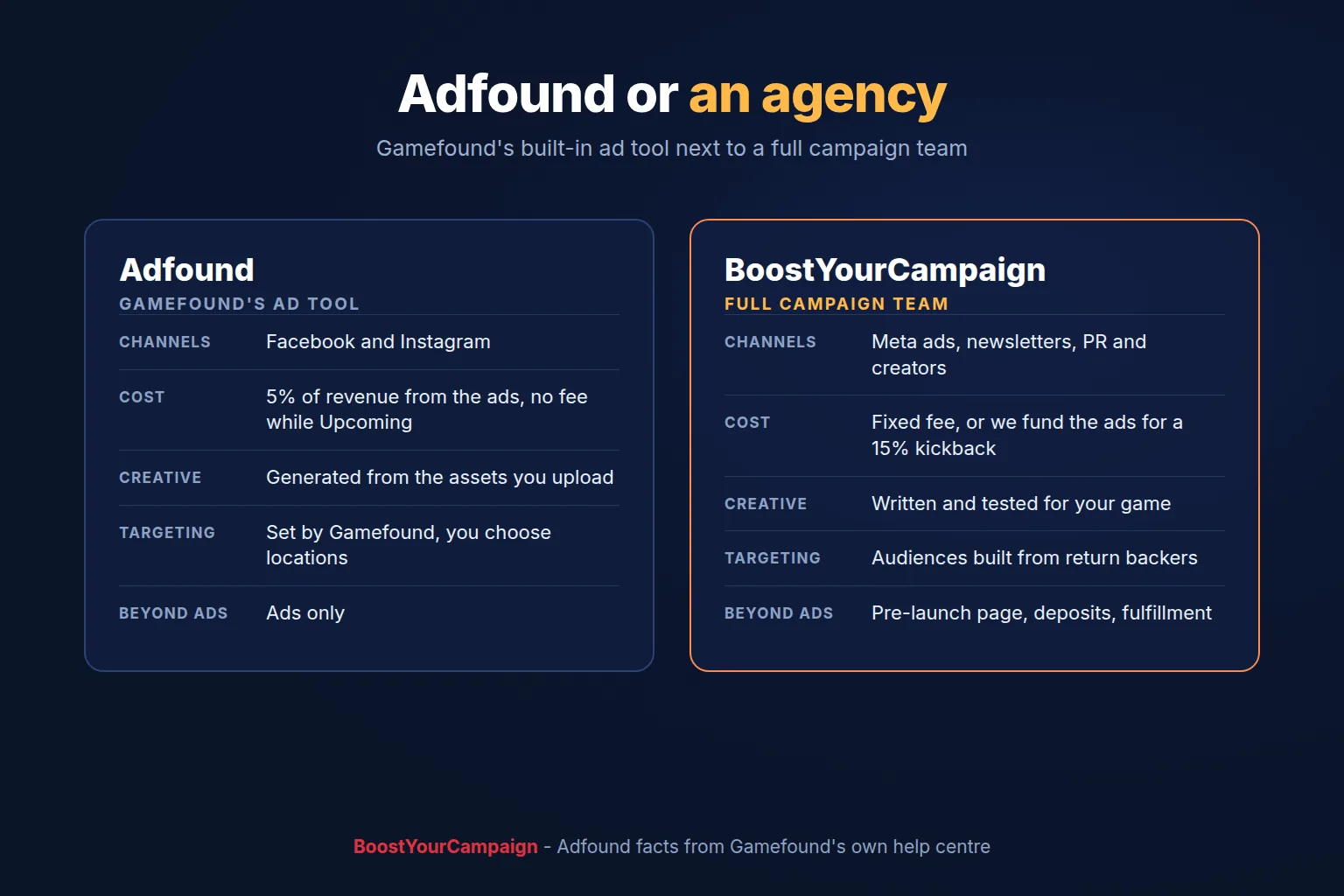
Adfound works when you already have strong creative, a following of your own, and you mainly want extra Meta reach during the live campaign. It does not build the audience you launch to. A campaign that funds on day one needs a pre-launch list, deposits, return-backer audiences, reviewer coverage and a page that converts, and those sit outside any ad tool. That is the work we do, and it is why most of the budget on a board game campaign goes into the weeks before launch rather than the 30 days after it.
The two are not exclusive. Some creators use Adfound during the live campaign while we run the pre-launch, the page and the outreach. We will tell you honestly whether it makes sense for your project.
Late pledge and the pledge manager
On Gamefound the pledge manager is part of the platform, and it costs nothing to run as such. Gamefound takes 5% of each payment collected through it plus payment processing of 3% + 0.20 per transaction in the project currency, according to its fee page. That is where most of the revenue after a campaign comes from: add-ons, tier upgrades, and late backers who join before production locks.
You can also use Gamefound's pledge manager and late pledge after a campaign that ran somewhere else. Gamefound sets these up as an external campaign, so a Kickstarter-funded game can move its backers into Gamefound for the pledge manager phase. We help decide whether that move is worth it, set up the add-on catalogue, and run the emails that turn a survey reminder into extra orders. Our pledge manager and late pledges guide covers the mechanics.
Shipping is charged in the pledge manager rather than during the campaign, once rewards, add-ons and addresses are locked. That way backers pay real rates by weight and zone, and your raise does not get eaten by a flat shipping guess made months earlier.
Fulfillment for board games
Board games are heavy for their price. A standard game weighs around 2 to 4 lbs, and a deluxe tier with miniatures or a plastic insert can reach 6 to 10 lbs or more, which is where shipping costs and customs surprises hit a campaign hardest. We ship from our own warehouses in the US and the EU, so backers on each side receive their games domestically, with VAT handled for European backers instead of being charged at their door. See our US fulfillment and EU fulfillment pages and the board game fulfillment guide.
Pricing
A Gamefound campaign is priced the same way as a Kickstarter campaign: a fixed package fee, quoted after we have seen your game, your goal and the audience you already have. We do not quote blind, because a price given before seeing the project is a guess.
Ad spend is separate, and there are two ways to handle it. We can run the ads from your own ad account and share our custom audiences with you. Or we fund the ads ourselves and receive a 15% kickback on the pledges those ads bring in, paid only if the campaign reaches its goal, so we carry part of the risk with you. See our skin in the game model for how that works. Package fees are paid 50% at the start, covering the pre-launch, and 50% three days before the campaign goes live.
Who it fits
This fits publishers and designers launching a board game, card game, miniatures line, RPG product or tabletop accessory, with a playable prototype and enough time for a proper pre-launch: six to eight weeks at the least, longer for a first campaign. It fits especially well when the reward structure has several add-ons or a deluxe tier, because that is where Gamefound's tools and a well-run pledge manager earn the most.
It is a weak fit if the campaign launches next week, if the game is not yet playable, or if there is no budget for ads at all. A campaign that is already live and struggling is a different case, and we can still help with a review of the page and a push for the remaining days. Read what creators say about working with us in our reviews, and see the projects we have worked on in our portfolio.
Frequently asked questions
Is Gamefound better than Kickstarter for board games?
It depends on your audience. Gamefound has a smaller audience focused entirely on tabletop and used to premium pledges, which suits publishers with an existing following and component-heavy games. Kickstarter has the larger general audience and stronger discovery, which usually suits a first campaign. We run campaigns on both and recommend the one that fits your numbers.
How much does Gamefound charge?
Gamefound takes 5% of the amount collected plus payment processing, and if the campaign does not reach its goal you pay nothing, including no processing fees. In the pledge manager it takes 5% of each payment collected plus processing of 3% + 0.20 per transaction in the project currency.
What is Adfound, and do I still need an agency?
Adfound is Gamefound's built-in ad tool. It runs Facebook and Instagram ads from Gamefound's ad accounts and charges 5% of the revenue the ads bring in, with no commission while a project is in the Upcoming phase. It is useful for extra reach during a live campaign. It does not build the pre-launch audience, the page, the reviewer coverage or the return-backer audiences that decide how much a board game raises on day one.
Can I use Gamefound's pledge manager after a Kickstarter campaign?
Yes. Gamefound supports external campaigns, so a game funded on Kickstarter can run its pledge manager and late pledge on Gamefound. Kickstarter also has its own pledge manager now, so we compare both for your reward structure before you commit.
Does Gamefound own Indiegogo?
Yes. Gamefound acquired Indiegogo in July 2025, and Indiegogo moved onto Gamefound's technology on 16 October 2025. Both platforms now run all-or-nothing campaigns with a built-in pledge manager. Our Kickstarter vs Indiegogo comparison covers what changed for creators.
How early should a Gamefound pre-launch start?
Six to eight weeks is the minimum we work with, and longer is better for a first campaign. The pre-launch is where the landing page, deposits, return-backer audiences and reviewer previews come together, and a board game that launches without them usually stalls in the first 48 hours.
Planning a board game launch on Gamefound or Kickstarter? Talk to an expert and we will map the pre-launch, the page and the budget around your game.
Ready to give your campaign the best shot?
We've helped 4,600+ creators raise over $734M since 2010. Let's pressure-test your launch plan and find the highest-leverage fixes before you go live.
Talk to an expert →