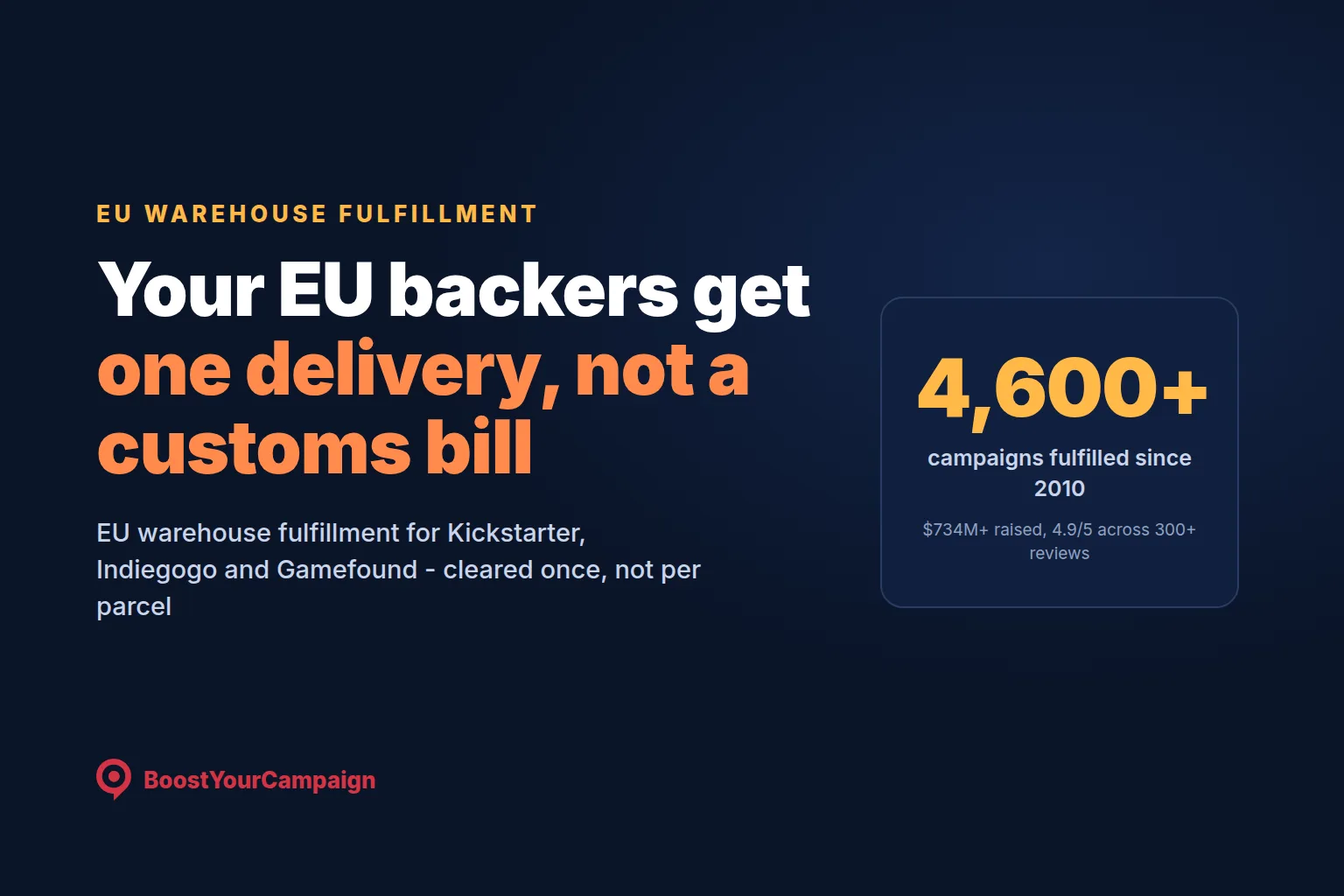
A campaign that ships from a single US warehouse turns every European backer's parcel into its own customs event. The courier holds the box until someone pays import VAT and a handling fee, delivery stretches from days into weeks, and the update thread fills with backers asking where their reward went. We have run crowdfunding launches and fulfillment since 2010 across more than 4,600 campaigns and over $734M raised, holding a 4.9/5 rating across more than 300 verified reviews, and we operate our own warehouses in the EU and the US instead of routing every parcel through one country and hoping customs cooperates.
Fulfilling a Kickstarter, Indiegogo or Gamefound campaign from an EU warehouse means your bulk shipment clears customs once, as a single commercial import, instead of every backer's parcel clearing individually at the border. EU backers then receive what looks like a domestic parcel - no courier collecting VAT on the doorstep, no handling fee, delivery in days rather than weeks. For individual reward tiers under 150 EUR shipped directly from outside the EU, the IOSS scheme lets you collect VAT at checkout instead; once you are shipping in volume, bulk import into an EU warehouse is generally the cleaner path. The service covers inbound freight, EORI-based customs clearance, receiving and QC, pledge manager order exports, pick and pack, and carrier dispatch through DHL, DPD and PostNL, with US backers served separately.
Why EU backers need EU stock
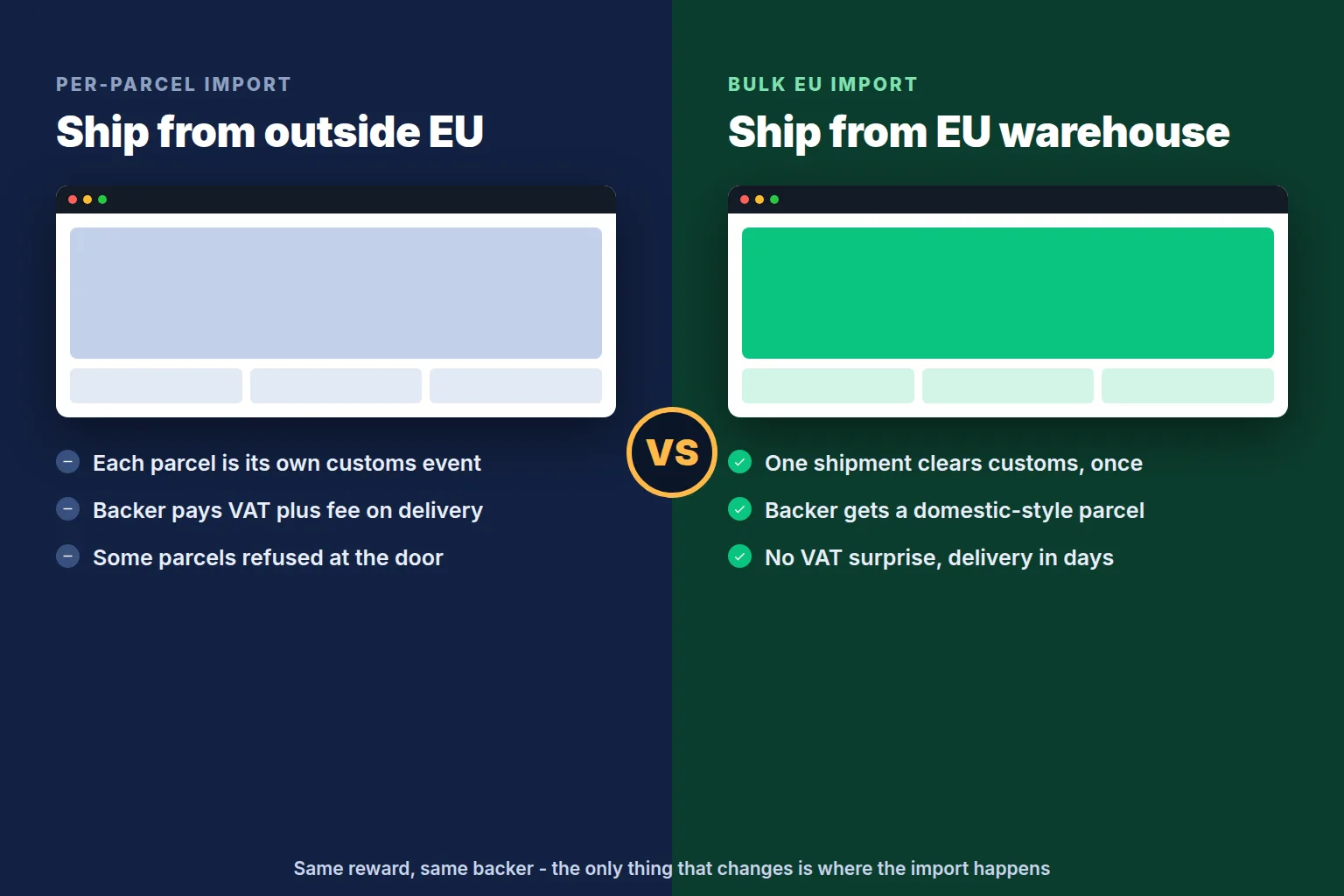
When your stock sits in our EU warehouse, the import happens once: a single commercial shipment clears EU customs as one event, with one commercial invoice, one set of HS codes, and one importer of record. Every parcel that goes out afterward is an intra-EU or domestic delivery, not a fresh border crossing, which removes the three things that do the most damage to a European fulfillment run.
The first is the doorstep bill: ship individually from outside the EU and a meaningful share of parcels get held until the backer pays import VAT plus a courier handling fee, often several euros on top of a box already paid for months earlier. Some backers refuse the parcel outright, leaving you with a return, a refund and a public complaint. Clear customs in bulk and that moment never happens.
The second is speed: a parcel already sitting inside the EU reaches a backer in Germany, France or the Netherlands in days once it leaves the warehouse, closer to a domestic order than an international one. The third shows up after the campaign: reviews. Fast, fee-free delivery earns good ones; a surprise bill and a long wait earns the kind that follow you into your next launch. European backers commonly make up a fifth to two fifths of a campaign's total and cost real money to acquire, so their fulfillment experience is the last impression most of them get of the project. Our guide to shipping Kickstarter rewards to Europe covers the backer-experience side in more depth.
VAT and IOSS explained for creators
EU tax authorities treat a crowdfunding reward as a sale of goods, not a gift, so VAT applies the same way it would on any commercial import. Which mechanism matters depends on how you ship.
Individual parcels shipped directly to EU backers from outside the EU, valued at 150 EUR or less, generally qualify for the Import One-Stop Shop (IOSS) scheme: you or your fulfillment partner collect VAT at the point of sale and remit it through one monthly return, so the parcel clears without VAT collected again at the border. Above 150 EUR, IOSS does not apply and the parcel goes through standard import procedures instead.
Freighting stock into an EU warehouse in bulk works differently: the shipment clears as a single commercial import, with import VAT and any duty assessed and paid once by the importer of record. From that point, parcels to EU backers are intra-EU or domestic deliveries that generally do not trigger a fresh VAT event. This scales better than per-parcel IOSS once you are shipping meaningful volume.
Two registrations sit underneath both models: an EORI number, which identifies the importer and which we hold for shipments through our warehouse, and VAT registration, a separate question depending on your setup and volume - you may need to register in one or more EU countries, or work through IOSS instead. Rates vary by country, commonly 17-27%, generally at the backer's own country rate. None of this is tax advice - confirm your obligations with your accountant before you set reward pricing.
Customs paperwork we handle
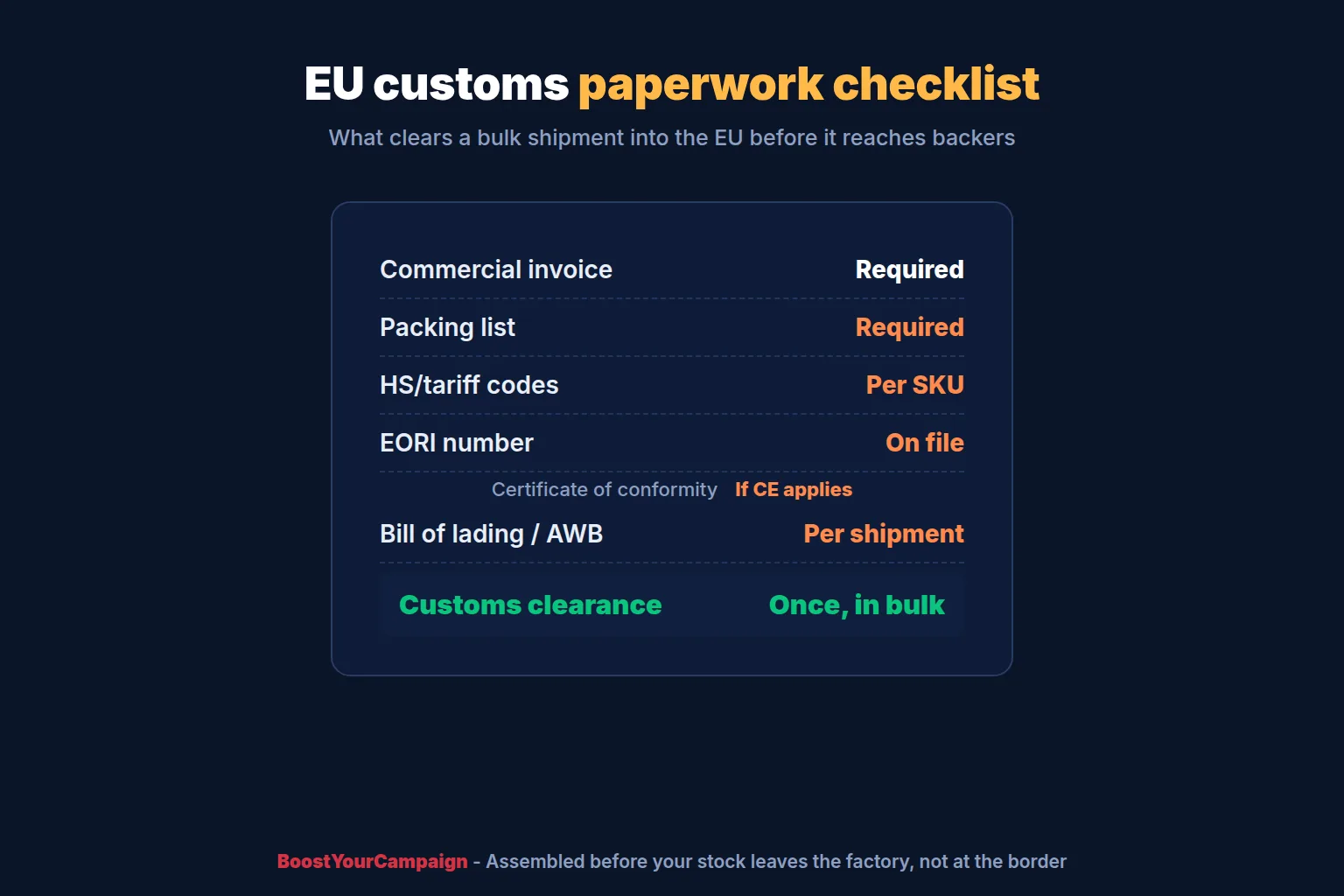
Clearing a bulk shipment into the EU cleanly comes down to having the right paperwork assembled before the container leaves the factory, not scrambling at the border. This is what we assemble for every EU-bound shipment.
| Document | What it does |
|---|---|
| Commercial invoice | Seller, buyer, item description, quantity, unit value and country of origin for every SKU - what customs uses to assess duty |
| Packing list | What is physically in each carton or pallet, so the warehouse can reconcile against the invoice without opening every box |
| HS/tariff codes | The Harmonized System code for each product, driving the duty rate and any extra certification needed |
| EORI number | Identifies the importer to EU customs - required on file before a commercial shipment can clear |
| Certificate of conformity (CE, where relevant) | Confirms electronics, toys and similar categories meet EU safety standards |
| Bill of lading or air waybill | The contract of carriage for freight by ocean or air, used by the freight forwarder and customs broker |
Getting any of this wrong is the most common reason a shipment sits in a bonded warehouse instead of moving to backers - a vague item description, a mismatched HS code, or a missing EORI number can each hold a shipment on its own. We assemble and file this documentation as part of running the EU warehouse. Our customs documentation guide covers each document and the common rejections that delay a shipment.
What EU shipping costs by weight and country band
EU shipping cost comes down to weight once packed, distance from the warehouse, and whether it moves as a domestic-style regional parcel or an individual cross-border shipment. Once inventory is already inside the EU, delivery to most of Western Europe prices close to a domestic parcel; the Nordics and the more distant parts of Southern Europe run a bit higher for the extra carrier zone. Treat the ranges below as planning estimates, not quotes - carrier rates shift with fuel surcharges and change yearly.
| Weight tier | Germany, France, Netherlands | Nordics | Southern Europe |
|---|---|---|---|
| Light (up to 0.5kg - pin, small accessory) | roughly 6-9 EUR | roughly 8-12 EUR | roughly 8-12 EUR |
| Mid (1-1.5kg - small game, gadget) | roughly 9-13 EUR | roughly 11-16 EUR | roughly 11-16 EUR |
| Heavy (3kg+ - board game, hardware bundle) | roughly 15-22 EUR | roughly 18-26 EUR | roughly 18-26 EUR |
Compare that to shipping the same reward as an individual parcel from outside the EU, where postage alone commonly runs 30-35 EUR for a mid-weight parcel before VAT and any handling fee - that gap is the whole argument for bulk freight into an EU warehouse. Freighting roughly 500 units in commonly costs a few thousand euros total, a few euros per unit before pick, pack and regional postage, and that fixed cost typically pays for itself well under the 500-unit mark. Our Kickstarter shipping costs guide has the fuller breakdown and freight break-even math.
The UK after Brexit
The UK left the EU customs and VAT area in January 2021, so a parcel shipped from an EU warehouse to a UK backer is an export, not an intra-EU delivery. Two models generally work: hold a separate slice of UK stock, either in the UK or dispatched from our US warehouse depending on backer mix, or ship UK orders delivered duty paid (DDP) directly from the EU warehouse with UK-specific documentation prepared in advance.
UK VAT is a separate registration from EU VAT and from IOSS, handled under its own rules rather than folded into your EU setup. This is general guidance, not tax advice - confirm your UK VAT position with your accountant if UK backers make up a meaningful share of your campaign. Our guide for UK creators goes deeper on pricing and audience questions.
A note on spelling, because it causes real confusion when creators compare quotes. British English writes it fulfilment with one l, American English writes it fulfillment with two. They are the same service. UK and Irish creators searching for crowdfunding fulfilment companies, and US creators searching for crowdfunding fulfillment companies, are looking at the same warehouses, the same carriers and the same customs paperwork. We use the American spelling across this site because most of our creators are US-based, but our London office runs the same conversations in British English every week.
Timeline from factory to EU backers
| Phase | What happens | Typical duration |
|---|---|---|
| Inbound freight | Finished goods ship by sea or air to our EU warehouse | Sea commonly 4-8 weeks; air days, at a much higher cost |
| Customs clearance | The bulk shipment clears as one commercial import using the invoice, packing list, HS codes and EORI on file | Within the freight timeline when paperwork is ready before arrival |
| Receiving and QC | Units counted against SKU, checked for damage, and shelved | A few days once the shipment lands |
| Pledge manager export | Validated addresses and order data matched to SKUs and add-ons | Ongoing as orders finalize |
| Pick, pack and dispatch | Each order picked, packed and handed to the regional carrier | Same day to a few days per batch |
| Delivery to EU backers | Parcels move as domestic or intra-EU deliveries with no customs event | A few days to just over a week |
Sea freight is cheaper for the inbound leg by a wide margin, but it only works if your timeline leaves room for it - promising delivery on air freight speed while budgeting sea freight pricing turns into a scramble later. We build the inbound timeline backward from your promised delivery date so the freight decision gets made early.
What the service includes
Running EU fulfillment as a done-for-you service means the pieces above are not separate vendors you have to find and manage yourself:
- Inbound freight coordination, sea or air depending on timeline
- Customs clearance under our EORI, with invoice, packing list, HS codes and certificates of conformity
- Receiving and QC against your SKU list before stock goes into inventory
- Kitting for reward tiers and add-ons
- Pledge manager order export, matched to validated addresses and SKU choices
- Pick, pack and dispatch through carriers including DHL, DPD and PostNL
- Tracking pushed back to each backer, with support for lost or damaged parcels
- Returns handling, so undeliverable parcels go back into sellable inventory
Because the warehouse is ours rather than an outsourced partner, we can adjust packing specs, carrier selection and kitting directly with you. Our crowdfunding fulfillment services overview puts this approach next to the alternatives.
Pricing model
EU fulfillment is priced per project, based on product weight and dimensions, order volume, number of SKUs and add-ons, and projected EU backer share. We would rather quote against your real numbers than publish a flat rate that fits no one exactly - a 200 gram enamel pin set and an 8kg board game bundle cost genuinely different amounts to freight, clear and ship. Ad management on the same engagement, where it applies, runs on the fixed-fee and skin-in-the-game model on our skin-in-the-game page; fulfillment is quoted separately.
Splitting EU and US stock
Most campaigns we run for creators outside Europe split inventory between our EU and US warehouses rather than shipping everything from one country. Freight a portion of your stock into each region once, in bulk, and every backer there gets a domestic-style delivery instead of an international one. Allocation follows your projected backer geography - if pre-launch data suggests a third of backers are in Europe, that is roughly the share of stock that belongs in the EU warehouse, with a buffer. Our US fulfillment page covers the other half of that split.
Who it fits and who it does not
This fits campaigns where European backers make up a real share of the total, commonly a fifth or more, and where the reward has enough margin to absorb freight and warehousing cost. It particularly fits hardware, tabletop games, design objects and other physical rewards with meaningful weight or fragility, where the gap between individual shipping and bulk EU freight is largest.
It is a weaker fit for a campaign with only a handful of European backers, where a second warehouse's fixed cost is unlikely to be recovered by the savings and IOSS-based direct shipping is simpler. It is also not the right starting point for a campaign that has not yet estimated its EU backer share, since that estimate decides whether a warehouse pays for itself - we are direct about this at the quoting stage rather than selling a split to every project. Weighing a European platform instead? Our guide to Kickstarter alternatives in Europe compares fees and audience.
What working with BoostYourCampaign looks like
Engagements start with a review of your product weight, packed dimensions, reward structure and projected backer geography, so the numbers we give you are built on your actual product, not a category average. From there we plan the EU warehouse allocation and the US split where it applies, set up EORI-based clearance and IOSS or VAT registration as needed, and prepare the paperwork before your first shipment leaves the factory. Once your pledge manager closes, we validate addresses, kit multi-item pledges, and start pick, pack and dispatch, with tracking and a direct point of contact for exceptions - damaged parcels, address corrections, missing rewards - rather than a generic support queue. Our services page covers how fulfillment fits alongside marketing, and our fulfillment and logistics page covers the wider planning behind reward pricing.
Before you ask for a quote, run your reward weight and backer split through our free Kickstarter shipping cost calculator to see the range you are working with.
Frequently asked questions
How do I ship Kickstarter rewards to Europe without customs charges for backers?
Fulfil EU backers from stock already inside the EU. A bulk shipment clears customs once, and every parcel that goes out afterward is a domestic or intra-EU delivery with no import event at the door - the model that removes the surprise VAT and handling fee backers otherwise get charged on arrival.
Do I need to register for VAT to fulfill a Kickstarter in the EU?
Generally yes, in some form, though the exact requirement depends on how you are shipping and your volume. Parcels under 150 EUR can often use IOSS instead of full VAT registration; a bulk import into an EU warehouse involves import VAT on the shipment plus its own registration considerations. Confirm specifics with your accountant.
What is IOSS and does it apply to crowdfunding rewards?
IOSS (Import One-Stop Shop) lets you collect VAT at the point of sale on parcels valued at 150 EUR or less and remit it through one monthly return, so the parcel clears without VAT collected again at the border. It applies to most individual reward tiers shipped directly from outside the EU. Above that threshold, or shipping bulk freight into a warehouse, import VAT on the bulk shipment is the relevant mechanism instead.
How much does EU fulfillment cost for a Kickstarter?
It depends on product weight and dimensions, order volume, number of SKUs and your EU backer share, so we quote per project. As a planning reference, freighting several hundred units in commonly runs a few thousand euros total, a few euros per unit, and typically pays for itself well before your EU backer count reaches the low hundreds.
Can you ship to the UK after Brexit?
Yes. The UK is a separate customs and VAT territory from the EU, so UK orders need their own export and import documentation rather than riding on your EU setup. Depending on backer mix, we either hold separate UK stock or ship DDP directly from the EU warehouse with UK-specific paperwork prepared in advance.
Which EU country is best for a crowdfunding warehouse?
It depends mainly on where your EU backers are concentrated and how the location connects to regional carriers like DHL, DPD and PostNL. We place stock based on your backer geography, not a single fixed location for every campaign.
How long does EU fulfillment take?
Inbound freight commonly takes 4-8 weeks by sea or a matter of days by air, plus clearance and receiving once it lands. Dispatch to EU backers is typically a few days to just over a week, since the parcel moves as a domestic delivery rather than crossing a border.
Do you handle Gamefound and Indiegogo campaigns too?
Yes. The EU warehouse model works the same way regardless of platform. For Indiegogo, that includes fulfilling Late Pledge (formerly called InDemand) orders as they arrive after the main campaign, using the same EU stock and customs setup. See our Indiegogo fulfillment guide for the Late Pledge details.
If your campaign has a real European backer base, talk to an expert and we will map your EU shipping cost, VAT approach and warehouse allocation before you set a single reward price.
Ready to give your campaign the best shot?
We've helped 4,600+ creators raise over $734M since 2010. Let's pressure-test your launch plan and find the highest-leverage fixes before you go live.
Talk to an expert →