Kickstarter has rolled out two features that change how a campaign is priced, run, and fulfilled: pledge over time, which lets a backer split a pledge into installments, and a built-in pledge manager that collects add-ons, surveys, and shipping charges without a separate tool. Neither one changes the platform's all-or-nothing funding rule, but both change what happens after a campaign funds. If you are still deciding which platform to launch on in the first place, our Kickstarter vs Indiegogo comparison is a useful starting point. If you want help deciding whether to run your pledge manager inside Kickstarter or hand it to BackerKit or Gamefound, talk with BoostYourCampaign about your reward structure and fulfillment timeline.
Kickstarter's pledge over time lets an eligible backer split a pledge into a small number of automatic installments instead of paying the full amount at checkout, and it tends to raise average pledge value on higher-priced rewards because backers who could not justify one large charge can commit at a payment schedule that fits their budget. Kickstarter's built-in pledge manager handles add-ons, backer surveys, and shipping collection inside the platform itself, which works well for a simple reward structure but has less configuration depth than BackerKit, Gamefound, or PledgeBox. Because eligibility, installment counts, and exact terms have changed before and can change again, confirm the current rules on Kickstarter's help center before you build reward pricing or campaign copy around them. The right setup depends on how complex your reward tiers and add-ons are, not on which tool launched most recently.
- Pledge over time splits a pledge into installments - it does not change Kickstarter's all-or-nothing funding rule, and eligibility can vary, so confirm current terms on Kickstarter's help center before you rely on it.
- Average pledge value tends to rise on higher-priced tiers once backers can spread the cost, but more payment attempts also means more chances for one installment to fail.
- The built-in pledge manager covers surveys, add-ons, and shipping without a third-party tool, which is enough for a simple reward structure and not enough for a complex one.
- BackerKit, Gamefound, and PledgeBox add configuration depth, marketing tools, and reporting that Kickstarter's native pledge manager does not try to match.
- Late pledges keep a campaign selling after the funding window closes, and they typically add a meaningful share on top of the original raise.
- Fulfillment planning starts from the pledge manager export, not the campaign page pledge count, because add-ons and installment status change what actually ships.
1) How pledge over time actually works
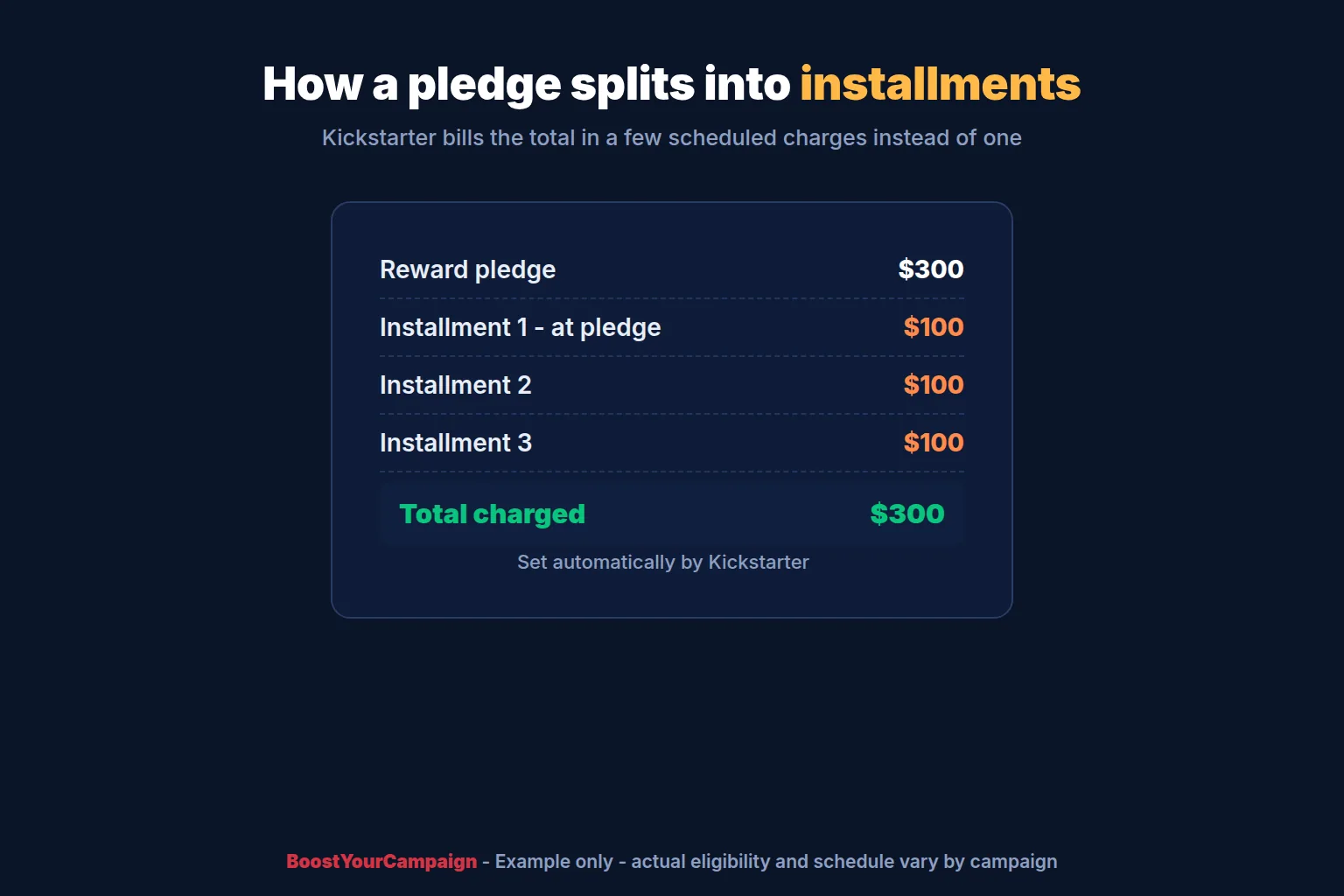
Pledge over time lets an eligible backer split a single pledge into a set number of automatic charges spread across the funding period, instead of paying the full reward price the moment they back. As an example, a $300 reward split into three installments works out to roughly $100 per charge, with Kickstarter handling the scheduling and the automatic billing rather than the creator running charges manually. The backer commits to the full pledge amount up front, they just do not pay all of it in one transaction.
Eligibility has been narrow and specific since the feature launched, and it has shifted more than once, tied to factors like reward price, campaign length, currency, and region. Do not assume a threshold you read somewhere last year is still the current one. Before you build reward pricing, campaign copy, or ad messaging around pledge over time, confirm the current eligibility rules and installment structure on Kickstarter's help center, because pricing a flagship reward around a payment plan that turns out not to be available for your campaign is a mistake you only find out about after launch.
What stays constant is the underlying logic: Kickstarter is doing the deferred billing, not the creator. You do not choose the exact number of installments or the exact schedule for an individual backer's pledge - Kickstarter's system determines that based on the reward price and its own rules. That is a meaningful difference from a third-party pledge manager's payment plan, where the creator or platform typically has more control over the schedule.
The practical takeaway is to treat pledge over time as a demand-side tool, not a pricing loophole. It does not let you charge more for a reward than backers are willing to pay in total, it lets backers who are willing to pay that total spread it out. Campaigns that price a reward assuming installments will paper over a genuinely too-high price tend to be disappointed either way.
2) Why it changes average pledge value and reward pricing
The clearest effect of pledge over time shows up on higher-priced reward tiers. A backer who hesitates at a single large charge for a flagship bundle is often willing to commit to the same total spread across a handful of payments, because the decision at checkout feels smaller even though the total commitment is identical. Campaigns that watch their tier-level conversion after enabling pledge over time frequently see average pledge value move upward on the tiers where it is available, simply because more backers are willing to say yes to the top of the reward ladder.
That effect cuts both ways on planning. A higher average pledge value looks good on the campaign page and in the funding total, but it is not the same as a higher amount of cash in hand at any given moment. A pledge that is technically fully committed can still have outstanding installments due weeks after the campaign closes, which matters for anyone budgeting production costs, ad spend, or fulfillment deposits against the campaign total shown on the page.
There is also a dropped-payment risk that a straight one-time-charge campaign does not have. Every additional charge attempt on a card is another chance for a decline: an expired card, insufficient funds, or a bank flagging a repeat charge as suspicious. Most installments go through without issue, but a share of backers who split a pledge will have at least one later installment fail, and Kickstarter gives the backer a window to fix payment details before the pledge is at risk. A creator planning production counts or reward inventory should not treat every split pledge as fully guaranteed revenue until the final installment actually clears.
The pricing implication is straightforward: it is reasonable to price a flagship, higher-cost reward more confidently once pledge over time is available, since it genuinely expands who can afford it. It is not reasonable to assume every pledge on that tier will convert into full, on-time cash. Build a small buffer into revenue and fulfillment projections rather than counting the funding total as fully collected the day the campaign ends.
3) Cash flow timeline and dropped-payment risk
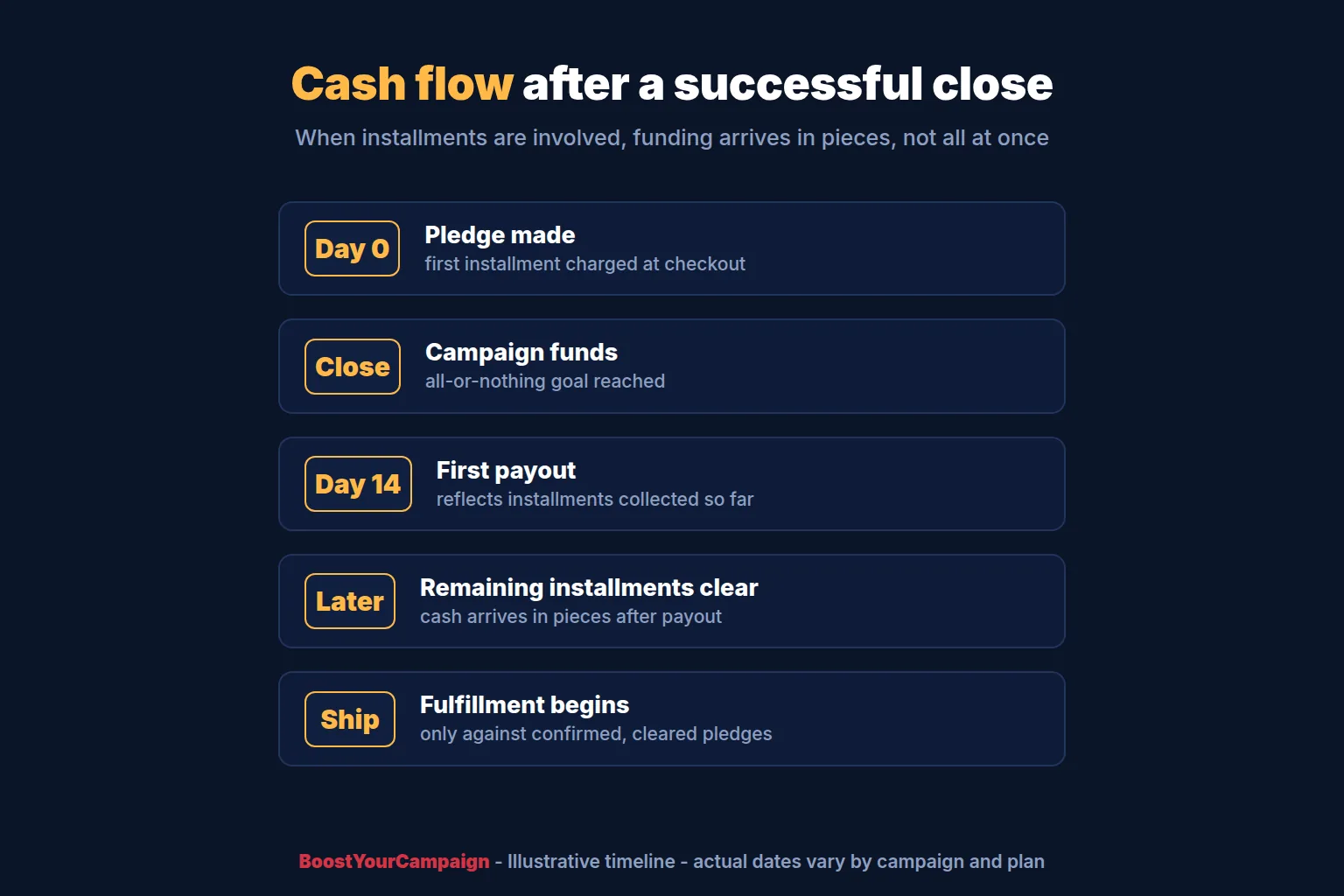
On a standard, non-installment pledge, the cash flow timeline is simple: the campaign closes funded, Kickstarter pays out to the creator about 14 days after a successful close, and that payout represents the money that was actually collected at pledge time. Pledge over time breaks that into pieces. The first installment is what gets collected at pledge time and included in that initial payout window. Any later installments are charged and paid out to the creator on their own schedule afterward, meaning part of a split pledge's total value arrives well after the campaign has already closed and the initial payout has landed.
This matters most for anyone using the funding total to plan production deposits, freight bookings, or fulfillment commitments in the days right after a campaign closes. If a meaningful share of the raise sits in reward tiers where pledge over time is common, the number that hits the bank account 14 days after close will understate the eventual total, and the remainder trickles in over the following weeks as later installments clear. Spending against the full funding total on day 14 as if all of it is already in hand can create a real cash flow gap if a large supplier deposit is due before the later installments have finished collecting.
The dropped-payment risk sits on top of that timeline. A backer whose second or third installment fails gets a window to update their payment method, but not every failed installment gets fixed. Build fulfillment and reporting around confirmed, cleared payments rather than the original pledge total, and treat any pledge with an outstanding installment as provisional until it actually clears. That is a small discipline that prevents a real, if usually modest, gap between what the campaign page shows as raised and what is actually collected and confirmable for shipping.
4) Kickstarter's built-in pledge manager
Kickstarter now offers a native pledge manager that lives inside the platform: a post-campaign survey where backers confirm their shipping address, select variants like color or size, and add optional extras for an additional charge, with Kickstarter calculating and collecting the shipping fee as part of that process. Backers never leave Kickstarter or create a separate account, and creators do not pay an additional per-backer or platform fee to a third-party tool on top of what Kickstarter already charges.
That simplicity is the built-in pledge manager's real strength. For a campaign with a single core reward, a handful of variants, and a few straightforward add-ons, it covers everything a fulfillment team actually needs: a confirmed address, a confirmed SKU selection, and a paid shipping charge, exported in a format that a warehouse can work from. There is nothing extra to set up, nothing extra for backers to learn, and no added integration cost.
Where it runs out of room is complexity. A reward structure with many SKUs per pledge, tiered upsells that need their own marketing push after the campaign ends, detailed segmentation for follow-up email, or a post-campaign storefront for late pledges with its own checkout flow is more than the native tool is built for. It handles the essentials well and does not try to be a full backer-marketing platform, which is a reasonable design choice, but it does mean a campaign with real fulfillment or marketing complexity outgrows it quickly.
5) Built-in vs third-party pledge manager
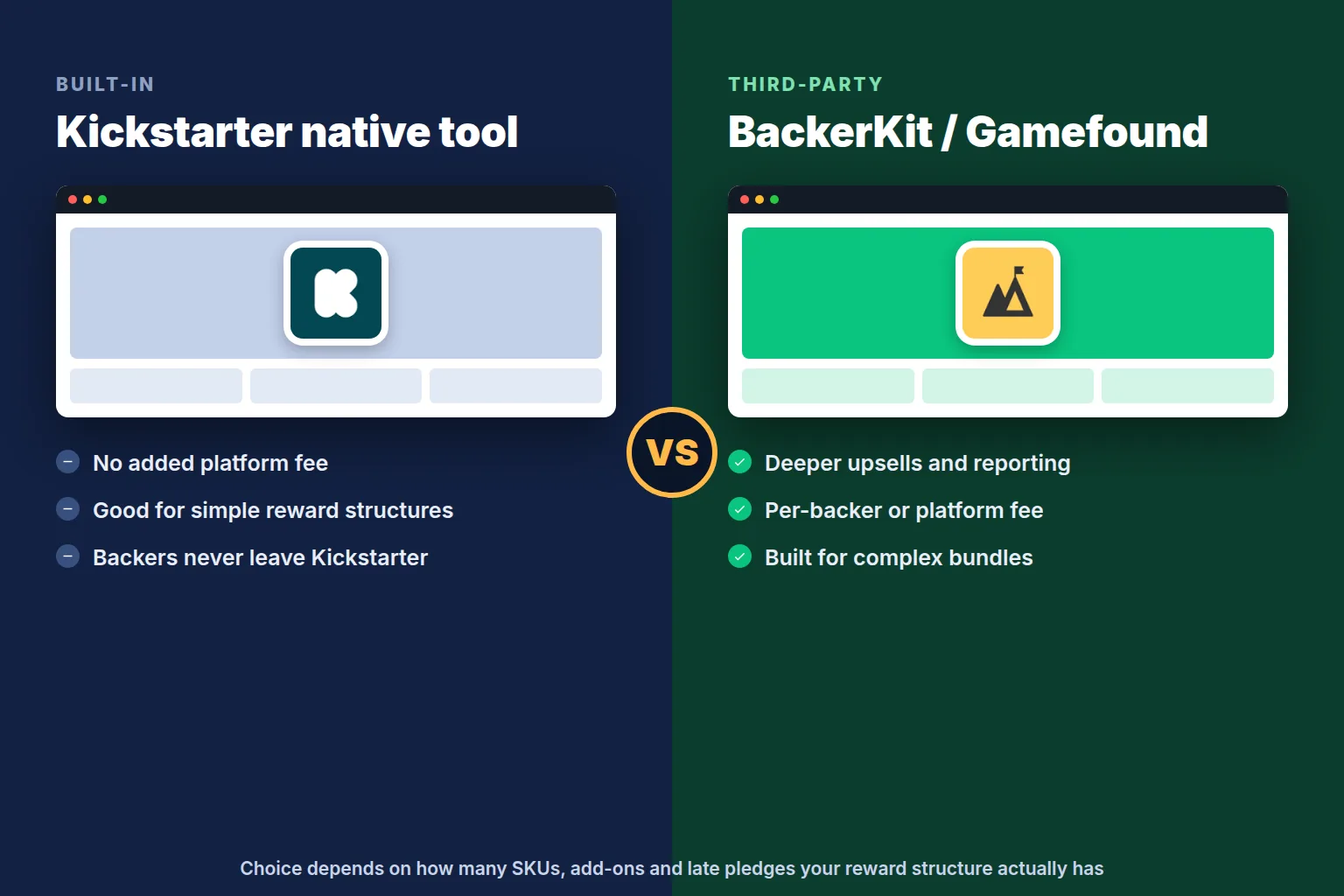
BackerKit, Gamefound, and PledgeBox all solve the same core problem as Kickstarter's native tool, plus more. Each collects addresses, add-ons, and shipping the same way, and each adds features Kickstarter's built-in version does not attempt: richer upsell flows, a post-campaign store for late pledges, abandoned-survey recovery emails, more detailed reporting by tier and region, and in Gamefound's case, a full platform that can also host a relaunch or a standalone campaign later. Our breakdown of whether BackerKit is worth it goes deeper into that specific tradeoff.
The cost of that added depth is a per-backer or platform fee on top of what Kickstarter already charges, plus an extra step for backers, who have to complete a second survey outside the platform they pledged on. For a campaign with a simple reward structure, that added cost and friction rarely pays for itself. For a campaign with many SKUs, meaningful add-on revenue, or a fulfillment partner that needs a cleaner data export than Kickstarter's native format provides, the third-party tool usually earns its fee back through fewer kitting errors and more add-on revenue captured after the campaign ends.
A useful way to decide is to count the moving parts in your reward structure before launch: how many SKUs per pledge, how many optional add-ons, and how much you expect to sell through late pledges after the campaign closes. A small number of moving parts points toward the built-in tool. A large number, especially with meaningful add-on or late pledge revenue at stake, points toward BackerKit, Gamefound, or PledgeBox, and toward budgeting the added fee into your overall cost structure alongside the platform and payment processing fees covered in our Kickstarter and Indiegogo fees guide.
6) Late pledges on Kickstarter
A late pledge lets someone back a campaign after the funding window has already closed, either through Kickstarter's own late pledge flow when a creator enables it, or through a third-party pledge manager's late pledge store once the survey process opens. Late pledges do not count toward the original funding goal, but they add real revenue on top of it, and for a campaign with an active social following or press coverage that lands after launch, that additional revenue is often meaningful. Late pledges typically add somewhere in the range of 10-20% on top of the original raise for a campaign that keeps marketing after it closes, though the exact share depends heavily on how much post-campaign promotion actually happens.
The practical questions to settle before enabling late pledges are pricing and duration. Keeping late pledge pricing consistent with what launch backers paid, or being clear about any premium if pricing goes up, protects trust with the backers who supported the campaign early. Deciding how long the late pledge window stays open, and whether it closes before or after fulfillment planning locks in, avoids the awkward situation of a backer joining the day before a shipping cutoff and expecting to be included in the first wave. Our pledge manager and late pledges guide covers the mechanics of running this well in more depth.
Late pledges are also one of the more reliable ways a campaign keeps its momentum going after the initial close, alongside the broader post-campaign selling strategies covered in our guide to selling after crowdfunding ends. A campaign that treats the funding close as the finish line leaves real revenue on the table that a campaign with a plan for late pledges captures instead.
7) What this changes for setup, ads, and fulfillment
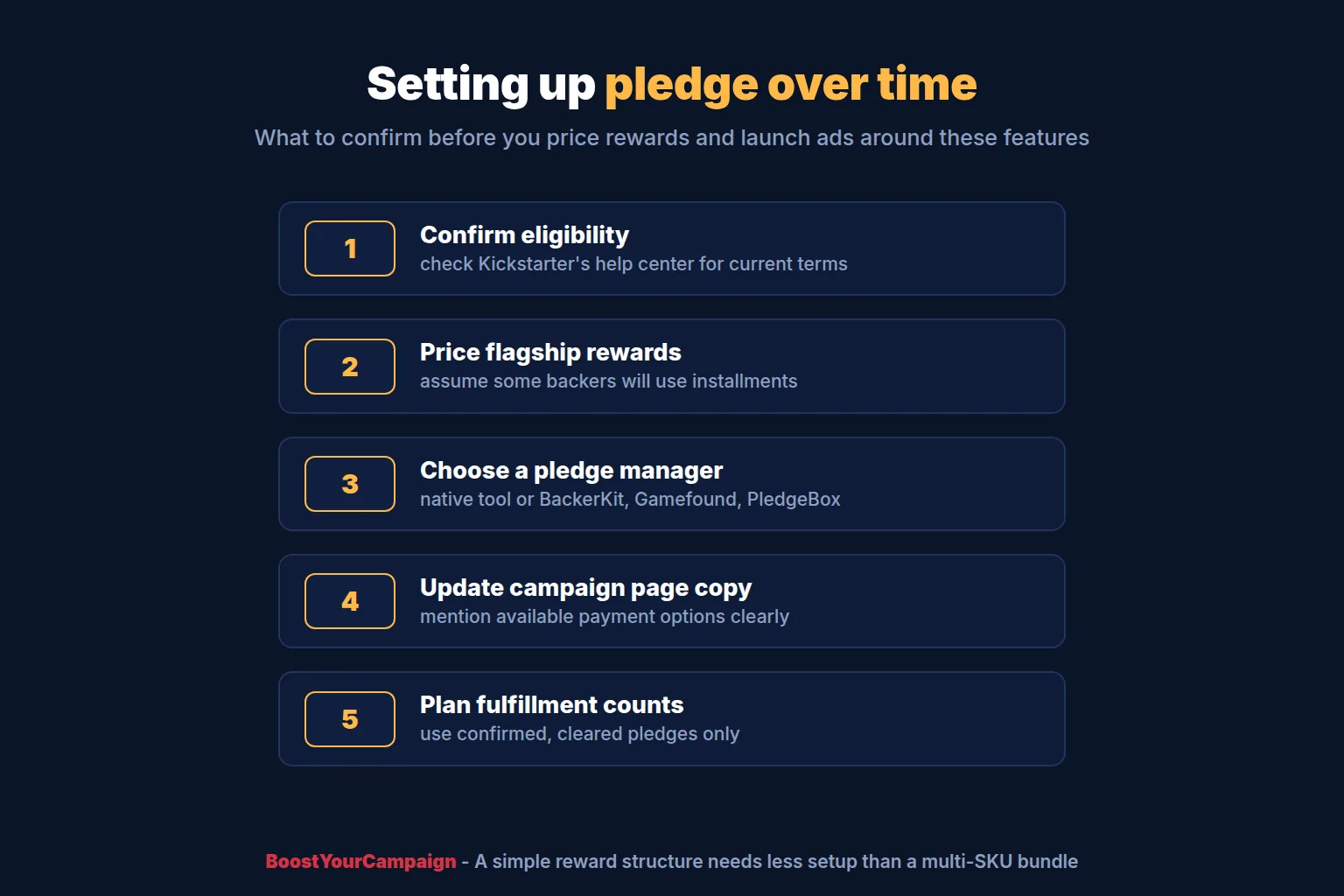
Reward pricing decisions need to happen before launch, not after. If pledge over time is likely to be available for your campaign, price your flagship reward with the expectation that a meaningful share of backers on that tier will use installments, and confirm the actual eligibility rules on Kickstarter's help center so you are not guessing. Campaign page copy should mention available payment options clearly, since backers actively search for whether a reward can be paid over time before deciding whether to commit to a higher tier.
Ad strategy shifts slightly too. When you are running paid traffic toward a higher-priced reward tier, noting that a payment plan may be available (with appropriate hedging, since eligibility can change) reduces the hesitation that often shows up at the pledge decision for an expensive reward. Pairing that with the pre-launch groundwork covered in our prelaunch audience building guide gives paid traffic a warmer audience to convert in the first place, which matters more to overall funding velocity than any single feature on the pledge page.
Fulfillment planning is where all of this actually gets tested. The pledge manager export, whether it is Kickstarter's native CSV or a BackerKit or Gamefound export, is the real shipping list, and it needs to be reconciled against installment and payment status before a production count or fulfillment count gets locked. A pledge that still has an outstanding installment is not a confirmed ship until that installment clears, and treating it as confirmed too early is how a campaign ends up producing or shipping units it has not actually been fully paid for. Our Kickstarter fulfillment guide covers the full process this data feeds into once units are ready to move.
| Tool | Cost | Configuration depth | Best fit |
|---|---|---|---|
| Kickstarter built-in | No added platform fee beyond Kickstarter's own | Good for a single core reward with a few variants and add-ons | Straightforward reward structures with light fulfillment complexity |
| BackerKit | Per-backer or platform fee on top of Kickstarter's fees | Deep - upsells, multiple surveys, detailed reporting | Complex bundles and teams that want a post-campaign store |
| Gamefound | Platform fee, also usable as a standalone crowdfunding platform | Deep - built around tiered rewards and relaunches | Tabletop and board game campaigns, projects planning a relaunch |
| PledgeBox | Per-backer fee | Mid - add-ons and address collection with a simpler interface | Small to mid campaigns that want more than the native tool without full BackerKit complexity |
How BoostYourCampaign fits
BoostYourCampaign decides pledge manager strategy with the client before launch, based on the actual reward structure rather than a default preference for one tool. A single-SKU campaign with a couple of add-ons usually stays on Kickstarter's native pledge manager. A multi-SKU bundle with real add-on and late pledge potential usually moves to BackerKit or Gamefound, priced into the overall cost plan alongside ad spend and fulfillment. On the ad side, the team accounts for pledge over time when pricing and promoting higher-value reward tiers, and treats the pledge manager export, not the raw pledge count, as the source of truth for fulfillment planning.
BYC uses a skin-in-the-game ad model, putting its own money into ad spend alongside the client's budget with fixed fees rather than a percentage-of-raise commission, and it owns fulfillment warehouses in the US and EU, so shipping runs off the same pledge manager exports discussed above rather than getting handed to a disconnected third party. The agency has been active since 2010 across 4,600+ campaigns with $734M+ raised and a 4.9/5 score across 300+ verified reviews. It's an Indiegogo Approved Agency, a Google Premier Partner, a Facebook Marketing Partner, an official Shopify Partner, and an Amazon Partner. See our services for the full breakdown of how strategy, ads, and fulfillment work together.
Before you turn on pledge over time or pick a pledge manager: a quick checklist
| Question | Why it matters |
|---|---|
| Have you confirmed current pledge over time eligibility on Kickstarter's help center? | Terms have changed before and pricing around an assumption that turns out wrong is hard to fix after launch. |
| Does your reward structure have few enough SKUs and add-ons for the native pledge manager? | A complex bundle usually needs the extra configuration depth of BackerKit, Gamefound, or PledgeBox. |
| Have you budgeted for cash arriving in pieces, not all at the 14-day payout? | Later installments clear on their own schedule, so spending the full total against the first payout creates a cash gap. |
| Do you have a plan for late pledges and how long that window stays open? | Late pledges add real revenue but need pricing and cutoff decisions made before the campaign closes. |
| Will your fulfillment count come from confirmed, cleared pledges rather than the raw total? | An outstanding installment is not a guaranteed ship until it actually clears. |
| Does your campaign page mention available payment options clearly for backers researching the reward tiers? | Backers actively look for whether a higher-priced reward can be paid over time before committing. |
If your campaign runs into trouble hitting its goal even with a strong pledge manager and payment plan in place, our companion guide on what happens if a Kickstarter doesn't reach its goal walks through what to expect and how to recover.
Frequently Asked Questions
What is Kickstarter's pledge over time feature?
It lets an eligible backer split a pledge into a small number of automatic installments instead of paying the full reward price at checkout. Kickstarter handles the billing schedule, and the backer's total commitment does not change, only how it is collected over time. Confirm current eligibility rules on Kickstarter's help center before pricing around it.
Which rewards are eligible for pledge over time on Kickstarter?
Eligibility has depended on factors like reward price, campaign duration, currency, and region, and the specific thresholds have shifted more than once since the feature launched. Rather than relying on a number you saw in an older article, check Kickstarter's help center for the current rules before you build reward pricing or campaign copy around the feature.
Does pledge over time change Kickstarter's all-or-nothing funding rule?
No. A campaign still only collects pledges if it reaches its goal by the deadline, and no backer is charged if the campaign fails to fund. Pledge over time only affects how a successful pledge is billed after the campaign funds, splitting it into installments instead of one charge.
Should I use Kickstarter's built-in pledge manager or BackerKit?
Use the built-in pledge manager if your reward structure is simple: one core item, a few variants, a handful of add-ons. Move to BackerKit, Gamefound, or PledgeBox if you have many SKUs, meaningful add-on revenue, or plan to run a real late pledge store after the campaign closes, since the added fee usually pays for itself through fewer fulfillment errors and more captured add-on revenue.
What is a late pledge on Kickstarter?
A late pledge is a pledge made after the funding window has closed, either through Kickstarter's own late pledge option when a creator enables it, or through a third-party pledge manager's late pledge store once the post-campaign survey opens. Late pledges do not count toward the original funding goal but add real revenue on top of it.
How much do late pledges typically add to a campaign's total raise?
For a campaign that keeps marketing after the funding window closes, late pledges typically add somewhere around 10-20% on top of the original raise, though the actual share depends heavily on how much post-campaign promotion and social following the creator keeps working after launch.
When does Kickstarter pay out if backers are using pledge over time?
The standard payout timeline still applies to funds actually collected: Kickstarter pays out about 14 days after a successful close. For pledges split into installments, that initial payout reflects only the installments collected by that point, and later installments clear and pay out on their own schedule afterward, so the full pledge value arrives in pieces rather than all at once.
Can I switch pledge managers after my campaign ends?
It is possible in most cases, but switching after backers have already started completing surveys creates real friction: confusion for backers, duplicated or lost data, and extra work reconciling two partial data sets. Deciding on the built-in tool or a third-party pledge manager before launch, based on your actual reward complexity, avoids that problem entirely.
If you are planning reward pricing, a pledge manager setup, or a payment plan strategy for an upcoming Kickstarter campaign, reach out through /contact.
Want results like these for your campaign?
We've helped 4,600+ creators raise over $734M. Let's pressure-test your launch plan and find the highest-leverage fixes before you go live.
Talk to an expert →Get the free 87-step launch checklist
The exact pre-launch, live-campaign and fulfillment steps we use across 4,600+ launches. Free PDF, emailed instantly.
You're in - check your inbox. Open the checklist now ->