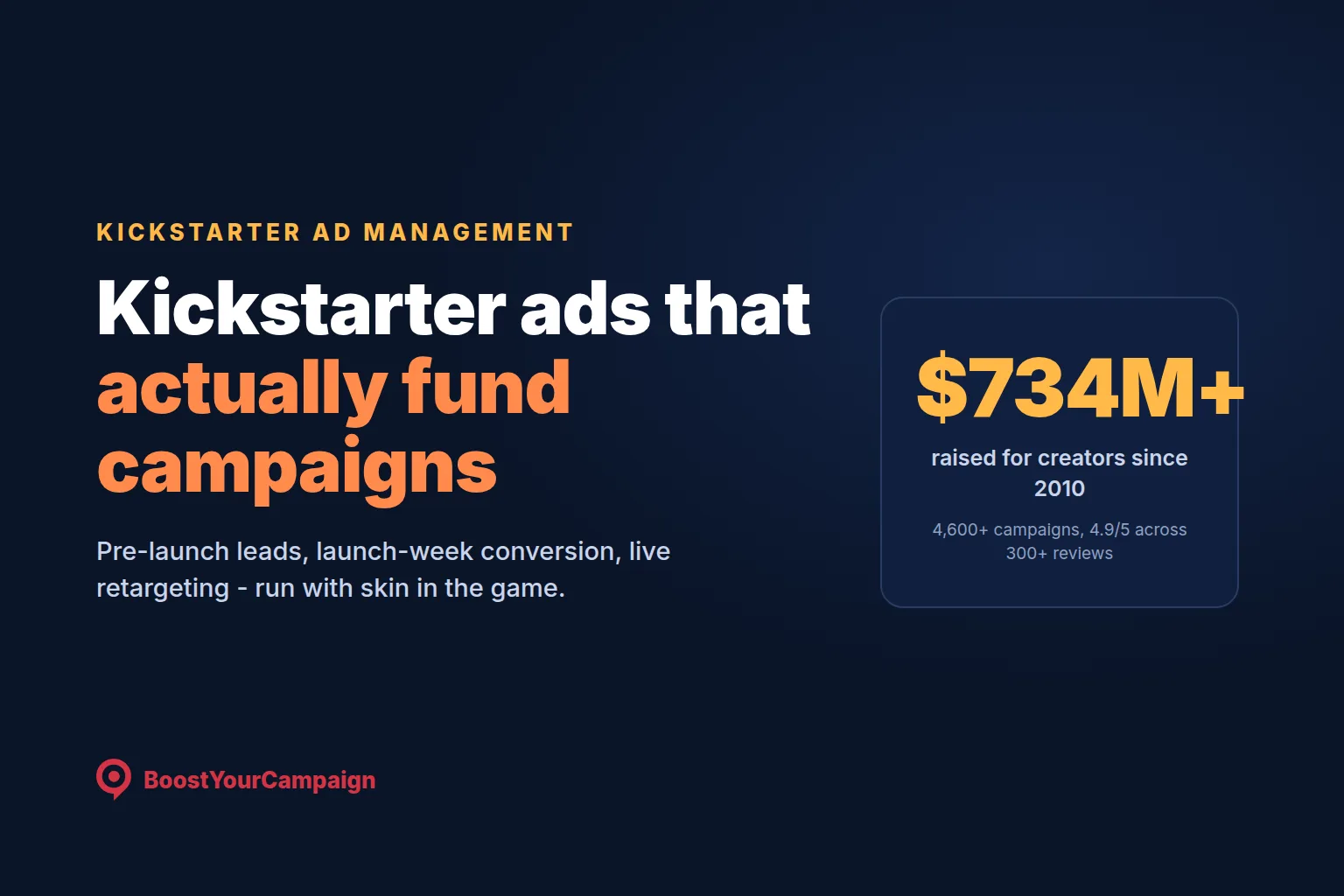
Most Kickstarter ads do not fail because the platform is expensive or the audience is not there. They fail because the ads were never built as a system. A founder turns on Meta ads the morning the campaign goes live, points cold traffic at a page with no pixel history, runs one video for three weeks, and watches cost per backer climb every day - the predictable result of skipping the parts of ad management that do the work. We have run paid ads across more than 4,600 crowdfunding campaigns since 2010, helping raise over $734M, and the difference between ads that fund a campaign and ads that drain a budget rarely comes down to the platform. It comes down to whether the ads were planned in phases, tracked properly, and paid for by an agency with something to lose if they do not work.
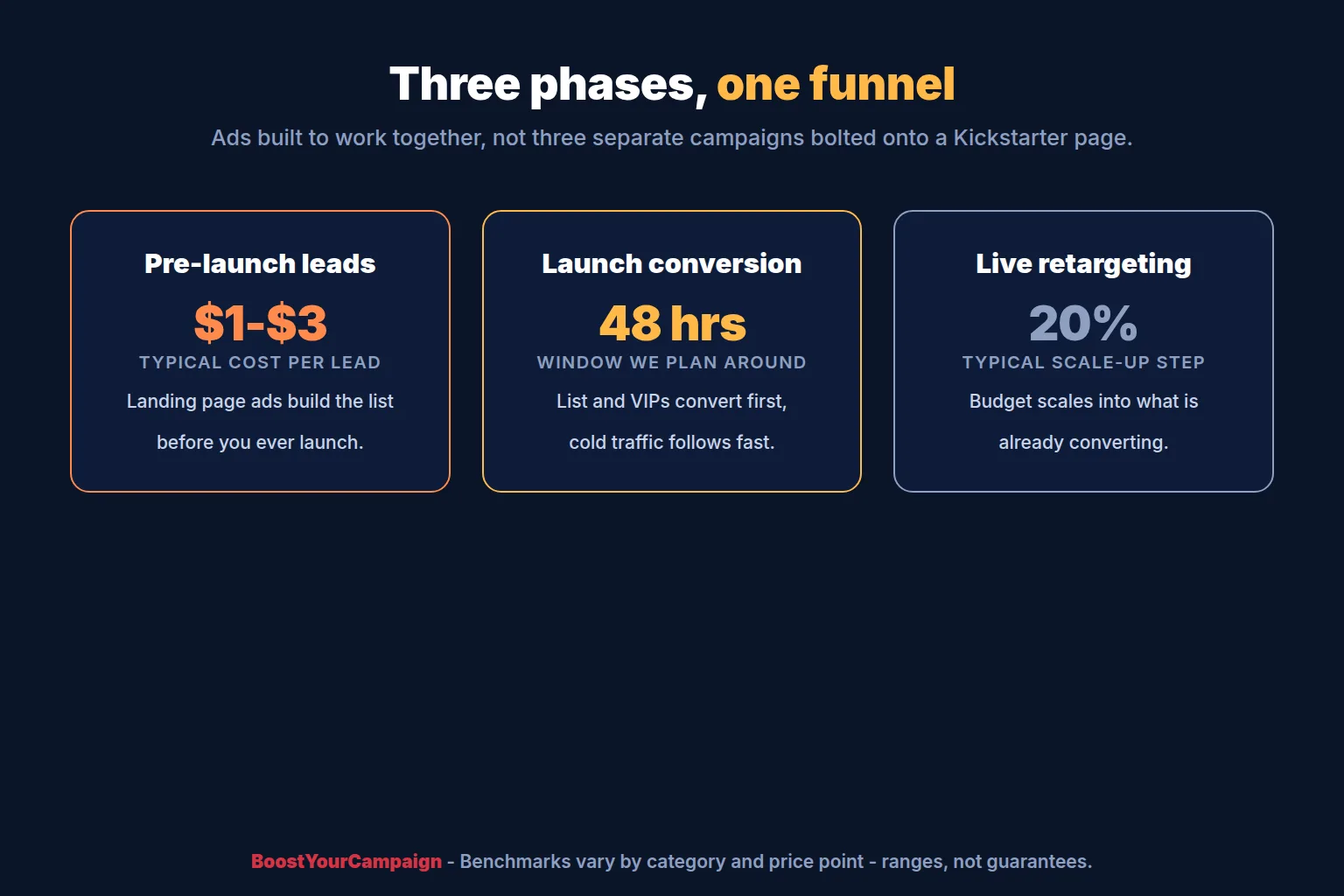
Kickstarter ad management is paid media run in three connected phases: pre-launch lead generation to a landing page, launch-window conversion of that warm list plus early cold traffic, and live-campaign retargeting and scaling once the funnel is proven. We run this across Meta, Google, and TikTok from our own creative studio, track it with a pixel and referral tags rather than platform-reported numbers, and price it as a fixed fee with an optional skin-in-the-game layer where we put our own cash into your ad budget. It fits physical products with real margin - hardware, tabletop, design - more than pure software or campaigns with no pre-launch list at all.
Why most Kickstarter ads lose money
Ask a founder who spent a few thousand dollars on ads and got a handful of backers what went wrong, and the answer is usually the same short list of mistakes, repeated on nearly every underperforming campaign we are brought in to fix.
The first is sending cold traffic straight to the Kickstarter page instead of a landing page you control. Kickstarter's own page cannot capture a lead, fire a pixel event, or retarget a visitor who did not pledge on the first visit, so a dollar spent driving strangers there converts once, if at all, and disappears.
The second is skipping the pixel entirely, or installing it the week of launch instead of months before, leaving an ad account with no tracking history to optimize against - the platform is left to guess, and it guesses badly, showing ads to broad, unqualified audiences at a rising cost.
The third is creative: one hero video, one static image, run unchanged for the campaign. Even a good ad fatigues as the same audience sees it repeatedly, and a single angle never reveals which message actually moves buyers - the demo, the price, the story, or the social proof.
The fourth is stopping at launch. Founders who build a real pre-launch list often turn everything off the day the campaign goes live, assuming the list alone will carry the funding. It rarely does - the campaigns that keep funding past day two are the ones still running ads through the live window. Our guide to choosing who runs your ads goes deeper on spotting an operator set up to avoid these mistakes.
What we run
We treat Kickstarter ads as one continuous funnel with four phases, not four unrelated jobs. Skipping a phase is how campaigns end up with warm leads nobody retargets and live budgets with no pre-launch list behind them.
Pre-launch lead generation to a landing page
Before your campaign exists on Kickstarter, we run ads to a landing page built to capture an email and, where it fits the offer, a small paid reservation. This is where your pixel builds history and your day-one list gets built. We size the budget to the goal and test in small daily increments before scaling, closer to the discipline in our pre-launch ad management guide than to turning on a large budget and hoping.
Launch-window conversion
When the campaign goes live, the objective shifts from lead capture to pledges. We retarget the warm list first, since it converts fastest and cheapest, then layer in cold traffic once that audience is exhausted for the day. Creative shifts too - "join the list" ads get replaced with "back now" ads built around the live page, reward tiers, and whatever urgency the first 48 hours creates.
Live-campaign retargeting and scaling
Through the rest of the funding window we scale what is converting, cut what is not, and keep creative rotating so the same audience does not see one ad for a month. Visitors who clicked through but did not pledge are one of the highest-return audiences on a live campaign, and they get ads different from anything shown to a cold viewer.
Post-campaign Late Pledge and Shopify ads
Funding is not the finish line. Once the campaign closes, we can shift spend to Late Pledge (formerly called InDemand) on Indiegogo or to a Shopify pre-order page, so the audience you spent months building keeps converting instead of going cold - often at the cheapest cost per result of the whole project.
Platforms and where each fits
We do not run every platform on every campaign, and we say plainly when a channel is not worth your budget rather than billing for it anyway.
Meta is the workhorse. For most categories, Facebook and Instagram carry the bulk of pre-launch lead generation and live retargeting - the targeting, creative formats, and audience size make it the platform we build around first. See our Meta ads guide and Facebook ads breakdown.
Google search and YouTube catch high intent and demo. Search ads reach people already typing your product category or brand name into Google, some of the highest-intent traffic available. YouTube suits products that need to be seen in motion to be understood. Our Google ads guide for Kickstarter covers when this budget earns its place.
TikTok wins on cheap reach for visual products. When a product looks good in motion and the audience skews younger, TikTok can beat Meta on cost per result, particularly for pre-launch reach. It is not a fit for every category, and we do not force it where the audience is not there - see our TikTok ads guide.
When we say no to a platform. A niche B2B tool, a narrow professional audience, or a small budget usually does not justify three platforms at once. We would rather run Meta well than run three channels half-heartedly on a budget too thin to learn from.
Creative from our own studio
Ad creative is not an afterthought bolted onto a campaign video after the fact. We produce campaign video and ad creative from the same in-house studio, planned together from the start, so the shoot that captures your hero video also captures the shorter cuts and product-in-motion clips the ad account needs.
Most of what runs in an ad account is not the three-minute campaign video - it is fifteen to forty-five second cutdowns built for a feed: a demo-first cut, a problem-and-solution cut, a social-proof cut, a founder-story cut. Different buyers respond to different angles, and you only find out which wins by testing several at once. Our video length and cost guide covers how production choices feed into this.
We mix polished studio footage with rougher, user-generated-style content, because they do different jobs. A crisp, well-lit shot builds trust; a phone-shot, UGC-style clip feels native to the feed and often outperforms the polished version on cost per result, particularly early on, when an audience has not decided whether to trust a brand it has never heard of. Letting the data pick the winner beats guessing which style your audience prefers.
Testing does not stop after week one. Creative that performs well early tends to fatigue as the same audience sees it on repeat, so new variations keep moving into the account rather than one winning ad running unchanged for a month.
Tracking and reporting
An ad account with no tracking is flying on guesswork, and a campaign that only trusts what Kickstarter reports is missing most of the picture. We set up a pixel and Conversions API on the landing page before pre-launch ads start, so every lead and reservation has a record the platform can learn from, not a number in a dashboard that goes stale once browser privacy settings interfere.
Kickstarter gives advertisers no native pixel on the campaign page, so we use referral tags to track which platform and ad sent a given visitor, letting us see cost per backer by source even though the pledge happens on Kickstarter's domain. Without that layer, you are stuck reading vague referral traffic and guessing which ad paid for itself.
Every week you see a report built around three numbers: cost per lead in pre-launch, cost per backer live, and return on ad spend calculated with Kickstarter's platform fees included, not ignored. A campaign that looks profitable before fees and unprofitable after them is not actually profitable, and we would rather show you that every week than let it surface as a surprise once the campaign closes.
Benchmarks we plan against
Every category and price point is different, and anyone quoting one universal cost-per-backer number for every campaign is not doing the math for your product. What we can share are the ranges we plan against, drawn from our own campaigns and the pre-launch data we track before every launch.
| Metric | What we plan toward | Why it matters |
|---|---|---|
| Cost per lead (pre-launch) | Often $1 to $3 for design and tech categories with strong creative, though this moves with category and price point | Sets how large a warm list your budget can realistically build before launch |
| Landing page conversion | Roughly 20% to 40% of visitors to leads on a well-matched page and audience | A page converting in the single digits usually points to an offer or targeting mismatch, not a traffic problem |
| VIP or reservation conversion | Often 30% to 50%+ of $1 reservers going on to back at launch | The clearest early signal of whether people who raised a hand will actually pay |
| First 48 hours of funding | Around 30% of total goal for a strong launch, driven mostly by the pre-launch list | Triggers Kickstarter's own discovery and momentum mechanics |
Read these as planning targets, not guarantees - our day-one benchmarks breakdown goes further into how goal, category, and price point move these numbers in either direction.
How the skin-in-the-game model works for ads
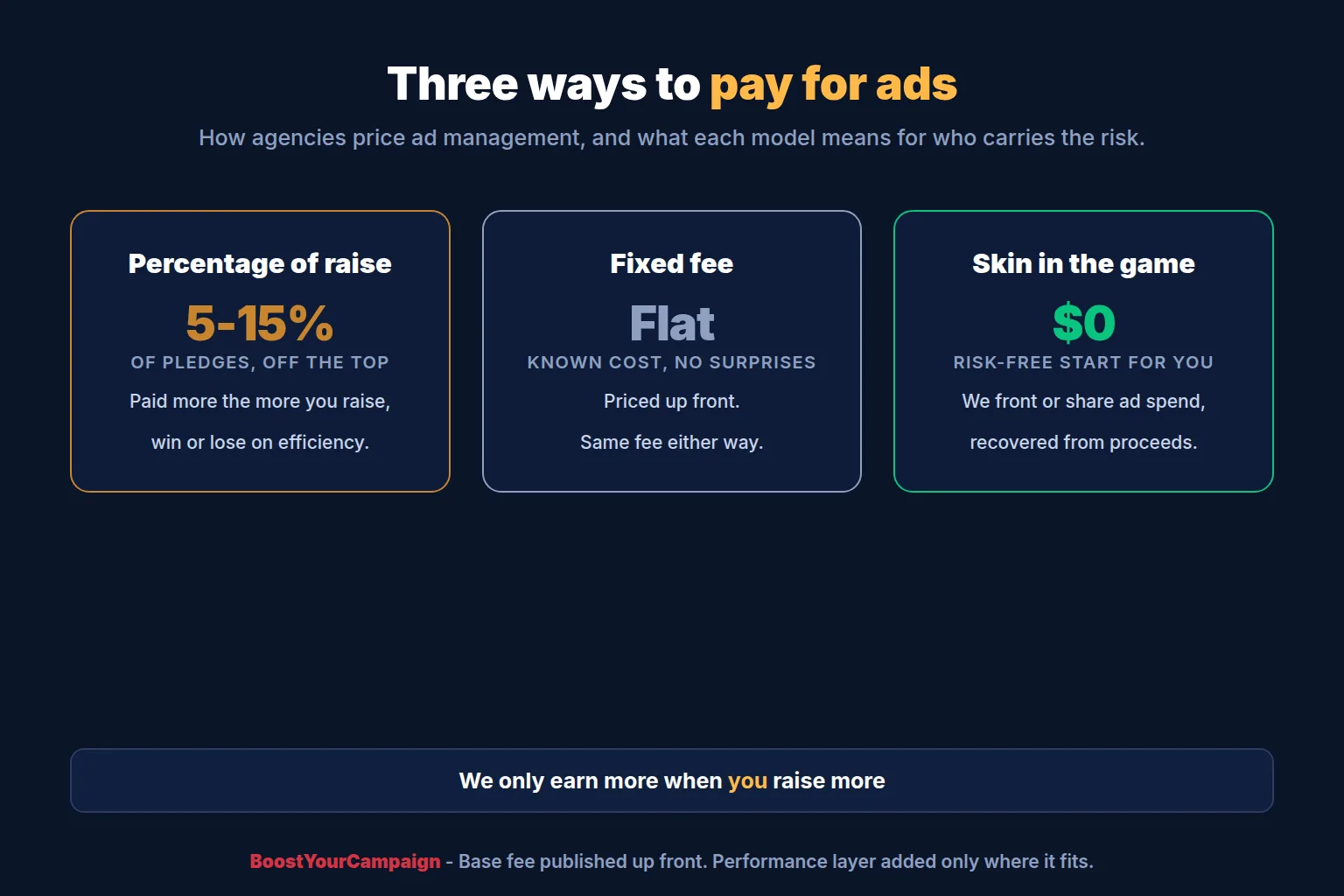
Most ad management is billed the same regardless of outcome: you fund the ad account, we spend it, and if cost per backer comes in high, that risk sits entirely with you. For qualifying campaigns we structure it differently - we invest our own cash into your ad budget alongside yours, so a weak-performing account costs us real money too. We only offer this on campaigns we have underwritten carefully, since the arrangement only works if we are selective.
The base engagement is still a transparent fixed fee, priced up front with no open-ended retainer clock. The skin-in-the-game layer sits on top of that: what portion of spend we front or share, and how it is recovered from proceeds once pledges start coming in. Ad spend, whether entirely yours or partly shared with us, is always separate from our fee.
| Model | How it works | Who carries the ad-spend risk |
|---|---|---|
| Percentage of raise | Agency takes a cut, often 5% to 15%, of what the campaign raises | You - the agency gets paid more the more you raise, regardless of how efficiently the ads ran |
| Fixed fee | One transparent price for the ad management scope, known before you start | You fund and own the ad account; the fee does not move with results |
| Skin in the game | Fixed fee for the work, plus we front or share the ad spend on qualifying campaigns and recover it from proceeds | Shared - a weak-performing account costs us capital too, not only you |
For the full mechanics of the model and what qualifies a campaign for it, our skin-in-the-game page lays out the whole structure, and our agency cost guide shows how this compares to typical retainers and commissions.
Who this is for and who it is not for
This fits physical products with real margin behind the price - hardware with a defensible feature set, tabletop games with an engaged hobby audience, design objects, and other categories where the pledge price leaves room to pay for acquisition and still profit once the product ships. These categories have deep, proven crowdfunding audiences and enough margin to absorb a genuine testing phase before spend scales.
It is a weaker fit for a few situations, and we would rather say so up front: pure software struggling on visual ad platforms built around a physical object, products priced too low to support real acquisition cost without a bundle, and founders who want ads to replace a pre-launch list entirely rather than convert one. See how this plays out across categories in our case studies, and how creators describe it in our client reviews.
What working with BoostYourCampaign looks like
Engagements typically move through five stages: an audit and a small validation test against your actual creative and offer, so we plan against real numbers; pre-launch, running roughly eight to twelve weeks and building the list while your pixel gets real history; launch week, shifting to conversion and retargeting the warm list first; the live campaign, scaling what works and cutting what does not; and post-campaign, where we can carry spend into Late Pledge (formerly called InDemand) or a Shopify pre-order page so the audience you built keeps paying off.
What we need from you: a product and price point that can support paid acquisition, access to the ad accounts and analytics so reporting stays honest, and a founder who can turn around approvals quickly once the campaign is live. Our services page covers how ad management fits alongside video, PR, and fulfillment for a larger engagement.
Frequently asked questions
How much do Kickstarter ads agencies charge?
It depends on the pricing model. Some agencies charge a percentage of what you raise, often 5% to 15%, others a flat retainer, some a blend of both. We price ad management as a transparent fixed fee, ad spend kept separate, with a skin-in-the-game option for qualifying campaigns. Our agency cost guide breaks down what other pricing models typically run.
How much should I budget for Kickstarter ads?
Work backward from your goal. Divide it by your average pledge for backers needed, subtract what your list should deliver on its own, and the rest comes from paid traffic at a cost per backer your margins can survive. Pre-launch testing starts on a modest daily budget per ad set, then scales into what is converting cheaply.
Do you run Facebook ads for Kickstarter campaigns?
Yes. Meta is the workhorse for most campaigns we run, covering pre-launch lead generation and live-campaign retargeting. We pair it with Google for high-intent search and YouTube for demo placements, and TikTok where the product and audience fit, rather than defaulting to one channel regardless of category.
Can you run ads for an Indiegogo or Gamefound campaign?
Yes. The same three-phase approach - pre-launch leads, launch-window conversion, live retargeting - applies across Kickstarter, Indiegogo, and Gamefound, with adjustments for how each site handles tracking and Late Pledge (formerly called InDemand) after the funding window closes.
When should I hire a Kickstarter ads agency?
The earlier the better, ideally months before launch rather than the week of. Pre-launch is where your pixel builds real history and your list gets built, and both compound in value the longer they run before launch day. Bringing an agency in once the campaign is already live and underperforming skips the phase that would have made live ads work better.
What results can I expect from Kickstarter ads?
Results vary by category, price point, and how strong the product and offer already are, so we would rather show you the ranges we plan against - cost per lead, landing page conversion, VIP conversion, and share of goal funded in the first 48 hours - than promise an outcome before we have seen your product. See our agency selection guide for more.
Do you need my Kickstarter login to run ads?
No. Ad management runs through the ad platforms - Meta, Google, TikTok - and the landing page and pixel we set up, not your Kickstarter account. You should always keep full ownership of your own ad accounts and campaign page, and be cautious of any operator who asks for account access that is not necessary for the work.
What is skin in the game for Kickstarter ads?
It means we can put our own capital into your ad budget for qualifying campaigns, alongside yours, and recover it from proceeds rather than charging it as a flat fee regardless of performance. Not every project qualifies, and we are direct about when a standard fixed-fee engagement is the better fit. The full breakdown is on our skin-in-the-game page.
If your launch needs ads run by a team with real numbers to show and a stake in whether they work, talk to an expert and we will walk through what your campaign needs before you spend a dollar.
Ready to give your campaign the best shot?
We've helped 4,600+ creators raise over $734M since 2010. Let's pressure-test your launch plan and find the highest-leverage fixes before you go live.
Talk to an expert →