This guide covers rewards crowdfunding for film and video projects only - documentaries, short films, web series, and features raising money in exchange for perks, not equity. If you want a working plan for your specific project and timeline, talk with BoostYourCampaign.
For most film projects, Kickstarter's Film & Video category is the strongest default: the largest audience of people who habitually back creative projects, and an all-or-nothing model that protects a small production budget from being underfunded. Indiegogo fits film projects that want an ongoing sales channel after the initial raise through Late Pledge (formerly called InDemand), and its discovery is generally weaker than Kickstarter's so you'll lean more on your own audience. Seed&Spark is a film-specific platform worth evaluating alongside the majors, particularly for documentary and indie narrative work, though its audience and reach are smaller than either major platform. None of these funds a movie by itself - the campaign only works as well as the pitch trailer and the pre-built audience behind it, since there is no physical product to demo.
- Kickstarter's Film & Video category rewards a strong pitch trailer - all-or-nothing funding protects your budget but demands real pre-launch traffic.
- Indiegogo's flexible funding is gone - new campaigns run fixed, all-or-nothing funding, with Late Pledge (formerly called InDemand) as the ongoing sales tool after launch.
- Seed&Spark is the film specialist - smaller audience than the majors, but built around film-specific tools and community.
- Rewards carry real fulfillment weight - physical media, credits, and experiences all need planning before launch, not after.
- Film has no product demo - the pitch trailer and the pre-launch audience do the work a product photo does for hardware.
- Funding day is not the finish line - festival strategy and distribution planning need to be lined up before the campaign closes, not after.
1) Kickstarter's Film & Video category: how all-or-nothing plays out on a film budget
Kickstarter has an official Film & Video category that covers documentaries, narrative shorts and features, web series, and animation. It's also where the largest pool of habitual crowdfunding backers spends time, which matters more for film than almost any other category, since film campaigns rarely have a viral product hook to carry organic discovery on their own.
The all-or-nothing model is the part first-time filmmakers underestimate. If the campaign doesn't reach its stated goal by the deadline, backers are not charged and the project receives nothing. That protects a small production budget from a half-funded campaign that leaves a project stuck between "not enough to shoot" and "too much sunk cost to walk away," but it also means the funding goal has to be set close to what's realistically achievable, not what the project would ideally love to have. Many experienced film creators set the goal at the bare minimum needed to complete a defined stage of production, then use stretch goals to expand scope once funded, rather than setting an ambitious goal and hoping.
Because Kickstarter locks the goal and deadline once a campaign is live, the pre-launch phase matters more for film than for most categories. A film project with an engaged mailing list and a trailer that's already been tested on a small audience walks into launch day with a real shot at the early momentum Kickstarter's discovery algorithm rewards. A project that launches cold, hoping the platform's organic traffic will find it, usually stalls.
2) Indiegogo for film: Late Pledge as ongoing sales, and what changed with flexible funding
Indiegogo was historically known for flexible funding, which let a creator keep whatever was raised even short of the stated goal. That option has since been discontinued: new Indiegogo campaigns now run fixed, all-or-nothing funding only, the same core model as Kickstarter, following the platform's move to its current Gamefound-powered infrastructure.
What still sets Indiegogo apart for film projects is Late Pledge, formerly called InDemand, which lets a campaign keep accepting pledges after the official funding window closes. For a documentary or indie feature planning a longer festival-to-distribution runway, that ongoing sales channel can matter more than the initial 30 or 40 day raise, since it gives the project a way to keep selling digital rentals, physical media, and merchandise to an audience that grows over months rather than a single funding window.
Indiegogo's organic discovery for film campaigns is generally considered weaker than Kickstarter's, so a film project choosing Indiegogo should expect to drive most of its own traffic through a pre-launch list, paid social, and press rather than counting on platform browsing to surface the campaign. That trade-off can still make sense for a project whose audience is already built through festival circuits, a director's existing following, or a subject with built-in press interest, where platform discovery was never going to be the primary source of backers anyway.
3) Seed&Spark: the film-specialist platform
Seed&Spark is a crowdfunding platform built specifically for film and media projects, and it remains active with an ongoing schedule of campaign rounds. Its audience is smaller than Kickstarter's or Indiegogo's, but it's a more concentrated one: people who show up specifically because they care about independent film, which can matter for a documentary or narrative project whose ideal backer is a film-community member rather than a general consumer crowd.
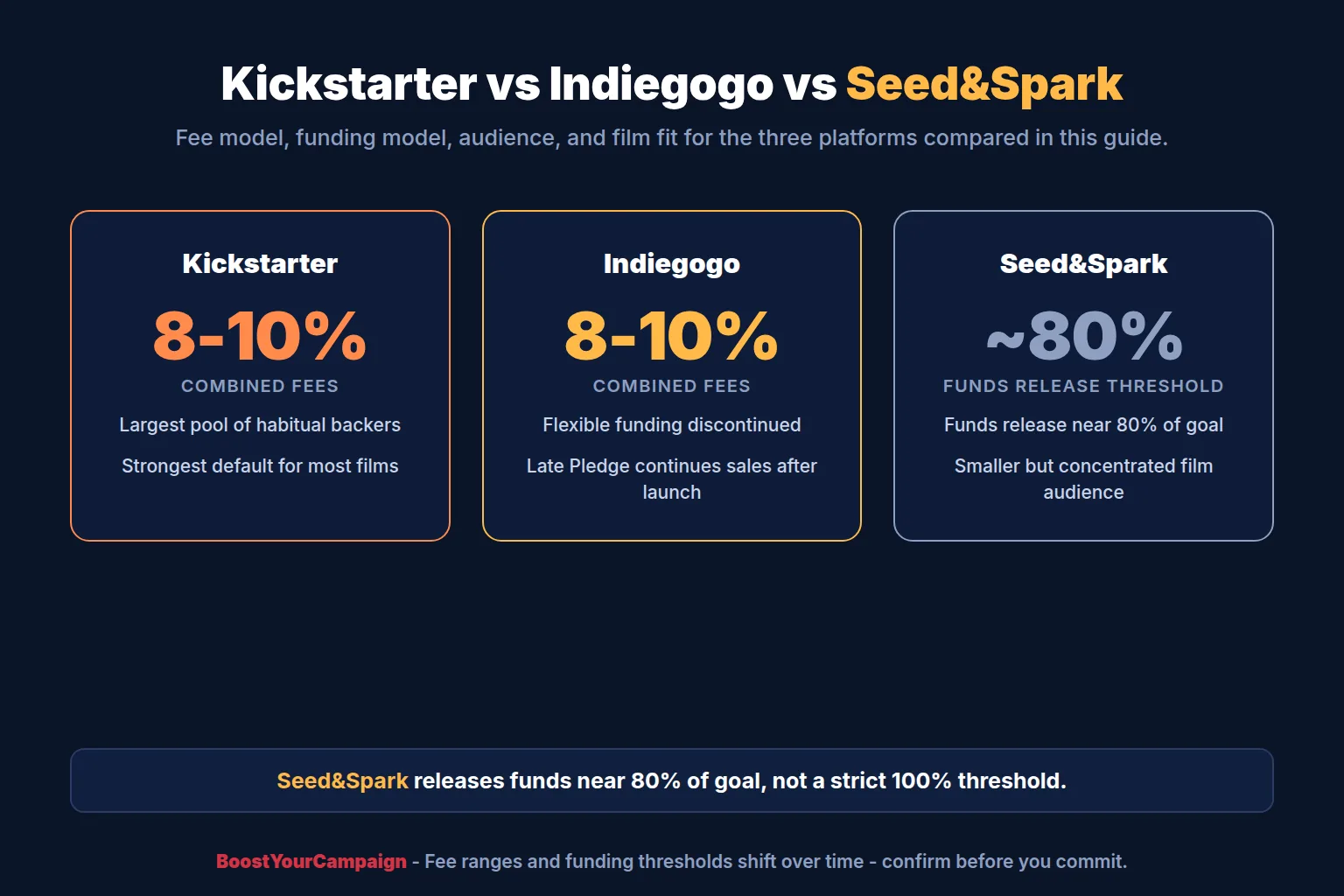
Seed&Spark's funding model differs from a strict all-or-nothing structure. Rather than requiring 100% of the goal to release funds, projects that reach a substantial share of their target, commonly cited as somewhere around 80%, can still keep what was raised. Fee structures on crowdfunding platforms change over time and are worth confirming directly before you commit, but Seed&Spark has generally charged creators a modest platform fee on funds raised, with the option to pass that cost to backers as an add-on to their pledge, alongside standard payment processing charges.
Where Seed&Spark tends to earn its place on a shortlist is for projects deep in the film and documentary community already, since the platform's tools and audience assume a film-specific context that Kickstarter and Indiegogo, as general crowdfunding platforms, don't build around as tightly. It generally shouldn't replace Kickstarter or Indiegogo as the sole platform for a project trying to reach the widest possible general audience, but it's worth evaluating alongside the majors rather than assuming the biggest platform automatically wins for every film project.
4) What rewards work for film, and what they cost to fulfill
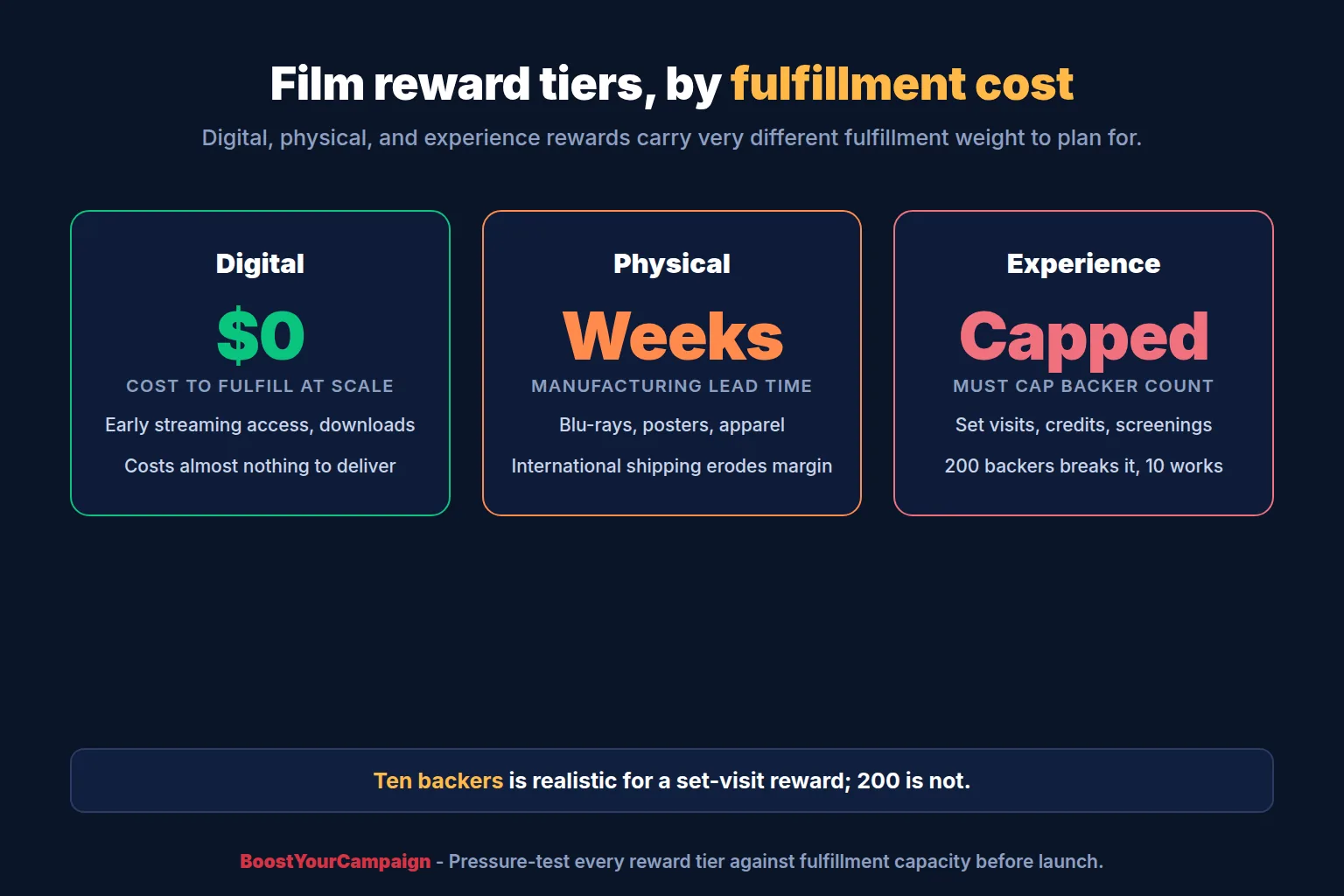
Film rewards split roughly into digital and physical, and the two carry very different fulfillment weight. Digital rewards, like early streaming access, a download of the finished film, deleted scenes, or a director's commentary track, cost almost nothing to deliver at scale and can be fulfilled through the same platform tools used for other digital delivery. They're also the easiest tier to over-deliver on, since there's no shipping deadline attached.
Physical rewards are where film campaigns run into the same fulfillment problems as any hardware campaign, even though the perceived risk feels lower. Blu-rays and DVDs need manufacturing lead time and, increasingly, a plan for backers who no longer own a disc player. Posters, apparel, and printed materials need a supplier and a shipping plan, including international rates that can quietly erode a reward tier's margin if they're priced before shipping costs are checked. Signed items and limited-run collectibles add manual handling time that scales badly past a certain backer count.
Experience-based rewards, like a set visit, a producer credit, a name in the credits, or a private screening invite, cost little to fulfill in dollars but cost real time and coordination, and they need a clear cutoff for how many can realistically be honored. A tier promising a set visit to 200 backers is a fulfillment problem waiting to happen; the same tier capped at ten is a genuine perk. Reward tiers should be pressure-tested against fulfillment capacity before launch, the same way a hardware campaign checks unit economics, not decided purely on what sounds appealing on the page.
5) The audience problem unique to film: no product to demo
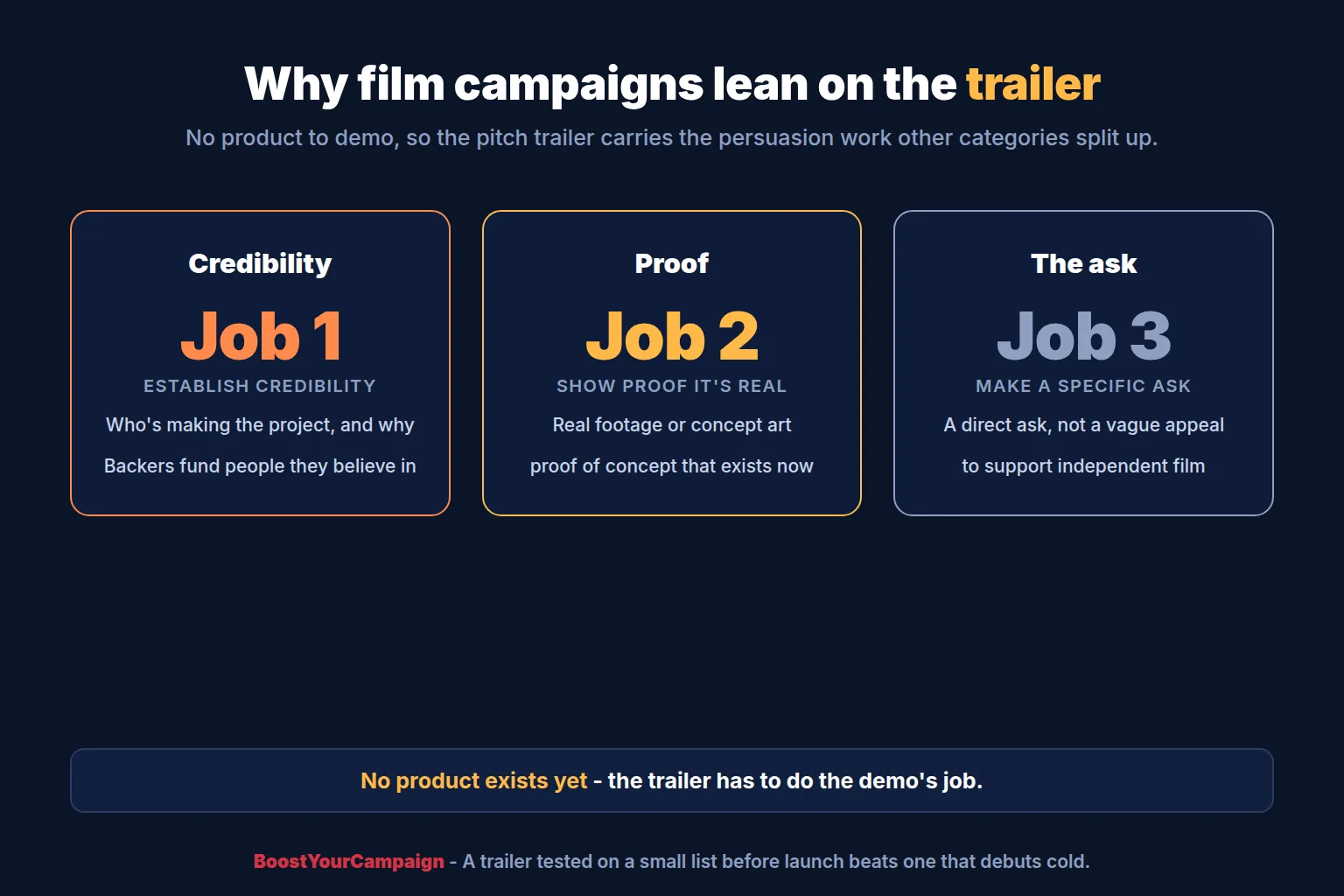
A hardware campaign can show a working prototype. A board game can show playable cards on a table. A film campaign, in almost every case, is asking backers to fund something that doesn't exist yet and can't be demonstrated the way a physical product can. That makes the pitch trailer the single highest-leverage asset a film campaign has, carrying a weight that a product photo or spec sheet simply doesn't have to carry in other categories.
A strong pitch trailer for a crowdfunding campaign is not the same thing as a finished film's promotional trailer. It has to do more work in less time: establish who is making the project and why they're credible to make it, show whatever footage, concept art, or proof of concept actually exists, and make a direct, specific ask rather than a vague appeal to support independent film. Backers fund people and stories they believe in as much as they fund a finished product, so the director or lead creator being visible and specific on camera tends to outperform a polished but impersonal sizzle reel.
Because there's no product to test-market, pre-launch audience building carries even more weight for film than for other categories. A trailer tested on a small email list or social following before public launch, with real feedback incorporated, walks into the campaign with a far better shot than one that debuts cold on day one. The same pre-launch tactics that work for consumer products apply here: an engaged list, a landing page that sets clear expectations, and community built ahead of the ask.
6) Festival and distribution positioning after a funded campaign
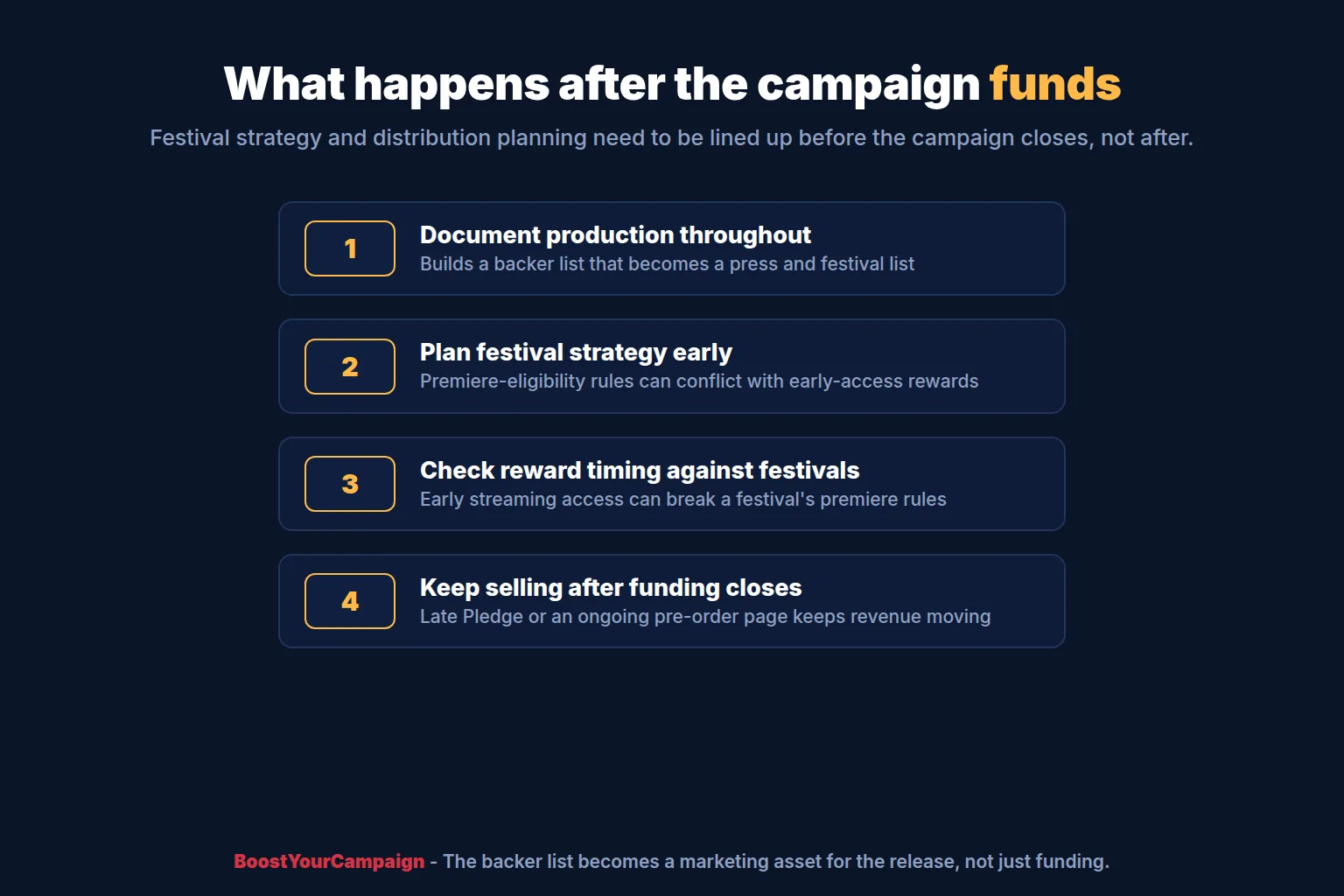
Funding closes one phase of a film project and opens another, and the campaign itself can do real work for the distribution phase if it's planned for from the start. A campaign that documents its own production, builds a backer list that later becomes a press and festival-outreach list, and collects testimonials and update engagement along the way arrives at the festival submission stage with material a project that skipped this step doesn't have.
Festival strategy should be considered before the campaign even launches, not after the film is finished, since festival submission windows and premiere-status rules affect how and when a film can be shown publicly, including whether backer-only screenings or early access rewards need to be scheduled around a festival's premiere requirements. A backer reward that promises early streaming access before a target festival's premiere date, for instance, can conflict with that festival's eligibility rules if it isn't checked in advance.
Post-campaign, Late Pledge on Indiegogo or an ongoing pre-order page can keep the project generating revenue and audience growth through the festival circuit and into eventual distribution, whether that's a distributor deal, self-distribution through digital platforms, or a hybrid release. The campaign's backer list, at that point, has become a marketing asset for the release itself, beyond its original role as a funding source for production.
7) Fiscal sponsorship and nonprofit angles for documentary
Documentary projects in the US have an option most narrative film and consumer product campaigns don't: fiscal sponsorship. A fiscally sponsored project partners with an existing 501(c)(3) nonprofit organization, which allows individual donors to make a tax-deductible contribution to the project even though the filmmaker themselves isn't a registered nonprofit. Organizations built around documentary specifically, along with several film-focused nonprofits, offer this kind of sponsorship, typically for an administrative fee taken from funds raised.
Fiscal sponsorship and rewards crowdfunding are not mutually exclusive. Some documentary campaigns run a rewards-based Kickstarter or Indiegogo campaign for one phase of funding while separately pursuing tax-deductible donations and grant funding through a fiscal sponsor for another. The two paths appeal to different supporters: a rewards campaign backer wants a perk and to feel part of the launch moment, while a donor giving through a fiscal sponsor is often motivated by the tax deduction and a longer-term interest in the subject matter.
This is genuinely specialized territory, and the details, eligible organizations, fee structures, and tax treatment, vary and change over time. Documentary filmmakers considering this route should talk to an accountant or entertainment attorney familiar with fiscal sponsorship before committing to a structure, rather than treating this section as complete guidance on its own.
8) When rewards crowdfunding fits a film project, and when it doesn't
Rewards crowdfunding fits film projects that need a defined, relatively modest amount of production or post-production funding, have or can build an audience willing to pre-support the project for a perk, and are comfortable delivering both a finished film and a set of physical or digital rewards on a public timeline. It's a strong fit for documentaries with a built-in community around their subject, narrative shorts with a clear creative hook, and web series with an existing following from prior work.
It fits less well for projects chasing a large budget with no existing audience, since crowdfunding rewards campaigns rarely scale to feature-film budgets without an unusually large pre-built following or major press support behind them. For those projects, equity crowdfunding, direct investment, grants, or a studio and streamer deal are usually the more realistic path, and each of those comes with its own trade-offs around ownership, creative control, and timeline that a rewards campaign doesn't carry. Our equity vs rewards crowdfunding guide covers that distinction for creators weighing both paths.
How BoostYourCampaign fits
BoostYourCampaign runs a full-stack, done-for-you model that's relevant to film crowdfunding specifically because of the production side: the agency operates owned video production studios in the US and EU, which matters for a category where the pitch trailer carries most of the persuasion work a campaign has to do. Campaign marketing, video production, and fulfillment sit under one roof rather than split across separate vendors who don't coordinate on timeline or creative direction.
On the paid media side, BYC uses a skin-in-the-game ad model, investing its own money alongside the client's ad budget with fixed fees rather than a percentage-of-raise commission, which keeps budget decisions aligned with actually finding an audience during the pre-launch and live phases rather than just spending toward a target. The agency also operates owned fulfillment warehouses in the US and EU, relevant for film campaigns shipping Blu-rays, posters, and other physical rewards to backers.
BYC is an Indiegogo Approved Agency, a Google Premier Partner, a Facebook Marketing Partner, an official Shopify Partner, and an Amazon Partner, and has been active since 2010 across 4,600+ campaigns with $734M+ raised and a 4.9/5 score across 300+ verified reviews, visible on the reviews page. Client products have gone from a BYC-run crowdfunding launch to Shark Tank coverage, documented on the press page, and Kevin O'Leary has given a video testimonial about the agency, available on the reviews page. For a deeper look at agency selection criteria specific to film, see our film crowdfunding agency guide, and for video production options specifically, see our crowdfunding video production guide.
Platform comparison for film crowdfunding
| Platform | Fee model | Funding model | Audience | Film fit |
|---|---|---|---|---|
| Kickstarter (Film & Video) | Combined platform and processing fees generally in the 8-10% range | Fixed, all-or-nothing | Largest pool of habitual crowdfunding backers | Strongest default for most documentaries, shorts, and web series |
| Indiegogo | Combined platform and processing fees generally in the 8-10% range | Fixed, all-or-nothing (flexible funding discontinued for new campaigns) | Smaller organic discovery than Kickstarter | Fits projects wanting an ongoing Late Pledge sales channel after launch |
| Seed&Spark (film specialist) | Modest creator-side platform fee plus payment processing; can be passed to backers | Funds released at a substantial share of goal, not a strict 100% threshold | Smaller, but concentrated around the film and documentary community | Worth evaluating alongside the majors for documentary and indie narrative work |
Frequently Asked Questions
Is this guide about rewards crowdfunding or equity financing for film?
Rewards crowdfunding only. This guide covers Kickstarter, Indiegogo, and film-specialist platforms like Seed&Spark, where backers receive a perk rather than an ownership stake. Equity or securities crowdfunding for film is a separate regulatory path with different platforms, rules, and investor protections.
Should a documentary use Kickstarter, Indiegogo, or Seed&Spark?
Kickstarter is the strongest default for most documentaries because of its larger pool of habitual backers and stronger organic discovery. Indiegogo fits projects that want an ongoing Late Pledge sales channel after the campaign closes. Seed&Spark is worth evaluating alongside both, especially for a project already connected to the film and documentary community, though its total reach is smaller than either major platform.
Does Indiegogo still offer flexible funding for film campaigns?
No. Flexible funding, which let creators keep whatever was raised short of the stated goal, has been discontinued for new Indiegogo campaigns. Indiegogo now runs fixed, all-or-nothing funding, the same core model as Kickstarter, though Late Pledge (formerly called InDemand) is still available as an ongoing sales tool after the campaign period ends.
What rewards should a film crowdfunding campaign offer?
A mix of digital rewards (early streaming access, the finished film, behind-the-scenes content) and physical rewards (Blu-rays, posters, signed items) generally works best. Digital rewards cost little to fulfill and scale easily. Physical and experience-based rewards need fulfillment planning and realistic backer caps before launch, since they carry real shipping and coordination costs.
How important is the pitch trailer for a film crowdfunding campaign?
Very. Unlike a physical product, a film can't be demonstrated before it exists, so the pitch trailer carries most of the persuasion work a campaign page normally splits across photos, demos, and specs. A trailer that establishes the creator's credibility, shows real footage or proof of concept, and makes a specific ask tends to outperform a polished but generic sizzle reel.
What is fiscal sponsorship, and does it apply to crowdfunding?
Fiscal sponsorship is a US arrangement where a documentary project partners with an existing 501(c)(3) nonprofit, allowing individual donors to make tax-deductible contributions to the project. It's a separate path from rewards crowdfunding and can run alongside it, but eligibility, fees, and tax treatment vary by sponsor and should be confirmed with an accountant or entertainment attorney familiar with the structure.
What happens to a film project after a crowdfunding campaign ends?
Funding is one phase, not the finish line. Festival submission strategy should be planned before the campaign launches, since premiere-eligibility rules can conflict with early-access backer rewards if they aren't checked in advance. Late Pledge or an ongoing pre-order page can keep generating revenue and audience growth through the festival circuit and into eventual distribution.
When does rewards crowdfunding not make sense for a film project?
When the budget is large relative to the project's existing audience. Rewards crowdfunding rarely scales to full feature-film budgets without a large pre-built following or major press support. For those projects, equity crowdfunding, direct investment, grants, or a studio and streamer deal are usually more realistic paths.
If you want help deciding between platforms for your specific film project and timeline, reach out through /contact.
Want results like these for your campaign?
We've helped 4,600+ creators raise over $734M. Let's pressure-test your launch plan and find the highest-leverage fixes before you go live.
Book a free strategy call →Get the free 87-step launch checklist
The exact pre-launch, live-campaign and fulfillment steps we use across 4,600+ launches. Free PDF, emailed instantly.
You're in - check your inbox. Open the checklist now ->