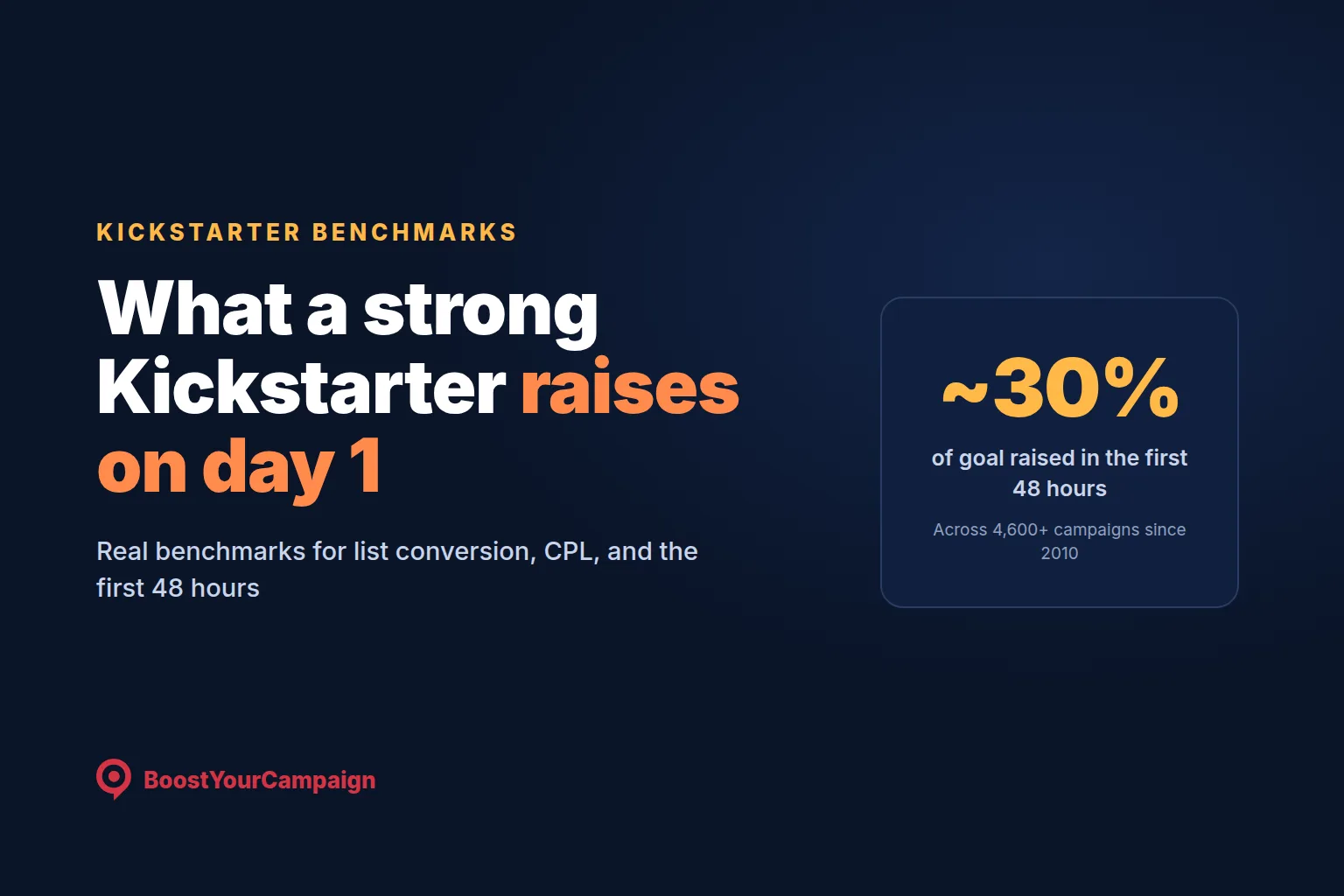
Creators ask us the same question the week before launch: how much should we actually raise on day 1? This page gives a direct, data-led answer instead of a guess, drawn from patterns across more than 4,600 campaigns and $734M+ raised since 2010. If you want your list and offer run through this math before you pick a launch date, talk with BoostYourCampaign.
Across the Kickstarter and Indiegogo campaigns we have run since 2010, the pre-launch funnel converts in two steps: roughly 10% to 30% of email leads go on to place a paid deposit of $1 to $25, and 30% to 50% of those deposits convert into actual backers on launch day. A lead-to-deposit rate under 10% means the offer needs work, not the traffic. The target is 100% of the funding goal on day one, which is what the campaigns BoostYourCampaign runs usually reach, and about 90% of first-48-hour backers come from the pre-launch email list, not organic Kickstarter discovery. A full pre-launch list, deposits and non-deposits together, converts to backers at roughly 5% to 10%, and paid leads at 2% to 3%. A well-built pre-launch landing page converts 20% to 40% of visitors into email leads, and a cost per lead under roughly $1.70 is achievable with ad testing and iteration. Anyone quoting a precise "organic day-1 revenue" figure for Kickstarter is guessing, since the platform does not publish that breakdown.
- Day-one target - 100% of the funding goal on day one, which is what the campaigns we run usually reach.
- Where day 1 comes from - roughly 90% of first-48-hour backers come from the pre-launch list, not organic search or browsing.
- List conversion - a full email list converts at roughly 5% to 10%, paid leads at 2% to 3%, deposit holders at 30% to 50%.
- Lead-to-deposit rate - a healthy rate sits in the 10% to 30% band; under 10% means the offer needs work, not the traffic.
- Landing page conversion - a well-built pre-launch page typically converts 20% to 40% of visitors into email leads.
- Cost per lead - test at $20/day per ad set; CPLs under roughly $1.70 are achievable with iteration.
1) How much a Kickstarter should raise on day 1 and in the first 48 hours
The question we hear most before a launch is the wrong one: "how much will we raise on day 1?" The better question is what share of goal that number needs to represent, because Kickstarter's algorithm rewards early momentum. Projects that fund fast in the first 48 hours are more likely to earn a spot on Popular, get surfaced in category rankings, and pick up the social proof that makes a stranger comfortable backing something they found on their own. Slow-opening projects are not punished exactly, but they miss that visibility window and earn every backer the hard way.
The target is 100% of the funding goal on day one, which is what the campaigns BoostYourCampaign runs usually reach. That target shapes the goal itself: set it at a number the pre-launch list can cover on launch day, before organic discovery, press, or live ads add anything. A thinner list backed by a strong ad budget can still fund with a slower start, but it gives up the visibility that funding on day one brings.
Here is what that looks like with real numbers. Say you have a pre-launch list of 10,000 qualified leads, with roughly 15% (1,500 people) upgrading to a $1 to $25 paid reservation - healthy, inside the 10% to 30% band from section 4. Deposit holders converting at 40%, mid-range for the 30% to 50% band, deliver 600 backers. The remaining 8,500 convert at a more typical 2%, adding 170 more - roughly 770 backers, about 7.7% of the full list, before a single organic or ad-driven pledge lands. At a hedged example average pledge of $120, that is roughly $92,000 from the list alone, so a goal at or under that figure is one this list can fund on day one.
| Scenario | Assumption | Backers (approx) | Day-1 revenue (approx, $120 avg pledge) |
|---|---|---|---|
| Thin, unsegmented list | 10,000 x 5% | ~500 | ~$60,000 |
| Segmented (worked example) | 1,500 VIPs x 40% + 8,500 x 2% | ~770 | ~$92,000 |
| Strong, unsegmented list | 10,000 x 10% | ~1,000 | ~$120,000 |
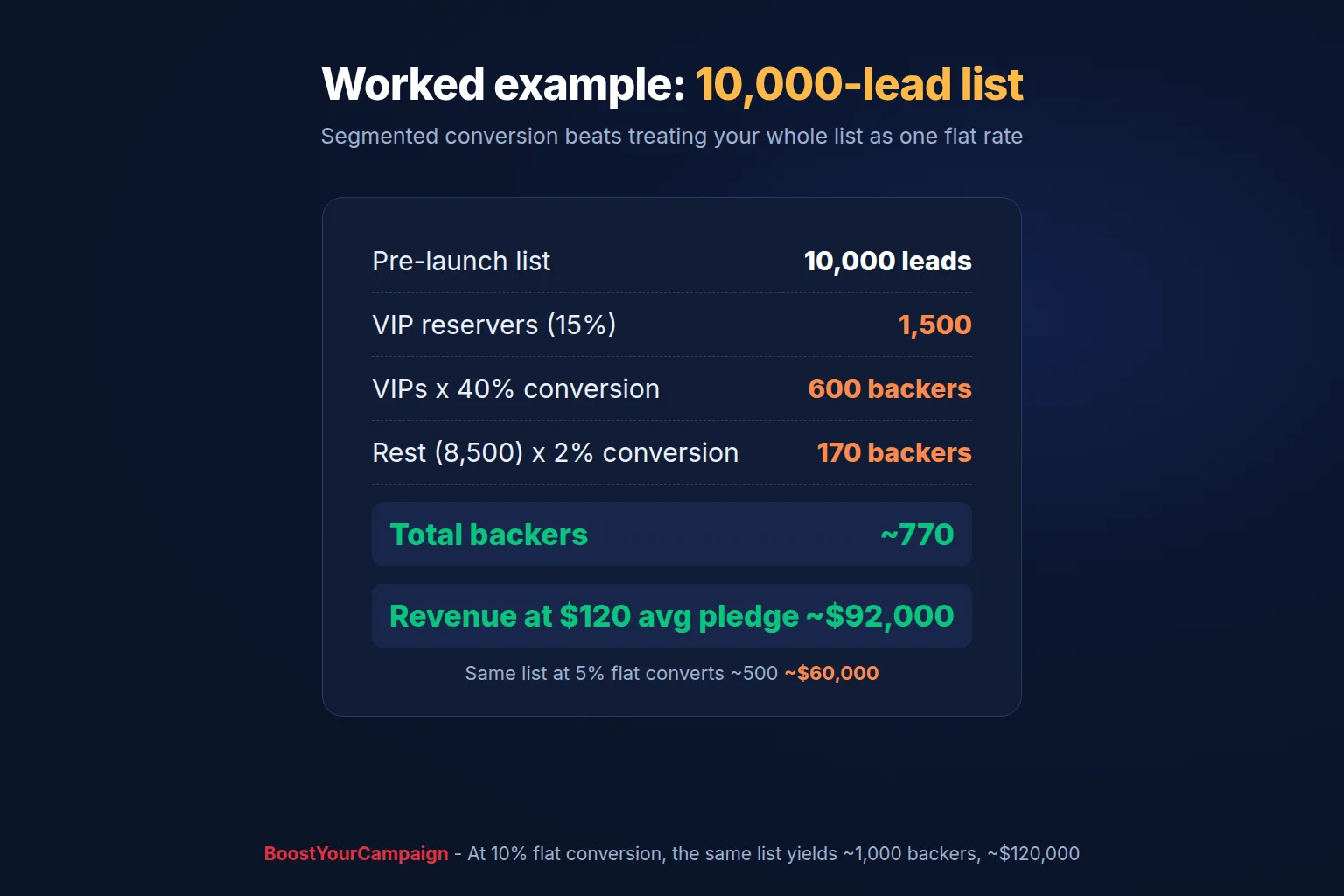
Same list size, three assumptions - the gap between a 5% and 10% blended conversion rate is a 2x swing in day-1 revenue on identical traffic. "How big should my list be" is the wrong first question. "What is my list actually converting at" is the one that determines your day 1.
2) Where day-1 revenue comes from
Day-1 revenue comes from four sources, and they do not contribute evenly: the pre-launch list, organic Kickstarter discovery (search, browsing, and the Popular or Projects We Love algorithm), live ads, and press. In the campaigns we run, the list is overwhelmingly the largest of the four - roughly 90% of first-48-hour backers come from people who were on it before launch, a pattern that holds fairly steady across categories and goal sizes, covered in more depth in our piece on pre-launch numbers that predict crowdfunding revenue.
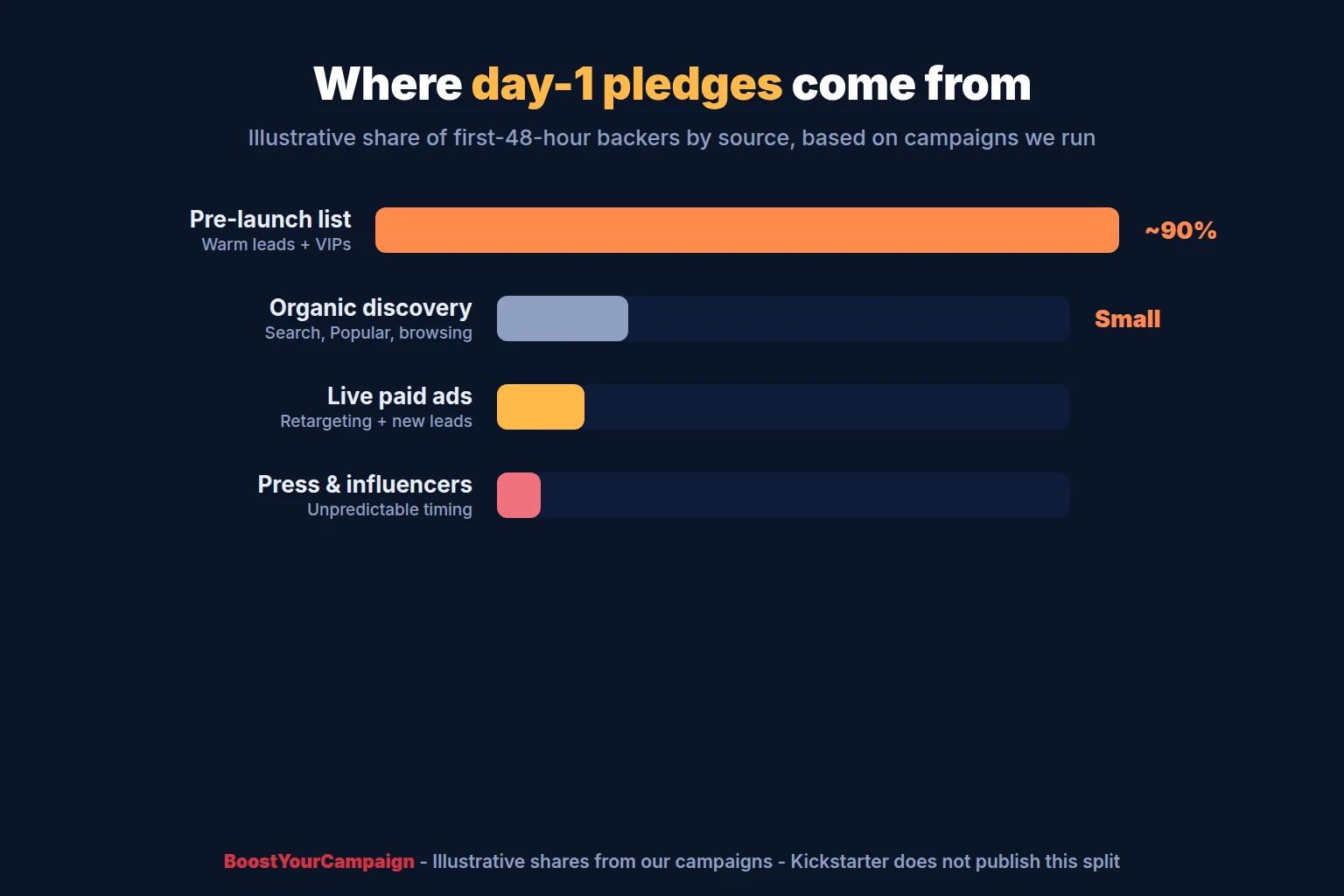
That leaves organic discovery, live ads, and press splitting a small remainder on day one, and organic discovery deserves an honest caveat: there is no hard public number for "day-1 organic Kickstarter traffic" revenue, and any source quoting a precise percentage is guessing, since Kickstarter does not publish a breakdown that detailed. From running campaigns ourselves, organic discovery is a small share of day-1 pledges, growing meaningfully only after a project earns a spot on Popular or Projects We Love - typically from day 2 or 3 onward, once list-driven momentum has proven the project worth surfacing. Treating organic discovery as a day-1 lever is the mistake; treating it as a day-3-onward multiplier the list has to earn first is the accurate read.
Live ads and press behave differently. Ads mostly convert people already close to the list, so their day-1 contribution compounds across the campaign rather than front-loading on day 1. Press is the least predictable of the four: a strong feature can move real revenue in hours, but placement rarely lines up with launch morning, so treat it as a bonus, not a substitute.
3) Email list to backer conversion benchmarks
Once the list exists, the number that matters is how much of it converts to a paying backer. Three bands show up again and again in our data. A full pre-launch email list - everyone who ever opted in - typically converts to backers at roughly 5% to 10%. Leads from paid ads convert a bit tighter, typically 2% to 3%, since paid traffic includes more people earlier in their interest curve. And $1 to $25 deposit holders convert at roughly 30% to 50% - covered in full in our reservation funnel guide.
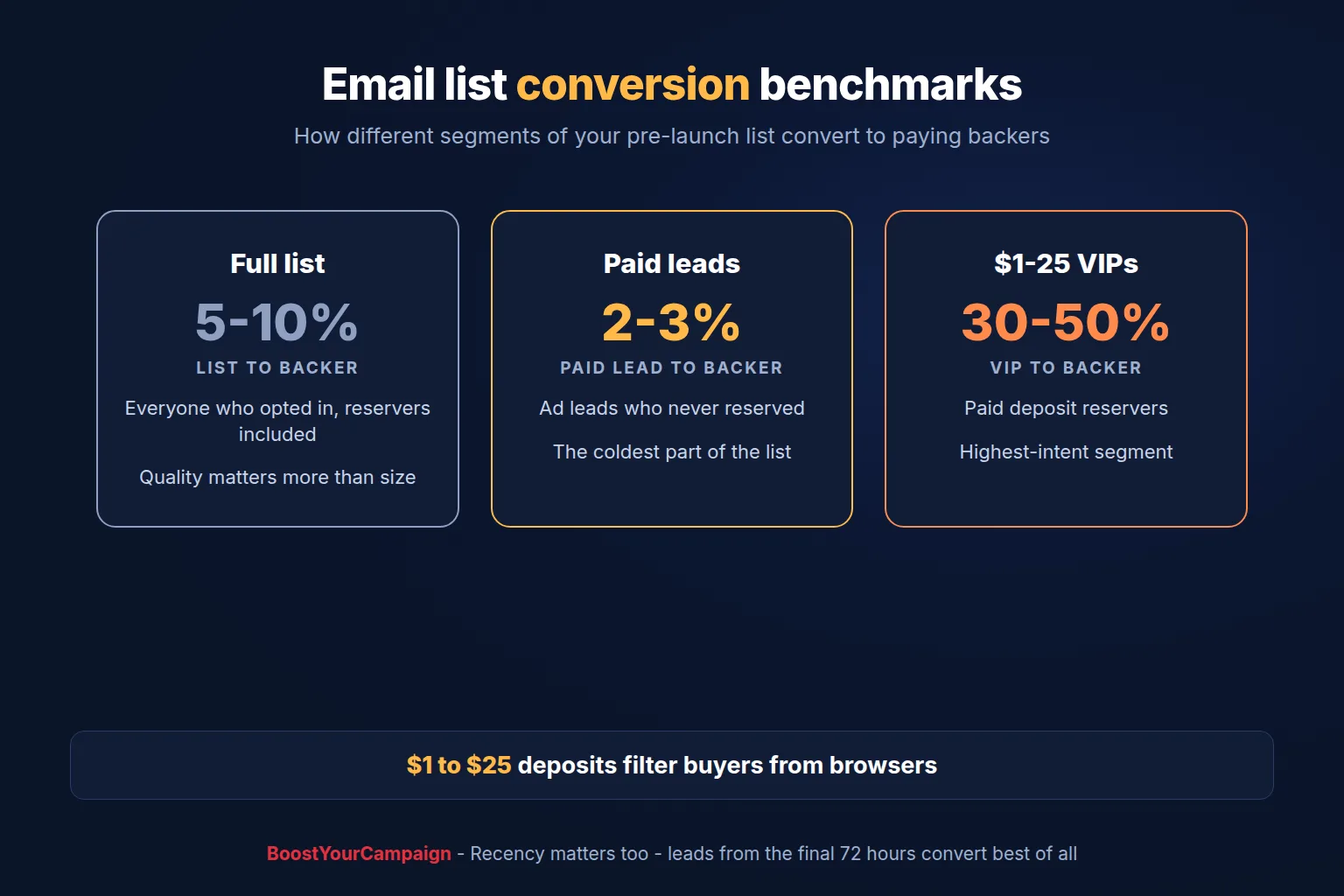
List recency matters as much as list size. Leads collected in the final 72 hours before launch are the warmest segment you have: they opted in closest to the moment they are asked to pledge, and are most likely to open a launch-morning email and act on it. That is why we run a final push in the last three days before launch - not to inflate the raw count, but because that 72-hour window produces backers at a noticeably higher rate than leads sitting weeks or months old.
4) Deposit and reservation conversion rate benchmarks
Two numbers get called "conversion rate" at this stage and they mean different things. The first is the deposit conversion rate, sometimes called the lead-to-reservation rate: what share of your email leads go on to pay a small refundable deposit, usually $1 to $25, to reserve a launch-day discount. The second is the reservation conversion rate: what share of those deposit holders become actual backers when the campaign goes live. We call the deposit step the VIP funnel internally, but the numbers are the same thing.
| Funnel step | What it measures | Healthy range | Warning sign |
|---|---|---|---|
| Visitor to lead | Landing page visitors who give an email | 20% to 40% | Under 15% |
| Lead to deposit | Email leads who pay a $1 to $25 reservation | 10% to 30% | Under 10% |
| Deposit to backer | Reservation holders who back on launch day | 30% to 50% | Under 20% |
| Full list to backer | Everyone on the list, deposits and not | 5% to 10% | Under 5% |
| Paid lead to backer | Leads acquired through ads only | 2% to 3% | Under 1% |
The deposit conversion rate is the single best pre-launch diagnostic we have, because it tests the moment that actually matters - will this person pay you something - weeks before launch day, while you can still fix what is wrong. A healthy deposit conversion rate for a well-positioned product typically sits in the 10% to 30% band. Strong offers push toward the top of that range; a rate under 10% means the offer needs work, and it is almost never a traffic problem. It usually means people liked the idea enough to give an email but not enough to hand over even a small deposit, which points to the offer or price needing work before you spend another dollar reaching more of the same unconvinced audience.
Watching this rate move week over week is more useful than checking it once. A rate that starts around 15% and holds steady as the list grows is a good sign. A rate that starts strong and drifts downward as you widen targeting usually means the earliest, most qualified audience is exhausted and newer traffic is colder - worth knowing before launch day, not after.
5) Landing page conversion rate benchmarks
Before any conversion-to-backer number above matters, the landing page has to turn a visitor into a lead. A well-built pre-launch page, matched to reasonably well-targeted traffic, typically converts 20% to 40% of visitors into email signups. A page converting in the single digits is a red flag, and rarely a cosmetic problem - it usually points to a structural issue: an unclear headline, a hero image that does not clearly show the product, distracting elements above the fold, or mismatched traffic.
What moves this number most is the top of the page, not the bottom. The headline and hero visual carry more weight than anything else, followed by how tightly the page is built for mobile, since most paid pre-launch traffic arrives on a phone. Our pre-launch landing page teardown covers the full anatomy - what belongs above the fold, where social proof converts, and how the VIP deposit step should be framed.
6) Cost per lead benchmarks
Cost per lead, or CPL, tells you whether your ad spend is buying real demand or just reach. We test new ad sets at $20 per day, running each long enough for a meaningful read before scaling or killing it, a protocol covered in our Kickstarter ads guide. With rapid creative iteration - testing multiple hooks, killing underperformers fast, scaling only what works - CPLs under roughly $1.70 are achievable, improving as the campaign gathers data.
CPL alone is not the full picture. What matters is cost per backer, which follows from CPL divided by your conversion rate. At a $1.70 CPL and a 2.5% paid-lead conversion rate (mid-range for section 3's band), cost per backer works out to roughly $68 through cold paid leads alone. The same $1.70 CPL feeding a VIP funnel converting at 40% drops that to roughly $4.25 - the case for the reservation funnel, which makes ad spend far more efficient by filtering for people who actually convert.
7) How to read your own numbers before launch
Benchmarks only help once you plug your own numbers in. Before setting a launch date, run your list size and deposit conversion rate through the math from section 1, and be honest about where you land against the target of 100% of goal on day one.
As a rough guide: a 2,000-lead list with a deposit rate near 10% typically supports a goal in the low five figures; a 10,000-lead list at a 15% deposit rate, the scenario from section 1, supports a mid five-figure goal up to roughly $90,000; and a 25,000+ list with a strong deposit rate is what six-figure-plus campaigns typically need before launch. Live ads, press, and organic lift after day 2 add on top - but if your forecast cannot plausibly cover the goal on day one, that is worth knowing during planning, not launch morning.
The honest response to a thin forecast is not to launch anyway and hope organic traffic fills the gap - section 2 covers why that is not how day 1 works. Delay the launch, size the goal to what the list supports, or put more budget behind list-building ads in the weeks remaining. Our pre-launch checklist and guide to choosing a launch date cover making that call with real numbers.
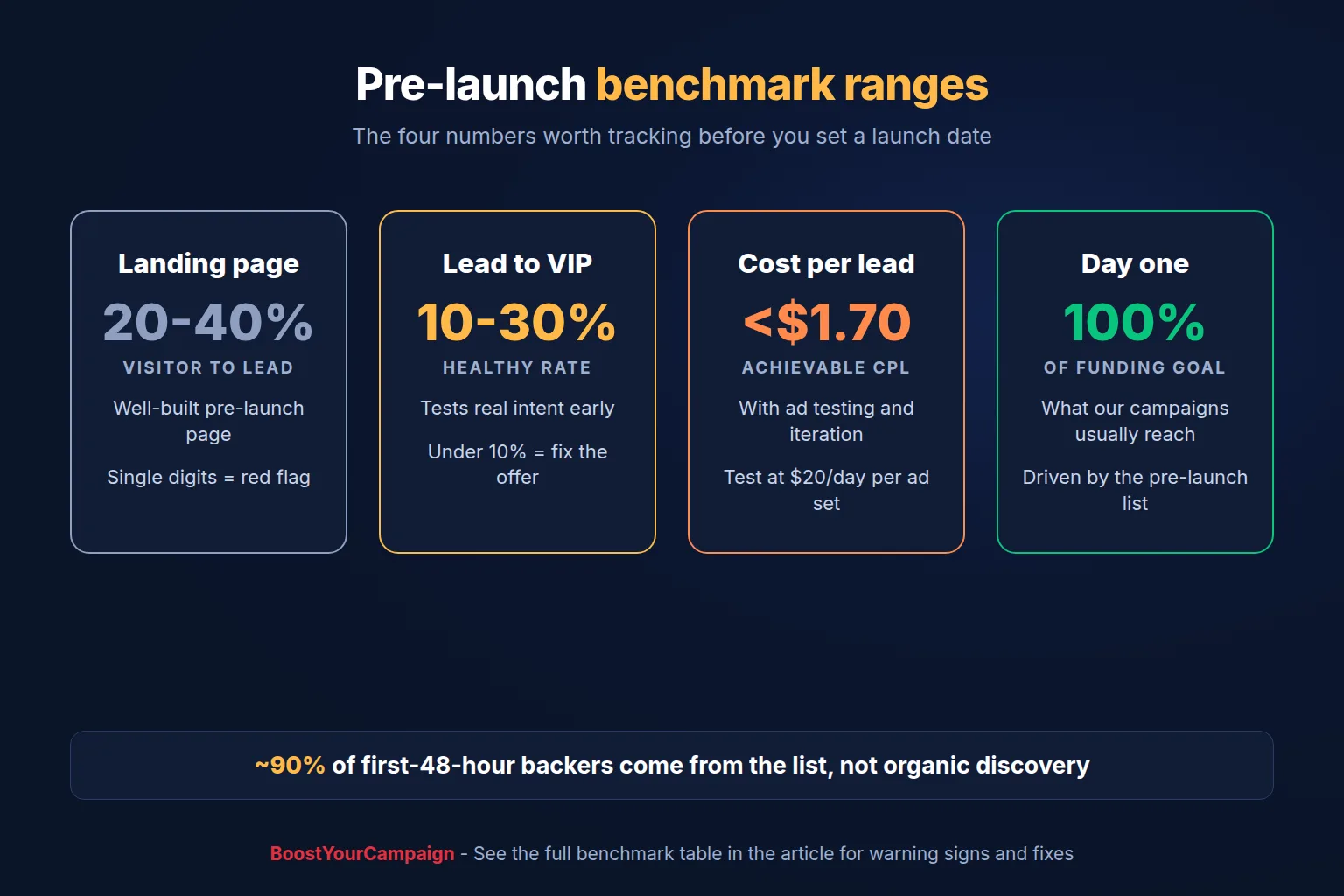
| Metric | Healthy range | Warning sign | What to fix |
|---|---|---|---|
| Landing page conversion | 20% - 40% visitor to lead | Single digits | Headline, hero image, mobile build, traffic match |
| Lead-to-deposit rate | 10% - 30% | Under 10% | Offer, price, perceived value - not more traffic |
| Full list conversion | 5% - 10% to backer | Under 5% by launch | List recency, segmentation, deposit funnel |
| Paid lead conversion | 2% - 3% to backer | Under 1% | Audience targeting, creative, offer clarity |
| Cost per lead | Under roughly $1.70 achievable | $5 - $8+ and rising with spend | Creative iteration, audience, offer |
| Day one | 100% of goal | Forecast cannot cover the goal on day one | Delay launch, rebuild list, or resize goal |
8) What changes the benchmarks
These ranges hold up across thousands of campaigns, but a few variables shift them meaningfully. Price point matters first: a $30 gadget and a $400 piece of furniture do not convert at the same rate even with an identical list, since the commitment asked of a backer differs in kind, not just size. Category matters too - tabletop games carry the platform's most experienced, price-sensitive repeat backers and often need reservation funnels reshaped rather than run at full strength, a nuance covered in our reservation funnel guide.
Country mix moves the numbers too. A list weighted toward the US and UK generally supports a stronger deposit-based VIP funnel than one weighted toward continental Europe, where prepayment habits and trust in an unfamiliar brand vary by market. Video quality is its own lever - a clear, well-paced pitch video lifts conversion in ways ad spend alone cannot make up for. And timing changes everything downstream, which is why launch-date selection is its own decision in our launch timing guide, and why how Kickstarter's all-or-nothing mechanics work matters before you set any of these targets.
How BoostYourCampaign fits
BoostYourCampaign has run pre-launch list building, ads, video, PR, and fulfillment as one connected process since 2010, across more than 4,600 campaigns and $734M+ raised, with a 4.9/5 score across 300+ verified reviews. The numbers here are not borrowed from a single case study - they are patterns tracked across enough campaigns to know which forecast reliably.
We test ad sets at $20/day, work toward CPLs under roughly $1.70 through creative iteration, and build the reservation funnel and landing page discipline above into every pre-launch program, so by launch date you are working from your own list size, deposit rate, and CPL, not a guess. See our services page or talk to an expert, and if you are still budgeting the campaign, our Kickstarter cost breakdown covers what the spend behind these numbers looks like.
Numbers to know before you launch
- Pre-launch list size, and how many of those leads came in the final 72 hours.
- Lead-to-deposit conversion rate (target 10% to 30%; under 10% means the offer needs work).
- Landing page visitor-to-lead conversion rate (target 20% to 40%).
- Cost per lead trend as ad spend scales - it should hold steady or improve, not climb.
- Forecasted day-one revenue against your actual funding goal (target 100%).
- The average pledge value you are modeling the forecast against.
- Whether your goal, list, and timeline actually line up, or need adjusting before launch.
Frequently Asked Questions
How much should a Kickstarter raise on day 1?
There is no single figure that fits every campaign, since it depends on your goal and list size. Plan against a share of goal, not a fixed number: the target is 100% of the funding goal on day one, which is what the campaigns we run usually reach. Use the worked example in section 1 to model your own number.
What percentage of a Kickstarter goal comes in the first 48 hours?
The target is 100% of the goal on day one, so a strong launch has already funded before the 48-hour mark. About 90% of first-48-hour backers come from the pre-launch list rather than organic discovery, ads, or press, which is why list size and deposit conversion are the numbers worth forecasting from before you commit to a launch date.
How much day-1 revenue comes from organic Kickstarter traffic?
There is no reliable public figure, and any source quoting a precise percentage is guessing, since Kickstarter does not publish a day-1 source breakdown. In the campaigns we run, organic discovery is a small share of day-1 revenue, growing meaningfully only after a project earns a spot on Popular or Projects We Love, typically from day 2 or 3 onward.
What is a good lead to deposit conversion rate for Kickstarter?
Across the campaigns we have run, 10% to 30% of email leads go on to place a paid reservation deposit of $1 to $25. Strong offers sit at the top of that band. Under 10% means the offer needs work, and it is almost never a traffic problem: people liked the idea enough to give an email but not enough to pay anything, which points at the offer or the price. Kickstarter's own guidance uses the same threshold, suggesting creators revisit the offer if fewer than roughly 10% of signups place a deposit.
What percentage of reservations convert to backers?
Between 30% and 50%, in our experience, with 30% being a sensible number to plan against and anything under 20% worth investigating before launch. Someone who has already paid a deposit has cleared the hardest hurdle, which is why this step converts several times better than a full email list at 5% to 10%. For a forecast, multiply your deposit count by 0.3 for a conservative backer estimate and by 0.5 for a strong one.
What is a good email list conversion rate for a Kickstarter launch?
A full list typically converts to backers at roughly 5% to 10%, paid-ad leads at roughly 2% to 3%, and $1 to $25 deposit holders at roughly 30% to 50%. Leads collected in the final 72 hours before launch, the warmest segment, convert noticeably better than older leads.
What is a good cost per lead for Kickstarter ads?
Test new ad sets at $20 per day and expect CPL to improve as you iterate on creative. CPLs under roughly $1.70 are achievable with that discipline, and a CPL that climbs as you scale spend usually signals the offer or audience needs work, not more budget.
What is a good Kickstarter landing page conversion rate?
A well-built page converting reasonably well-targeted traffic typically converts 20% to 40% of visitors into email leads. A rate in the single digits usually points to a structural problem - an unclear headline, a distracting layout, or mismatched traffic - not a small cosmetic fix.
How big should my email list be before launching a Kickstarter?
It depends on your goal and, more importantly, your lead-to-deposit rate, not raw list count. A 10,000-lead list with a 15% deposit rate can support roughly 770 backers and tens of thousands of dollars in day-1-to-week-1 revenue, worked through in section 1. A smaller, more engaged list with a higher deposit rate can outperform a much larger cold one.
How many backers can I expect from my pre-launch list?
Model it from your list size and lead-to-deposit rate rather than guessing. A segmented list where roughly 15% place a deposit and convert at 40%, and the rest converts at roughly 2%, produces meaningfully more backers than treating the whole list as a single pool at the bottom of the 5% to 10% range. See the worked example in section 1 for the full math.
If you want these numbers modeled against your own list, price point, and category before you set a launch date, reach out through /contact and we will walk through the forecast with you.
How ready is your campaign?
Score your page out of 100 in about 3 minutes, against the benchmarks in this post.
Want results like these for your campaign?
We've helped 4,600+ creators raise over $734M. Let's pressure-test your launch plan and find the highest-leverage fixes before you go live.
Talk to an expert →Get the free 87-step launch checklist
The exact pre-launch, live-campaign and fulfillment steps we use across 4,600+ launches. Free PDF, emailed instantly.
You're in - check your inbox. Open the checklist now ->