"What is Kickstarter" is one of the most-searched questions in crowdfunding, and most answers online are either too short to be useful or written by people who have never actually run a campaign. We have managed more than 4,600 crowdfunding campaigns since 2010, so here is the plain, complete answer: what Kickstarter is, how it works for creators and backers, what it costs, and what happens when a project misses its goal. If you are past the "what is it" stage and planning a launch, talk with BoostYourCampaign about your project.
Kickstarter is a rewards-based crowdfunding platform, founded in 2009, where creators post a project and a funding goal, and backers pledge money in exchange for a reward - usually the product itself at a discount, not a share of the company. Funding is all-or-nothing: if the project does not reach its goal by the deadline, no backer is charged and the creator gets nothing. If it does reach the goal, backers' cards are charged, Kickstarter takes a cut, and the creator uses the money to make and ship the rewards. Kickstarter is not a store (you are pre-ordering something that does not exist yet) and not an investment (backers never receive equity or a financial return).
- It is all-or-nothing - a project keeps nothing and charges nobody unless it reaches 100% of its funding goal.
- Launching is free - Kickstarter only takes a fee from a project that actually funds, so there is no upfront cost to post a campaign.
- The fee is 5% plus payment processing - roughly 3-5% more, both taken only from a successful raise.
- Backers pre-order a reward, not a stock stake - Kickstarter is not equity crowdfunding, and delivery is a promise, not a guarantee.
- Money moves fast, product moves slow - payout lands roughly 14 days after the campaign ends, but rewards typically ship months later.
- Most projects do not fund - a large share of campaigns miss their goal, which is why the platform is generally considered safe for backers and risky for creators who skip preparation.
1) What Kickstarter is
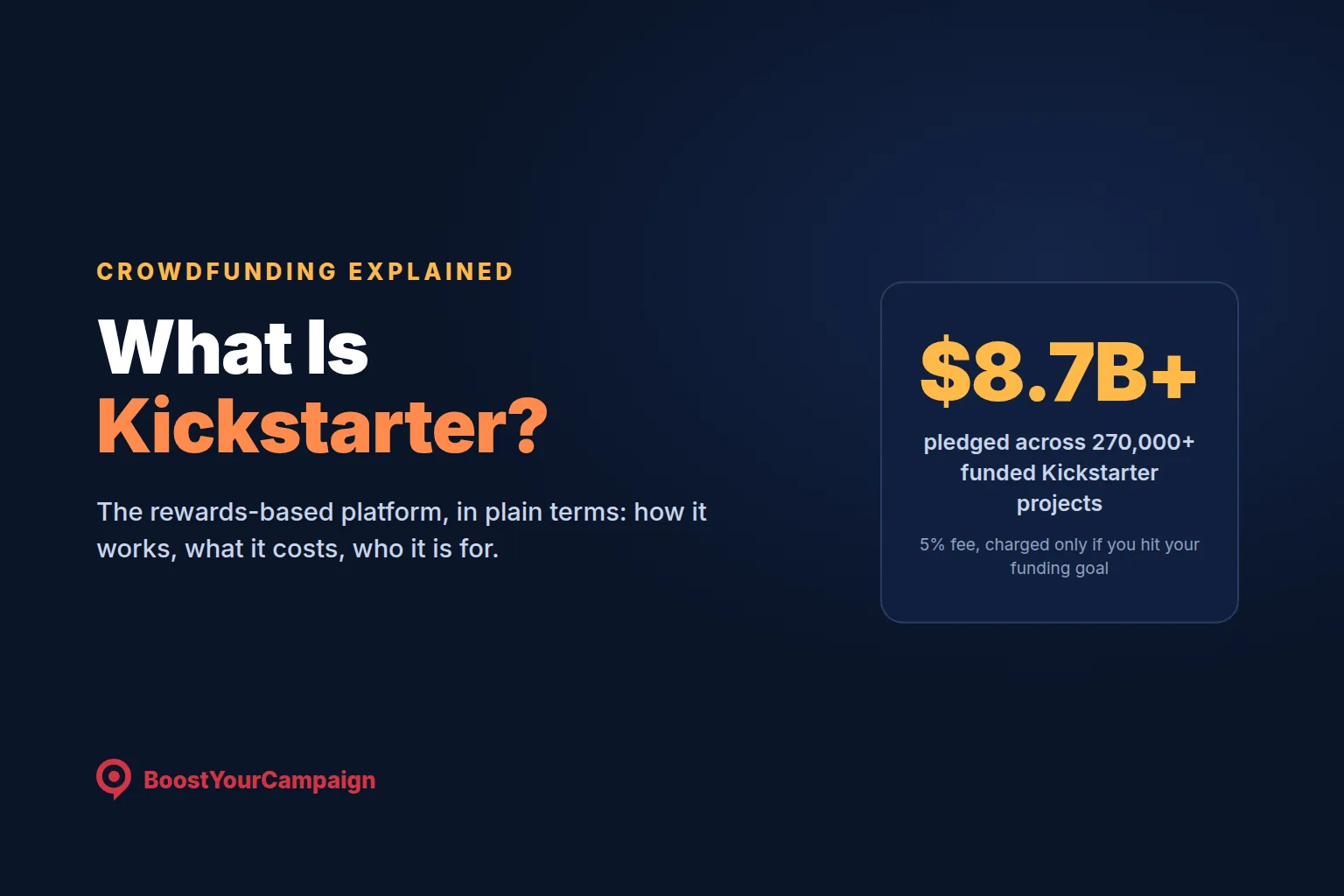
Kickstarter launched in 2009 as a rewards-based crowdfunding platform: a website where a creator posts a project, sets a funding goal and a deadline, and asks the public to pledge money toward making it real. In exchange, backers typically receive the finished product once it ships, priced as a pre-order rather than a shelf purchase, since the product usually does not exist yet when the pledge is made. Since launching, the platform has passed $8.7 billion in pledges across more than 270,000 successfully funded projects, spanning games, gadgets, films, books, music, food, and fashion.
Two things trip people up about what Kickstarter actually is. First, it is not a store: pledging funds production of something that may still need months of manufacturing and shipping after the campaign ends, not a finished item that ships tomorrow. Second, it is not an investment - backers never receive equity, a share of profits, or a financial return. What they get is the reward itself, depending on the tier chosen. That distinction is also what keeps Kickstarter outside securities regulation and lets it run with a lighter review process than equity crowdfunding platforms carry.
The mechanism tying all of this together is all-or-nothing funding, covered next from the creator's side and the backer's side.
2) How Kickstarter works for creators
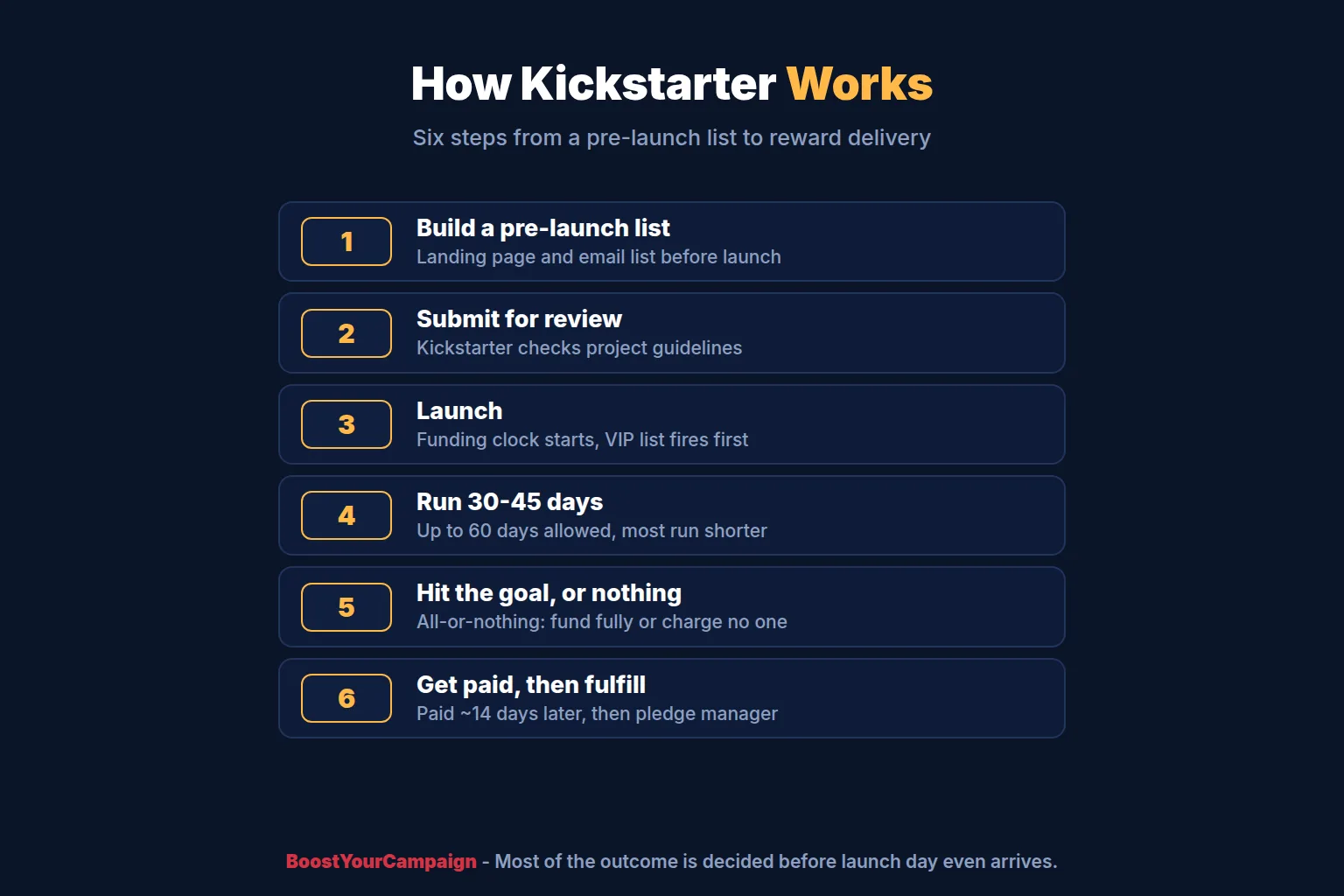
Running a Kickstarter follows a fairly consistent sequence, whether the project is a board game, a gadget, or a graphic novel, and the work before launch usually decides the outcome more than the live campaign itself.
Build a pre-launch page and email list. Most successful creators build a landing page and collect emails before the project goes live, then warm that list up with updates. A campaign that opens to a few thousand engaged subscribers behaves very differently than one that opens to nobody, because Kickstarter's own discovery surfaces respond to early momentum. Our full walkthrough of this stage is in how to launch a Kickstarter.
Submit the project for review. Kickstarter reviews every project before it can go live, checking that it meets the platform's guidelines - a real reward-based project with a genuine plan to deliver, not a cause, a charity ask, or a straight product sale. Review typically takes a few business days.
Launch. Once approved, the creator sets the campaign live and the funding clock starts, and the pre-launch list gets activated, usually in waves, to create a visible spike in the opening hours.
Run for 30-60 days. Kickstarter allows a campaign to run for up to 60 days, but most experienced creators run somewhere in the 30-45 day range, since a shorter window tends to hold urgency better than a long, slow-fading one.
Reach the goal, or nothing is charged. If total pledges reach the stated goal by the deadline, every backer's card is charged and the project is funded. If the deadline passes below the goal, no card is ever charged and the project raises nothing.
Funds are paid out roughly 14 days after the campaign ends, assuming the project is verified and in good standing. From there, the creator moves backers into a pledge manager to lock in addresses and any add-ons or late pledges, then moves into production and fulfillment, where the real work of a funded campaign begins. See how long a Kickstarter campaign takes for the full timeline.
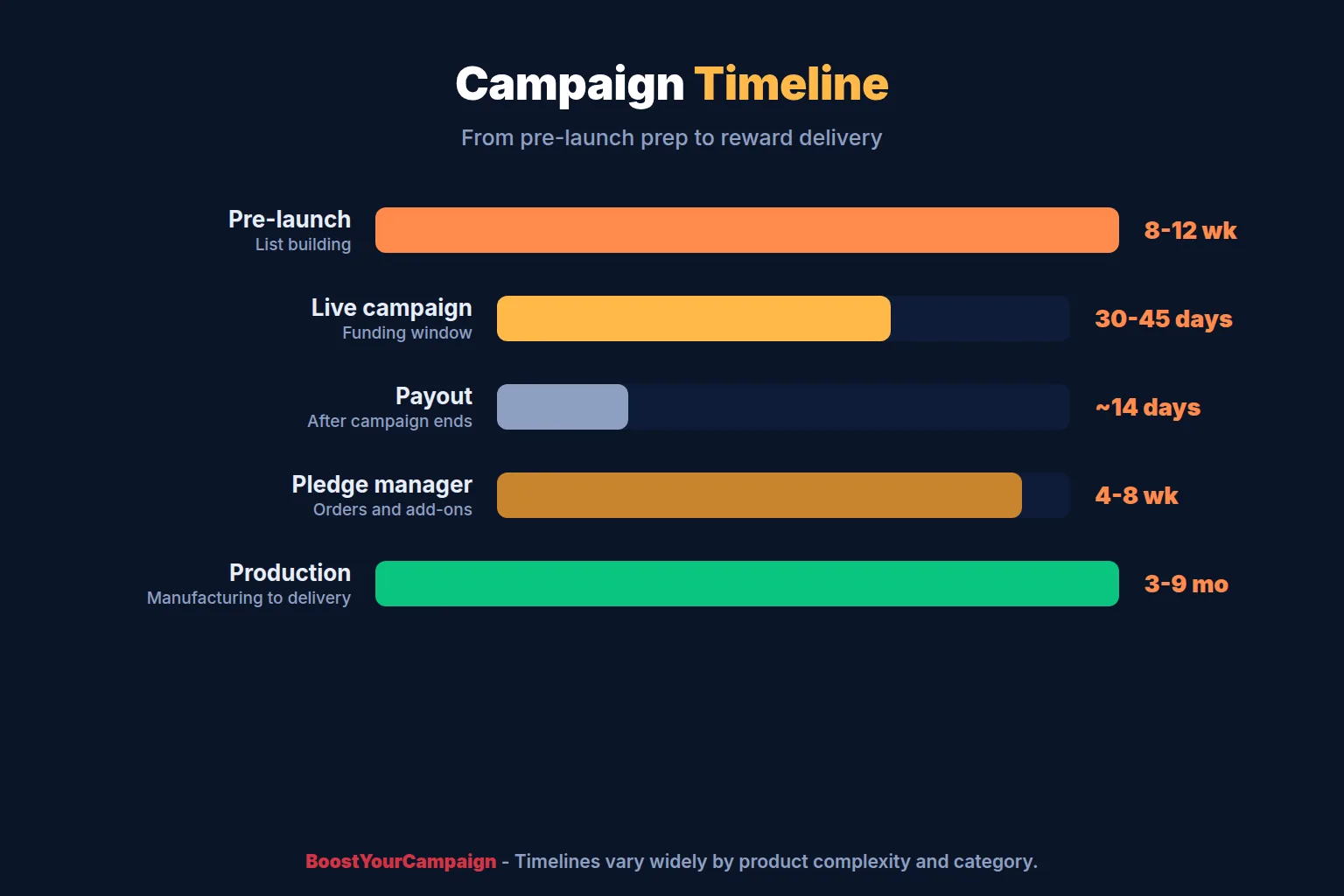
Laid end to end: weeks or months of pre-launch preparation, a 30-45 day live campaign, a roughly two-week payout window, several more weeks confirming orders through a pledge manager, then a production and fulfillment stretch that commonly runs from a few months to the better part of a year. The campaign itself is usually the shortest part of the whole process.
3) How Kickstarter works for backers
A backer pledges to one of the creator's reward tiers, usually priced around the finished product at a discount to what it will eventually retail for. The card on file is authorized but not charged at the moment of pledging - it is only charged if and when the project reaches its funding goal by the deadline. If the project falls short, the authorization simply expires and nothing is billed. Delivery is a promise from the creator, not a guarantee from Kickstarter: the platform is not a party to the transaction beyond hosting and processing payment, so a late or failed delivery is a dispute between backer and creator, not something Kickstarter refunds by default. Refund policy, if any, is set by the individual creator. Backers can message creators directly, and most creators post regular project updates, the main channel for hearing about delays or shipping timelines.
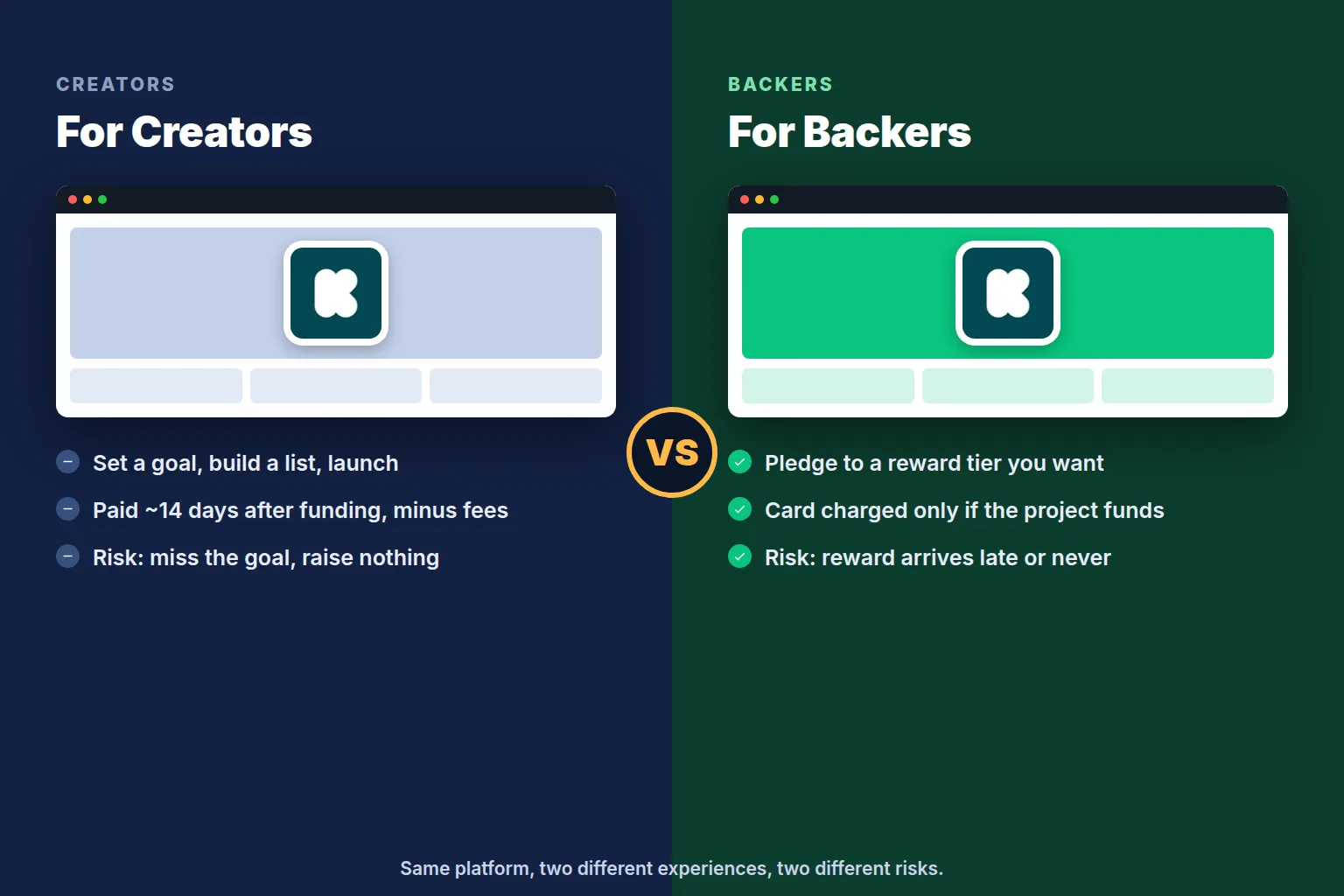
| For creators | For backers | |
|---|---|---|
| What you do | Post a project, set a goal and deadline, run a campaign to attract pledges | Pledge to a reward tier on a project you want to see made |
| When money moves | Paid out roughly 14 days after the campaign ends, only if it funded | Card is charged only if the project reaches its goal, not at the moment of pledging |
| What you get | The funds to manufacture and ship the reward, minus platform and payment fees | The reward, once produced and shipped, usually months after the campaign ends |
| Main risk | Missing the goal and raising nothing after months of preparation | A funded project that delivers late, delivers a lesser version, or does not deliver at all |
4) What Kickstarter costs
Kickstarter is free to launch a project on. There is no listing fee, no upfront charge, and no cost to submit a project for review. Kickstarter only earns money when a project actually funds, one of the more creator-friendly parts of the model, since the platform has no incentive to approve projects unlikely to succeed.
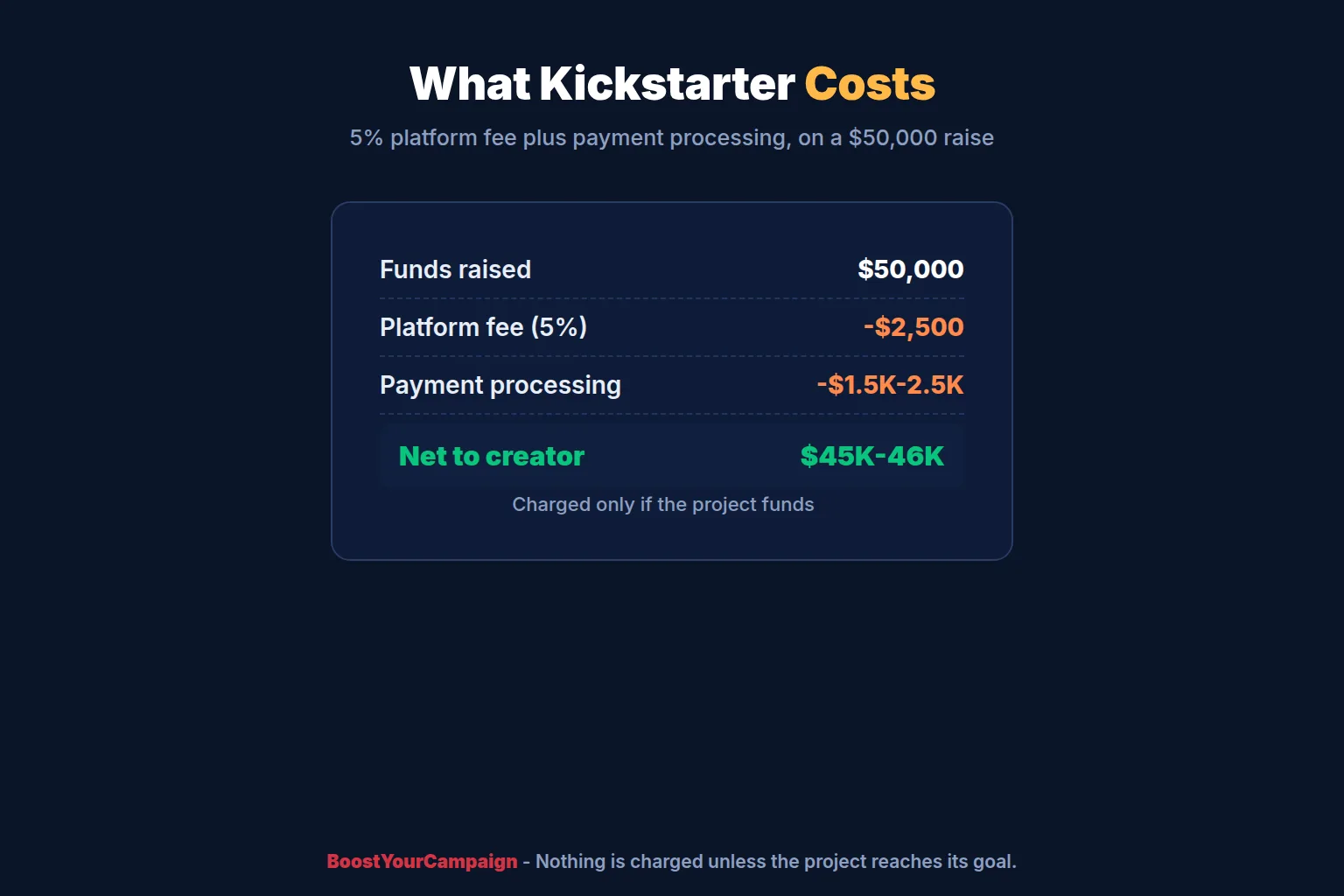
On a funded project, Kickstarter takes a 5% platform fee off the total pledged. On top of that, payment processing runs roughly 3-5% more, depending on card types, currencies, and pledge amounts, since Kickstarter uses Stripe to handle the charges. Combined, budget roughly 8-10% of the raise going to fees before any of it is available for production or fulfillment. Neither fee is ever charged on a project that does not reach its goal. For a full breakdown, see how much a Kickstarter costs, and for a platform comparison, Kickstarter and Indiegogo fees compared.
5) Who can use Kickstarter
Kickstarter restricts who can create a project by country, though anyone worldwide can back one. Eligible creator countries include the US, Canada, the UK, most of Western Europe, Australia, New Zealand, Japan, Singapore, Hong Kong, and Mexico, among others. A creator must also be at least 18 years old and able to set up a bank account in an eligible country to receive payouts. The list has grown over the years and occasionally changes, so check the current list before assuming a country is or is not covered. Our Kickstarter eligibility guide covers the full country list and the workarounds creators elsewhere sometimes use.
6) Categories and what does well
Kickstarter organizes projects into categories, and some consistently outperform others in both project count and funding success rate. Games, particularly tabletop and board games, are one of the strongest categories, with a built-in audience that actively browses for new releases. Design and technology, covering gadgets, hardware, and consumer electronics, is another major category, though it tends to need more capital and a longer production runway. Film, publishing (books, comics, and graphic novels), music, food, and fashion round out the categories with the most consistent activity. What they share is a product or creative work with a clear, visual pitch that translates well into a campaign page and a short video - the harder a project is to explain in a few seconds, the harder it tends to be to fund regardless of category.
7) What happens if a project fails or misses its goal
Because Kickstarter is all-or-nothing, missing the goal is mechanically clean: no backer is charged, the creator collects nothing, and Kickstarter takes no fee on an unfunded project. The page stays live, marked unsuccessful, rather than being deleted, and a large share of eventually successful projects are second attempts by a creator who fixed whatever caused the first miss. Our dedicated guide on what happens if a Kickstarter fails covers the full mechanics, and our failed Kickstarter relaunch guide walks through rebuilding a campaign that missed the first time.
8) Kickstarter vs Indiegogo vs Gamefound
Kickstarter vs Indiegogo: Kickstarter is all-or-nothing only, with no way to keep a partial raise. Indiegogo now runs fixed, all-or-nothing funding as its standard model too, since its old flexible funding option was retired in October 2025, so the two platforms are mechanically closer than they used to be. The real differences now are audience and discovery: Kickstarter draws more organic browsing traffic in design, tabletop, and creative categories, while Indiegogo is often chosen for its Late Pledge (formerly called InDemand) feature, which lets a campaign keep collecting pledges after the funding deadline closes. Our Kickstarter vs Indiegogo comparison breaks the differences down category by category.
Kickstarter vs Gamefound: Gamefound is built specifically around tabletop and board game campaigns and includes a native pledge manager, which Kickstarter does not, so it can handle add-ons and shipping calculation directly on-platform. Kickstarter still has the larger general audience outside the tabletop niche, so many publishers fund on Kickstarter and use Gamefound (or a pledge manager like BackerKit) for post-campaign logistics. See Kickstarter vs Gamefound vs BackerKit for the full comparison.
For most first-time creators outside tabletop, Kickstarter remains the default starting point because of its size and its all-or-nothing discipline, which tends to produce more realistic funding goals than platforms that let a campaign limp along at a partial raise.
9) How to succeed on Kickstarter
The single biggest predictor of whether a Kickstarter project funds is the size and warmth of its pre-launch email list. Campaigns that launch to a list of engaged, primed subscribers routinely fund within days, while campaigns that launch to nobody usually stall. Build that list before you press launch, and treat the first 48 hours as the moment that sets the tone for the rest of the campaign, since discovery surfaces and prospective backers both read early momentum as a signal a project is worth backing. Our pre-launch checklist covers what to have in place before launch day.
Beyond the list, three levers matter most. A strong campaign video compresses the whole pitch into the seconds where attention is highest - see Kickstarter video length, cost, and production. Paid ads, run well during the opening spike and the live campaign, extend reach past what the creator's own list can deliver alone, covered in our Kickstarter ads guide. And launch timing, which day and week a campaign goes live, has a real if smaller effect; our best day to launch a crowdfunding campaign guide covers what the data shows.
How BoostYourCampaign fits
BoostYourCampaign has run this process, from pre-launch list building through the live campaign to fulfillment, across more than 4,600 campaigns since 2010, raising over $734M with a 4.9/5 score across 300+ verified reviews. We run strategy, the campaign page, an in-house video studio, paid ads, and PR under one team, then fulfill rewards through our own US and EU warehouses, so the people who set the funding goal and priced the reward tiers are also responsible for getting boxes to backers. We use a skin-in-the-game ad model, putting our own money into ad spend alongside the client's budget with fixed fees instead of a percentage-of-raise commission, keeping the incentive on actually hitting the goal. See our services, or get in touch for an honest read on whether your project, goal, and timeline are set up to fund.
Before you launch on Kickstarter: a quick checklist
- Idea and price validated with real strangers, not just friends and family
- A pre-launch email list, with a warm VIP segment ready to fire first on launch day
- Funding goal set at the true minimum needed to deliver, built from real production and shipping costs
- Fees budgeted at roughly 8-10% of the raise (5% platform plus payment processing)
- Campaign length chosen in the 30-45 day range rather than the full 60-day maximum
- Country eligibility confirmed for where you plan to receive payouts
- A campaign video with a hook in the first few seconds, not a slow build-up
- A pledge manager and fulfillment plan in place before launch, not improvised after funding
Frequently Asked Questions
What is Kickstarter?
Kickstarter is a rewards-based crowdfunding platform, founded in 2009, where creators raise money for a project by offering backers a reward, usually the finished product, in exchange for a pledge. Funding is all-or-nothing: a project keeps the money and charges backers only if it reaches its stated goal by the deadline.
How does Kickstarter work?
A creator sets a funding goal and deadline, backers pledge toward reward tiers, and if total pledges reach the goal before the deadline, backers are charged and the creator is paid out roughly 14 days later to produce and ship the rewards. If the goal is not reached, no one is charged and the creator raises nothing.
Is Kickstarter free?
Yes, to launch. There is no cost to post a project or submit it for review. Kickstarter only takes a fee, 5% of the total raised plus roughly 3-5% in payment processing, from projects that actually reach their funding goal.
Do you have to pay back Kickstarter?
No. Kickstarter is not a loan, so there is nothing to pay back. The 5% platform fee and payment processing costs are deducted automatically from a funded raise before payout, and that is the only money Kickstarter ever takes.
Does Kickstarter take a percentage?
Yes, 5% of the total amount successfully raised, plus roughly 3-5% more in payment processing fees. Both are taken only from projects that reach their funding goal - a project that does not fund is never charged anything.
Is Kickstarter safe?
For backers, the financial mechanics are safe: cards are never charged unless a project actually funds, and payment runs through standard processing via Stripe. The real risk is not fraud, it is a funded project that delivers late or not at all, since delivery is the creator's promise, not something Kickstarter guarantees. Reading a creator's track record and update history before pledging is the best protection against that.
How long does a Kickstarter campaign last?
Kickstarter allows campaigns to run for up to 60 days, but most experienced creators choose something in the 30-45 day range, since shorter campaigns tend to sustain urgency and momentum better than long ones. That is the live campaign window only - total time from pre-launch preparation to reward delivery is much longer.
What happens if a Kickstarter does not reach its goal?
Nothing is charged. No backer's card is billed, the creator raises nothing, and Kickstarter takes no fee. The project page stays live, marked as unsuccessful, and many creators relaunch after fixing whatever caused the first attempt to miss. Our full guide to what happens if a Kickstarter fails covers the mechanics and the relaunch process in detail.
If you are weighing a Kickstarter launch and want an honest assessment of your goal, timeline, and reward pricing before you go live, reach out through /contact.
Want results like these for your campaign?
We've helped 4,600+ creators raise over $734M. Let's pressure-test your launch plan and find the highest-leverage fixes before you go live.
Talk to an expert →Get the free 87-step launch checklist
The exact pre-launch, live-campaign and fulfillment steps we use across 4,600+ launches. Free PDF, emailed instantly.
You're in - check your inbox. Open the checklist now ->