Most pre-launch advice stops at "build an email list." If you already know that part and want the actual playbook - deposit funnels, ad testing cadence, landing page structure, and the math that connects list size to funding goal - this is that playbook. If you'd rather have a team build and run it for you, talk with BoostYourCampaign about your product and launch date.
Filling a pre-launch email list is not one tactic, it's a stack of five or six that reinforce each other: a landing page built around a hook and a proof point, paid social ads tested weekly for the strongest creative, a $1 to $25 reservation deposit that filters curious visitors from real buyers, community spaces opened at the right moment rather than the first week, and a nurture cadence that keeps the list warm for months without going quiet. None of these tactics work well alone. A great landing page with no traffic behind it converts nobody, and a large email list with a low deposit rate and low open rate predicts a weak launch day no matter how big the subscriber count looks.
- Deposits filter for intent, plain signups don't - a small refundable deposit separates browsers from buyers far better than an email opt-in alone.
- Ad testing during pre-launch is data collection more than spend - the goal each week is learning which hook and creative angle converts, rather than maximizing signups at any cost.
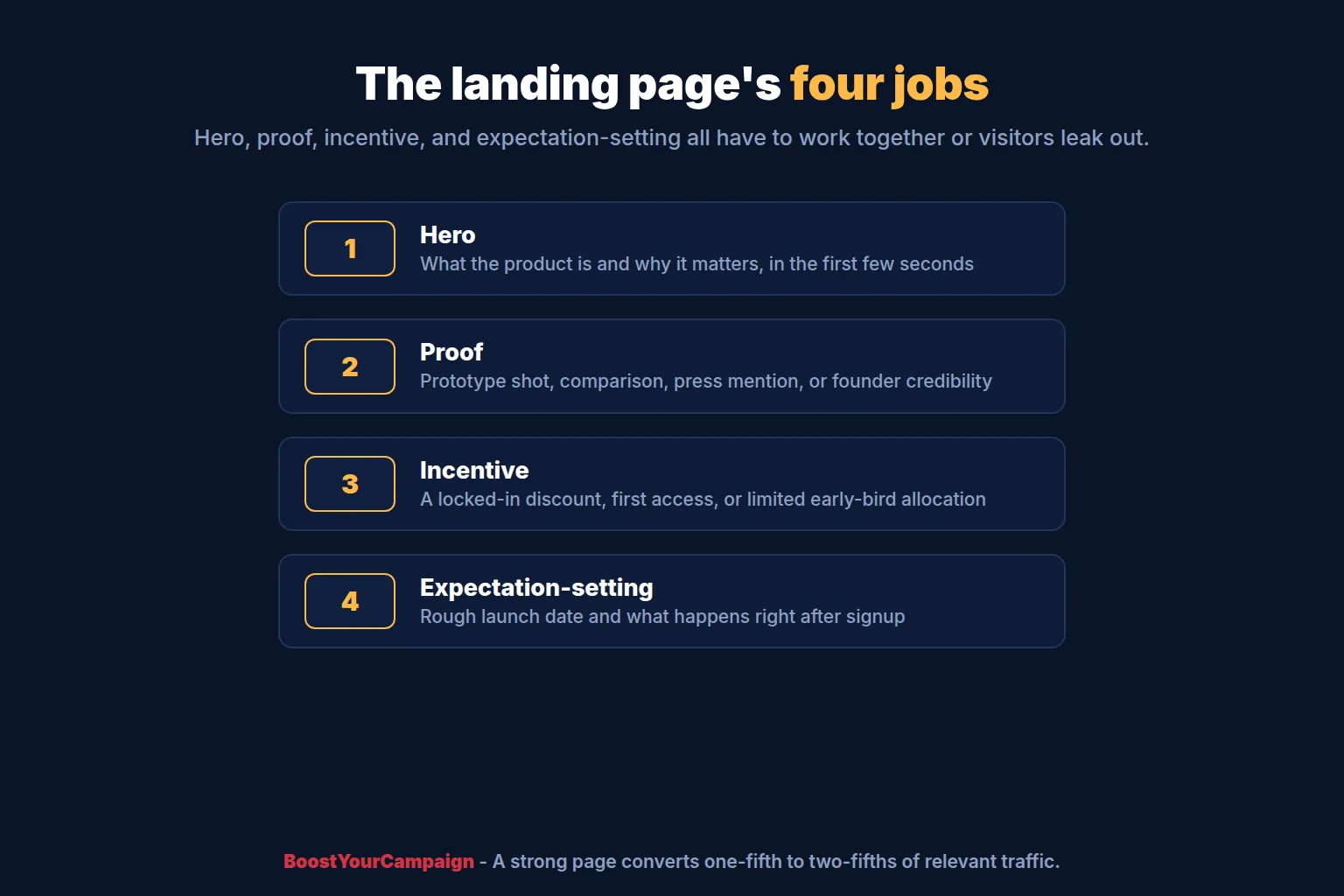
- The landing page has four jobs, not one - hero, proof, incentive, and expectation-setting all have to work together or visitors leak out.
- Community only pays off with the right timing - open a Discord or Facebook group too early and it dies from silence; open it too late and it never builds real activity.
- List quality beats list size - open rate, deposit rate, and survey engagement predict launch-day pledges better than subscriber count alone.
- Work backward from your funding goal - a list-size target only means something once you've done the math from goal to average pledge to expected conversion rate at each list tier.
1) The reservation-deposit funnel: how a $1 signup differs from a plain email
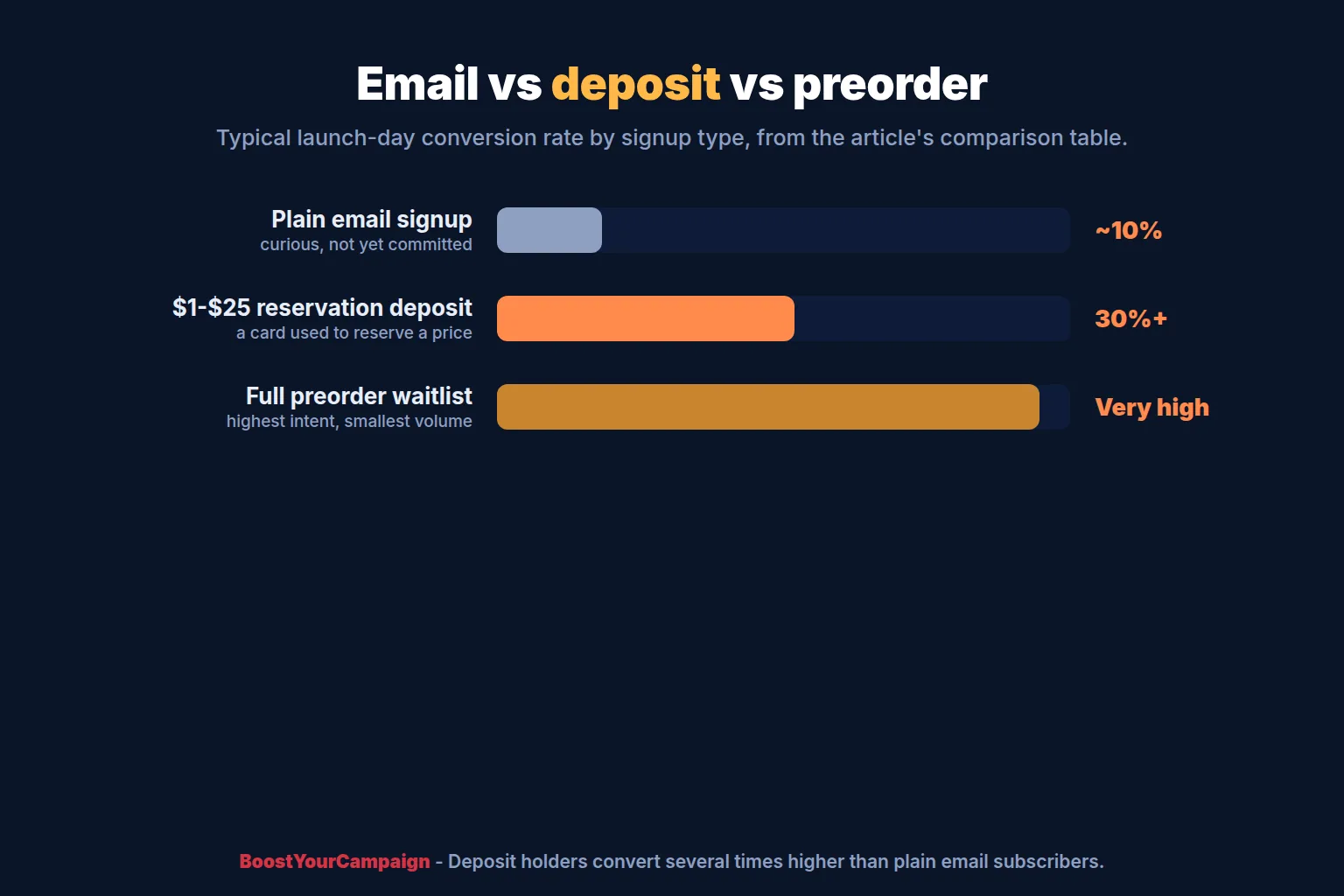
A plain email signup asks for almost nothing: an address, maybe a first name. That low friction is good for volume and bad for signal. Most people who type an email into a pre-launch page are mildly curious, not committed, and the list that results tells you reach more than it tells you revenue.
A reservation deposit changes the question. Instead of "want updates," it asks "want to lock in the best price with a small refundable deposit." Typical deposits run from around $1 up to $25, and the amount is less about the money than the friction: a person willing to put a card into a checkout for a product that doesn't exist yet is telling you something an email address can't. In practice, plain email subscribers convert to backers on launch day in a low range, often somewhere between the low single digits and around ten percent. Deposit holders convert at several times that rate, commonly landing well into the double digits and sometimes higher, because the deposit step already did the filtering work for you.
The trade-off is volume. A $1 deposit collects more reservations than a $25 one but lets more low-intent people through, which can flatter a pre-launch dashboard and then underdeliver on launch day. A higher deposit produces a shorter list that predicts revenue more reliably and supports a bigger reserved discount without reading as a gimmick. Our reservation funnel guide covers how to size the deposit to your product and audience in more depth.
The output worth tracking is not one list but two: the email list, which tells you reach, and the deposit list, which tells you likely revenue. Forecasting off the deposit list is almost always the more honest number.
2) Paid social ad testing during pre-launch: what a week of spend should teach you
Pre-launch ad spend has a different job than launch-day ad spend. During launch, the goal is scale: put budget behind what already works. During pre-launch, the goal is learning: find the hook, format, and audience that actually pulls a cold visitor into your funnel, before you commit real money to it at volume.
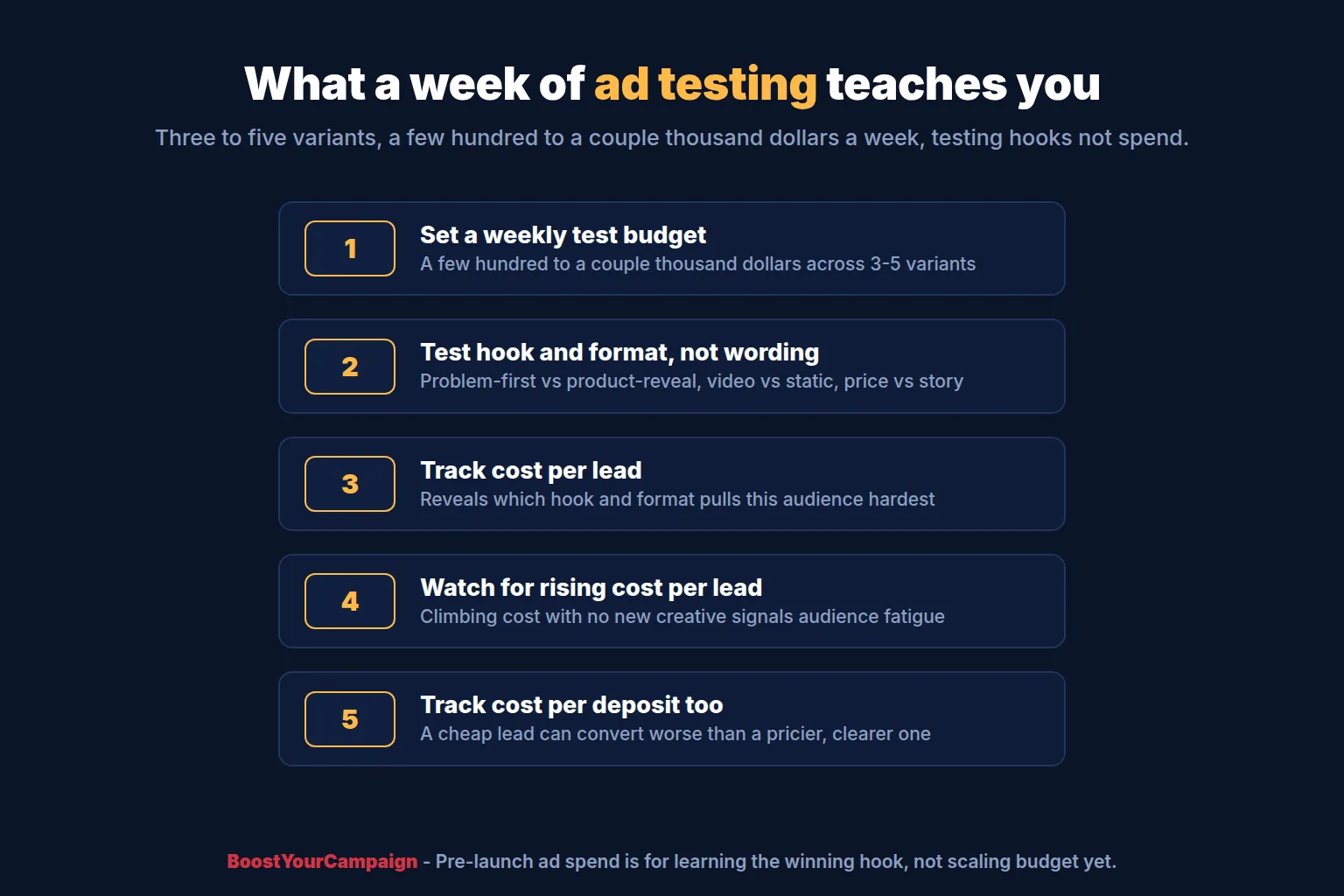
A useful weekly testing budget is smaller than most first-time creators expect. Many campaigns run early creative tests on a few hundred to a couple thousand dollars a week, spread across three to five distinct variants, which is usually enough to see a real gap in cost per lead between a winning hook and a losing one without betting the full pre-launch budget on an untested angle. The variants worth testing are rarely subtle: a problem-first hook versus a product-reveal hook, a short vertical video versus a static image with copy, a price-led angle versus a story-led one. Small wording tweaks inside an already-working ad matter less than getting the fundamental hook and format right first.
What a single week of testing should tell you: which hook produces the lowest cost per email signup, whether video or static creative is pulling harder for this specific product, and whether your current audience targeting is too broad or too narrow based on how cost per lead moves as you widen it. If cost per lead climbs steadily week over week with no new creative introduced, that's usually audience fatigue, not a targeting problem, and it's a signal to refresh creative rather than raise the budget.
Resist the urge to judge a test by total signups collected. A cheap lead from a vague, curiosity-bait ad often converts to a deposit and later a pledge at a much lower rate than a slightly more expensive lead from an ad that set clear expectations about price and category. Track cost per deposit alongside cost per lead once your reservation funnel is live, because that pair tells the real story an email-only number hides.
3) Landing page anatomy: the four elements that make people sign up
A pre-launch page has one job: turn a visitor who arrived from an ad, a social post, or a friend's share into an email address or a deposit. Everything on the page should point at that single conversion, which is a different design brief than a full campaign page trying to close a pledge.
Four elements do most of the work. The hero has to communicate what the product is and why it matters in the first few seconds, ideally with a short clip or a strong static image rather than a paragraph of copy nobody reads before scrolling. Proof comes next: a working prototype shot, a comparison against a known reference product, an early press mention, or a founder credibility line, anything that answers "is this real" before the visitor asks it out loud. The incentive is the actual reason to give up an email address today rather than bookmark the page and forget about it: a locked-in discount, first access, or a limited early-bird allocation. Expectation-setting closes the loop by telling visitors roughly when the campaign launches and what happens after they sign up, since vague timelines create drop-off at the exact moment someone was ready to convert.
A page hitting all four elements should convert a meaningful share of relevant traffic into signups, typically somewhere in the range of one-fifth to two-fifths of visitors who actually match your target audience. If conversion sits well below that, the fix is almost never more traffic. It's usually the headline or the incentive, not the amount of visitors reaching the page. For a full teardown of layout choices and section-by-section benchmarks, see our pre-launch landing page guide.
4) Community tactics: when a Discord or Facebook group is worth the timing

A community space is not a default add-on for every pre-launch. It's a tool with a specific cost, mainly founder time and attention, that only pays for itself once there's a real base of people to populate it. Opening a Discord server the same week you launch the landing page usually produces an empty room that makes the project look quiet rather than active, which does more harm than having no community space at all.
Timing matters more than platform choice. A reasonable rule is to wait until you have a few hundred engaged subscribers, people who open emails and click through, before inviting them into a group space. That gives the group enough people to generate its own conversation instead of leaning entirely on the founder to fill silence. Facebook groups tend to fit older, less technical, and lifestyle-leaning audiences better, while Discord fits younger, gaming, tech, and hobby crowds who already spend time there. Match the platform to where your specific audience already gathers rather than picking whichever one is trendier.
Not every product benefits from a dedicated community hub at all. Products with a lot to discuss, like games, gear with real customization choices, or anything creators and hobbyists debate, benefit from a space where members talk to each other, beyond talking to you alone. A simple, single-purpose gadget with little to discuss can turn a group into dead air that a small, well-run email list would have served better. Our pre-launch community guide walks through the format decision and a realistic content cadence once a group is live.
5) Influencer and press seeding before the public pre-launch
Influencer and press outreach works best when it starts before your landing page goes fully public, not after. Sending product samples or early access to a short list of relevant creators and journalists weeks ahead of your pre-launch push gives them time to actually use the product, film honest content, and have something ready to publish or post close to your launch date instead of scrambling once you're already live.
Smaller, category-relevant creators with an engaged, on-topic audience frequently outperform a single larger name with broad but disconnected reach, particularly for niche products where the audience needs to already care about the category to convert. A stack of five or six creators, each with a modest but real following in your exact niche, often drives more qualified signups than one big name whose audience only partly overlaps with your buyer.
Press seeding follows a similar logic. A single embargoed pitch to a relevant trade publication or niche outlet, timed to publish in the days around your campaign's public launch rather than during quiet pre-launch, tends to convert readers directly into backers rather than into cold email subscribers who forget by the time you go live. Our guide on getting press for a Kickstarter covers pitch timing and outlet targeting in more depth.
6) Email nurture cadence: what to send between signup and launch day
Collecting an email address is the easy half of list building. Keeping that person interested for weeks or months without going silent, and without turning into spam, decides how many of them actually show up on launch day.
A working cadence usually mixes a handful of content types on a rotation, sent somewhere around once or twice a week rather than daily. A welcome sequence introduces the founder and the origin story right after signup, while the interest is freshest. Behind-the-scenes updates, prototype photos, and small production milestones give people a reason to keep opening beyond the first email. Occasional polls or questions, like asking which color or feature matters most, turn a passive subscriber into someone who feels some ownership over the outcome. In the final one to two weeks before launch, the cadence should shift into countdown mode: a clear launch date, a reminder of the reserved-price deadline for anyone who hasn't deposited yet, and a final "we're live" email the moment the campaign goes public.
Open rate is the health check on this whole sequence. A list holding steady open rates in the thirty percent range or better through the nurture period is staying genuinely engaged. A list that drifts down into the low teens or single digits over a few months is losing interest faster than new signups are refreshing it, which is a sign to change the content mix rather than send more of the same. Our email marketing guide for crowdfunding goes deeper on sequence structure and tooling.
7) Measuring list quality alongside list size
Subscriber count is the easiest number to report and one of the worst ones to plan a launch around. A list of two thousand people who open, click, and occasionally reply will out-raise a list of ten thousand cold addresses almost every time, because launch-day pledges come from people paying attention, not people who once saw an ad.
A handful of numbers matter more than raw size. Open rate tells you whether the list is still paying attention at all. Deposit rate, the share of email subscribers who go on to put down a reservation, is the clearest available signal of buying intent before launch. Click-through rate on emails with a specific call to action shows whether people are willing to act rather than only read. Survey engagement, where you ask subscribers directly which reward tier or price point interests them, gives a rough read on average pledge size months before launch, which matters for the funding math in the next section. Unsubscribe rate is worth watching too, since a spike after a specific email usually points to content that missed the mark rather than list fatigue in general.
None of these numbers alone tells the full story, but tracked together over the pre-launch period, they give a far more honest read on launch-day readiness than subscriber count ever will. Our guide on the pre-launch numbers that predict revenue breaks down how to weight these signals against each other.
8) Launch-day conversion math: working backward from funding goal to list size
Most creators build a list first and hope it's enough. A better approach is to start from the funding goal and work backward to the list size that goal actually requires, then build toward that number deliberately instead of guessing.
The math has a few steps. Start with your funding goal and divide by your expected average pledge to get the number of backers you need. From there, apply rough conversion expectations by list tier: plain email subscribers converting somewhere in the low-single-digit to around ten percent range, and deposit holders converting several times higher, often into the thirty percent range or beyond. If you need, say, 300 backers and expect a mixed list where deposit holders do most of the early conversion work, you can back into roughly how many deposits and how many total subscribers you need heading into launch day, then set your pre-launch traffic and ad targets to hit those numbers with weeks of runway rather than days.
This exercise also tells you how much time you actually need before launch, since a list doesn't grow to the required size overnight. Our guide on how long a Kickstarter pre-launch should take maps realistic timelines against list-size targets by product complexity and starting audience.
The math is not meant to be precise to the backer. It's meant to replace a guess with a target, so that when you're three months out and your list is tracking below the number you need, you know it early enough to adjust the ad budget, tighten the landing page, or push the launch date, rather than finding out on day one that the list was never going to be enough.
How BoostYourCampaign fits
BoostYourCampaign has run pre-launch audience building for a large share of its 4,600+ campaigns since 2010, and has raised $734M+ across categories where the pre-launch list, not the launch-day ad budget, was the deciding factor. The agency's model is full-stack and done-for-you: pre-launch landing pages, paid social ad testing, reservation funnel setup, community strategy, and email nurture sequences are handled under one roof rather than split across separate vendors who don't coordinate with each other.
On the ad side, BYC runs a skin-in-the-game model, investing its own money alongside the client's ad budget with fixed fees rather than a percentage-of-raise commission, which keeps the incentive aligned with actually finding a converting hook during pre-launch testing rather than just spending the budget. The agency is a Google Premier Partner and a Facebook Marketing Partner, both directly relevant to the paid testing work described above, along with being an Indiegogo Approved Agency, an official Shopify Partner, and an Amazon Partner.
Beyond ad management, BYC operates owned video production studios in the US and EU for the hero footage and ad creative a strong pre-launch page needs, and its team has built the reservation-funnel and landing-page systems described in this guide across thousands of campaigns rather than once or twice. The agency holds a 4.9/5 score across 300+ verified reviews, visible on the reviews page, and client work has included Shark Tank coverage, documented on the press page. For cost context while planning a pre-launch budget, see this pricing guide.
Signup types compared
| Signup type | Intent level | Cost to collect | Typical launch-day conversion |
|---|---|---|---|
| Plain email signup | Low to moderate - curious, not yet committed | Lowest cost per lead; highest volume | Roughly low single digits up to around 10%, in practice |
| $1-$25 reservation deposit | High - a card was used to reserve a price | Higher cost per lead; meaningfully lower volume than email alone | Several times the plain-email rate, often into the 30%+ range |
| Full preorder waitlist | Highest - closest thing to an actual purchase before launch | Highest friction; smallest list of the three | Very high among those who complete it, but volume is usually too small to carry a full launch alone |
The cost of skipping this work is spelled out in what happens if a Kickstarter does not reach its goal - a missing pre-launch list is the most common reason campaigns fall short.
Frequently Asked Questions
How big should my pre-launch email list be before I launch?
It depends on your funding goal and average pledge more than any fixed number. Work backward: divide your funding goal by your expected average pledge to get the backers you need, then use rough conversion ranges by list tier (low single digits to around 10% for plain email, several times higher for deposit holders) to estimate the list size that gets you there.
Is a $1 deposit better than a $25 deposit?
Neither is universally better. A $1 deposit collects more reservations but lets more low-intent people through, which can inflate a pre-launch dashboard without a matching launch-day result. A $25 deposit produces a shorter list that predicts revenue more reliably and supports a bigger reserved discount. The right size depends on your product's price point and audience.
How much should I spend on pre-launch ad testing per week?
Many campaigns run early creative tests on a few hundred to a couple thousand dollars a week, spread across three to five distinct variants. The goal at this stage is finding the winning hook and format at a readable cost per lead, not maximizing total signups from a single week's spend.
When should I open a Discord or Facebook group for my campaign?
Once you have a real base of engaged subscribers, often a few hundred people who actually open and click your emails, rather than in the first week of your landing page going live. An early, empty group tends to make a project look quiet, and a group opened once there's a real audience builds its own momentum instead of relying on the founder to fill the silence.
What email open rate should I expect during pre-launch?
A healthy pre-launch list holds open rates in the thirty percent range or better through the nurture period. If open rates drift down into the low teens or single digits over a few months, that usually points to content that has gone stale rather than list fatigue in general, and it's worth changing the content mix before sending more of the same.
Should I run press and influencer outreach before or after my landing page goes live?
Before, if possible. Seeding product samples or early access to relevant creators and journalists weeks ahead of your public pre-launch push gives them time to produce real content and have it ready to publish close to your launch date, rather than starting from zero once you're already live.
What's more important, list size or list quality?
Quality, in almost every case. A smaller list with strong open rates, a healthy deposit rate, and real survey engagement predicts launch-day pledges better than a much larger list of cold addresses. Subscriber count is the easiest number to report and one of the least reliable ones to plan a launch around.
How do I know if my pre-launch landing page is converting well?
A page that includes a clear hero, proof the product is real, a concrete incentive, and honest expectation-setting on timeline should convert somewhere between one-fifth and two-fifths of relevant traffic into signups. If conversion sits well below that range, the fix is usually the headline or the incentive rather than the amount of traffic reaching the page.
If you want a pre-launch plan built around your actual funding goal, not a guess at list size, reach out through /contact and we'll map the numbers for your product.
Want results like these for your campaign?
We've helped 4,600+ creators raise over $734M. Let's pressure-test your launch plan and find the highest-leverage fixes before you go live.
Book a free strategy call →Get the free 87-step launch checklist
The exact pre-launch, live-campaign and fulfillment steps we use across 4,600+ launches. Free PDF, emailed instantly.
You're in - check your inbox. Open the checklist now ->