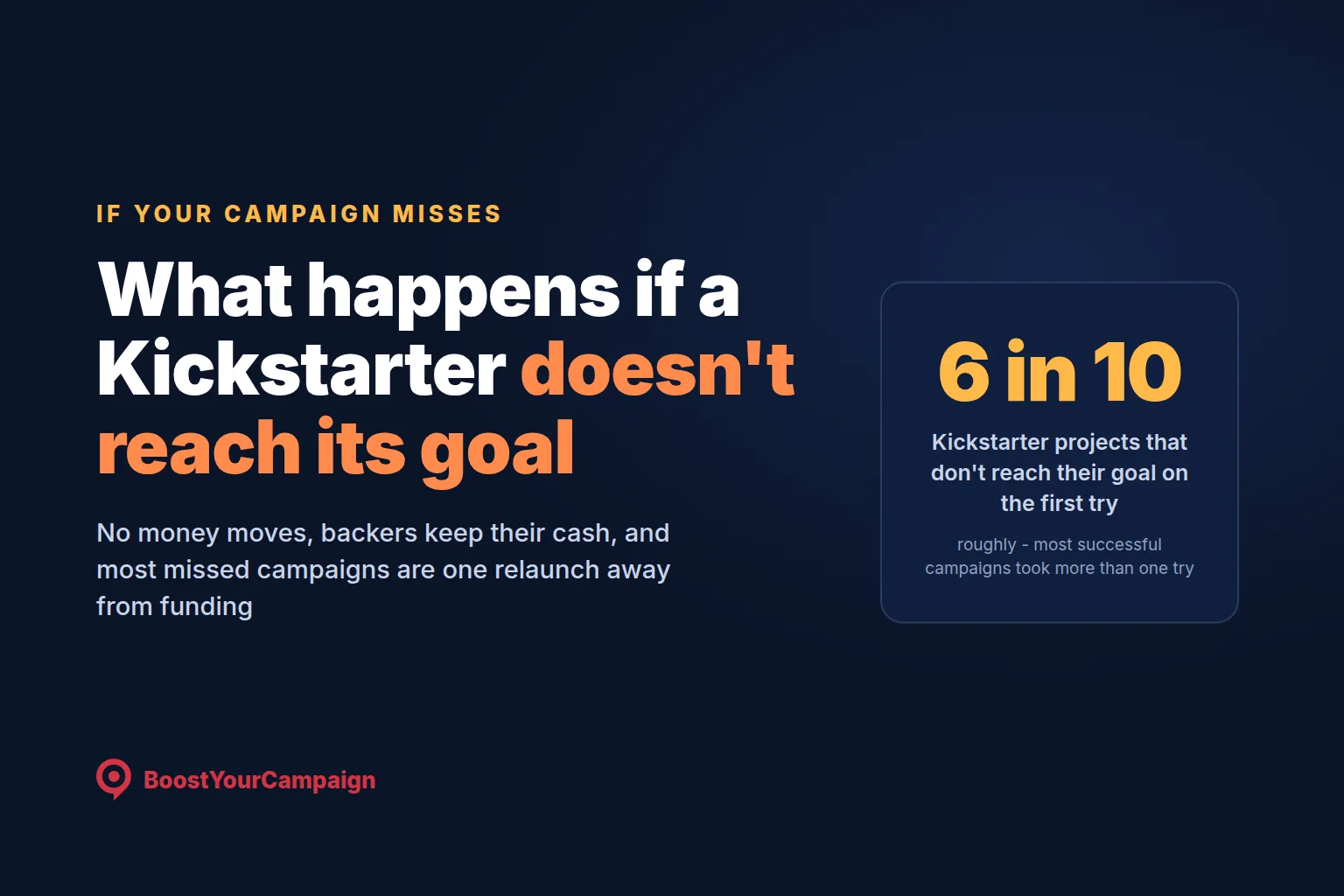
Roughly six in ten Kickstarter projects do not reach their funding goal, so if you are staring down a campaign that looks like it will miss, you are in familiar company, not a rare failure. The mechanics are more forgiving than most first-time creators expect, and a missed goal is very often a setup step for a stronger second attempt rather than a dead end. If you want a second set of eyes on whether your campaign can still recover or whether a relaunch is the better move, talk with BoostYourCampaign - we validate campaigns before launch and run relaunches for exactly this reason.
If a Kickstarter campaign does not reach its funding goal, nothing is charged. Kickstarter is all-or-nothing, so backers keep their money, the creator collects nothing, and Kickstarter takes no platform fee on an unfunded campaign. The creator does not get to keep a general list of everyone who pledged - only the people who opted into updates, followed the project, or were captured through a separate pre-launch email list stay reachable. The project page itself stays live and is marked unsuccessful rather than being deleted. None of this prevents a relaunch, and a large share of eventually successful Kickstarter campaigns are in fact relaunches of a project that missed the first time.
- No money moves on a failed campaign - backers are not charged, the creator collects nothing, and Kickstarter takes no fee.
- You do not get a full backer list - only people who opted into updates or that you captured yourself before launch stay reachable after the campaign ends.
- The page stays up, marked unsuccessful - it is not deleted, and it can still work as a landing page while you plan next steps.
- Most misses trace back to a handful of honest causes - a thin pre-launch list, mispriced rewards, a weak opening 48-72 hours, or a goal set too high for the actual audience.
- Cancelling early and letting a campaign run out both signal something different to your future audience - neither is automatically the right call.
- Relaunching is common and often works better the second time, once the creator fixes the specific thing that caused the first miss.
1) What actually happens when a Kickstarter doesn't reach its goal
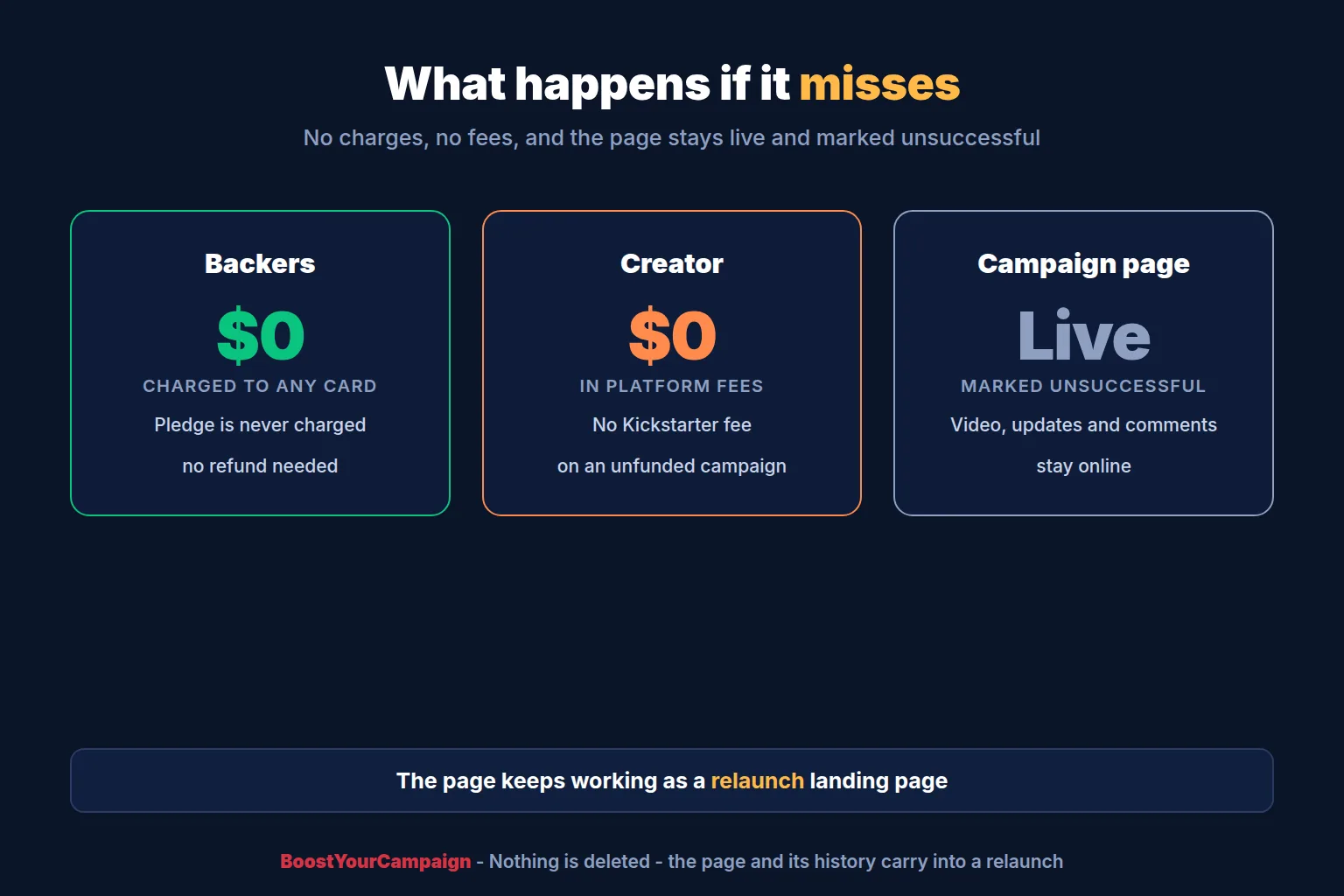
Kickstarter runs on all-or-nothing funding, and that mechanic is more protective than most first-time creators realize. If the total pledged does not reach the stated goal by the deadline, no payment cards are ever charged. Backers see the pledge disappear from their account, not a refund process, because the money was never actually collected in the first place. There is no invoice to untangle and no chargeback risk to manage, because nothing happened financially beyond an authorization that simply expires.
The creator's side is just as clean. Kickstarter does not collect its platform fee or pass along payment processing charges on a campaign that does not fund, so there is no bill waiting after a miss. The financial exposure of trying and missing is close to zero beyond the time and money already spent on production, video, and marketing before or during the campaign itself, which is real cost but is not compounded by any additional platform charge for failing.
The campaign page does not disappear either. It stays live on Kickstarter, marked as unsuccessful, and it keeps its updates, comments, and video. That page still has value: it is proof the idea exists, it still ranks for whatever it ranked for during the live campaign, and it is often the first thing a relaunch links back to as evidence the project is real and has a history. Nothing about a failed campaign erases the work that went into building it, which is part of why relaunching is such a common and often successful path.
2) What you actually keep - and what you don't
The single most common misunderstanding about a failed campaign is what happens to the backer list. Creators sometimes assume that anyone who pledged, even on a campaign that ultimately missed its goal, becomes a contact the creator can message directly going forward. That is not how it works. Kickstarter does not hand creators a general marketing list of everyone who pledged. What a creator keeps access to after the campaign ends is the group of backers who specifically opted into receiving project updates, plus anyone who followed the project, which is a real but usually smaller group than the full pledge count.
This is exactly why pre-launch list building matters so much, and why it is worth doing regardless of how confident you are about hitting the goal. Anyone captured through a separate email signup, a landing page, or a waitlist before launch stays entirely under the creator's own control, independent of what Kickstarter does or does not hand over after the campaign ends. Our guide to prelaunch audience building covers how to build that list before you need it, which is the single biggest lever for making sure a missed campaign is not also a lost audience.
What else survives a failed campaign: the page itself, the video, the comments and updates, any press coverage or social proof already generated, and everything learned about which reward tiers, price points, and messaging did or did not land with real backers. That is a meaningful amount of usable material for a second attempt, even without a full contact list to email directly.
3) The honest reasons campaigns miss their goal
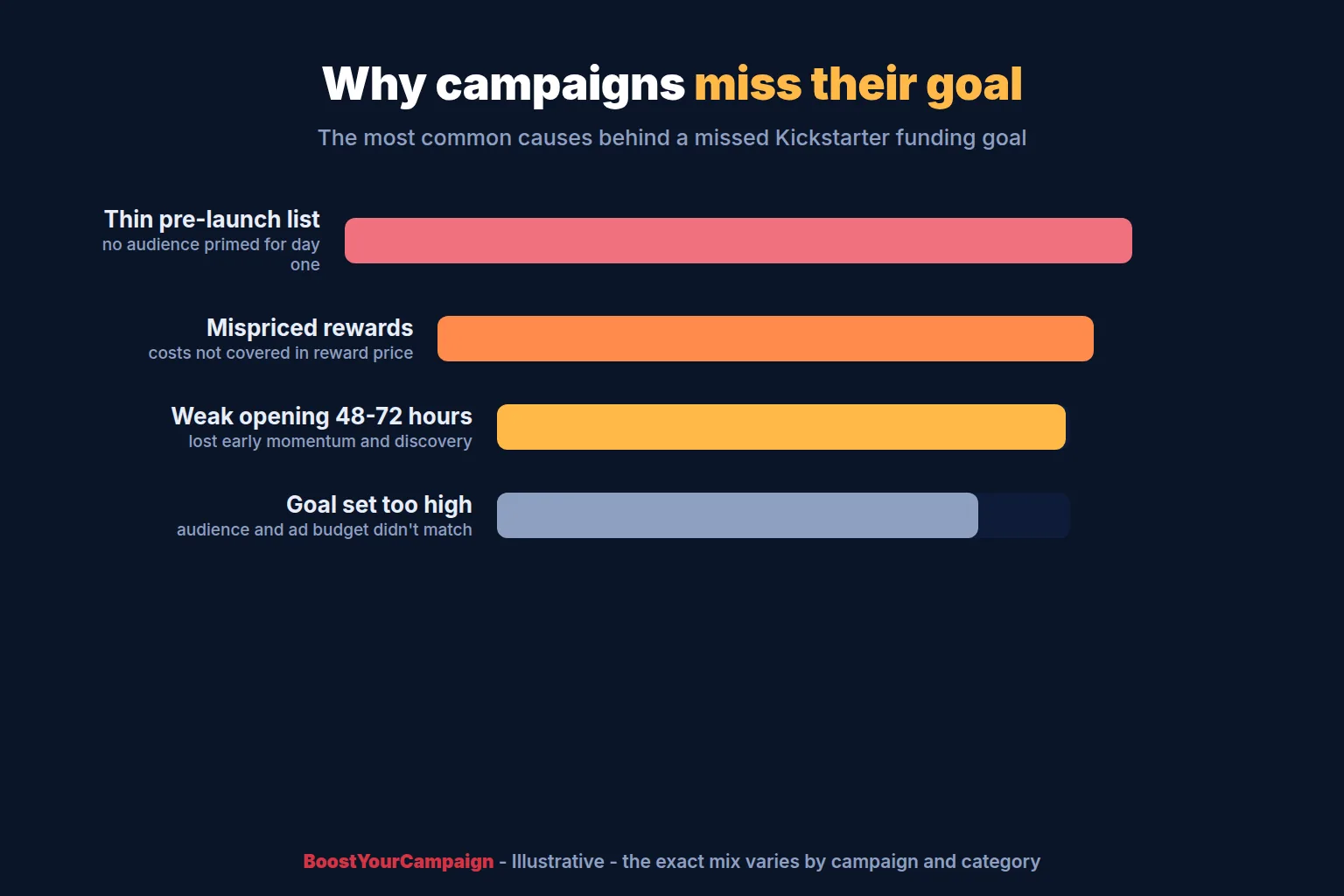
Most misses are not mysterious once you look at the actual data behind the campaign, and they tend to trace back to a small set of causes rather than bad luck. The most common one is a thin or nonexistent pre-launch list. A strong campaign often reaches a large share of its total funding goal within the first 48-72 hours after launch, driven by people who already knew the project was coming. A campaign that launches cold, with no one primed to back on day one, struggles to build the early momentum that Kickstarter's own algorithm and potential backers both read as a signal the project is worth backing.
Mispriced rewards are the second common cause. A reward priced too high for what it delivers sits unclaimed while backers wait for a lower tier or skip the project entirely. A reward priced too low undercuts the campaign's ability to fund at all once shipping and production costs are factored in, and a campaign that quietly realizes its reward math does not work rarely recovers the confidence to push hard on marketing for the remainder of the campaign.
A weak opening stretch compounds both of the above. Kickstarter's discovery and recommendation systems, along with the platform's own audience of browsing backers, respond to early momentum. A campaign that opens slowly gets less organic visibility for the rest of its run, which makes the middle weeks - already the hardest stretch of any campaign - even harder to fill.
The last major cause is a goal set without a real look at the size and spending behavior of the audience actually available to the project. A goal that assumes a far larger reach than the creator's actual following, ad budget, and press interest can support is a goal built on hope rather than a plan, and it is one of the more avoidable reasons a campaign misses. Setting a goal against a realistic model of pre-launch audience size, expected ad-driven traffic, and typical conversion rates catches this problem before launch instead of during it.
4) What to do in the last days if you're falling short
If a campaign is clearly going to miss with only a few days left, the two real options are letting it run to the deadline or cancelling it early, and each sends a different signal to the audience that matters for whatever comes next. Letting a campaign run out unfunded is the more common choice, and it is usually the right one if there is any realistic chance of a late surge, since backers occasionally rally in the final 24-48 hours of a visibly struggling campaign. It also preserves the page's full history exactly as it happened, which some creators prefer for transparency when they relaunch and want to be upfront about the first attempt.
Cancelling early is the less common path, and it makes more sense when the shortfall is severe enough that no realistic surge would close the gap, and when the creator wants to stop the clock on a campaign that is clearly not going to work in its current form rather than let it limp to an unfunded finish. The tradeoff is that cancelling removes any chance of a last-minute surge, and it can read to a following audience as the creator giving up rather than adjusting course, so it is worth pairing a cancellation with a clear, honest update explaining what is changing before the relaunch.
Neither choice is inherently better. What matters more than the choice itself is what the creator does with it: an honest update to the people who are already paying attention, explaining what did not work and what is changing, does more for a future relaunch than the specific decision to cancel or let the clock run out.
5) How to relaunch a Kickstarter campaign
Relaunching is a normal, well-worn path on Kickstarter, not an admission of defeat. A large number of eventually successful campaigns are in fact second or third attempts by a creator who fixed the specific thing that caused the first miss, whether that was pricing, goal size, pre-launch reach, or messaging. Since roughly six in ten Kickstarter projects do not fund on the first try, a relaunch strategy is closer to standard practice for anyone serious about the platform than a rare fallback.
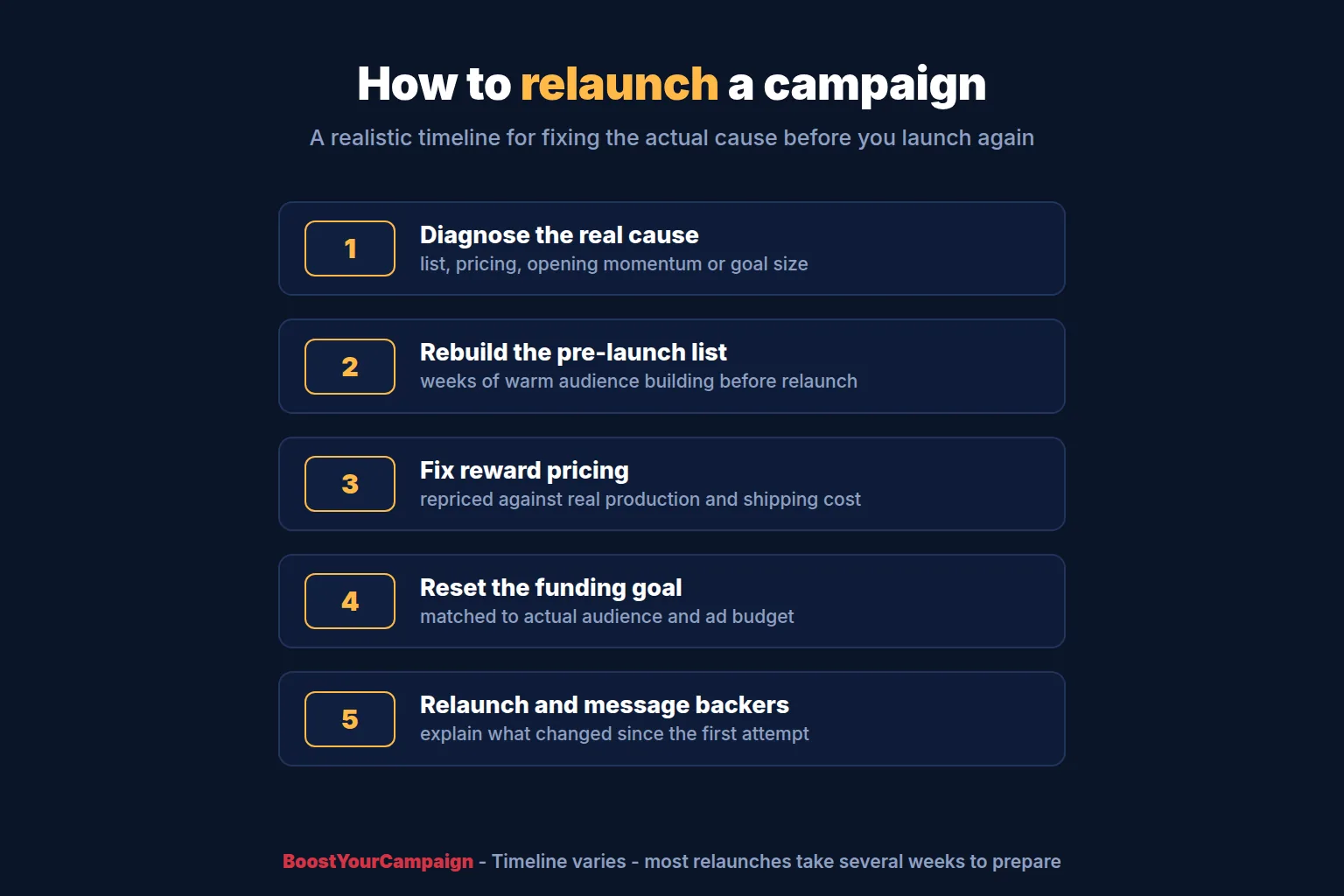
The relaunch process starts with an honest diagnosis of why the first campaign missed, using the actual causes in section 3 above as a checklist rather than guessing. If the pre-launch list was thin, the priority before relaunching is building a real list through the tactics in our prelaunch audience building guide, not just resubmitting the same page with a new date. If rewards were mispriced, the fix is redoing the reward math against real production and shipping costs, not just adjusting one number and hoping. If the goal was unrealistic, set a new one against an honest model of the audience and ad budget actually available this time.
Kickstarter allows a creator to relaunch a project, and creators frequently update the campaign page, video, and reward structure based on what they learned, rather than relaunching an identical page. A meaningful number of relaunches also use the gap between attempts to build out a stronger pledge manager and reward structure using tools like Gamefound or BackerKit, so the second launch starts with cleaner logistics as well as a stronger audience - our pledge manager and late pledges guide and BackerKit breakdown cover that setup in more depth. It is also worth being transparent with returning backers about what changed and why, since people who followed the first attempt are often the core of the second one's early momentum, and early momentum is exactly what section 3 identified as the biggest lever for funding success.
The timeline for a relaunch varies by how much needs to change, but a reasonable rhythm is a few weeks diagnosing the actual cause of the miss, several more weeks rebuilding the pre-launch list and fixing pricing or messaging, and then a relaunch date set once the pre-launch list and ad readiness are actually in place, not on a fixed calendar date chosen for convenience.
6) Alternatives if a second Kickstarter attempt isn't right for you
Not every project should relaunch on Kickstarter immediately, and there are real alternatives worth considering depending on what caused the first miss. Indiegogo now runs fixed, all-or-nothing funding as its standard model, having moved away from its older flexible funding option, which is now discontinued. That makes the platform mechanically similar to Kickstarter, though its audience and discovery patterns differ enough that some projects perform differently there. Our Kickstarter vs Indiegogo comparison covers those differences in more depth, and if fee structure is a factor in the decision, our fees guide breaks down what each platform actually charges.
Selling pre-orders directly through your own store, on Shopify or a similar platform, is another real option, especially for a project that has a following capable of buying without the social proof a crowdfunding platform provides. It comes without platform fees or an all-or-nothing funding cliff, but it also comes without Kickstarter's built-in discovery, so it works best for a creator with an existing following rather than one relying on the platform itself to find backers.
Gamefound is worth considering specifically for tabletop and board game projects, since it is built around the reward-tier and add-on structure common in that category and is also a reasonable relaunch destination if the original campaign ran on Kickstarter. Whichever path you pick, the underlying fix has to be the same: address the actual reason the first attempt missed, rather than assuming a different platform alone will change the outcome.
7) Cancel vs let it end: the tradeoffs side by side
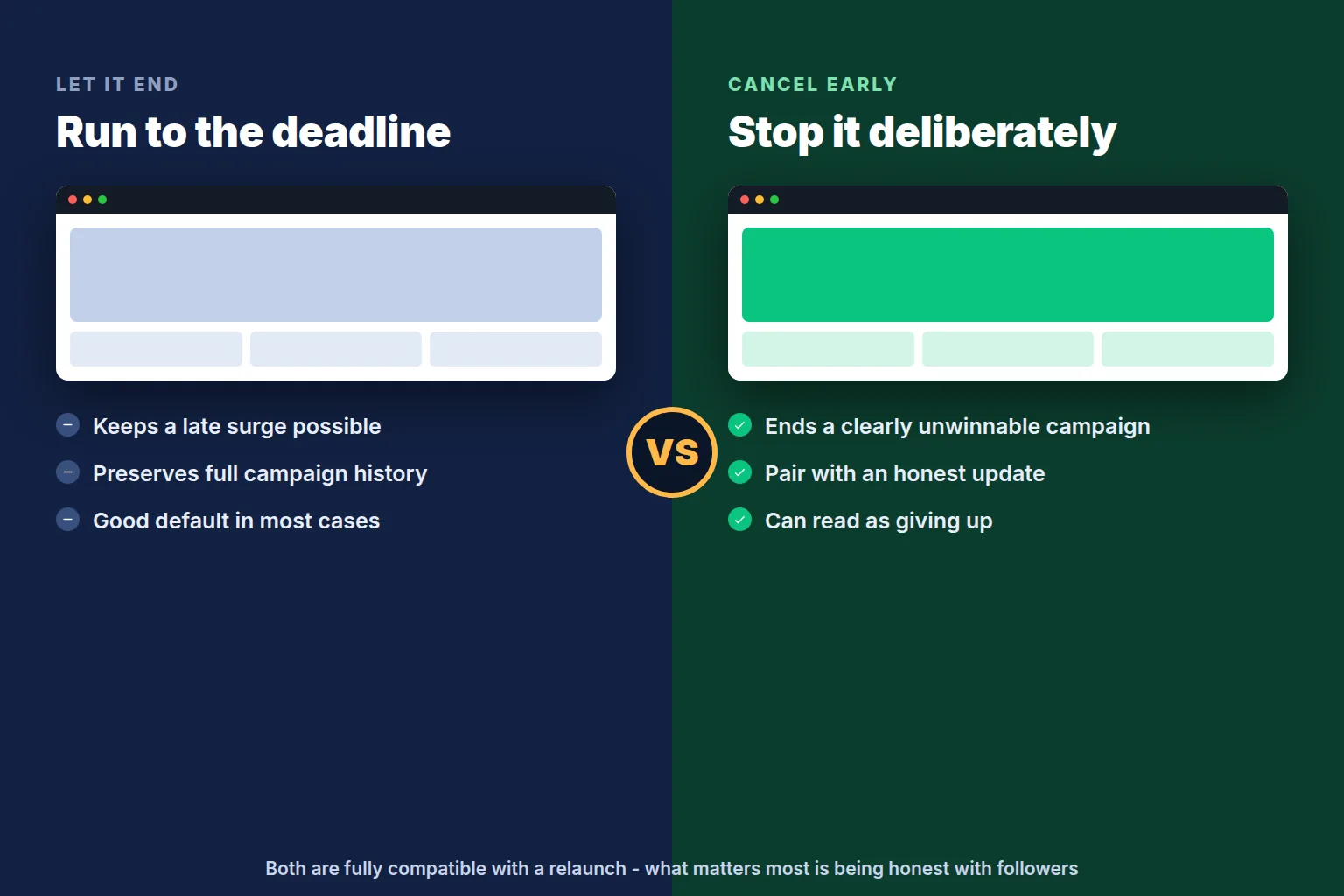
Section 4 above covers the reasoning behind each choice in detail, but it is worth putting the two options next to each other clearly, since creators facing a shortfall in the final days are usually deciding under real time pressure. Letting a campaign run to its deadline keeps every option open, including a late surge, and preserves the full record of the attempt exactly as it happened. Cancelling early stops the clock deliberately and can pair well with an immediate, honest update to followers about what is changing, but it forecloses any chance of a last-minute recovery and can read as giving up if it is not explained well.
Both choices are fully compatible with a relaunch. Kickstarter does not penalize a creator for either outcome when it comes to running a future campaign, and backers generally respond better to an honest explanation of what happened and what is changing than to the specific mechanical choice between cancelling and letting the deadline pass. The decision matters less than what the creator does with it afterward.
How BoostYourCampaign fits
The best way to handle a missed goal is not needing to worry about it in the first place, and that is the core of how BoostYourCampaign approaches new campaigns: validating pricing, goal size, and pre-launch audience before launch, not after the campaign is already live and struggling. The agency builds a real pre-launch list, prices rewards against actual production and shipping costs rather than guesswork, and sets funding goals against a realistic model of the audience and ad budget available, which are exactly the four causes covered in section 3 above.
When a campaign does need to relaunch, whether it came through BoostYourCampaign the first time or not, the agency runs that process directly: diagnosing what went wrong, rebuilding the pre-launch list, fixing reward pricing, and setting a new goal that matches what the audience and ad budget can actually support. BYC uses a skin-in-the-game ad model, putting its own money into ad spend alongside the client's budget with fixed fees instead of a percentage-of-raise commission, which keeps the incentive aligned toward an actual successful funding outcome rather than just running ad spend regardless of results. The agency owns fulfillment warehouses in the US and EU as well, so a successful relaunch has the same fulfillment backbone in place as any first-time campaign. BYC has been active since 2010 across 4,600+ campaigns with $734M+ raised and a 4.9/5 score across 300+ verified reviews. See our services for the full picture, or read our companion guide on Kickstarter's pledge over time and pledge manager features if you are also planning reward structure for a relaunch.
If your campaign is falling short: a quick checklist
| Question | Why it matters |
|---|---|
| Do you actually know which of the common causes applies to your campaign? | A thin pre-launch list, mispriced rewards, a weak opening, and an oversized goal each need a different fix. |
| Is there any realistic chance of a late surge before the deadline? | If yes, letting the campaign run to the deadline usually beats cancelling early. |
| Have you captured backer contacts outside of Kickstarter's opt-in updates? | You do not get a general backer list after the campaign ends - only opted-in followers and your own separate list stay reachable. |
| Do you have a plan for an honest update explaining what happened and what changes next? | Followers respond better to transparency than to silence, whether you cancel or let the deadline pass. |
| Have you actually fixed the root cause before setting a relaunch date? | A relaunch with the same pricing, goal, and pre-launch plan tends to produce the same result. |
| Is your new goal set against a realistic model of your actual audience and ad budget? | An oversized goal built on hope rather than a plan is one of the most avoidable reasons campaigns miss twice. |
If you are trying to decide whether your current campaign can still recover, or you are already planning a relaunch, our Kickstarter fulfillment guide and guide to selling after crowdfunding ends are useful next reads once funding is back on track.
Frequently Asked Questions
What happens if a Kickstarter doesn't reach its goal?
Nothing is charged. Kickstarter is all-or-nothing, so if the campaign does not hit its funding goal by the deadline, no backer's card is charged, the creator collects no money, and Kickstarter takes no platform fee. The campaign page stays live, marked as unsuccessful, rather than being deleted.
Do I get to keep the list of people who backed my failed campaign?
Not the full list. Kickstarter gives creators access to backers who specifically opted into project updates, plus anyone who followed the project, but not a general marketing list of everyone who pledged. Anyone captured through your own pre-launch email list or landing page stays fully under your control regardless of the campaign's outcome.
Can you relaunch a Kickstarter campaign after it fails?
Yes. Relaunching is a common and well-established path, and a meaningful share of eventually successful Kickstarter campaigns are second or later attempts. The key is diagnosing what actually caused the first miss - list size, pricing, goal size, or opening momentum - and fixing that specific thing before relaunching rather than resubmitting the same page.
Why do most Kickstarter campaigns fail to fund?
The most common causes are a thin or nonexistent pre-launch list, reward tiers priced without a real look at production and shipping costs, a weak opening 48-72 hours, and a funding goal set without an honest model of the audience and ad budget actually available to support it.
Should I cancel my Kickstarter campaign or let it run out unfunded?
Letting it run to the deadline is usually the better default if there is any realistic chance of a late surge, and it preserves the full campaign history for a future relaunch. Cancelling early makes more sense when the shortfall is too large for any surge to close, and it works best paired with an honest update to your audience about what is changing.
What percentage of Kickstarter projects fail?
Roughly six in ten Kickstarter projects do not reach their funding goal. That figure moves around by category and year, so treat it as a general reference point rather than an exact number, but it is a large enough share that missing a goal puts a creator in common company, not a rare failure.
Does a failed Kickstarter campaign hurt my ability to launch again?
No. Kickstarter does not penalize a creator's account or future campaigns for a project that did not fund. A missed campaign, handled honestly with followers, is often the setup for a stronger relaunch rather than a mark against future attempts.
What should I do differently the second time I launch?
Fix the specific cause of the first miss rather than making general changes. Build a real pre-launch list if the first attempt launched cold, re-price rewards against actual production and shipping costs if margins were the issue, and set a new funding goal against a realistic model of the audience and ad budget you actually have this time.
If you are deciding whether to let a campaign run out, cancel it, or start planning a relaunch, reach out through /contact and we will help you figure out the right next step.
Want results like these for your campaign?
We've helped 4,600+ creators raise over $734M. Let's pressure-test your launch plan and find the highest-leverage fixes before you go live.
Talk to an expert →Get the free 87-step launch checklist
The exact pre-launch, live-campaign and fulfillment steps we use across 4,600+ launches. Free PDF, emailed instantly.
You're in - check your inbox. Open the checklist now ->