Every creator planning a launch asks the same two questions: how long does this need to be, and what is it going to cost. We shoot these videos weekly, so this article answers both with real numbers instead of vague ranges. If you want a script and a production team under one roof, talk with BoostYourCampaign about your product and launch date.
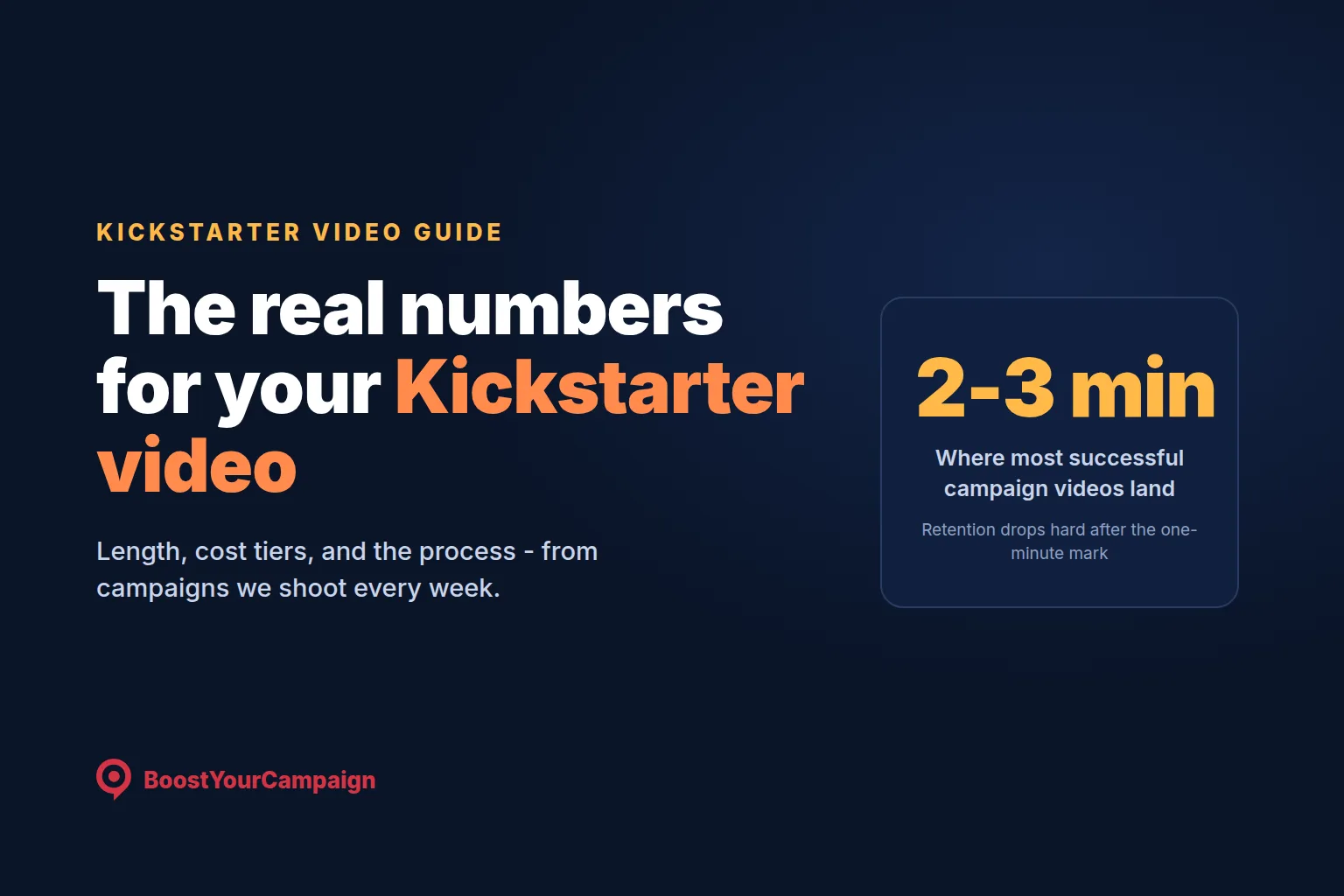
Most successful Kickstarter videos run under 2 minutes, because the first 5 seconds decide whether a visitor keeps watching and retention typically drops hard after the one-minute mark, so nothing essential can sit past it. Cost splits into three honest tiers: a DIY phone shoot with a tight script runs roughly a few hundred dollars in gear and time, a freelancer or small studio runs roughly $3,000 to $10,000, and a full production with a crew, locations, and motion graphics runs roughly $10,000 to $25,000 or more. Ad cutdowns at 15 to 45 seconds are a separate deliverable from the main campaign video, not a byproduct of it, and budgeting for them upfront is cheaper than commissioning them later.
- Under 2 minutes is the workable default - long enough to prove the product, short enough that most viewers stay to the ask.
- The first 5 seconds carry the whole video - lose the viewer there and the rest of the script never gets watched.
- Cost tracks scope, not talent - a freelancer with a tight script can outproduce an expensive crew shooting without one.
- Ad cutdowns are a separate line item - a 2-minute campaign video does not double as a 15-second ad without a real edit.
- Sound problems kill videos that camera quality can't save - viewers forgive soft lighting far more often than bad audio.
- The reward and price need to be on screen - the ask is where campaigns lose pledges they'd already earned.
1) How long should a Kickstarter video be
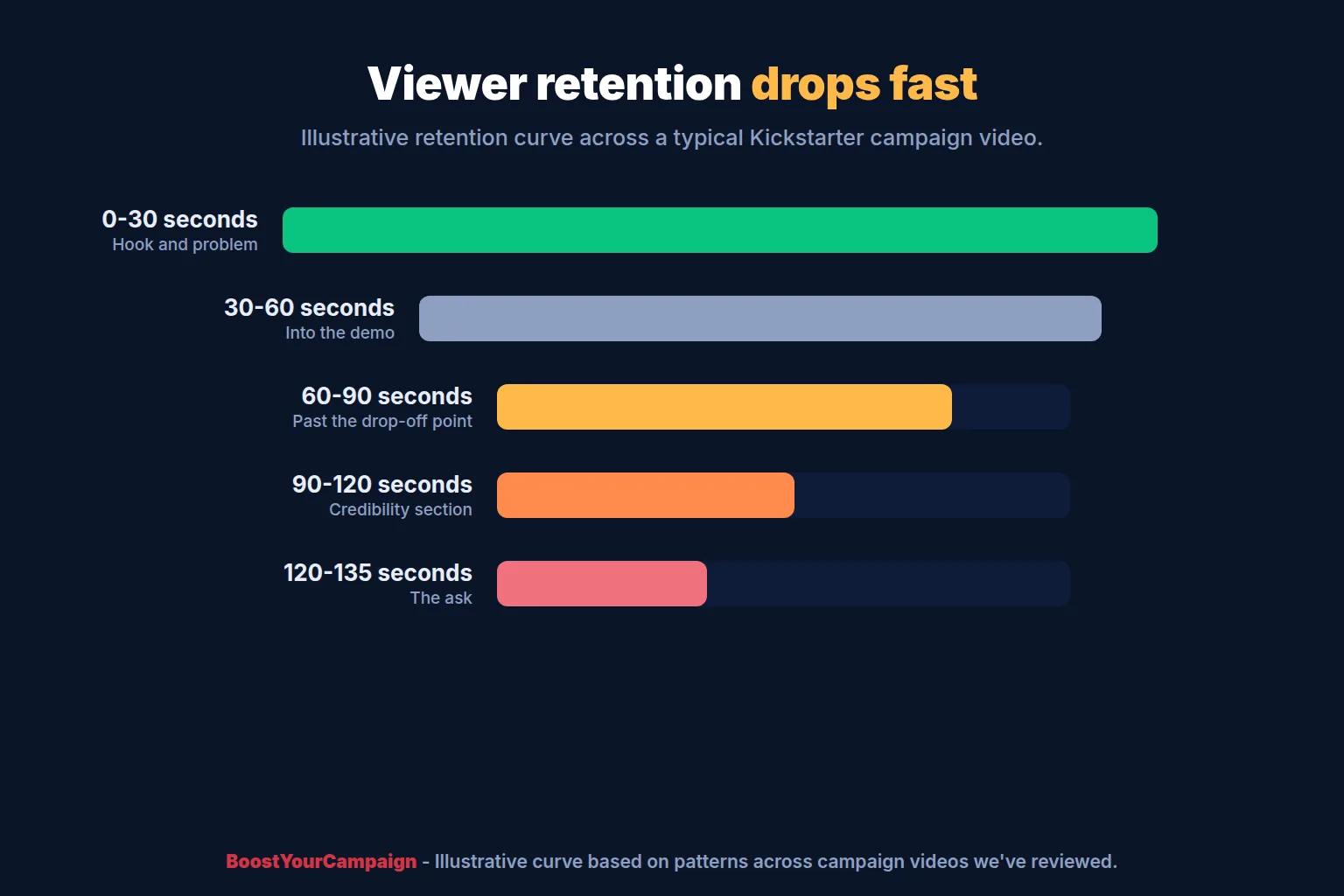
Kickstarter has no rule on video length. Across thousands of campaigns the pattern holds: videos under 2 minutes convert best because that's enough time to hook a viewer, prove the product works, build credibility, and make a clear ask without padding.
The first 5 seconds do most of the work. A visitor lands on a campaign page already skeptical, already comparing this project to a dozen others, and the video has one job in that window: prove something is worth their next minute. The product needs to be visible and doing something in the opening shot, not a logo, not a slow fade from black, not a founder introducing themselves. Our Kickstarter video script guide covers that opening structure section by section and pairs with this article rather than repeating it.
Retention drops sharply after about 60 seconds on almost every campaign video we've reviewed, regardless of category. That's not a reason to cut the video down to 60 seconds - some products genuinely need the full demo to land - but it is a hard constraint on where the strongest material goes. The claim that differentiates the product, the hardest-to-believe feature, the comparison against the obvious alternative: all of it belongs before the one-minute mark, not saved for an ending nobody sees.
A runtime under 2 minutes is the workable default for most hardware and consumer product campaigns. Software, food, and apparel campaigns can often run shorter since the demo needs less setup. A complex device with several distinct functions can add a second, longer demo video further down the page, but the main video still stays under 2 minutes, and every extra 15 seconds needs to earn its place.
Ad cutdowns are a different deliverable and a different length. Paid social and search ads typically run 15 to 45 seconds, built around the single strongest claim rather than the full arc of hook, problem, demo, credibility, and ask. Treating the campaign video as if it doubles as an ad once trimmed down at the last minute is one of the most avoidable mistakes - see the mistakes section below.
2) How much does a Kickstarter video cost
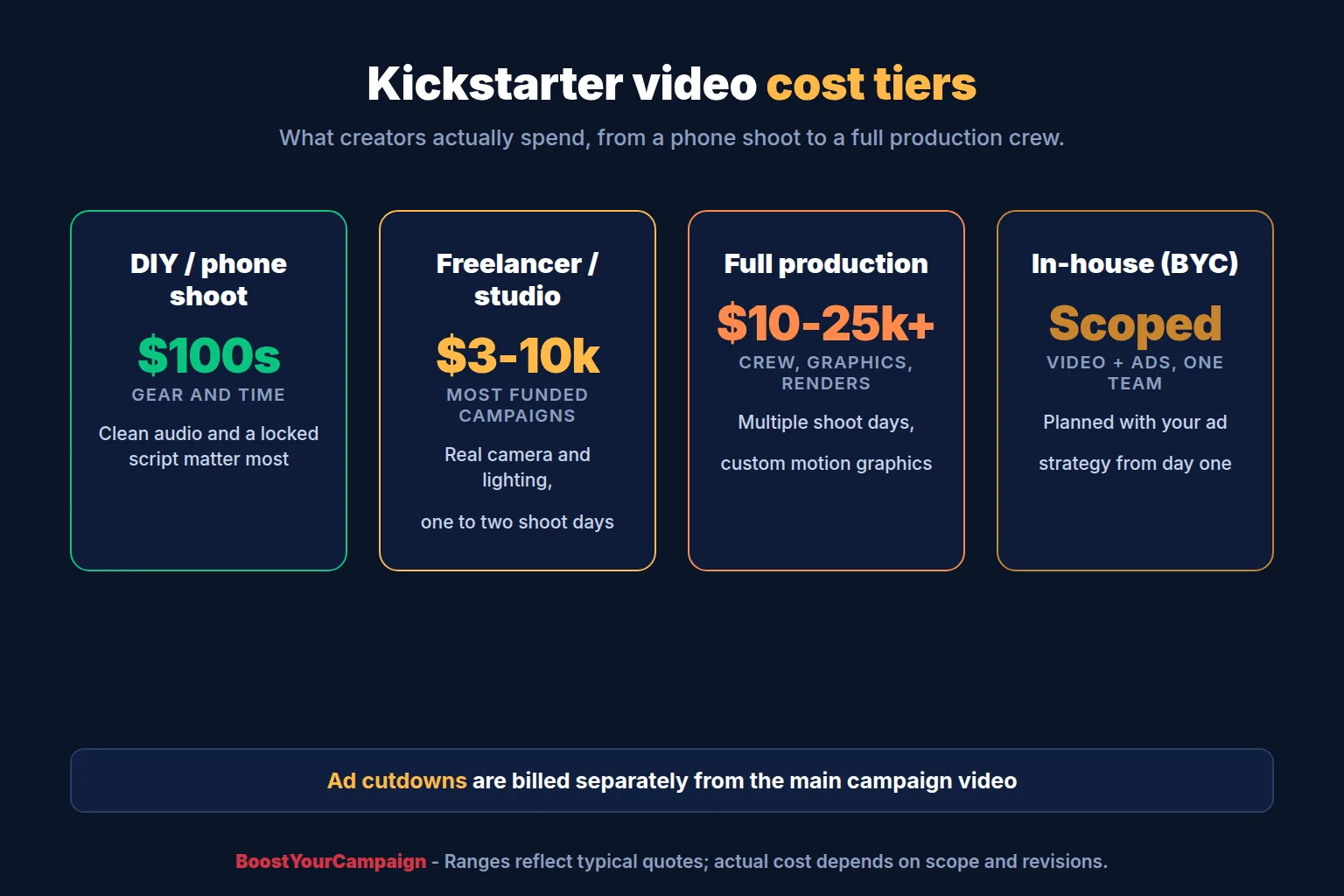
Cost is where most articles get vague, so here are honest numbers from what we see creators spend and what we quote ourselves. There are three real tiers, and which one fits depends more on your product and your script than on ambition alone.
DIY or phone-shot with a good script: roughly a few hundred dollars in gear and time. A recent phone shoots clean 4K footage, a $30-60 clip-on microphone solves the biggest weakness of phone audio, and a couple of cheap lights or well-placed daylight get you most of the way there. This tier works when the product is simple to demonstrate and the script is tight enough for a beginner editor to cut to. It doesn't work for products that need multiple locations, actors, or real lighting control.
Freelancer or small studio: roughly $3,000 to $10,000. This is where most funded campaigns land. A freelance videographer or a small crew brings real camera and lighting equipment, a day or two of shooting, and an editor who can build in motion graphics for on-screen claims. The range moves with location count, delivery coaching, and revision rounds before the script is locked.
Full production: roughly $10,000 to $25,000 or more. This tier adds multiple shoot days, a dedicated director, professional lighting and sound crews, custom motion graphics or 3D product renders, and often a second unit for B-roll. It fits a genuinely complex demo, a launch with a large ad budget riding on the video's performance, or a category where visual polish is part of the pitch, like fashion or design-forward hardware.
What drives the number inside any tier is crew days, not crew size, and how prepared the shot list is going in. Locations add cost fast - a studio rental, a real kitchen, or an outdoor location with weather risk all add planning time a single-room shoot doesn't need. Motion graphics and renders are usually billed separately, done after the edit is locked, and revisions are the quiet cost driver nobody budgets for: an unlocked script almost always means paid reshoots.
Ad cutdowns and social versions belong on the invoice as their own line item, not an assumption baked into the main quote - expect a dedicated edit pass per cutdown length and platform aspect ratio, since a cutdown that performs as an ad needs its own pacing. Our Kickstarter ads guide covers what those cutdowns need to do once the campaign is live and spending on traffic.
One more number worth knowing while budgeting: Kickstarter's own fees run roughly 5% of funds raised plus 3-5% payment processing, and a late pledge campaign afterward typically adds roughly 10-20% more in reward volume to fulfill. Pricing video against the wrong tier early is a common way campaigns end up underfunded on the parts that drive traffic.
3) How to make a Kickstarter video
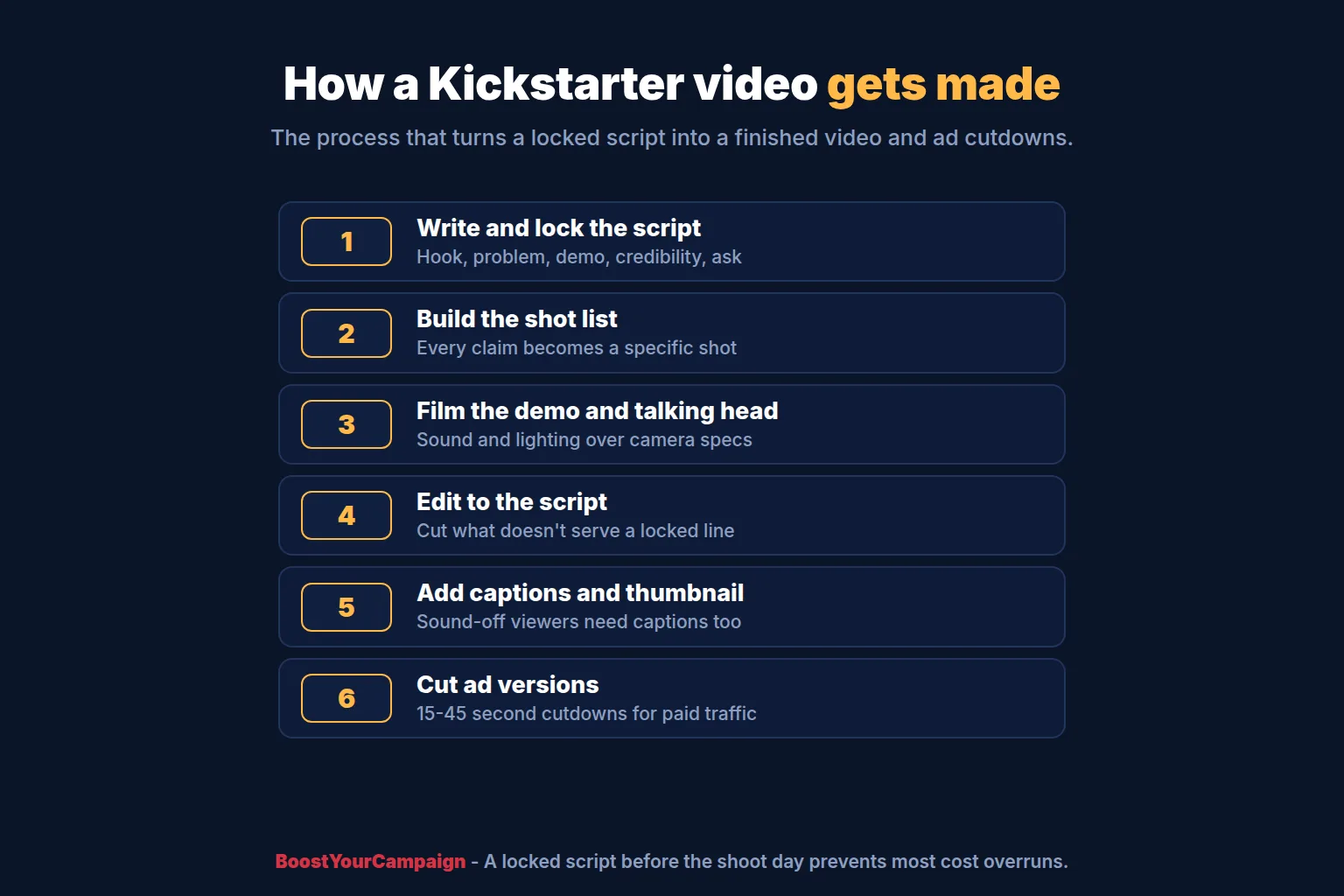
The process breaks into three phases, and the biggest predictor of a smooth shoot is how much work happened before anyone picked up a camera.
Pre-production. Start with the script, not the shot list. Our script structure guide walks through the hook, problem, demo, credibility, and ask section by section, and that script is the input everything else depends on. Once it's written, translate every line into a specific shot: angle, close-up or wide, what's in motion, and what on-screen text pairs with it. This is also the point to lock every factual claim the video will make, since a claim that changes after filming means a reshoot, and a wrong claim in a live campaign video is a far bigger problem than a delayed shoot.
Production. Decide early whether a section is a talking head or a product demo, and default to demo whenever the claim can be shown rather than said - the product doing the thing it does always beats someone describing it. Sound matters more than camera: a viewer forgives a phone shoot with clean audio far more readily than a cinema camera with echoey room tone or wind noise ruining the voiceover, so if the budget stretches to only one upgrade, spend it on a microphone first. Lighting is the next lever - soft, even light reads as professional even on modest equipment, while harsh overhead light or mixed color temperatures read as amateur even on expensive gear.
Post-production. Edit to the script, not around it - if a shot doesn't serve a line in the locked script, cut it rather than extending the runtime to use it. Captions are not optional: a large share of views happen with sound off, and uncaptioned video loses that audience mid-scroll. Pick the thumbnail frame deliberately rather than letting the platform grab whatever lands at the midpoint - it's often the first thing a visitor sees before deciding to press play.
4) What a Kickstarter video must contain
Regardless of length or budget, a campaign video that converts needs five things genuinely present, not implied. The hook opens with the product visibly doing what it does, before narration has had time to lose the viewer's attention. The problem states specifically what this solves and for whom, in a line or two a target backer recognizes instantly rather than a universal feeling nobody can disagree with. The demo proves three to five core claims with the product shown doing them, on-screen text reinforcing each one, not a voiceover listing specs over B-roll. Credibility comes after the demo, not before it, and needs to be specific - real factory footage, a working prototype, a named manufacturing partner, or relevant prior experience.
The ask is the section campaigns most often shortchange, and it directly costs pledges. The video needs to state plainly what to do next, with the reward tier and price visible on screen instead of only spoken - a viewer ready to back the project shouldn't have to scroll away to find out what they're committing to.
5) Common mistakes that sink a Kickstarter video
The same handful of mistakes show up across almost every underperforming campaign video we're asked to fix. Running too long without earning the extra time is the most frequent one - padding the middle with every feature instead of the three to five claims that differentiate it loses viewers before the ask. Narration over demo is close behind: a voiceover describing the product over generic B-roll, instead of showing it, asks the viewer to take the claim on faith.
No clear ask costs pledges directly - a video that ends on a product shot without stating what to do next, or without the reward and price visible, leaves a ready viewer without a next step. Missing captions cut off the portion of the audience watching with sound off, often the majority on social platforms. And launching without ad cutdowns ready means scrambling for short versions the moment the campaign goes live, right when momentum matters most. Our prelaunch audience building guide and prelaunch page examples cover the broader campaign timeline this video needs to fit into.
6) Production company vs freelancer vs in-house studio
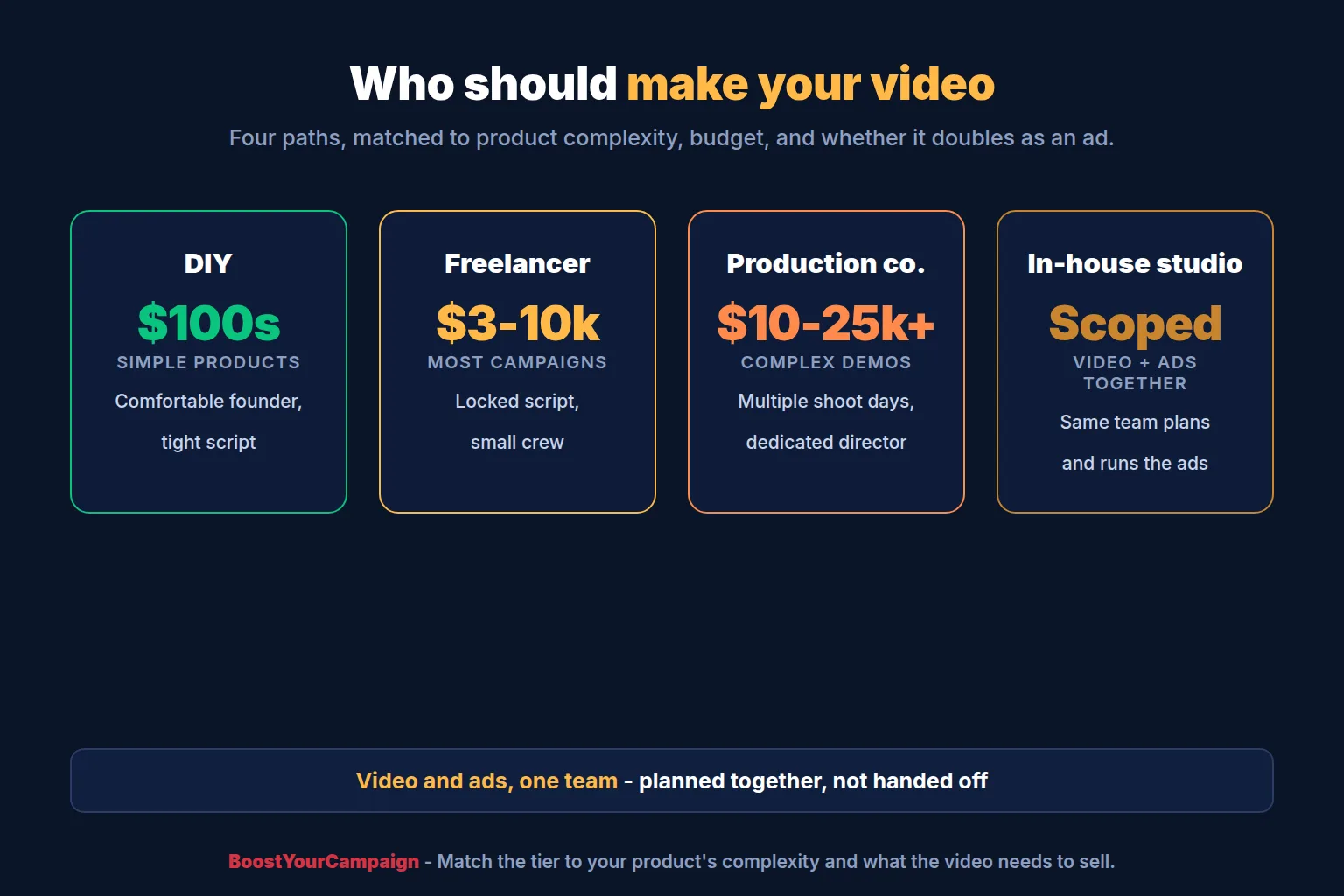
Each path fits a different situation, depending on your product, your timeline, and whether the video needs to work as an ad too. A freelancer usually fits a straightforward product with a comfortable founder and a modest budget - it's the tier where most funded campaigns land, and a good freelancer working from a locked script can outperform a pricier shoot done without one. A dedicated production company suits a genuinely complex demo, multiple locations, or a launch where visual polish is part of the pitch. An in-house studio that also runs the marketing removes a different problem: the handoff gap where a video shot by one vendor gets passed to an ad-buying team that has to guess which claims and shots will cut into working ads.
| Option | Cost band | Timeline | What you get | Best for |
|---|---|---|---|---|
| DIY / phone shoot | A few hundred dollars in gear and time | 1-2 weeks | A workable video with a tight script and a simple product | Simple products, comfortable founder, tight budget |
| Freelancer / small studio | Roughly $3,000-10,000 | 2-4 weeks | Real camera and lighting, a shoot day or two, basic motion graphics | Most funded campaigns |
| Full production company | Roughly $10,000-25,000+ | 4-8 weeks | Multiple shoot days, a director, custom graphics or renders | Complex demos, large ad budgets |
| BoostYourCampaign in-house studio | Freelancer to full-production range | Planned with the marketing timeline | Campaign video plus ad cutdowns shot together, same team running ads after | Video and ad strategy as one relationship |
7) How BoostYourCampaign's in-house studio works
The video gets planned alongside the marketing, not handed off after it's finished. Before a shoot day is booked, we work through which claims the ads will need to prove, so the shot list covers both the full campaign video and the 15 to 45 second cutdowns in the same session instead of a second shoot later to catch what the first one missed. That single step is where a lot of the freelancer-vs-agency cost gap comes from - reshoots to catch a missing ad shot cost more than filming it correctly the first time.
The same team that shoots the video runs the ads once the campaign is live, closing the handoff gap that shows up when a video vendor and an ad-buying team have never spoken. Whoever built the ad strategy already knows which shots and claims are available to cut into new variations as the campaign progresses, instead of requesting a new shoot mid-launch when the footage runs out.
How BoostYourCampaign fits
BoostYourCampaign has run an in-house video studio since the agency's founding in 2010, shooting campaign films, ad cutdowns, and product demos for the same clients whose ads it manages, rather than outsourcing either half to a separate vendor. The agency has worked on 4,600+ campaigns with $734M+ raised and a 4.9/5 score across 300+ verified reviews, and uses a skin-in-the-game ad model, investing its own money alongside the client's ad budget with fixed fees rather than a percentage-of-raise commission. For more on video planning, see our Kickstarter video guide and our video production overview, and for fees and late pledges, see our Kickstarter and Indiegogo fees guide.
Before you brief a video: a quick checklist
| Question | Why it matters |
|---|---|
| Is the script locked before any shoot day is booked? | Filming around an unfinished script drives most reshoots and revision costs. |
| Does the runtime stay under 2 minutes, strongest claims before one minute? | Retention drops hard after about 60 seconds. |
| Are ad cutdowns budgeted and shot alongside the main video? | Cutdowns built after launch mean scrambling during the campaign's most important days. |
| Is the reward and price shown as on-screen text at the ask? | A viewer shouldn't have to leave the video to find out what they're pledging for. |
| Has the audio been checked separately from the picture? | Viewers forgive soft lighting far more than bad sound. |
| Does the video have captions ready for sound-off viewing? | A large share of social and mobile views happen without sound. |
Frequently Asked Questions
How long should a Kickstarter video be?
Under 2 minutes. Retention drops sharply after about 60 seconds, so the strongest claims need to land before that point rather than being saved for later.
How much does a Kickstarter video cost?
Three honest tiers: a DIY phone shoot with a tight script runs roughly a few hundred dollars, a freelancer or small studio runs roughly $3,000 to $10,000, and full production runs roughly $10,000 to $25,000 or more. Ad cutdowns for paid traffic are usually billed separately.
How much does it cost to make a Kickstarter video?
The same three tiers apply whether you call it making or producing the video: a few hundred dollars DIY, roughly $3,000-10,000 for a freelancer, and roughly $10,000-25,000 or more for full production. What drives the number within any tier is crew days, locations, motion graphics, and revision rounds.
What is Kickstarter video production?
Everything that goes into a campaign's main video and its ad cutdowns: locking the script, planning a shot list, filming demo and talking-head segments, then editing with captions and a deliberate thumbnail frame. It spans DIY phone shoots, freelancers, production companies, and in-house agency studios that also run the resulting ads.
How do you make a Kickstarter video?
Start with a locked script, since the shot list, the shoot day, and the edit all depend on it. In production, default to demo shots over narration and prioritize clean audio over camera quality. In post-production, edit strictly to the script, add captions, and pick a thumbnail frame that shows the product clearly.
Do Kickstarter videos need to be professional?
No, but they need to be clear. A phone-shot video with clean audio, good lighting, and a tight script can outperform an expensive shoot with a weak one. What matters is whether the product is shown clearly, the audio is clean, and the ask is direct.
How long should a Kickstarter ad be?
Typically 15 to 45 seconds, much shorter than the full campaign video. Cutdowns are built around a single strongest claim rather than the full hook-problem-demo-credibility-ask structure, and should be planned and shot as their own deliverable, not trimmed from the main video at the last minute.
What should a Kickstarter video include?
Five things: a hook showing the product working in the opening seconds, a specific problem statement, a demo proving three to five core claims on screen, brief specific credibility for the team, and a direct ask with the reward and price visible as on-screen text.
If you want your video scripted, shot, and turned into ads by the same team, reach out through /contact. And if you haven't seen our approach to services more broadly, our services overview covers how video fits alongside the rest of a campaign launch.
Want results like these for your campaign?
We've helped 4,600+ creators raise over $734M. Let's pressure-test your launch plan and find the highest-leverage fixes before you go live.
Talk to an expert →Get the free 87-step launch checklist
The exact pre-launch, live-campaign and fulfillment steps we use across 4,600+ launches. Free PDF, emailed instantly.
You're in - check your inbox. Open the checklist now ->