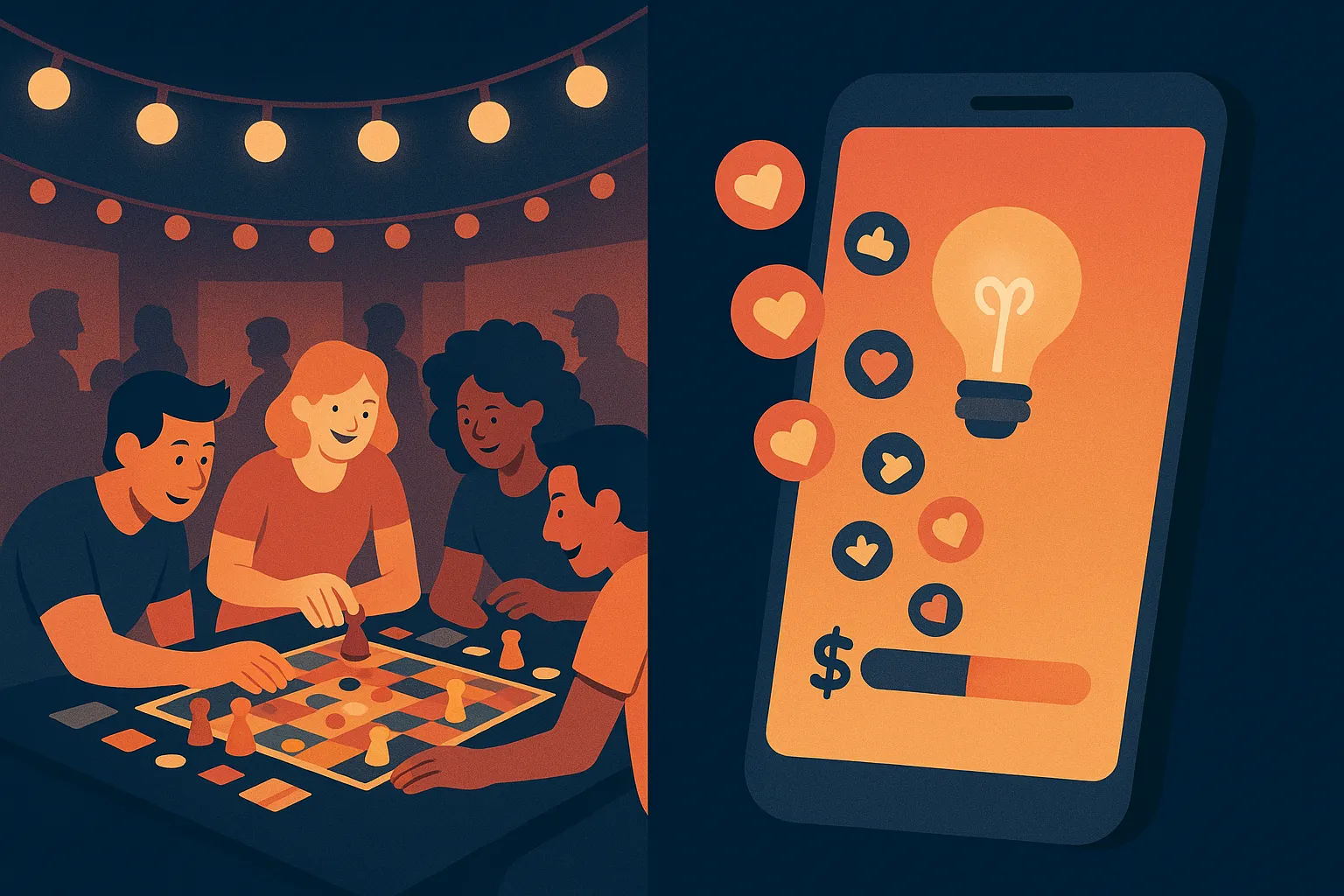
Conventions and paid ads solve different problems, so the question is not which one to pick, it's what order to run them in. A demo table gets a small number of the right people to physically play your game and hand over their email with real intent, which is the highest-trust signal you can collect pre-launch. Paid ads get volume fast once you know what messaging actually converts. Most well-run tabletop campaigns use conventions early to find that messaging and build a core of true fans, then use ads to scale the list once the fundamentals are proven.
Ask a first-time tabletop creator how they are building their pre-launch list, and you will usually get one of two answers: a Meta ads budget, or a convention booth they already paid a deposit on. Both are legitimate. The mistake is treating them as competitors for the same budget line instead of two tools that answer different questions. This guide breaks down what each one actually costs, what it actually converts, and how to sequence them so the money you spend at a convention makes your ad spend more efficient later, not the other way around.
Why conventions still work for a category ads struggle with
A board game is a physical, tactile product that people evaluate with their hands before they evaluate it with their wallet. A thirty-second ad can show a beauty shot of components and a quick rules explainer, but it cannot replicate the moment someone picks up your prototype, plays a real round against a stranger, and decides on the spot that they want this game on their shelf. That moment is worth more than most creators give it credit for, because it compresses the entire trust-building job of a pre-launch campaign into fifteen minutes at a table.
This matters more for tabletop than almost any other crowdfunding category. A backer choosing a phone case can trust a product photo. A backer choosing a strategy game with a novel mechanic is being asked to imagine an experience they have never had, and imagination is a weaker sales tool than a real playthrough. Conventions are the one channel where you can close that gap directly, which is exactly why hobby-weight and strategy games lean on them more than lighter party games do.
Which conventions are actually worth the trip
Not every convention deserves a booth fee and a flight. The right pick depends on your genre and your audience's geography, not on which show has the biggest overall attendance number.
Gen Con is the largest hobby gaming convention in North America and the default choice for mid-to-heavy strategy games, because the attendees are already the exact demographic that funds ambitious Kickstarter campaigns. Origins Game Fair draws a similar hobbyist crowd at a smaller scale, often with more accessible demo slots for a first-time exhibitor. PAX Unplugged skews toward a crossover audience that also plays video games, which fits games with strong thematic hooks or licensed IP better than dense Euro-style strategy games. UK Games Expo is the equivalent anchor event for a European audience, worth the trip specifically if a meaningful share of your prior backers or wishlist adds are EU-based. Smaller regional conventions rarely justify a full booth for a first-time creator, but they can be worth a demo-only presence if one happens to sit near your home base and cuts travel cost to near zero.
The filter that actually matters: does this show's attendee base overlap with the genre you are launching. A miniatures-heavy dungeon crawler belongs at Gen Con. A quick-playing party game aimed at a broader, more casual audience may get more value from a smaller consumer-facing show, or from skipping conventions largely in favor of content creators and paid social instead.
What a demo booth actually costs
Booth fees at a major show like Gen Con typically run from a few hundred dollars for a shared demo table through several thousand for a dedicated exhibitor booth with signage and floor space, depending on size and location on the floor. That is before travel, lodging, printed prototype copies sturdy enough to survive a full weekend of strangers handling them, and the value of the days you or your team spend staffing the table instead of doing anything else.
A realistic all-in budget for a first convention, shared table, one or two staff, printed demo copies, travel and lodging for a long weekend, lands somewhere between $1,500 and $5,000 depending on the show and how far you are traveling. A dedicated booth at a major show with signage and a larger footprint can run well past that. None of this includes the cost of the game itself: budget for demo copies to take real wear, because a single fragile prototype will not survive dozens of playthroughs across three days.
Cost per lead: convention table vs. paid ads
The honest comparison is not which channel is cheaper, it's what you are actually paying for. A well-run Facebook or TikTok ad campaign can generate email signups at a lower blended cost per lead than a convention, especially once your creative and targeting are dialed in. But a convention signup has already played your game, talked to you directly, and chosen to hand over an email in person, which is a meaningfully higher-intent action than clicking an ad and filling out a form.
| Factor | Convention demo table | Paid ads |
|---|---|---|
| Typical cost per qualified lead | Higher once travel and staff time are counted | Lower once creative and targeting are proven |
| Lead intent | Very high, played the game in person | Variable, depends on creative and offer |
| Volume | Limited to a few hundred conversations per show | Scales with budget |
| What it's best for | Testing messaging, gathering direct feedback, building true-fan core | Scaling a message that already works |
| Timing in a launch calendar | Early, 4 to 9 months out | Throughout pre-launch, heaviest in the final weeks |
Read that table as a sequencing argument, not a scoreboard. Conventions are expensive per lead but cheap per insight: watching a hundred strangers play your game in a weekend tells you which rule confuses people, which part of the pitch lands, and which box art stops someone walking by. Feed that into your ad creative and landing page, and every dollar you spend on ads afterward converts better than it would have without the convention data.
What to actually collect at the table
A stack of business cards is not a pre-launch list. The booth's job is to convert a good demo into an explicit opt-in, ideally with a QR code straight to a landing page where the person confirms their email themselves, rather than you typing names into a spreadsheet after a long day. Offer a clear reason to sign up in the moment: early-bird pricing, a specific launch date, a sneak peek at stretch goals, something more concrete than "stay updated."
Just as important as the sign-up is what you do with it. A convention lead that never hears from you again is a wasted conversation. Plan a short, honest follow-up sequence that references the show by name, thanks them for playing, and gives a real launch date as soon as you have one, rather than folding them into a generic newsletter. Our guide to building a pre-launch community covers how to keep that list warm between the show and your launch date without burning it out.
Putting the two channels on one calendar
The strongest pattern we see across board game launches is not conventions or ads, it's conventions first, ads second, sequenced against the same pre-launch timeline. Roughly four to nine months before launch, a convention appearance builds a genuine core audience, tests the pitch in person, and surfaces the messaging and box art choices that actually land. That real-world feedback then informs the ad creative that runs through the rest of pre-launch, so the paid spend is scaling a message that has already been validated by strangers at a table instead of a guess from a spreadsheet.
Skipping straight to ads without ever testing the pitch in person is the most common way board game creators waste early ad spend: they scale a message before they know if it actually lands with the audience it is aimed at. Skipping ads entirely and relying only on conventions caps your reach at whatever a handful of shows can deliver, which is rarely enough audience to fund an ambitious goal on its own. For the paid side of that calendar, our breakdown of advertising a board game Kickstarter covers realistic cost-per-lead ranges and channel mix once you're ready to scale.
- Pick conventions by genre and audience overlap, not by total attendance size.
- Budget printed demo copies sturdy enough to survive dozens of playthroughs.
- Capture emails through an explicit opt-in at the table, not a stack of business cards.
- Follow up within days, referencing the show by name, not a generic newsletter blast.
- Use what you learn in person, which rules confuse people, which pitch lands, to sharpen your ad creative afterward.
- Sequence conventions early in pre-launch and paid ads through the rest of it, not the reverse.
Frequently Asked Questions
Are board game conventions worth it for a first-time creator?
Usually yes, if the show's audience genuinely overlaps with your genre. The value is less about volume of leads and more about the direct feedback and validated messaging you walk away with, which makes every dollar of ad spend afterward more efficient.
Which convention should I pick for my first board game launch?
Match the show to your genre. Gen Con and Origins fit mid-to-heavy strategy games well. PAX Unplugged fits games with strong thematic or crossover appeal. UK Games Expo is the equivalent for a European audience. A lighter party game may get more value from content creators and paid social than from a hobby-focused show.
How much does a convention booth cost for a board game Kickstarter?
A shared demo table with modest travel typically runs $1,500 to $5,000 all-in for a first show. A dedicated exhibitor booth with signage at a major convention can run well past that, depending on floor space and location.
Should I run ads or do conventions first?
Conventions first, if your timeline allows it. Testing your pitch and box art on real strangers before you scale paid spend means the ad creative you eventually run is proven, not a guess.
How do I capture emails at a convention booth without losing people?
Use a QR code to a landing page where the person confirms their own email, rather than collecting business cards to enter later. Give a concrete reason to sign up in the moment, like early-bird pricing or a specific launch date.
If you're weighing a convention circuit against paid acquisition for an upcoming board game launch, book a free strategy call and we'll help you build a realistic pre-launch calendar around your actual budget and timeline.
Want results like these for your campaign?
We've helped 4,600+ creators raise over $734M. Let's pressure-test your launch plan and find the highest-leverage fixes before you go live.
Book a free strategy call →Get the free 87-step launch checklist
The exact pre-launch, live-campaign and fulfillment steps we use across 4,600+ launches. Free PDF, emailed instantly.
You're in - check your inbox. Open the checklist now ->