If you have launched a Kickstarter or Indiegogo campaign, someone has probably DM'd you offering "promotion." The word covers at least five completely different services, and knowing which one you are being offered is the difference between a smart marketing spend and a wire transfer you never see again. If you want a partner that runs promotion as one part of a full launch, talk with BoostYourCampaign about your product and audience.
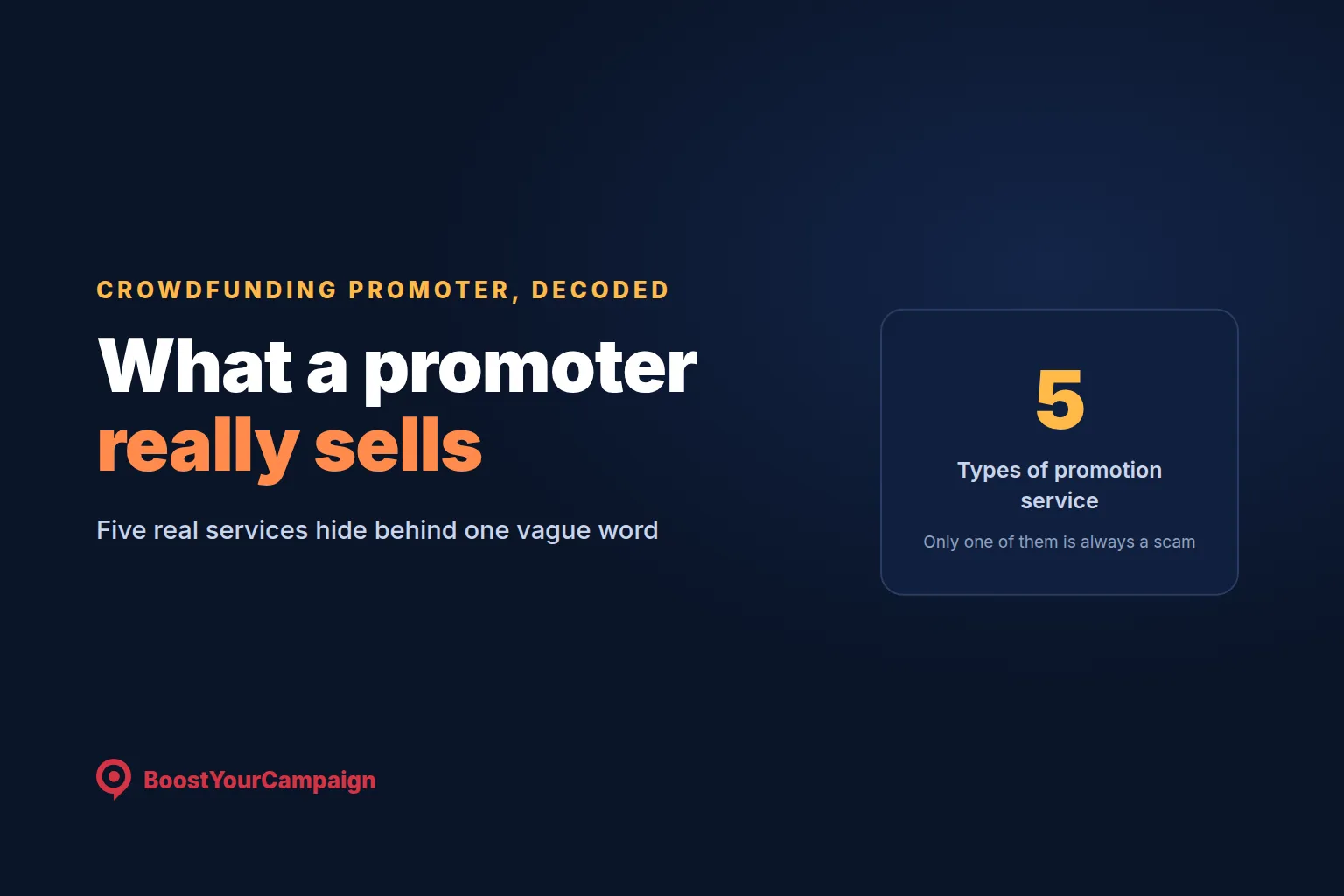
A crowdfunding promoter is an umbrella term for anyone offering to send traffic or backers to your campaign page, covering wildly different services under one loose label. Newsletter features, cross-promotion swaps, freelance or agency-run ads, and PR outreach are all legitimate when the person or company can show real past work. The one offer that is always a scam is a guarantee of funding or a specific backer count - no promoter controls whether your product converts, so anyone promising a number is selling a lie, not a service.
- "Promoter" is a warning word on its own - a cold DM on launch day offering vague "exposure" is the most common scam opener.
- Five real categories exist - newsletter features, cross-promotion, paid ads, PR outreach, and "guaranteed backer" sellers, and only the last is a scam.
- A guarantee is the tell - no legitimate promoter can promise funding or a backer count.
- Cost varies by type - newsletter and PR run flat fees, ads run on ad spend plus a fee, and guaranteed-backer sellers charge upfront for nothing.
- Nothing replaces a pre-launch list - promotion amplifies an audience that already exists.
- Timing decides value - promotion earns the most in the first 48 and closing 72 hours of a campaign.
1) What a crowdfunding promoter actually is
"Crowdfunding promoter" is not a job title with a fixed definition. It is a catch-all phrase attached to at least five different services: a newsletter operator who features your campaign to an opted-in list, a creator who trades a shout-out with another live campaign, a freelancer or agency who runs paid ads, a PR contact who pitches press, and a seller who claims they can send you a set number of backers for a flat fee. Those five things have almost nothing in common besides the word used to describe them.
That vagueness is why the word itself should make you slow down. A real newsletter operator calls themselves that; a real ad freelancer names the platforms they run. Someone who calls themselves a "Kickstarter promoter" and DMs you on launch day with a generic pitch is using the vaguest label on purpose, because it lets them promise anything without committing to a checkable service. Legitimate services rarely need to cold-message creators the moment a campaign goes live - their past results already bring in clients.
None of this means every self-described promoter is a scam. It means the label tells you nothing, and you have to ask which category they fall into before judging their price or claims.
2) The five types of promotion service and what each actually delivers
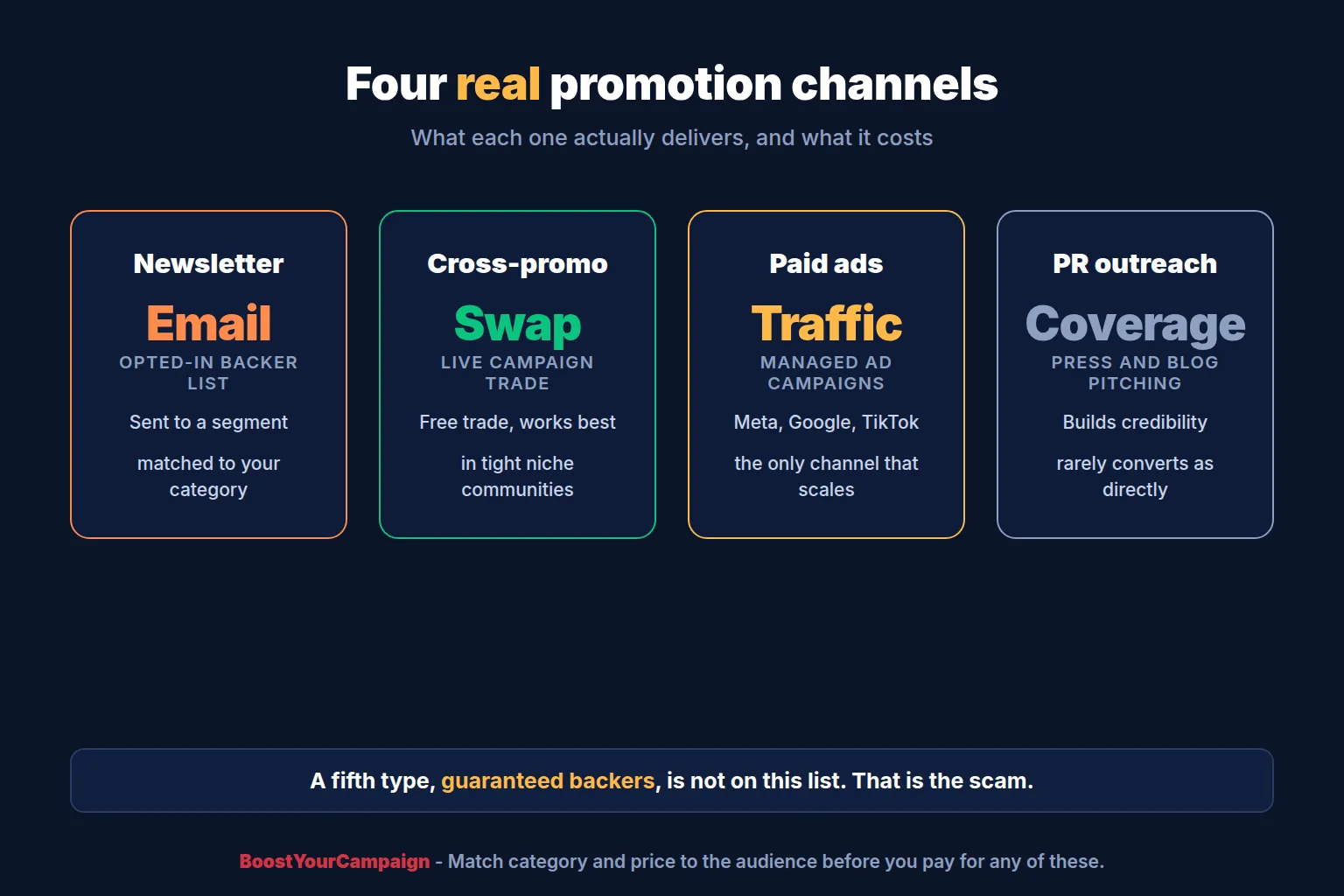
Newsletter and backer-list promotion. A newsletter operator with a real opted-in list of past backers features your campaign in an email sent to a segment matched to your category and price point. This is legitimate when the list is real, opted-in, and the operator can show past campaigns they featured. Our own Kickstarter newsletter works this way: an 8,500,000-plus backer database, with roughly 100,000 backers selected per send based on category fit.
Cross-promotion between live campaigns. Two creators running campaigns at the same time agree to feature each other, usually through an update, a "you might also like" section, or a shared social post. This works especially well in tabletop games and comics, where backers of one project are likely to back another in the same niche, and it costs nothing but the swap itself.
Paid ads run by a freelancer or agency. Someone builds and manages ad campaigns on Meta, Google, or TikTok, driving traffic to your page or a pre-launch landing page. This is the only channel of the five that scales - you can put more budget behind ads that are converting, unlike a one-time newsletter feature or a single cross-promo swap. It is also the channel where quality varies most: a skilled operator turns spend into pledges at a healthy cost per backer, while a weak one burns budget on traffic that never converts. Our Kickstarter ads guide covers what a well-run account looks like.
PR and press outreach. A freelancer or agency pitches your launch to journalists and outlets that cover crowdfunding or your category. Coverage builds credibility and can drive a traffic spike, though it rarely converts as directly as ads or a targeted newsletter feature. Our guide to getting press for your Kickstarter covers how to pitch this yourself.
"Guaranteed backers" sellers. This is the scam category. Anyone offering a specific backer count or guaranteed funding for a flat upfront fee is not selling promotion, they are selling a story. No one controls whether strangers pledge to your product, and a service that claims it can is either lying outright or planning fake or bot traffic that inflates a vanity number while doing nothing for your campaign.
| Type | What you get | Typical cost model | When it helps | Scam risk |
|---|---|---|---|---|
| Newsletter feature | Email to a segment of an opted-in list | Flat per-feature fee | Category and price match the list | Low, if verifiable |
| Cross-promotion | A shout-out swap with another live campaign | Usually free, a trade | Tabletop, comics, niche communities | Low, overlap can be weak |
| Paid ads | Managed campaigns on Meta, Google, or TikTok | Ad spend plus fee or percentage | Any campaign willing to scale spend | Medium, tied to operator skill |
| PR and press | Journalist and blogger pitching, occasional coverage | Flat fee or short retainer | A real story or category-press interest | Low to medium, never guaranteed |
| "Guaranteed backers" | A promised number, rarely anything real behind it | Flat upfront fee, often crypto only | Never - this category is the scam | High, avoid entirely |
3) How to tell a legitimate promoter from a scam
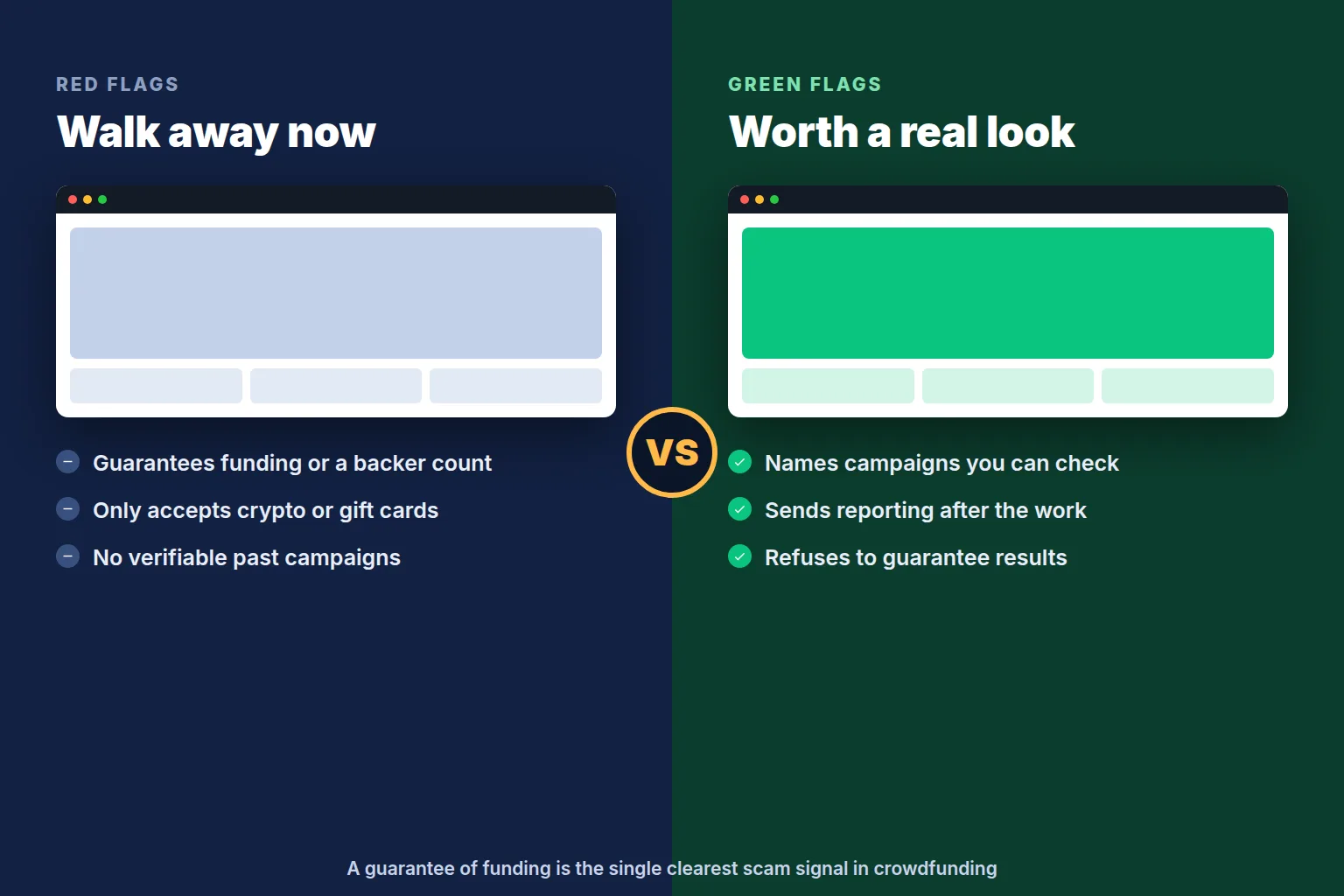
The pattern separating a legitimate promotion service from a scam is consistent enough to check in a five-minute conversation before you send money. A guarantee of funding or a backer count is the biggest red flag, because it is a promise nobody can keep. Payment demanded only in crypto or gift cards is the second, since it cannot be reversed once paid. A promoter with no verifiable past campaigns has nothing to lose by lying to you.
Other red flags stack on top of those three. No reporting on clicks, traffic, or pledges means no way to know whether anything happened. Reviews that all read the same or cannot be traced to a real campaign signal purchased testimonials. A cold DM offering to "share your project to 500,000 backers" with no list you can inspect is close to a scripted scam template. And a promoter who asks for your Kickstarter or Indiegogo login, rather than a link and creative assets, is asking for access no promotion service legitimately needs.
The green flags run the opposite direction. A legitimate promoter can name specific past campaigns you can look up. They send reporting on clicks, traffic, or pledges after the work is done, not just a promise it happened. They work off a contract and an invoice, not an unregistered payment app. And, counterintuitively, the most trustworthy promoters refuse to guarantee results and explain why - a sign they understand how the platform actually works.
4) What promotion costs
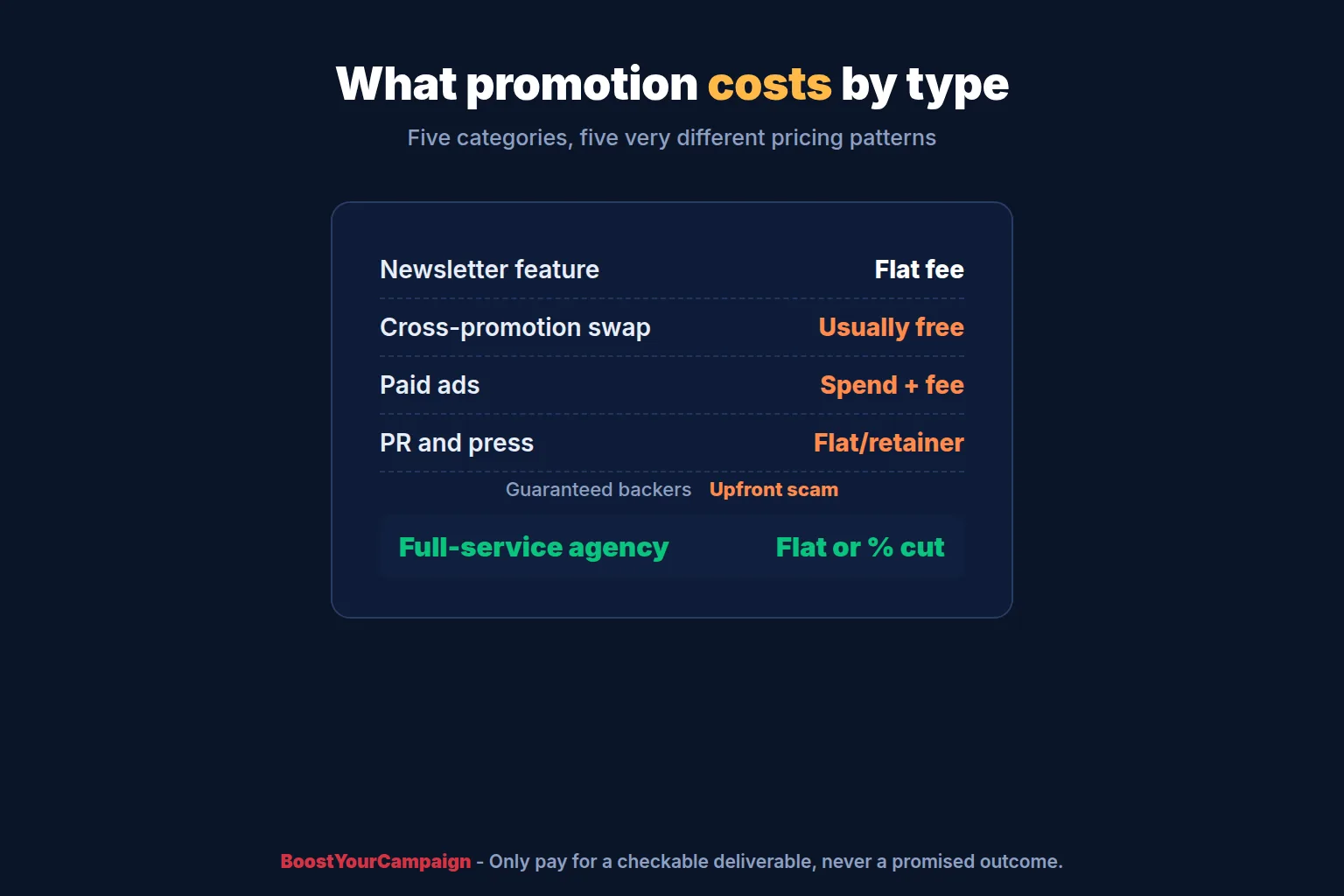
Cost depends on which category you are paying for. A newsletter feature is usually a flat per-campaign fee. Cross-promotion typically costs nothing beyond coordination time, since it is a trade rather than a purchase. Paid ads are priced on ad spend plus a management fee or percentage, with the spend itself as the largest line - a freelancer or small agency still needs a real budget behind the campaigns, not just their fee, to produce results. PR is usually a flat fee or short retainer, since coverage cannot be purchased outright. Full-service agencies bundle several channels together into a fixed fee or a percentage of what the campaign raises - our agency cost guide breaks down that range. "Guaranteed backer" sellers charge whatever they think you will pay upfront, with no relationship between price and deliverable, since there is none.
5) What results to expect
Promotion to an opted-in backer list works when your product genuinely fits the categories that list's backers care about. A tabletop game featured to a tabletop-heavy list converts; the same feature sent to a list built around gadgets and tech converts far less, no matter how large the list is. Size alone is a weak predictor - fit is what matters.
Cross-promotion works best in categories with tight, engaged communities, which is why it is such a common tactic in tabletop games and comics. Backers in those categories actively look for what else is funding, and a well-matched swap routinely outperforms a paid ad targeting a much larger, less focused audience.
Paid ads are the only channel of the five that scales predictably, because you can put more budget behind whatever creative and targeting is already converting. An operator who has run ads across hundreds of campaigns has pattern recognition on a healthy cost per backer, and can catch a failing ad set before it burns through your budget. None of these channels replace a pre-launch list, though - promotion amplifies an audience that already exists, and zero pre-launch audience leaves very little for any promoter to amplify.
6) Questions to ask before paying anyone
Ask these directly before you send money, and note how specifically they answer. A vague or evasive response is reason enough to walk away.
- Can you name three specific campaigns you have promoted, with links I can check?
- What exactly will you deliver, and when?
- Will you report back on clicks, traffic, or pledges after the work is done?
- What payment methods do you accept, and will you provide an invoice?
- Do you guarantee a specific number of backers or a funding outcome?
- If it is a newsletter feature, how is the list segmented by category?
7) How to run promotion yourself with no budget
If you cannot afford to pay anyone, there is a real amount of promotion you can do for free. Kickstarter's own newsletter and its Projects We Love badge are the strongest free promotion on the platform, since both put your campaign in front of backers already there to fund something - our guide to getting featured as a Project We Love covers what the platform's curators look for.
Community posts in forums, subreddits, and Discord servers built around your product category cost nothing but time, and work when you participate genuinely rather than dropping a link and leaving. Cross-promo swaps cost nothing either - reach out to campaigns live at the same time and propose a trade.
Press outreach is also doable without an agency. Our press guide walks through building a targeted journalist list and pitching directly, which costs nothing but research and writing. None of this replaces a pre-launch list or paid ads at scale, but together it is a real strategy for a campaign with no budget.
8) How promoters fit into a full launch plan
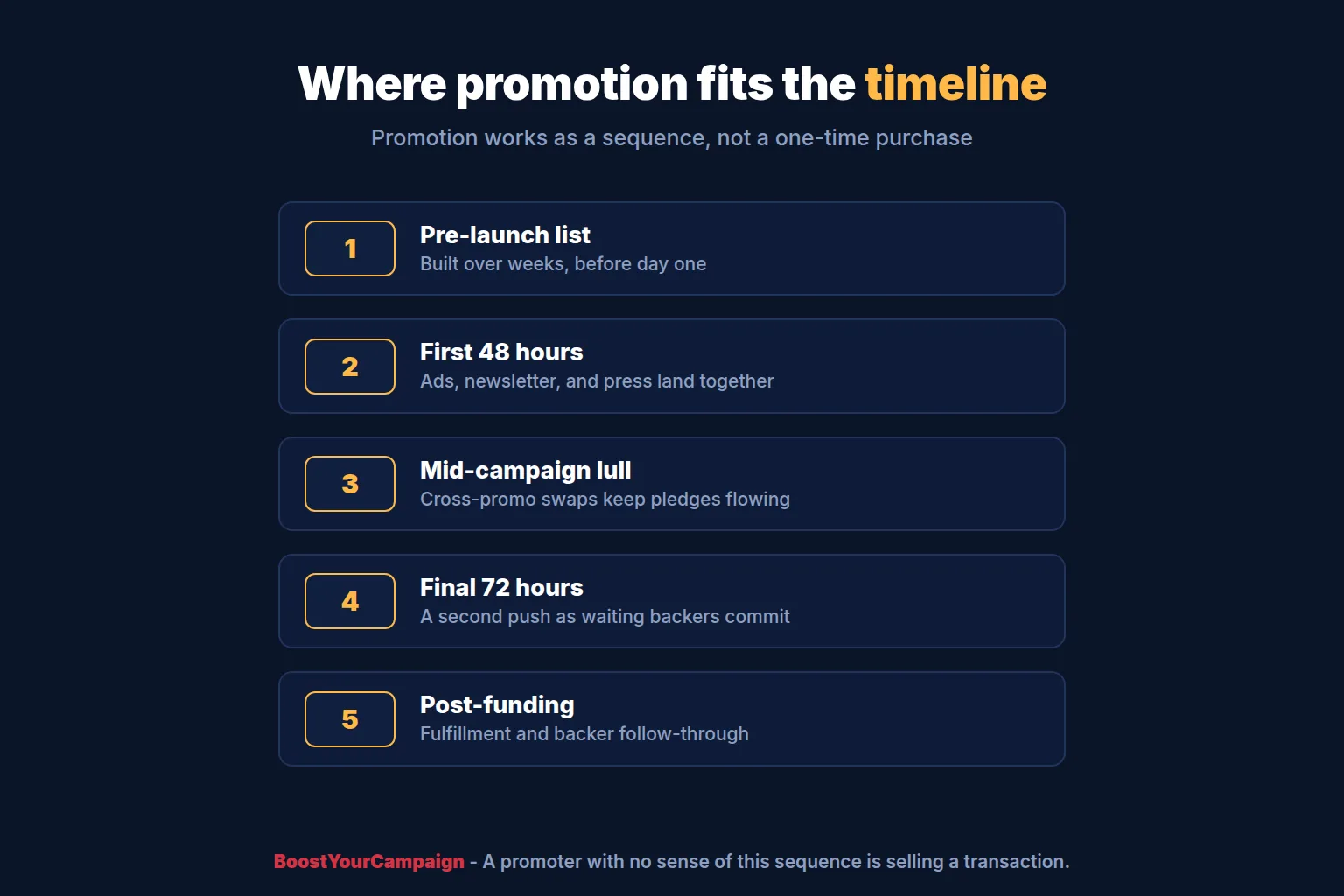
Promotion works best as one piece of a sequence, not a standalone purchase. The pre-launch list comes first, built over weeks or months before launch day, because that list is what every later promotion channel amplifies. Without it, a newsletter feature or a cross-promo swap reaches cold strangers instead of an audience with existing context on your product.
The first 48 hours of a live campaign get the most attention from Kickstarter's own algorithm, so this is when paid ads, a newsletter feature, and any press coverage should land together, converting your pre-launch list into early momentum the platform then amplifies. The middle of a campaign is usually the quietest stretch, where cross-promotion swaps and steady ad optimization keep pledges flowing. The final 72 hours bring a second surge as backers who were waiting decide to commit, worth a second push of ads and any remaining press or newsletter placements saved for the close.
A promoter who only shows up once, with no sense of where their piece fits, is offering a transaction, not a strategy. Campaigns that get the most out of promotion treat it as scheduled infrastructure inside a full plan.
How BoostYourCampaign fits
BoostYourCampaign is a full-service agency, not a promoter. Our services run pre-launch list building, paid ads, video production, PR, our own backer newsletter, and fulfillment as one connected engagement, priced as a transparent flat fee rather than a per-feature charge or a percentage. Our own newsletter, reaching an 8,500,000-plus backer database with roughly 100,000 backers selected per send based on category fit, is one channel inside that plan, not a service sold to strangers who cold-message us.
We also tell creators plainly when their product will not work with paid promotion. A weak offer, no pre-launch audience, and thin margins will not be fixed by a bigger ad budget, and we would rather say so upfront than take a fee for spend that cannot convert. Our skin-in-the-game model reflects the same principle - we can front or share ad spend on qualifying campaigns, which only makes sense for products we believe will convert. Since 2010 we have run more than 4,600 campaigns and helped raise over $734M, with a 4.9 out of 5 rating across 300-plus verified reviews. See our agency cost guide and, for specialists, our PR and advertising agencies guide and top agencies list.
Before you pay a promoter: a quick checklist
| Question | Why it matters |
|---|---|
| Can they name real past campaigns you can verify? | No verifiable history means no way to check if claims are true. |
| Do they guarantee a backer count or funding outcome? | Nobody controls whether strangers pledge - a guarantee is always false. |
| Will they accept payment by card or invoice? | Crypto- or gift-card-only payment is chosen to prevent refunds. |
| Will they report clicks, traffic, or pledges after the work is done? | No reporting means no way to know if anything happened. |
| Did they cold-DM you the day you launched? | Legitimate services rarely cold-pitch creators mid-launch. |
Frequently Asked Questions
What is a crowdfunding promoter?
An umbrella term for anyone offering to send traffic or backers to your campaign, covering at least five services: newsletter features to an opted-in list, cross-promotion swaps, freelance or agency-run ads, PR outreach, and "guaranteed backer" sellers. The label alone does not tell you which you are getting, so ask directly before you pay anyone.
Are Kickstarter promotion services legit?
Some are, some are not - the difference is what they deliver and whether you can verify it. Newsletter operators with a real list, ad freelancers with a track record, and PR contacts with real relationships are legitimate. Anyone guaranteeing a funding outcome or backer count is not, since no promoter controls whether strangers pledge.
How much does Kickstarter promotion cost?
It depends on the type. Newsletter features are usually a flat per-campaign fee. Cross-promotion swaps typically cost nothing beyond coordination time. Paid ads run on ad spend plus a management fee or percentage. PR is usually a flat fee or short retainer. Full-service agencies bundle several channels into a flat fee or a percentage of funds raised - see our agency cost guide for real ranges.
Can a promoter guarantee my Kickstarter gets funded?
No. Whether a campaign funds depends on the product, price, audience, and offer, none of which any promoter controls. A guaranteed funding outcome or backer count is the clearest scam signal in this industry.
What is the difference between a crowdfunding promoter and a marketing agency?
A promoter typically sells one channel - a newsletter feature, a cross-promo swap, a batch of ads - as a standalone transaction. A full-service marketing agency runs pre-launch list building, ads, video, PR, and often fulfillment as one connected plan, usually for a flat fee, and stays engaged through the campaign.
How do I promote my Kickstarter for free?
Apply for Kickstarter's Projects We Love badge and pitch its newsletter, post genuinely in communities built around your category, arrange cross-promotion swaps with other live campaigns in your niche, and pitch press yourself with a targeted list of journalists. None of it costs money, only time.
How do I spot a Kickstarter promotion scam?
Watch for a guaranteed backer count, payment demanded only in crypto or gift cards, no verifiable past campaigns, no reporting after the work is done, reviews that all read the same, a cold DM the day you launch, and any request for your Kickstarter or Indiegogo login. Any one is reason to walk away.
Do Kickstarter newsletter promotions work?
They work when your product's category and price match the list's backers. A tabletop game featured to a tabletop-heavy list converts well; the same feature sent to a mismatched list converts poorly regardless of size. Ask any operator how their list is segmented by category before paying.
If you want a full launch plan built around your product, reach out through /contact.
Want results like these for your campaign?
We've helped 4,600+ creators raise over $734M. Let's pressure-test your launch plan and find the highest-leverage fixes before you go live.
Talk to an expert →Get the free 87-step launch checklist
The exact pre-launch, live-campaign and fulfillment steps we use across 4,600+ launches. Free PDF, emailed instantly.
You're in - check your inbox. Open the checklist now ->