Most Kickstarter campaigns that miss their goal were never validated - they were assumed. A prototype and encouraging friends feel like proof, but neither answers the four questions that decide whether a launch funds. If you want a team to run that testing before you commit to a launch date, talk with BoostYourCampaign about your product and audience.
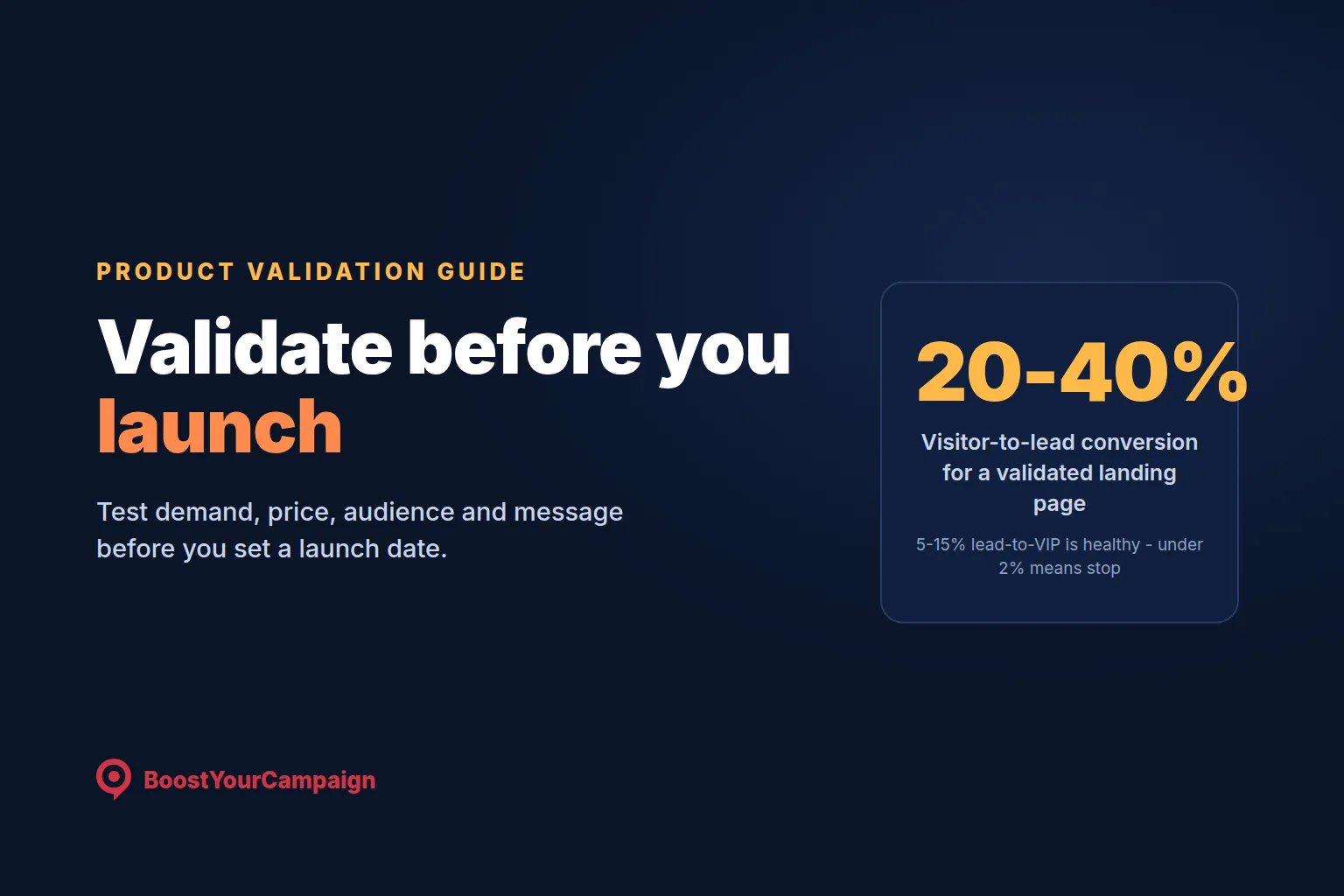
Validate a product before Kickstarter by running a small paid landing page test, not by asking friends or counting followers. Spend a few hundred dollars on ads to a pre-launch page and judge results against two numbers: visitor-to-lead conversion, which should land in the 20-40% range, and lead-to-VIP conversion on a $1 to $25 reservation, which should land in the 10-30% range. Under 10% means the offer needs work: fix it rather than launch anyway and hope.
- Validation answers four separate questions - demand, price, audience, and message - and a working prototype answers none of them.
- The landing page and ad test is the cheapest real signal - a few hundred dollars beats months of asking people if they'd buy.
- The $1 to $25 reservation is the strongest test short of a real pledge - it asks for money, not opinions.
- Price and message need their own tests - guessing at either is how a validated product still launches soft.
- Thresholds matter more than instinct - a go/fix/stop table stops founders talking themselves into a launch the numbers already answered.
- The list you validate with becomes day-1 revenue - validation and pre-launch list-building are the same work.
1) What product validation actually means for crowdfunding
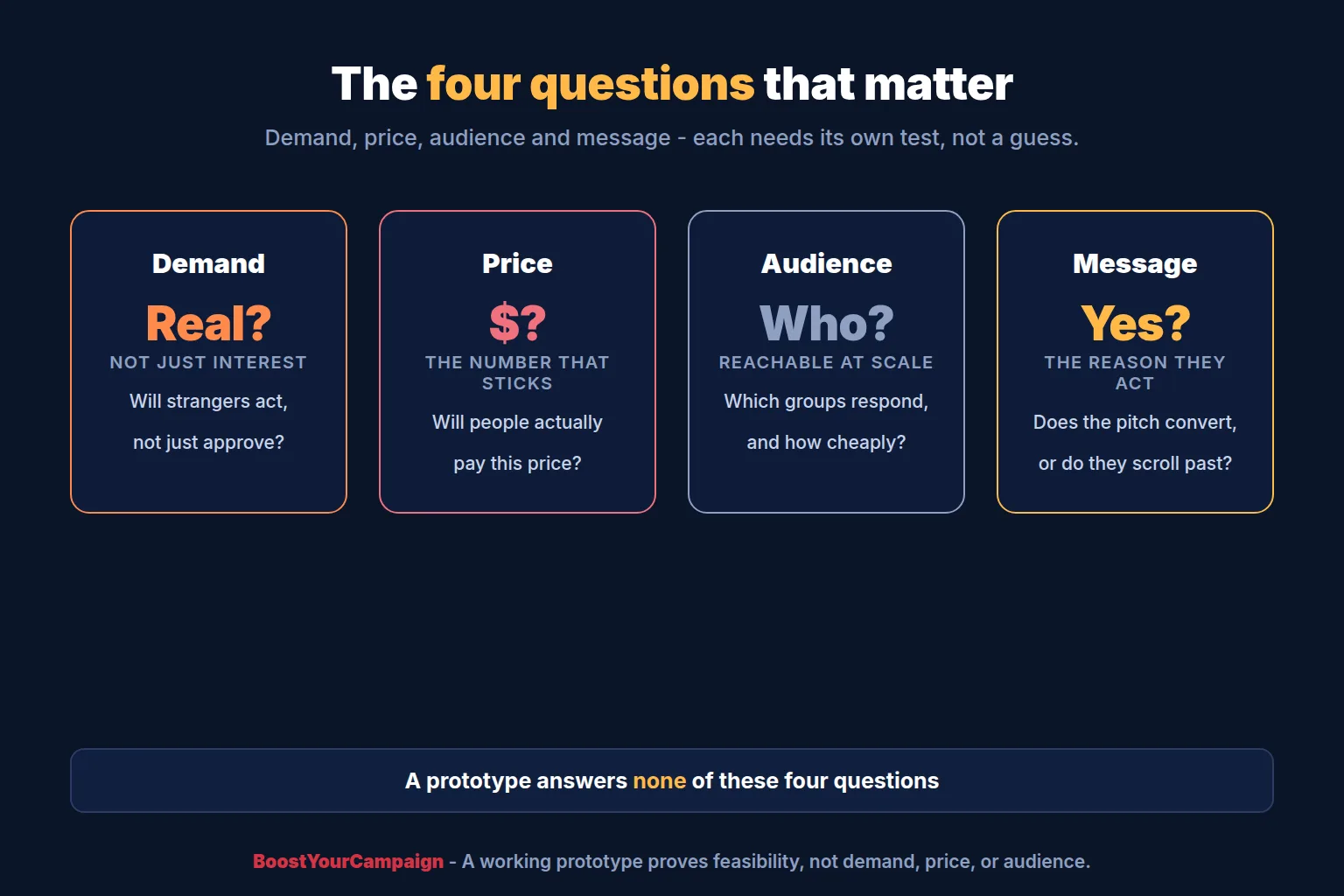
Founders use "validation" to mean a lot of things, and most are not validation at all. A working prototype validates that the thing can be built. A hundred compliments in a Discord server validate that people are polite. Neither tells you whether strangers will hand over money, which is the only question a crowdfunding platform actually asks. Real validation means a real answer to four separate questions, tested one at a time.
Demand asks whether enough people want this product enough to act, not just nod along. Price asks whether the number in your head is one people will actually pay. Audience asks who those people are and how expensive they are to reach at scale. Message asks whether the way you describe the product is the reason people say yes or scroll past. A product can pass one and fail the others - strong demand at the wrong price still launches soft.
A prototype video and a friends-and-family reaction are not validation, even though they feel like it. A prototype proves feasibility; friends are biased by definition, so their approval predicts nothing. Validation has to involve strangers, a real transaction, and money changing hands, even if it is only a dollar.
2) The cheapest test first: the pre-launch landing page and ad test
Before spending on anything else, run a small pre-launch landing page behind a few hundred dollars of paid traffic, usually Meta ads. It should be the first thing you build, not an afterthought bolted onto a campaign page later. The page needs almost nothing: a clear product visual, a one-line value promise, and an email field.
The benchmark is visitor-to-lead conversion, and a well-built page with reasonably targeted traffic typically converts somewhere in the 20-40% range. A page converting well under that, into the single digits, almost always has a structural problem - an unclear headline, a mismatch between the ad and the page, or poorly matched traffic - covered in the pre-launch landing page guide.
The second number is cost per lead, or CPL. Run each ad set at roughly $20 a day for three to four days, long enough for a real read without burning the budget on one early winner. A healthy CPL for a well-targeted product often lands in the $1 to $3 range, and disciplined testing can push it under $1.70. A CPL that climbs as you add budget means you have already reached the people who want this. Our Kickstarter ads guide covers the testing structure - running two or three audiences and hooks against each other turns the winner from a guess into a comparison.
3) The $1 reservation test
An email address is cheap to give. A deposit is not, and that gap is why the reservation step is the strongest validation signal short of an actual pledge. Right after a visitor gives an email, the page offers a second step: a small refundable deposit, typically $5 to $25 rather than a flat $1, locking in the best early-bird price once the campaign goes live.
The metric to track is lead-to-VIP conversion: of every 100 email leads, how many upgrade to a paid reservation. A healthy rate typically sits in the 10-30% band. A rate under 10% is a warning sign, and rarely a traffic problem - it usually means the offer has not made the jump from interesting to worth paying for. VIP reservers convert to a full pledge at 30-50% or higher, several times a plain subscriber's rate, which is why a deposit-list forecast is worth trusting and an email-list one is not - our guide to pre-launch numbers that predict revenue covers the math.
Deposit size is a dial, not a fixed rule. A $1 reservation produces the most reservations but lets more low-intent people through, flattering an early dashboard and disappointing on launch day. A $10 or $25 deposit produces fewer reservations that each predict a pledge more reliably. Mechanics and sizing by price are in the $1 reservation funnel guide.
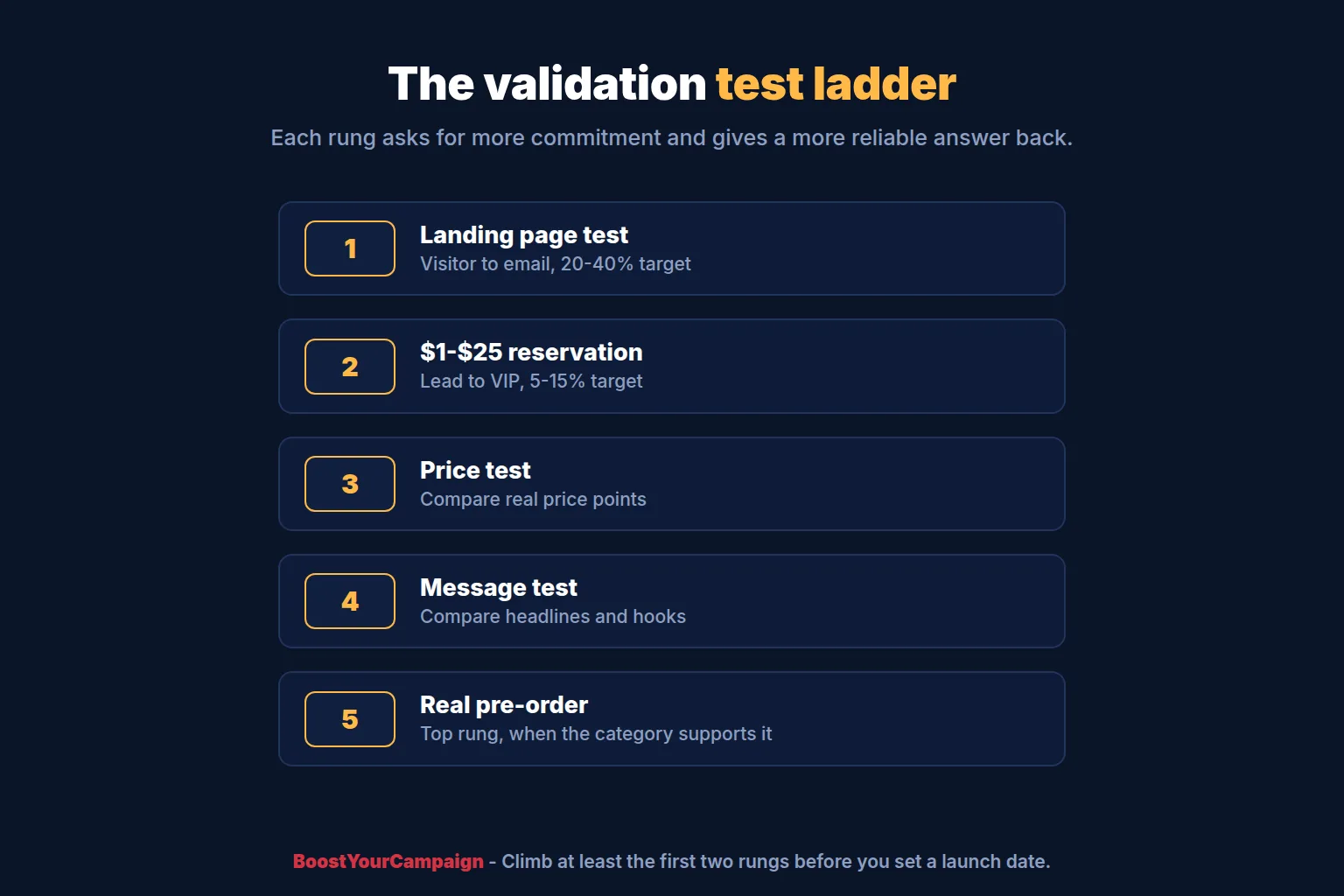
Think of these as rungs on a ladder, each asking for more commitment and giving a more reliable answer in return. An email is the first rung, a deposit the second, and a real pre-order is the top rung short of the campaign itself. Climb at least the first two before you set a launch date.
4) Message and price testing
Demand and audience can both check out fine and a launch can still fund soft because the price or pitch was wrong, which is why message and price deserve their own tests. Message testing is the more familiar of the two: run two or three headlines and hero visuals against the same audience and budget, and let visitor-to-lead conversion pick the winner. Plain, concrete statements of what the product does beat headlines that need a second read to parse.
Price testing is where founders get nervous, because it feels close to lying to people. It does not have to be. Show different, real price points to different segments of your traffic, each presented plainly as the actual reserved price for that group, and compare lead-to-VIP conversion across segments. You are testing which of two or three genuine prices a real audience is willing to reserve at, not showing a fake high price against a fake discount. If a lower price meaningfully lifts reservation rate without collapsing pledge economics, that is a real answer you needed before launch.
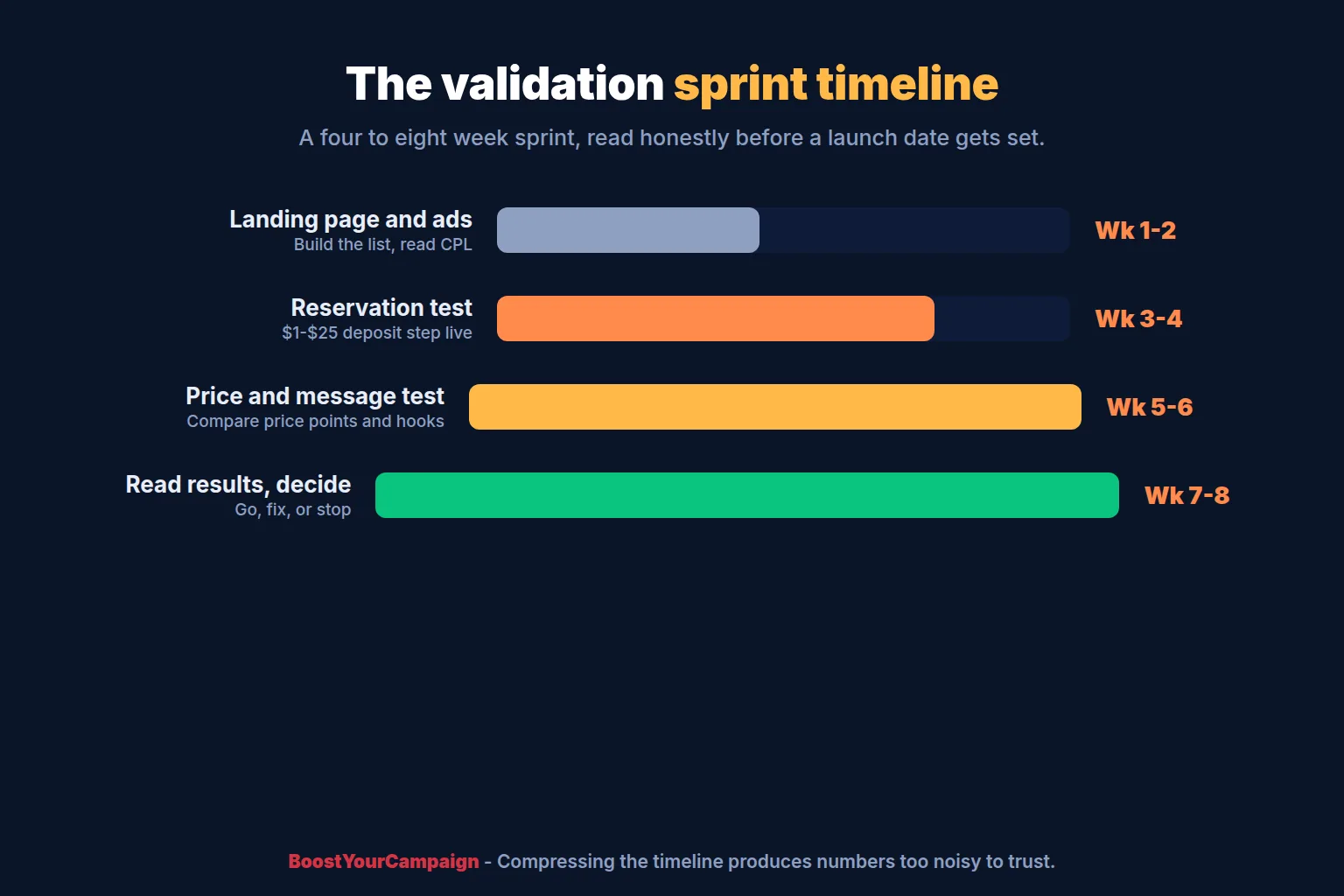
Run these tests in sequence, since a small ad budget cannot cleanly separate several variables at once: two weeks on the page and ad test, two weeks layering in the reservation step, two weeks on price and message, two weeks to read the results and decide. That four-to-eight-week sprint is a realistic minimum, worth protecting rather than compressing, since a rushed test produces a number too noisy to trust.
5) Audience validation
Demand that only exists in one narrow slice of the market is a fragile foundation for a funding goal, which is why audience is its own question. As the landing page test runs, break results down by interest group, country, and age band rather than reading one blended number. A product that converts well with one group and poorly with everything adjacent has a narrower audience than assumed, changing the funding goal and the budget needed to reach a meaningful list.
Two failure patterns show up most: an audience too small to scale without CPL climbing fast, or an audience too expensive to reach, where CPL sits above the healthy range at small spend. Either is better discovered at $500 of test spend than $5,000 of launch spend, covered alongside testing structure in the Kickstarter ads guide.
6) Qualitative signals that matter and ones that don't
Not every signal short of a payment is worthless, but most that founders lean on hardest are weaker than they feel. Reddit threads and community forums, read honestly, can surface real objections early - a category complaint, a competitor gap, a price expectation - that a landing page test will not catch. A pre-order intent survey adds useful color on feature priority, as long as you read it as color, not proof.
What does not hold up as well: likes, follows, and shares. A follow costs nothing and signals almost nothing, which is why a list built from platform follows underperforms a smaller list built from targeted ads. Waitlist replies sit in between - more effort than a like, but still far from a deposit. Weight every signal by what it cost the person to give: payment predicts the most, a like predicts almost nothing.
7) Reading the results: a go, fix, or stop decision
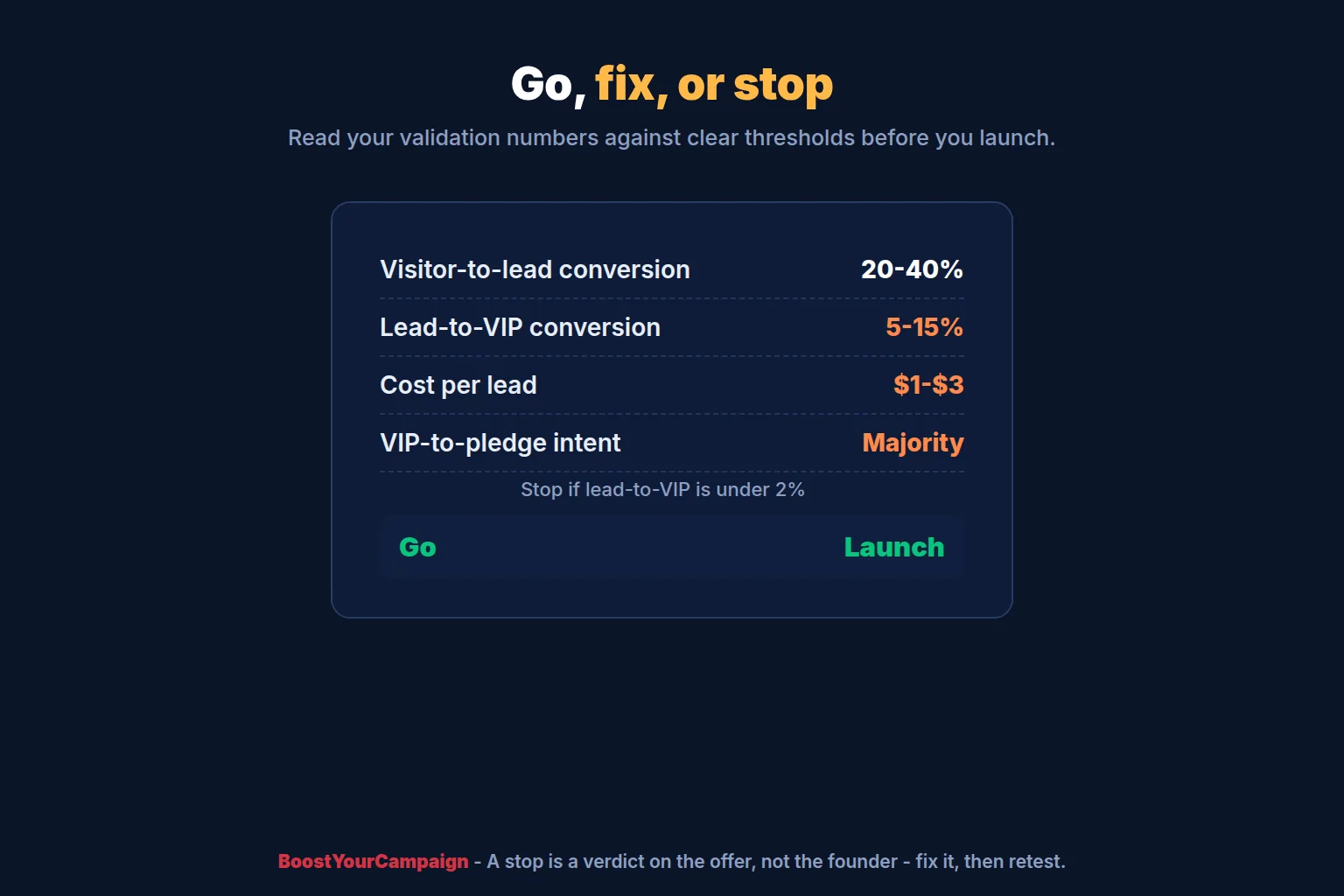
Numbers only help if they lead to a decision, so set the thresholds before the test runs, not after. A metric inside the healthy range is a go. A metric below it but not collapsed is a fix-it signal worth another round. A metric at or below the warning line is a stop, at least at the current price or audience.
| Metric | Go | Fix | Stop |
|---|---|---|---|
| Visitor-to-lead conversion | 20-40% or higher | 10-20%, retest headline | Under 10% after retest |
| Lead-to-VIP conversion | 10-30% or higher | Under 10%, retest price and offer | Under 10% after retest |
| Cost per lead | $1-$3, stable at scale | $3-$8, narrow audience | Climbing past $8 |
| VIP-to-pledge intent | Majority intend to back | Mixed, mostly "maybe" | Mostly non-answers |
A stop is not a verdict on the founder, it is a verdict on the current offer. Most stops get fixed by changing the price, sharpening the message, or narrowing the audience, then retesting at the same budget rather than scaling into a weak signal. If the numbers still do not move, take that seriously - a soft pre-launch rarely gets better once ad spend and public attention pile on top. Our guide to what happens if a Kickstarter fails covers what that outcome costs a founder.
8) The mistakes we see
The same mistakes show up across nearly every founder who arrives at us after a soft or failed launch, each a version of skipping a real test for a comfortable one. Validating with friends and family tops the list - their approval predicts nothing about strangers. Counting followers or email signups as demand is the second: a list is reach, not proof.
The third is specific to hardware and design: launching on a prototype video that promises features or specs the current build does not actually have. Backers and platforms both treat that gap harshly once it surfaces, and it surfaces constantly. The fourth is skipping the price test entirely and picking a number from margin math alone, which tells you the price you need, not whether the market will pay it.
9) How validation feeds the launch
Validation and pre-launch list-building are the same work read two different ways. Every email and deposit collected during testing becomes the actual list a campaign launches to, and roughly 90% of the backers who pledge in the first 48 hours come from people already on that list. The go/fix/stop decision in section 7 is really about whether that list is warm enough to fund a campaign fast, since platform algorithms reward early momentum and bury campaigns that limp out of the gate. A validated list of a few thousand warm leads and a few hundred paid reservers beats a larger list built without any test of intent. Our pre-launch checklist covers the runway from validation through launch day, and our day-1 revenue and conversion benchmarks guide shows what a validated list should translate into.
10) When you need an MVP first
A landing page test can validate demand, price, and message for most physical products with nothing more than a rendering or a prototype behind it. It cannot validate a software product or anything where the actual behavior of the product, not interest in the idea, is the risky assumption. If your riskiest question is "will people use this and come back" rather than "will people pay for this concept," a landing page test alone will not answer it - you need a working MVP real users can act on.
An MVP built for validation looks nothing like a finished product: it is scoped to the one assumption that matters most, built in weeks, and instrumented so every action produces a real data point. We build these in 4-6 weeks at fixed pricing starting from $2,500, and hand over full code ownership. Our MVP development service and the MVP page cover how that build is scoped around validation.
How BoostYourCampaign fits
We run paid audience tests before agreeing to a launch date, not after. An agency that gets paid regardless of the numbers has little reason to tell a founder to wait, and a founder who has already told friends about a launch date has every reason to talk themselves into a soft signal. We use a skin-in-the-game ad model, putting our own money alongside the client's ad budget with fixed fees, not a percentage of the raise, which keeps our incentive pointed at the numbers a founder should watch.
Since 2010 we have run more than 4,600 campaigns and raised over $734M+ for creators, with a 4.9/5 score across 300+ verified reviews, and reading pre-launch numbers honestly is a large part of that track record. We build the page, run the tests, read results against the thresholds in this guide, and tell founders plainly when a launch date should move. See the full range on our services page, or book a strategy call.
Validation checklist before you commit to a launch date
- A pre-launch landing page is live and has run paid traffic long enough for a reliable number.
- Visitor-to-lead conversion is in the 20-40% range, or you have retested the headline and audience.
- A $1 to $25 reservation step is live and lead-to-VIP conversion is at or above 10%.
- You have tested at least two price points against real reservation behavior, not just margin math.
- You have tested at least two headlines or hooks and picked a winner by conversion, not opinion.
- Cost per lead is stable or falling as spend scales, not climbing past $5-$8.
- Audience results are broken down by interest group, country, and age band, not one blended number.
- Qualitative feedback is weighted below any signal that involved a real payment.
- If the product needs working software to test real behavior, an MVP exists and is producing data.
- The go/fix/stop table has been applied honestly, including to metrics you hoped would pass.
Frequently Asked Questions
How do you validate a product before Kickstarter?
Run a pre-launch landing page behind a small paid ad test and measure visitor-to-lead conversion against a 20-40% benchmark. Add a $1 to $25 reservation step and measure lead-to-VIP conversion against a 10-30% benchmark. Test price and message separately, then read results against go, fix, or stop thresholds before setting a launch date.
What is crowdfunding product validation?
Testing, with real strangers and real money, whether a product has enough demand, the right price, a reachable audience, and a message that converts, before you commit to a launch date. It differs from proving the product can be built, which is what a prototype does.
How much does it cost to validate a Kickstarter idea?
A basic landing page and ad test can run for a few hundred dollars, starting around $20 a day per ad set for three to four days per test. A fuller sprint with a reservation step, price testing, and message testing typically runs into the low thousands over four to eight weeks. An MVP build starts around $2,500 at fixed price.
How many email leads do I need to validate demand?
Demand validation needs a representative list, not a huge one. A few hundred to a couple thousand leads from well-targeted paid traffic is enough to read visitor-to-lead and lead-to-VIP rates reliably. Launch list-size targets scale higher with your funding goal, but validation is about the rate, not the raw count.
What conversion rate proves a product will fund?
No single rate proves funding alone, but a landing page converting 20-40% of visitors to leads, combined with a lead-to-VIP rate of 10-30% or higher, is a strong signal that offer, price, and audience are working together. A lead-to-VIP rate under 10% is the clearest warning sign that the offer needs work.
Can I validate a product without a prototype?
Yes, for most physical products a rendering or concept image is enough to run a landing page and ad test, since you are testing whether people respond to the idea and price, not whether the build is finished. A prototype becomes necessary once real usage, not just interest, is the risky assumption.
What is a Kickstarter smoke test?
The cheapest version of validation: a landing page with a product visual, a one-line value promise, and an email field, run behind a small amount of paid traffic to see whether strangers respond before you build anything further.
How long does product validation take before a launch?
A realistic sprint runs four to eight weeks: two weeks for the landing page and ad test, two weeks layering in the reservation step, two weeks testing price and message, two weeks to read results and decide.
If you want your validation numbers read against real launch data, and a launch date set only once the numbers say go, reach out through /contact and we will map the test plan for your product.
Want results like these for your campaign?
We've helped 4,600+ creators raise over $734M. Let's pressure-test your launch plan and find the highest-leverage fixes before you go live.
Talk to an expert →Get the free 87-step launch checklist
The exact pre-launch, live-campaign and fulfillment steps we use across 4,600+ launches. Free PDF, emailed instantly.
You're in - check your inbox. Open the checklist now ->