The days right after a campaign closes are the highest-value window most creators never use. If you want a plan for keeping sales moving while rewards are still in production, talk with BoostYourCampaign about your post-campaign phase.
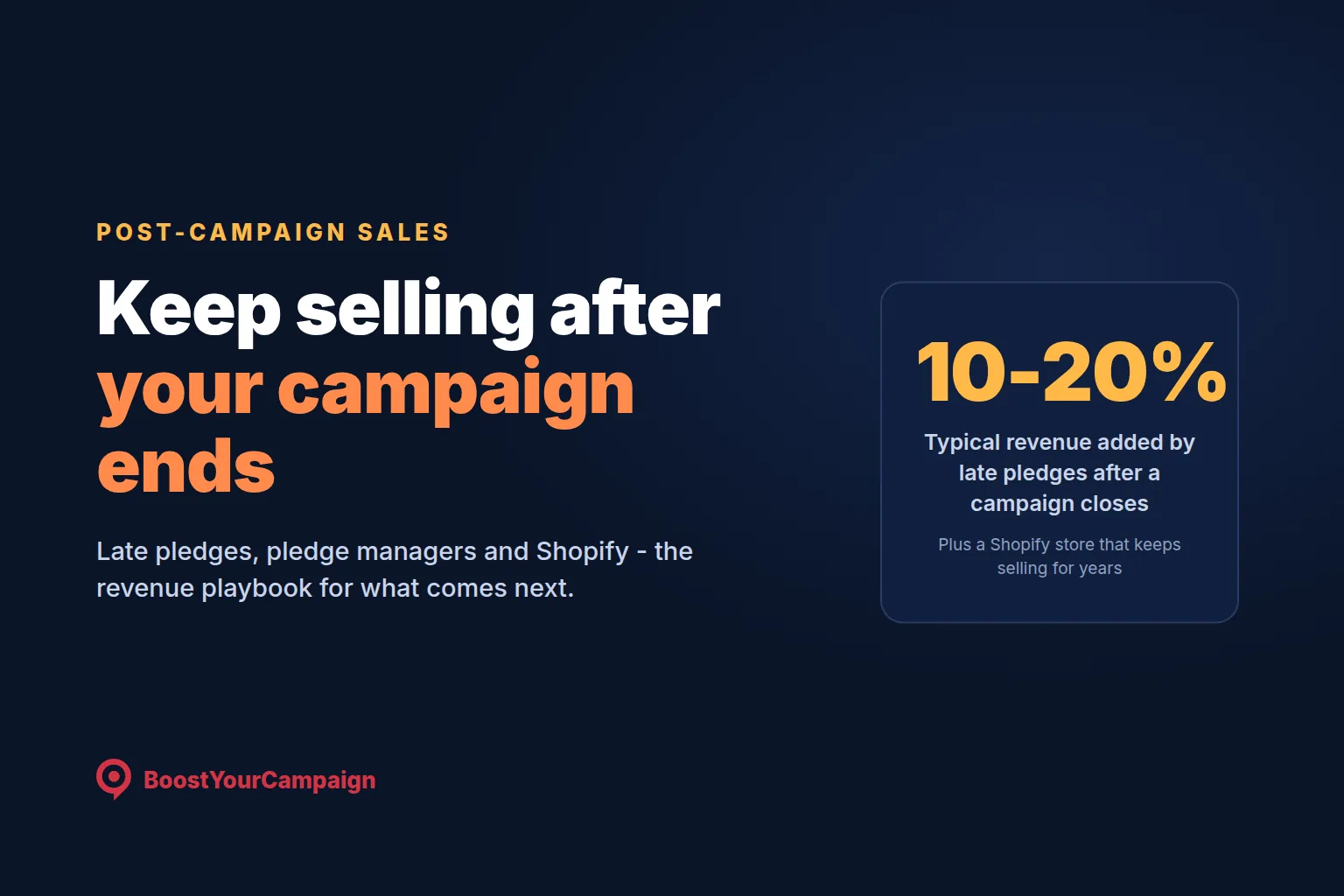
Once a Kickstarter or Indiegogo campaign closes, open late pledges within one to two weeks while the campaign page still has traffic and your buyers are still watching for updates. Late pledges typically add roughly 10-20% to the total raise, and a strong one can occasionally add more. The three real channels for post-campaign sales are platform late pledges, a pledge manager pre-order store like BackerKit, and an owned Shopify store, and most brands end up running two of the three at once rather than picking a single one.
- The momentum window closes fast - open late pledges within one to two weeks of your campaign ending, before campaign page traffic and buyer attention fade.
- Late pledges add real money - typically 10-20% on top of the raise, sometimes more for a product with strong word of mouth.
- Three channels, not one - platform late pledges, pledge manager pre-orders, and an owned Shopify store each serve a different kind of buyer.
- Fees differ meaningfully by channel and platform - Indiegogo's Late Pledge fee runs 5% for Indiegogo-origin campaigns versus 8% for Kickstarter-origin ones.
- Ads don't have to stop - campaign audiences that were warming up when the clock hit zero are still buyable traffic for weeks after close.
- The backer list is a launch asset - it's the single best audience you'll have for a second product, not just a support list for the first one.
1) The momentum window: why the first two weeks matter most
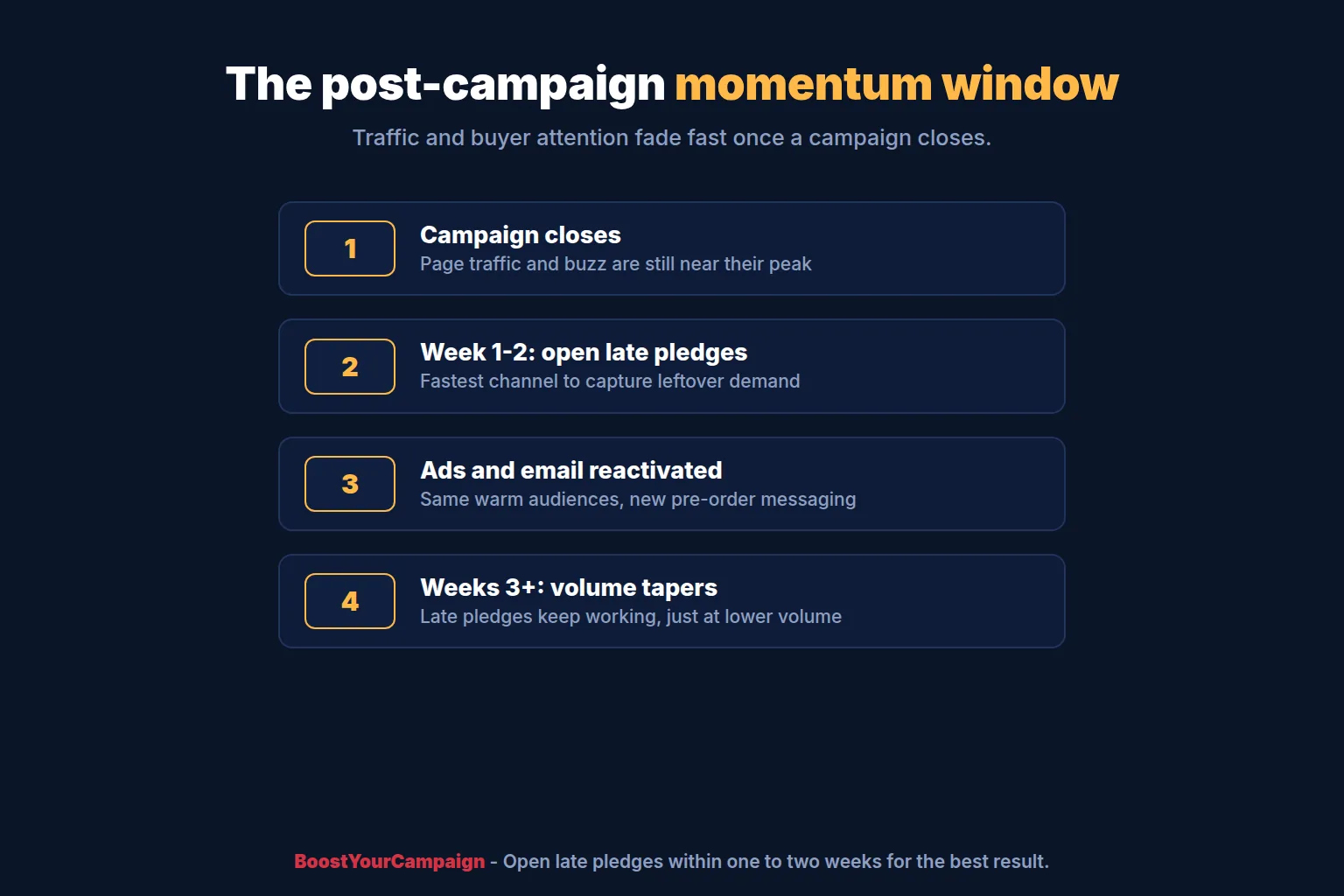
A funded campaign doesn't stop getting traffic the moment the countdown hits zero. Kickstarter and Indiegogo both keep funded projects visible - in category listings, in search, in the "recently funded" sections buyers browse - for weeks after close. Backers who were on the fence, and new visitors who find the page through search, are still landing there and still willing to pay if there's a way to do it. The mistake most creators make is closing the page mentally the moment funding ends, when the traffic curve hasn't actually dropped off yet.
Open late pledges within one to two weeks of the campaign closing. Every week you wait, page traffic and the "just funded" buzz decay further, and buyers who would have converted immediately move on to the next thing in their feed. There's also a practical reason to move fast: your reward tiers, production timeline, and pricing are all still fresh in your head and in your update history, so relaunching a pledge option is mostly a settings change, not a new campaign to plan.
The window doesn't close entirely after two weeks - late pledges and pre-orders keep working for months in smaller volume - but the first two weeks are where the bulk of the additional revenue shows up, because that's where the leftover campaign traffic and the freshest word of mouth both live. Waiting until rewards have shipped to reopen sales, which some creators do out of caution, throws away most of this window for no real benefit.
2) The three channels compared
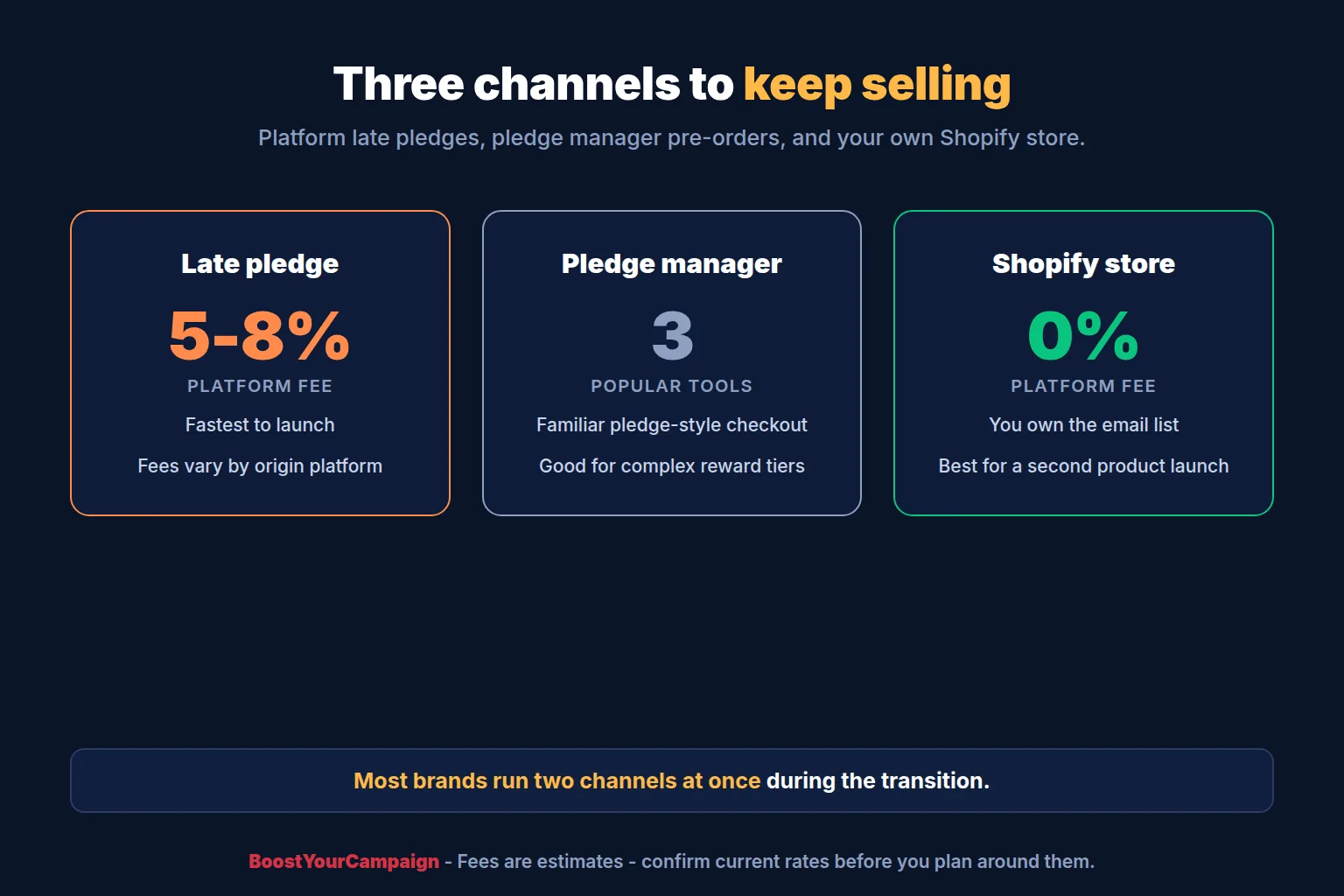
Platform late pledges are the fastest to turn on and the easiest for buyers to find, because they live right on the page that's already getting traffic. Kickstarter's late pledge option lets funded creators keep accepting pledges after the deadline, processed through the same Kickstarter checkout backers already trust. Indiegogo's equivalent is the Late Pledge (formerly called InDemand) option, which functions as an ongoing pre-order channel after a campaign ends. Indiegogo prices Late Pledge differently depending on where the campaign started: roughly 5% for a campaign that launched on Indiegogo, versus roughly 8% for one that launched on Kickstarter and is using Late Pledge as a secondary channel. That fee gap is worth knowing before you assume Late Pledge costs the same no matter where you started.
Pledge manager pre-order stores - BackerKit, PledgeBox, and Gamefound are the most common - sit between the platform and your own site. They give you a dedicated storefront that still looks and feels like a pledge experience, with the add-on and upsell tooling many creators already used to run their reward survey. Buyers coming from campaign updates and email tend to convert well here because the experience is familiar. The tradeoff is that you're still inside someone else's platform and fee structure, even if it's a different one than Kickstarter or Indiegogo charges.
An owned Shopify store is the only option where you keep the full customer relationship: the email address, the purchase history, and the ability to remarket without going through a platform's rules. It takes more setup - product pages, shipping profiles, tax registration - but nothing about it depends on the crowdfunding platform staying favorable to post-campaign sales. Our companion guide, Shopify store after crowdfunding: the setup guide, walks through building this specific piece step by step, including backer data import and email flows.
| Channel | Speed to launch | Fees | Who owns the customer |
|---|---|---|---|
| Kickstarter late pledge | Fastest - a settings change on an existing page | Platform and processing fees on every pledge | Kickstarter - limited contact detail |
| Indiegogo Late Pledge (formerly called InDemand) | Fast - built into the existing campaign | Roughly 5% for Indiegogo-origin, 8% for Kickstarter-origin | Indiegogo - limited contact detail |
| Pledge manager pre-order (BackerKit, PledgeBox, Gamefound) | Moderate - needs a store build inside the tool | Platform fee on the pre-order transaction | Shared - better contact data than the platform alone |
| Owned Shopify store | Slower - full store build required | Shopify plan plus payment processing only | You - full email list and purchase history |
3) A decision framework by product type and audience
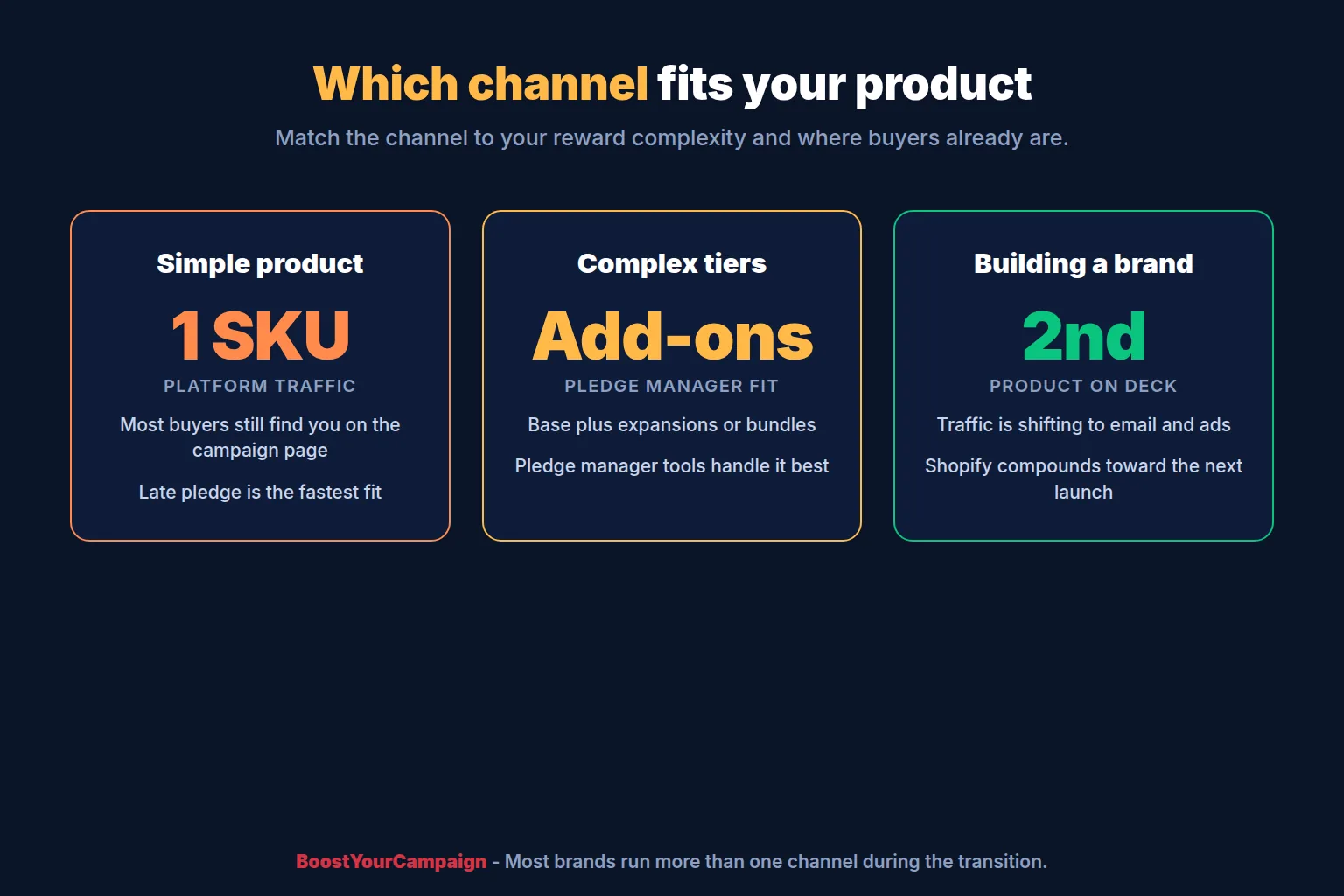
The right channel mix depends on where your buyers are coming from and how complex your reward structure is. A campaign with a simple, single-SKU product and most of its traffic still coming from the platform's own discovery tools gets the most value from a fast platform late pledge, because that's where the buyers already are. A tabletop or gadget campaign with a complicated tier structure - base game plus expansions, or a device with multiple color and bundle options - tends to fit a pledge manager pre-order better, since that's the tool built for exactly that kind of add-on-heavy checkout.
A brand planning a second product, or one whose traffic is shifting from platform discovery to email and paid ads within the first couple of weeks, should prioritize the Shopify store even if it takes a little longer to launch, because that's the channel that compounds. A late pledge or pledge manager sale is a one-time transaction with limited data returned to you; a Shopify sale builds the list and purchase history you'll use for the next launch.
Most established creators don't pick one and stop. The common pattern is: platform late pledge opens immediately for continued page traffic, pledge manager or Shopify pre-order opens within the same one to two week window for email and ad traffic, and the late pledge option eventually closes once the Shopify store is fully live and can absorb all new demand on its own.
4) Keeping ads running on your campaign audience
Ad accounts don't have to go quiet when the campaign clock hits zero. The audiences you built during the campaign - video viewers, landing page visitors, engagement on your ad creative - are still usable custom audiences for weeks after close, and they're warmer than anything you'd build from scratch for a brand-new store. Shifting ad spend from "back this campaign" messaging to "pre-order now" or "shop the store" messaging, aimed at the same audiences, is usually a straightforward creative swap rather than a new campaign build.
The return on this spend tends to be strong precisely because you're not paying to introduce the product to a cold audience again - you're paying to remind a warm one that it's still available. Letting ad accounts sit idle during the first two weeks after close is one of the more avoidable ways campaigns leave money on the table.
5) Email list monetization
Your backer and campaign-follower email list is the highest-converting audience you have during this window, and it needs a specific sequence, not a single blast. A close-out email announcing the late pledge or pre-order option, sent within days of the campaign ending, captures the buyers who were still deciding when the deadline hit. A second email a week or two later, timed to any manufacturing or shipping update, re-engages anyone who didn't act on the first message. If you're running a Shopify pre-order in parallel, route this traffic there directly rather than splitting attention between two checkouts.
Segment the list where you can. Backers who already paid don't need another sales pitch - they need shipping updates and a reason to buy an add-on or a second unit. Followers who never backed are the actual sales audience for the late pledge or pre-order push, and they should get messaging built around urgency and proof (reviews, unboxing content) rather than a repeat of the original campaign pitch.
6) Retail and Amazon, later
Retail and Amazon distribution both reward a product with a track record - reviews, a stable supply chain, and proven demand - which a campaign alone doesn't fully establish. Most creators are better served treating retail and Amazon as the third phase, after late pledges and pledge manager sales have run their course and the Shopify store has enough order history and reviews to support a marketplace listing or a retail buyer conversation. Going to Amazon too early, before reviews exist and before fulfillment is dialed in, tends to produce a listing that looks unproven next to established competitors.
When you do get there, the same warehouse inventory that served backers and Shopify customers should be able to serve Amazon FBA or seller-fulfilled orders without a separate logistics setup, which is one more reason to get the US/EU warehouse question settled early rather than rebuilding fulfillment for each new channel.
7) Using the backer list as a launch asset for product two
The backer list from a first campaign is one of the most underused assets in crowdfunding. It's not just a support list for the first product - it's a pre-qualified audience of people who already paid for something you made, which is exactly the audience a second product launch needs. Creators who stay in touch with that list through the post-campaign period, rather than going quiet once rewards ship, routinely see a meaningfully faster and cheaper launch the second time around, because a chunk of day-one demand is already warm.
This is also the strongest argument for building the Shopify store early rather than relying only on platform late pledges: a platform pledge doesn't hand you a reusable email list the way a Shopify order does. If a second product is anywhere on your roadmap, the store isn't optional infrastructure, it's the asset that makes the next launch cheaper.
8) Revenue math: what late pledges and pre-orders actually add
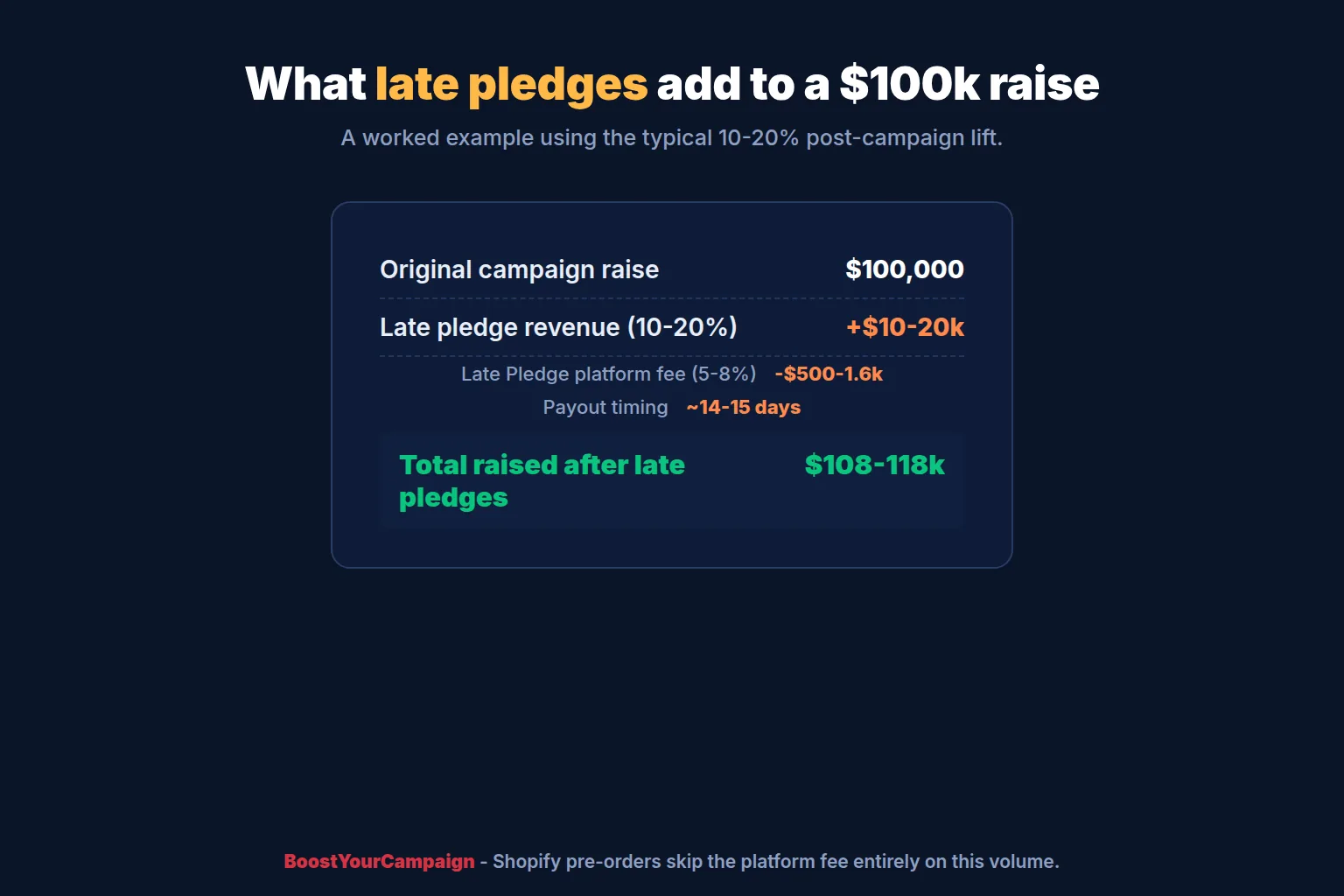
Take a campaign that raised $100,000. A typical post-campaign push through late pledges and pre-orders adds roughly 10-20% on top of that, which works out to somewhere around $10,000 to $20,000 in additional revenue, collected in the weeks after the original deadline with essentially no additional ad spend for the platform-side traffic. A campaign with strong word of mouth, active ad retargeting, and a well-run email sequence can occasionally push past that range, though 10-20% is the range to plan around rather than assume you'll beat.
Remember that fees come out of this number before it's real profit. Indiegogo's Late Pledge (formerly called InDemand) charges roughly 5% for Indiegogo-origin campaigns and roughly 8% for Kickstarter-origin ones, on top of standard payment processing. A Shopify pre-order avoids that platform fee entirely, paying only standard payment processing, which is part of why the revenue math favors shifting volume to an owned store once it's ready. Either way, payout timing matters for planning: Kickstarter pays out roughly 14 days after a campaign closes, and Indiegogo pays out within roughly 15 business days, so build your production and cash flow plan around those windows rather than assuming funds land the day the campaign ends.
Run the same math against your own numbers before you assume the range applies evenly across every campaign. A $30,000 campaign with a small, highly engaged backer group might see a late pledge push closer to the top of the 10-20% range, because a small list is easier to reach with a personal, well-timed email. A $500,000 campaign with a broad, less engaged backer base can still add a large dollar amount even at the lower end of that range, simply because the base number is bigger. What both have in common is that the additional revenue costs very little to generate compared with the original campaign - most of the audience, the creative, and the trust already exist, so the marginal cost of capturing another 10-20% is mostly the time it takes to open the channel and send the emails.
It's also worth planning for the shipping and fulfillment cost that comes with this additional volume, not just the incremental revenue. A late pledge or pre-order buyer still needs a box packed and shipped, and if your fulfillment plan was sized to your original backer count, an extra 10-20% in orders can strain a tight production run or a warehouse that wasn't expecting the additional volume. Building a small buffer into your manufacturing order, and confirming with your fulfillment partner that the added volume fits inside the existing plan, avoids turning a revenue win into a shipping bottleneck a few weeks later.
How BoostYourCampaign fits
BoostYourCampaign runs the post-campaign phase as a continuation of the campaign itself, not a separate project handed off to someone else. Our team keeps ad accounts live on campaign audiences, helps set up late pledges or a pledge manager pre-order store, and builds the Shopify store and email flows that turn the backer list into a lasting business - all backed by fulfillment from our own US and EU warehouses so the same inventory serves backers, pre-order buyers, and eventual Amazon orders without a second logistics setup. See our ecommerce service page and our broader services overview for the full scope.
We've supported this exact transition since 2010, across 4,600+ campaigns with $734M+ raised and a 4.9/5 score across 300+ verified reviews. For the fulfillment side of the post-campaign window specifically, see our Kickstarter fulfillment guide, Indiegogo fulfillment guide, and fulfillment services overview, and for platform comparison background, our Kickstarter vs Indiegogo guide and 2026 fee breakdown.
Post-campaign sales checklist
- Late pledges or Late Pledge (formerly called InDemand) opened within one to two weeks of campaign close.
- Decision made on which of the three channels - platform, pledge manager, or Shopify - fits your product and audience.
- Ad accounts shifted from campaign messaging to pre-order or shop-now messaging on the same warm audiences.
- Close-out and follow-up emails scheduled to the full list, segmented between backers and non-backing followers.
- Shopify store roadmap set, even if it launches a few weeks after the platform late pledge goes live.
- Fulfillment plan confirmed for the added volume, including the US/EU warehouse split if you sell internationally.
- Backer list treated as a reusable asset, with a plan to stay in touch through to product two.
Kickstarter's own installment and pledge-manager features are covered in Pledge Over Time and the built-in pledge manager, and BackerKit's pre-order layer in the BackerKit crowdfunding guide.
Frequently Asked Questions
What should I do after my Kickstarter campaign ends?
Open late pledges within one to two weeks while campaign page traffic is still strong, keep your ad accounts running on campaign audiences, and start planning a Shopify store if you want to own the customer relationship past the platform. Waiting weeks to do any of this loses most of the momentum from a successful launch.
How much revenue do late pledges typically add?
Roughly 10-20% on top of the original raise is the typical range, so a $100,000 campaign might add $10,000 to $20,000 through late pledges and pre-orders. A product with strong word of mouth and active retargeting can occasionally exceed that range, but it's not the number to plan around by default.
What is Indiegogo's Late Pledge, formerly called InDemand?
It's Indiegogo's built-in way to keep accepting pledges after a campaign closes, functioning as an ongoing pre-order channel. The fee is roughly 5% for a campaign that originated on Indiegogo, and roughly 8% for a campaign that originated on Kickstarter and is using Late Pledge as a secondary channel.
Should I use a pledge manager or my own Shopify store after the campaign?
A pledge manager like BackerKit, PledgeBox, or Gamefound fits products with complex reward tiers and buyers who expect a familiar pledge-style checkout. A Shopify store takes more setup but gives you the full customer email and purchase history, which matters most if you're planning a second product. Many creators run both during the transition.
Can I keep running Facebook or Google ads after my campaign ends?
Yes. The custom audiences built during the campaign - video viewers, page visitors, engaged users - are still usable for weeks after close and tend to convert better than a cold audience, since they've already seen your product story once.
When should I move from crowdfunding to Amazon?
After late pledges and pre-orders have run their course and your Shopify store has real order history and reviews. Amazon and retail both reward a proven track record, and launching there too early, before reviews exist, tends to produce a weak listing next to established competitors.
How long does it take to get paid after a campaign closes?
Kickstarter typically pays out roughly 14 days after the campaign closes. Indiegogo pays out within roughly 15 business days. Build your production and cash flow planning around those windows rather than assuming funds arrive immediately.
If you want help running late pledges, pre-orders, and a Shopify launch in the same window, reach out through /contact.
Want results like these for your campaign?
We've helped 4,600+ creators raise over $734M. Let's pressure-test your launch plan and find the highest-leverage fixes before you go live.
Talk to an expert →Get the free 87-step launch checklist
The exact pre-launch, live-campaign and fulfillment steps we use across 4,600+ launches. Free PDF, emailed instantly.
You're in - check your inbox. Open the checklist now ->