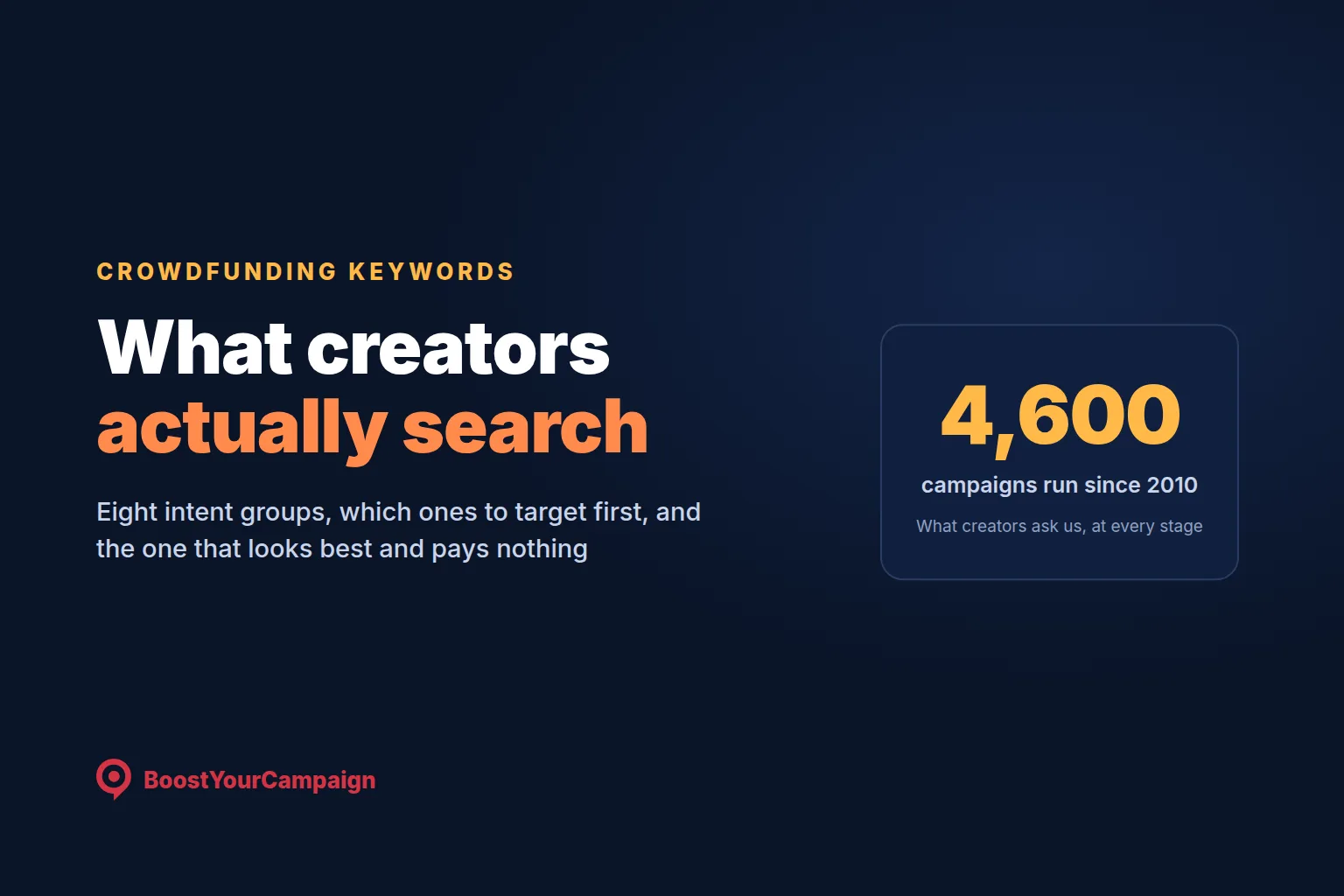
Search for "crowdfunding keywords" and almost everything you find is a list scraped from a keyword tool: a few hundred phrases with a volume number beside each, sorted by how many people supposedly type them every month. That is not useless, but it is not what a creator needs either, because it tells you what a tool estimates and nothing about which of those searches a small site can realistically win, or which ones bring someone who is about to fund a campaign rather than someone writing a school assignment about crowdfunding.
Crowdfunding keywords fall into eight intent groups, and they do not behave the same way. Commercial terms like "crowdfunding marketing agency" are the most heavily contested in the category and the hardest for a new site to win. Eligibility and rules questions are far less glamorous and bring in the most engaged readers. The pattern that matters most: long, specific, question-shaped searches are far easier to rank for than short head terms, and they are what AI assistants quote. Statistics keywords are the trap, because they attract volume that never clicks through.
1) Why keyword tools mislead crowdfunding creators
A keyword tool gives you an estimated monthly search volume and a difficulty score. Neither number tells you what happens when a real page on a real domain competes for that phrase, and in this niche the gap between the estimate and the reality is unusually wide for two reasons.
The first is that crowdfunding head terms are dominated by the platforms themselves. Search "kickstarter" and the top results are kickstarter.com. Search "indiegogo" and the same thing happens. A tool will report large volume on those terms and a difficulty score that looks beatable; in practice nobody outranks a platform for its own name, and the volume is worthless to you regardless because those searchers want the platform, not a supplier.
The second is that the commercial terms are the most heavily contested in the category. Every agency in crowdfunding publishes against those phrases, which is exactly why a keyword tool rates them highly and exactly why a creator or a newer site should not start there.
2) The eight intent groups that matter
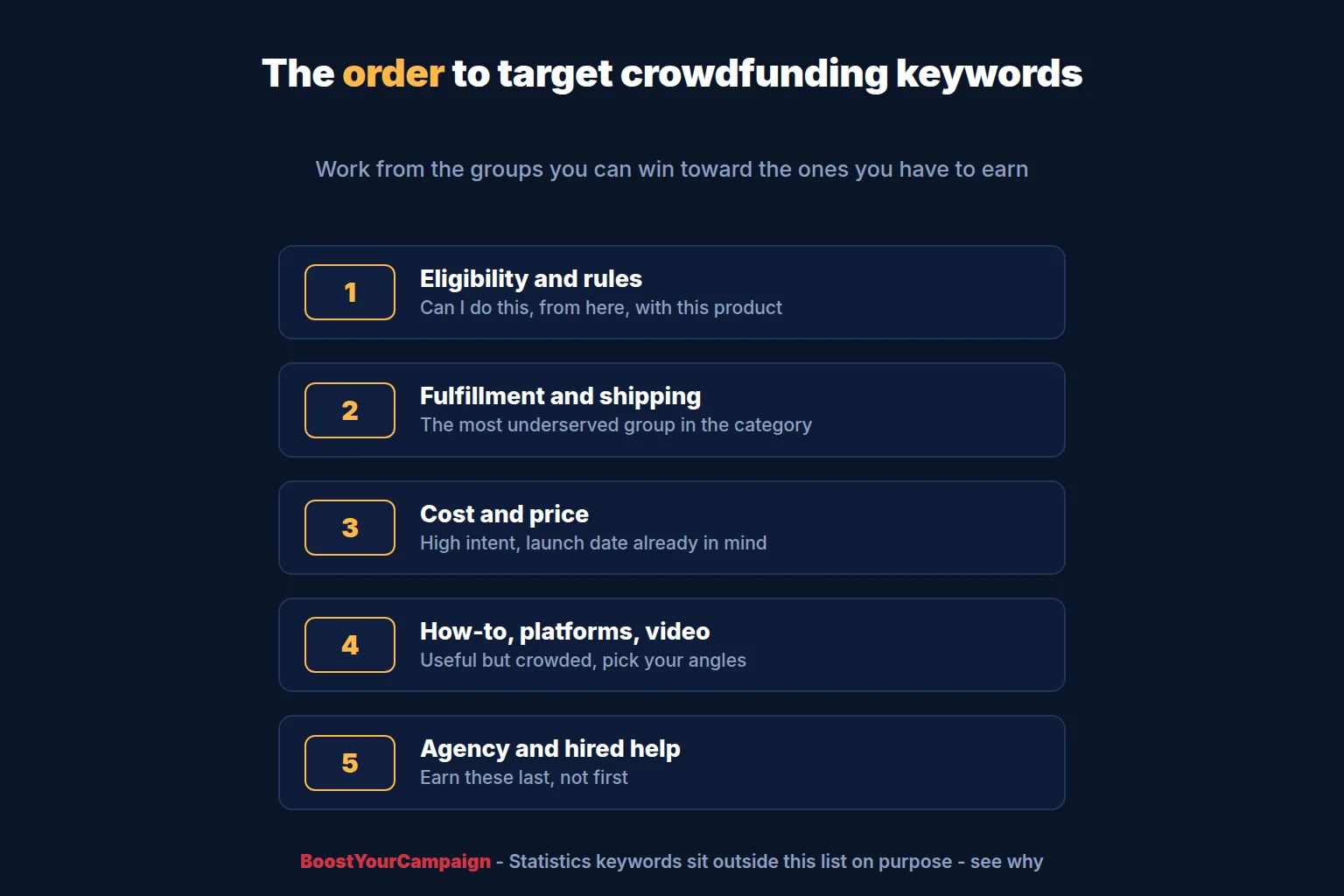
Group crowdfunding searches by what the person actually wants and eight clear patterns emerge. Which group a keyword belongs to tells you more about whether it is worth chasing than any volume estimate.
| Intent group | What the searcher wants | Worth targeting? |
|---|---|---|
| Eligibility and rules | Can I do this, from my country, at my age, with my product | Yes, start here |
| Fulfillment and shipping | What happens after funding, customs, VAT, pledge managers | Yes, most underserved |
| Cost and price | What a campaign costs to run and what help costs to hire | Yes, high intent |
| How-to and process | Step-by-step guidance, checklists, timelines | Yes, but crowded |
| Platform comparison | Kickstarter or Indiegogo or Gamefound, and why | Selectively |
| Video | Length, cost, structure, who makes it | Selectively |
| Agency and hired help | Who to pay to run the campaign | Earn it later |
| Statistics and benchmarks | Success rates, averages, how many campaigns fund | No, see below |
Two of those deserve expanding, because they are the ones most people get backwards.
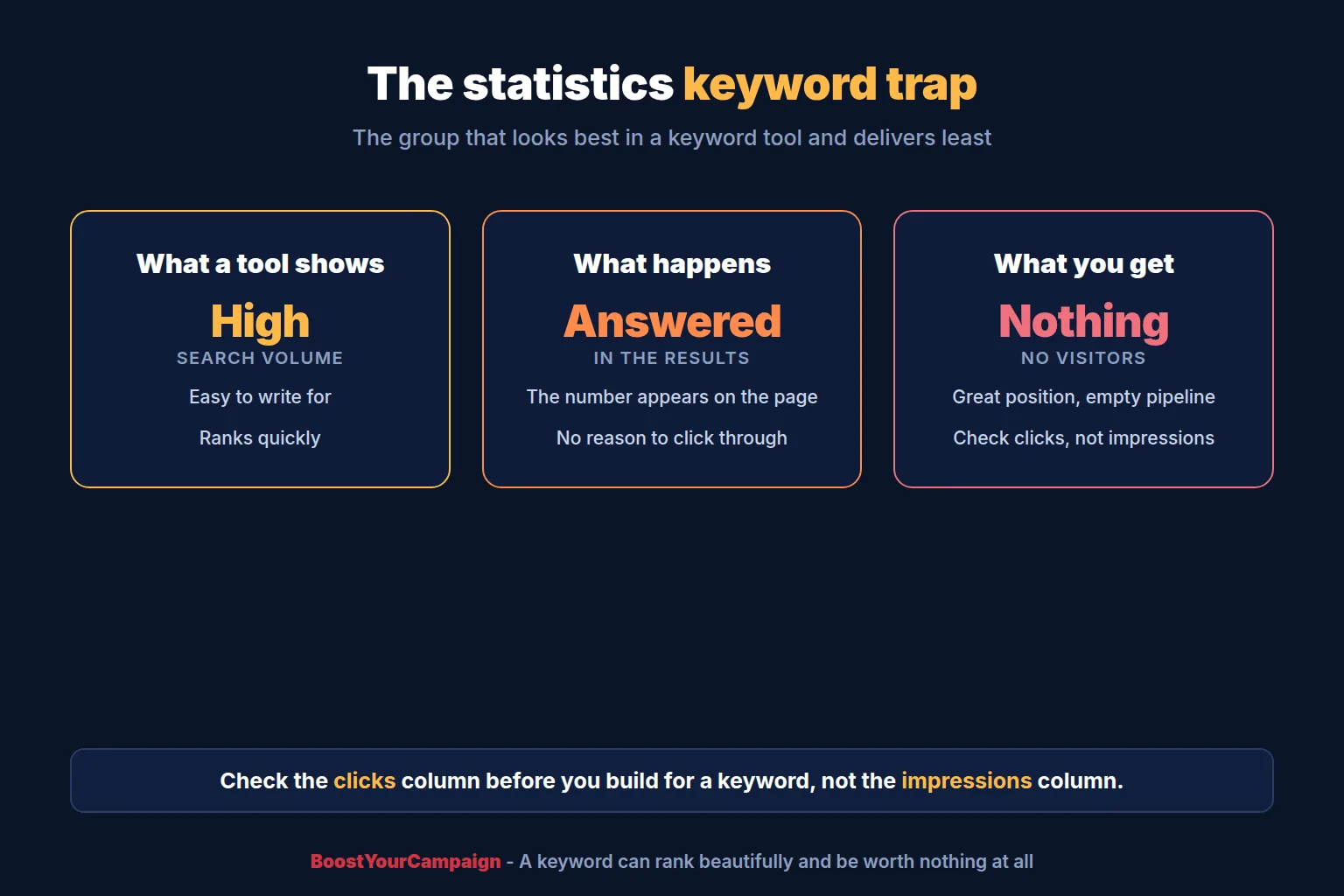
Statistics keywords are a trap. They look irresistible: high volume, easy to write for, and a page can rank well on them quickly. The problem is that someone searching for a crowdfunding statistic reads the answer directly in the search results and never arrives. Excellent ranking, no visitors. If you build a content plan around statistics keywords because the volume looks good, that is what you get.
Eligibility and rules questions are the opposite. Lower volume, unglamorous, and the most productive group in the set, because someone asking whether they can run a Kickstarter from their country has a specific problem and needs a real page to solve it.
Commercial terms are the hardest group in the category. Every agency in crowdfunding publishes against them. They are worth targeting, but they are what you earn once the rest of the site is working, not what you open with.
3) Long keywords are far easier to win than short ones
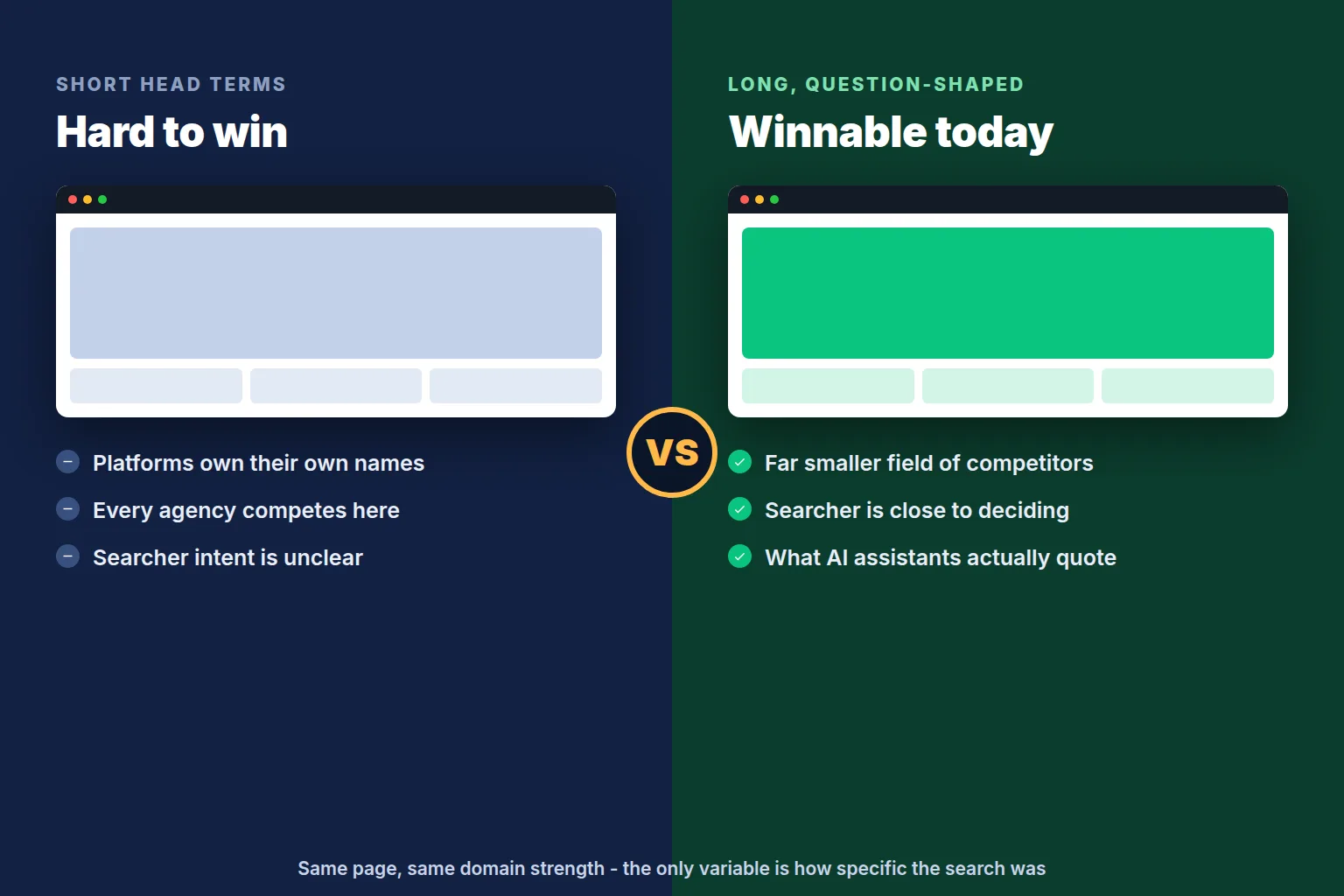
This is the clearest pattern in crowdfunding search and the easiest to act on. Short keywords like "crowdfunding" or "kickstarter agency" put you in a fight with the platforms themselves and with every established agency in the category. Long ones like "what are the best kickstarter pr agencies for a board game" put you in a much smaller field, against far weaker pages, and the person searching is considerably further along in deciding something.
The same effect shows up in phrasing. Searches that begin with how, what, when, why, which, can, do or should are consistently easier to rank for than the same idea compressed into a two-word keyword, on the same site with the same domain strength. The only variable is specificity.
There is a second reason this matters more than it used to. Assistants like ChatGPT, Perplexity and Google's AI summaries are fed by conversational, question-shaped searches rather than keyword strings. A page written to answer a real question in plain language is eligible to be quoted in those answers. A page built around a keyword string is not. The long tail stopped being a consolation prize.
4) The crowdfunding keywords worth targeting, by stage
Group your keywords by where the searcher is in their own project, not by search volume. A creator eight weeks from launch and a creator deciding whether to crowdfund at all need completely different pages.
Before deciding to crowdfund
Searches about whether crowdfunding is viable at all: eligibility by country, age requirements, what happens if a campaign fails, equity versus rewards, platform comparisons. High volume, low immediate commercial intent, and the group that brings in the most engaged readers. These are the pages that introduce someone to you months before they need help.
While planning a campaign
Cost, timeline, goal-setting, pre-launch strategy, video requirements, reward tier structure. These questions are specific enough that a genuinely useful page can win them, and the reader has a launch date in mind.
While looking for help
Agency, consultant, service and promoter terms. The hardest group in the category, and the one every competitor is fighting for. Worth building toward, not worth starting with.
After funding
Fulfillment, shipping costs, customs, VAT, pledge managers, late pledges, moving to an online store. Almost nobody writes well about it, because it is unglamorous and requires operational knowledge rather than marketing copy. The most underserved group in the category.
5) How to build your own keyword list without a tool
You do not need a subscription to do this properly. You need your own data and an hour.
- Open Google Search Console, go to Performance, then Search results, and set the range to the last three months. This is the only source that tells you what people actually searched before landing on your pages, rather than what a tool estimates.
- Export the queries and sort by impressions. Anything with impressions and a position between 11 and 30 is a page you already nearly rank for. Those are your first targets, not the head terms you wish you ranked for.
- Read the long queries, the ones of six words or more. They are written in the words your actual audience uses, and they are usually phrased as questions you can answer directly in a heading.
- Check the clicks column, not just impressions. A query with high impressions and zero clicks is either answered in the search results or attracting the wrong reader. Do not build a page for it without understanding which.
- Type your best candidates into ChatGPT or Perplexity and see who gets cited. If the answer quotes a competitor, that is the page you need to beat, and it tells you what a citable answer looks like on that topic.
If you have not launched yet and have no Search Console data of your own, borrow the structure above: build one page per stage, write them as answers to specific questions, and let the data tell you what to expand once it exists.
6) How we use this when we run a campaign
Keyword research is the first thing we do when a creator comes to us, and it is the reason our campaigns start building an audience months before launch rather than scrambling in the final fortnight. The order we work in follows the data above.
We start with the after-funding and eligibility groups, because those pages bring in creators early, while they are still deciding whether crowdfunding is right for them, and they convert far better than anything written for a commercial keyword. We build the planning group next, since those searches come from people with a launch date in mind. And we treat the commercial terms as something a site earns over time rather than something it starts with.
The same logic applies to your campaign itself. Roughly 90% of the backers who pledge in the first 48 hours come from a pre-launch email list, not from search, which means keyword work is what fills the top of that funnel in the months beforehand rather than what rescues a live campaign. If you want the full picture on how the two connect, our Kickstarter benchmarks guide has the conversion rates, and our crowdfunding statistics page has the funding data behind them.
If you would rather not spend three months learning which of these searches is worth chasing, that is the work we do for creators every week, and we do it with the data above rather than a tool subscription.
Frequently Asked Questions
What are the best crowdfunding keywords to target?
For a new or small site, the specific ones. Long, question-shaped searches are consistently easier to win than short head terms, because the head terms are contested by the platforms themselves and by every established agency. Eligibility and rules questions bring in the most engaged readers despite lower volume. Commercial terms like "crowdfunding marketing agency" are the hardest group in the category and the last ones to target.
Do keyword tools work for crowdfunding?
They are useful for discovering phrasings you had not thought of and useless for judging whether you can win a term. Crowdfunding head terms are dominated by the platforms themselves and the commercial terms by established agencies, neither of which shows up properly in a difficulty score. Use a tool to generate candidates, then use your own Search Console data to decide which ones to act on.
How many crowdfunding keywords should a campaign page target?
One primary intent per page. A campaign page itself is not really an SEO asset, because most Kickstarter traffic arrives from your own pre-launch list rather than search. Keyword work belongs on your own site, on the pages that bring people in months before launch, not on the campaign page.
Why do some pages rank well and get no clicks?
Because the search result answers the question without needing the click. This is most common on statistics and definition queries, where the number a searcher wants is displayed directly in the results. Check the clicks column in your own Search Console before assuming a high-impression keyword is worth building a page for.
Do crowdfunding keywords matter for AI search?
Question-shaped searches matter more than keyword strings. Assistants are fed by conversational queries, so a page written to answer a specific question in plain language is eligible to be cited in an AI answer where a keyword-optimised page is not. This is the single biggest change in how crowdfunding search works, and most keyword advice has not caught up with it.
Where this comes from
The groupings and patterns in this article come from running 4,600 Kickstarter and Indiegogo campaigns since 2010 and watching what creators search for at every stage of them, from the first "can I even do this" question through to customs paperwork eighteen months later. It is not compiled from a keyword tool, which is why the conclusions occasionally contradict what a tool would tell you.
If you are writing about crowdfunding search and want to use any of this, please do. Attribute it to BoostYourCampaign and link to this page so readers can see where it comes from.
Since 2010 we have run 4,600 Kickstarter and Indiegogo campaigns, and the audience work that fills a pre-launch list starts with knowing what your buyers actually search for. If you would rather build the product and have someone else do that, book a free strategy call and we will map the keywords worth owning for your category.
Want results like these for your campaign?
We've helped 4,600+ creators raise over $734M. Let's pressure-test your launch plan and find the highest-leverage fixes before you go live.
Book a free strategy call →Get the free 87-step launch checklist
The exact pre-launch, live-campaign and fulfillment steps we use across 4,600+ launches. Free PDF, emailed instantly.
You're in - check your inbox. Open the checklist now ->