Planning a Kickstarter or Indiegogo campaign from the UK? Talk with BoostYourCampaign about your product, target markets, and timeline.
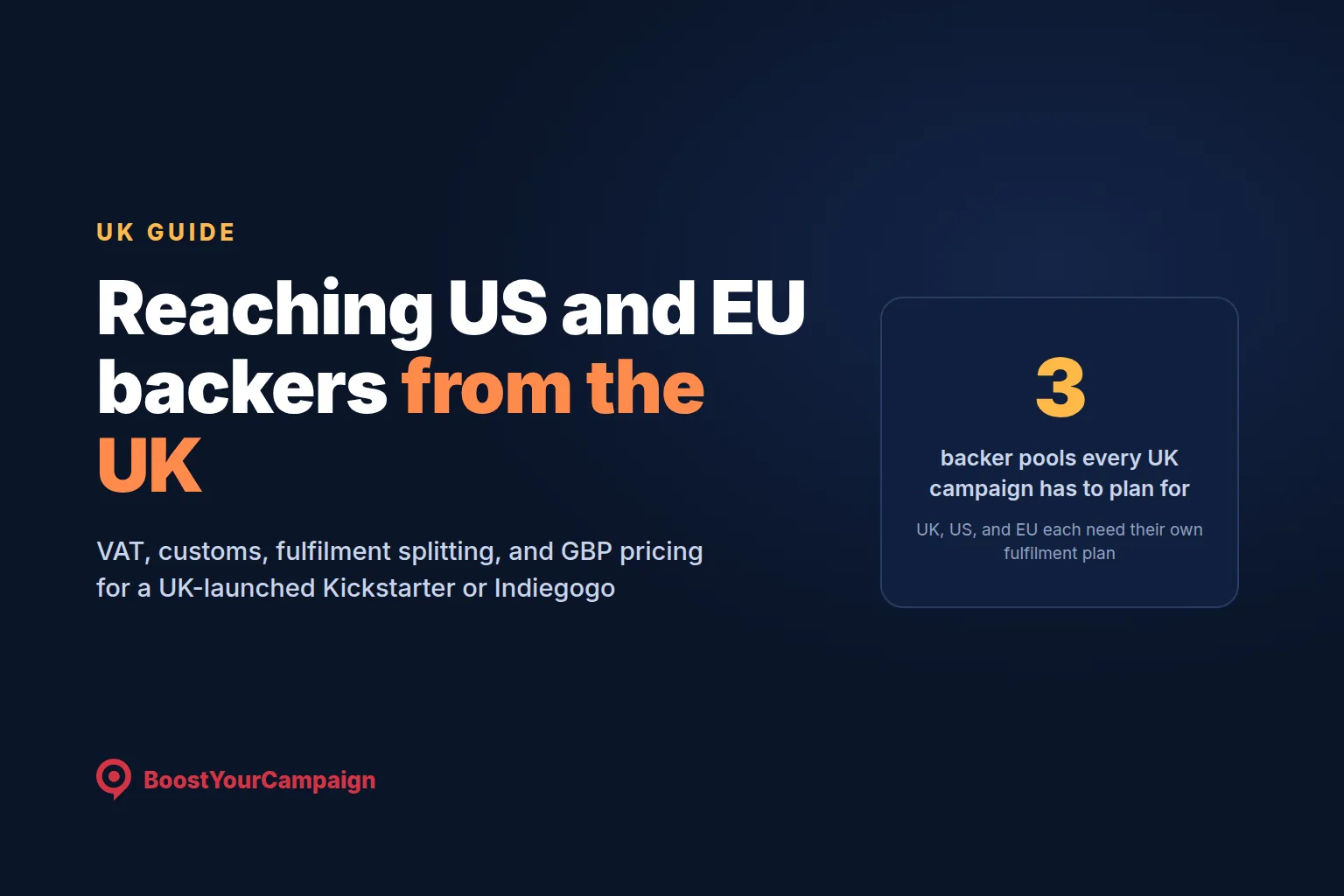
Brexit changed what a UK crowdfunding launch actually involves, even though most creators only notice once rewards start shipping. A UK creator sending a reward to a backer in Germany or France is now handling an export, with VAT and customs exposure on the EU side that simply didn't exist before January 2021. The fix most established UK creators land on is splitting fulfilment: stock held inside the EU for EU backers, and UK or US stock for everyone else, rather than shipping every parcel from a single UK address and hoping customs cooperates. Pricing, audience mix, and category strength all matter too, but the customs question is the one that catches new UK creators off guard.
- The EU side of your audience is now an export market - a UK-to-EU parcel carries VAT and customs exposure it didn't carry before Brexit.
- The US is usually still your biggest backer pool - the UK domestic audience matters, but it's rarely the largest group pledging.
- GBP pricing needs a US-facing translation - a campaign priced in pounds needs its value stated clearly for backers converting from dollars.
- Splitting fulfilment beats shipping from one address - EU stock for EU backers, UK or US stock for the rest, usually beats one warehouse serving three regions.
- The UK has real category strength - tabletop games, product design, and independent publishing all have an established UK track record on Kickstarter.
- Video doesn't have to mean a London studio day rate - an agency with owned production capacity can often beat sourcing a UK crew independently.
1) Post-Brexit reality: a UK-to-EU parcel is now an export
Before January 2021, a UK creator shipping a reward to a backer in Berlin or Amsterdam was moving goods within a single customs and VAT area. That's no longer true. A UK-based business shipping into the EU is now handling a genuine export, with the EU side treating the incoming parcel the same way it treats an import from any other non-EU country, the US or Japan included.
That shift is easy to miss for a first-time UK creator, because nothing about running the actual Kickstarter or Indiegogo campaign changed. The page still gets built the same way, backers still pledge the same way, and the difference only shows up once rewards are ready to ship, when a UK creator who assumed EU shipping still worked the way it used to finds VAT registration requirements, customs declarations, and potential duty charges sitting between "funded" and "delivered."
None of this makes an EU backer base a bad idea. It makes it a planning item that needs a decision before launch rather than a surprise during fulfilment, and our guide to shipping Kickstarter rewards to Europe covers the VAT and customs mechanics in more depth than this section can.
2) VAT, customs, and what a UK creator actually owes now
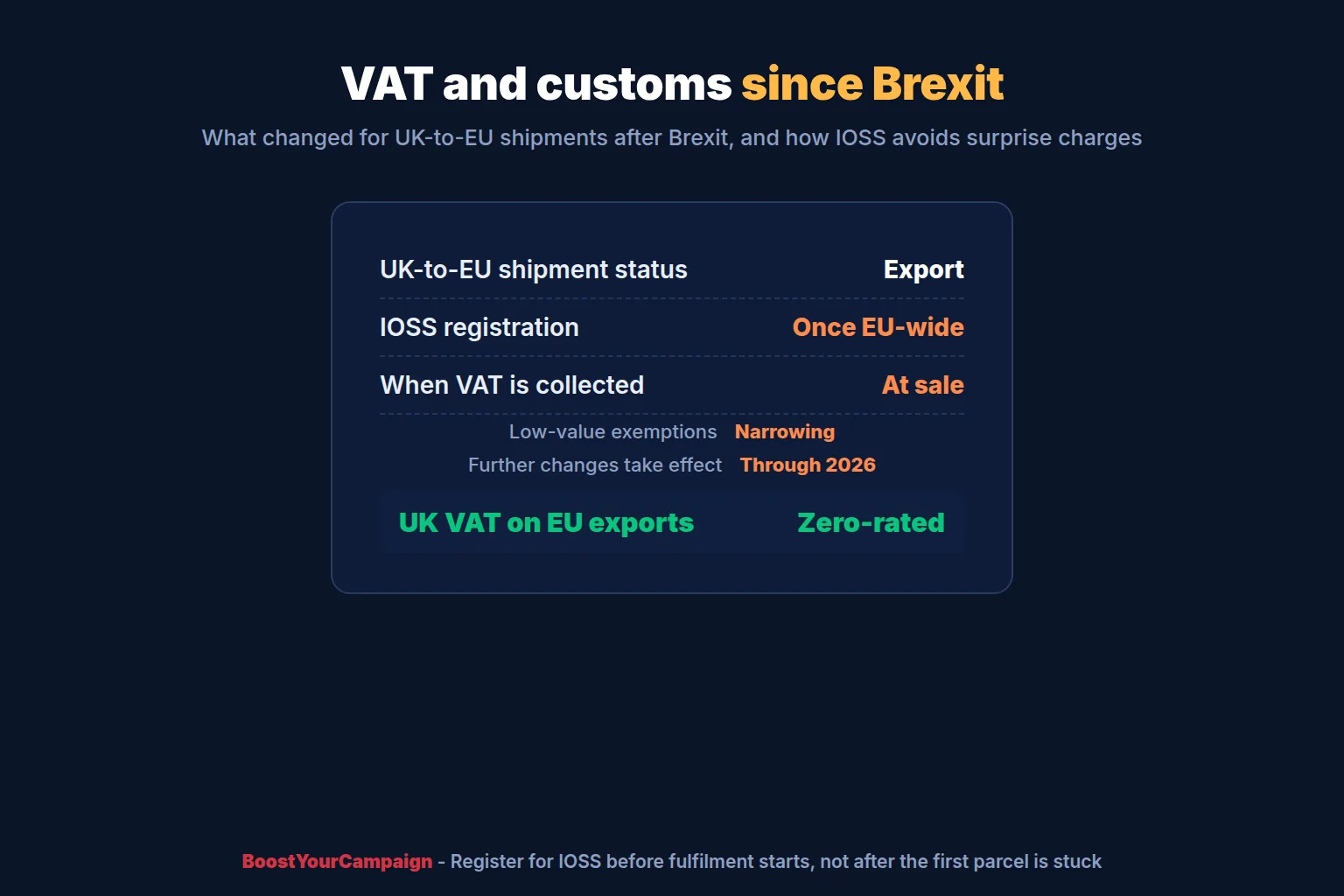
The EU's Import One Stop Shop scheme lets a non-EU seller, which now includes a UK-based creator, register once and collect VAT at the point of sale for lower-value shipments rather than leaving the backer to pay an unexpected charge when the parcel arrives. Registering ahead of a campaign's fulfilment window avoids the single most common complaint on EU-bound crowdfunding shipments: a backer getting hit with a surprise VAT and handling fee from the courier on delivery, on top of what they already paid to pledge.
The EU has also been narrowing the low-value exemptions that used to make small parcels simpler. Rules around duty-free thresholds for low-value goods have been tightening, with further changes affecting shipments under previous exemption levels taking effect through 2026, so a UK creator should check current EU customs guidance directly when setting reward pricing rather than relying on older assumptions about what clears duty-free.
On the UK side, exports to the EU are generally zero-rated for UK VAT purposes, but that doesn't mean there's nothing to file. A UK creator running meaningful EU volume should get a straight answer from an accountant experienced in cross-border ecommerce VAT before launch, not partway through fulfilment when the first EU shipment is already stuck in a customs queue somewhere in Rotterdam or Frankfurt.
3) Splitting fulfilment: EU stock for EU backers
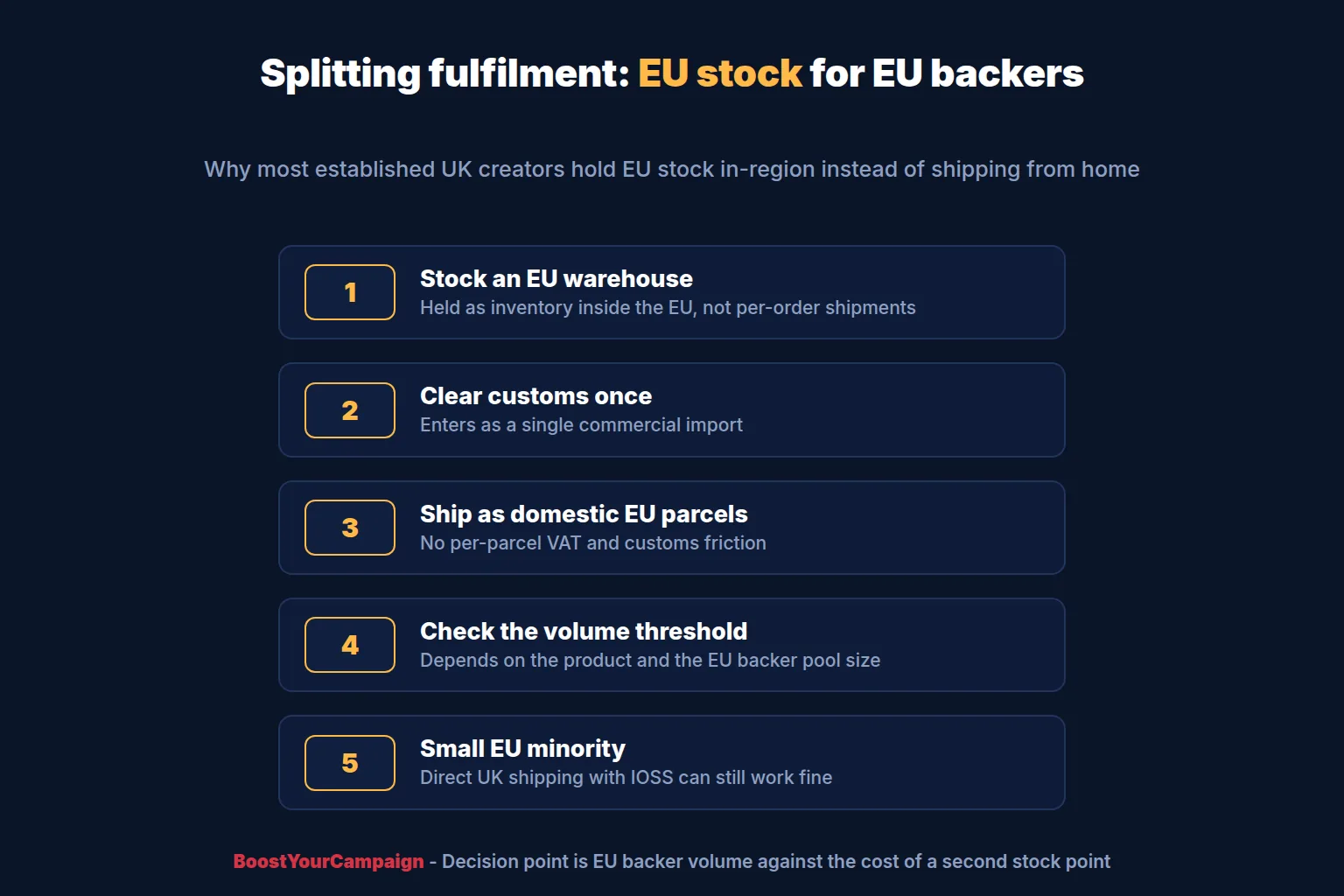
The practical answer most established UK creators land on is splitting fulfilment by region rather than shipping every reward from a single UK address. Stock held inside an EU warehouse clears customs once, as a single commercial import, then ships to individual EU backers as ordinary domestic parcels within the EU, avoiding the VAT and customs friction that comes with shipping thousands of individual low-value parcels across the UK-EU border.
This is the same pre-positioning model covered in our fulfillment companies guide, applied specifically to the UK-EU split. The volume needed to justify a dedicated EU warehouse leg depends on the product and the size of the EU backer pool, but for campaigns where EU pledges make up even a modest share of the total, in-region EU stock usually pays for itself in avoided customs delay and lower per-parcel shipping cost alone.
For campaigns where EU backers are a small minority, direct shipping from the UK with IOSS registration handled properly can still work fine. The decision point is EU backer volume relative to the extra cost and lead time of setting up a second regional stock point, not a fixed rule that applies the same way to every campaign.
4) UK or US stock for the rest of the world
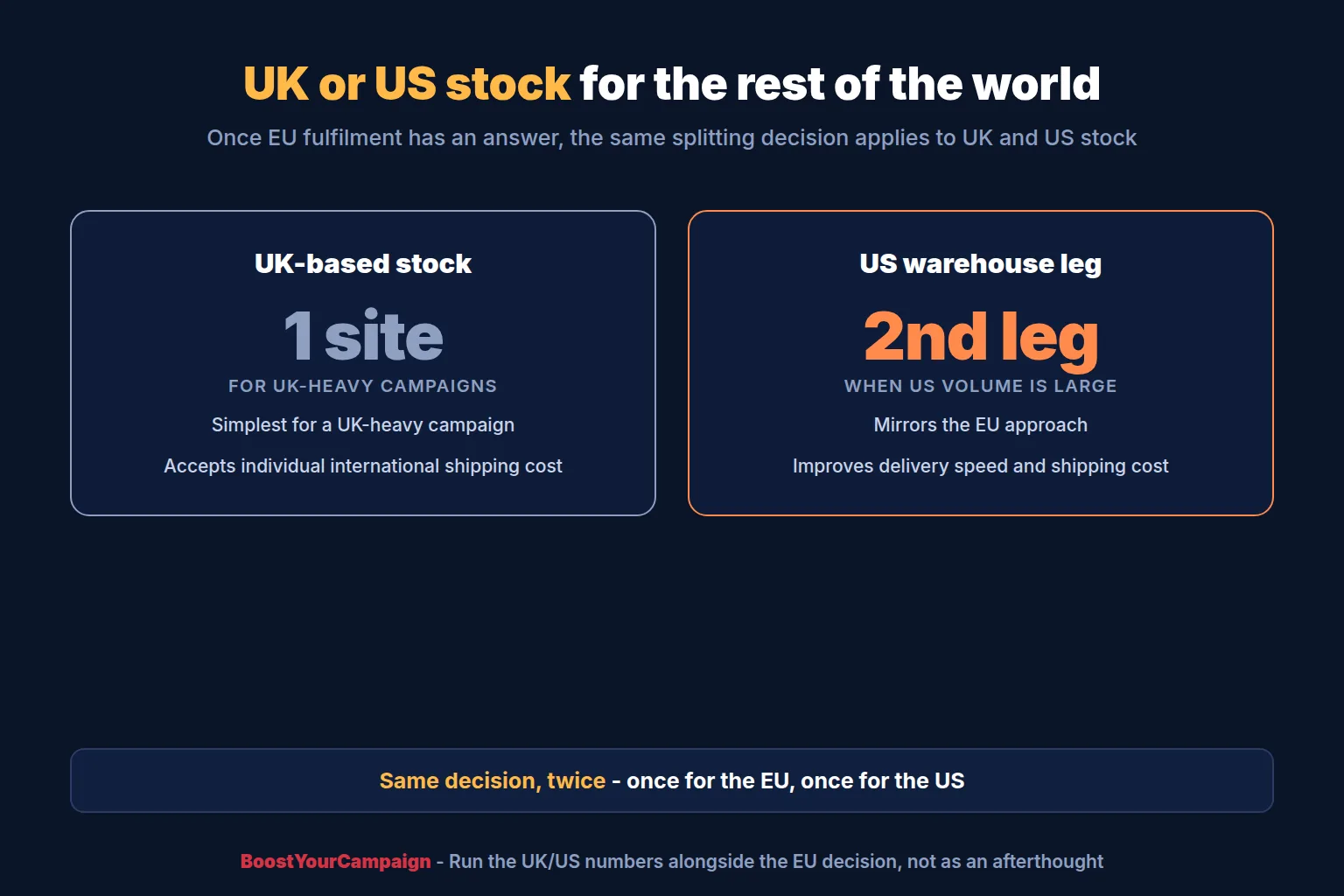
Once EU fulfilment has its own answer, the remaining question is where stock for UK and US backers should sit, since the US is usually the largest single backer pool on a UK-launched campaign. Shipping from the UK to US backers works, and for a UK-heavy campaign it's often simplest to keep US-bound stock in the same UK warehouse serving domestic backers, accepting individual international shipping cost and transit time.
For campaigns where the US backer count is large enough to matter on its own, a separate US warehouse leg, mirroring the EU approach, usually improves both delivery speed and shipping cost for that audience. This is effectively the same fulfilment-splitting decision UK creators already make for the EU, applied a second time for the US, and it's worth running the numbers on both at once rather than solving one region and treating the other as an afterthought.
What UK creators call "fulfilment" and US-based guides call "fulfillment" is the identical operational question either way: where does stock sit relative to the backer receiving it, and how many separate regional legs does the campaign's backer geography actually justify.
5) Where your backers actually sit: UK, US, and EU
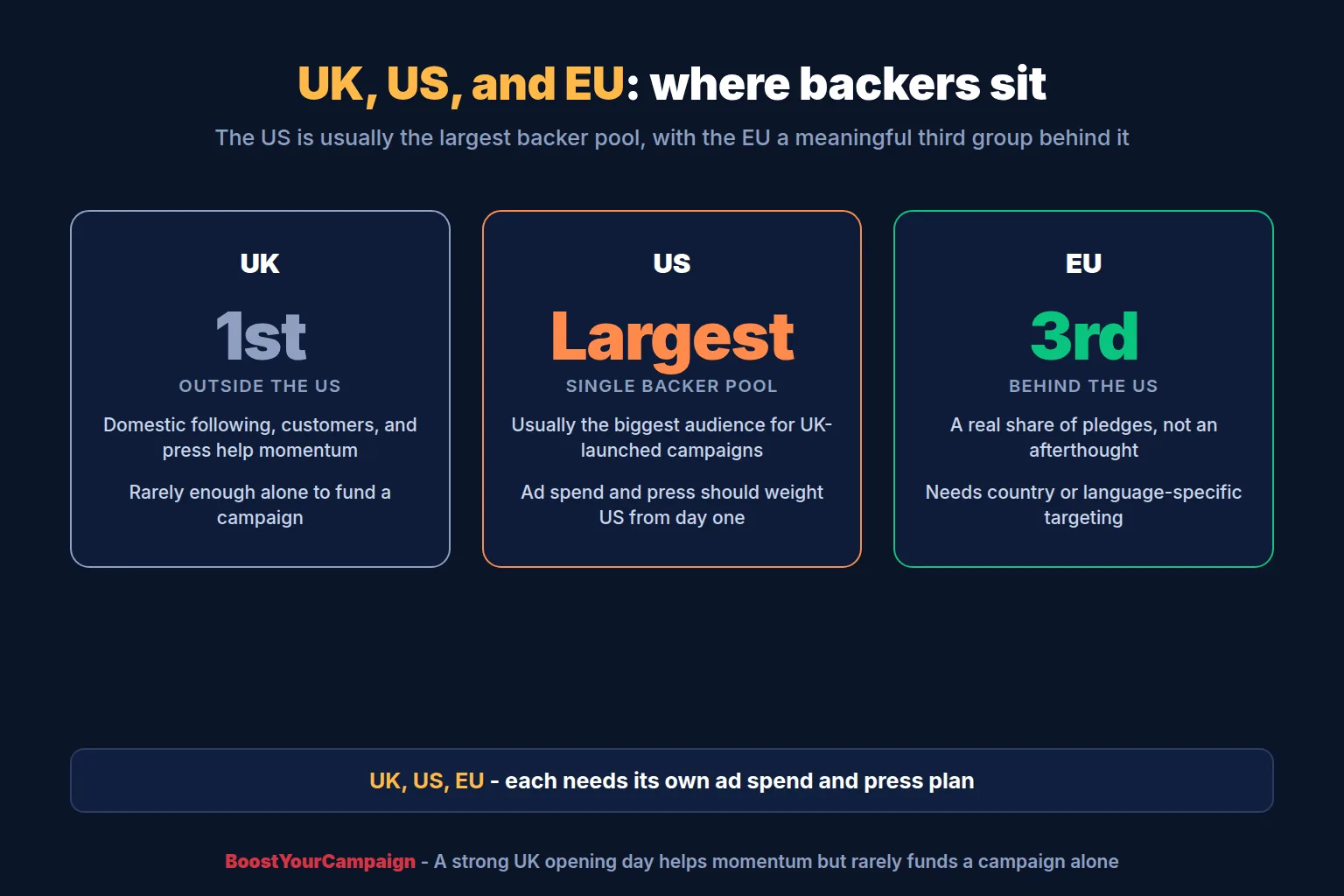
The UK is one of the more active countries on Kickstarter outside the US by most public measures, and a UK creator's domestic following, existing customers, local press contacts, genuinely helps in a way that creators from smaller or less crowdfunding-active countries don't get. But domestic backers alone rarely fund a campaign of any real size. The US remains the largest single audience for most UK-launched campaigns, with the EU making up a meaningful third group behind it.
That split should shape where ad spend goes from day one rather than defaulting to a UK-first buy that gets rebalanced once the campaign is already live. Press outreach follows the same logic: UK trade and consumer press matter, but US outlets covering the product's category usually reach a larger slice of the audience that actually funds the campaign.
None of this means UK backers don't matter. A strong UK opening day, particularly from an existing following, genuinely helps a campaign's early momentum and can influence how the platform's discovery algorithm treats it in the first 48 hours. It just shouldn't be the only audience the campaign is built for.
6) GBP pricing on Kickstarter and what it does to US backer conversion
Kickstarter runs a UK creator's campaign in GBP by default, which means every reward tier a US backer sees has already gone through a currency conversion the backer has to do mentally before deciding whether a price feels reasonable. Kickstarter shows an approximate USD figure alongside the GBP price, which helps, but it's still worth being deliberate about how tiers are set rather than picking round GBP numbers and letting the USD conversion land wherever it lands.
A reward priced at a clean £45 might convert to an oddly specific $57 or $61 depending on the exchange rate at any given moment, which reads less cleanly to a US backer than a price that was set with the USD conversion in mind from the start. Stating the approximate USD value directly in the reward description, rather than relying on Kickstarter's small conversion note, removes a small but real point of friction for the audience that usually makes up the largest share of pledges.
7) UK strength in tabletop, design, and publishing
The UK has a genuinely strong, established track record on Kickstarter in a handful of categories: tabletop games, product and industrial design, and independent publishing all have a real history of well-funded UK campaigns, backed by an active domestic community of backers, reviewers, and press who follow these categories closely. That's a real advantage worth leaning into if a product sits in one of these spaces.
Outside those specific categories, being UK-based carries less automatic weight, and a campaign should lead with the product and its actual value proposition rather than assuming "British-designed" or "British-made" does meaningful work on its own. It's a real asset in the categories where it applies and a neutral fact everywhere else, which is worth being honest about when setting expectations for a campaign.
8) London video production costs versus an agency's own studios
Campaign video is one of the largest line items in most UK creators' pre-launch budgets, and London day rates for a crew, studio space, and post-production can add up quickly for a small team trying to produce a polished campaign video on a first-time budget. Sourcing a UK production team independently is entirely workable, but it's worth pricing it out properly before assuming it's the cheaper path compared to working with an agency that already owns production capacity.
An agency running its own video studios spreads that fixed cost across many campaigns rather than pricing a single client for a one-off shoot, which can meaningfully change the math for a UK creator weighing a London freelance crew against a done-for-you production package that includes video as part of a larger campaign engagement rather than a separately billed line item.
9) Building a pre-launch list across three different backer pools
A UK creator building a pre-launch audience is effectively building three separate lists at once: a UK list that's usually the easiest to reach given existing local following and press contacts, a US list that typically needs to be built close to from scratch through paid social, and a smaller EU list that benefits from country or language-specific targeting rather than treating "Europe" as one audience.
Skipping the US and EU list-building work because the UK following is already strong is a common early mistake. A campaign that opens well domestically but has done no work to reach US and EU audiences ahead of launch often sees a strong first day followed by a noticeable slowdown once the domestic list is exhausted, right when the platform's discovery algorithm is paying closest attention to momentum.
How BoostYourCampaign fits
BoostYourCampaign has run full-stack crowdfunding campaigns since 2010, combining marketing, video production, and fulfilment under one roof rather than leaving a UK creator to coordinate separate vendors across three regions. Owned fulfillment warehouses in both the US and EU give UK creators a direct route to the region-split fulfilment model this guide describes, without having to source and manage separate warehouse partners in each market individually.
Owned video production studios in the US and EU also mean campaign video doesn't have to be sourced and billed separately from a UK crew; it's part of the same engagement. BYC's ad model puts its own money into the campaign budget alongside the client's spend, with fixed fees rather than a percentage of what the campaign raises, and the agency holds Indiegogo Approved Agency status along with Google Premier Partner, Facebook Marketing Partner, official Shopify Partner, and Amazon Partner recognitions. Since 2010, BYC has worked across more than 4,600 campaigns raising over $734 million combined, with a 4.9 out of 5 rating across more than 300 verified reviews on the reviews page.
BYC also offers in-house MVP development for products still being finalized (/services/mvp-development) and has helped clients secure retail introductions to major retailers including Best Buy. Some client products have gone on from a BYC-run launch to Shark Tank coverage, documented on the press page, and the agency has a video testimonial from Kevin O'Leary on the reviews page. See this pricing guide for cost context while comparing agencies.
Before you launch from the UK: a quick checklist
| Question | Why it matters |
|---|---|
| Is IOSS registration handled for EU-bound rewards? | Post-Brexit, UK-to-EU shipments are exports subject to VAT and customs rules that didn't apply before 2021. |
| Is fulfilment split by region, or shipped from one UK address? | EU stock for EU backers, and UK or US stock for the rest, usually beats one warehouse serving three regions. |
| Does ad spend reflect that the US is usually the largest backer pool? | A UK-first ad buy underweights the audience that typically drives most pledges. |
| Are GBP reward tiers set with the USD conversion in mind? | An oddly specific converted price reads less cleanly to US backers than a tier planned around it. |
| Has an accountant confirmed UK export VAT treatment for the campaign? | UK exports are generally zero-rated but still require correct filing and documentation. |
| Is pre-launch list building happening in the US and EU, not just the UK? | A strong UK opening day alone often can't sustain momentum through the full funding period. |
For the document-by-document view of post-Brexit exports, see customs documentation for crowdfunding shipments, and for the per-parcel math, Kickstarter shipping costs with real US and EU examples.
Weighing a UK or European platform instead of Kickstarter? Our guide to Kickstarter alternatives in Europe compares Ulule, Verkami, Startnext, Crowdcube and Crowdfunder UK on fees, funding rules and audience.
Frequently Asked Questions
Does Brexit stop a UK creator from launching on Kickstarter or Indiegogo?
No. The UK remains a fully supported country on both platforms for creators. Brexit changed the customs and VAT treatment of shipping rewards into the EU, not a UK creator's ability to launch and run a campaign.
Do UK creators need to register for EU VAT?
Generally yes, if shipping rewards to EU backers. The EU's Import One Stop Shop scheme lets a UK-based creator register once and collect VAT at the point of sale for eligible shipments rather than leaving backers to pay an unexpected charge on delivery.
Should a UK campaign price in GBP or USD?
Kickstarter runs UK-based campaigns in GBP by default. Since the US is usually the largest backer pool, it's worth setting reward tiers with the USD conversion in mind and stating the approximate USD value directly in the reward description.
Is it worth setting up a separate EU warehouse for a UK campaign?
It depends on EU backer volume. For campaigns where EU pledges make up even a modest share of the total, in-region EU stock usually pays for itself in avoided customs delay and lower per-parcel cost compared to shipping individually from the UK.
How does Indiegogo's Late Pledge phase apply to UK creators?
Late Pledge, formerly called InDemand, lets a campaign keep taking orders once the main funding window has closed. UK creators use it the same way as anyone else, and it's often worth timing against whatever fulfilment split, UK, US, or EU, is already set up rather than treating it as a separate logistics problem.
Is London video production worth it compared to using an agency's studios?
It depends on budget and the specific crew. London day rates for a full crew and post-production add up quickly for a first-time campaign, and an agency with owned production capacity can often deliver comparable quality as part of a broader campaign engagement rather than a separately billed shoot.
What's the biggest mistake UK creators make with pre-launch marketing?
Relying on an existing UK following without building US and EU audiences ahead of launch. A strong domestic opening day often can't sustain momentum once that list is exhausted, right when the platform's discovery algorithm is paying closest attention.
For a direct read on whether your VAT, fulfilment, and pricing plan are ready for a US/EU audience, reach out through /contact.
Want results like these for your campaign?
We've helped 4,600+ creators raise over $734M. Let's pressure-test your launch plan and find the highest-leverage fixes before you go live.
Book a free strategy call →Get the free 87-step launch checklist
The exact pre-launch, live-campaign and fulfillment steps we use across 4,600+ launches. Free PDF, emailed instantly.
You're in - check your inbox. Open the checklist now ->