Deciding between Kickstarter and a European platform? Talk with BoostYourCampaign about your product, your backer base, and which platform actually fits.
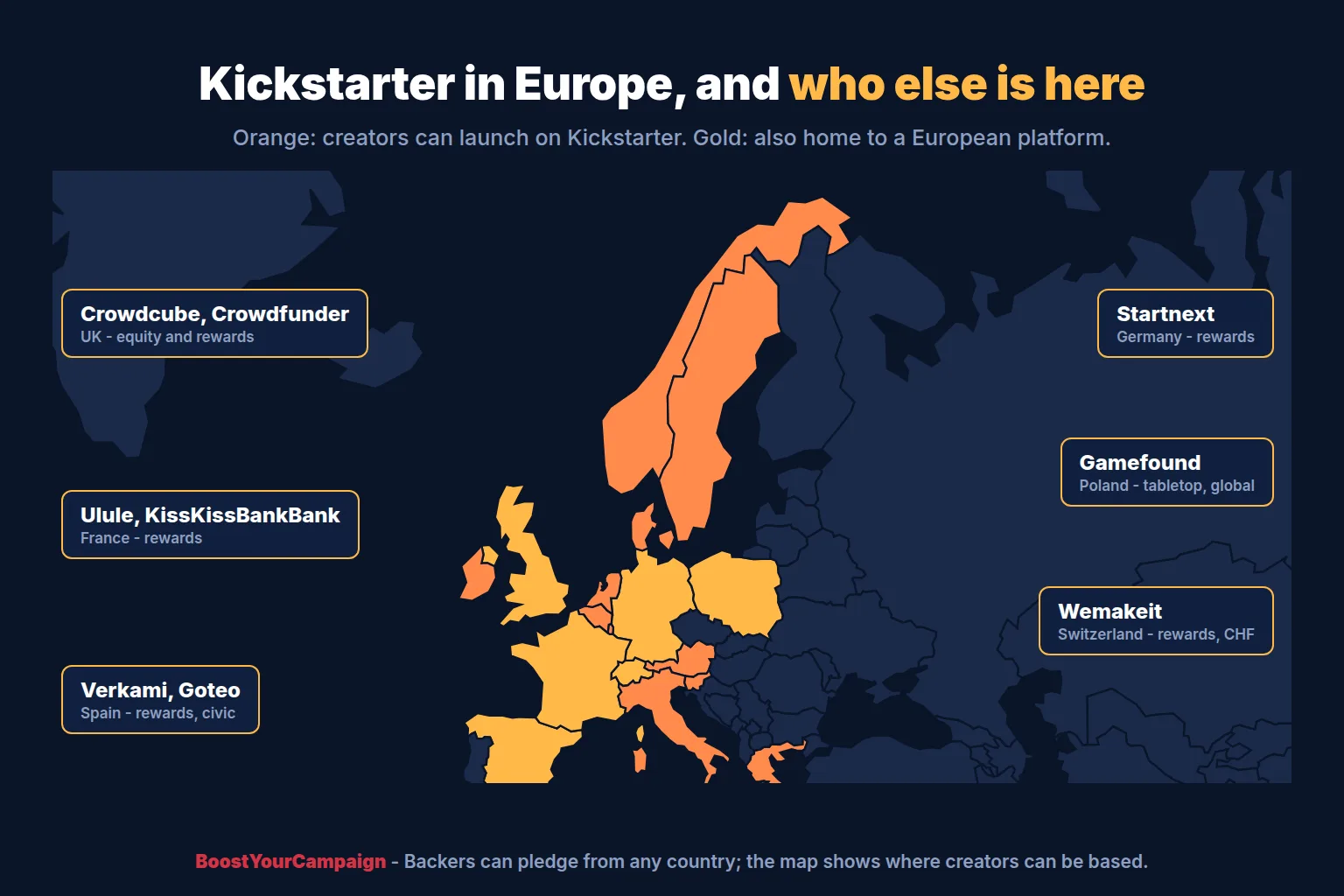
Kickstarter is available to creators in the UK, Ireland, France, Germany, Spain, Italy, and most of Western Europe, so "is Kickstarter available in Europe" has a straightforward yes for most countries. Creators still look at alternatives for local-language reach, payment methods, and category fit: Ulule in France, Verkami in Spain, Startnext in Germany, KissKissBankBank and Wemakeit for creative projects, Crowdcube and Crowdfunder UK for equity, and Gamefound for tabletop games. Kickstarter still wins on raw audience size and discovery, so the right call comes down to where your backers live and whether you want pre-orders or investors.
- Kickstarter works in most of Western Europe - the UK, Ireland, France, Germany, Spain, Italy, and more, though not every EU country is on the list.
- Local platforms win on language and payment methods - SEPA, iDEAL, and a French, Spanish, or German-first audience matter more than most creators expect.
- Each country has a platform that leads locally - Ulule in France, Verkami in Spain, Startnext in Germany.
- Equity crowdfunding is a separate track - Crowdcube and parts of Crowdfunder UK sell shares, not rewards.
- Kickstarter still leads on discovery - Projects We Love, category depth, and US backer volume are hard to match.
- Shipping into the EU needs its own plan - VAT, IOSS, and warehouse location change the backer's experience.
1) Is Kickstarter available in Europe?
Yes, for creators based in most Western European countries. Kickstarter supports creators launching from the UK, Ireland, France, Germany, Spain, Italy, the Netherlands, Belgium, Austria, Switzerland, Denmark, Norway, Sweden, Poland, Luxembourg, and Greece, among others, covering most countries with an established crowdfunding culture. A creator in Berlin, Barcelona, or Amsterdam can launch the same way a creator in Chicago or Toronto can.
The list is not every EU member state, though. Some Central and Eastern European countries are not on Kickstarter's supported list for creators, even though backers there can still pledge to any campaign - eligibility to launch depends on where the creator is based, not where backers live. If your country is not on the list, backers can still fund your project through a European platform, or you can incorporate through a supported one, covered in our Kickstarter eligibility guide.
One more detail trips up first-time European creators: a campaign runs in the creator's local currency, not automatically in USD. A UK creator runs it in GBP, a German or French creator in EUR, and Kickstarter shows an approximate conversion - worth planning around, since US backers still make up most pledges on a typical European campaign.
2) Why European creators still look at alternatives
If Kickstarter already works in most of Europe, the real question is why so many European creators still search for alternatives. Kickstarter is built around a large, English-first, US-heavy audience, and a handful of real gaps show up for creators whose product or backer base sits closer to home.
Language is the first gap: a page, video, and updates written in French, German, or Spanish reach a domestic audience with far less friction than a translated English page. Payment methods are the second: SEPA transfers and iDEAL, common ways European backers prefer to pay, sit more naturally on platforms built around European banking.
VAT and invoicing are a third reason - a European platform based in the creator's own tax jurisdiction can make invoicing and payout reconciliation simpler. Eligibility gaps close the loop for creators in countries Kickstarter does not support. And for some, the reason is cultural fit: a smaller, warmer community that already knows the platform can outperform a large, anonymous audience, particularly in publishing, culture, and craft categories.
3) Ulule: France's largest rewards platform
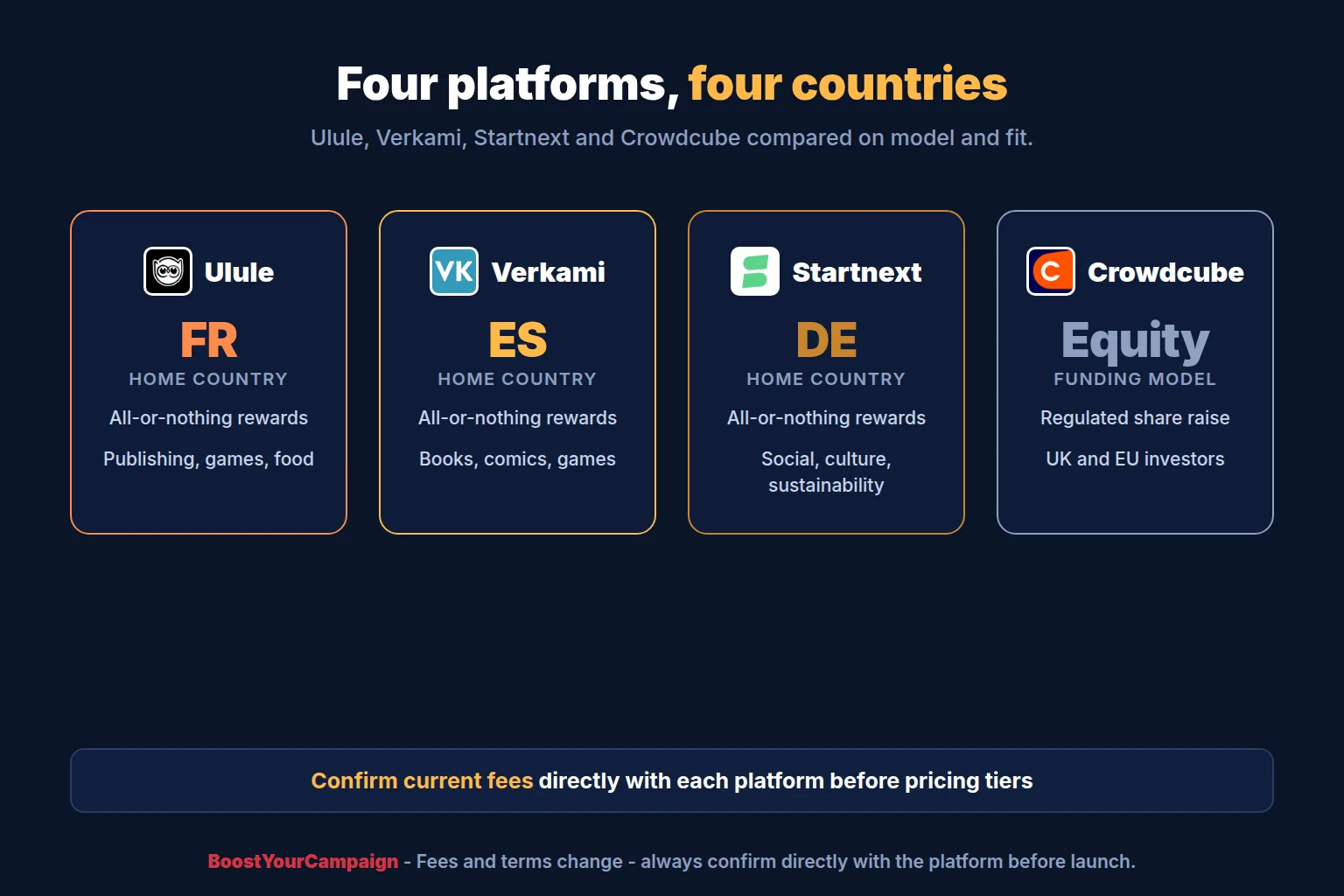
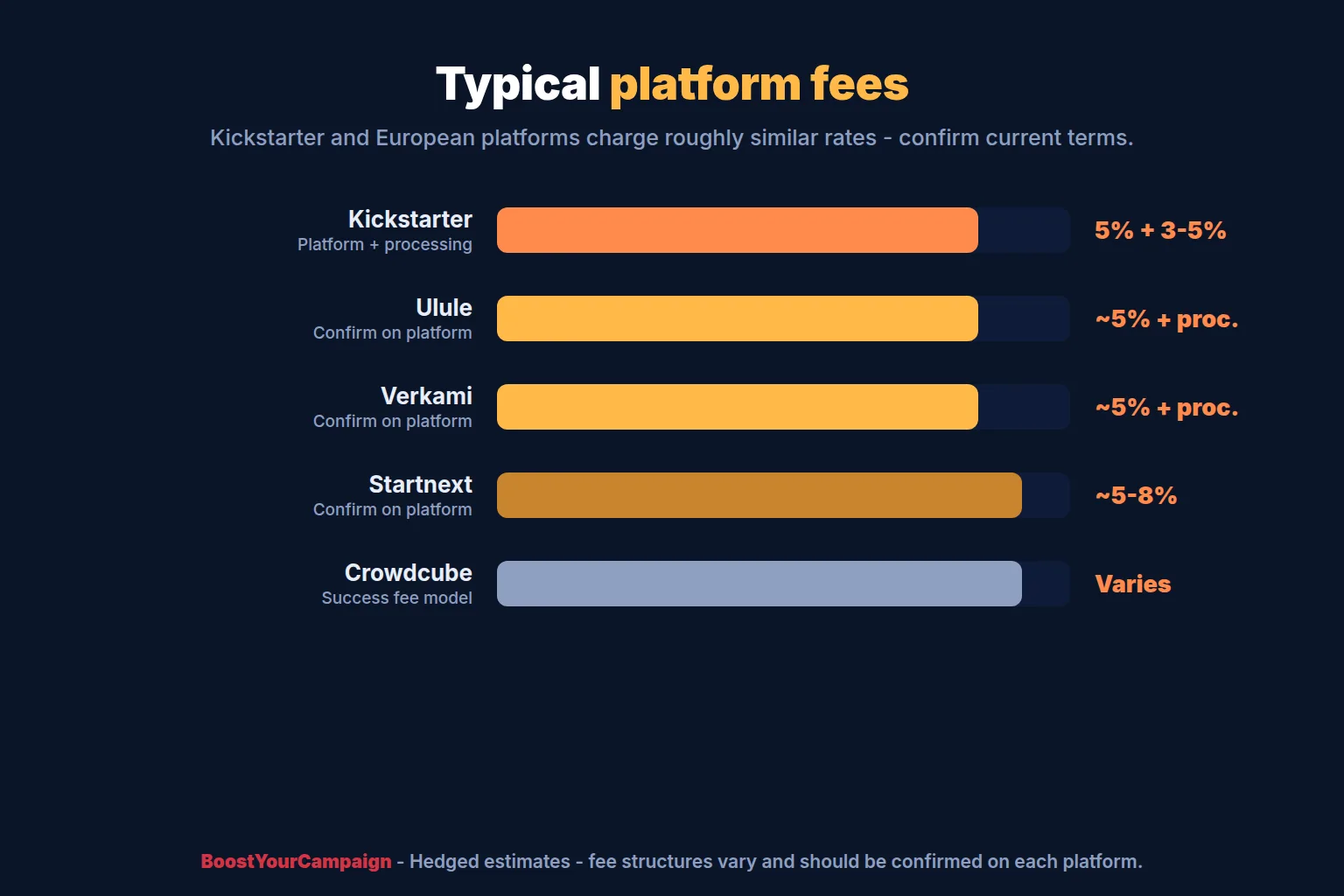
Ulule is the largest rewards-based crowdfunding platform based in continental Europe, with French roots and a genuinely international reach. It runs an all-or-nothing model, the same structure Kickstarter uses: a campaign only collects pledges if it hits its goal. The platform supports French and English, plus other languages depending on the campaign, and its fee is roughly 5% plus payment processing - confirm current terms before pricing reward tiers.
Ulule's strongest categories are publishing, tabletop and card games, food and drink, and independent film, where its French and wider European audience has a genuine track record of backing creative projects. It suits a product with real appeal to a French-speaking or continental European audience, alongside or instead of a Kickstarter launch aimed at US backers. Our best crowdfunding platforms guide covers where it fits next to the major global platforms.
4) Verkami: Spain's platform for books, comics and games
Verkami is Spain's best-known rewards crowdfunding platform, built around an all-or-nothing model and a community centered on books, comics, tabletop games, and music. It supports Spanish, Catalan, and English, a natural home for a project whose backer base is concentrated in Spain. Fees run roughly 5% plus payment processing, confirm current terms on the platform before setting reward prices.
Creators from outside Spain can and do launch on Verkami, and its projects are visible internationally, but its real strength is reach into the Spanish and Catalan creative community specifically. A comic artist, indie publisher, or tabletop designer with an established Spanish following often sees warmer engagement there than the same project would get buried in Kickstarter's much larger, more anonymous catalog.
5) Startnext: Germany's platform for social and sustainable projects
Startnext, based in Dresden, is the largest reward-based crowdfunding platform for the German-speaking DACH region, with a community built around German, Austrian, and Swiss creators and a track record stretching back to 2010. It runs an all-or-nothing model and is particularly strong in social projects, culture, and sustainable products, categories where its domestic audience is especially engaged. Fees are typically quoted as roughly 5-8% all in - confirm the current structure on the platform, since Startnext has historically offered flexible fee options rather than one flat number.
Startnext suits a creator whose first priority is a German-speaking audience, local press, or building initial traction before a larger international push. Our Kickstarter marketing guide for German brands goes deeper on how DACH creators weigh it against a global Kickstarter or Indiegogo launch, including running both in sequence.
6) KissKissBankBank: French culture and creative projects
KissKissBankBank is another French rewards platform, positioned around culture, design, and creative projects, with a funding model similar to Ulule's. Its fee is roughly 5% plus payment processing, confirm on the platform, and it supports French and English. It suits art, music, and design projects with a French or wider European audience, and some creators weigh it directly against Ulule.
7) Wemakeit: Switzerland's rewards platform
Wemakeit is Switzerland's leading rewards crowdfunding platform, running campaigns in Swiss francs and covering French, German, and Italian-speaking parts of the country along with English. Its fee is typically quoted as roughly 5-8% all in - confirm current terms before finalizing a budget. It fits a creator whose backer base is concentrated in Switzerland, or whose product benefits from a CHF-denominated campaign.
8) Goteo: civic and open-source crowdfunding
Goteo is a Spain-based platform with a different focus than most rewards platforms on this list, built around civic, social, and open-source projects, often mixing individual pledges with matched funding from public institutions. It is not right for a typical product launch with rewards and shipping, but for a civic initiative or open-source tool, Goteo reaches an audience Kickstarter and the commercial platforms simply do not serve.
9) Crowdcube: UK and EU equity crowdfunding
Crowdcube is a UK-based equity crowdfunding platform, operating on a fundamentally different model than everything else on this list. Backers are not pre-ordering a product - they are buying actual shares in the company, in exchange for ownership and a potential future return. That makes Crowdcube a regulated financial platform, with investor eligibility rules and legal structuring a rewards campaign never has to deal with.
Crowdcube is not a fit for a creator who wants pre-order revenue and a simple pledge-for-reward exchange. It fits a company raising growth capital from investors in exchange for equity, typically once a product already has traction. Fees are structured differently, generally a success fee on funds raised plus completion costs - confirm the figures with Crowdcube before committing.
10) Crowdfunder UK: rewards and equity in one place
Crowdfunder UK is a UK-focused platform supporting both rewards-based campaigns and equity raises, unusual compared to the single-model platforms above. Its rewards side works similarly to Kickstarter, and its community leans toward UK businesses and local initiatives. Fees vary by track - roughly 5% plus payment processing on the rewards side is a reasonable starting expectation, but confirm current terms since equity differs.
Crowdfunder UK suits a UK-based creator or small business with a genuine community or local angle. For a UK creator weighing it against a global platform, our crowdfunding marketing guide for UK creators covers the wider decision, including VAT and fulfillment questions.
11) Gamefound: Poland's platform for tabletop games
Gamefound is based in Poland and built specifically for tabletop games, with a native pledge manager, add-ons, and stretch goals included by default rather than bolted on through a separate tool. Its audience is genuinely global rather than regionally concentrated, but it is worth including here because European tabletop creators consider it directly alongside Kickstarter, and its category focus makes it a stronger fit for board games and miniatures than most general-purpose platforms on this list. Our full Gamefound guide covers its fee structure and how it compares to Kickstarter and BackerKit.
12) When to still choose Kickstarter
None of the alternatives above change the fact that Kickstarter remains the largest crowdfunding platform in the world by discovery traffic and backer volume, and for many European creators that is still the right reason to launch there. Its Projects We Love feature, category-specific press relationships, and the sheer size of its US backer base are hard for any regional platform to match.
Kickstarter's fee is 5% of funds raised, plus roughly 3-5% in payment processing. Indiegogo is the other global option; it retired flexible funding in October 2025, and every new campaign now runs fixed, all-or-nothing funding, with Late Pledge (formerly called InDemand) available afterward. Our Kickstarter vs Indiegogo comparison and best crowdfunding platforms guide go deeper on both.
13) How to decide: five questions for European creators
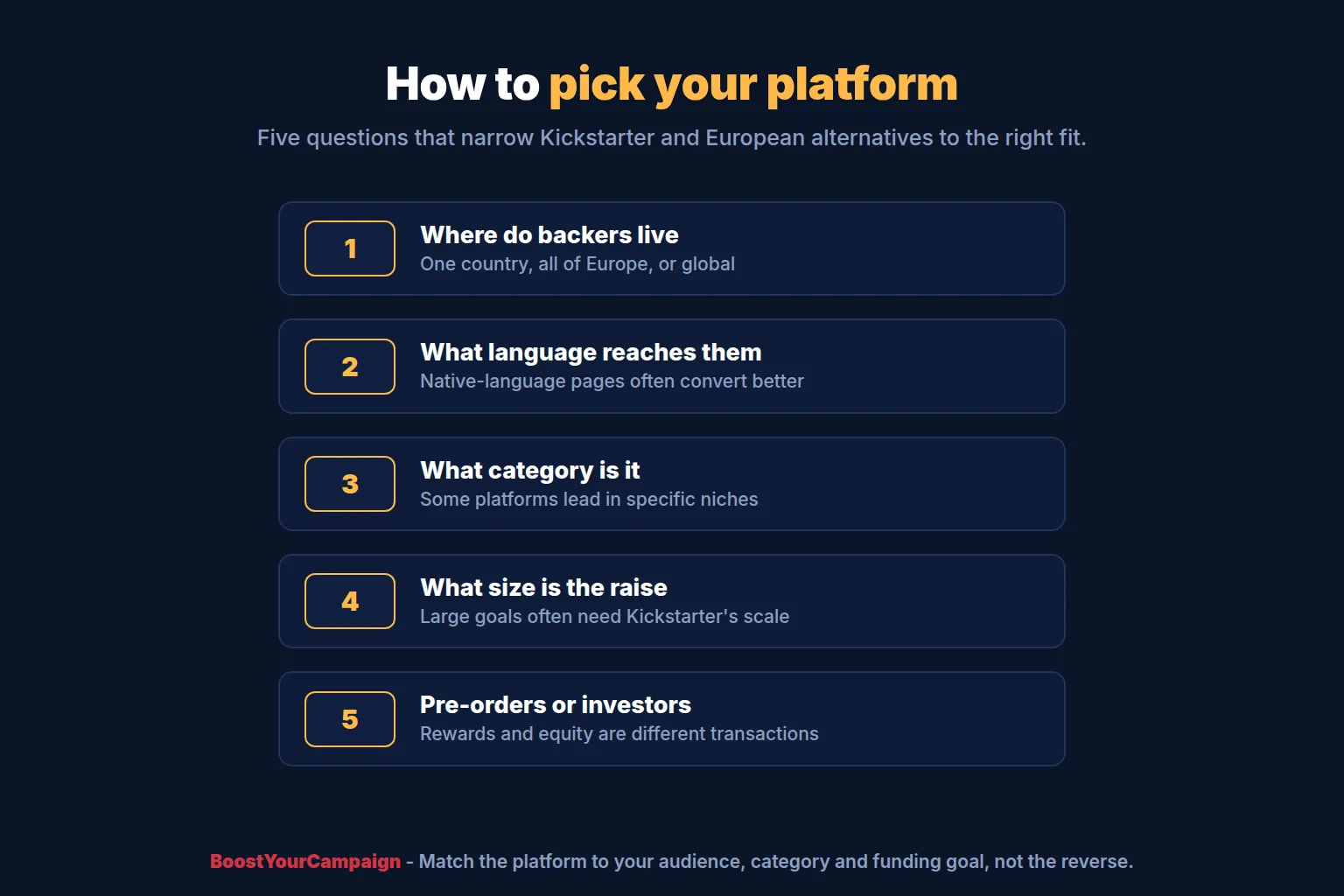
Choosing between Kickstarter and a European alternative comes down to a short list of practical questions. Where do your realistic backers live - one country, spread across Europe, or genuinely global? What language does your audience read first? What category is your product in, since some platforms have a real edge in tabletop games, publishing, or design specifically?
Funding size matters too: a large goal usually needs Kickstarter's scale, while a smaller project can do well on a regional platform. The biggest fork is whether you want pre-orders or investors - a rewards campaign is a fundamentally different transaction than an equity raise, and mixing up which one your product needs is the most common planning mistake here.
14) Shipping and VAT for EU campaigns
Whichever platform you choose, shipping rewards to European backers raises the same VAT and customs questions. Every reward shipped to an EU backer counts as a sale, and VAT applies at the backer's country rate. For parcels valued at 150 EUR or less, the IOSS (Import One-Stop Shop) scheme lets a creator or fulfillment partner collect that VAT at the point of pledge and remit it through one return, so the parcel clears customs without the courier collecting VAT again at the door. Parcels above that threshold need a separate customs plan.
Fulfilling from a warehouse inside the EU sidesteps most of this friction, since stock already in the EU does not trigger a new import event. UK-based creators face a related question post-Brexit, since a UK-to-EU parcel is now an export with its own VAT exposure; our guide to shipping Kickstarter rewards to Europe and customs documentation guide cover the mechanics, and our fulfillment services guide covers picking a partner with EU warehouse capacity.
| Platform | Country | Model | Funding rule | Typical fee | Best for |
|---|---|---|---|---|---|
| Kickstarter | US, global creators | Rewards | All-or-nothing | 5% plus roughly 3-5% processing | Largest audience, discovery, broad category reach |
| Ulule | France | Rewards | All-or-nothing | Roughly 5% plus processing, confirm on platform | French and wider European audience, publishing, games, food |
| Verkami | Spain | Rewards | All-or-nothing | Roughly 5% plus processing, confirm on platform | Spanish and Catalan audience, books, comics, games, music |
| Startnext | Germany | Rewards | All-or-nothing | Roughly 5-8% all in, confirm on platform | DACH audience, social, culture, sustainable products |
| Crowdcube | UK, EU | Equity | Regulated raise, not all-or-nothing rewards | Success fee plus completion costs, confirm on platform | Companies raising growth capital for shares, not pre-orders |
| Crowdfunder UK | UK | Rewards and equity | Varies by track | Roughly 5% plus processing on rewards, confirm on platform | UK community and business projects |
How BoostYourCampaign fits
BoostYourCampaign is based in Europe and has run crowdfunding campaigns since 2010 across Kickstarter, Indiegogo, Gamefound, and European platforms, so we help creators choose a platform based on where their backers live. We operate owned fulfillment warehouses in both the US and EU, which matters for the shipping and VAT questions in section 14, since regional stock removes most of the customs friction a single-warehouse setup creates.
On the marketing side, BYC uses a skin-in-the-game ad model, putting its own money into the campaign budget alongside the client's spend, with fixed fees rather than a percentage of what the campaign raises. Since 2010, the agency has worked across 4,600+ campaigns raising $734M+ combined, with a 4.9/5 rating across 300+ verified reviews. Full-service work covers strategy, campaign page, video, ads, PR, and fulfillment, with Shopify support after launch. See our services page, or the Indiegogo fulfillment guide if your campaign runs there.
Choosing a platform as a European creator
- Have you confirmed Kickstarter supports your country of residence, not just your backers' countries?
- Do you know where most of your realistic backers live, country by country?
- Does your product fit a category where a specific European platform has a real edge?
- Have you decided whether you want pre-orders (rewards) or investors (equity)?
- Have you confirmed current fees directly with the platform, not a general estimate?
- Is your shipping and VAT plan, including IOSS and warehouse location, decided before launch?
Frequently Asked Questions
What is the European alternative to Kickstarter?
There is no single one - the right choice depends on your country and category. Ulule is the largest rewards platform based in continental Europe, Verkami leads in Spain, Startnext leads in Germany, and Crowdcube and Crowdfunder UK cover equity crowdfunding in the UK. Most creators pick the platform closest to their audience.
Is Kickstarter available in Europe?
Yes, for creators based in most Western European countries, including the UK, Ireland, France, Germany, Spain, Italy, the Netherlands, Belgium, Austria, Switzerland, Denmark, Norway, Sweden, Poland, Luxembourg, and Greece. Not every EU member state is supported, though backers anywhere can pledge to any project.
Ulule vs Kickstarter: which is better?
Neither is universally better. Kickstarter has a larger, more international backer base and stronger discovery tools, while Ulule has deeper reach into French and wider European audiences and feels warmer for a project with genuine regional appeal. Some creators run Ulule alongside or instead of Kickstarter depending on where backers live.
Is Verkami only for Spain?
No. Creators from outside Spain can launch on Verkami and its projects are visible internationally, but its real strength is reach into the Spanish and Catalan creative community. A project with an established Spanish audience often performs better there than on a much larger, anonymous platform.
What is the best crowdfunding platform in the UK?
It depends on the raise. For rewards-based pre-order campaigns, Kickstarter reaches the largest audience, with Crowdfunder UK as a UK-focused rewards option. For equity raises, Crowdcube is the leading UK platform - it depends on selling a product or selling shares.
What is the best crowdfunding platform in Germany?
Startnext is the largest reward-based platform built for the German-speaking DACH region, a strong choice for a domestic-first launch, particularly in social, culture, and sustainable product categories. For a product aimed beyond DACH, Kickstarter or Indiegogo usually reaches more backers, and some German creators run Startnext first to validate demand.
Can I run Kickstarter and a European platform at the same time?
Running two rewards campaigns for the same product is uncommon and can split your audience and press attention. More creators run them sequentially: a Startnext or Ulule campaign to validate demand first, then a larger Kickstarter or Indiegogo launch for a global audience, or the reverse.
Which platform is best for equity crowdfunding in Europe?
Crowdcube is the best-known equity crowdfunding platform serving the UK and wider EU, letting backers buy actual shares in a company rather than pre-order a product. Crowdfunder UK also supports an equity track alongside its rewards option. Equity crowdfunding is a regulated raise, not a substitute for a pre-order campaign, so the choice comes down to selling a product versus selling ownership.
If you are weighing Kickstarter against a European platform for your next launch, reach out through /contact and we will help you work through the country, category, and funding-model questions that actually decide it.
Want results like these for your campaign?
We've helped 4,600+ creators raise over $734M. Let's pressure-test your launch plan and find the highest-leverage fixes before you go live.
Talk to an expert →Get the free 87-step launch checklist
The exact pre-launch, live-campaign and fulfillment steps we use across 4,600+ launches. Free PDF, emailed instantly.
You're in - check your inbox. Open the checklist now ->