Missing or wrong customs paperwork is the single most common reason a crowdfunding shipment sits in a bonded warehouse instead of reaching a backer. If you want that handled before it becomes a support ticket, talk with BoostYourCampaign about your fulfillment routes.
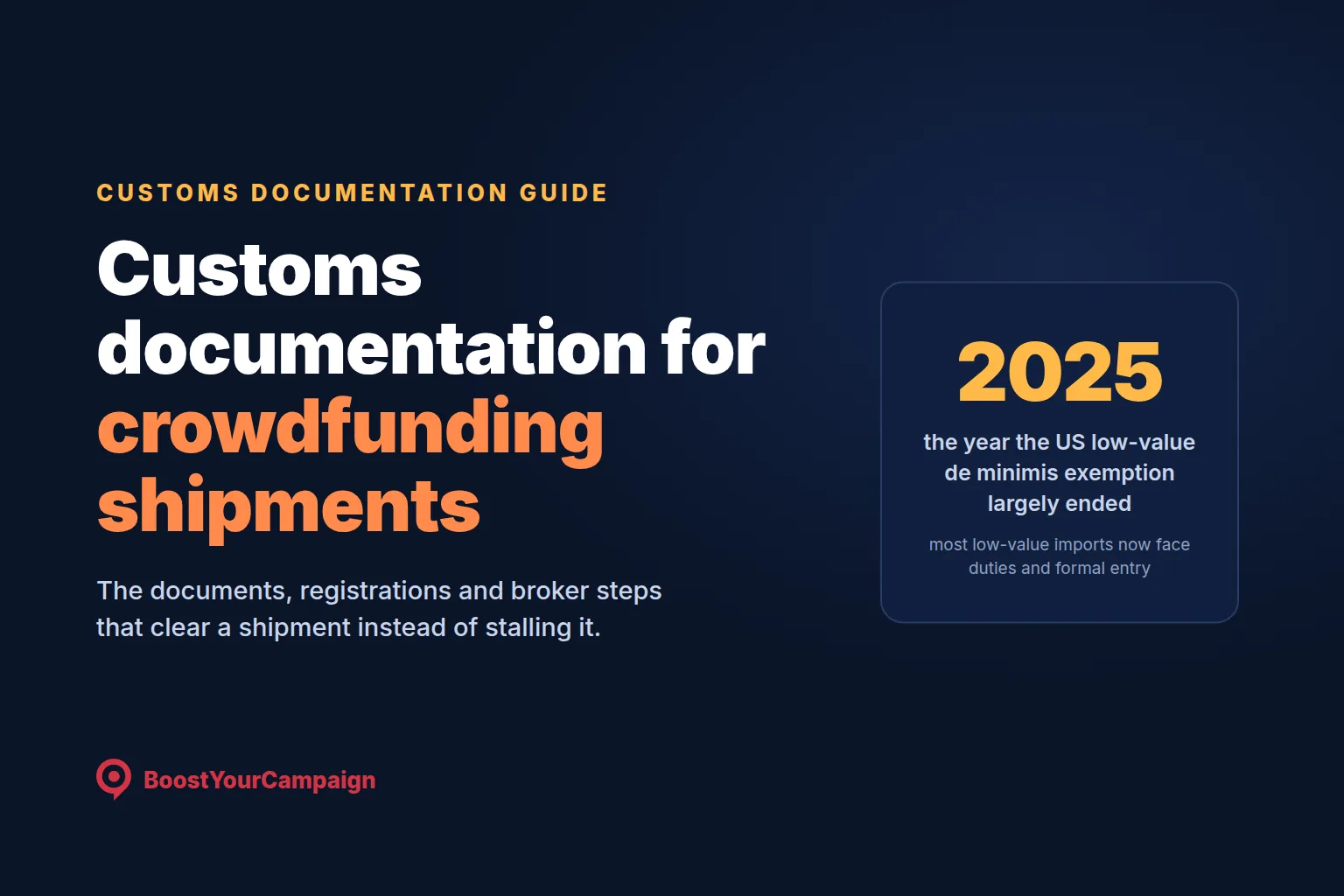
A crowdfunding shipment needs a commercial invoice, a packing list, the correct HS/tariff code for each product, and - for freight - a bill of lading or air waybill, plus a certificate of origin when the destination country requires one. Shipping into the US now generally means formal entry and duty exposure for most parcels, since the low-value de minimis exemption largely ended in 2025. Shipping into the EU means an EORI number for the importer, IOSS registration for parcels valued at 150 EUR or less, and separate treatment for the UK as a non-EU export since Brexit. Get these right before a single unit leaves the factory, and clearance is routine. Get them wrong, and parcels sit.
- Every shipment needs a commercial invoice and packing list - customs authorities won't clear a parcel or a container without a paper trail describing what's inside and what it's worth.
- HS codes drive everything downstream - the wrong code means the wrong duty treatment and a real chance of a hold for inspection.
- US low-value imports lost their easy path in 2025 - the de minimis exemption that let many low-value parcels skip formal entry mostly ended, so plan for duties and paperwork on volume you used to ship duty-free.
- The EU needs its own registrations - an EORI number identifies the importer, and IOSS covers VAT on parcels valued at 150 EUR or less.
- The UK is not the EU for customs purposes - since Brexit, a UK shipment is a separate export with its own paperwork, even if it transits through an EU hub.
- One bulk import clears easier than a thousand parcels - a single commercial shipment into a regional warehouse goes through customs once, not once per backer.
1) The documents every crowdfunding shipment needs
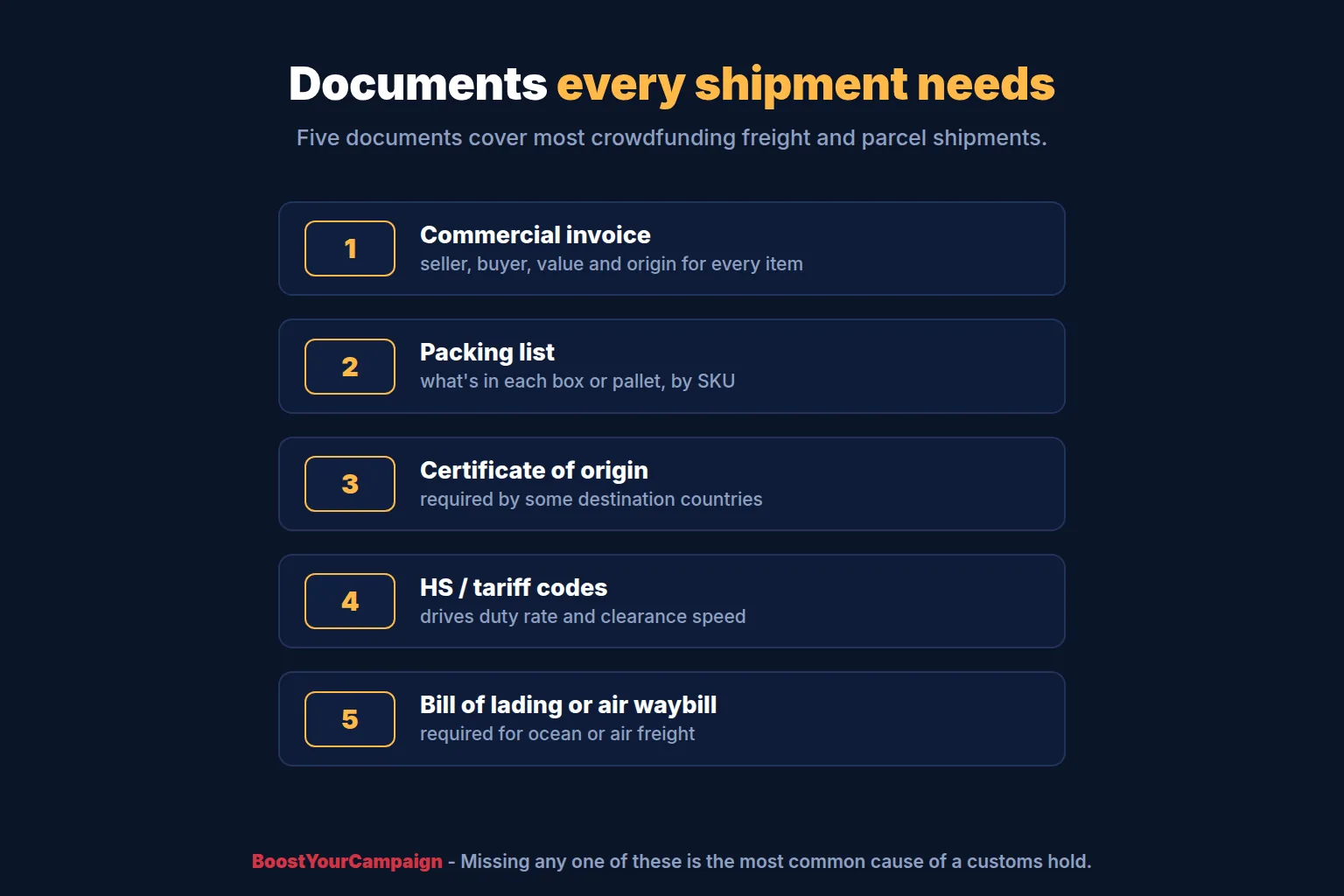
Four documents cover most crowdfunding shipments, and which ones you need depends on the shipment type - bulk freight or an individual parcel.
Commercial invoice. This is the core document for any international shipment. It states the seller, the buyer, a description of each item, the quantity, the unit value, the total value, and the country of origin. Customs uses this to assess duty and confirm the shipment matches what's declared. An invoice that's vague ("assorted goods") or that undervalues the shipment to reduce duty is the fastest way to get a parcel or container flagged for inspection.
Packing list. A packing list breaks down what's physically in each box or pallet - which SKUs, how many of each, and how they're packed. For a bulk freight shipment carrying dozens of reward SKUs and add-ons, this is what lets a warehouse receive and reconcile the shipment against the commercial invoice without opening every carton to check.
Certificate of origin. Not every shipment needs one, but some destination countries or specific trade agreements require a certificate confirming where the goods were manufactured, separate from where they were shipped from. Check the destination country's requirement before assuming you don't need one - it's cheap to get and expensive to be missing when customs asks for it.
HS/tariff codes. Every product needs a Harmonized System code, an internationally standardized classification that tells customs what the item is. The code drives the duty rate and whether the item needs any additional certification. Get this wrong and you risk the wrong duty assessment, a hold for reclassification, or in worse cases a compliance flag that slows down every future shipment from the same importer.
Bill of lading or air waybill. For freight moving by ocean or air rather than as a parcel, this is the contract of carriage and the document that proves who owns the goods in transit. It's separate from the commercial invoice, and freight forwarders and customs brokers both work off it directly.
2) Shipping into the US: de minimis, formal entry, and importer of record
For years, a large share of low-value crowdfunding parcels shipped into the US skipped formal customs entry entirely, cleared under a de minimis exemption designed for small personal shipments. That exemption largely ended in 2025, and low-value imports that used to move with minimal paperwork now generally face duties and some form of formal entry, depending on origin country and product category. If your fulfillment plan assumed the old low-value path, it's worth re-checking against current rules before you rely on it for a launch.
Practically, this means two things matter more than they used to for US-bound shipments. First, someone has to be the importer of record - the legal entity responsible for the shipment's customs compliance, duty payment, and recordkeeping. For a bulk shipment into a fulfillment warehouse, that's usually the warehouse operator or a customs broker acting on the creator's behalf, not the creator personally trying to work through entry filings. Second, a customs broker is worth having for anything beyond the simplest shipment - brokers file entries, classify goods, and catch documentation problems before they turn into a hold, and their fee is generally small next to the cost of a shipment sitting uncleared.
Duty rates themselves vary by product and HS code, and change with trade policy, so don't treat any specific percentage as fixed. Get your products classified early and ask your broker or fulfillment partner what to expect for your specific goods rather than assuming a number from a different product category applies to yours.
3) Shipping into the EU: EORI, IOSS, and VAT on import
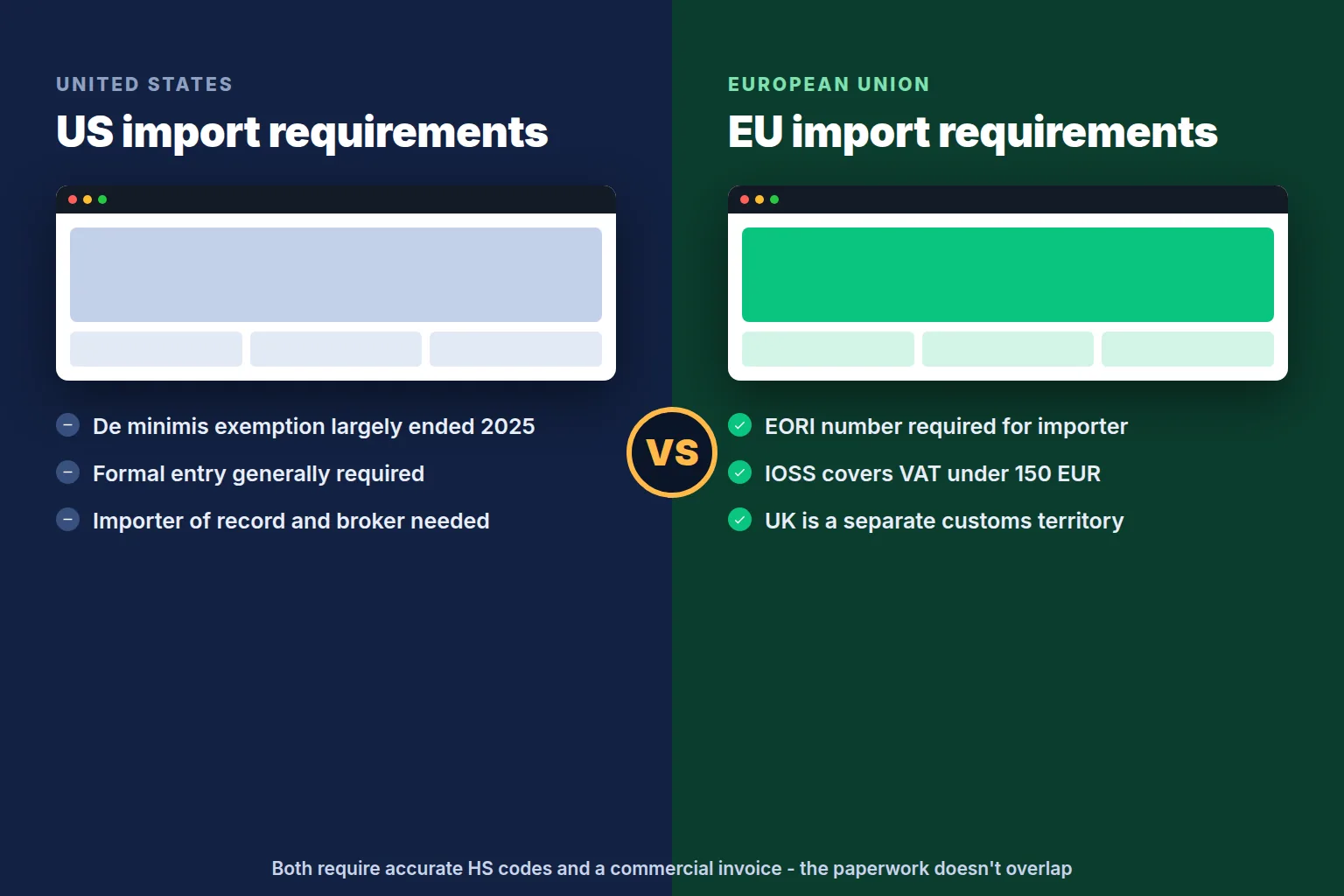
The EU side has its own registration requirements that don't map directly onto the US ones. An EORI number (Economic Operators Registration and Identification) identifies the importer to EU customs authorities, and you or your fulfillment partner needs one registered before goods can clear as a commercial import. Without it, a shipment can sit at the border while the paperwork gets sorted out, which is exactly the kind of delay that turns a funded campaign's goodwill into a wave of "where's my order" messages.
For parcels valued at 150 EUR or less, the IOSS (Import One-Stop Shop) scheme lets you or a fulfillment partner collect VAT at the point of sale and remit it through one return, so the parcel clears without VAT being collected again at the border. Above that threshold, the shipment goes through standard import VAT procedures instead. Our EU VAT and customs guide covers IOSS mechanics and the backer-facing consequences of getting this wrong in more depth - this article focuses on the documents themselves rather than repeating that ground.
One detail that trips up creators who set up their EU plan before Brexit and haven't revisited it: the UK is not part of the EU for customs purposes anymore. A shipment destined for UK backers needs its own export documentation and its own import process into the UK, separate from whatever EORI and IOSS setup covers EU destinations. Routing UK-bound stock through an EU customs process and assuming it covers the UK leg too is a common and avoidable mistake.
4) DDP vs DDU: who's responsible for the paperwork and the bill
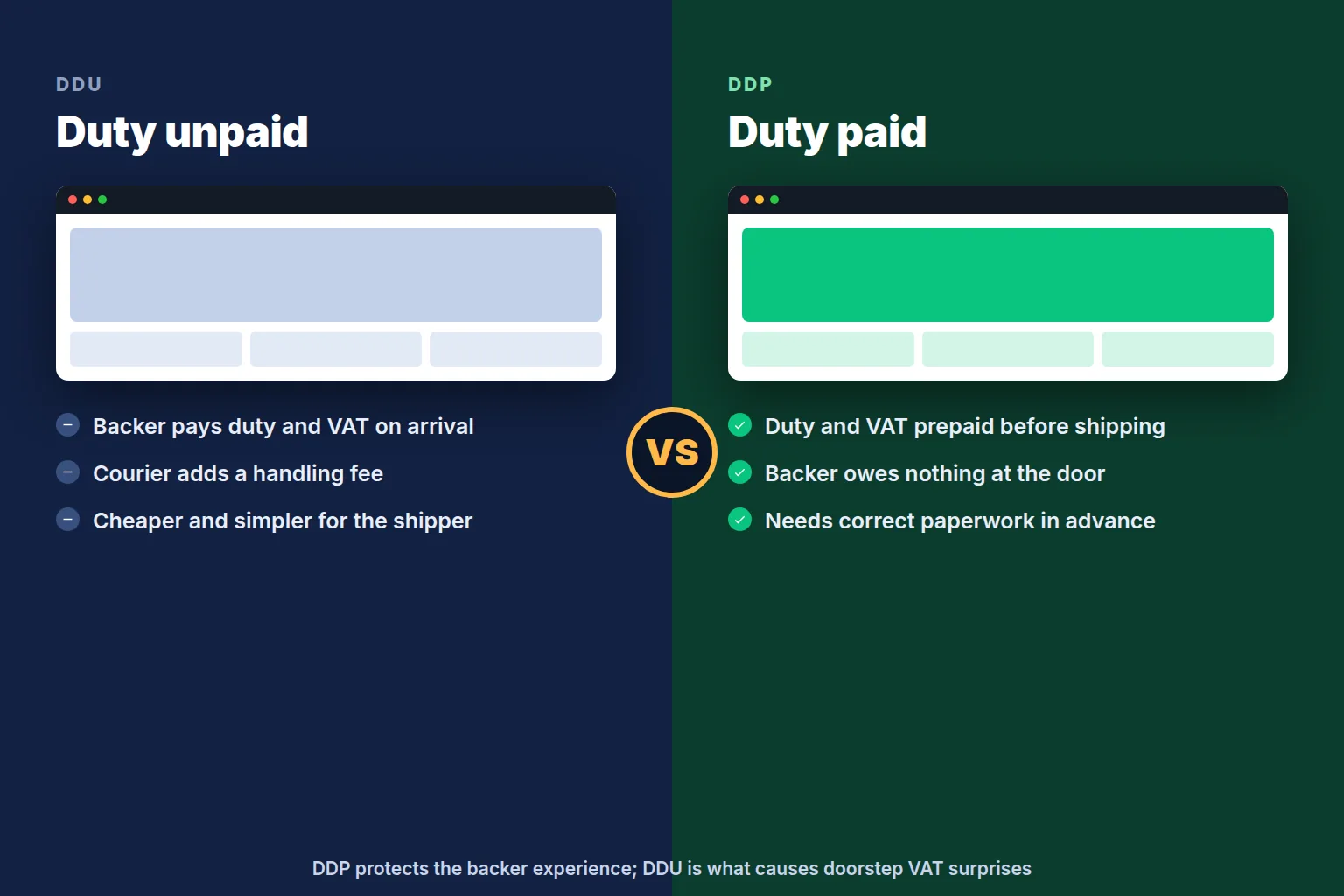
These two shipping terms decide who handles duty and VAT, and they have a direct paperwork consequence. Under DDU (delivered duty unpaid), the seller ships the goods with the commercial documentation attached, but duty and VAT get assessed and collected from the recipient on arrival - often with a courier handling fee added on top. Under DDP (delivered duty paid), the seller or their fulfillment partner prepays duty and VAT as part of the shipment, which requires the correct documentation and registrations to already be in place before the parcel ships, not sorted out at the border.
From a documentation standpoint, DDP is the harder setup up front - it needs accurate HS codes, correct declared values, and the right tax registrations (IOSS for the EU, formal entry arrangements for the US) prepared in advance. But it's the only version that avoids a backer getting a surprise bill at the door, which is why it's worth the extra setup work. Our Europe VAT and customs guide covers the backer experience side of DDP versus DDU in more detail if you want the fuller picture beyond the paperwork itself.
5) Per-parcel customs vs a single bulk commercial import
There are two fundamentally different ways a print run's units cross a border, and they carry very different documentation loads. Shipping units directly to backers as individual international parcels means every single parcel is its own customs event - its own commercial invoice data, its own duty assessment, its own chance of a hold. At a few hundred or a few thousand backers, that's a few hundred or a few thousand chances for a documentation problem to delay someone's reward.
Shipping units in bulk to a regional warehouse as a single commercial import means the paperwork gets assembled once - one commercial invoice covering the full shipment, one packing list, one set of HS codes, one bill of lading or air waybill - and customs clears the whole shipment as one event. From there, units move out to backers as domestic or intra-region parcels, which for the US and most of the EU don't trigger a new customs event at all. This is the same warehouse-routing logic that drives the cost savings covered in our Kickstarter shipping costs guide, and it applies just as strongly to documentation risk as it does to postage cost - clearing once, correctly, beats clearing thousands of times and hoping each one goes smoothly.
6) What to print on the label and the invoice
A few details on the outside of a parcel and inside its commercial invoice prevent most avoidable delays. The shipper's full legal name and address, the recipient's full address including any apartment or unit number, an accurate item description (not a vague category name), the correct HS code, the true declared value, and the country of origin all need to match across the label, the commercial invoice, and any electronic customs filing that goes ahead of the physical shipment. Mismatches between what's printed on the box and what's filed electronically are a common, entirely avoidable cause of a hold.
Declared value deserves its own note: it has to be the real transaction value, not a lowered number meant to reduce duty or fees. Under-declaring value is a compliance problem, not a savings strategy, and it risks the shipment getting seized or the importer getting flagged for future scrutiny, which is a far more expensive outcome than paying the correct duty on an accurately declared shipment.
7) Common rejections and delays, and how to avoid them
Most customs delays trace back to a small set of recurring problems. A vague item description ("gift," "sample," "merchandise") without enough detail for customs to classify the goods is one of the most common. An HS code that doesn't match the actual product, whether from a copy-paste error or an outdated classification, is another. A declared value that doesn't match the commercial invoice, or an invoice that's missing entirely, stops a shipment cold. Missing registrations - no EORI number on file for an EU-bound commercial import, no IOSS registration for a DDP shipment under 150 EUR - cause delays even when every other document is correct, because customs has nothing to match the shipment against.
The fix for nearly all of these is the same: assemble the documentation and registrations before the shipment moves, not while it's already in transit or sitting at a border. A customs broker or a fulfillment partner who already holds the relevant registrations catches most of these problems before they become a hold, because they've seen the same mistakes on other shipments and know what a clean filing looks like for your product category.
8) Document checklist by route
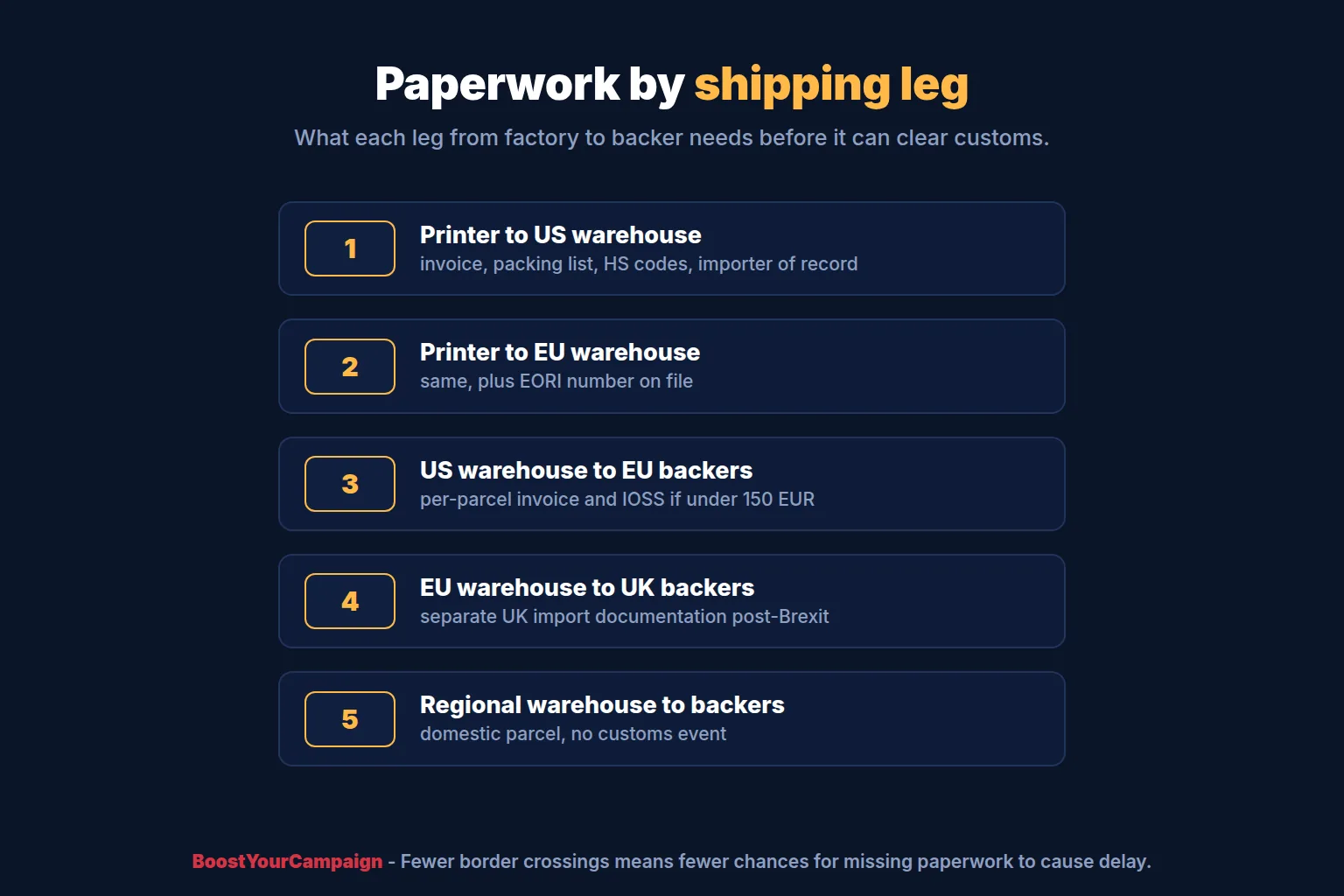
Different legs of a crowdfunding fulfillment chain need different documents. Here's what a typical multi-leg route looks like end to end.
| Route | Documents needed | Who typically files |
|---|---|---|
| China printer to US warehouse | Commercial invoice, packing list, HS codes, bill of lading or air waybill, importer of record on file | Freight forwarder and customs broker, working from the creator's product and value data |
| China printer to EU warehouse | Commercial invoice, packing list, HS codes, bill of lading or air waybill, EORI number on file, certificate of origin if required by destination country | Freight forwarder and customs broker, using the EU importer's EORI |
| US warehouse to EU backers | Not applicable if fulfilled from an EU warehouse instead; otherwise commercial invoice per parcel, HS code, IOSS number if under 150 EUR | Fulfillment warehouse's shipping system, or an EU warehouse bypassing this leg entirely |
| EU warehouse to UK backers | Commercial invoice, HS code, UK-specific import documentation (UK is a separate customs territory from the EU) | Fulfillment warehouse or customs broker familiar with post-Brexit UK entry rules |
| Regional warehouse to domestic backers | None - domestic parcels don't cross a customs border | Not applicable |
The pattern across every row is the same: paperwork gets assembled once at the border-crossing leg, and everything downstream of an in-region warehouse is a domestic shipment with no customs event at all. That's the same structural reason the US/EU warehouse split saves money in our shipping costs guide and the same reason it reduces documentation risk here - fewer border crossings means fewer chances for a missing form to hold up a backer's reward.
How BoostYourCampaign fits
BoostYourCampaign's fulfillment team handles brokerage and paperwork as part of running the owned US and EU warehouses described throughout this guide. That means the EORI registration, IOSS setup, HS code classification, and broker relationships covered above are already in place rather than something a creator has to research and stand up for a single campaign under launch pressure. Bulk shipments from the printer clear once, correctly, and downstream parcels to backers move as domestic or intra-region shipments with no separate customs event, which is the structural fix this whole article has been building toward.
BYC has been active since 2010 across 4,600+ campaigns with $734M+ raised and a 4.9/5 score across 300+ verified reviews. Beyond fulfillment, BYC uses a skin-in-the-game ad model, investing its own money alongside the client's ad budget with fixed fees rather than a percentage-of-raise commission, and runs post-campaign ecommerce and Shopify growth work using the same warehouse infrastructure. For platform-specific fulfillment planning, see our Kickstarter fulfillment guide and Indiegogo fulfillment guide, and for the heaviest, most paperwork-sensitive category, see our board game fulfillment guide. Our crowdfunding fulfillment services overview and fulfillment companies comparison put this approach next to the alternatives, our shipping costs guide covers what all of this actually costs by weight and region, and our Kickstarter and Indiegogo fees guide covers the platform fee side of the budget. See our full services for how fulfillment fits alongside marketing and video production.
Before your first international shipment: a quick checklist
| Question | Why it matters |
|---|---|
| Does every product have a correct, specific HS code? | The code drives duty treatment and is the single most common cause of a customs hold when wrong. |
| Is your commercial invoice specific, with accurate declared values? | Vague descriptions or mismatched values are among the fastest ways to trigger inspection. |
| Do you have an EORI number on file for EU-bound commercial imports? | Without it, an EU shipment can sit at the border while registration gets sorted out. |
| Is IOSS set up for EU parcels valued at 150 EUR or less? | Without it, backers can get charged VAT again at the door, on top of what they already paid you. |
| Does your UK plan use UK-specific import documentation, separate from the EU? | The UK is a separate customs territory since Brexit, not covered by EU registrations. |
| Are you clearing customs once via bulk import, or per-parcel for every backer? | One clean bulk clearance carries far less documentation risk than thousands of individual parcel clearances. |
Frequently Asked Questions
What customs documents do I need to ship Kickstarter rewards internationally?
At minimum, a commercial invoice and a packing list for every shipment, correct HS/tariff codes for each product, and a bill of lading or air waybill for freight moving by ocean or air. Some destinations also require a certificate of origin. EU-bound commercial imports additionally need an EORI number on file, and parcels valued at 150 EUR or less generally use IOSS for VAT.
Do Kickstarter rewards shipped to the US need formal customs entry now?
Generally yes for most parcels. The de minimis exemption that let many low-value shipments skip formal entry largely ended in 2025, so low-value imports that used to move with minimal paperwork now typically face duties and some form of formal entry, depending on origin and product category. Check current rules against your specific goods before relying on the old low-value path.
What is an EORI number and do I need one?
An EORI number (Economic Operators Registration and Identification) identifies the importer to EU customs authorities. You or your fulfillment partner needs one on file before goods can clear as a commercial import into the EU. Without it, a shipment can sit at the border while the registration gets sorted out.
What is the difference between DDP and DDU for customs purposes?
DDU (delivered duty unpaid) means duty and VAT are assessed and collected from the recipient on arrival, often with a courier handling fee added. DDP (delivered duty paid) means the seller or their fulfillment partner prepays duty and VAT as part of the shipment, which requires the correct documentation and tax registrations to be in place before the parcel ships. DDP avoids a surprise bill for the backer.
Is it better to clear customs per parcel or as one bulk shipment?
One bulk commercial import carries far less documentation risk than thousands of individual parcel clearances, since the paperwork gets assembled once and checked once instead of once per backer. It's also the same structural reason bulk freight into a regional warehouse tends to be cheaper than shipping every parcel individually.
What HS code should I use for my crowdfunding reward?
It depends on exactly what the product is - HS classification is specific to the item's material, function, and construction, not the campaign category. Get each distinct product classified correctly, ideally with help from a customs broker or fulfillment partner, since an incorrect code is one of the most common causes of a customs hold.
Does Brexit affect how I ship Kickstarter rewards to UK backers?
Yes. The UK is a separate customs territory from the EU, so a UK-bound shipment needs its own export and import documentation, distinct from whatever EORI and IOSS setup covers EU destinations. Assuming an EU customs process automatically covers the UK leg too is a common and avoidable mistake.
If you want your customs documentation and brokerage handled by a team that already runs it for the US and EU, reach out through /contact.
Want results like these for your campaign?
We've helped 4,600+ creators raise over $734M. Let's pressure-test your launch plan and find the highest-leverage fixes before you go live.
Talk to an expert →Get the free 87-step launch checklist
The exact pre-launch, live-campaign and fulfillment steps we use across 4,600+ launches. Free PDF, emailed instantly.
You're in - check your inbox. Open the checklist now ->