Shipping is the line item most Kickstarter creators guess at, and guessing is expensive. If you want real numbers before you set reward prices, talk with BoostYourCampaign about your box weight and backer map.
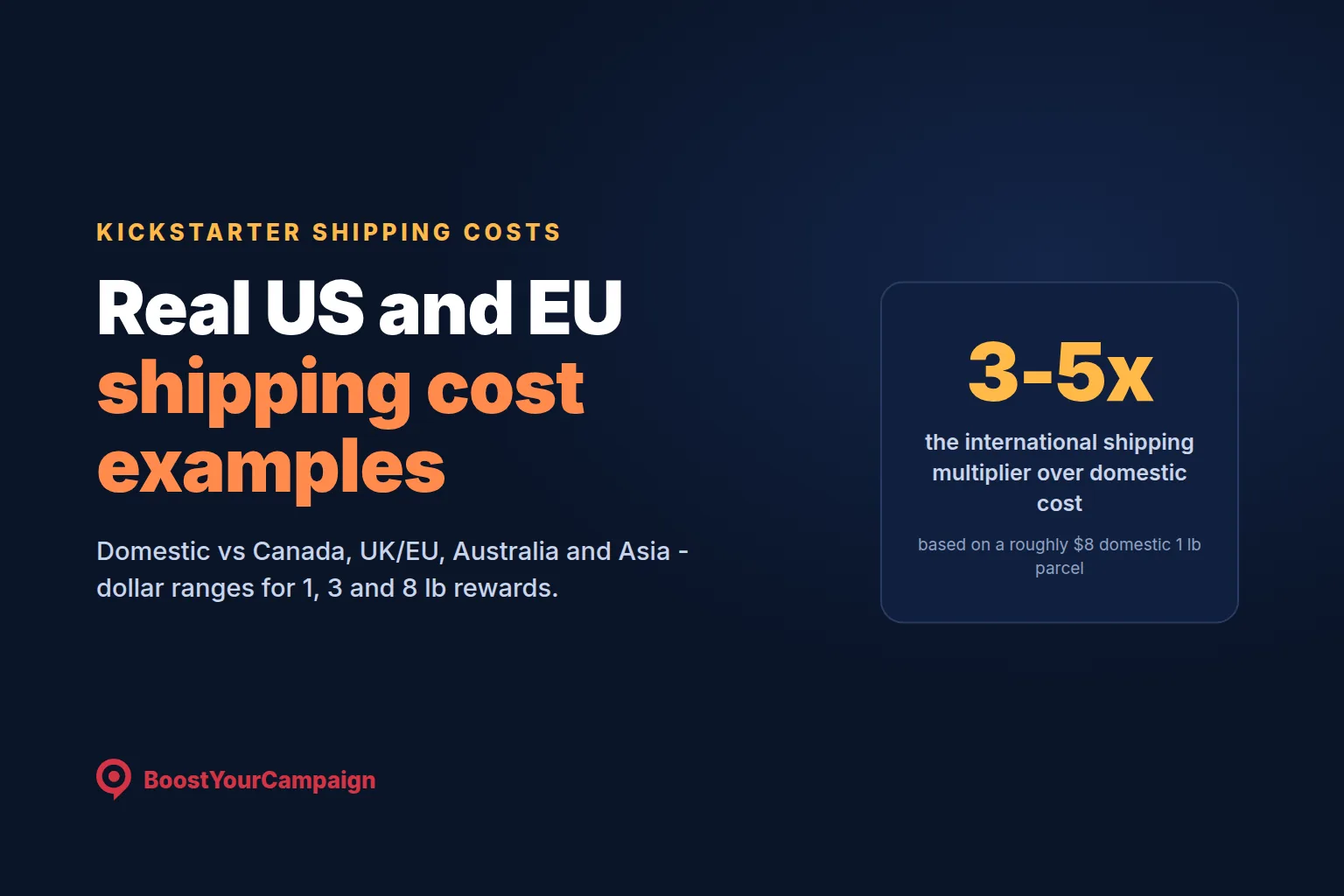
Shipping a Kickstarter reward domestically in the US typically runs $6-20 depending on weight, while the same parcel sent internationally costs roughly 3-5 times more - about $25 to Canada, $35 to the UK or EU, $40 to Australia, and $50 or more to Asia for a comparable parcel. Bulk freight to a regional warehouse cuts that international cost sharply once you're shipping enough units to the same region, often saving $15-25 per parcel versus mailing each one individually. The numbers below walk through both paths so you can price shipping correctly before backers pledge, not after.
- Weight sets the domestic price band - a 1 lb reward, a 3 lb reward, and an 8 lb reward sit in three different postage brackets before you even leave the country.
- International shipping is a multiplier, not an add-on - the same parcel costs roughly 3-5 times more once it crosses a border.
- Bulk freight beats individual parcels past a certain volume - shipping 500 units to a regional warehouse can cost around $2,000 total, which is a fraction of what 500 individual international parcels would cost.
- Pick and pack is a separate cost from postage - budget $2-4 per order plus packaging materials on top of the shipping label itself.
- Dimensional weight can cost you more than actual weight - a light, bulky box can price like a much heavier one.
- How you price shipping on the campaign page matters as much as the shipping cost itself - charge-at-pledge, collect-later, and "free shipping" all shift risk differently.
1) What actually drives the cost of shipping a Kickstarter reward
Four things set the price of a shipping label: weight, dimensions, distance, and service level. Weight and dimensions decide which pricing bracket a carrier puts your parcel in, distance decides how far that parcel has to travel and through how many customs borders, and service level decides how fast it gets there. A creator pricing shipping off a single number - "it's about ten bucks to ship" - is almost always wrong for at least one weight tier or one region, and that gap comes straight out of margin once a few hundred backers pledge.
The other factor that catches first-time creators off guard is that postage rates move. Carriers adjust rates yearly and add fuel surcharges that shift with fuel prices, so a number that was accurate when you researched it six months before launch can be off by the time you're actually packing boxes. Treat every figure in this article as a planning range, not a quote, and get an actual rate check against your real packed box before reward prices go live.
2) Domestic US shipping costs by weight
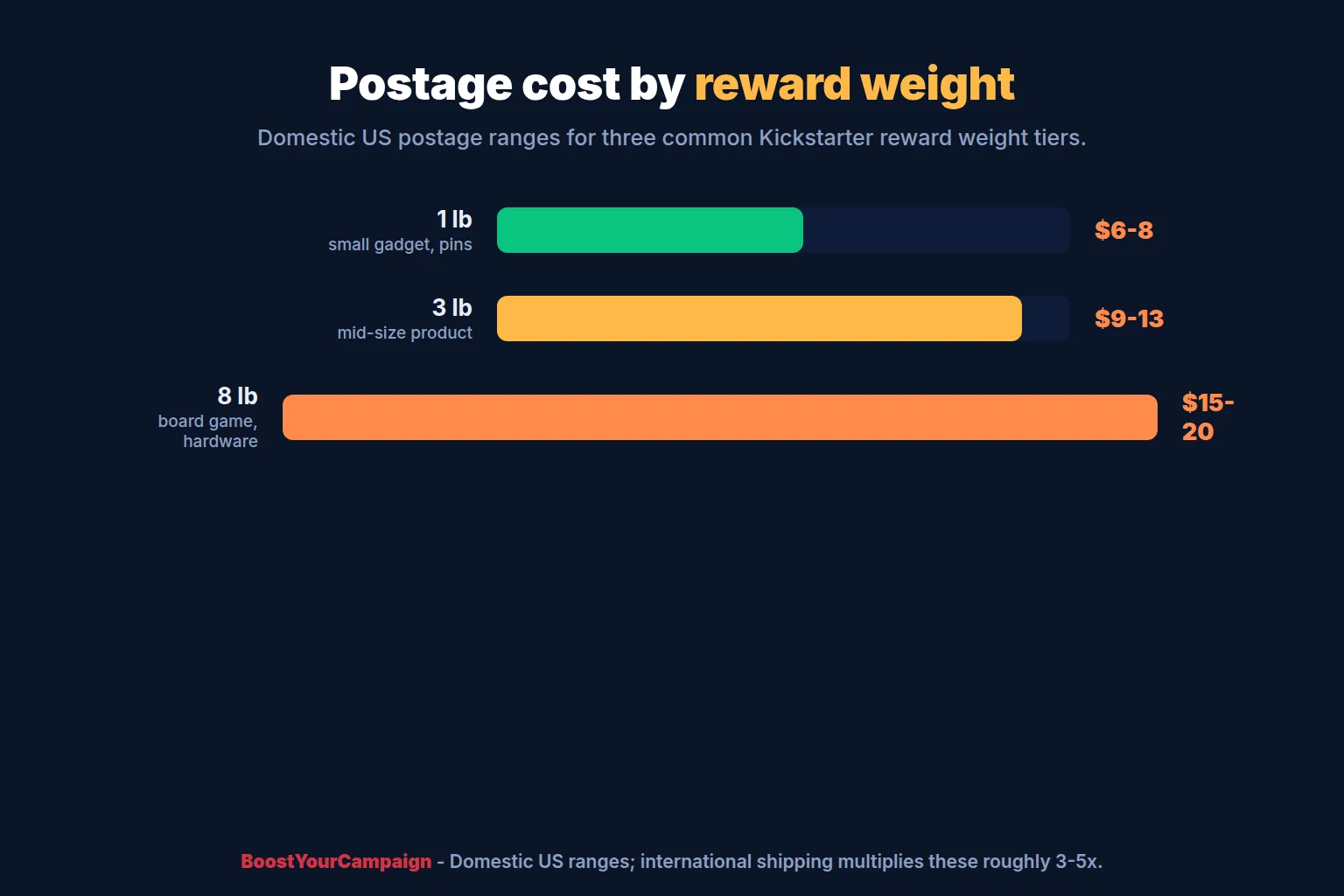
Three weight tiers cover most Kickstarter rewards, and each sits in a distinct cost band for a domestic US shipment:
1 lb (a small gadget, an enamel pin set, a slim book) typically runs roughly $6-8 domestically using a standard ground or first-class-style parcel service.
3 lb (a mid-size product, a small game with components, a stack of accessories) typically runs roughly $9-13 domestically.
8 lb (a board game, a piece of hardware, a bundle with multiple add-ons) typically runs roughly $15-20 domestically, and can go higher once the box crosses standard carrier size limits.
These ranges assume a reasonably efficient box - not oversized for the product inside. The gap between the low and high end of each range usually comes down to which service tier you pick (a slower ground option versus a faster expedited one) and how close the box sits to the next weight break. A parcel at 3.1 lbs can price like a 4 lb parcel depending on the carrier's rounding rules, so packing to stay just under a weight break is worth the extra five minutes at the packing table.
3) The international multiplier: Canada, the UK/EU, Australia, and Asia
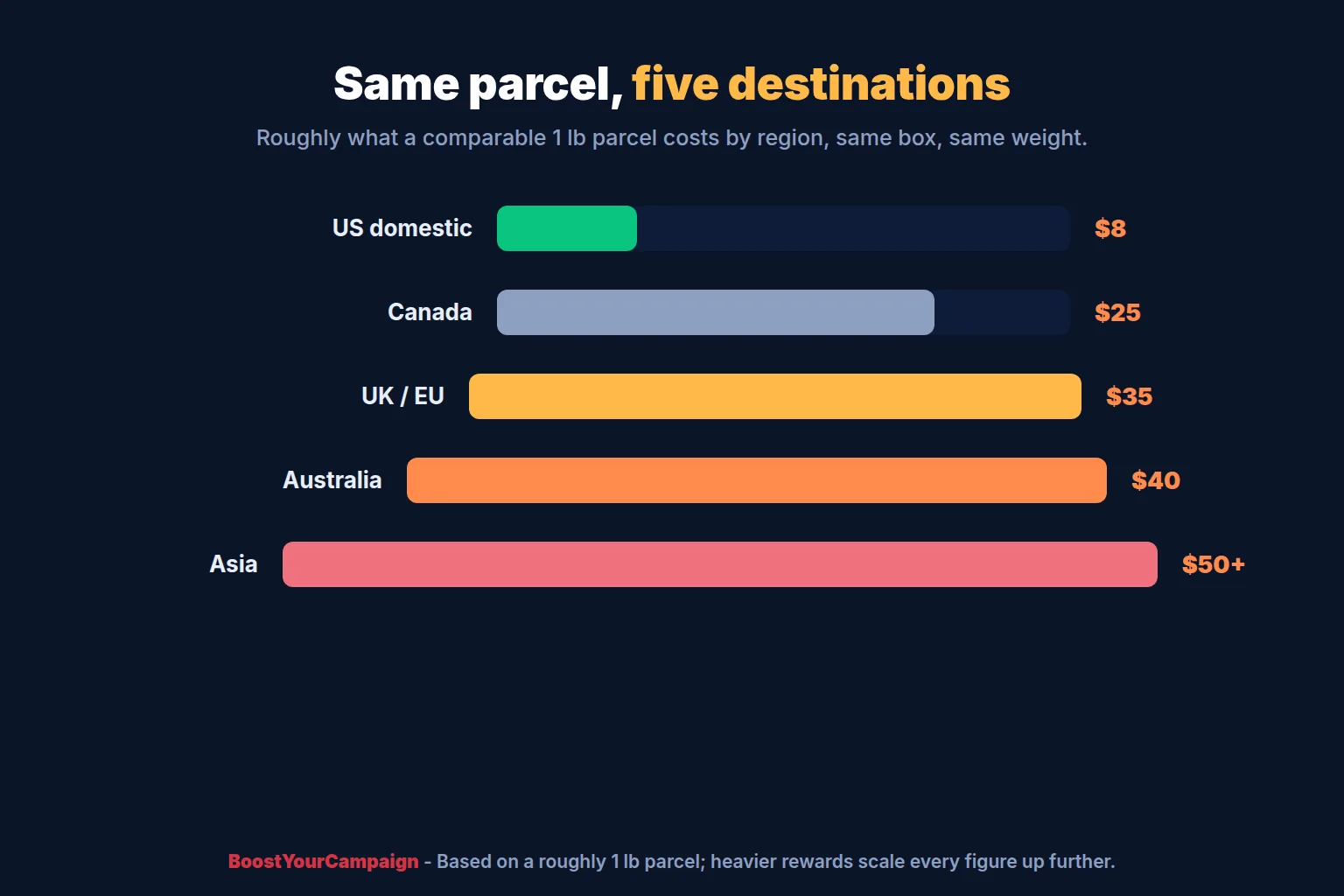
This is the number that surprises most first-time creators. International shipping is not domestic-plus-a-bit - it's a multiplier, usually somewhere in the 3-5x range over the equivalent domestic cost, and it climbs the farther the parcel travels. Using a roughly $8 domestic parcel as the anchor:
To Canada: roughly $25, driven mostly by cross-border customs handling and the carrier's international parcel rate rather than distance alone.
To the UK or EU: roughly $35, which reflects both the longer haul and the customs clearance event every parcel goes through on arrival.
To Australia: roughly $40, since it sits at the far end of most carriers' international zones.
To Asia: $50 or more, for the same reasons plus generally thinner direct carrier lanes for outbound US parcels.
These figures scale with weight the same way domestic rates do, so an 8 lb reward shipped to the UK isn't $35 - it can run well past $60-70 once you apply the same weight scaling shown in the earlier table. This is exactly why a flat "$15 international shipping" line on a campaign page is almost always wrong: it either overcharges a 1 lb Canada shipment or badly undercharges an 8 lb Asia shipment, and either way it's costing you money or conversion. Our guide to shipping rewards to Europe goes deeper on the VAT and customs side of the UK/EU numbers specifically, and our guide to customs documentation covers the paperwork that has to travel with every one of these parcels.
4) Dimensional weight: why a light box can cost like a heavy one
Carriers don't price purely on scale weight. Most use dimensional weight (sometimes called DIM weight), which calculates a billable weight from the box's length times width times height divided by a carrier-set divisor, then charges whichever number is higher - actual weight or dimensional weight. A bulky but light box, like a game with a large insert or a product shipped in an oversized mailer with a lot of empty space, can get billed at a much higher weight than the scale actually shows.
This matters most for board games and anything with rigid packaging, since the box shape is set by the product and there's less room to shrink it. The practical fix is packing to the smallest box the product safely fits in rather than the box that's easiest to grab off the shelf - a mailer that's an inch smaller on each dimension can drop a parcel into a cheaper dimensional-weight bracket even though the actual product weight hasn't changed at all. Get a sample box measured and rate-quoted before you commit to packaging at scale, not after the first pallet has already shipped.
5) Bulk freight vs individual parcels: the warehouse break-even
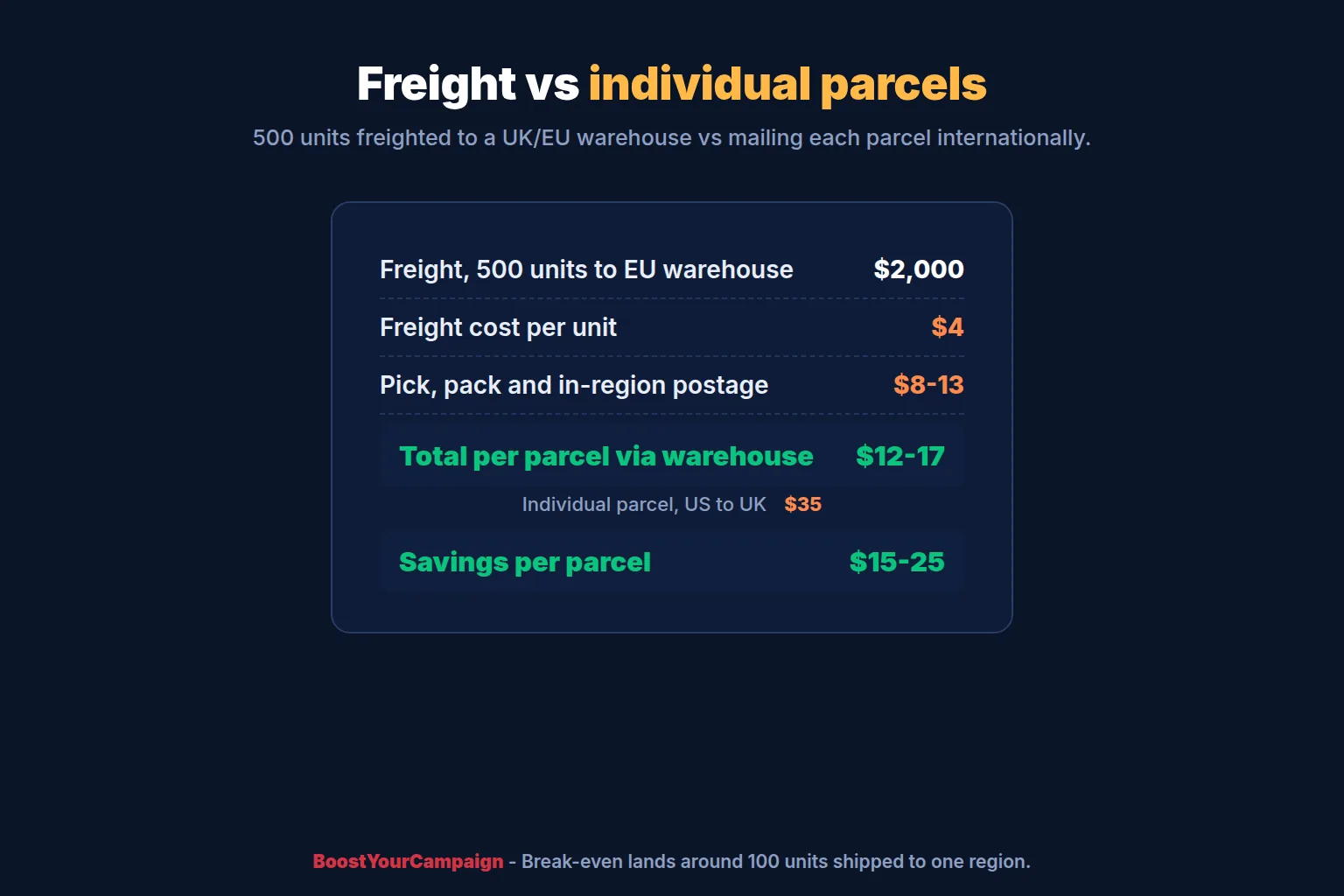
Once you have more than a handful of backers in one region, mailing each reward as its own international parcel stops being the cheapest option. The alternative is bulk freight: shipping a pallet or container of units to a regional warehouse as a single commercial import, then fulfilling each backer's order from there as a domestic or intra-region parcel instead of a cross-border one.
Here's the rough math. Freight for around 500 units into a UK or EU warehouse commonly costs somewhere around $2,000 total, which works out to about $4 per unit before pick, pack, and regional postage are added. Add pick and pack (roughly $2-4 per order) and domestic-style regional postage (roughly $6-9 for a light-to-mid parcel once it's already in-region) and the fully loaded cost per parcel through the warehouse route often lands around $12-17. Compare that to mailing the same parcel individually from a US warehouse to the UK at roughly $35, and the warehouse route saves somewhere in the range of $15-25 per parcel.
The break-even point is where that saved-per-parcel amount covers the fixed cost of the freight shipment itself. With a $2,000 freight cost and roughly $20 saved per parcel by not shipping it individually, the shipment pays for itself at around 100 units going to that region - well under the 500-unit example above. Below that volume, individual parcels can still be cheaper once you account for warehouse storage and handling fees; above it, the freight-plus-warehouse route usually wins by a wide and growing margin as backer count climbs. The exact crossover point depends on your specific freight quote and your regional backer count, so run the math against your own numbers rather than assuming the 100-unit figure applies to every campaign.
6) Pick, pack, and packaging cost
Postage is only part of the per-order cost. Pick and pack - the labor of pulling the right items for an order, checking them against the pledge, and boxing them - typically runs roughly $2-4 per order at a standard fulfillment warehouse, on top of whatever the shipping label itself costs. Multi-item orders (a base reward plus two or three add-ons) sit at the higher end of that range since there's more picking and more room for an error.
Packaging materials are a separate line again: mailers, boxes, void fill, and any protective inserts. These add anywhere from well under a dollar for a simple poly mailer up to a few dollars for a rigid box with corner protection, which matters more for fragile or heavy products. None of this shows up on a shipping rate calculator, which is exactly why creators who price shipping off a carrier's rate lookup alone routinely underprice the true landed cost per order by several dollars.
7) Carriers and services: US and EU compared
In the US, USPS generally offers the cheapest rates for light parcels and is the default choice for 1-3 lb rewards, while UPS and FedEx tend to be more competitive at higher weights and offer more predictable transit times, which matters more once a parcel gets heavy enough that a delay is costly to resend. In the UK and EU, Royal Mail plays a similar role to USPS for lighter, budget-conscious parcels, while DHL and DPD are common choices for heavier or time-sensitive shipments and for cross-border movement within Europe. None of these carriers are interchangeable on price for every weight and lane, so the right move is quoting your actual box against two or three services rather than defaulting to whichever one you used on a previous, differently-sized product.
| Approach | How it works | Main risk |
|---|---|---|
| Charge shipping at pledge | Backer pays an estimated shipping add-on when they pledge, based on their region | Estimate has to be close to real cost, or you eat the gap or scare off pledges |
| Collect shipping in the pledge manager | Backers pledge for the reward only, then pay actual shipping later once address and weight are confirmed | Some backers drop off between pledge and pledge manager checkout |
| Regional shipping tiers | Separate shipping charges for US, Canada, UK/EU, Australia, rest of world | Needs real per-region cost data, not a guess, or one region quietly subsidizes another |
| "Free shipping" baked into the reward price | One reward price, no separate shipping line, cost folded into the pledge amount | Domestic backers overpay for distant backers' shipping, and international conversion often still suffers if the price looks high |
8) Pricing shipping on the campaign page without losing backers or margin
The two broad models are charging shipping at the moment of pledge or collecting it later through a pledge manager once addresses and final reward configurations are locked in. Charging at pledge is simpler for the backer and gets the money committed early, but it forces you to estimate shipping before you know exactly what each backer ordered, which is risky if add-ons change the final weight. Collecting shipping in the pledge manager, the more common approach for campaigns with several add-ons, lets you charge the real cost once the order is finalized, at the cost of a small drop-off between people who pledge and people who complete pledge manager checkout.
Regional shipping tiers - separate charges for US, Canada, UK/EU, Australia, and rest of world - are the right level of granularity for most campaigns. Fewer tiers than that and you're forcing distant backers to either overpay relative to close ones or undercharging yourself on the far tiers. More tiers than that usually isn't worth the added complexity in the pledge manager.
"Free shipping" is the trap worth naming directly. Folding shipping into the reward price sounds backer-friendly, but it means every domestic backer is quietly subsidizing every international one through a higher headline price, and international backers often still balk at that headline price even though shipping is technically included. The campaigns that handle this best are transparent about a real, regionally accurate shipping charge rather than hiding it in the reward price and hoping nobody does the math.
9) A worked shipping cost calculator
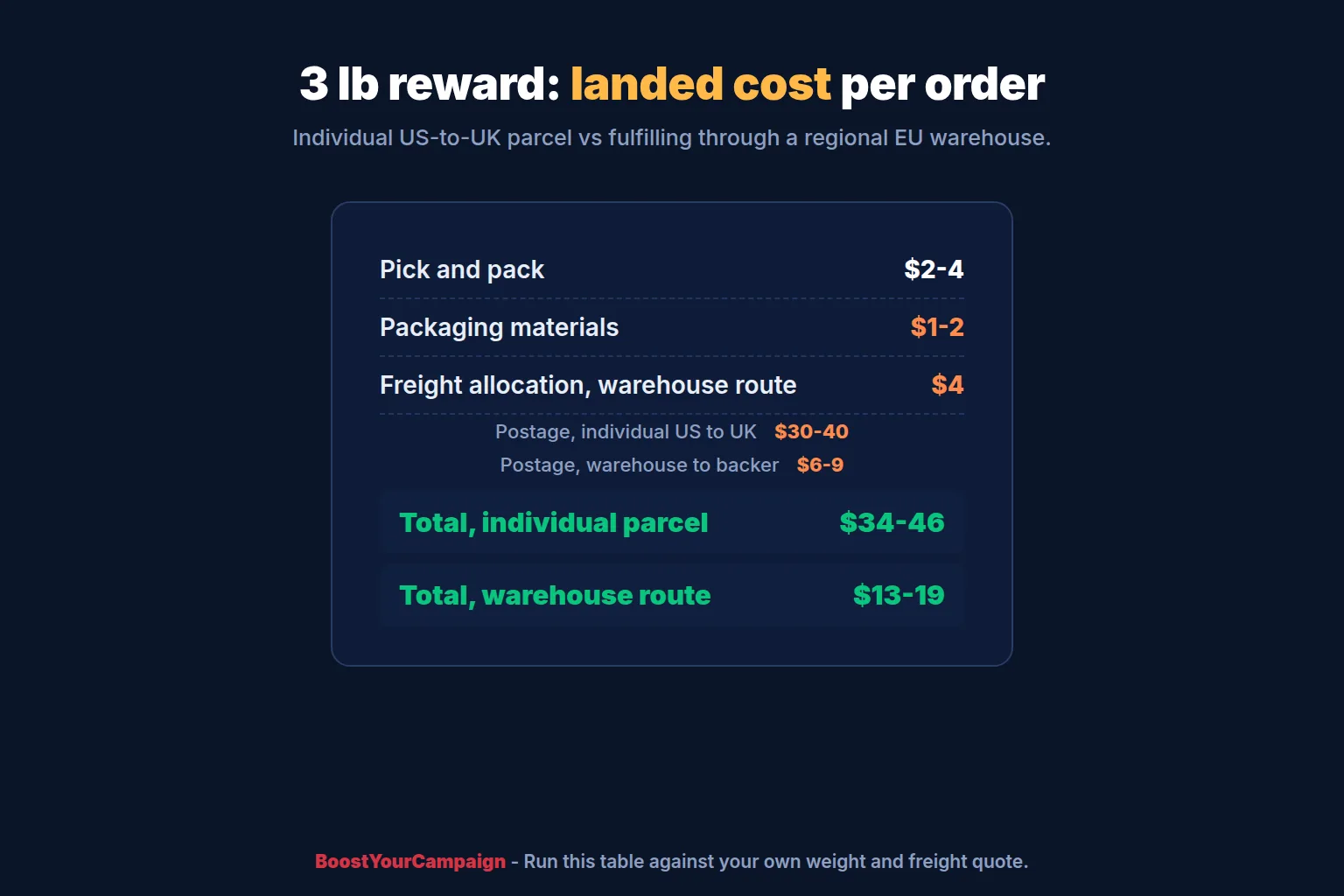
Putting the pieces from this article together, here's what a full landed cost estimate looks like for a 3 lb reward shipped two ways - individually from a single US warehouse, and through a regional EU warehouse for a UK backer:
| Cost line | Individual parcel from US | Through a regional EU warehouse |
|---|---|---|
| Pick and pack | $2-4 | $2-4 |
| Packaging materials | roughly $1-2 | roughly $1-2 |
| Freight/warehouse allocation | not applicable | roughly $4 per unit (500-unit example) |
| Postage to backer | roughly $30-40 (US to UK, cross-border) | roughly $6-9 (domestic-style, in-region) |
| Estimated total per order | roughly $34-46 | roughly $13-19 |
Run this same table against your own reward weight and your own freight quote before you set a shipping charge. The pattern holds across most weight tiers: the individual-parcel route looks fine at low backer counts, and the warehouse route pulls ahead fast once a region's backer count climbs past the break-even point described in section 5.
10) What owned US and EU warehouses actually save
Everything in section 5 and section 9 assumes you can get freight into a regional warehouse and get pick, pack, and postage handled from there without adding a new vendor relationship for every region you ship to. That's the part that's hard to arrange on your own for a single campaign - most creators can get a freight quote, but standing up warehouse receiving, inventory management, and outbound fulfillment in a second country is a real operational lift for a one-time project.
This is where an agency that owns its own fulfillment infrastructure changes the math rather than just the marketing. When the same partner runs your campaign services and your fulfillment, the regional warehouse route from section 5 isn't a vendor you have to find and vet under launch pressure - it's already there. That's the direct value behind the numbers in this article: the gap between a $35 individual UK parcel and a roughly $13-19 warehouse-routed one only closes if the warehouse relationship already exists before your campaign funds.
How BoostYourCampaign fits
BoostYourCampaign operates owned fulfillment warehouses in both the US and the EU, which is the infrastructure behind the break-even math in section 5. Instead of quoting a hypothetical freight-to-warehouse setup, BYC already runs receiving, pick and pack, and regional outbound shipping in both regions, so the savings shown in the worked example in section 9 are available without you having to build that relationship from scratch under a launch deadline.
The agency has been active since 2010 across 4,600+ campaigns with $734M+ raised and a 4.9/5 score across 300+ verified reviews. BYC uses a skin-in-the-game ad model, investing its own money alongside the client's ad budget with fixed fees rather than a percentage-of-raise commission, and pairs that with the fulfillment operation described above so shipping costs get modeled correctly before reward prices go live, not discovered afterward. BYC also runs post-campaign ecommerce and Shopify growth work for creators who want to keep selling after the campaign ends, which uses the same warehouse infrastructure covered in this article. Our Kickstarter fulfillment guide and Indiegogo fulfillment guide cover the platform-specific fulfillment timeline in more depth, our board game fulfillment guide goes deeper on the heaviest, highest-cost category, and our crowdfunding fulfillment services overview and fulfillment companies comparison put BYC's approach next to the alternatives. For the paperwork side of every one of these shipments, see our customs documentation guide, and for how shipping costs interact with platform fees, see our Kickstarter and Indiegogo fees guide.
Before you price shipping on your campaign page: a quick checklist
| Question | Why it matters |
|---|---|
| Have you weighed the fully packed reward, not just the product? | Packaging and add-ons routinely push a reward into a more expensive weight bracket. |
| Do you have separate cost estimates for domestic, Canada, UK/EU, Australia, and Asia? | A flat international rate almost always overcharges one region and undercharges another. |
| Have you checked dimensional weight against your actual box dimensions? | A bulky, lightweight box can bill at a higher weight than the scale shows. |
| Have you run the freight-to-warehouse break-even for your biggest region? | Past a certain backer count, bulk freight into a regional warehouse beats individual parcels by a wide margin. |
| Does your shipping charge include pick, pack, and packaging, not just postage? | Postage alone routinely understates true per-order cost by several dollars. |
| Are you charging at pledge or collecting shipping in the pledge manager? | Each approach shifts risk differently between you and the backer, and the wrong one for your add-on structure costs margin. |
If you would rather not run the shipping yourself, our US fulfillment service and EU fulfillment service quote real per-parcel costs from the reward list before you price your tiers.
Want these bands applied to your own backer split? Use our free Kickstarter shipping cost calculator to estimate per-order and total cost by region for both fulfillment models.
Frequently Asked Questions
How much does it cost to ship Kickstarter rewards?
Domestically in the US, a light reward typically costs roughly $6-8, a mid-weight reward roughly $9-13, and a heavier reward roughly $15-20. Internationally, expect roughly 3-5 times the domestic cost - about $25 to Canada, $35 to the UK or EU, $40 to Australia, and $50 or more to Asia for a comparable parcel. Get a real quote against your packed weight before pricing reward tiers.
Why is international shipping so much more expensive than domestic?
International parcels go through customs clearance, use different carrier networks with fewer direct lanes, and carry higher handling and documentation costs than domestic mail. Those combine into a multiplier effect rather than a flat markup, which is why the gap between domestic and international cost grows rather than staying constant as weight increases.
Is it cheaper to ship in bulk to a warehouse than individually to backers?
Past a certain volume, yes, often by a wide margin. Freight for around 500 units into a regional warehouse can cost roughly $2,000 total, and fulfilling from there as domestic-style parcels can save roughly $15-25 per parcel compared to mailing each one internationally. The break-even point depends on your freight quote and backer count in that region, but it's frequently well under 500 units.
What is dimensional weight and why does it matter for Kickstarter rewards?
Dimensional weight is a billable weight carriers calculate from a box's dimensions rather than its actual scale weight, and they charge whichever number is higher. A bulky but light box, like a board game with a large insert, can get billed at a higher weight than the scale shows, so packing to the smallest safe box size can meaningfully lower the shipping cost.
Should I charge shipping at pledge or collect it in the pledge manager?
Charging at pledge is simpler and gets money committed early but forces an estimate before the final order is known. Collecting shipping in the pledge manager lets you charge the real cost once add-ons and address are confirmed, at the cost of some drop-off between pledge and pledge manager checkout. Most campaigns with several add-ons do better collecting it in the pledge manager.
Is "free shipping" a good idea for a Kickstarter campaign?
Usually not. Folding shipping into the reward price means domestic backers subsidize international ones through a higher headline price, and international backers often still hesitate at that price even though shipping is technically included. A transparent, regionally accurate shipping charge tends to convert better and protect margin more reliably than hiding the cost in the reward price.
How much should I budget for pick and pack on top of postage?
Roughly $2-4 per order at a standard fulfillment warehouse, plus packaging materials that typically run under a dollar to a few dollars depending on the box or mailer. Neither of these show up on a carrier's rate lookup, so budgeting postage alone as the shipping cost usually understates the real per-order cost by several dollars.
If you want your shipping costs modeled correctly, by weight and by region, before you set reward prices, reach out through /contact.
Want results like these for your campaign?
We've helped 4,600+ creators raise over $734M. Let's pressure-test your launch plan and find the highest-leverage fixes before you go live.
Talk to an expert →Get the free 87-step launch checklist
The exact pre-launch, live-campaign and fulfillment steps we use across 4,600+ launches. Free PDF, emailed instantly.
You're in - check your inbox. Open the checklist now ->