Comparing options before you sign anything? If you want a direct read on fit and budget, contact our team for a no-pressure breakdown.
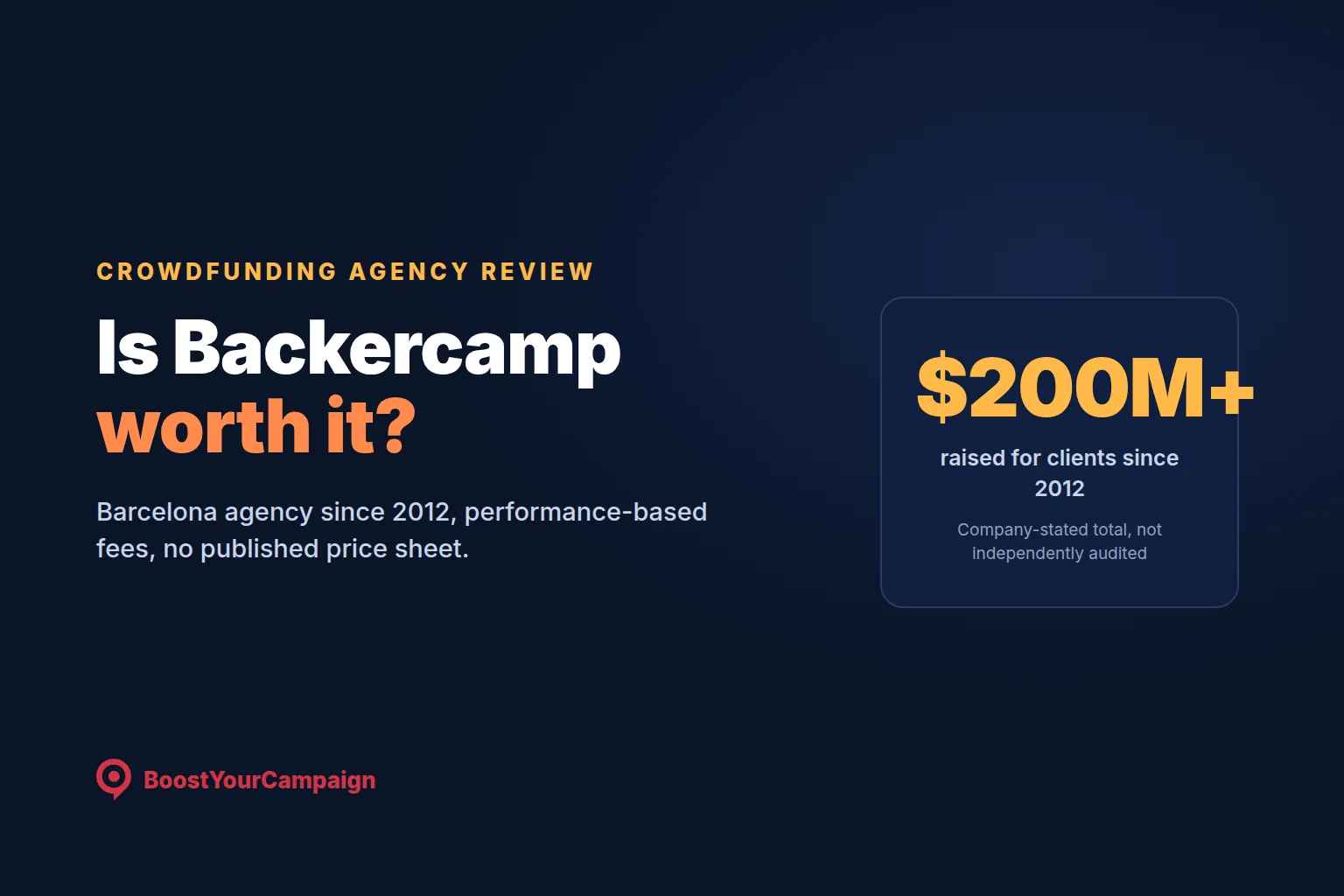
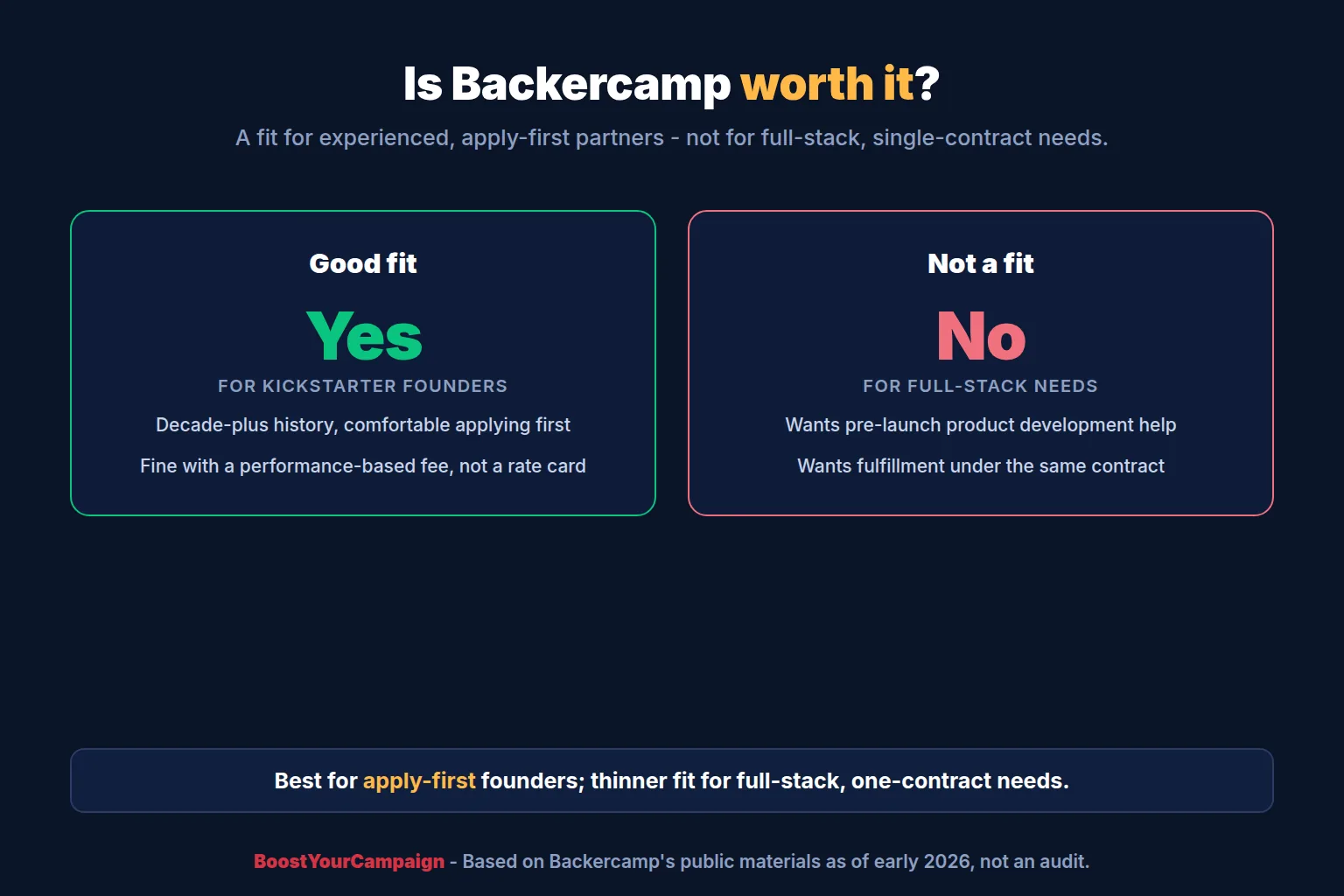
Quick answer: Backercamp is a Barcelona-based agency that has worked in crowdfunding since 2012, built primarily around Kickstarter and Shopify-based ecommerce, with Indiegogo campaigns appearing among its client testimonials. Based on public information, it is generally worth it for founders who want an experienced, apply-first partner for campaign marketing and backer acquisition and who are comfortable with a performance-based model instead of a published price sheet. It is a weaker fit for teams that specifically need pre-launch product development, owned fulfillment infrastructure, or one contract covering everything from concept to shipped reward, since Backercamp's public materials do not describe that as part of its scope.
What Backercamp actually offers
Backercamp's own site describes it as a full-service crowdfunding marketing group that has been "in service since the early days of crowdfunding," dating its founding to 2012. The company is headquartered in Barcelona, in an office the site notes overlooks Casa Batllo, and states it works with clients globally. That Barcelona base is a point of differentiation worth naming on its own: most of the well-known names in crowdfunding marketing are US-based, so a founder outside North America may find a European team easier to schedule around or more familiar with EU-specific backer behavior. Whether that translates into better results for a given product is not something public information can settle either way, but it is a reasonable factor to weigh if time zone overlap and EU market experience matter to you.
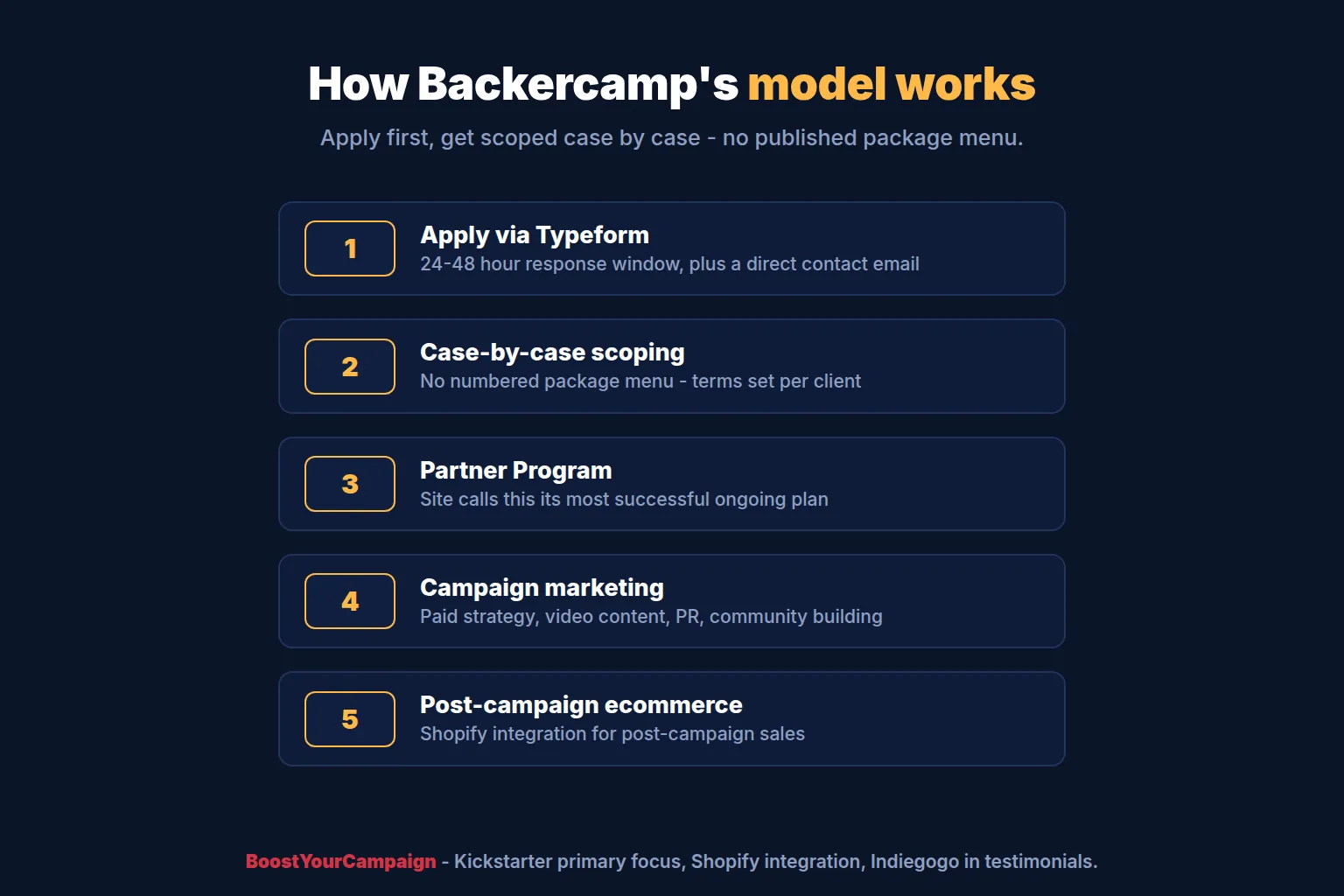
Based on the company's own pages, the service scope includes:
- Performance-driven paid marketing strategy for live campaigns
- Video marketing and content production
- Budget forecasting, reporting, and analytics
- Community building and social/influencer-style promotion
- PR support
- Post-campaign ecommerce support, including a Shopify integration
- Pre-application feedback on campaign readiness
Backercamp's site refers to a "Partner Program" as its "most successful service plan," which reads as a closer, ongoing working relationship rather than a one-off service purchase. The company does not publish a numbered menu of packages the way some agencies do. Instead, engagement appears to be scoped case by case: prospective clients apply through a Typeform on the site, and Backercamp states a 24-48 hour response window, with a direct contact email also listed for questions before applying.
Platform focus, based on the public site, centers on Kickstarter and Shopify, with Indiegogo campaigns showing up in client testimonials rather than being called out as a dedicated primary channel the way Kickstarter is.
Backercamp's history and track record
Backercamp's about page lays out a timeline of self-reported milestones: over 1,000 projects served by 2015, more than $100 million raised across its client campaigns by 2017, and more than $200 million by 2018. As of the current version of its site, Backercamp states it has worked with 5,000+ projects across 30+ countries, with marketing reach the company describes as extending into 80+ countries. Named highlight campaigns on the site include OYO NOVA Gym (cited at $6.4 million-plus), La Mansio (cited at $3.7 million-plus), and the GAMMA Jacket (cited at roughly $2.9 million).
These are figures the company publishes about itself, not numbers we independently audited against platform data, so it is fair to treat them as claimed track record rather than third-party-verified totals. That is common across the crowdfunding agency category, where most companies self-report highlight campaigns rather than publishing a full, auditable client list.
What kind of campaigns fit Backercamp's portfolio
Backercamp does not publish a stated category specialization, so this section is inference based on the handful of campaigns the company chooses to highlight, not a claim the company makes about itself. The named highlight campaigns span fitness equipment (OYO NOVA Gym), furniture or home goods (La Mansio), and apparel (the GAMMA Jacket), which points to a mix of physical consumer product categories rather than a single niche like tech gadgets or games. A history dating back to 2012 and a client base described as spanning 30+ countries suggests the agency has worked across a fairly wide range of product types, though founders in a specific category should still ask directly for comparable case studies before assuming fit, since a highlight reel of three named campaigns is a thin sample to generalize from.
It is also worth noting what is absent from the public highlight list: software, apps, tabletop games, and publishing projects, categories where other crowdfunding agencies specifically advertise expertise, are not called out in Backercamp's public materials. That does not mean the agency has not worked in those categories, only that it has not chosen to feature them prominently, which is itself a data point worth asking about directly during an application conversation.
Pricing: what's public and what isn't
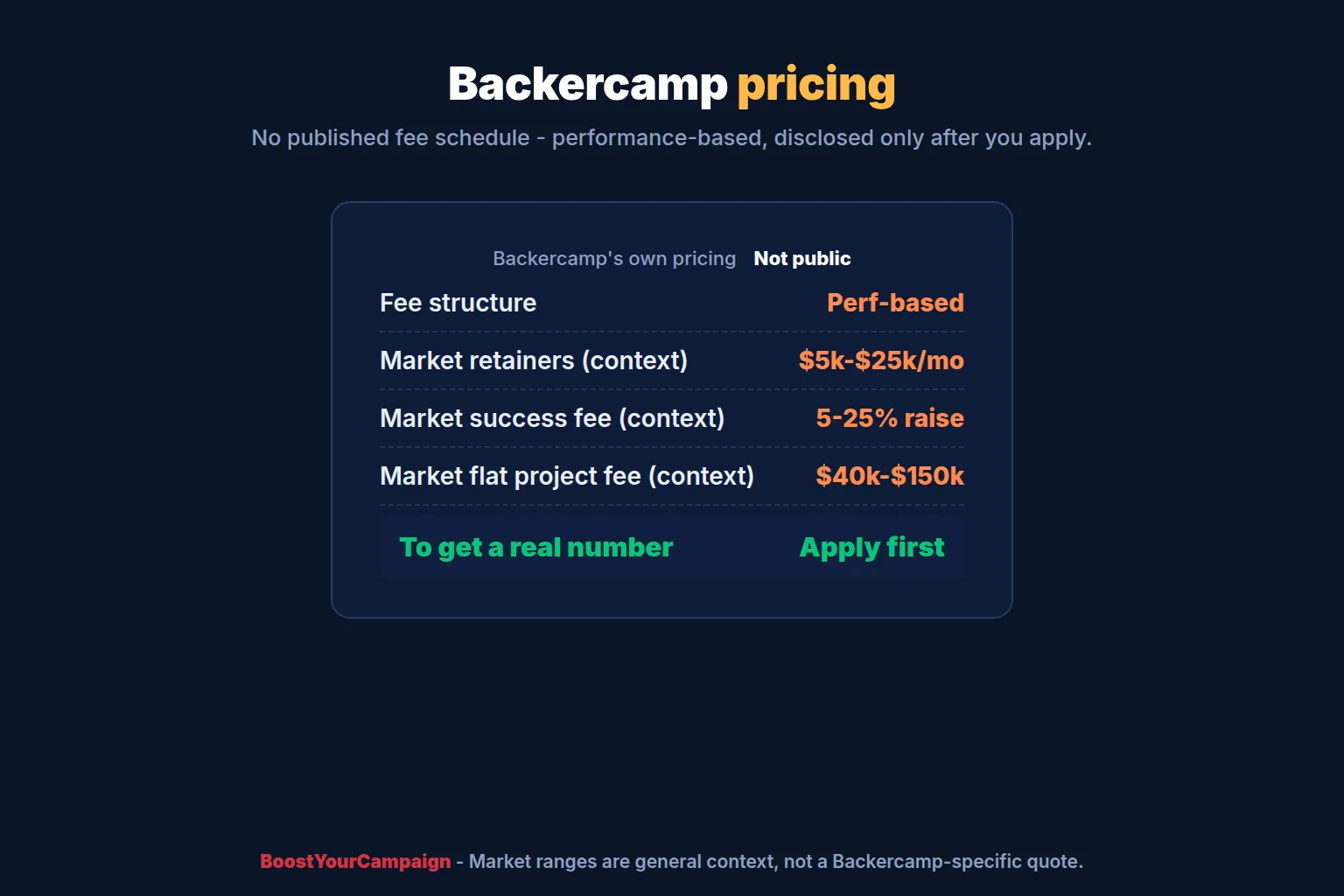
Backercamp does not publish a fee schedule, a percentage of raise, or a retainer figure anywhere on its site. Its language around compensation is consistently framed as performance-based, meaning payment is tied to results the campaign generates rather than a flat fee paid regardless of outcome. The exact percentage, minimum spend, or contract structure is not disclosed publicly, and the only way to get a real number is to apply and go through the company's intake process.
For general context, not a Backercamp-specific quote, the broader crowdfunding agency market in 2026 spans roughly $5,000 to $25,000 in monthly retainers, 5% to 25% of raise as a success fee, or $40,000 to $150,000 in flat project fees, depending on scope and campaign size. That range is a useful anchor for budgeting conversations, not a stand-in for what Backercamp itself would propose. Our own crowdfunding marketing agency cost guide breaks that range down in more detail.
A performance-based fee has real trade-offs worth thinking through before applying. On one hand, it can lower the financial risk of hiring an agency for a founder who has not yet proven a product can convert, since compensation is tied to results rather than paid regardless of outcome. On the other hand, performance-based arrangements sometimes come with less flexibility once a contract is signed, since the agency's incentives are built around a specific fee structure that may be harder to renegotiate mid-campaign than a flat retainer would be. Neither of those points is specific to Backercamp; they are general considerations for any performance-based crowdfunding agency relationship, and worth asking about directly during the application process.
How the market describes Backercamp: two different pictures
Looking past Backercamp's own site to how third parties cover it, the picture is not fully consistent, and that's worth naming plainly. Some independent agency roundups describe Backercamp mainly as a backer-acquisition and newsletter-placement partner: a company that connects a campaign to its existing backer network and community list, priced per placement rather than a full retainer, and best used alongside a separate team handling strategy, page design, ads, and PR. In that framing, Backercamp is a supplementary channel, not the lead agency running the whole campaign.
Other independent coverage describes Backercamp in more full-service terms, pointing to video content production and cross-market campaign adaptation for international audiences as particular strengths. Backercamp's own site sits closer to this second description, listing marketing strategy, video, PR, community, and post-campaign support as part of its stated work.
Given that mix of outside descriptions, the honest takeaway is: confirm the exact scope of any engagement directly with Backercamp before assuming a specific bundle of deliverables. What one third-party list calls a backer-acquisition add-on, the company's own materials describe as a fuller marketing partnership, and only a direct conversation resolves which applies to your campaign.
Who Backercamp is likely worth it for
- Founders who want an agency with over a decade of crowdfunding-specific history rather than a newer entrant.
- Teams comfortable applying first and negotiating terms before seeing a published price list.
- Campaigns primarily on Kickstarter, or ones that will move to Shopify for post-campaign ecommerce.
- Founders who are comfortable with a performance-based fee tied to results rather than a fixed monthly retainer.
In that setup, a long operating history and a results-linked fee structure can be a reasonable trade-off for founders who want experience without a large fixed cost up front. It also tends to suit founders who already have a product photographed, priced, and ready to sell, and mainly need the marketing and backer-acquisition layer executed well, rather than founders who need help shaping the offer itself from an early prototype.
Where the scope may fall short
Based on what is publicly available, a few gaps are worth naming directly:
- No published fulfillment or warehouse infrastructure. Post-campaign logistics are not described as part of the stated service list.
- No published in-house product-development or MVP service for teams still finalizing what they're building.
- No published pricing, so comparing budget against other agencies requires applying first rather than reading a rate card.
- Thin independent review data. A search for third-party reviews, including Trustpilot, does not surface a dedicated, verified Backercamp profile as of early 2026, so there isn't a public review score to weigh the way there is for some competitors in this category.
None of these gaps are unusual for a marketing-focused crowdfunding agency. They matter mainly for founders who specifically want one vendor covering product development, marketing, and fulfillment under a single contract, or who weigh independent review data heavily when choosing between agencies and would rather see a large, verifiable review sample than rely on the company's own published milestones.
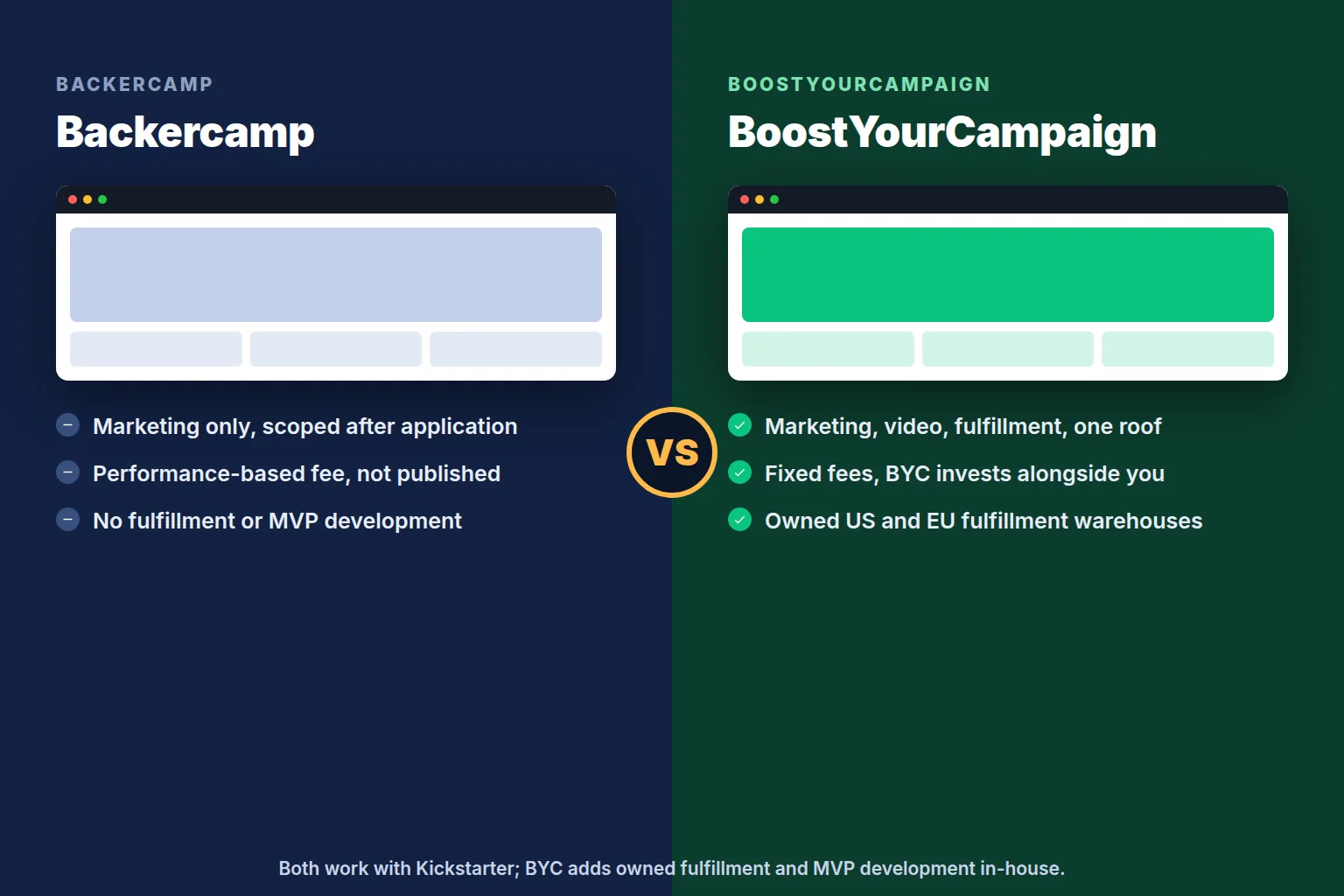
| Category | Backercamp | BoostYourCampaign |
|---|---|---|
| Core model | Crowdfunding marketing and backer acquisition, scoped case by case after application | Full-stack done-for-you: campaign marketing + video + fulfillment under one roof |
| Platforms | Kickstarter primary focus, Shopify integration, Indiegogo in client testimonials | Indiegogo Approved Agency; supports Kickstarter and Indiegogo launches |
| Pricing structure | Performance-based, not publicly disclosed; requires applying to get a number | Fixed-fee model with skin in the game: BYC invests its own money alongside the client's ad budget |
| Creative production | Video marketing listed as a service, production setup not publicly detailed | Owned video studios in the US and EU |
| History | Founded 2012, headquartered in Barcelona | Operating since 2010 |
| Self-reported track record | 5,000+ projects, $200M+ raised (company-stated milestones) | 4,600+ campaigns, $734M+ raised, 4.9/5 across 300+ verified reviews |
| Post-campaign and fulfillment | Not listed in public materials | Post-campaign ecommerce and owned US + EU fulfillment warehouses |
| Product development | Not listed in public materials | In-house MVP development (MVP services) |
| Partnership credentials | Not listed in public materials | Indiegogo Approved Agency, Google Premier Partner, Facebook Marketing Partner, official Shopify Partner, Amazon Partner |
| Independent review data | No dedicated, verified review-platform profile found as of early 2026 | 4.9/5 across 300+ verified reviews, plus a Kevin O'Leary video testimonial (reviews page) |
BoostYourCampaign as the full-stack alternative
If the goal is one partner across the whole launch lifecycle rather than a marketing-only engagement scoped after an application, BoostYourCampaign runs a full-stack, done-for-you model. Campaign marketing, video production, and fulfillment sit under one roof, which removes the coordination work of hiring a marketing agency, a separate video team, and a separate fulfillment provider individually. On paid acquisition, BYC uses a skin-in-the-game structure: fixed fees, with BYC investing its own money alongside the client's ad budget instead of charging a percentage of the raise. For creative, BYC operates owned video studios in the US and EU.
On platform and partnership credentials, BYC is an Indiegogo Approved Agency, a Google Premier Partner, a Facebook Marketing Partner, an official Shopify Partner, and an Amazon Partner. Beyond the campaign itself, BYC operates owned fulfillment warehouses in the US and EU and has in-house MVP development support (see MVP development) for teams still finalizing a product before launch. The team can also help with introductions to major retailers, including Best Buy, without guaranteeing placement. Client products have gone from a BYC-run crowdfunding launch to Shark Tank coverage (press page), and Kevin O'Leary has given a video testimonial about the agency (reviews page).
For long-term confidence, BYC cites operating history since 2010, 4,600+ campaigns, $734M+ raised, and a 4.9/5 rating across 300+ verified reviews. Where Backercamp's public materials leave scope and pricing to a case-by-case application conversation, BYC's model is built to be evaluated up front: fixed fees, a stated review score with a large sample size, and named partner credentials that a founder can verify independently before signing anything. That is not a claim that one approach is universally better, since a founder who wants a lean, performance-based marketing partner and nothing else may genuinely prefer Backercamp's model. It is simply a different shape of engagement, and worth comparing directly against your own priorities rather than against price alone.
If you want to see how other agencies in this category compare side by side, our top crowdfunding marketing agencies guide is a useful starting point, and our agency cost guide covers pricing models across the category in more depth. We have also reviewed other agencies in this space, including Jellop, LaunchBoom, Funded Today, and BackerKit, if you are comparing more than one option.
Frequently Asked Questions
Is Backercamp legit?
Based on public information, Backercamp is an active agency that has operated in the crowdfunding space since 2012, with self-reported milestones including 5,000+ projects and $200M+ raised, and named client campaigns listed on its own site. We did not independently audit those figures.
How much does Backercamp charge?
Backercamp does not publish pricing. It describes its model as performance-based, meaning fees are tied to results rather than a flat rate, but the exact percentage or minimum spend is not disclosed publicly. You would need to apply to get a specific number.
What platforms does Backercamp work with?
Based on the company's own site, the primary focus is Kickstarter, with a Shopify integration for post-campaign ecommerce. Indiegogo campaigns appear in client testimonials, though it is not called out as a dedicated primary channel the way Kickstarter is.
Does Backercamp handle fulfillment?
Fulfillment and warehousing are not listed among Backercamp's public services. Its stated scope centers on marketing, video, PR, community building, and post-campaign ecommerce support rather than physical logistics.
How long has Backercamp been in business?
Backercamp's own site dates its founding to 2012, describing itself as operating since the early days of crowdfunding, and is headquartered in Barcelona.
Are there independent reviews of Backercamp?
A search for third-party review data, including Trustpilot, did not surface a dedicated, verified Backercamp profile as of early 2026. Third-party agency roundups do cover the company, though they describe its scope somewhat differently from one another, so it is worth reading a few sources rather than one.
How does Backercamp compare to a full-service, all-in-one agency?
Backercamp's public materials focus on marketing, video, and post-campaign ecommerce support. They do not describe owned fulfillment infrastructure or in-house product development, which a full-stack alternative like BoostYourCampaign includes under one contract. If your product still needs development work before it is ready to launch, or you want warehousing and shipping handled by the same company running your ads, that gap is worth resolving before you sign with any marketing-only agency.
What if I need one partner from pre-launch through fulfillment?
That is where a full-stack model tends to fit better. BoostYourCampaign's stated model includes campaign marketing, video production, and owned US + EU fulfillment operations in one system, rather than requiring separate vendors at each stage.
If you want help comparing your options based on your product, budget, and timeline, contact BYC here for a direct recommendation.
Want results like these for your campaign?
We've helped 4,600+ creators raise over $734M. Let's pressure-test your launch plan and find the highest-leverage fixes before you go live.
Book a free strategy call →Get the free 87-step launch checklist
The exact pre-launch, live-campaign and fulfillment steps we use across 4,600+ launches. Free PDF, emailed instantly.
You're in - check your inbox. Open the checklist now ->