Fees are the smallest line on a real crowdfunding budget. If you want the whole budget - platform fees, ads, video, and fulfillment - planned as one number before you set a funding goal, talk with BoostYourCampaign.
Kickstarter charges a 5% platform fee plus payment processing that Kickstarter lists as 3% to 5% depending on country, with an added fixed fee per pledge (roughly $0.20 for standard pledges, lower for pledges under $10). Indiegogo now runs on the same 5% platform fee since its 2025 acquisition by Gamefound folded Indiegogo onto Gamefound's fee structure, with payment processing around 3% plus a small fixed per-transaction fee. Gamefound itself charges the identical 5% plus roughly 3% and a per-transaction fee. On every platform, combined platform and processing fees land around 8-10% of what you raise - and that's the smallest number in your actual budget. Ads, video, fulfillment, VAT, pledge manager fees, and dropped pledges are what really decide what you keep.
- Platform fees are nearly identical across platforms - Kickstarter, Indiegogo, and Gamefound all sit around 5% platform plus roughly 3% processing.
- Payment processing varies by country - Kickstarter itself lists a range, not one flat global number.
- Indiegogo changed its fee structure in late 2025 - after Gamefound's acquisition, Indiegogo moved to Gamefound's flat 5% model and is fixed-funding only now.
- Dropped and failed pledges cost money you never see - a percentage of pledges never actually charge successfully.
- The real budget is ads, video, and fulfillment - these line items are typically many times larger than the platform fee.
- A $100,000 raise nets far less than $95,000 - once every real cost is counted, not just the platform's cut.
1) What Kickstarter actually charges
Kickstarter's platform fee is 5% of the total funds a successfully funded project raises. On top of that sits payment processing, handled through Stripe, which Kickstarter lists as roughly 3% to 5% of each pledge depending on the backer's country and card type, plus a fixed fee per pledge that's commonly around $0.20 for standard pledges. Pledges under $10 use a different split - a higher percentage cut but a smaller fixed fee, since a flat $0.20 on a $5 pledge would eat an outsized share of a small contribution.
Kickstarter lists this range rather than one single global number because processing costs differ by country and by how the backer pays, so a campaign with a lot of international backers or a lot of small pledges will land at a different effective rate than a campaign concentrated in large US pledges. The practical range creators should plan against is a combined 8-10% of total funds raised for platform fee plus processing, all of it collected automatically before the payout reaches your account.
One structural point worth remembering: Kickstarter is all-or-nothing. If a project doesn't reach its funding goal, no fees are collected at all, not even on individual pledges that would otherwise have charged successfully. That protects unfunded projects from a fee bill, but it also means a campaign that barely misses its goal walks away with nothing, which is part of why goal-setting strategy matters as much as fee math.
2) What Indiegogo actually charges, and what changed in 2025
Indiegogo's fee structure changed meaningfully in late 2025. Gamefound, the tabletop-focused crowdfunding platform, acquired Indiegogo, and the combined platform moved Indiegogo onto Gamefound's fee model: a flat 5% platform fee plus payment processing around 3% and a small fixed per-transaction fee, in place of Indiegogo's older fee arrangement. The upgraded platform went live in October 2025, and campaigns launched since then run on this newer structure.
The bigger practical change for creators is that Indiegogo is fixed funding only now. Flexible funding, which used to let a campaign keep whatever it raised even if it missed its goal, was discontinued - every campaign now works on an all-or-nothing basis like Kickstarter, so a campaign that doesn't reach its goal doesn't collect pledged funds or pay fees on them. If you've seen older guides describing Indiegogo's flexible funding option, treat that as outdated: it no longer exists on the current platform.
Indiegogo's continued sales phase after the main campaign window closes is called Late Pledge, formerly called InDemand. It still functions as an ongoing pre-order channel post-campaign, and fees on Late Pledge sales generally follow the same structure as the main campaign, though creators should confirm current terms directly since post-acquisition documentation is still settling.
3) What Gamefound charges, for comparison
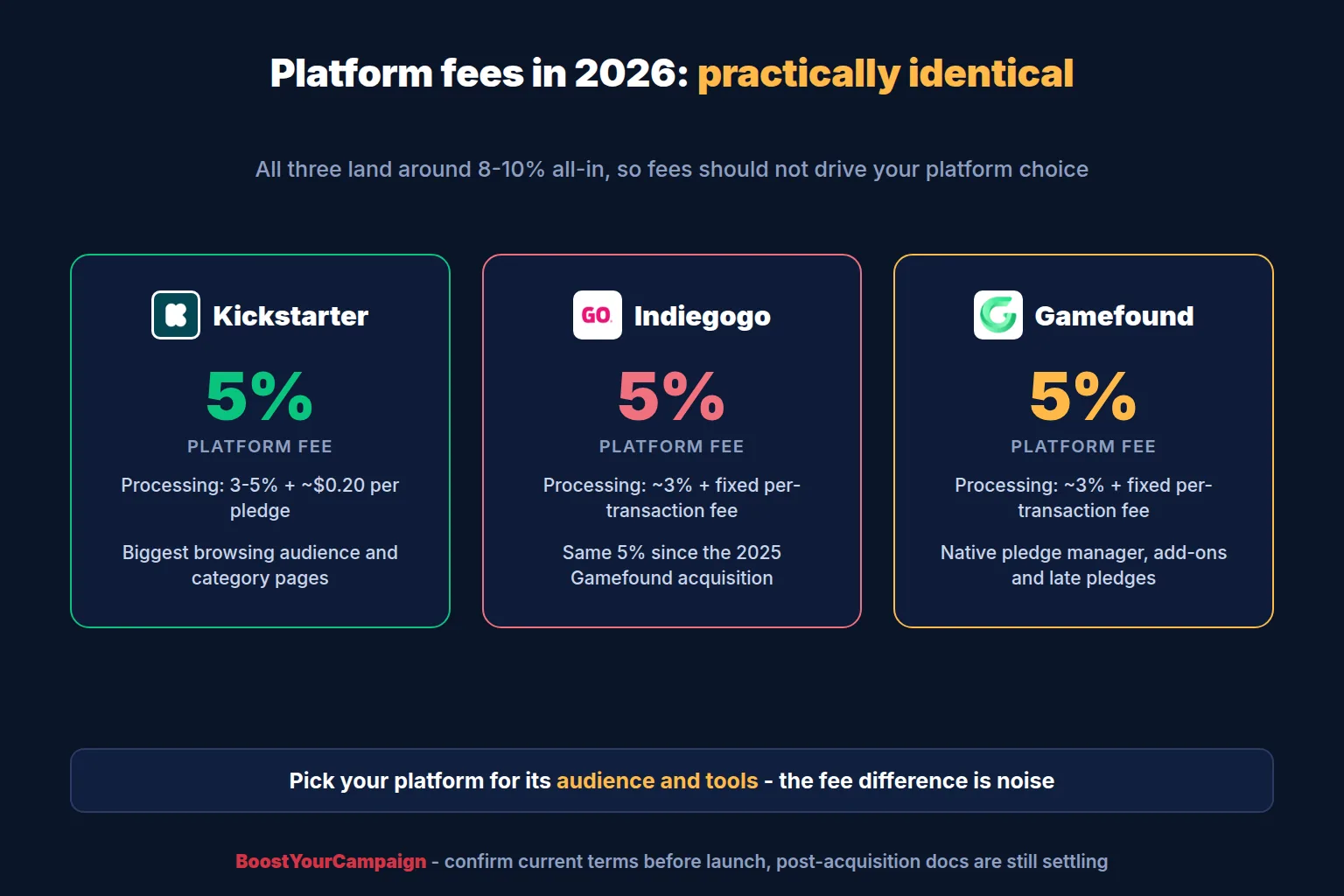
Gamefound, which has grown into a serious alternative for tabletop and board game crowdfunding specifically, charges a 5% platform fee on funds collected, plus payment processing of roughly 3% and a small fixed fee per transaction. That's now the same basic shape as Indiegogo's post-acquisition structure, which makes sense given the two platforms are now under common ownership.
Where Gamefound differs from Kickstarter and Indiegogo in practice is less about the fee percentage and more about its built-in pledge manager and tools designed specifically for tabletop campaigns - add-ons, shipping calculation by region, and late pledge handling are native to the platform rather than requiring a separate pledge manager tool. For a board game creator weighing platforms, the fee difference between all three is now small enough that platform choice should be driven by audience and discovery mechanics, not by fee math alone.
4) Dropped and failed pledges: the cost you don't see coming
A meaningful share of pledges made during a live campaign never actually charge successfully. A backer's card can decline at the moment of charge, whether because of an expired card, insufficient funds, or a fraud flag from the card issuer, and platforms typically give backers a short window to fix a failed payment method before the pledge is dropped entirely. Campaigns commonly see somewhere in the low single digits to as much as 10% of total pledged funds fail to collect, depending on category and how well the campaign follows up with backers whose cards declined.
This matters because your funding total, the number shown on the campaign page and celebrated at goal, is not the number that actually lands in your account. Budgeting against the headline funding total rather than a realistic collected total after drop-off is one of the more common ways creators end up short on production budget after the campaign closes. Building a 3-8% cushion into your budget for this, rather than assuming every dollar pledged becomes a dollar collected, avoids a nasty surprise once the campaign closes and payout hits.
5) The real budget: ads, video, fulfillment, and everything else
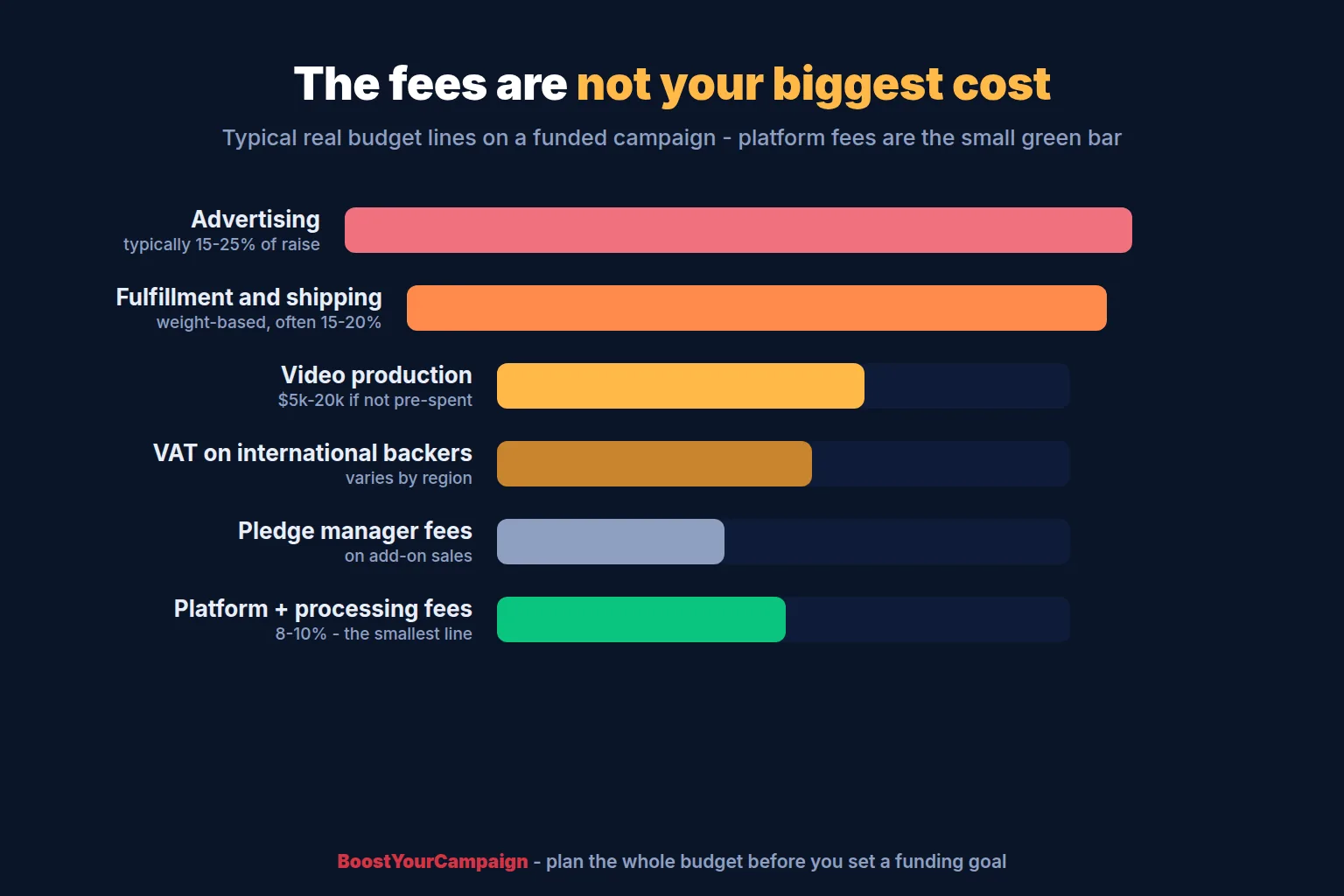
Platform and processing fees combined typically run 8-10% of funds raised. That's the smallest real number in a crowdfunding budget, and creators who stop their fee research at the platform's own fee page usually end up badly underestimating what a campaign actually costs to run. The bigger line items, in rough order of size for a typical hardware or tabletop campaign, are marketing and paid ads, video production, fulfillment and shipping, and a handful of smaller costs that add up: VAT and duties, pledge manager fees, and refunds or chargebacks.
Marketing and paid ad spend is usually the largest controllable line item after the cost of goods themselves. A campaign that wants meaningful reach beyond its existing email list and social following needs an ad budget, and that budget is separate from and usually larger than what the platform itself charges. Our full Kickstarter cost breakdown goes deeper on how ad spend typically scales with funding goal.
Video production is the second major line most first-time creators underprice. A campaign video that actually converts cold traffic costs real production time and equipment, and a weak, self-shot video is one of the more common reasons an otherwise good product underfunds. Fulfillment and shipping, covered in detail in our fulfillment companies guide, is the line most likely to be underestimated because creators often price it off a rough guess rather than an actual quote against packed weight and destination.
VAT and duties apply specifically to backers outside your home country, and get complicated fast for a US-based creator with a large EU backer share. Pledge manager fees, whether it's BackerKit, Gamefound's built-in tools, or another platform, typically run a small percentage or flat fee on top of what the crowdfunding platform itself charges, and cover add-on sales, shipping calculation, and address collection. Refunds and chargebacks are a smaller but real line - some percentage of backers will request a refund or dispute a charge after the campaign, and platforms generally don't refund the platform fee on a chargeback even though the money leaves your account.
6) A worked example: what a $100,000 raise actually nets
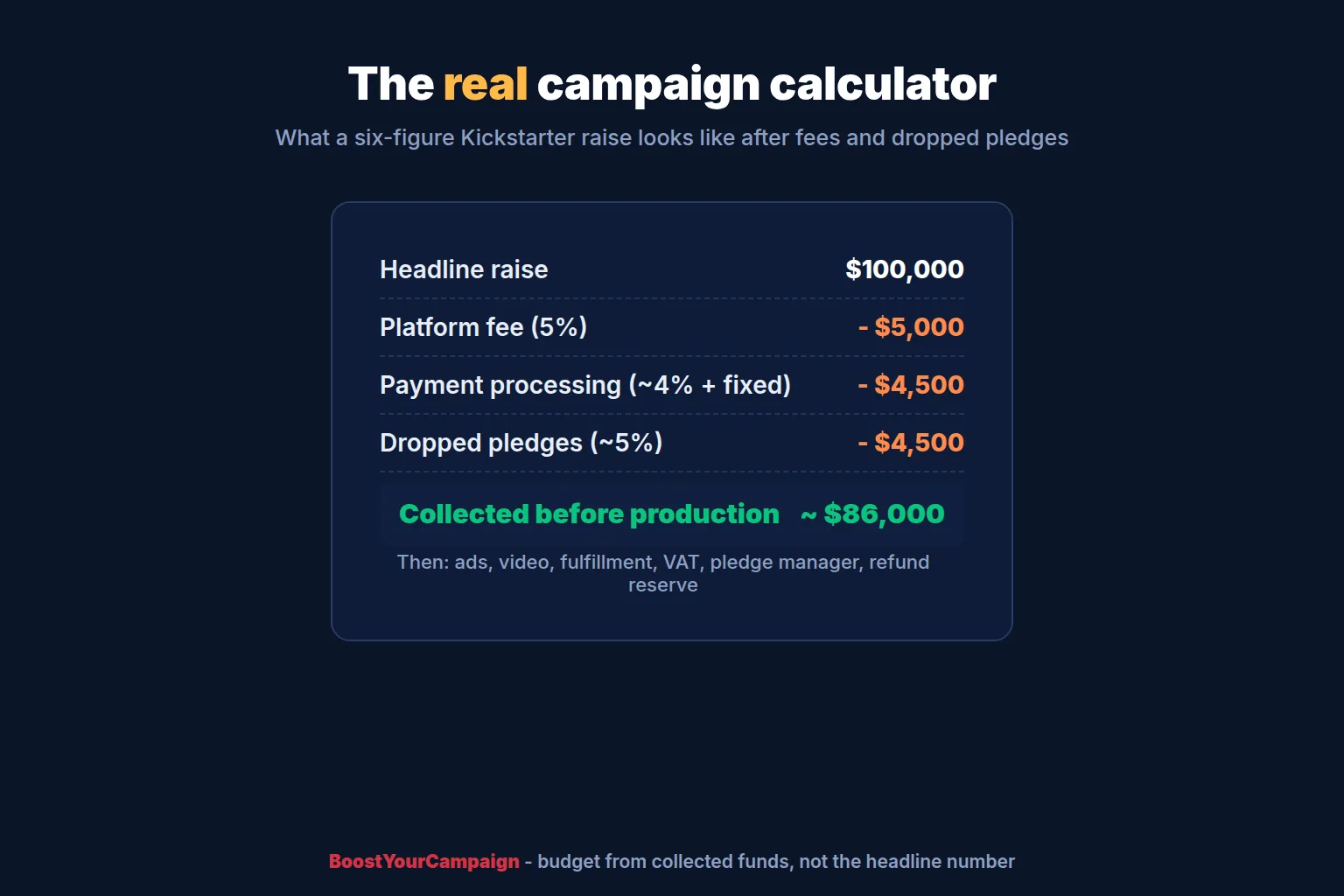
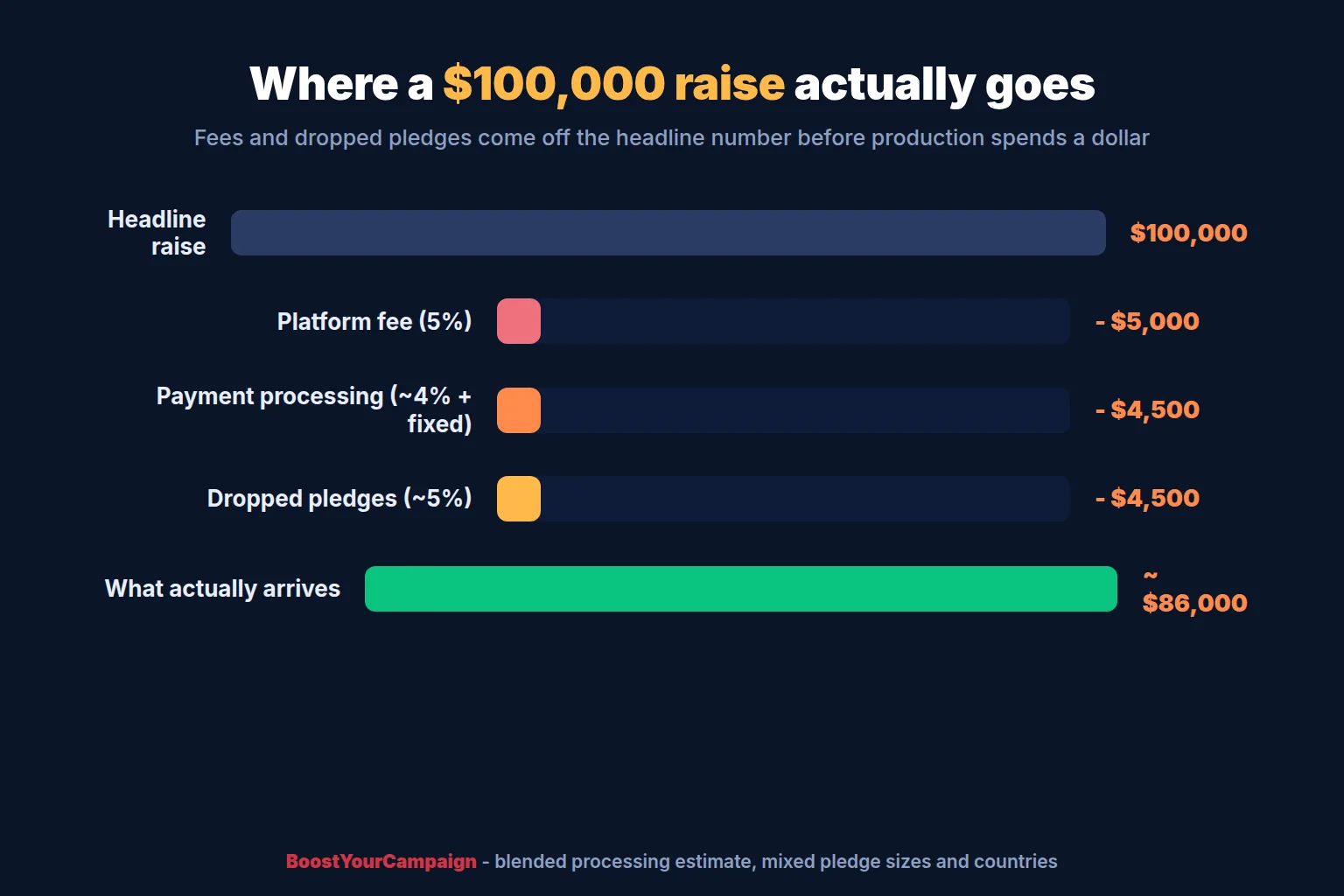
Take a $100,000 Kickstarter raise as a concrete example. Platform fee at 5% removes $5,000. Payment processing at roughly 4% (a reasonable blended estimate across a mixed pledge size and country base) removes another $4,000, plus small per-pledge fixed fees that add a few hundred dollars more depending on how many individual pledges made up the total. That alone brings the number from $100,000 down to roughly $90,500 before anything else is counted.
Now count dropped pledges. If 5% of pledged funds fail to collect (a reasonable mid-range estimate), that's another $4,500 that was part of the celebrated funding total but never actually arrives. The realistic collected total, before a single dollar goes toward production, is closer to $86,000 on a $100,000 headline raise. From there, the real budget lines apply: ad spend, video production if it wasn't already spent pre-launch, fulfillment and shipping priced against actual weight, VAT for international backers, pledge manager fees on add-on sales, and a small reserve for refunds. Depending on category and how much of that was already budgeted pre-launch versus paid for out of the raise, it's common for the actual cash available for production and growth after every cost is counted to land meaningfully below what the $100,000 headline number implied on launch day.
The takeaway isn't that crowdfunding fees are unreasonable - 8-10% combined platform and processing fees is broadly in line with, or better than, many other funding and sales channels. The takeaway is that platform fees are a rounding error next to the real cost structure of running and fulfilling a campaign, and budgeting only against the platform's published fee page is how creators end up short mid-production - exactly the gap an experienced team prices for before launch, not after.
| Fee line | Kickstarter | Indiegogo (since Oct 2025) | Gamefound |
|---|---|---|---|
| Platform fee | 5% of funds raised | 5% of funds collected | 5% of funds collected |
| Payment processing | Roughly 3-5%, varies by country, plus a small per-pledge fixed fee | Roughly 3% plus a small fixed fee per transaction | Roughly 3% plus a small fixed fee per transaction |
| Funding model | All-or-nothing only | Fixed funding only (flexible funding discontinued) | All-or-nothing |
| Post-campaign sales | Not native; usually a separate pledge manager or store | Late Pledge, formerly called InDemand | Built-in late pledge and pledge manager tools |
| Failed-funding fee exposure | None if goal isn't met | None if goal isn't met | None if goal isn't met |
7) So which platform actually has the lowest fees?
Close to none of them, in practice. Kickstarter, Indiegogo, and Gamefound all charge a 5% platform fee, and payment processing on all three lands in a similar 3-5% band that depends more on backer country and card mix than on which platform you picked. A creator asking "which fundraiser website has the lowest fees" is usually better served asking a different question: which platform's audience, discovery mechanics, and tools (pledge manager, Late Pledge, category focus) fit this specific product best, since the fee gap between them is now small enough to be a rounding error next to ad spend and fulfillment cost.
Our Kickstarter vs Indiegogo comparison covers the audience and discovery differences in more depth, and is a better starting point than fee comparison for most creators choosing between platforms in 2026.
How BoostYourCampaign fits
BoostYourCampaign runs marketing, video production, and fulfillment under one roof, which is exactly the set of costs this article shows dwarf the platform fee itself. The agency uses a skin-in-the-game ad model, investing its own money alongside the client's ad budget with fixed fees rather than a percentage-of-raise commission, which keeps ad spend - the largest controllable budget line most campaigns have - managed by a team with its own money on the table rather than an incentive to just spend more.
BYC operates owned video production studios in the US and EU and owned fulfillment warehouses in the US and EU, so the video and fulfillment lines in the worked example above are handled in-house rather than bought piecemeal from separate vendors. The agency has been active since 2010 across 4,600+ campaigns with $734M+ raised and a 4.9/5 score across 300+ verified reviews, and is an Indiegogo Approved Agency, Google Premier Partner, Facebook Marketing Partner, official Shopify Partner, and Amazon Partner. For a full picture of what an agency relationship costs against these numbers, see our agency cost guide, and for support during a live campaign, our support handbook covers what to plan for once funding starts.
Before you set a funding goal: a quick checklist
| Question | Why it matters |
|---|---|
| Have you budgeted for 8-10% combined platform and processing fees? | This is the baseline cut before any other budget line applies. |
| Have you built in a cushion for dropped or failed pledges? | A percentage of the headline funding total never actually collects. |
| Is ad spend budgeted separately from the platform fee? | Paid marketing is usually the largest controllable cost, and it's not included in what the platform charges. |
| Has fulfillment been quoted against real weight, not a guess? | Shipping is one of the most commonly underestimated budget lines. |
| Is VAT/duty exposure for international backers accounted for? | A large EU or international backer share adds cost that a US-only budget misses. |
| Are pledge manager fees included in the total cost model? | Add-on and shipping tools charge their own fee on top of the platform's cut. |
Two of the budget lines above have their own deep dives: Kickstarter shipping costs with real US and EU examples and, for the revenue side after the campaign closes, how to keep selling after crowdfunding.
Frequently Asked Questions
What percentage does Kickstarter take in 2026?
Kickstarter takes a 5% platform fee on successfully funded projects, plus payment processing that Kickstarter lists as roughly 3% to 5% depending on the backer's country, plus a small fixed fee per pledge. Combined, plan for roughly 8-10% of total funds raised.
What percentage does Indiegogo take in 2026?
Since Indiegogo's late-2025 acquisition by Gamefound, Indiegogo runs on Gamefound's fee structure: a 5% platform fee plus payment processing of roughly 3% and a small fixed fee per transaction. This replaced Indiegogo's earlier fee arrangement.
Is Indiegogo still flexible funding?
No. Indiegogo discontinued flexible funding; every campaign now runs on a fixed, all-or-nothing funding model like Kickstarter. If a campaign doesn't reach its goal, pledged funds are not collected.
Which platform has the lowest fees, Kickstarter or Indiegogo?
They're now close to identical - both charge a 5% platform fee with payment processing in a similar 3-5% range. The fee gap between platforms is small enough that it shouldn't be the deciding factor; audience fit and discovery mechanics matter more.
Does Gamefound charge lower fees than Kickstarter or Indiegogo?
No, Gamefound's fee structure is essentially the same 5% platform fee plus roughly 3% payment processing. Since Gamefound acquired Indiegogo in 2025, the two platforms now share a very similar fee model.
What is Indiegogo's Late Pledge?
Late Pledge, formerly called InDemand, is Indiegogo's continued pre-order phase after the main campaign window closes. It gives creators an ongoing sales channel and generally follows a similar fee structure to the main campaign.
Why does my actual payout look smaller than my funding total?
Between platform fees, payment processing, and dropped or failed pledges that never successfully charge, the amount that actually lands in your account is routinely lower than the headline funding total shown on the campaign page. Budget against a realistic collected total, not the celebrated funding number.
What's the biggest cost in a crowdfunding campaign besides platform fees?
For most campaigns, paid advertising is the largest single controllable cost, followed closely by video production and fulfillment. All three are typically several times larger than what the platform itself charges in fees.
If you want your real budget - fees, ads, video, and fulfillment - modeled honestly before you set a funding goal, reach out through /contact.
Want results like these for your campaign?
We've helped 4,600+ creators raise over $734M. Let's pressure-test your launch plan and find the highest-leverage fixes before you go live.
Book a free strategy call →Get the free 87-step launch checklist
The exact pre-launch, live-campaign and fulfillment steps we use across 4,600+ launches. Free PDF, emailed instantly.
You're in - check your inbox. Open the checklist now ->