Gamefound has grown from a tabletop-only alternative into a company that now owns Indiegogo, and both platforms run on the same fee structure and technology stack. If you're planning a tabletop launch and want help deciding whether Gamefound, Kickstarter, or both fit your project, talk with BoostYourCampaign - we run campaigns and fulfillment for tabletop creators on all of them. Our Gamefound marketing service covers what that looks like for a board game.
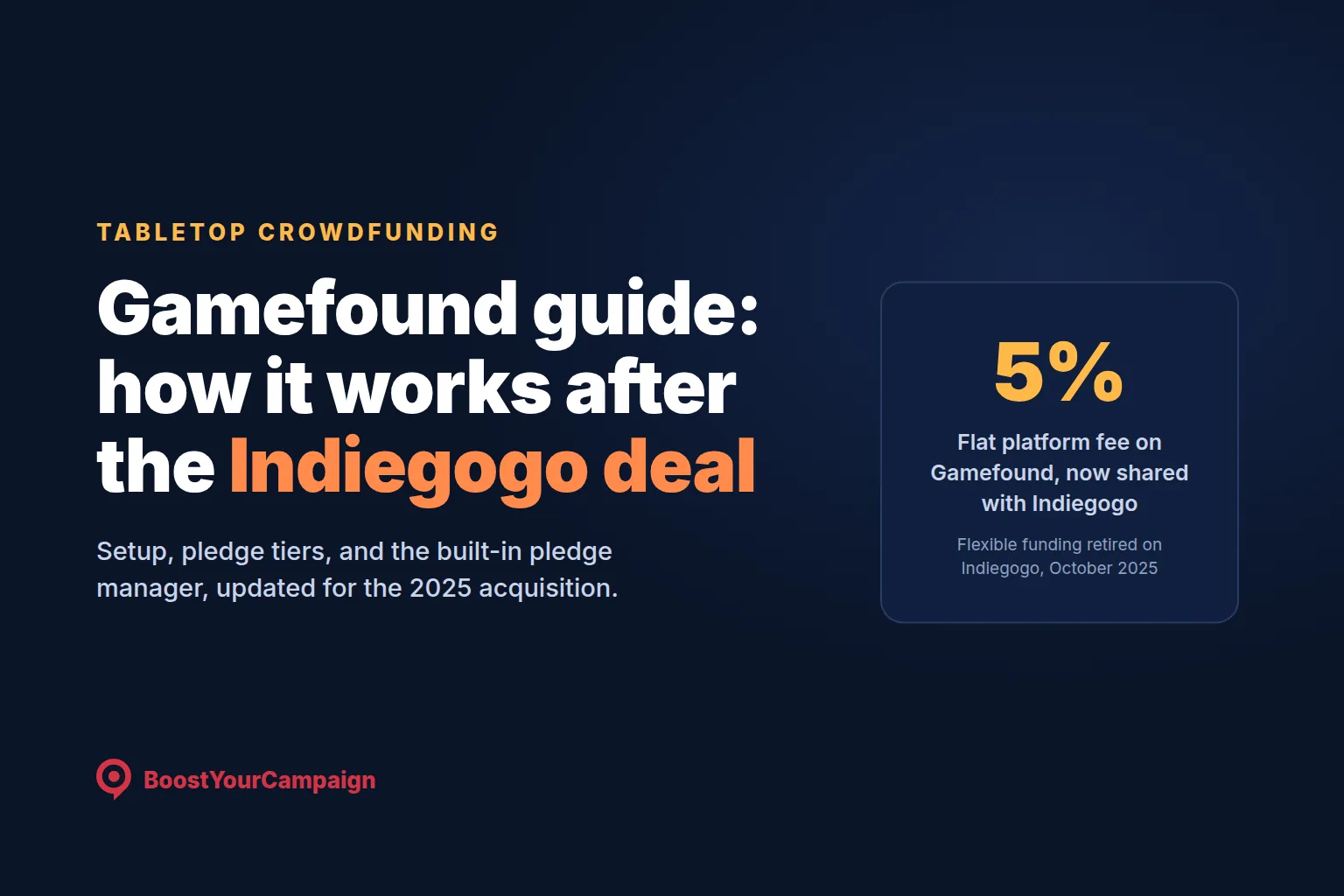
Gamefound is a crowdfunding platform built specifically for tabletop games, with a native pledge manager, add-ons, and stretch goals included by default instead of added through a separate tool. It charges a flat 5% platform fee and, in 2025, acquired Indiegogo, whose October 2025 relaunch now runs on Gamefound's technology and the same flat fee structure. A Gamefound campaign fits creators whose product is board games, miniatures, or tabletop accessories and who want a concentrated, already-qualified audience; a general hardware or design product without tabletop appeal usually still performs better on Kickstarter's larger general audience.
- Gamefound is tabletop-first - the platform, its tools, and its audience were all built around board games specifically.
- The pledge manager is built in - add-ons, tier upgrades, and shipping address collection happen inside the same platform the campaign ran on.
- Gamefound acquired Indiegogo in 2025 - Indiegogo's October 2025 relaunch runs on Gamefound's technology and adopted the same flat 5% fee.
- Flexible funding is gone - Indiegogo retired its keep-what-you-raise option in October 2025; every new campaign on either platform is fixed, all-or-nothing.
- Late pledges keep the momentum going - both Gamefound's own late pledge tools and Indiegogo's Late Pledge (formerly called InDemand) let backers join after the funding window closes.
- Marketing has to reach a specific audience - tabletop backers concentrate around conventions and community hubs, not general browsing traffic.
1) What Gamefound is and its tabletop roots
Gamefound launched as a crowdfunding platform built for one category: tabletop games. That focus shows up in every part of the product. Where a general platform treats add-ons and stretch goals as extras a creator sets up manually, Gamefound treats them as the default campaign structure, because nearly every board game campaign needs a pledge tier system, an add-on list, and a stretch goal ladder to work the way backers expect.
The audience matches the product. Backers who browse Gamefound are there specifically for tabletop games, and they already understand how pledge managers, add-ons, and shipping calculators work, since that's standard on every campaign they've backed before. That familiarity means a Gamefound campaign spends less time explaining its own mechanics and more time selling the actual game, compared to introducing the same concepts to a general audience unfamiliar with tabletop crowdfunding conventions.
Gamefound is smaller than Kickstarter in total traffic, but the traffic it does have is concentrated and pre-qualified. A creator choosing between the two isn't choosing a bigger or smaller version of the same thing; they're choosing between a large general audience and a smaller audience that's already primed for exactly this kind of product. Our Kickstarter vs Gamefound vs BackerKit comparison walks through that tradeoff across all three major options for tabletop and hardware creators.
The platform's origin also shapes how it presents a campaign page. Rather than a single generic layout, Gamefound's project pages are built to show pledge tiers, add-ons, and stretch goal progress prominently and consistently across every campaign on the platform, which is a small detail with a real effect: backers browsing Gamefound already know where to look for that information, so a creator doesn't need to spend page space teaching visitors how to read a pledge structure they've seen dozens of times before.
2) The 2025 Indiegogo acquisition and what changed
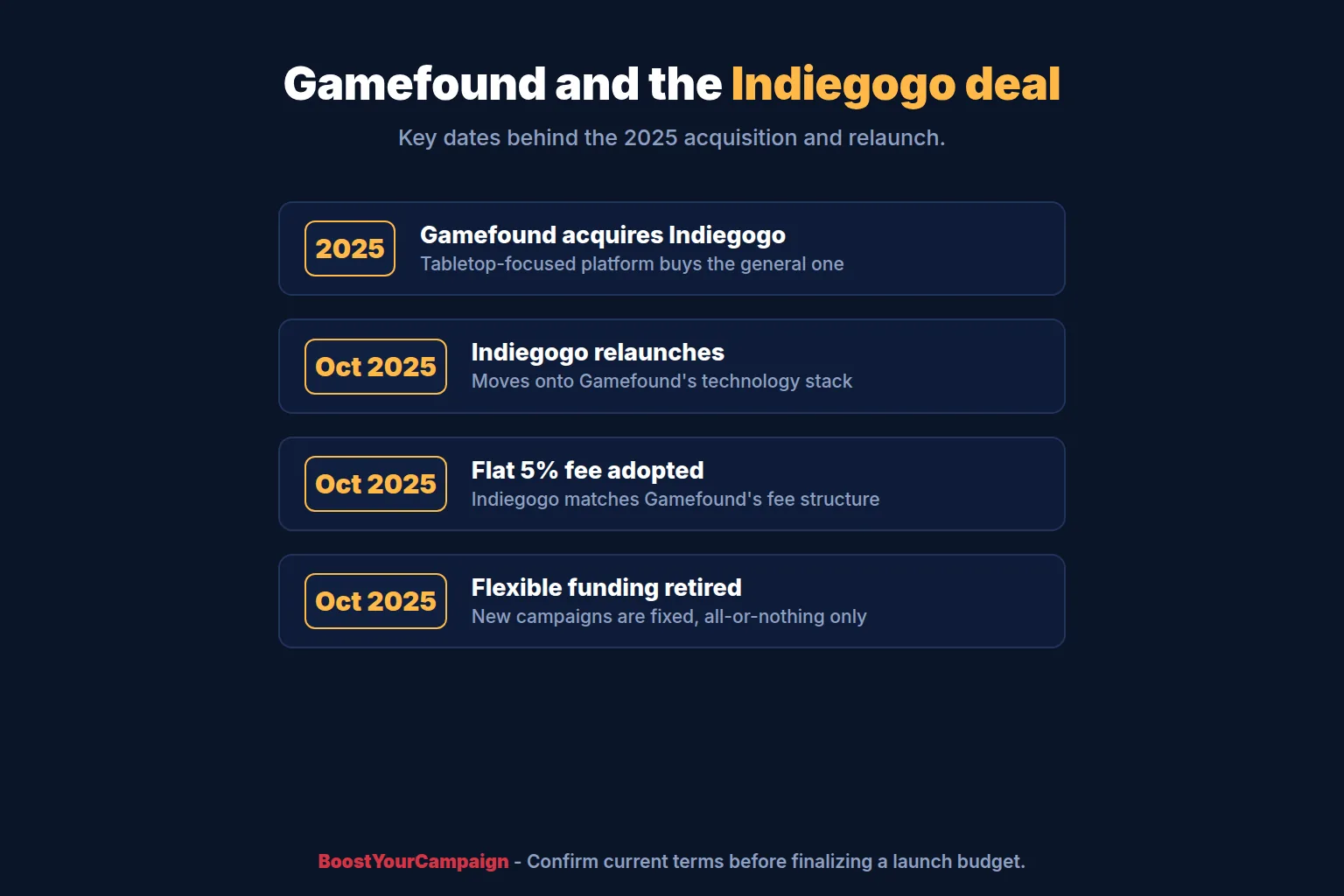
In 2025, Gamefound acquired Indiegogo. The deal is tied directly to Indiegogo's October 2025 relaunch, which moved the platform onto Gamefound's technology stack. Two changes came with that relaunch and matter to every creator on either platform. First, Indiegogo adopted the same flat 5% platform fee structure Gamefound already used, replacing whatever fee arrangement Indiegogo ran before. Second, Indiegogo retired flexible funding - the option that let creators keep whatever they raised even short of their goal - for new campaigns. Every new campaign on Indiegogo is now fixed, all-or-nothing funding, the same model Gamefound and Kickstarter both use, and Indiegogo replaced flexible funding with automated stretch goals that unlock extra rewards as pledges climb past the target.
Indiegogo's post-campaign phase got a new name in the same relaunch: it's now called Late Pledge (formerly called InDemand), and it runs on mechanics similar to Gamefound's own late pledge tools.
For creators, the acquisition cuts two ways. Indiegogo now runs on technology built by a company that has spent years solving pledge manager and add-on problems specifically, and feature development has moved faster since the deal closed than in the few years before it. On the other side, Gamefound's core expertise and product roots are in tabletop games, so it's a fair question whether a hardware, fashion, or lifestyle campaign on Indiegogo gets the same long-term product attention as a board game does. Creators planning a launch months out should confirm current terms directly with Indiegogo or Gamefound before finalizing a budget, since terms and features can keep shifting after an acquisition like this one.
3) How a Gamefound campaign works, step by step
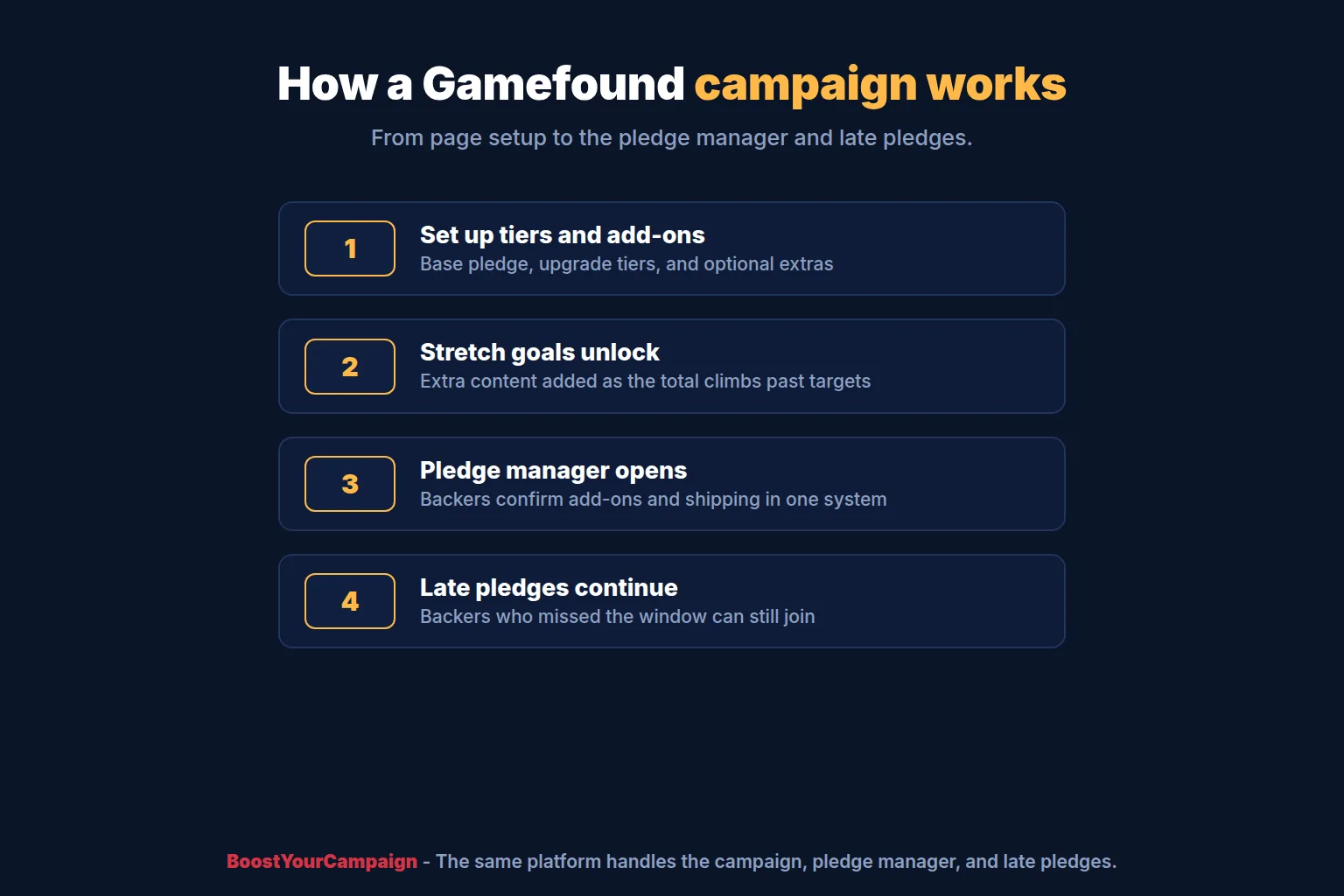
Setting up a Gamefound campaign starts with the project page: description, images, video, and the funding goal. Because the platform is built for tabletop, the setup flow expects a pledge tier structure from the start - a base pledge for the core game, then higher tiers that bundle expansions or upgraded components. Add-ons sit alongside the pledge tiers as optional extras backers can add to any pledge level, which is the standard structure tabletop backers already expect from any campaign they browse.
Stretch goals unlock as the campaign's total climbs past preset funding thresholds, adding components, upgrades, or new content to some or all pledge tiers. This is where Gamefound's tabletop focus shows most clearly: stretch goal management, including which tiers a given stretch goal applies to, is a native part of the campaign tools rather than something a creator tracks manually in a spreadsheet and updates by hand.
Once the campaign funds, backers move into the pledge manager automatically, inside the same platform. There, they confirm their final pledge, add any last add-ons, choose variants like language or component upgrades, and enter a shipping address. That data flows directly into the same system a creator uses to track orders and, eventually, export for fulfillment - no separate signup or account creation required on the backer's side.
After the pledge manager closes, campaigns commonly open a late pledge phase, letting people who missed the funding window still join at a similar structure, typically at a modest markup over the original price - often in the roughly 10-20% range, though the exact figure is the creator's call. That phase uses the same underlying tools as the main campaign, so there's no platform switch required to keep collecting pledges after the official campaign ends.
4) Who fits Gamefound, and who should still choose Kickstarter
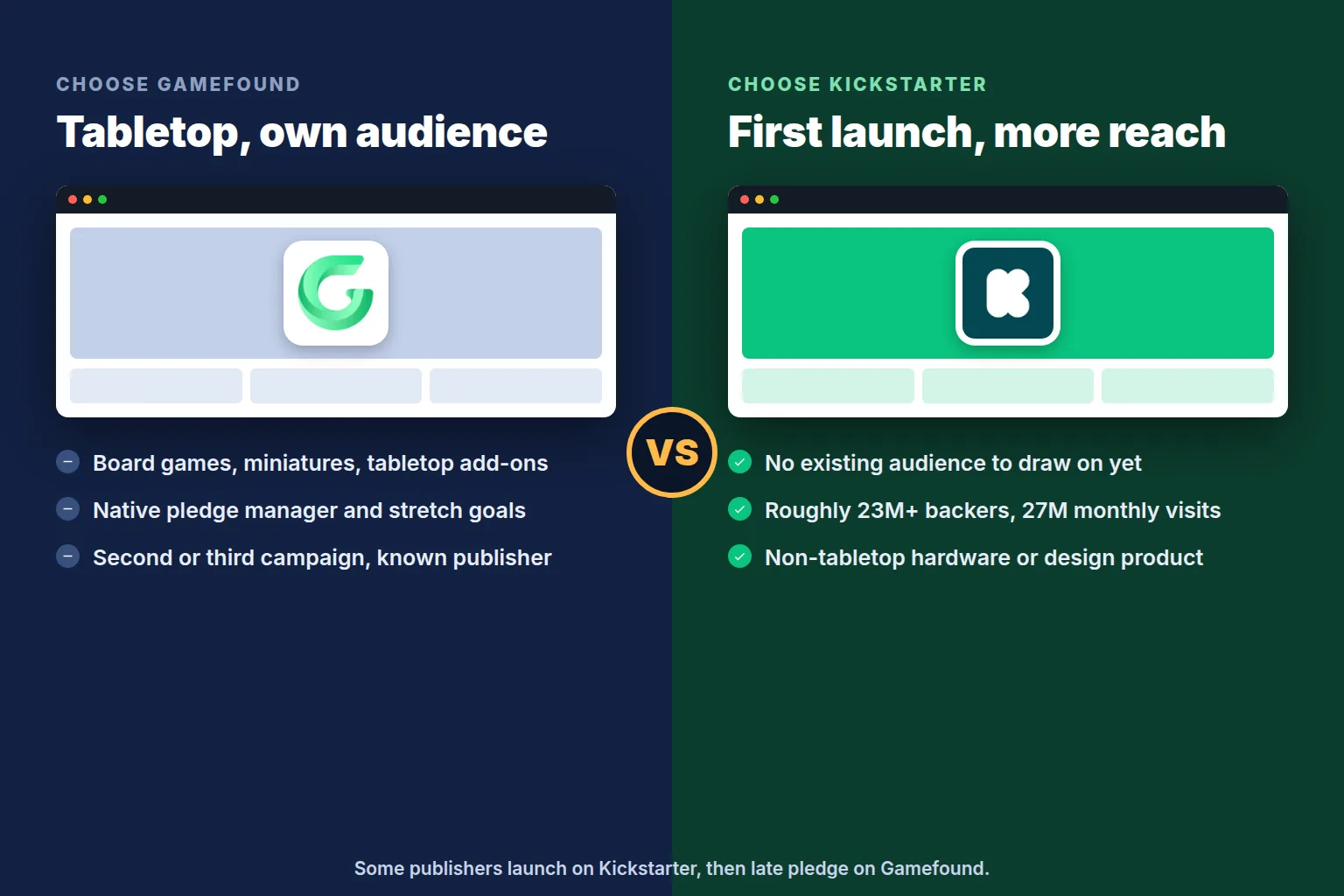
Gamefound fits creators whose product is a board game, card game, miniatures line, or tabletop accessory, especially when the reward structure includes several add-ons and a stretch goal ladder. It also fits an established publisher running a second or third campaign, since Gamefound's concentrated tabletop audience tends to include backers who already know the publisher's earlier work and are watching for the next release.
Kickstarter still makes sense for a first-time tabletop creator without an existing audience, since its roughly 23M+ backers and around 27M monthly visits give a new campaign a real shot at organic discovery that Gamefound's smaller total audience doesn't match. It also fits any campaign that isn't primarily tabletop, since Gamefound's audience and product focus stay board-game-centric even after the Indiegogo acquisition broadened the company's reach into general categories.
Some publishers use both in sequence: launch on Kickstarter for the larger initial audience, then run a late pledge phase on Gamefound to take advantage of its native pledge manager and tabletop-specific backer base for the continuation. That combined approach is covered in more depth in our platform comparison guide, including the fee and timing tradeoffs involved.
Campaign size plays a role too. A small, niche card game with a modest goal and a narrow theme can do well on Gamefound precisely because the audience actively looking for tabletop projects is more likely to find it than it would be lost in Kickstarter's much larger and more varied games category. A large-scale campaign aiming for a seven-figure raise usually wants Kickstarter's bigger total audience as the primary platform, since even a small percentage of a much larger visitor pool can outweigh a higher conversion rate on a smaller one.
5) Marketing a Gamefound campaign
Gamefound's audience is concentrated, which changes how marketing works compared to a general platform. Tabletop backers cluster around specific community hubs - board game forums, Discord communities, YouTube reviewers and channels that cover new releases, and conventions like Gen Con, Essen Spiel, and UK Games Expo. A campaign that shows up in those spaces before launch, through demo copies to reviewers or a booth presence at a relevant convention, tends to convert better on Gamefound than a campaign relying purely on platform browsing traffic, since Gamefound's total volume is smaller than Kickstarter's to begin with.
Paid advertising still matters, but audience targeting needs to reflect the tabletop-specific nature of the buyer. General crowdfunding ad targeting that works for a broad hardware audience often underperforms for tabletop, where interest tends to cluster around specific game mechanics, themes, or comparisons to well-known existing titles rather than broad product categories.
Email and community building before launch matter as much here as on any other platform. A creator with an established mailing list or Discord community from a previous campaign brings real momentum to a Gamefound launch, since that audience already understands the tabletop crowdfunding format and doesn't need the mechanics explained before they'll pledge.
Timing a launch around the tabletop calendar also affects performance more than it does on a general platform. Announcing a campaign or opening a wishlist ahead of a major convention, then launching in the weeks around it, puts the campaign in front of press coverage, reviewer content, and word-of-mouth that's already concentrated in one window. A launch scheduled with no relationship to the convention calendar loses that boost and has to generate the same attention through paid spend and outreach alone.
6) Fulfillment integration and pledge manager exports
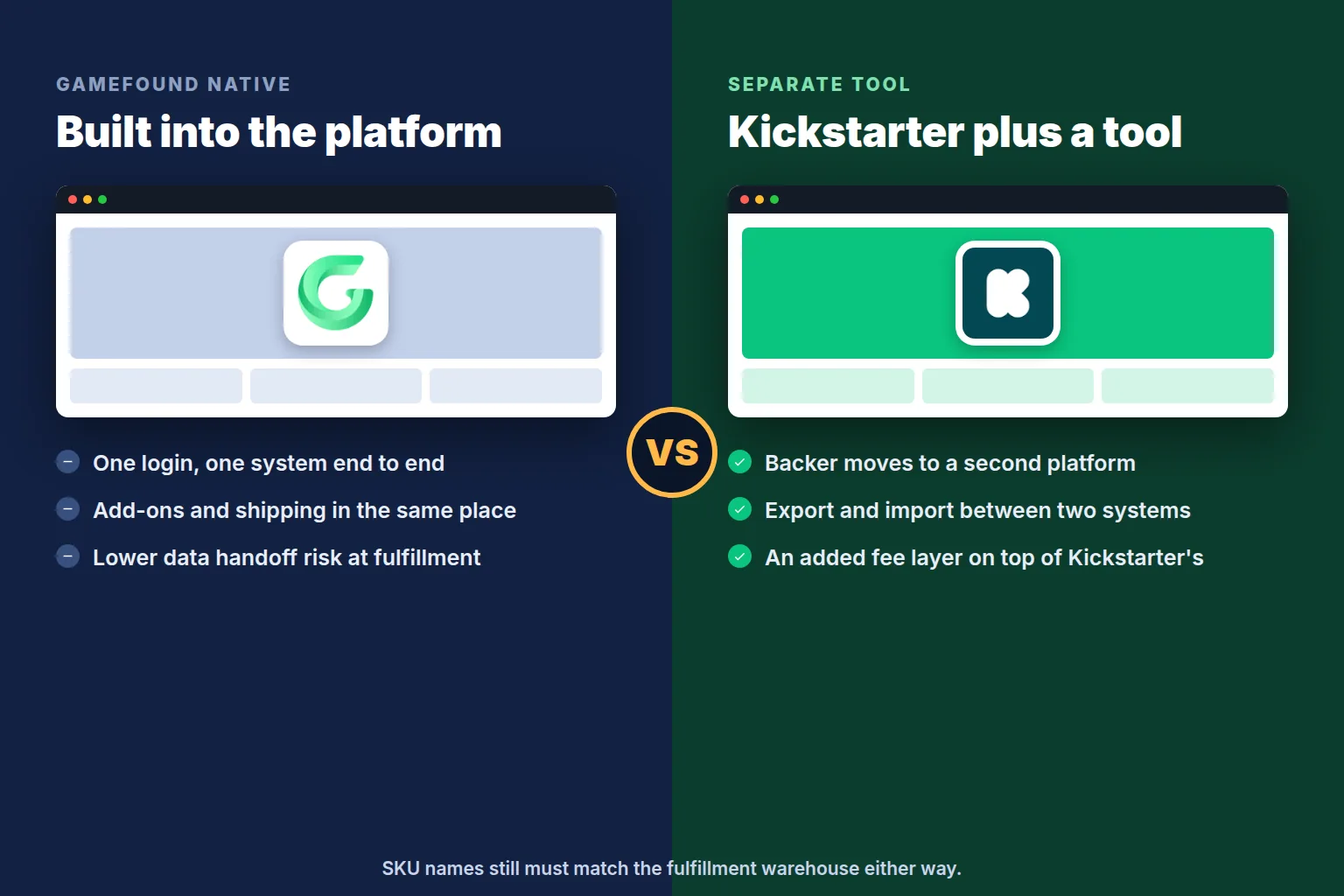
The practical value of Gamefound's built-in pledge manager shows up most clearly at fulfillment time. Because add-ons, tier selections, and shipping addresses all live in one system, the export a fulfillment warehouse needs to kit orders can come from a single source rather than getting reconciled across a crowdfunding platform and a separate pledge manager tool. That matters a lot for board games specifically, since a single backer's order commonly includes several distinct SKUs - base game, expansion, a metal coin upgrade, a promo card - that all need to ship together, matched correctly to what they actually pledged for.
The integration isn't automatic in the sense of requiring zero setup. SKU names in the pledge manager still need to match what the fulfillment warehouse uses internally, and address data still benefits from a validation pass before shipping starts. What Gamefound's native pledge manager removes is the extra handoff step of exporting data from one platform and importing it into a separate pledge manager tool, which is one less place for errors to creep in on a category where a wrong-item shipment on a heavy, multi-component box is an expensive mistake to fix. Our pledge manager and late pledges guide covers that data-hygiene process in more depth, and our board game fulfillment guide covers the physical side - weight, packaging, and the US/EU warehouse split that most tabletop campaigns need.
Timing the export matters as much as the data itself. Pulling a fulfillment file too early misses last-minute address corrections and late add-on purchases; waiting too long delays packing and shipping past the date backers were told to expect. The practical approach is to lock the pledge manager on a set date, run one clean export against that locked data, and treat any changes after that point as individual exceptions handled outside the bulk file rather than reasons to re-export the whole batch.
| Factor | Gamefound (native pledge manager) | Kickstarter plus separate pledge manager |
|---|---|---|
| Setup steps for backers | One account, one login, all in one platform | Backer moves from Kickstarter to a separate tool |
| Data handoff risk | Lower - one system end to end | Higher - export/import between two systems |
| Audience during funding | Smaller, tabletop-concentrated | Larger, general audience |
| Platform fee | Flat 5% - confirm current rates | Roughly 5% plus 3-5% processing, plus separate pledge manager fee |
| Late pledge continuation | Built in, same platform | Usually needs a move to Indiegogo or a separate store |
How BoostYourCampaign fits
BoostYourCampaign has launched tabletop campaigns on Gamefound as well as Kickstarter and BackerKit Crowdfunding, so we can help a board game creator decide which platform, or which sequence of platforms, actually fits their product rather than defaulting to whichever one is most familiar. On the marketing side, BYC runs paid acquisition with a skin-in-the-game model, investing its own money alongside the client's ad budget with fixed fees instead of a percentage-of-raise commission, and we've worked with tabletop clients where weight, kitting, and stretch goal structure are the exact problems this guide covers.
BYC also operates its own fulfillment warehouses in the US and EU, which matters for Gamefound campaigns specifically because a heavy board game box benefits from the regional split described in our fulfillment guides - domestic-style shipping for both continents instead of one warehouse serving every backer worldwide. The agency has been active since 2010 across 4,600+ campaigns with $734M+ raised and a 4.9/5 score across 300+ verified reviews. For fulfillment planning once a Gamefound campaign funds, see our board game fulfillment guide and Kickstarter fulfillment guide, and for what to do once your pledge manager and any late pledge window close, see how to keep selling after crowdfunding.
Before you launch on Gamefound: a quick checklist
- Is your product genuinely tabletop? - board games, miniatures, and tabletop accessories fit Gamefound's audience best.
- Have you planned your stretch goal ladder before launch? - backers expect a structured ladder, not goals added reactively.
- Have you confirmed current fee rates? - platform and processing rates can shift; confirm before pricing reward tiers.
- Do you have a plan for tabletop-specific marketing? - reviewer copies, community outreach, and convention presence matter more here than general ad targeting alone.
- Is your SKU data planned for a clean fulfillment export? - even a native pledge manager needs matching SKU names on the warehouse side.
- Have you decided on a late pledge plan? - know whether it runs on Gamefound itself or moves elsewhere before your main campaign ends.
For a full comparison against Kickstarter and BackerKit Crowdfunding, see our three-platform guide, and for the fee mechanics shared with Indiegogo, see our fee comparison guide.
Frequently Asked Questions
How does Gamefound work?
A creator sets up pledge tiers, add-ons, and a stretch goal ladder, then runs a fixed, all-or-nothing funding campaign. Once it funds, backers move into Gamefound's built-in pledge manager to confirm add-ons and shipping details, and the campaign can open a late pledge phase afterward for backers who missed the funding window.
Is Gamefound owned by Indiegogo or did Gamefound acquire Indiegogo?
Gamefound acquired Indiegogo in 2025. Indiegogo's October 2025 relaunch runs on Gamefound's technology stack and uses the same flat 5% platform fee structure Gamefound already had in place.
Gamefound vs Kickstarter: which should I choose for a board game?
Gamefound gives a concentrated, already-qualified tabletop audience and a native pledge manager. Kickstarter gives a much larger total audience, roughly 23M+ backers and around 27M monthly visits, which tends to matter more for a first-time creator without an existing following. Established tabletop publishers often lean toward Gamefound; first-time creators often lean toward Kickstarter.
What does Gamefound charge in fees?
Gamefound uses a flat 5% platform fee, plus payment processing on top. Confirm current rates directly with Gamefound before finalizing a campaign budget, since processing costs vary by country and payment method.
Does Gamefound have a pledge manager built in?
Yes. Add-ons, tier upgrades, variant selection, and shipping address collection all happen inside the same platform the campaign ran on, without a separate signup or a data export to another tool.
Is flexible funding still available on Indiegogo or Gamefound?
No. Indiegogo retired flexible funding for new campaigns in October 2025, when it relaunched on Gamefound's technology. Every new campaign on Indiegogo or Gamefound now uses fixed, all-or-nothing funding.
What is Late Pledge (formerly called InDemand) on Indiegogo?
It's Indiegogo's post-campaign continuation phase, letting backers who missed the original funding window still pledge afterward. The name changed from InDemand as part of the October 2025 relaunch on Gamefound's technology, though the underlying mechanics stayed similar to Gamefound's own late pledge tools.
Can a non-tabletop product launch on Gamefound?
It can, but Gamefound's audience and product focus remain concentrated in tabletop games even after the Indiegogo acquisition. A hardware or lifestyle product without tabletop appeal usually reaches more backers on Kickstarter or on Indiegogo directly, where the audience is broader and not board-game-specific.
If you're planning a tabletop launch and want fulfillment and marketing planned together from day one, reach out through /contact.
Want results like these for your campaign?
We've helped 4,600+ creators raise over $734M. Let's pressure-test your launch plan and find the highest-leverage fixes before you go live.
Talk to an expert →Get the free 87-step launch checklist
The exact pre-launch, live-campaign and fulfillment steps we use across 4,600+ launches. Free PDF, emailed instantly.
You're in - check your inbox. Open the checklist now ->