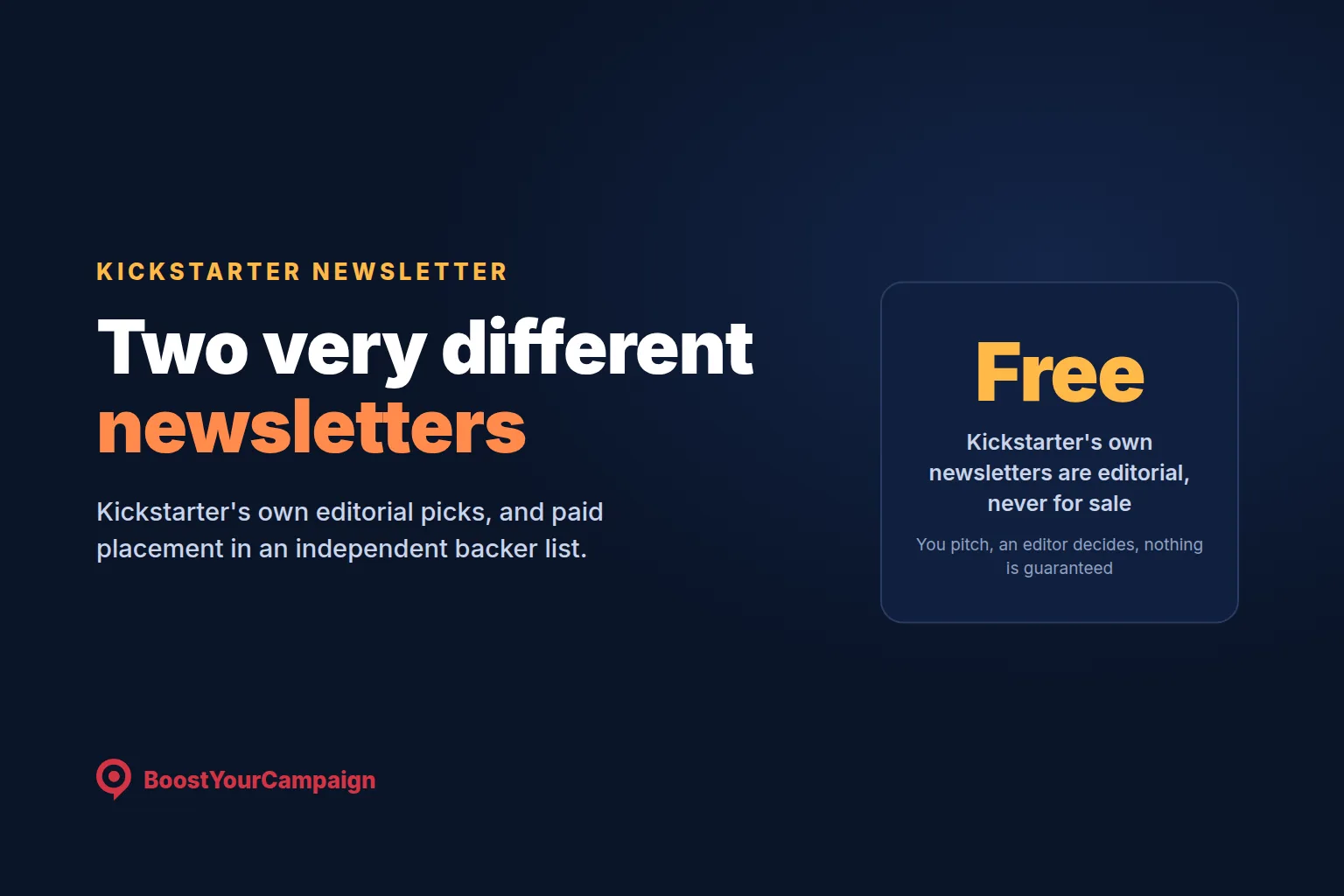
Type "Kickstarter newsletter" into Google and you get two different questions tangled into one search. Some people want to subscribe to Kickstarter's own emails as a backer. Others want to know how to get their project written up inside one, as a creator trying to reach backers. This article is for the second group, and untangling that distinction is the whole point of what follows, because the two paths - free editorial placement in Kickstarter's own newsletters, and paid placement in an independent backer newsletter - work nothing alike.
Kickstarter runs its own free newsletters, curated by its staff, and you cannot pay to get into them. Getting picked usually starts with earning the Projects We Love badge, which means a finished page, a working prototype, and a pitch sent to Kickstarter's editorial team before launch, with no guarantee either way. If you are not selected, or want reach you can schedule yourself, paid placement in an independent backer newsletter - including our own, sent to a database of 8,500,000+ backers - is the alternative that puts you in control of timing.
- Two different things share one name - Kickstarter's own editorial newsletters versus paid placement in an independent newsletter that reaches backers.
- Kickstarter's newsletters are curated, not bought - a human editorial team picks projects, and there is no application form or fee.
- The pitch has to land before launch - editors are looking at what is already finished, not promises about what will exist later.
- It is a spike, not a guarantee - a feature helps a campaign that already has momentum; it does not create momentum from nothing.
- Paid placement is the fallback with control - you choose the send date instead of hoping an editor notices you.
- The pre-launch list still does the heavy lifting - newsletters of either kind are a boost on top of a list, not a substitute for one.
1) The two things people mean by "Kickstarter newsletter"
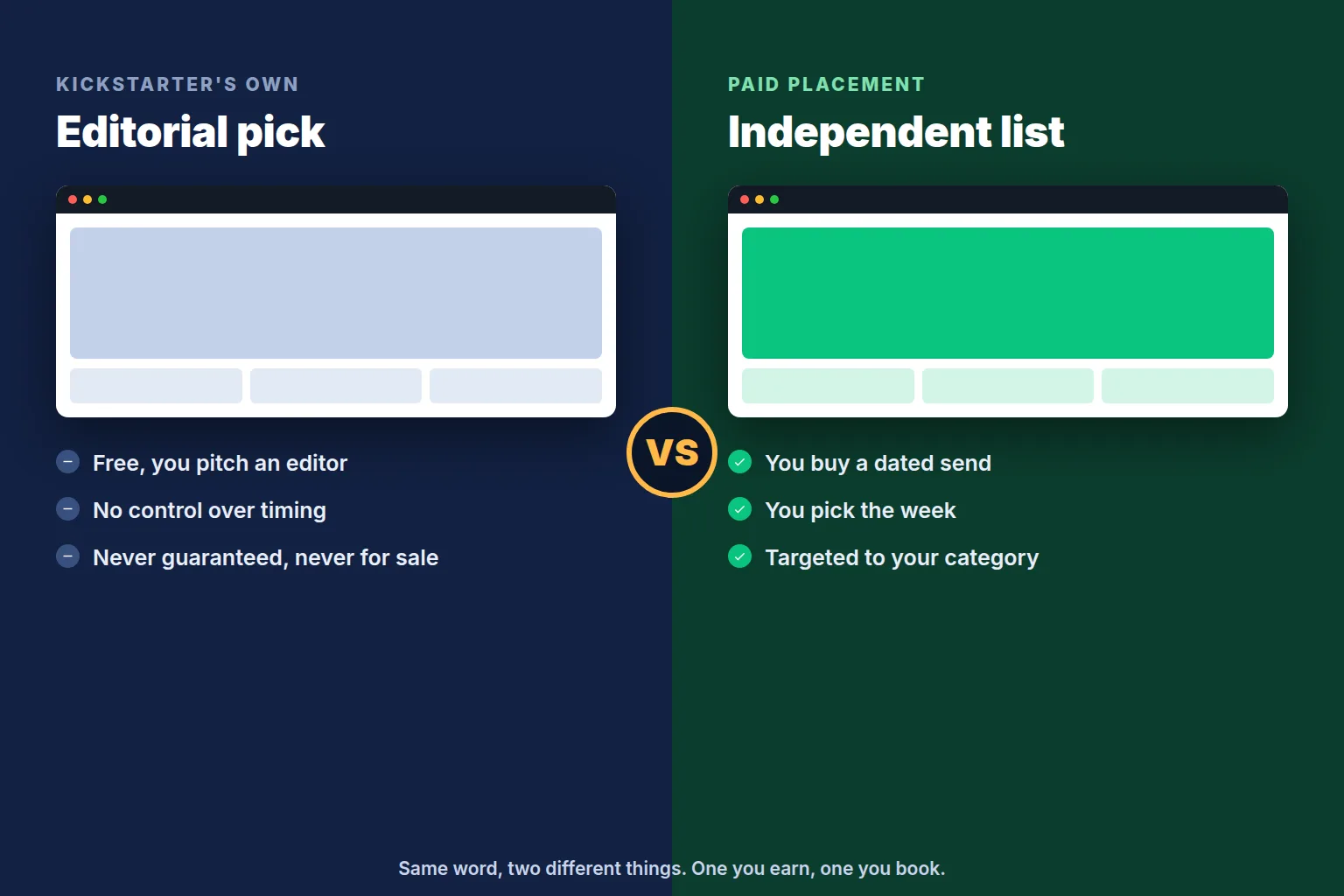
When someone searches "Kickstarter newsletter," they are usually reaching for one of two very different things. The first is Kickstarter's own official newsletters - emails Kickstarter itself writes and sends to backers who subscribed, curated by Kickstarter's staff, and completely free to appear in if an editor decides your project belongs there. The second is a paid newsletter placement: a slot inside an independent, third-party newsletter that also reaches Kickstarter backers, but that a creator buys rather than earns editorially.
These two are not competing versions of the same product. One is Kickstarter's own audience, curated by Kickstarter, unpaid, and entirely outside your control. The other is someone else's audience, made available to you for a fee, on a date you can actually schedule. Confusing the two leads to two common mistakes: creators who email Kickstarter asking to "buy" a newsletter spot (it is not for sale, ever), and creators who assume every paid backer-newsletter service is somehow affiliated with Kickstarter (most are not). The rest of this article walks through both paths in order, then compares them directly so you can decide which one - or which combination - fits your launch.
2) Kickstarter's official newsletters, explained
Kickstarter maintains its own newsletter program for backers who want project recommendations sent to their inbox. The general shape, based on what Kickstarter has run historically, is a broad weekly roundup of projects worth a look, plus a handful of category-specific editions - things like games, design and technology, arts, and publishing - each curated for backers who follow that particular kind of project. Backers opt in themselves through their Kickstarter account settings, choosing which categories they want to hear about, and Kickstarter's own editors decide what goes into each send.
Two things matter here for a creator. First, this list is not static. Kickstarter has changed newsletter names, categories, and cadence before, and will likely do so again, so treat any specific list of newsletter titles as a snapshot rather than a promise - check kickstarter.com/newsletters directly for whatever is currently running. Second, Kickstarter does not publish subscriber counts, open rates, or click-through numbers for these newsletters, and neither we nor anyone else outside Kickstarter has a reliable figure for how many people actually read a given edition. Be skeptical of anyone who quotes you a precise reach number for Kickstarter's own newsletters - they are guessing.
3) How projects get picked
Kickstarter's editorial team does not run an open submission queue where every project gets reviewed in turn. In practice, newsletter inclusion tracks closely with Kickstarter's Projects We Love badge - the same curation team that flags a project as "loved" is the one deciding what surfaces in category pages, homepage placements, and newsletter editions. We cover the full mechanics of that badge, what specifically earns it, and how to raise your odds in that guide, so this article will not repeat it point for point. The short version: curators respond to a clear, specific story rather than generic marketing copy, strong real photography and video rather than mockups, a genuinely working prototype rather than a rendering, and a campaign page that reads as finished on day one rather than something still being assembled after launch.
The common thread across all four is that curators are judging what already exists, not what a creator promises will exist by the time the campaign ends. A page that looks half-built, a video that is clearly a placeholder, or a prototype photo that is obviously a 3D render rather than a real object all read as "not ready yet" to an editor scanning dozens of projects a week. Fix the fundamentals covered in the Projects We Love guide first; a newsletter mention without the badge behind it is rare.
4) How to actually pitch
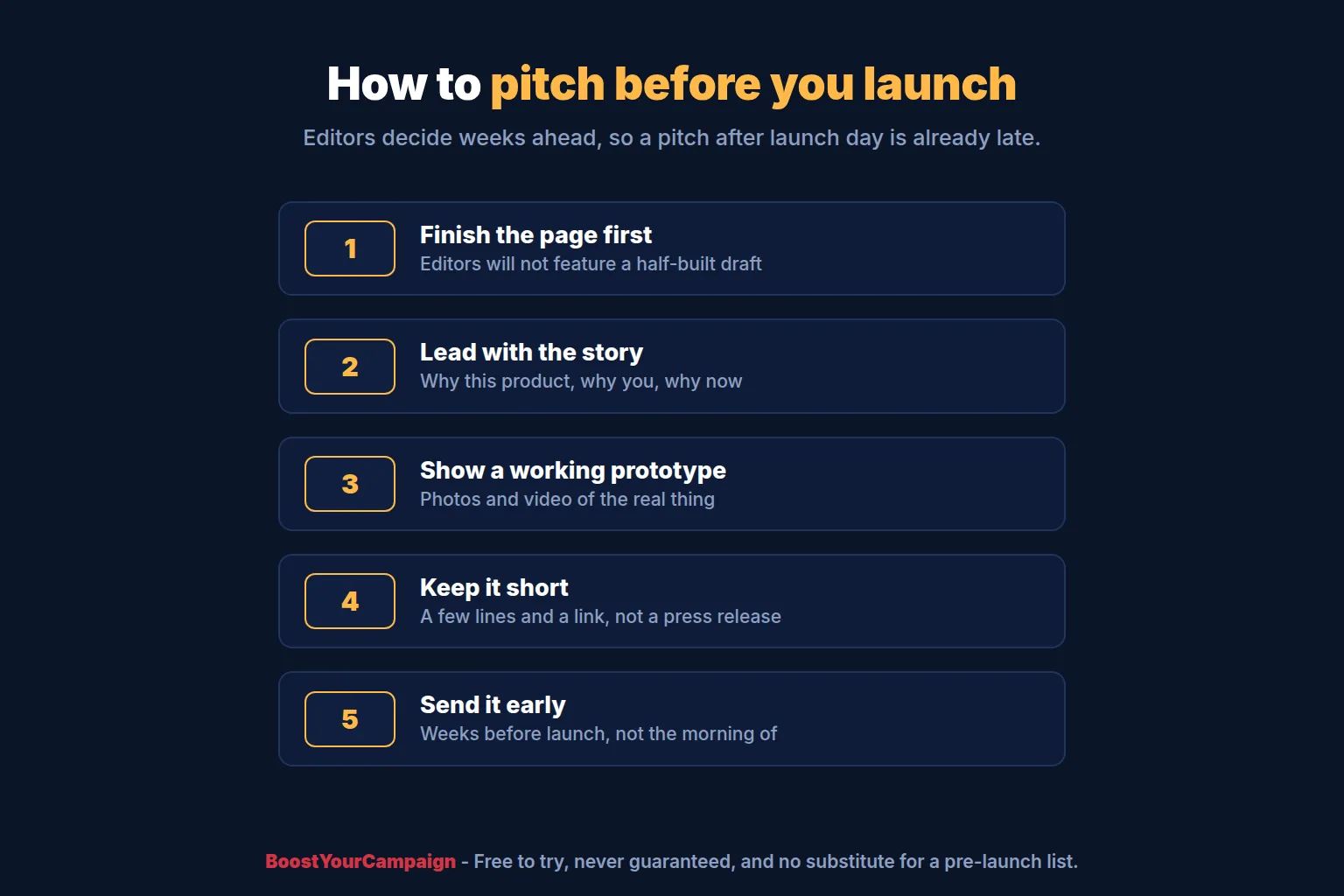
Creators can reach out to Kickstarter's editorial and curation team directly - the current contact method is listed on Kickstarter's own help and creator resources, since Kickstarter updates its submission channels from time to time and we would rather point you to the live source than publish an address that might already be wrong by the time you read this. What stays constant is the shape of a good pitch: a short note, not a press release, that states what the project is in one or two sentences, links directly to the finished pre-launch page, and includes two or three images or a link to the video rather than attachments. Editors are scanning many pitches; a pitch that takes thirty seconds to read gets read.
Timing matters as much as content. Send the pitch while your Kickstarter pre-launch page is live and finished, not after you have already launched and are hoping for a rescue. Curators scout upcoming projects during the pre-launch window specifically, and a project that pitches itself only after struggling in week one has already missed the moment editors are actually looking. Set the realistic expectation early: this is free, unpaid, entirely at Kickstarter's discretion, and never guaranteed no matter how good the pitch or the page. Treat it as a long-shot upside you pursue in parallel with your actual launch plan, not as the plan itself.
5) What it is worth if you get it
Getting picked for a Kickstarter newsletter feature produces a real, visible bump while the send is live - more page views, a spike in pledges, and a short burst of the kind of unpaid traffic that would otherwise cost real ad spend to buy. That is genuinely valuable. It is also narrow. You do not control when it happens; Kickstarter's editorial calendar runs on its own schedule, not yours, so a feature might land on day two of your campaign or not at all. And it will not rescue a campaign that launched without a pre-launch list - our benchmarks on day-1 revenue and conversion rates show that the day-one target is 100% of the funding goal, which is what the campaigns BoostYourCampaign runs usually reach, and roughly 90% of first-48-hour backers come from the list a creator built before launch, not from any single external mention.
A newsletter feature amplifies a launch that is already working. It is interest on momentum you already built, not the source of the momentum. If your plan for reaching goal depends on Kickstarter noticing you, the plan needs a pre-launch list underneath it regardless of whether the feature ever materializes.
6) If you do not get picked
Most projects never get a Kickstarter editorial feature, badge or no badge, and that is normal rather than a sign something is wrong with the campaign. If free placement does not happen, or you would rather not leave day-one reach up to an editor's calendar, there are paid and semi-paid alternatives that put timing back in your hands. Independent backer newsletters - third-party publications built specifically around crowdfunding audiences - sell placements the way any niche publication sells a sponsored slot, and our newsletter guide covers how that works in detail, including how BoostYourCampaign's own service fits in.
Cross-promotion swaps are another route: pairing up with another live campaign in a related category to trade shoutouts, update mentions, or email swaps with their own backer list, at no cost beyond the arrangement itself. And our broader guide to crowdfunding promoters covers the wider range of paid promotional channels beyond newsletters specifically, for creators comparing options rather than picking one in isolation.
7) Official newsletter vs paid newsletter placement
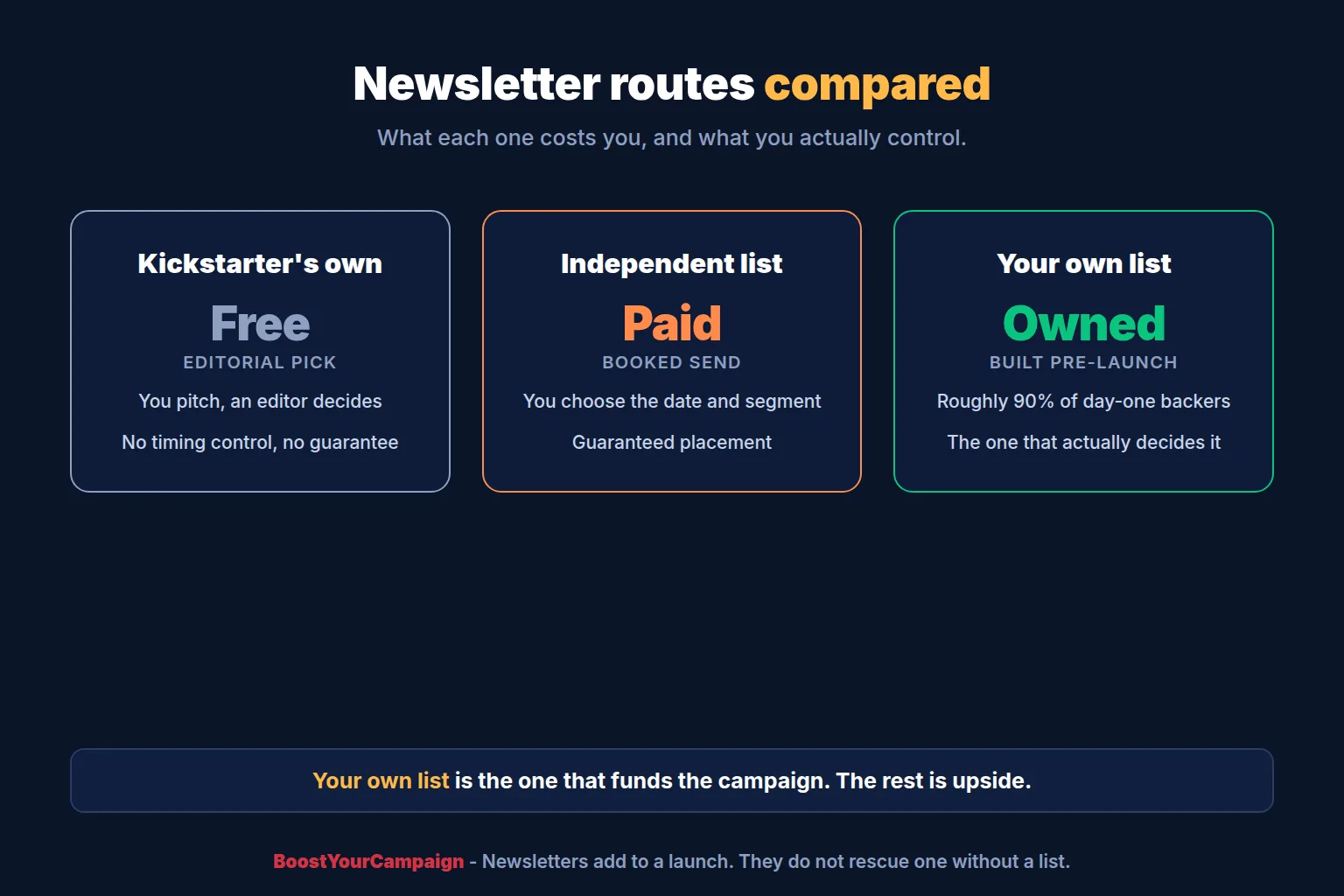
| Factor | Kickstarter's official newsletter | Paid newsletter placement |
|---|---|---|
| Cost | Free | Paid, priced per send |
| Control over timing | None - Kickstarter decides if and when | High - you pick the send date |
| Guarantee | None, ever | Placement is contracted once booked |
| Audience size | Not published by Kickstarter | Disclosed by the provider (ours: ~100,000 selected per send from a database of 8,500,000+) |
| Targeting | Backer-chosen category subscriptions | Provider selects backers matched to your category and price point |
| Who it suits | A finished, badge-worthy page with time to spare before launch | Any funded or funding campaign that wants a scheduled reach boost |
8) What actually drives launch-day revenue
It is worth stepping back from newsletters entirely for a moment, because neither kind - free or paid - is the biggest lever available to a creator. That lever is the pre-launch email list. As covered in our pre-launch checklist, roughly 90% of the pledges that arrive in a campaign's first 48 hours come from people who were already on a creator's list before launch day, not from organic Kickstarter discovery, press, or any single newsletter mention. A newsletter feature, official or paid, works best as a multiplier on a list that already exists - it reaches people who were not already going to hear about you, on top of the audience your own pre-launch work built. Chasing a newsletter feature instead of building a list gets the order of operations backward.
How BoostYourCampaign fits
BoostYourCampaign runs a paid newsletter feature service alongside pre-launch list building, ads, video, and fulfillment, which matters because none of those pieces work as well in isolation as they do together. Our newsletter reaches an opted-in database of 8,500,000+ backers, with roughly 100,000 selected per send and matched to a campaign's category, price point, and shipping regions rather than blasted to the full list. Unlike a Kickstarter editorial feature, you know the audience size going in and you can schedule the send against your own launch timeline instead of waiting on an editor's discretion.
We also help creators build the pre-launch page and prototype quality that gives an editorial pitch an actual chance, since a genuinely finished page is the one thing every path in this article has in common. BYC has been active since 2010 across 4,600+ campaigns with $734M+ raised and a 4.9/5 score across 300+ verified reviews, using a skin-in-the-game ad model that puts our own money alongside a client's ad budget rather than charging a straight percentage of the raise. If you want your page, pre-launch list, and newsletter reach working together instead of as separate bets, get in touch.
Before you pitch Kickstarter's editors
- Is your pre-launch page fully finished, not a placeholder you plan to fill in after launch?
- Do you have real photos or video of a working prototype, not a rendering?
- Have you written the risks and challenges section honestly rather than skipping it?
- Is your reward structure clean and easy to scan, not a wall of confusing tiers?
- Have you sent a short, specific pitch to Kickstarter's editorial team before launch, not after?
- Do you have a pre-launch list that will produce day-one momentum regardless of whether the pitch works?
- If a feature does not land, do you have a paid newsletter or cross-promotion plan booked as a backup?
Frequently Asked Questions
How do I get my Kickstarter in the newsletter?
Start by earning consideration for the Projects We Love badge: a finished pre-launch page, a real working prototype, honest risk disclosure, and a clean reward structure. Then send a short, specific pitch to Kickstarter's editorial team before launch, linking your pre-launch page and a couple of images or your video. There is no application form, and inclusion is entirely at Kickstarter's discretion.
Can you pay to be in Kickstarter's newsletter?
No. Kickstarter's own newsletters are editorial and not for sale at any price. Anyone offering to guarantee you a spot in Kickstarter's own newsletter for a fee is not telling you the truth. What you can pay for is placement in an independent, third-party newsletter that also reaches backers, which is a different product entirely.
What is the difference between Projects We Love and the Kickstarter newsletter?
Projects We Love is the badge and discovery boost - the heart icon on your project card, plus eligibility for homepage and category placement. The newsletter is one of the channels that badge can feed into: badged projects are more likely to show up in a newsletter edition, but the badge and the newsletter are not the same thing, and getting one does not automatically guarantee the other.
How many people read the Kickstarter newsletter?
Kickstarter does not publish subscriber counts, open rates, or click-through numbers for its own newsletters, and no outside source has a reliable figure either. Treat any specific reach number you see quoted for Kickstarter's own newsletter as unverified.
When should I contact Kickstarter about a feature?
Before launch, while your pre-launch page is live and finished. Curators scout upcoming projects during that window specifically, and a pitch sent after you have already launched and are struggling has missed the moment editors are actually looking.
Do newsletter features actually raise money?
Yes, in the sense that they produce a real, visible spike in traffic and pledges while the feature is live. But the size of that spike depends heavily on how strong the campaign already is - a feature amplifies momentum a creator already has rather than manufacturing momentum from nothing.
What are the alternatives to Kickstarter's newsletter?
Paid placement in an independent backer newsletter, cross-promotion swaps with other live campaigns, and running your own pre-launch and live-campaign email list are the three main alternatives. Our newsletter guide and crowdfunding promoter guide cover the paid options in more depth.
Does a newsletter feature work without a pre-launch list?
Not well. A newsletter feature, official or paid, reaches people outside your own audience, but it cannot replace the day-one momentum that a pre-launch list produces. Roughly 90% of first-48-hour backers on a strong launch come from the list a creator built before launch, so a newsletter feature works best layered on top of that foundation rather than substituted for it.
Whichever path you are pursuing - an editorial pitch, a paid newsletter slot, or both - the fundamentals are the same: a finished page, real proof the product works, and a list that gives you momentum on day one no matter what happens with any single feature. If you want help with any part of that, reach out through /contact.
Want results like these for your campaign?
We've helped 4,600+ creators raise over $734M. Let's pressure-test your launch plan and find the highest-leverage fixes before you go live.
Talk to an expert →Get the free 87-step launch checklist
The exact pre-launch, live-campaign and fulfillment steps we use across 4,600+ launches. Free PDF, emailed instantly.
You're in - check your inbox. Open the checklist now ->