Reward strategy decides more of a Kickstarter campaign's final number than almost any other page element, and it is the page most creators build backward - picking prices first, then trying to make the tiers feel special after. If you want a tier structure and pricing plan built around your margin before you launch, talk with BoostYourCampaign.
A Kickstarter reward strategy should give most backers one obvious hero tier to choose, built from 4-6 visible tiers rather than a long list that forces comparison. Price the core tier off retail with a real campaign discount, and hold back margin for an 8-10% platform and processing fee plus product cost. Limit the early bird, either by quantity or to the first 24 to 48 hours, at 20 to 40% off, and let it end when the limit is reached. Keep most add-ons in the pledge manager rather than piling them onto the live campaign page, and charge shipping later once you know the real weight and region.
- One tier should win by design - the hero tier is priced and positioned so most backers land there.
- 4-6 visible tiers beats 10 or 12 - every extra option is a reason to leave the page instead of pledging.
- Margin is set before launch, not discovered after - retail price, discount, fees, and shipping all have to net out first.
- The early bird has a real limit - cap it by quantity or to the first 24 to 48 hours; either one creates urgency as long as you hold to it.
- Add-ons belong mostly in the pledge manager - a shorter live-campaign list converts better, and the survey is where upgrade revenue lands.
- Shipping charged later protects margin - a flat guess baked into the tier price either overcharges nearby backers or eats margin on distant ones.
1) What a reward strategy has to do
A reward page has four jobs, and most campaigns only build for one. It has to make the choice easy for a backer deciding in under a minute whether to pledge at all. It has to protect the margin the rest of the business depends on, since a price that looks good on launch day is worthless if it does not clear fees, shipping, and product cost. It has to create real urgency without leaning on tricks the audience has already seen. And it has to feed the pledge manager, which collects add-ons, confirms shipping, and captures revenue that lands weeks after the campaign closes.
These jobs pull against each other: built purely for easy choice, a page has one tier and no upside for anyone who wants to spend more; built purely for margin, it bakes fees into a price that looks worse than the competitor's next tab over; built purely for urgency, it discounts so hard on day one the campaign has nowhere left to go. Across more than 4,600 campaigns since 2010, the tier structures that raised the most had a hero tier a backer could pick in ten seconds. Our broader crowdfunding reward strategy guide covers the same principles across platforms, and our guide to what a Kickstarter actually costs is a useful companion to the margin math below.
2) How many reward tiers to offer
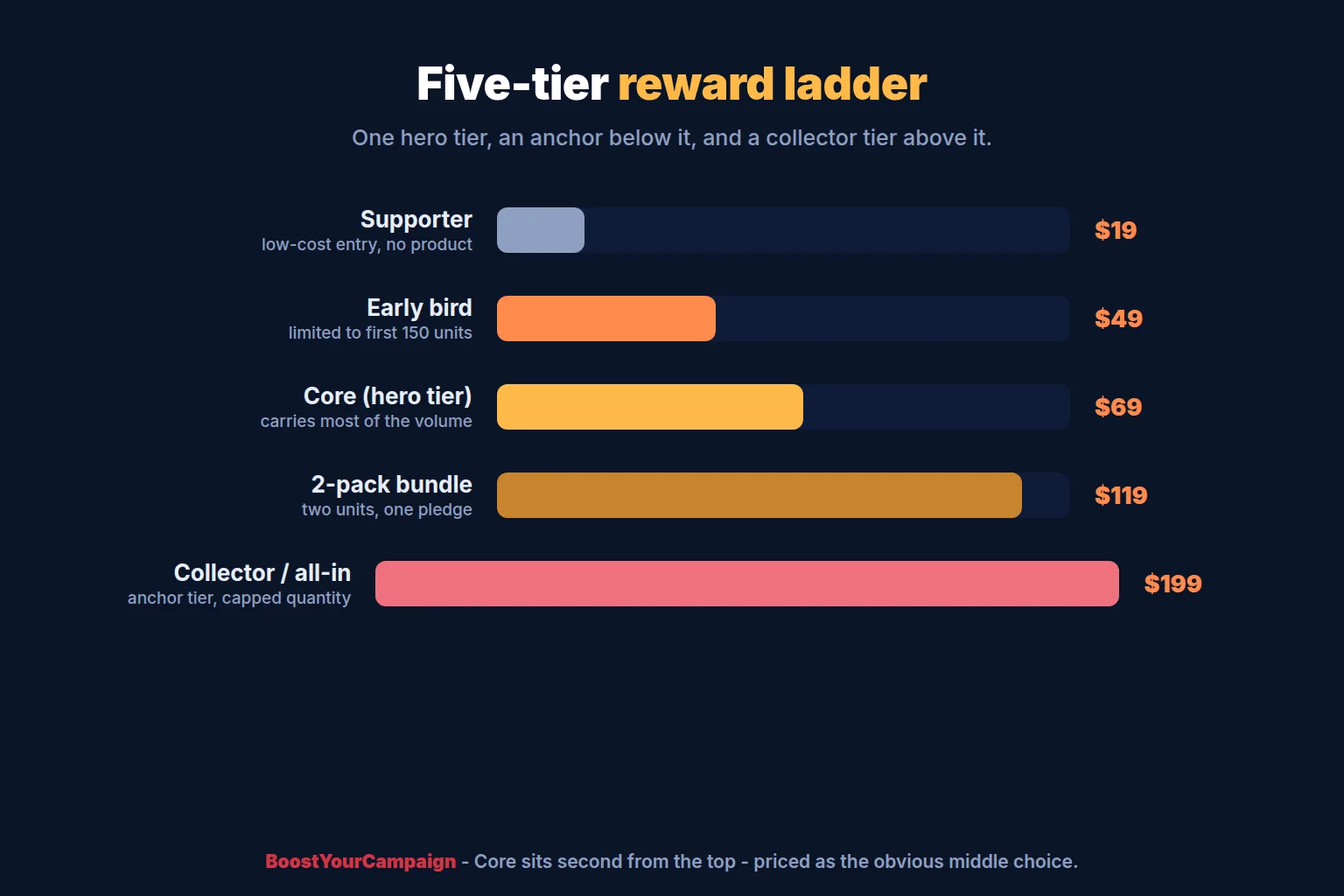
Most campaigns should show 4-6 visible reward tiers, built around one hero tier most backers are meant to choose. That tier usually sits second or third from the top: expensive enough to feel like the real product, cheap enough that a first-time backer does not have to think hard. A cheaper option below it keeps the hero from feeling like the entry price, and one or two pricier options above it keep it from feeling like the ceiling.
Twelve tiers, or eight that differ by one add-on each, do the opposite of what a creator intends. A backer comparing ten similar options is not shopping, they are stalling, and a stalled backer closes the tab more often than they pledge. The ladder that tends to work: a cheap supporter tier, the hero tier carrying most of the volume, one or two mid tiers or bundles for a natural upgrade path, and a high collector tier at the top that exists mostly as an anchor, making the hero tier look like the sensible middle choice. For tabletop specifically, our board game reward tier guide goes deeper on the category's core, deluxe, retailer, all-in shape.
| Tier | Price | What's included | Limit | Purpose |
|---|---|---|---|---|
| Supporter | $19 | Digital thanks, name in the credits, all project updates | Unlimited | Low-cost entry point for backers who cannot afford the product yet |
| Early bird | $49 | Core product at the deepest campaign discount | First 150 units | Rewards launch-day backers and builds day-one momentum |
| Core (hero tier) | $69 | Core product at the standard campaign price | Unlimited | Carries most of the campaign's pledge volume |
| 2-pack bundle | $119 | Two core products, one pledge | Tied to the initial production run | Raises average pledge for gift-givers and friend splits |
| Collector / all-in | $199 | Core product, every add-on, one exclusive extra | Capped at 300 units | Anchors the top of the page so the hero tier looks like the sensible middle choice |
3) Pricing the core tier
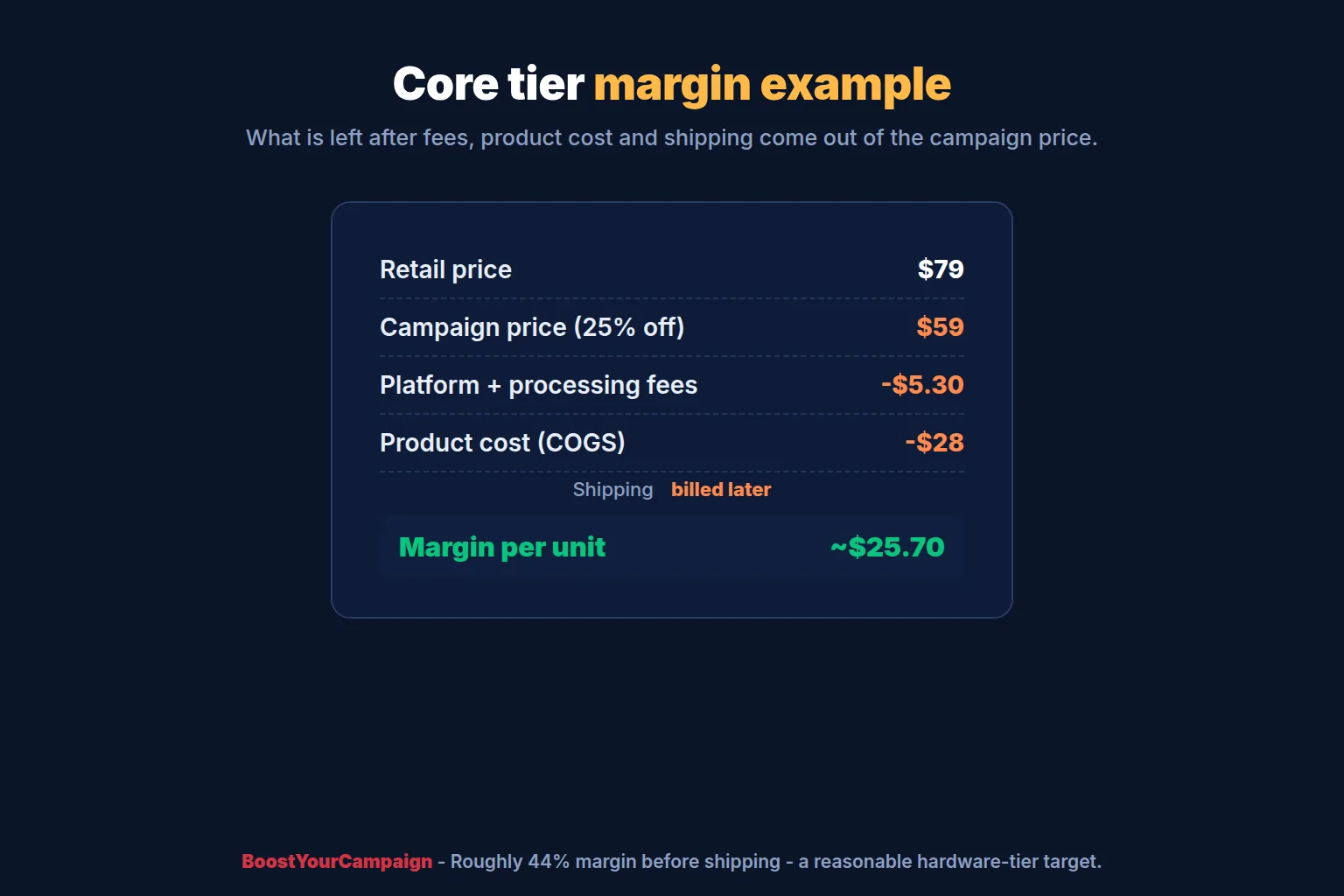
Start from a real retail price, not a campaign price you back into after deciding what feels achievable. Retail is what the product sells for once it is on a shelf, and the campaign discount is the gap between that and what backers pay for funding it early - a discount in the 20-35% range off retail is common for a core tier.
From that campaign price, three things come out before real margin appears: platform and processing fees, running roughly 8-10% all in on Kickstarter, Indiegogo, and Gamefound alike (our fees guide breaks that down further); shipping, still modeled against a realistic weight and region even if collected separately (more in section 7); and product cost, which most first-time creators underestimate since an early quote rarely matches the finished cost. Run the math before the tier goes live - a tier that loses money once these are subtracted cannot be fixed retroactively. Our reward pricing guide goes deeper on the psychology side.
| Line | Amount |
|---|---|
| Retail price | $79 |
| Campaign price (25% off retail) | $59 |
| Platform + processing fees (~9%) | -$5.30 |
| Shipping | Collected separately, not deducted here |
| Product cost (roughly 35% of retail) | -$28 |
| Margin per unit before shipping | ~$25.70 |
Here, roughly $25.70 of the $59 campaign price is margin before shipping, a little under half - a reasonable target for a hardware or tabletop core tier. What matters is whether the total after fees and product cost still funds ads, video, and the overrun that shows up once real quotes come in.
4) Early bird strategy
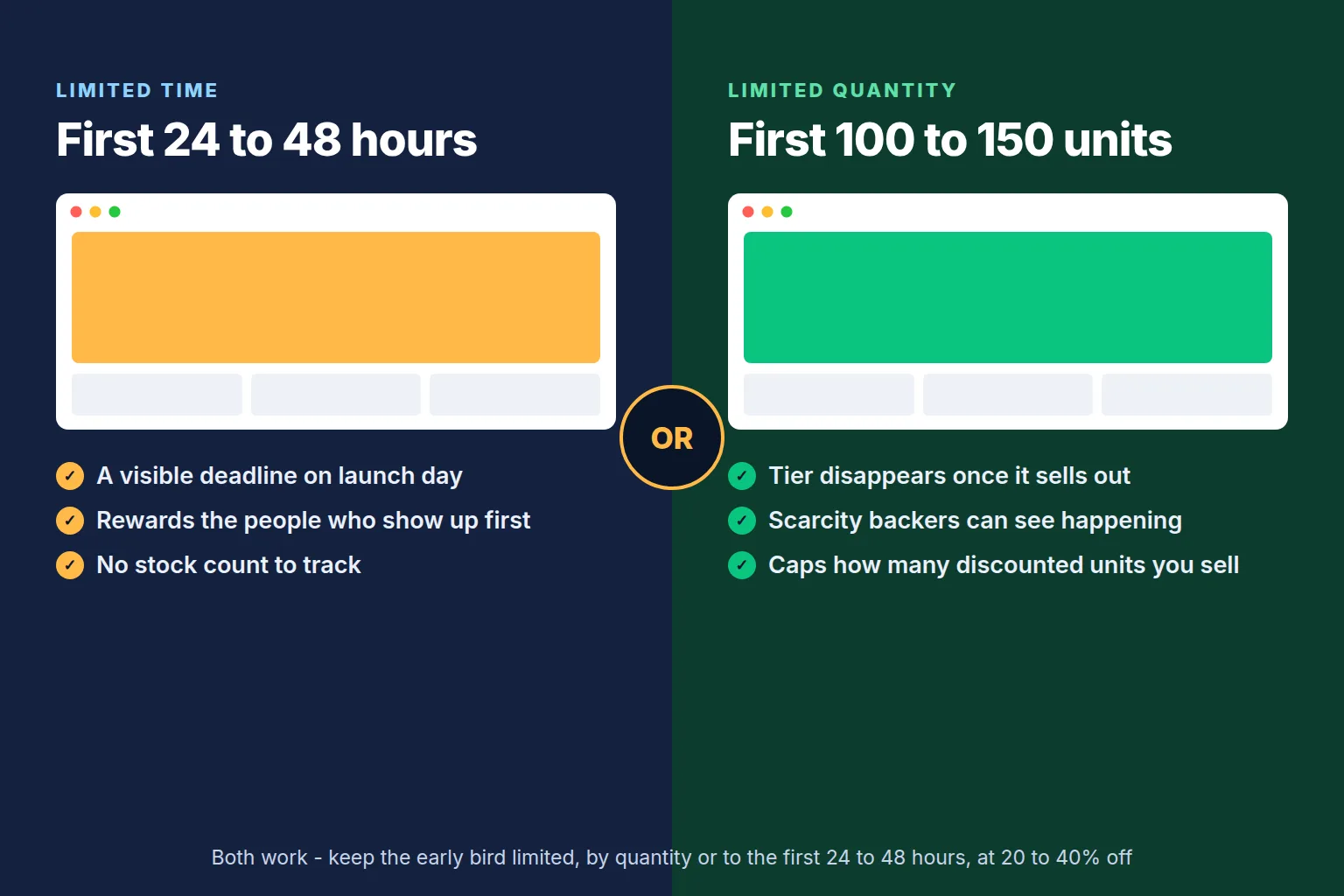
The question that matters most for an early bird is not the discount, it is the limiter. A limited-quantity early bird - the first 100 or 150 units at a lower price - disappears once it sells out. A limited-time early bird - the first 24 to 48 hours of the campaign - ends when that window closes. Both work, and both create real urgency as long as the limit holds: the tier ends when you said it would, with no restock and no extended deadline.
On discount depth, a 20-40% reduction from the standard campaign price is the usual range. Launch-day urgency matters because Kickstarter and Indiegogo both reward early velocity, so a well-priced early bird that moves quickly does double duty. A super early bird, a small, steeply-discounted tier for a pre-launch VIP list or a secret reward link, is worth adding on top of the public one, capped to list size and priced as the best deal on the page.
The real risk is training backers to wait. Set the limit, let it run out, and resist restocking or extending it - a closed early bird is a success signal, not a problem to solve.
5) Bundles and multi-packs
A 2-pack or 3-pack tier - the same core product, sold as one pledge covering two or three units - is one of the simplest ways to raise average pledge without inventing a new product. It works because a meaningful share of backers are already buying for someone else: a spouse, a sibling, a friend who has been talking about the same project. One pledge covering both units, at a small per-unit discount, turns an intention they already had into one larger pledge instead of two smaller ones, or a lost sale entirely. Gift bundles frame the same logic explicitly, with a second unit positioned as a gift, and that framing matters since a backer weighing a gift responds differently to a tier labeled for that purpose than a generic multi-pack.
Average pledge tends to rise wherever a multi-pack sits close to the hero tier in visibility, not buried below the collector tier. Position it directly after the hero tier, price the discount so the math is obvious, and keep the quantity limit tied to your actual production plan so it does not outrun what you can manufacture.
6) Add-ons and the pledge manager
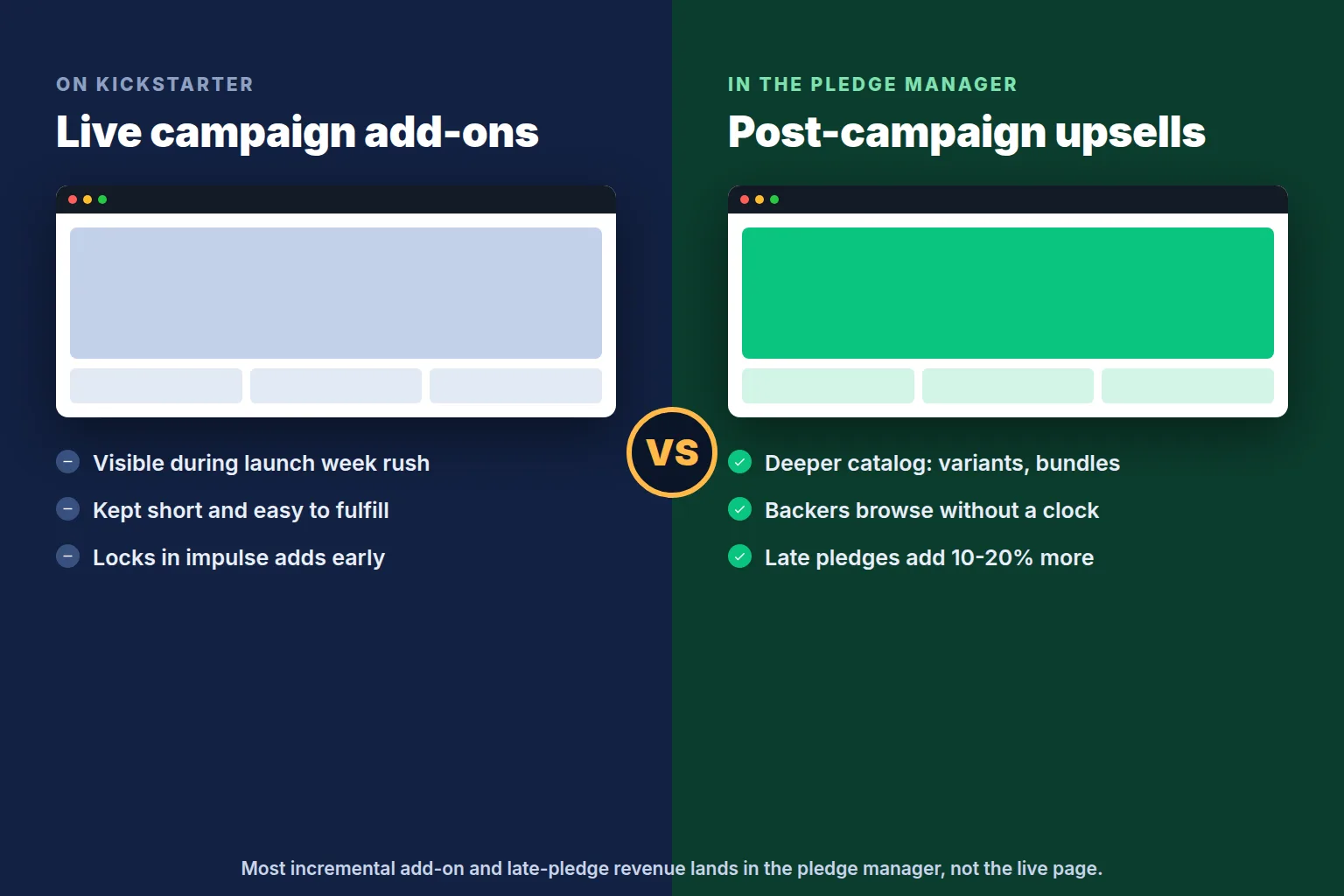
Add-ons are individual extras any backer can attach to a pledge: an accessory, a color variant, a second smaller product, sleeves or a playmat for a tabletop title. They lift average pledge once the core tier decision is already made, and work best when the tier structure is already solid.
Keep the live campaign page's add-on list short: a handful of the most obvious, easiest-to-fulfill extras. Save the deeper catalog for the pledge manager, where backers confirm their address and finalize what ships - a shorter live page converts better, and the pledge manager is a captive audience with time to browse. Late pledges typically add somewhere in the range of 10-20% on top of the original raise for a campaign that keeps marketing after it funds. Our pledge manager and late pledges guide covers that window, and our guide to Kickstarter's pledge manager options covers when a complex structure earns back the fee on BackerKit or Gamefound. The mistake to avoid is an add-on that needs tooling you have not actually secured.
7) Shipping in the reward price
Baking a shipping estimate into the tier price, set eight or nine months before a product ships, locks in a guess that real freight rates and fuel surcharges will almost certainly move past by delivery time. Collecting shipping later, once addresses, weights, and add-ons are confirmed, lets you charge each backer a number close to the real regional cost instead of a blended average that overcharges nearby backers to cover distant ones. "Shipping calculated later" reads as transparent, and backers have generally come to expect it - a short line noting shipping is charged separately once the pledge manager opens prevents surprises. Our shipping cost guide walks through the actual dollar ranges by weight and region.
EU backers add a second layer: VAT applies to a shipped reward as a sale, not a gift, and registering for IOSS ahead of launch lets VAT get collected cleanly at pledge rather than as a surprise customs bill at the door.
8) Stretch goals and reward inflation
Stretch goals and reward tiers solve different problems, and mixing them up is where margin quietly disappears. A reward tier is something a backer pays more to get; a stretch goal unlocks a free upgrade for every backer, funded by overfunding rather than by any one backer paying extra. Treating an unlocked stretch goal as free to deliver is how reward inflation happens - every unlock is a new SKU and a new cost against the margin the tier pricing already built in.
The protection is the same discipline that governs pricing the core tier: model the cost, time, and complexity before it goes live, not after backers already expect it. Favor unlocks with near-zero marginal cost - digital content, a name in the credits - over physical upgrades that look exciting mid-campaign and turn into a fulfillment problem later. Our stretch goals guide covers the sequencing and threshold math; every stretch goal is a promise layered on pricing you already locked in.
9) Reward page copy and images
Name tiers by outcome, not internal jargon. "Core game" or "Everything bundle" tells a backer what they are getting in the half-second they spend reading the name. A clever in-joke name, or a version number only the creator understands, makes a backer pause to decode what they are buying right when they were ready to commit.
Show the contents, not just the price. A single clear image per tier prevents more confusion and support tickets than another paragraph of description text, especially at the boundary between adjacent tiers.
A "most popular" tag on the hero tier is a small piece of social proof that does real work: backers default toward whatever looks like the safe choice, and the tag removes the need to compare every tier line by line. Use it honestly, on the tier actually carrying volume.
10) Mistakes we see
Too many tiers is the most common mistake by a wide margin. A page with eight or ten pledge levels, several differing by a single add-on, forces backers to compare instead of decide, and they often leave without picking anything.
An early bird priced too deep is the second - a discount steep enough to make the standard tier look like a bad deal trains backers to wait for the next markdown. Free worldwide shipping baked into every tier is the third: domestic backers quietly subsidize distant ones through a higher headline price.
Unlimited early birds are the fourth - a "limited" tier that never sells out reads as marketing theater to backers who have seen the trick before. And add-ons that need new tooling are the fifth, promised on enthusiasm before the supplier relationship actually exists.
How BoostYourCampaign fits
We build reward strategy as part of the same planning process as ad strategy and fulfillment. Tier count, hero tier price, early bird quantity, and shipping plan get modeled together against real fee, product cost, and freight numbers before launch, so the structure a backer sees on day one still has margin left on delivery day.
BoostYourCampaign has been active since 2010 across more than 4,600 campaigns with $734M+ raised and a 4.9/5 score across more than 300 verified reviews. The agency uses a skin-in-the-game ad model, putting its own money into ad spend alongside the client's budget with fixed fees rather than a percentage-of-raise commission, and operates owned fulfillment warehouses in the US and EU, where the shipping-charged-later approach in section 7 gets executed rather than just recommended. See our services, or talk to an expert.
Reward structure checklist before launch
- Does one hero tier stand out, with 4-6 visible tiers total?
- Has the core tier survived the math: retail, discount, 8-10% fees, product cost, and shipping?
- Is the early bird limited, either by quantity or to the first 24 to 48 hours?
- Does a 2-pack or bundle tier sit close enough to the hero tier for gift-givers to see it?
- Are most add-ons planned for the pledge manager rather than the live page?
- Is shipping charged separately by region instead of baked into the tier price?
- Has every stretch goal been cost-modeled before it goes live?
- Does every tier name describe the outcome, with one image showing what is included?
Frequently Asked Questions
How many reward tiers should a Kickstarter have?
Most campaigns do best with 4-6 visible tiers built around one hero tier most backers are meant to choose. More than that forces backers to compare instead of deciding, and they often leave without pledging.
How much should Kickstarter early bird discounts be?
A 20-40% discount off the standard campaign price is the common range. Limit it, either by quantity or to the first 24 to 48 hours, so the urgency is real.
Should I offer early bird rewards on Kickstarter?
In most categories, yes - a well-priced early bird rewards backers most likely to drive launch-day momentum, since both Kickstarter and Indiegogo reward early velocity. Limit it by quantity or to the first 24 to 48 hours, and resist restocking or extending it once the limit is reached.
How do you price Kickstarter rewards?
Start from a real retail price, apply a 20-35% campaign discount for the core tier, then subtract roughly 8-10% in combined platform and processing fees plus your actual product cost to see what margin is left.
What are Kickstarter add-ons and how do they work?
Add-ons are optional extras any backer can attach to a pledge, separate from the core tier. Keep the live page's list short and save the deeper catalog for the pledge manager, where a real share of upgrade revenue lands.
Should shipping be included in Kickstarter reward prices?
Generally no. Collecting shipping separately through the pledge manager, once weight and region are confirmed, lets you charge an accurate regional cost instead of a flat guess that overcharges some backers and eats margin on others.
What is a good average pledge on Kickstarter?
There is no single number across categories, since it depends on price point and whether bundles and add-ons pull backers upward from the hero tier. A ladder with a clear upgrade path lifts average pledge well above that tier's own price.
Can you change rewards after a Kickstarter launches?
You can add new tiers at any point, and edit a tier freely as long as no one has pledged to it yet. Once a backer has pledged, Kickstarter locks that tier's price and contents in place.
If you want your reward tiers and pricing modeled before you launch, reach out through /contact.
How ready is your campaign?
Score your page out of 100 in about 3 minutes, against the benchmarks in this post.
Want results like these for your campaign?
We've helped 4,600+ creators raise over $734M. Let's pressure-test your launch plan and find the highest-leverage fixes before you go live.
Talk to an expert →Get the free 87-step launch checklist
The exact pre-launch, live-campaign and fulfillment steps we use across 4,600+ launches. Free PDF, emailed instantly.
You're in - check your inbox. Open the checklist now ->