The campaign video is usually the biggest single cost before launch, and the quotes creators get vary so much that it is hard to know what a fair price looks like. The good news is that an affordable Kickstarter video can convert as well as an expensive one, as long as the money goes into the parts backers actually judge: a clear script, the product working on screen, and clean light and sound. This guide covers what an affordable budget buys, where you can safely save, where cutting costs will cost you pledges, and how to brief a studio so the quote matches the video you need. For the full price ranges across every tier, see our Kickstarter video cost guide.
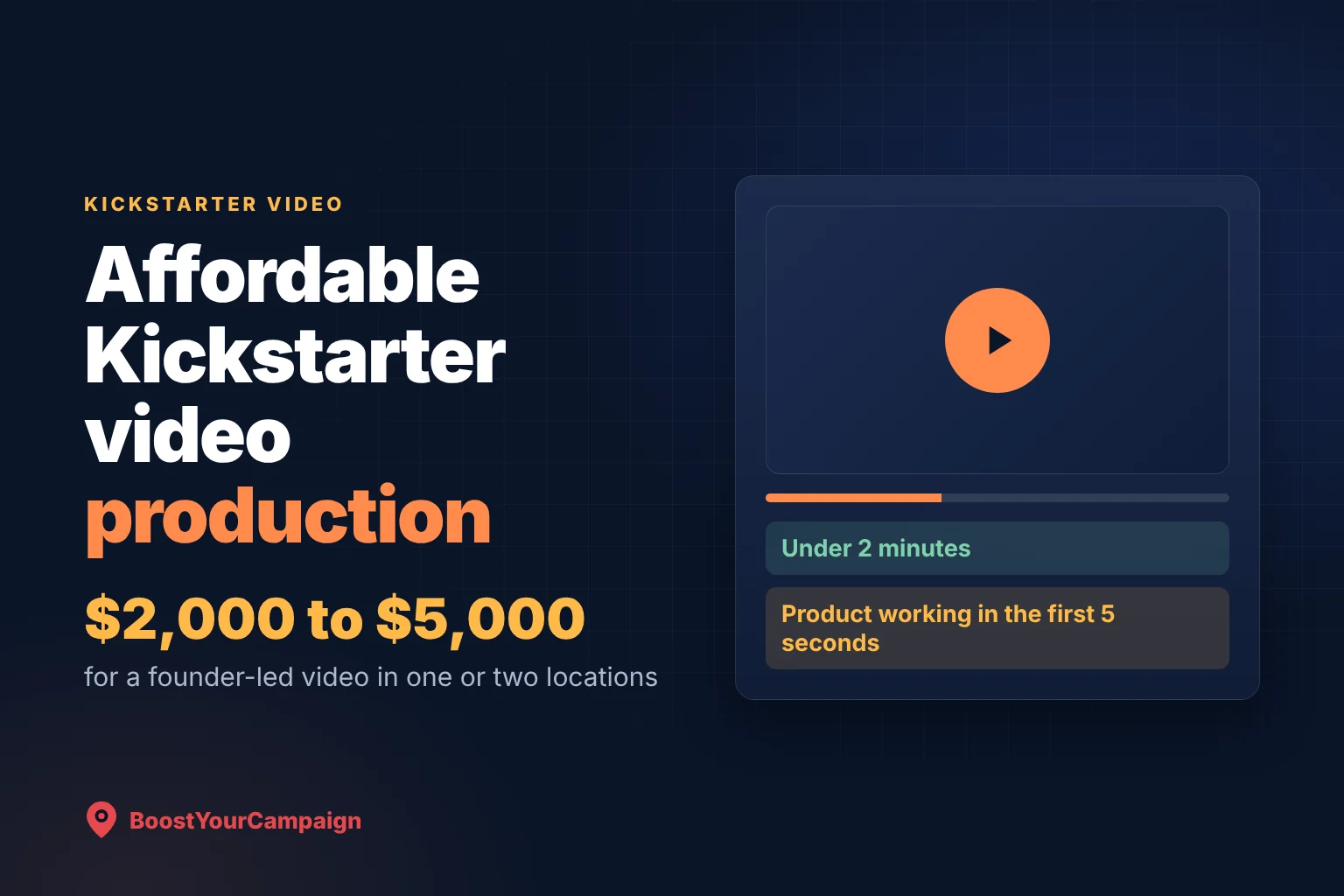
Affordable Kickstarter video production runs about $2,000 to $5,000 for a founder-led video filmed in one or two locations. That budget covers a script, a short shoot day, product close-ups, simple motion graphics and an edit under 2 minutes. Spend it on a clear script and on showing the product working in the first 5 seconds. Save on locations, actors and 3D. A multi-scene shoot with actors or several locations runs about $5,000 to $12,000.
- $2,000 to $5,000 is the affordable tier for a professional, founder-led campaign video.
- The script is the cheapest place to win. A clear structure costs little and moves conversion more than camera gear.
- One location, no actors, no 3D is how affordable productions keep the budget down.
- Never cut sound, light or product close-ups. Backers forgive a simple set, not a product they cannot see.
- Shoot once, cut many times. The same footage should give you ad cutdowns, GIFs and page images.
What "affordable" means for a Kickstarter video
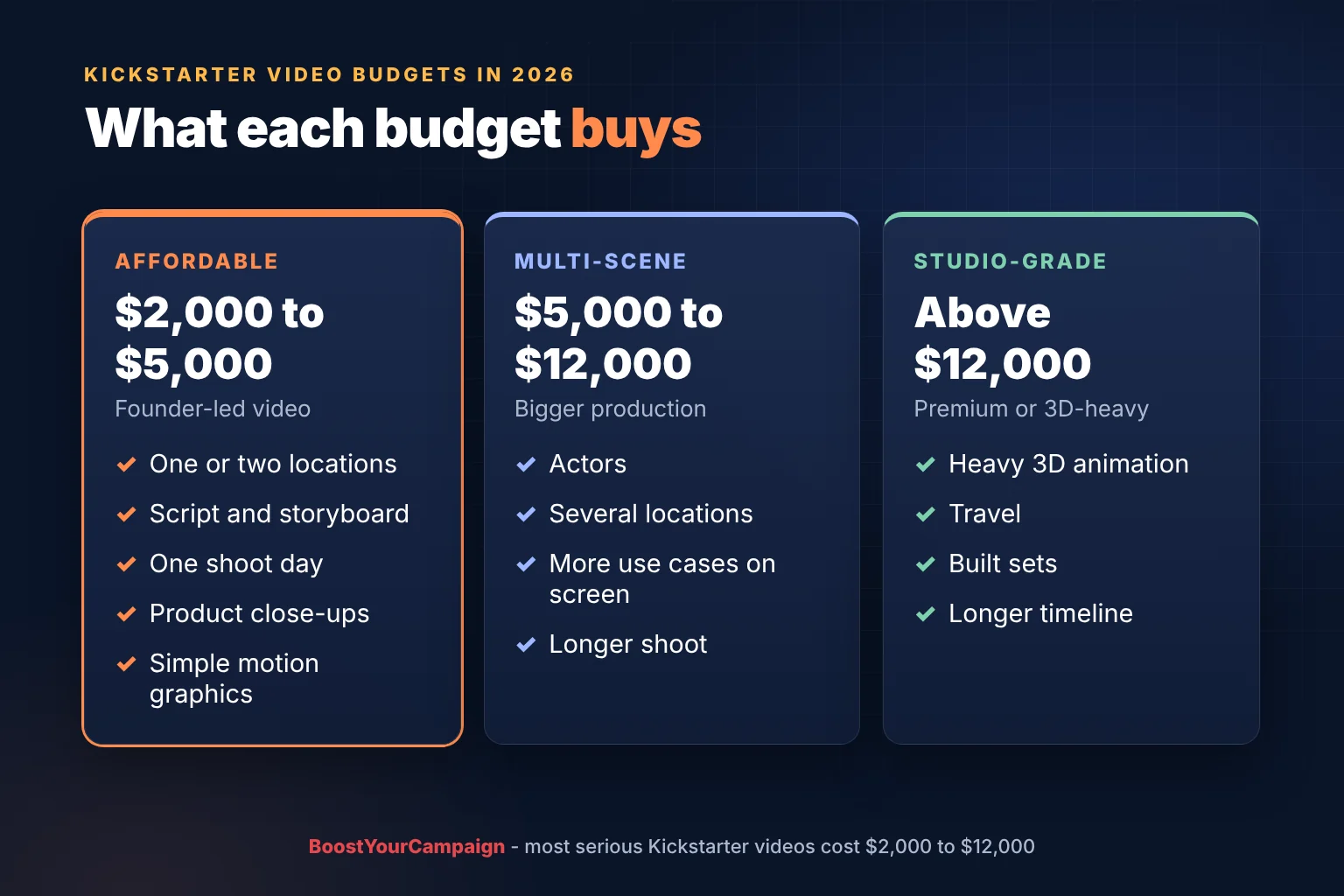
Most serious Kickstarter videos in 2026 cost between $2,000 and $12,000. Inside that range there are two clear tiers. The affordable tier, about $2,000 to $5,000, is a founder-led video filmed in one or two locations, with the product doing the talking. The next tier, about $5,000 to $12,000, adds actors, several locations and more complex scenes. Heavy 3D animation, travel or built sets go above that.
Affordable is not the same as cheap. A bargain video that nobody finishes watching costs more than an affordable one that converts, because the video sits at the center of the campaign page and feeds every ad you run. The aim is the lowest budget that still makes the product clear, credible and desirable.
| Option | Typical budget | Good for | Watch out for |
|---|---|---|---|
| Affordable founder-led video | About $2,000 to $5,000 | Products that are easy to show, founders who are comfortable on camera | Scope creep: extra locations and scenes push it into the next tier |
| Multi-scene shoot | About $5,000 to $12,000 | Lifestyle products, several use cases, products that need actors | Spending on scenes that do not explain the product |
| Studio-grade or 3D-heavy | Above $12,000 | Premium hardware where visuals decide the sale | Long timelines and little footage left for ads |
What an affordable budget should include
At $2,000 to $5,000 you should still get a complete, professional video. When you compare quotes, check that each one includes these items, because a low quote that leaves them out is not really cheaper.
- A script and storyboard written for Kickstarter, built around the problem, the product working, proof and the rewards. Our guide to writing a Kickstarter video script shows the structure.
- One shoot day in one or two locations, with proper lighting and clean audio for any talking to camera.
- Product close-ups and demonstration shots that show every key feature working.
- Simple motion graphics for specs, prices and key claims.
- Editing, color and licensed music, delivered as a main video under 2 minutes.
- Raw footage or extra cuts you can use in ads and on the campaign page.
Where you can save
Affordable productions stay affordable by cutting the things backers do not miss.
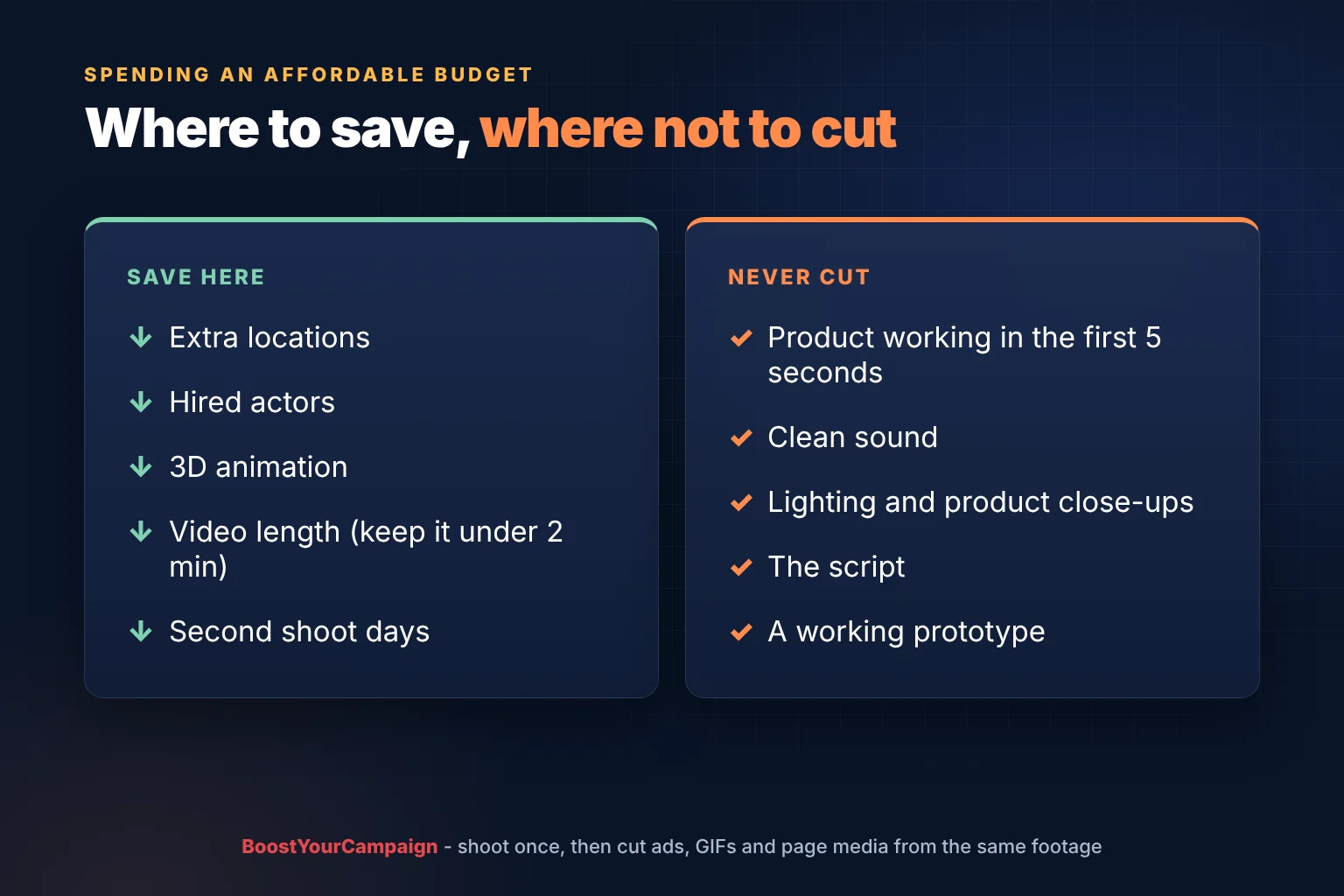
- Locations. One well-lit space beats three average ones. Every extra location adds travel, setup time and crew hours.
- Actors. A founder who explains why they built the product is often more convincing than a hired actor, and costs nothing extra.
- 3D animation. If the product is physical and works, film it working. Keep animation for internal parts the camera cannot see.
- Length. A tight video under 2 minutes is cheaper to edit and converts better than a long one. A complex product can add a second, longer demo video later.
- Shoot days. A detailed shot list written before the shoot is what lets a crew finish in one day instead of two.
Where not to cut
Some savings show up straight away in the pledge numbers.
- The first 5 seconds. The product should be on screen and working within the first 5 seconds. A slow brand intro loses viewers before the video has said anything.
- Sound. Viewers forgive simple visuals much faster than bad audio. Clean voice recording is cheap insurance.
- Lighting and product shots. If backers cannot see the details, they cannot judge the quality, and they will not pay for it.
- The script. Writing is the least expensive part of the production and the one that decides whether the video sells. Our article on why Kickstarter videos lose pledges covers the most common structure mistakes.
- A working prototype. Filming a product that does not work yet forces expensive workarounds in the edit and can mislead backers. Plan the shoot for when the prototype works.
How to brief a studio so the quote stays affordable
A vague brief produces a high quote, because the studio has to price in uncertainty. A clear one-page brief gets you comparable quotes and a shorter shoot. Include:
- What the product is, who it is for, and the one problem it solves.
- The three to five features the video must show working.
- Who will appear on camera (founder, team, users) and whether you need hands-only shots.
- Your preferred location and whether props or a set are needed.
- The target length (under 2 minutes) and the extra cuts you want for ads.
- Your launch date, so the edit is finished in time for the pre-launch ads, not just for launch day.
- Your budget range. Studios plan very differently for $2,000 and $10,000, and saying it up front saves rounds of revisions.
Our Kickstarter video FAQ answers the questions creators ask most often before a shoot.
Shoot once, use the footage everywhere
The most affordable video is the one that pays for itself several times. The same shoot should give you the main campaign video, short vertical cutdowns for Meta and TikTok ads, GIFs and stills for the campaign page, and footage for your pre-launch landing page. Plan those outputs before the shoot, so the crew films the extra angles and vertical framings in the same day. Adding them afterwards almost always means a second shoot.
This matters because the ads usually run for weeks before launch and through the campaign. A video that only works as a 2-minute horizontal file leaves your ad buyer without fresh creative halfway through the pre-launch.
Freelancer, studio or agency?
A freelancer can be the cheapest route if you write the script and direct the shoot yourself and know exactly what you need. A video studio adds a producer and a crew, which reduces the risk of a weak result but usually not the price. A crowdfunding agency with its own studio adds the part both of those miss: a video built from the same plan as the ads and the campaign page, by people who see the conversion data. Our guide to crowdfunding video production services compares the options in detail.
We run two in-house video studios, in the US and in Europe, and produce video as part of the launch plan, not as a separate job. Because the footage, the ads and the page are planned together, the same shoot covers the campaign video, the ad creative and the page media. Since 2010 we have supported 4,600+ campaigns that raised over $734M, and the videos are built to the same rules every time: under 2 minutes, product working in the first 5 seconds. If you want a quote for a video sized to your budget, talk to an expert.
Frequently asked questions
How much does an affordable Kickstarter video cost?
About $2,000 to $5,000 for a professional, founder-led video filmed in one or two locations. Multi-scene shoots with actors or several locations run about $5,000 to $12,000. See the full breakdown in our Kickstarter video cost guide.
Can a low-budget video still fund a Kickstarter?
Yes, if it is clear. Backers judge whether they understand the product and trust that it works. A simple video with the product working in the first 5 seconds, clean sound and good light beats an expensive video with a slow start.
How long should a Kickstarter video be?
Under 2 minutes for the main campaign video. If the product is complex, add a second, longer demo video further down the page.
What is the cheapest way to make a Kickstarter video look professional?
Spend on a strong script, proper lighting and clean audio, and film in one well-lit location. Those three choices matter more than the camera or the number of scenes.
Should my Kickstarter video include ad versions?
Yes. Ask for short vertical cutdowns from the same shoot. Your ads run for weeks before launch and through the campaign, and fresh creative from the main shoot is far cheaper than a second production.
Planning a campaign video on a tight budget? Talk to an expert, or read the full Kickstarter video cost guide first.
Want results like these for your campaign?
We've helped 4,600+ creators raise over $734M. Let's pressure-test your launch plan and find the highest-leverage fixes before you go live.
Talk to an expert →Get the free 87-step launch checklist
The exact pre-launch, live-campaign and fulfillment steps we use across 4,600+ launches. Free PDF, emailed instantly.
You're in - check your inbox. Open the checklist now ->