The video is where most campaigns are won or lost, and it's decided before a camera ever turns on. If you want a script and a production team under one roof, talk with BoostYourCampaign about your product and launch date.
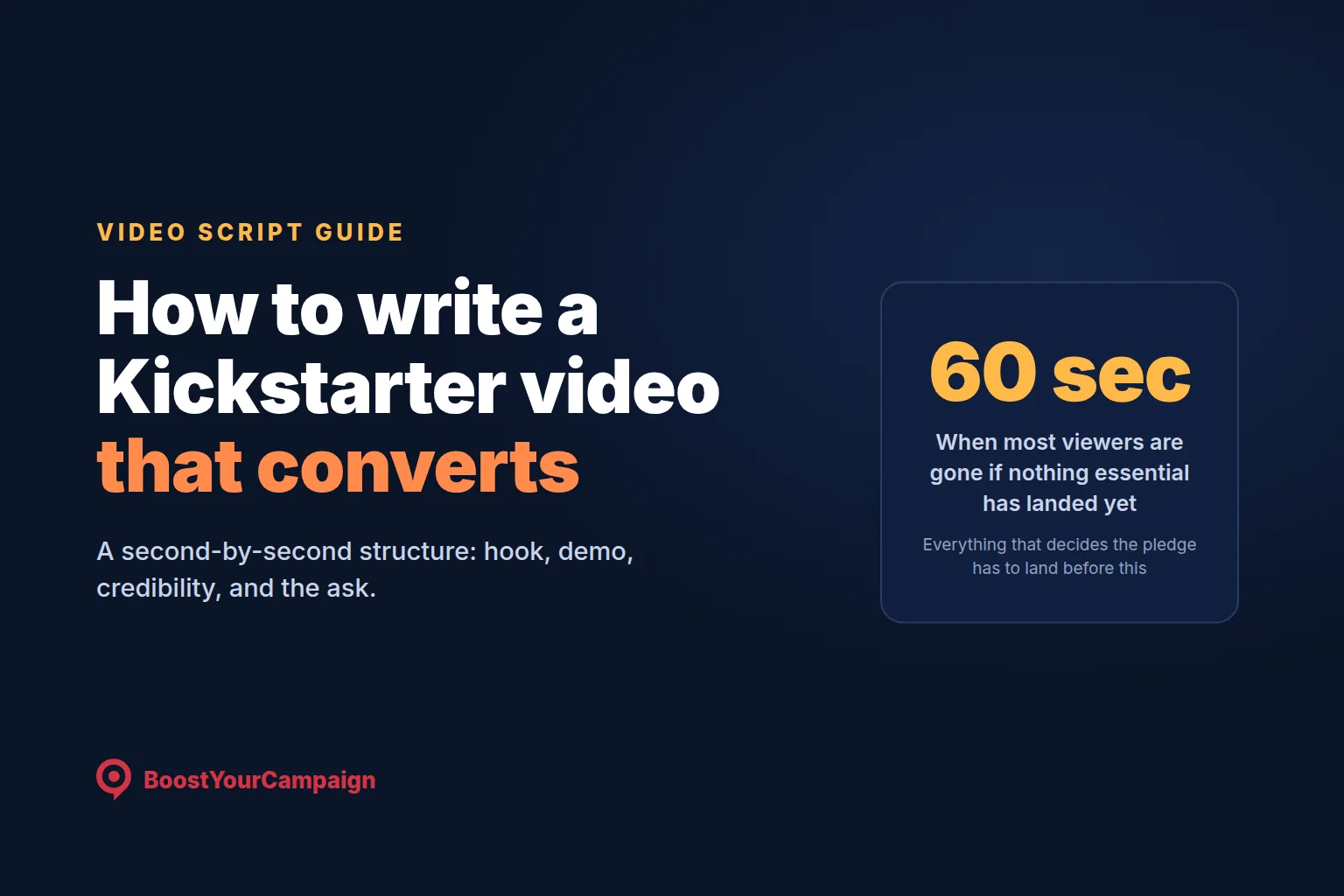
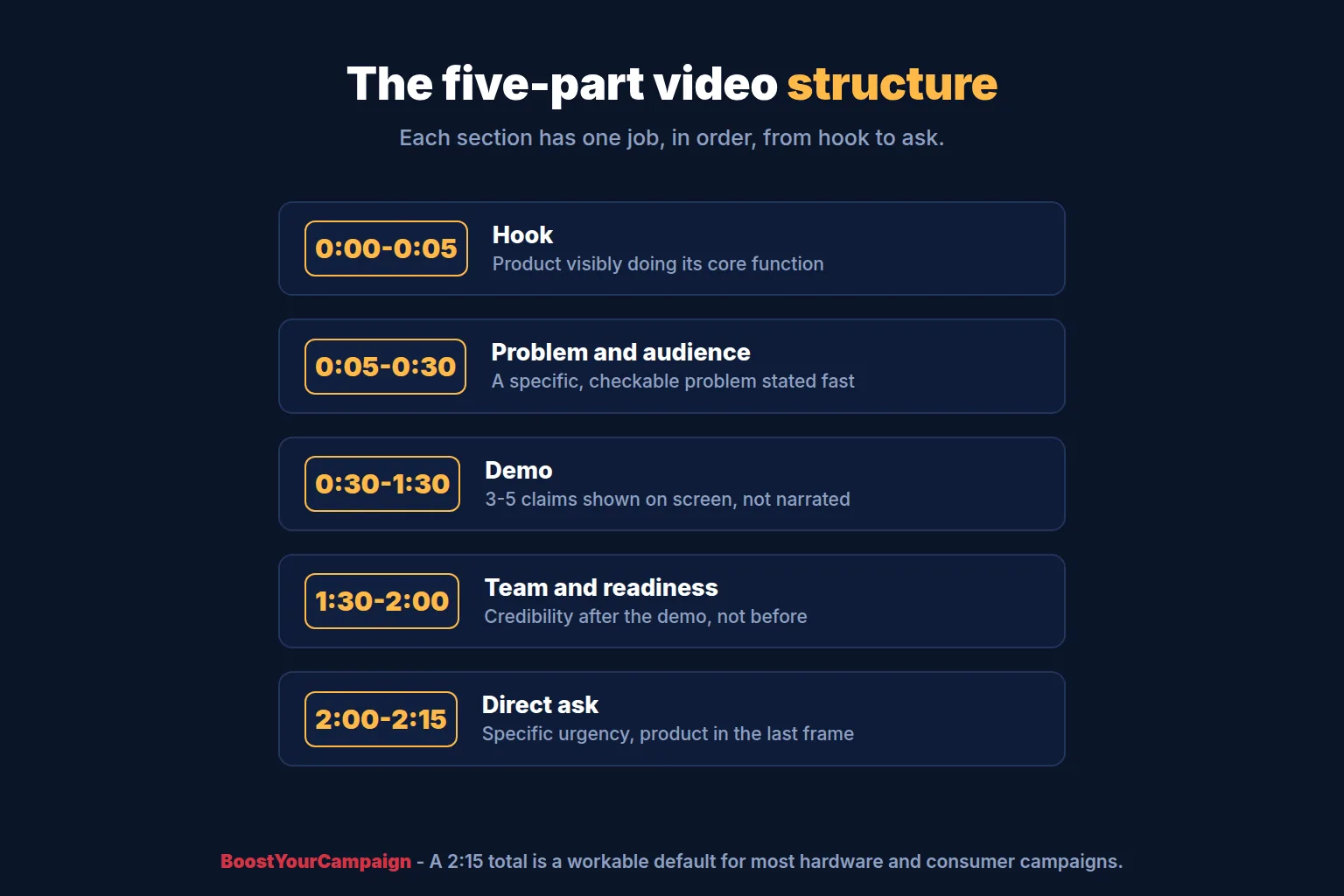
A Kickstarter video that converts is written, not filmed into existence. The first 5 seconds need to show the product visibly doing the thing it does, not a logo or a founder's face. The next 25 seconds establish the problem and who it's for. The middle 60 seconds demonstrate the product with claims shown on screen, not narrated over B-roll. The next 30 seconds build credibility - team, manufacturing readiness, timeline. The final 15 seconds make a direct ask with real urgency. Most viewers are gone by 60 seconds, so nothing essential can live past the demo, and the shot list should be built from the finished script, not the other way around.
- The hook is the product, not the pitch - the first 5 seconds need to show the thing working, not a logo or a slow fade-in.
- Retention drops hard after 60 seconds - anything essential to the pledge decision has to land before that point.
- Claims need to be shown, not narrated - text on screen and a demo beat a voiceover listing specs.
- Credibility comes after the demo, not before it - founder biography openings lose viewers before they've seen the product.
- The ask needs urgency, stated directly - a vague closing line converts worse than a specific instruction.
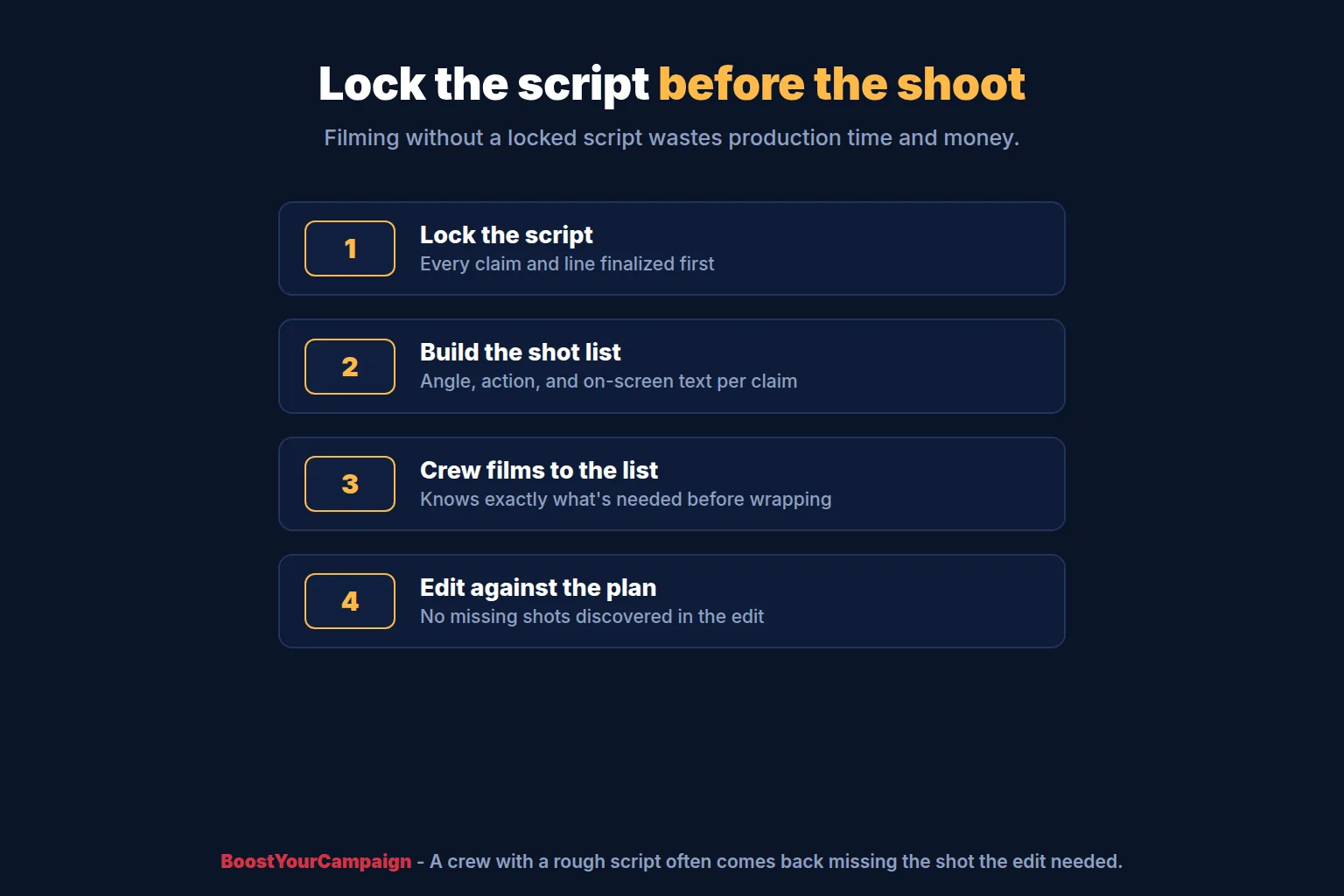
- The shot list is written after the script - filming without a locked script wastes production time and money.
1) The first 5 seconds: the hook is the product
A viewer clicking into a campaign video has already decided, in the first couple of seconds, whether to keep watching. That decision gets made before any narration has had time to land, which means the opening shot has to do the work a script usually saves for later. The product needs to be on screen, visibly doing the thing it does, in the first 5 seconds. Not a logo animation. Not a founder walking into frame. Not a slow establishing shot of a workshop. The product, working, immediately.
This is the single most common mistake in first-time campaign scripts: opening with a feeling-first line like "We've always believed that great design changes lives," read over a moody shot of the product sitting still. It sounds like a pitch because it is one, and viewers who came to see what the thing does scroll past a pitch. A script that opens with the product doing its core function - the knife cutting, the light changing color, the bag expanding - gives the viewer a reason to keep watching before it asks them to care about anything else.
Write the opening line to describe an action, not a feeling. "Watch this" beats "Let me tell you about." If the product's core function is genuinely hard to show in five seconds (a service, a piece of software, something abstract), find the closest visual proxy - a before/after, a result, a reaction - rather than defaulting to narration over nothing happening on screen.
2) Seconds 5-30: the problem and who it's for
Once the hook has earned a few more seconds of attention, the script needs to establish two things quickly: what problem this solves, and who's watching that should care. This section is where a lot of scripts either drag or skip entirely, and both are mistakes. Drag too long on the problem and viewers who already understood it from the hook start losing patience. Skip it entirely and viewers who didn't immediately grasp the use case never catch up.
The efficient version states the problem in one or two lines, specific rather than universal. "Most travel bags either fit under the seat or hold a week of clothes, never both" is a real, checkable claim a target backer recognizes instantly. "Everyone deserves better travel gear" is a feeling with no information in it. The audience identification can often be implicit in the problem statement itself - if the problem is specific enough, the "who this is for" is obvious without a separate line spelling it out.
This section should end with a clean transition into the demo, not a cliffhanger. The viewer already knows the problem; the next natural thing they want is to see the solution, not to sit through another 10 seconds of setup before getting there.
3) Seconds 30-90: the demo, with claims shown, not narrated
This is the longest section of the video and the one that actually earns the pledge. The core rule: claims need to be shown on screen, not just narrated over footage. If the script says the product is waterproof, the shot needs to show it underwater or in rain, with the claim as on-screen text reinforcing what the viewer is already watching happen. A voiceover saying "it's fully waterproof" over a static product shot asks the viewer to take the claim on faith, and faith is a weak substitute for evidence in a medium built around seeing is believing.
Structure this section as a sequence of specific claims, each paired with its own shot: claim, demonstration, brief on-screen text confirming the number or fact, move to the next claim. Three to five core claims is usually enough - trying to cram in every feature the product has turns the demo into a spec dump that loses viewers exactly at the point they should be getting most convinced. Pick the claims that differentiate the product from the obvious alternative a backer already owns or could easily buy, and cut the rest, or save them for the campaign page's FAQ section instead of the video.
Comparison shots work especially well here when there's a credible reference point. Side-by-side against a well-known competing product, shot under matched conditions, tells a viewer more in three seconds than a paragraph of narrated specs. If the product has a genuinely surprising capability, this is where it earns its moment, but it needs to be shown doing the surprising thing, not described as surprising.
4) Seconds 90-120: team and manufacturing readiness
Once the demo has done its job, the script needs a short section that answers a question the viewer is now implicitly asking: can these people actually deliver this? This is credibility, and it belongs after the demo, not before it. A founder biography opening - "Hi, I'm Alex, and five years ago I had an idea" - is one of the most common script mistakes precisely because it puts credibility-building in front of product-proving, and viewers who don't yet care about the product don't care who's telling them about it.
Once they've seen the product work, a brief, specific credibility section lands differently. Real footage of the factory floor or workshop, a quick shot of a working prototype next to earlier iterations, a one-line mention of relevant experience or a previous successful launch - these all do more in 20-30 seconds than an extended founder story would do in twice the time. Specificity beats warmth here: "We've run three production cycles of a similar product with this factory" is more convincing than "We've worked incredibly hard to get this right."
If manufacturing is genuinely ready - tooling done, a working pre-production sample, a named factory partner - say so plainly and show the evidence. If it isn't fully ready yet, don't oversell readiness the video can't back up; a vague claim here that later proves false is exactly the kind of thing that shows up in unhappy backer comments mid-campaign.
5) The final 15 seconds: the direct ask
The closing section needs to do one job: tell the viewer exactly what to do next, with urgency that's specific rather than generic. "Back us today" is weak because it could be said about any campaign at any time. "Back us in the first 48 hours to lock in the early bird price before it's gone" gives a viewer a concrete reason to act now instead of bookmarking the page and forgetting about it, which is what a vague ask actually produces.
This section should reinforce the single strongest claim from the demo one more time, briefly, alongside the ask - not introduce a new idea this late in the video. The last thing on screen should be the product again, ideally in its best hero shot, with the pledge button or campaign name clearly visible, since a viewer who's ready to act needs to know exactly where to click without hunting for it.
6) Writing for retention: nothing essential after 60 seconds
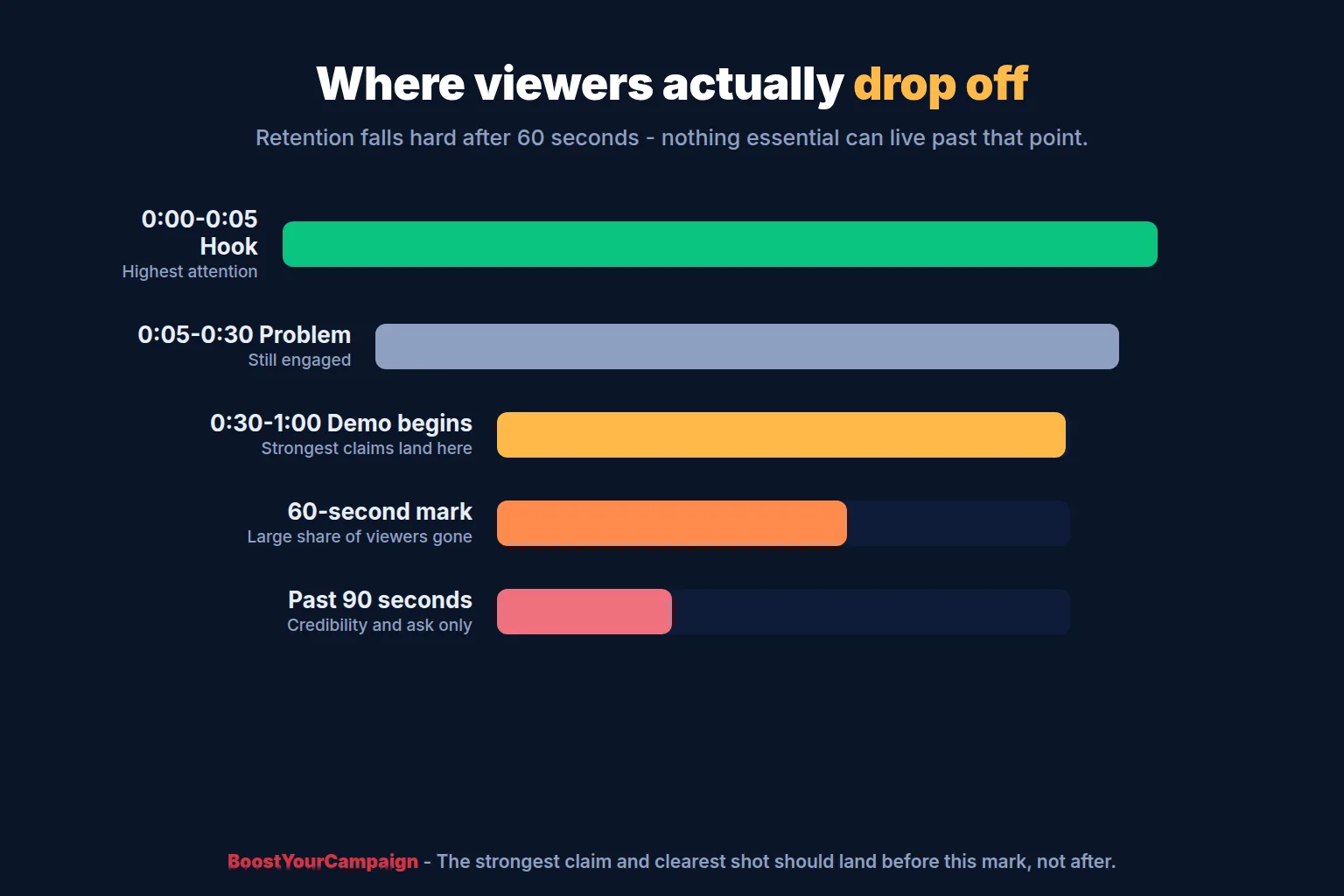
Platform view data consistently shows the same pattern: a large share of viewers who start a campaign video are gone by the 60-second mark, and the drop-off continues from there. That's not a reason to make the video shorter than it needs to be - some products genuinely need 2-3 minutes to demonstrate properly - but it is a reason to structure the script so that nothing critical to the pledge decision lives past that point.
In practice, that means the core demo and the strongest claims need to land inside the first 60-90 seconds, with credibility and the ask filling the remaining time for the viewers who stay. If a script currently saves its best claim, its clearest comparison shot, or its most persuasive number for the final 30 seconds, that's a structural problem worth fixing before filming, not after the video is live and underperforming. Reorder the script so the strongest material sits earliest, then let weaker supporting material fill the tail.
This is also why a script needs a hard total runtime decided before writing starts, not discovered after editing. A script written to an unbounded length tends to bloat in the middle section, adding claims and shots that feel important while writing but that a viewer with a shrinking attention span never reaches.
7) Second-by-second timing table
| Time | Section | Job it has to do |
|---|---|---|
| 0:00-0:05 | Hook | Product visibly doing its core function, no logo or narration first |
| 0:05-0:30 | Problem and audience | State a specific, checkable problem and who it applies to |
| 0:30-1:30 | Demo | 3-5 core claims, each shown on screen with on-screen text, not narrated alone |
| 1:30-2:00 | Team and readiness | Short, specific credibility - real factory footage, working prototype, relevant experience |
| 2:00-2:15 | Direct ask | Specific urgency and a clear instruction, product visible in the last frame |
This 2:15 total is a workable default for most hardware and consumer product campaigns. A more complex product with a genuinely longer demo need can extend the middle section, but every extra second added there should be tested against whether it's a claim the campaign can't fund without, not a nice-to-have.
8) Script-to-shot-list translation
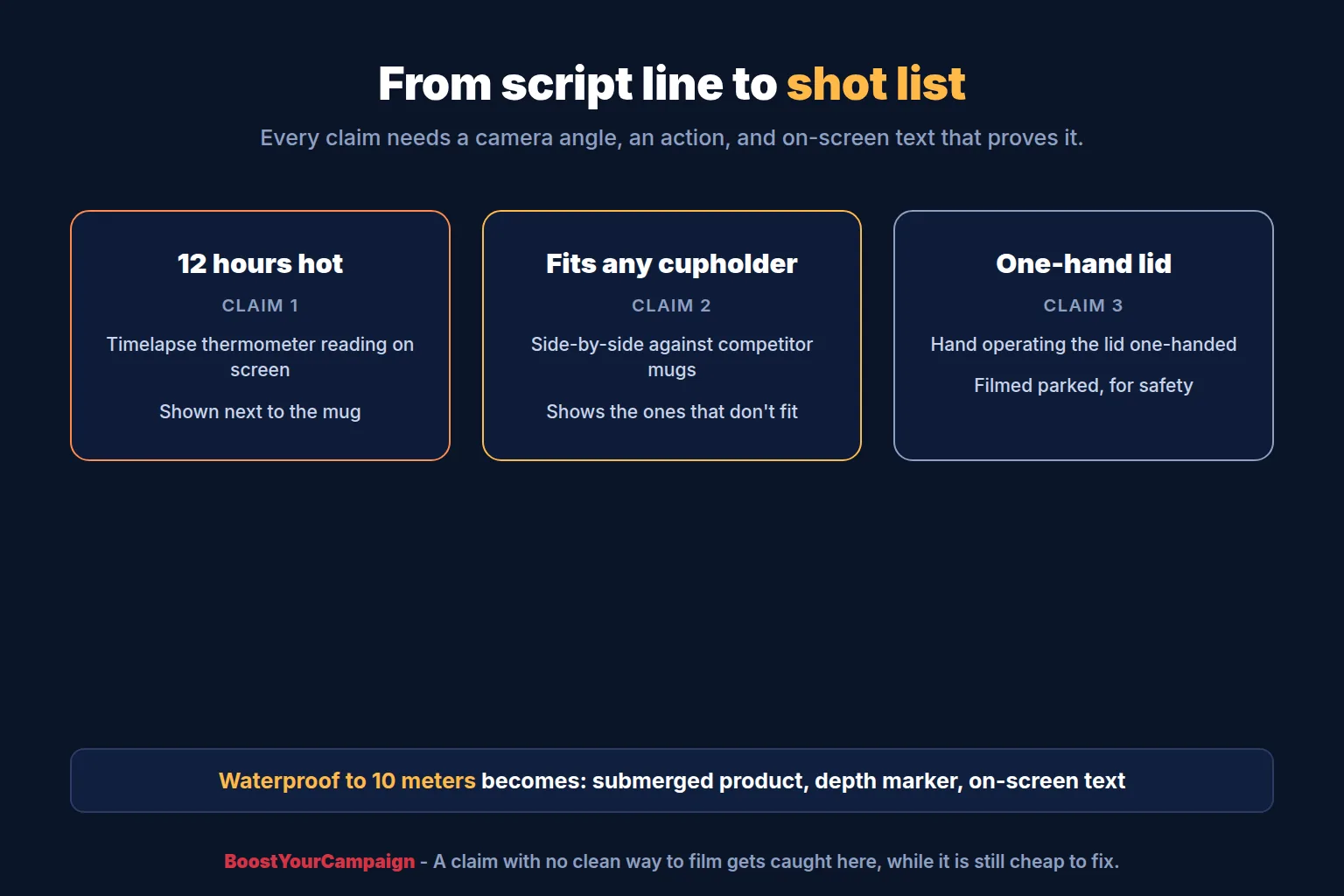
Once the script is locked, the next step is turning each line into a specific shot, not filming loosely around the script and hoping it cuts together. For every line or claim in the script, write down what the camera needs to see to prove that line: the angle, whether it's a close-up or a wide shot, what needs to be in motion, and what on-screen text or graphic pairs with it. A script line like "waterproof to 10 meters" translates to a specific shot list entry: product submerged, timer or depth marker visible on screen, on-screen text confirming the number as the shot holds.
This translation step is where a lot of production budget gets saved or wasted. A crew showing up with a locked shot list built from a locked script films efficiently and knows exactly what's needed before wrapping. A crew showing up with a rough script and a plan to "get some good shots and figure it out in editing" burns hours and often still comes back missing the one shot the edit actually needed. Our preproduction checklist covers the planning steps that sit between a locked script and a filming day.
Building the shot list also surfaces gaps in the script early - a claim that sounds fine written down but turns out to have no clean way to film convincingly gets caught at the shot-list stage, when it's cheap to rewrite, instead of on set, when it's expensive to discover.
9) Common script mistakes
A handful of mistakes show up repeatedly in first-draft campaign scripts. Feeling-first headlines that open with adjectives instead of action - "revolutionary," "life-changing," "like nothing you've seen" - tell the viewer nothing concrete and read as generic marketing language rather than a specific claim about the product. Founder biography openings, covered above, put the wrong section first and lose viewers before the product has proven anything. Spec dumps try to cram every feature into the demo section instead of picking the three to five claims that actually differentiate the product, which dilutes the strongest points among weaker ones the viewer doesn't retain.
A closing ask that's vague rather than specific ("support us today" instead of a concrete instruction with a reason to act now) wastes the highest-intent moment in the entire video. And a script written to an unbounded length, with the strongest material buried in the middle or saved for the end, works against how viewers actually watch - most of them won't get there. Reading the script out loud against a stopwatch before filming, and cutting anything that pushes the runtime past what the structure above calls for, catches most of these before they become expensive to fix on set.
10) A short annotated example script skeleton
Below is a generic skeleton for a fictional product, a compact travel mug that keeps drinks hot for 12 hours, meant only to illustrate structure. Swap in real claims and shots for an actual product; this is a template, not a script to copy directly.
0:00-0:05 (Hook) - Close-up: steam rising off coffee poured into the mug, lid clicks shut. No narration, no logo yet.
0:05-0:30 (Problem/audience) - Voiceover: "Most travel mugs go cold by lunch. This one doesn't." Cut to a commuter opening the mug hours later, steam still visible.
0:30-1:30 (Demo) - Claim 1: "12 hours hot" - timelapse thermometer reading on screen next to the mug. Claim 2: "Fits any car cupholder" - side-by-side against two competitor mugs that don't fit. Claim 3: "One-hand lid" - hand operating the lid one-handed while driving-adjacent (parked, for safety).
1:30-2:00 (Team/readiness) - Quick factory floor shot, on-screen text: "Tooling complete. First production run: [month]." One line from the founder about prior manufacturing experience with insulated products.
2:00-2:15 (Ask) - Mug in hero shot, on-screen text: "Back in the first 48 hours for the early bird price." Campaign name and pledge button visible.
How BoostYourCampaign fits
BoostYourCampaign writes the script and produces the video under one roof, using owned production studios in the US and EU rather than outsourcing either half to a separate vendor. That matters specifically because a script written by someone who isn't also planning the shoot tends to include claims that are hard or expensive to film, while a shoot planned without a locked script tends to come back missing the exact shots the edit needs - the handoff gap this article's structure is built to avoid.
The agency has been active since 2010 across 4,600+ campaigns with $734M+ raised and a 4.9/5 score across 300+ verified reviews, and uses a skin-in-the-game ad model, investing its own money alongside the client's ad budget with fixed fees rather than a percentage-of-raise commission, so the video and the ad strategy that drives traffic to it are planned together rather than as separate handoffs. For the broader video planning process, see our Kickstarter video guide, our video for Kickstarter overview, and our video cost and budget guide. For how video fits into the wider campaign plan, see our campaign video strategy guide.
Before you write your script: a quick checklist
| Question | Why it matters |
|---|---|
| Does the first 5 seconds show the product working, not a logo or founder shot? | Viewers decide whether to keep watching almost immediately. |
| Are the 3-5 strongest claims picked, with weaker features cut from the demo? | A spec dump dilutes the claims that actually move a pledge decision. |
| Is every major claim paired with a shot that proves it, not just narration? | Shown claims convert better than told claims in a visual medium. |
| Does credibility come after the demo, not before it? | Viewers who haven't seen the product yet don't care who's behind it. |
| Is the closing ask specific, with a real reason to act now? | A vague call to action wastes the highest-intent moment in the video. |
| Is the script locked before the shot list is built? | Filming without a locked script wastes production time and misses key shots. |
Frequently Asked Questions
How long should a Kickstarter video script be?
Most hardware and consumer product campaigns work well around 2 to 2.5 minutes total. The structure matters more than the exact length: the strongest claims need to land before the 60-90 second mark, since that's roughly where viewer retention drops off hard.
What should the first line of a Kickstarter video say?
Nothing - the first 5 seconds should be visual, showing the product doing its core function, with narration or a headline coming after that hook has earned attention. Opening with a founder biography or a feeling-first tagline is one of the most common mistakes.
Should I write the script before or after filming?
Before. A locked script drives an efficient shot list, so the crew knows exactly what needs to be filmed. Filming loosely around a rough script and hoping it cuts together wastes production time and often misses the exact shot the edit needs.
How many product claims should the demo section cover?
Three to five is usually the right range. Trying to cover every feature turns the demo into a spec dump that dilutes the claims that actually differentiate the product from what a backer could already buy.
Where should the founder or team appear in the script?
After the product demo, not before it. A founder biography opening asks viewers to care about the people before they've seen the product prove itself, which loses viewers who came to see what the thing does.
What's the biggest mistake in Kickstarter video scripts?
Opening with a feeling-first headline or a founder story instead of the product visibly working. The second most common mistake is a vague closing ask that doesn't give viewers a specific reason to pledge now instead of later.
Do claims in the video need to be shown on screen, or can they be narrated?
They should be shown. Text on screen paired with a demonstration is more convincing than a voiceover listing specs over unrelated footage, since a video is a visual medium and viewers trust what they see more than what they're told.
How does a shot list get built from a script?
For every claim or line in the locked script, write down the specific camera angle, action, and on-screen text needed to prove it. This translation step also catches claims that sound fine written down but have no clean way to film, while it's still cheap to fix.
If you want your script written and produced by the same team, reach out through /contact.
Want results like these for your campaign?
We've helped 4,600+ creators raise over $734M. Let's pressure-test your launch plan and find the highest-leverage fixes before you go live.
Book a free strategy call →Get the free 87-step launch checklist
The exact pre-launch, live-campaign and fulfillment steps we use across 4,600+ launches. Free PDF, emailed instantly.
You're in - check your inbox. Open the checklist now ->