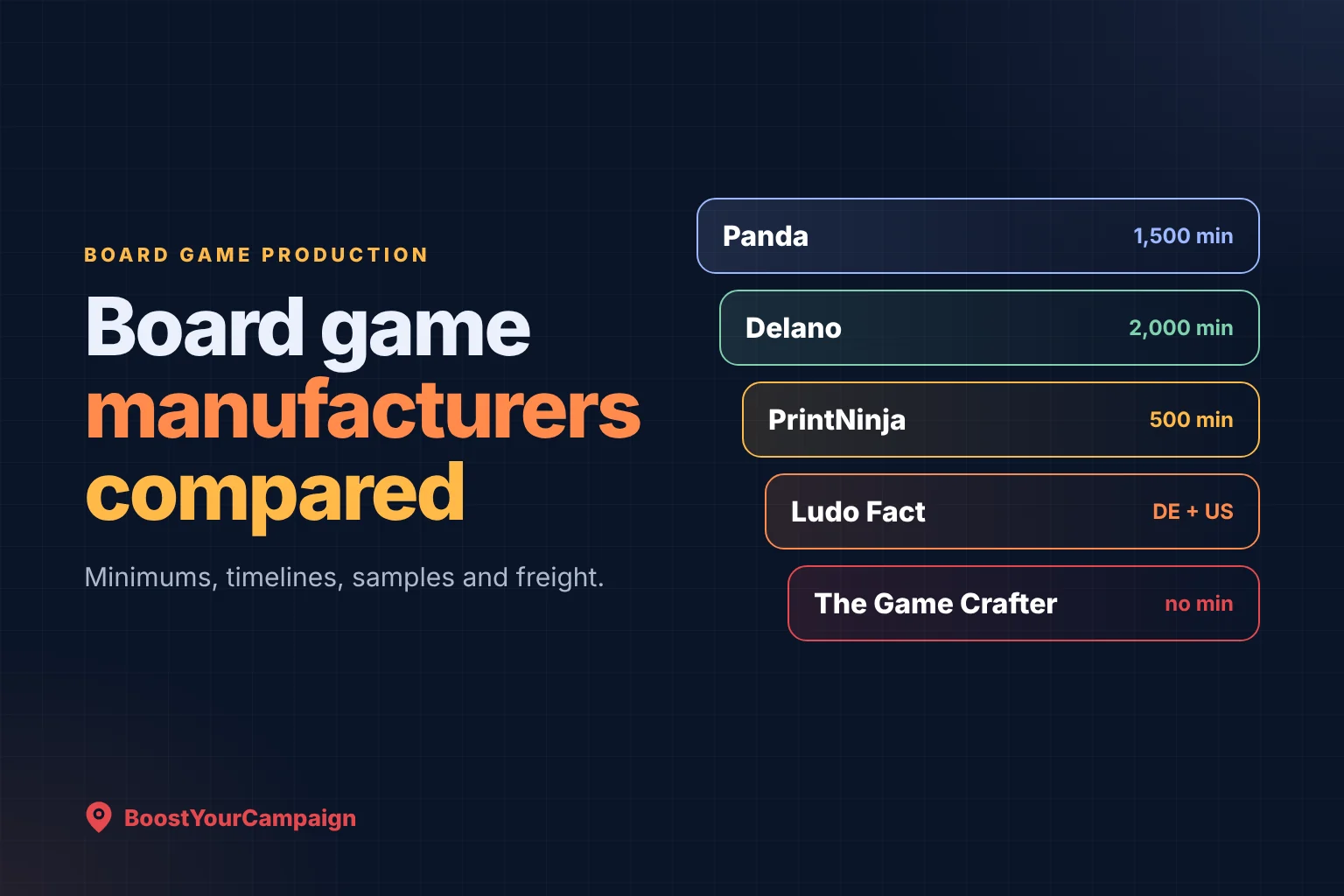
Most Kickstarter board games are made in China by factories such as Panda Game Manufacturing, LongPack, Whatz, Magicraft and Boda, with Ludo Fact (Germany and the US) and Delano (US) as the main options closer to home. Expect a minimum order of roughly 500 to 2,000 copies (Panda publishes 1,500, Delano 2,000), about 3 to 4 months of production, and then several weeks of ocean freight before the games reach a warehouse near your backers.
- Most indie games are made in China, where the widest range of custom components sits under one roof.
- Published minimums cluster between 500 and 2,000 copies. Below that, you are in print-on-demand or card-only territory.
- Production takes about 3 to 4 months after files are approved, plus freight. Lunar New Year adds several weeks.
- Some companies on every list are brokers, not factories, which changes who you talk to when something goes wrong.
- Freight and fulfillment decide your real cost per copy, so plan where the games land before you sign.
Who makes board games for Kickstarter creators
A small group of factories prints the majority of crowdfunded board games, and most of them are in China. That is where you find printing, punchboard, wood, plastic, dice, miniatures and assembly in one place, which matters for a game with twenty different component types. European and American factories exist and are the right call for some games, usually simpler ones, card-led ones, or publishers who need short shipping into one market.
Below we compare the names you will see most often. One thing to know before you read the table: most factories do not publish their minimum order quantity or lead times. Where a number is in the table, it comes from the company's own site or quote form. Where it says "not published", ask for it in writing with your quote.
Board game manufacturers compared
| Company | Where | Model | Published minimum | Known for |
|---|---|---|---|---|
| Panda Game Manufacturing | Head office in Vancouver, own factory in China, Brazil joint venture announced 2025 | Factory | 1,500 games | Premium and deluxe games, pre-production and mass production copies before shipping |
| LongPack Games | Shanghai, China | Factory | Not published | Full component range, including dice, metal, wood and miniatures |
| Whatz Games | Jiaxing, China | Factory | Not published | ICTI and ISO 9001 facility, recycled-material and FSC paper options |
| Magicraft | Henan, China, with sales offices in Germany and the US | Factory | Not published | Says it makes 90% of components on-site |
| Boda Games | Zhejiang, China | Factory | Not published | Board and card games, artwork templates and sample boxes |
| Ludo Fact | Germany, plus a production site in Lafayette, Indiana | Factory | Not published | Large independent European maker of board games, cards and puzzles |
| Delano Games | Michigan, US | Factory | 2,000 units (quote form) | US-based board and card game production |
| Shuffled Ink | Florida, US | Factory | 15 sets for card products | Card games, playing cards and tarot decks in small runs |
| Grand Prix International | Massachusetts, US, with a Hong Kong office | Sourcing partner | Not published | Manages production with factories in China and Vietnam, plus testing and freight |
| PrintNinja | US company, partner factories mostly in China | Broker | 500 units for simple games | Offset printing with hard copy proofs |
| The Game Crafter | Wisconsin, US | Print on demand | No minimum | Prototypes and very small runs |
Sources: Panda's process page, PrintNinja on minimum order quantities, and each company's own website. Ownership, minimums and locations change, so confirm them in your quote.
Factory, broker or print on demand
A factory owns the production line. A broker or sourcing partner manages a factory for you, which can help a first-time creator with communication, proofing and freight, at the cost of a margin and one more party between you and the line. Print on demand is a different product altogether: no minimum and no tooling, but a cost per copy that only makes sense for prototypes, review copies and very small runs. Know which one you are dealing with, because it decides who is accountable when a batch comes out wrong.
What minimum order quantities really mean
A minimum order quantity exists because setting up a print run and cutting tools costs the same whether you print 500 or 5,000 copies. PrintNinja puts it plainly: 500 units is "a fine production MOQ for simple board games", while 1,000 is "the most commonly-encountered MOQ" at Chinese component makers. Custom plastic is where small runs hurt most. In PrintNinja's words, "you'll end up being charged as much for 500 units on a thermoplastic insert as you would for 2,000."
For a Kickstarter, the practical question is not the factory's minimum. It is how many copies your campaign is likely to sell plus a buffer for late pledges, retail and replacements. If your realistic number sits below a factory's minimum, either simplify the components, pick a maker with a lower minimum, or budget for stock you will sell after the campaign.
How long board game manufacturing takes
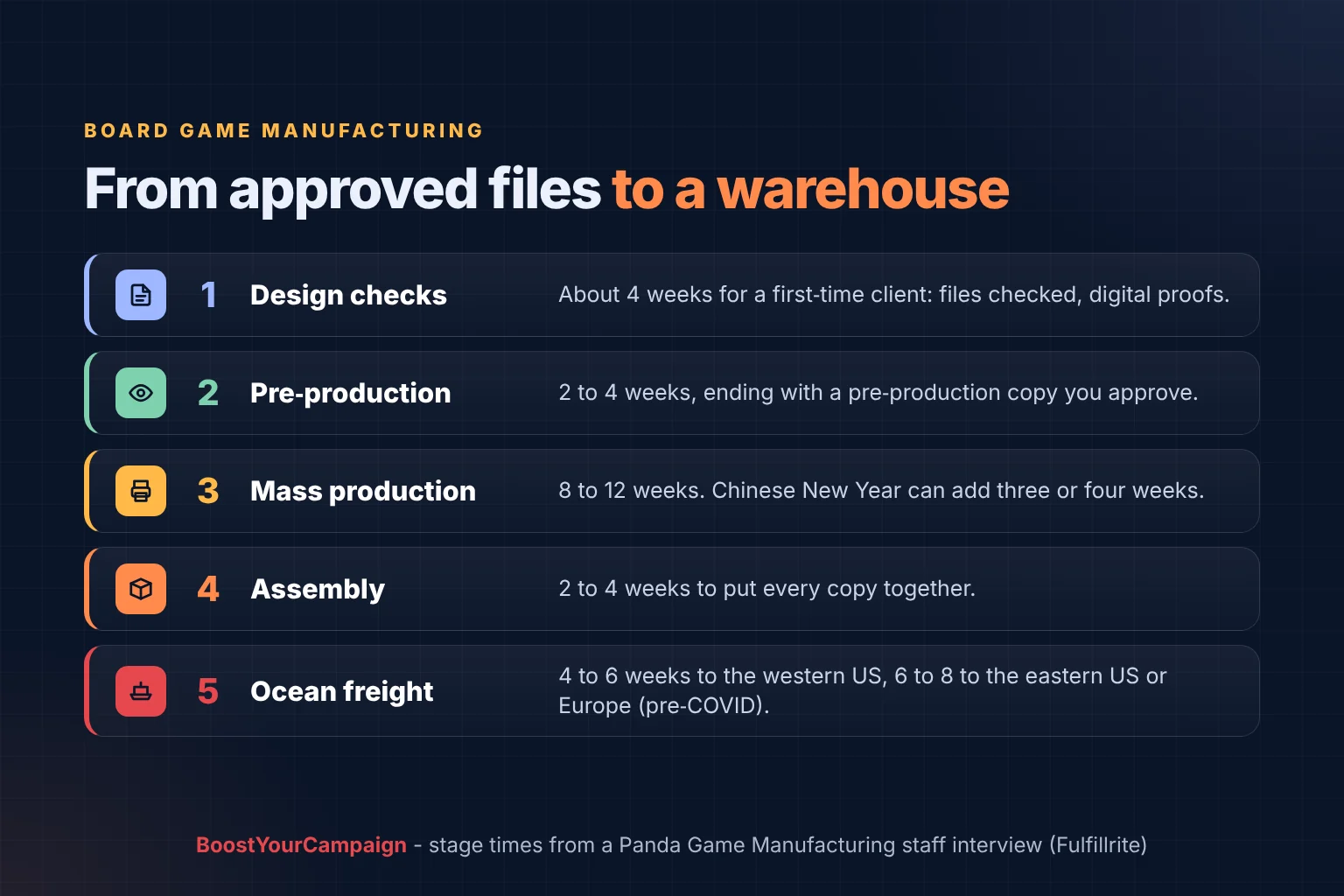
Stonemaier Games, which manufactures with Panda, sums it up as "a minimum of 3 months, usually 3.5-4 months" for manufacturing (Stonemaier Games). A Panda staff interview breaks the stages down: about 4 weeks of design verification for a first-time client, 2 to 4 weeks of pre-production, 8 to 12 weeks of mass production and 2 to 4 weeks of assembly, with Chinese New Year adding "three or four weeks" (Fulfillrite interview with Panda).
Then the games still have to travel. The same interview gives ocean freight of about 4 to 6 weeks to the western US and 6 to 8 weeks to the eastern US or Europe, framed as pre-COVID figures, so allow extra time today. Work backwards from your promised delivery date and add the campaign itself plus the pledge manager survey on top. Start talking to factories before you launch.
What drives the cost per copy
- Component count and type: paper and punchboard are cheapest, then wood and standard plastic, then custom plastic and metal. Every unique component adds cost to every copy.
- Tooling: custom miniatures and plastic inserts need moulds, a one-time cost that only spreads well over a large run.
- Quantity: setup costs are fixed per run, so the cost per copy falls as the run grows.
- Box size: ocean freight is priced on volume. As the Panda interview puts it, "the smaller your box, the better."
- Freight and duties: often the line creators underestimate most, which is why we look at landed cost, not factory price.
Our breakdown of what it costs to publish a board game covers the full budget, including art, marketing and fulfillment.
Samples and proofs you should insist on
Good factories build checkpoints into the process and do not resist them. Panda's published process runs from design verification and digital proofs to a pre-production copy (PPC), a near-final printed copy sent to you before the run, and a mass production copy pulled near the end of production. LongPack offers several pre-production sample options, from a plain white sample to digitally printed and offset printed copies. PrintNinja recommends hard copy proofs over electronic ones because electronic proofs "are not always completely accurate to the colors and overall result."
Ask every factory you shortlist which samples are included, what they cost and how they are shipped. Sign off the pre-production copy in writing, keep one, and compare the finished games against it. Our guide to finding and vetting a manufacturer covers the sample stages, payment terms and inspections in more detail.
Freight: where your games land decides your margin
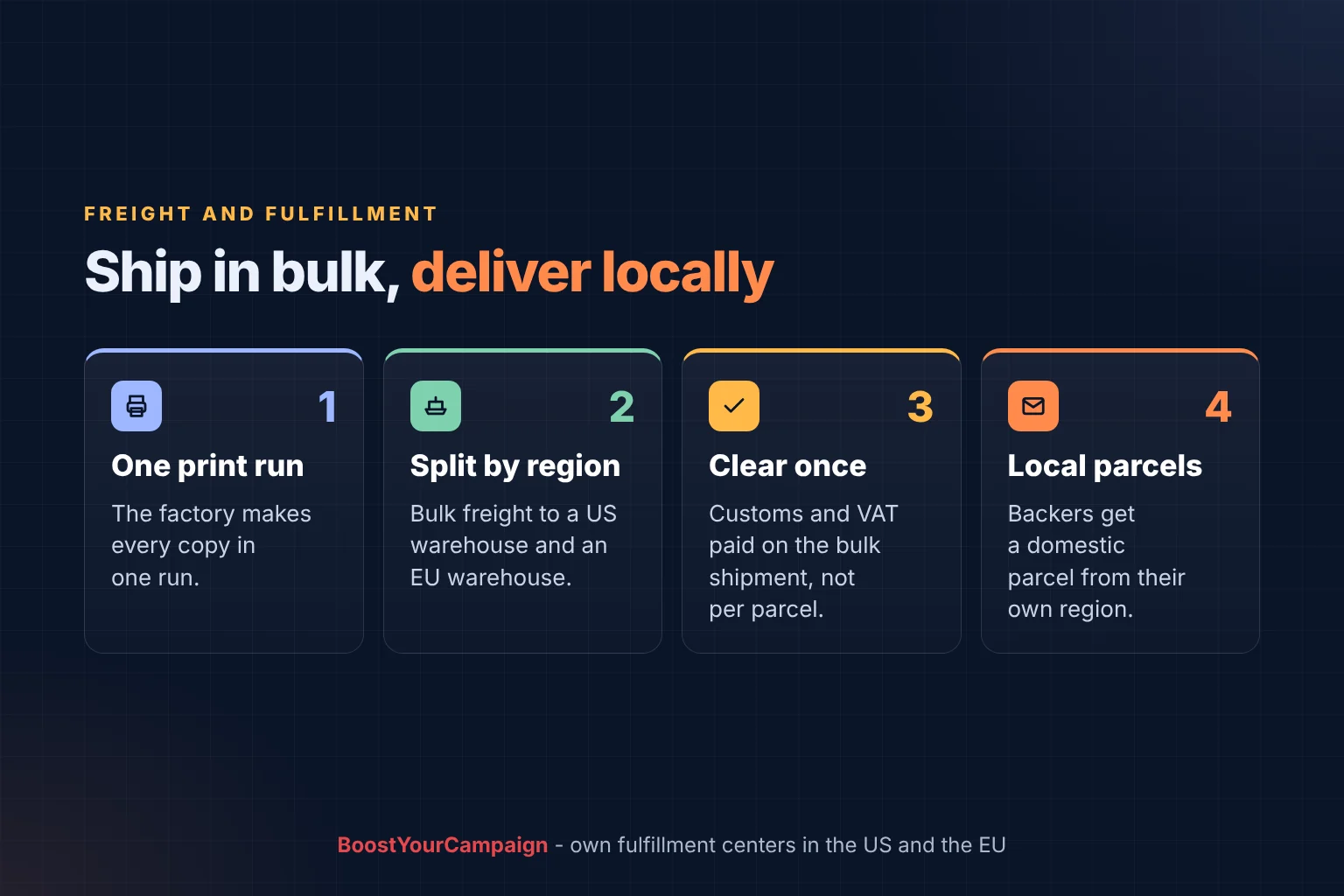
Shipping every copy from the factory straight to each backer is the most expensive way to deliver a board game, and the slowest for backers. The better route is to split the run by where your backers live, send it in bulk to warehouses in each region, clear customs and VAT once on the bulk shipment, and then send domestic parcels. Backers in the US get a parcel from inside the US, and backers in the EU get one from inside the EU, without a courier asking them for VAT at the door.
We run our own fulfillment centers in the US and the EU for exactly this reason, so the plan for where your games land can be made before you sign with a factory. See fulfillment in the USA, fulfillment in Europe, and our board game fulfillment guide.
How to choose a board game manufacturer
- Lock the component list first. Quotes are only comparable when every factory prices the same game.
- Request quotes from three makers with the same spec, quantity tiers and delivery terms.
- Ask for the numbers they do not publish: minimum order, lead time per stage, sample costs and what is included.
- Check the safety marks your sales markets need and who handles the testing.
- Look at games they have made in your category, ideally physical copies.
- Plan freight and fulfillment with the quote, so the landed cost per copy is known before your reward prices are set.
If you are still shaping the game itself, start with how to design a board game worth launching, and when you are ready to plan the campaign, read how to launch a board game on Kickstarter.
Frequently asked questions
Where are most board games made?
Most crowdfunded board games are made in China, by factories such as Panda, LongPack, Whatz, Magicraft and Boda. Germany and the US have strong options too, including Ludo Fact and Delano, usually at a higher cost per copy.
What is the minimum order quantity for a board game?
Published minimums mostly sit between 500 and 2,000 copies. Panda lists 1,500, Delano's quote form says 2,000, and PrintNinja calls 500 a fine minimum for simple games. Card-only products and print on demand can go far lower.
How long does it take to manufacture a board game?
About 3 to 4 months of manufacturing after your files are approved, plus ocean freight and time to reach backers. Chinese New Year can add several weeks if it falls inside your schedule.
Are there board game manufacturers in the US and Europe?
Yes. Ludo Fact makes games in Germany and in Lafayette, Indiana, Delano is in Michigan, and Shuffled Ink in Florida covers card products. They suit simpler games and shorter shipping, while complex component mixes usually still go to China.
What is a pre-production copy?
A near-final printed copy of your game that the factory sends before the full run. You check it, approve it in writing and keep it as the reference the finished games are compared against.
Should I choose a manufacturer before my Kickstarter launches?
Yes. You need a real quote to price your rewards, a schedule to promise a delivery date, and a freight plan to set shipping charges. Launching without them is how campaigns fund and then lose money.
Planning a board game launch and want the manufacturing, freight and fulfillment plan worked out before you go live? Talk to an expert.
Want results like these for your campaign?
We've helped 4,600+ creators raise over $734M. Let's pressure-test your launch plan and find the highest-leverage fixes before you go live.
Talk to an expert →Get the free 87-step launch checklist
The exact pre-launch, live-campaign and fulfillment steps we use across 4,600+ launches. Free PDF, emailed instantly.
You're in - check your inbox. Open the checklist now ->