A funded Kickstarter or Indiegogo campaign proves that people want the product. It does not give you a store, a steady flow of new customers, or a warehouse that ships on time every week. That is the work that starts when the campaign ends, and it is spread across several skills that rarely sit in one small team: Shopify design, product photography and video, paid ads, email, shipping and fulfillment. This guide explains what a full-service ecommerce partner handles for a crowdfunded brand, what you should keep in-house, and what the first 90 days usually look like. If you want to talk through your own post-campaign plan, talk to an expert.
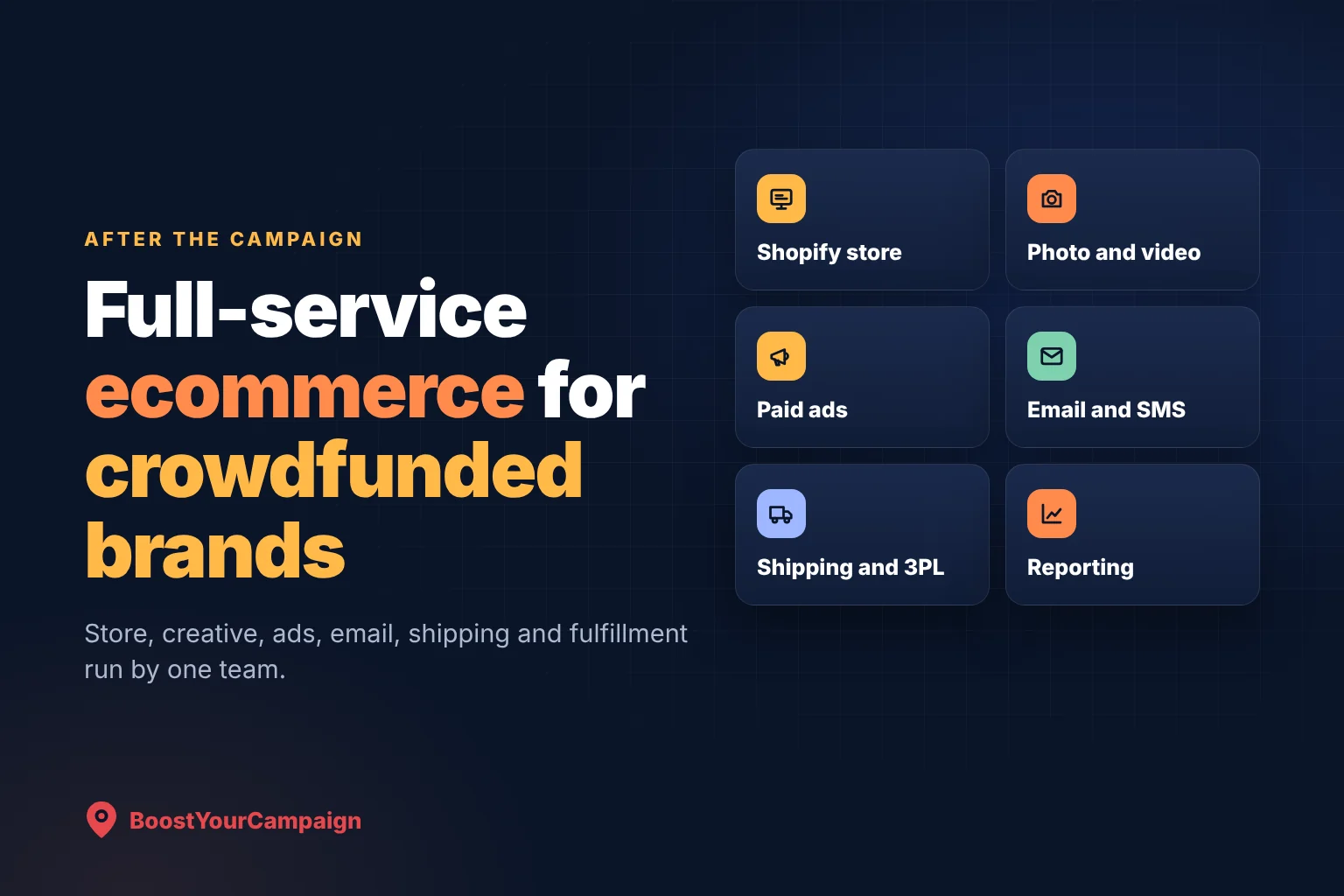
Full-service ecommerce for a crowdfunded brand means one partner runs the whole selling system after the campaign: the Shopify store and its product pages, the photo and video creative, paid ads on Meta, Google and TikTok, email and SMS flows, shipping rates and duties, and fulfillment from warehouses in the US and Europe, with one weekly report on revenue, ad spend and margin. The founder keeps product, pricing, brand and supplier decisions. The advantage over hiring separate freelancers is that the store, the ads and the warehouse are planned together, so a campaign that sells out does not outrun its stock or its shipping setup.
- The campaign gives you proof and an audience, and ecommerce turns both into repeat sales.
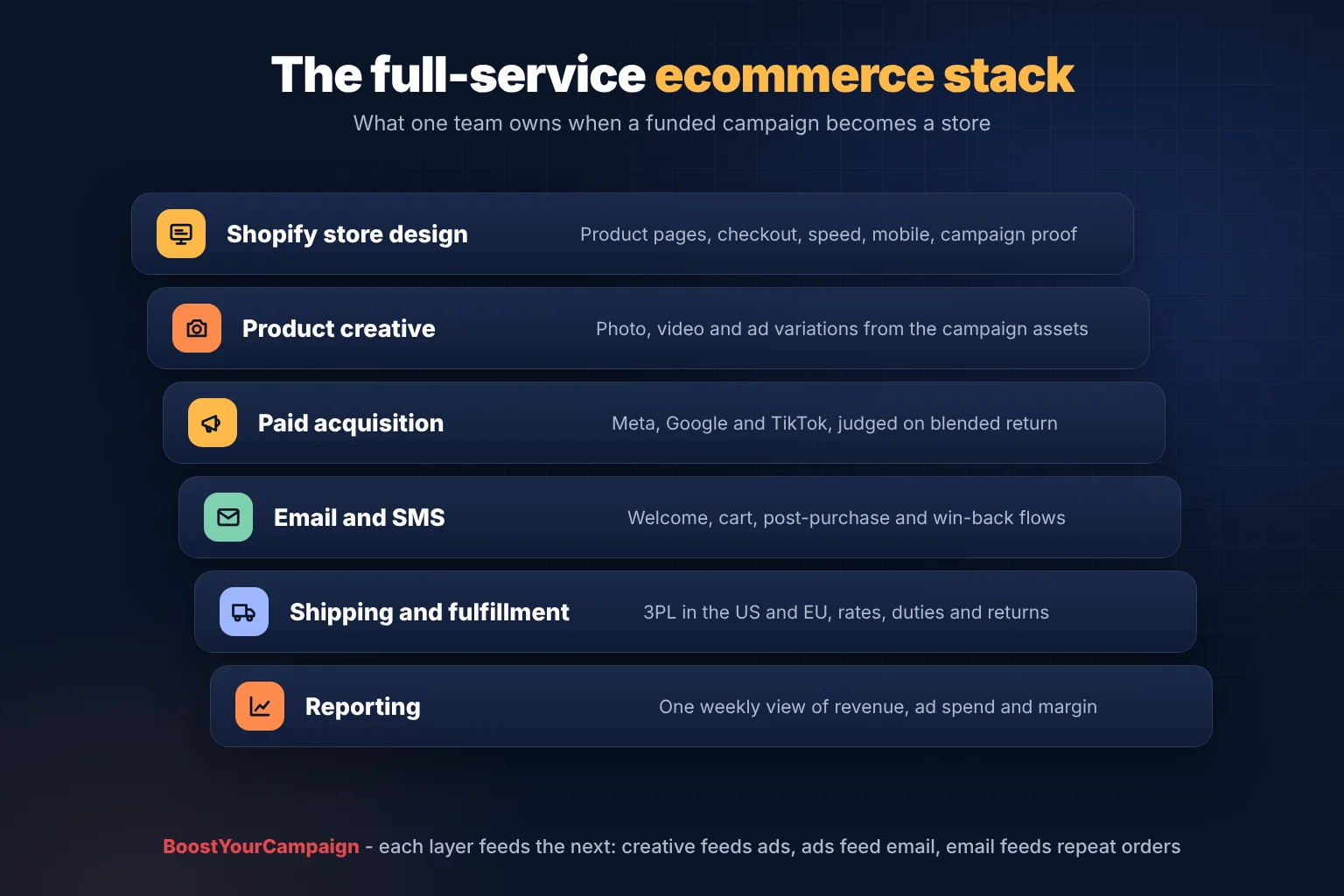
- Six parts make up the stack: store, creative, ads, email, shipping and fulfillment, and reporting.
- The store should reuse campaign proof: backer numbers, press, reviews and real photos.
- Ads are judged on blended return, total revenue against total ad spend, rather than one platform's numbers.
- Shipping decides margin, especially for European customers where VAT and duties apply.
- Founders keep the decisions and hand off the execution that needs volume and specialists.
What full-service ecommerce means after a campaign
During a campaign, the platform does a lot of the selling infrastructure for you. Kickstarter or Indiegogo hosts the page, takes payment and keeps the backer list. After the campaign, all of that moves to you. You need a store that converts visitors without the urgency of a deadline, traffic that keeps arriving after the launch buzz fades, a way to bring customers back for a second order, and shipping that works for every country you sell to.
A full-service partner takes ownership of that whole system rather than one piece of it. The difference matters because the pieces depend on each other. Ad creative is only as good as the product footage behind it. Ads only pay off if the product page converts. Email only works if the store captures addresses with consent. Fulfillment has to keep up with whatever the ads sell. When five different freelancers each own one part, the gaps between them are where money gets lost.
At BoostYourCampaign this is the path we have run for creators since 2010: launch on Kickstarter or Indiegogo, then scale through ecommerce channels with the audience and proof the campaign earned. Our ecommerce services page describes the approach.
Shopify store design that converts campaign interest
Most crowdfunded brands move to Shopify, and the store is the base that every other channel sends traffic to. A good post-campaign store does a few specific things well:
- Product pages that answer the questions buyers ask: what it does, what is in the box, dimensions, materials, shipping time and returns.
- Campaign proof in plain sight: the number of backers, the amount raised, press mentions and reviews from people who received the product.
- Clear stock status, whether a product is in stock, on pre-order or shipping in a later wave.
- A fast mobile experience, since most ad traffic lands on a phone.
- Shipping rates and duties shown before checkout, so international buyers are not surprised.
Our Shopify store setup guide walks through backer data, reward tiers, tax and shipping in detail.
Product creative: photos, video and ad variations
A campaign usually leaves behind a strong video and a set of renders or prototype photos. That is a good start, but ecommerce ads need far more variations than a campaign page, because platforms reward fresh creative and audiences tire of the same clip within weeks. Production photos of the finished product, unboxing clips, short demos and customer videos all feed the ads and the product pages.
We run two in-house video studios, which lets the creative and the ad buying sit with the same team. If you are still on the campaign side, our campaign video strategy guide shows how to shoot footage that keeps working after launch.
Paid ads after the campaign
After a campaign, paid acquisition usually runs on three platforms. Meta (Facebook and Instagram) finds new buyers with video and image ads and retargets people who visited the store. Google covers search and Shopping, where people already look for the product category. TikTok works well for products that demonstrate well in a short clip.
The useful number to manage is blended return: total store revenue divided by total ad spend across every platform. Each platform takes credit for the same sales in its own reports, so adding up platform numbers overstates what ads delivered. Watching blended return alongside product margin tells you whether you can afford to spend more. Our guides to Facebook ads, Google ads and TikTok ads cover each platform from the campaign side.
Email and SMS: the channel you own
Email is the channel no platform can take away, and for a crowdfunded brand it usually starts with a list built during pre-launch. A post-campaign email setup has a few automated flows that run in the background:
- Welcome flow for new subscribers, introducing the brand and the product range.
- Abandoned cart and browse flows that bring back people who nearly bought.
- Post-purchase flow with setup tips, a review request and a cross-sell.
- Win-back flow for customers who have not ordered in a while.
Only email people who agreed to hear from you. Backers who signed up to your own pre-launch list can be moved across; a backer list exported from a crowdfunding platform is not the same as marketing consent. Our email marketing guide for crowdfunding covers list building and sequences.
Shipping, fulfillment and returns
Shipping is where a profitable product can quietly lose its margin. A crowdfunded brand selling worldwide usually needs a warehouse in the US and one in Europe, so customers on both sides get local delivery times and EU buyers are not hit with surprise import charges. For European sales, VAT and customs have to be handled correctly at checkout, and our guide to shipping to Europe explains how.
A full-service partner sets up the shipping zones and rates in Shopify, connects the warehouse, and plans stock so ads never sell what the warehouse cannot ship. We run our own in-house warehouses in the US and the EU for this reason. Our US fulfillment and European fulfillment services cover both regions, and the shipping cost calculator gives a quick estimate per order.
Amazon and other marketplaces
Amazon can add volume once the Shopify store, reviews and stock levels are stable. It has its own rules on listings, advertising and inventory, and it takes a share of each sale, so most brands treat it as a second channel rather than the first. Our post-campaign playbook compares Shopify and Amazon in more depth.
The first 90 days after the campaign
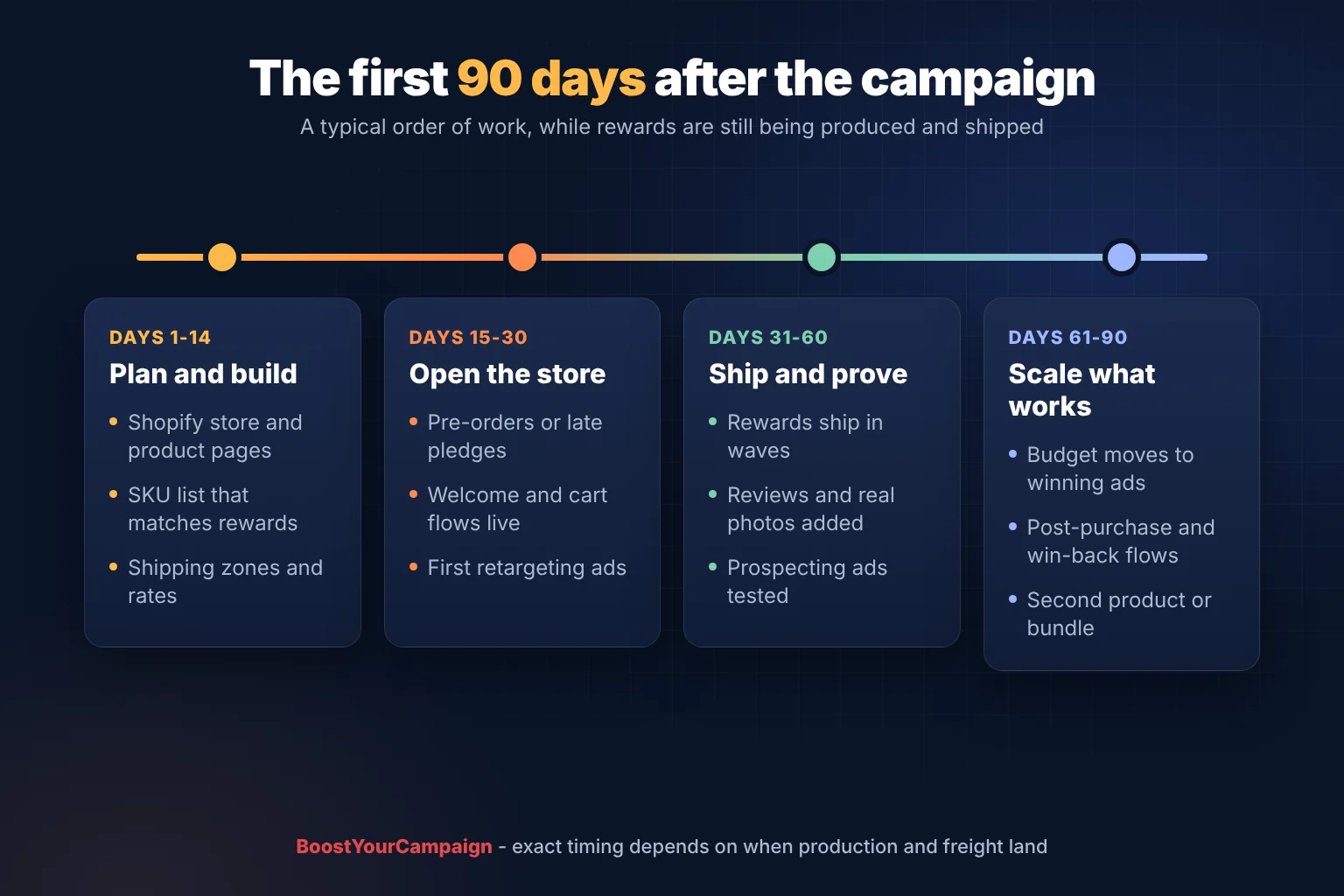
Exact timing depends on when production and freight land, but the order of work is fairly consistent.
Days 1 to 14: plan and build. Build the Shopify store and product pages, create a SKU list that matches the campaign rewards, and set shipping zones and rates.
Days 15 to 30: open the store. Take pre-orders or late pledges, switch on the welcome and abandoned cart flows, and start retargeting ads to people who already know the product.
Days 31 to 60: ship and prove. Rewards go out in waves, reviews and real customer photos come in, and prospecting ads to new audiences get tested.
Days 61 to 90: scale what works. Move budget to the ads that sell at a healthy blended return, add post-purchase and win-back flows, and plan the next product or bundle.
What to keep in-house and what to hand off
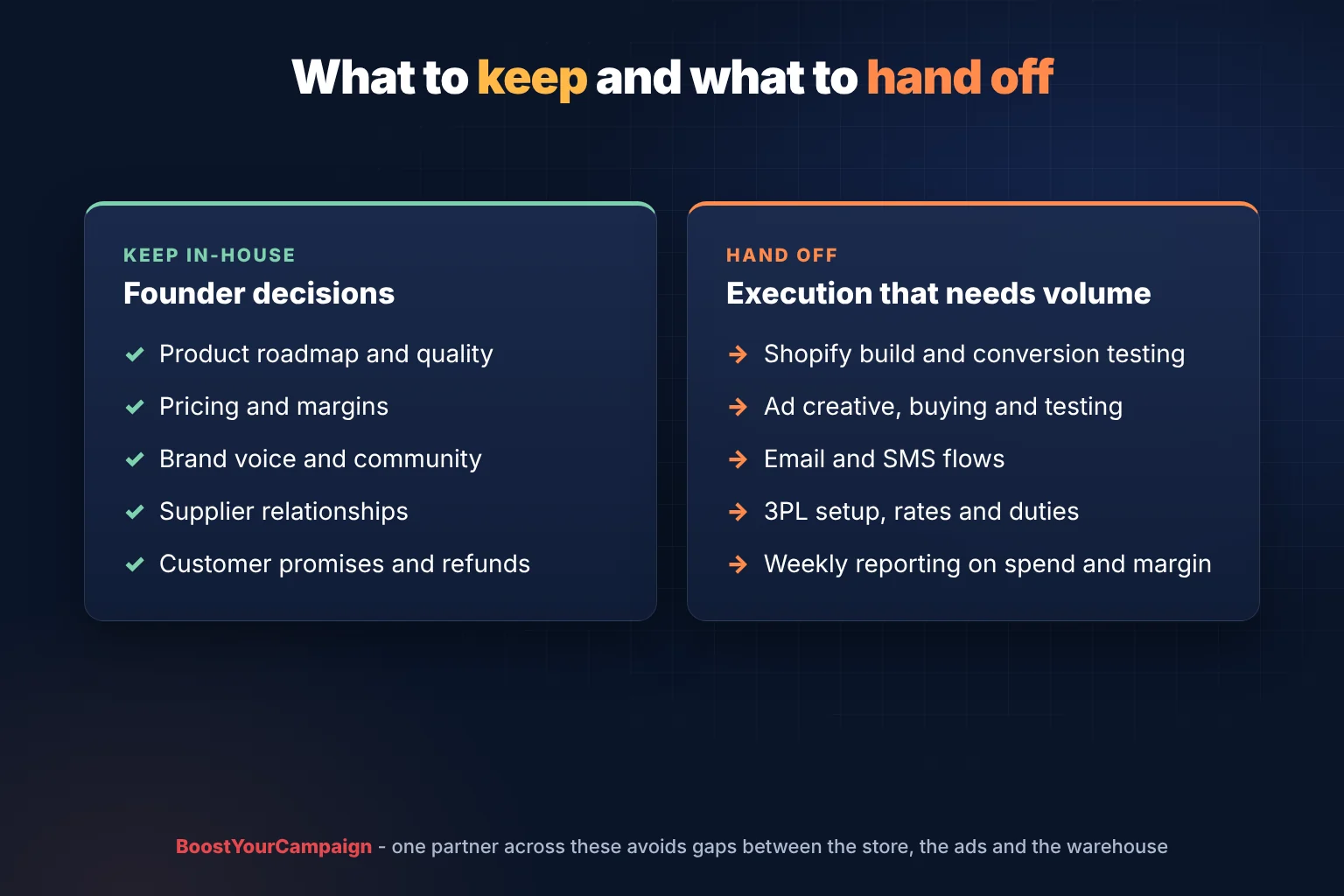
Keep the decisions that define the business: product quality and the roadmap, pricing and margins, brand voice, supplier relationships, and what you promise customers. Hand off execution that needs volume and specialist skills to do well: the Shopify build and conversion testing, ad creative and buying, email flows, warehousing and shipping, and reporting.
When you compare partners, ask who owns each of those tasks, how often you get a report and what it contains, whether creative is produced in-house, and how stock and ad spend are planned together. A partner that only runs ads cannot fix a product page that does not convert or a warehouse that ships late.
Frequently asked questions
What is full-service ecommerce for a crowdfunded brand?
It is one partner running the whole selling system after a Kickstarter or Indiegogo campaign: the Shopify store, product creative, paid ads, email and SMS, shipping and fulfillment, and reporting. The founder keeps product, pricing and brand decisions.
When should I start building my store after a Kickstarter campaign?
Start in the first weeks after the campaign closes, while rewards are being produced. That gives you time to build product pages, set shipping rates and open pre-orders or late pledges before the first rewards ship.
Should a crowdfunded brand use Shopify or Amazon first?
Most start with Shopify, because the brand owns the customer data and the store experience. Amazon is usually added later as a second channel once reviews and stock levels are stable.
How do I measure whether ecommerce ads are working?
Track blended return: total store revenue divided by total ad spend across all platforms, compared with your product margin. Platform reports each claim the same sales, so their numbers added together overstate results.
Can I email my Kickstarter backers from my Shopify store?
Only those who agreed to receive marketing from you, for example by joining your own pre-launch list. A backer list from a crowdfunding platform is not marketing consent on its own.
Do I need a warehouse in Europe as well as the US?
If you sell meaningful volume to European customers, a European warehouse usually gives faster delivery and avoids surprise import charges for buyers. Smaller volumes can ship from one warehouse with VAT and duties handled at checkout.
Planning the move from campaign to ecommerce? Talk to an expert about your store, ads and fulfillment.
Want results like these for your campaign?
We've helped 4,600+ creators raise over $734M. Let's pressure-test your launch plan and find the highest-leverage fixes before you go live.
Talk to an expert →Get the free 87-step launch checklist
The exact pre-launch, live-campaign and fulfillment steps we use across 4,600+ launches. Free PDF, emailed instantly.
You're in - check your inbox. Open the checklist now ->