Weighing a Kickstarter or Indiegogo launch as a Canadian creator? Talk with BoostYourCampaign about your product, your backer geography, and how ready your fulfillment plan is.
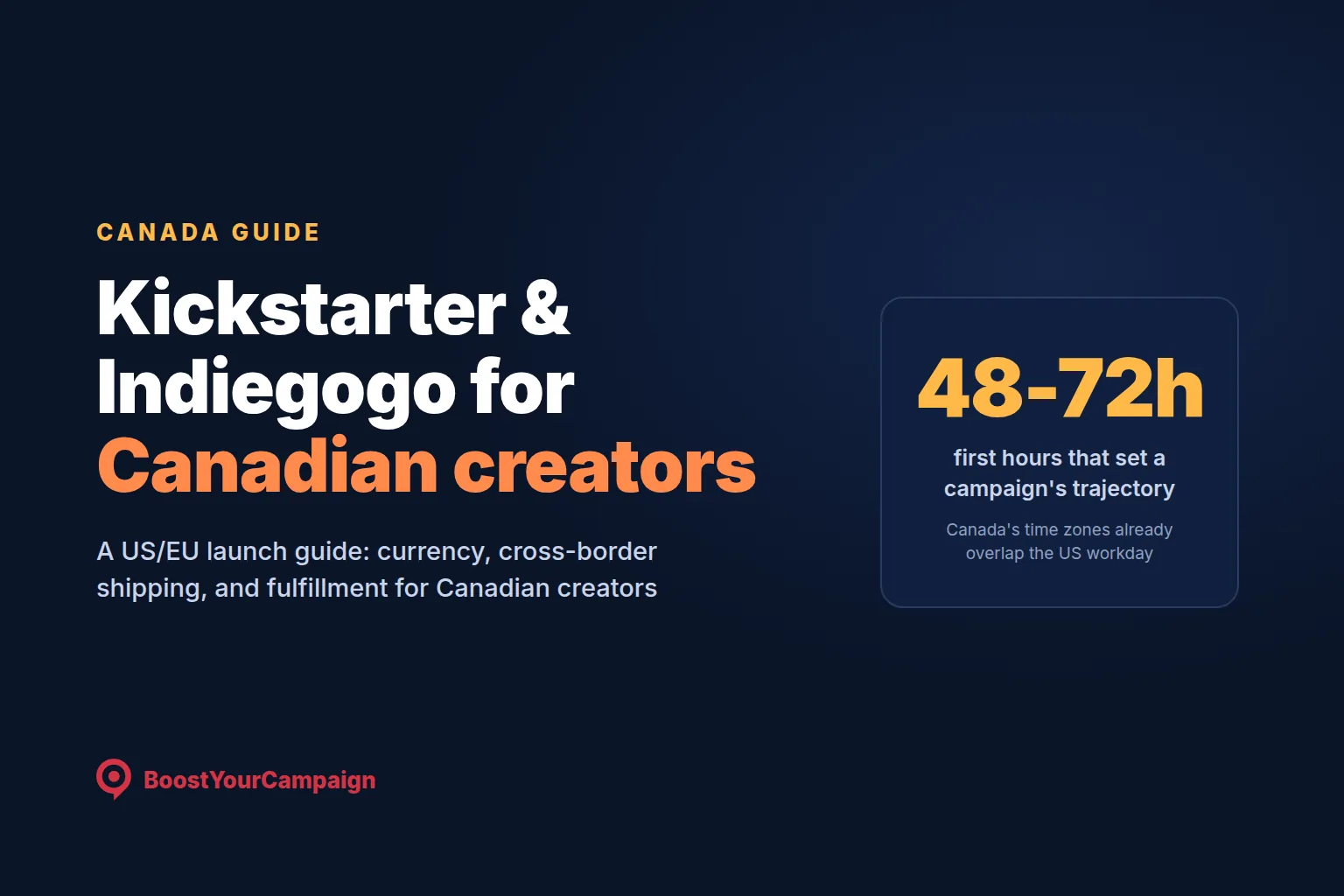
Canada is one of the easier starting points for a US/EU-focused crowdfunding launch. Both Kickstarter and Indiegogo treat Canada as a fully eligible country, the language matches most of your audience, and Canadian business hours already overlap the US workday, so the access and time-zone problems covered in our guides for Japanese, Chinese, or Australian creators mostly don't apply here. What does need a real plan: whether to price and think in CAD or USD, how southbound shipping and duties work now that US import rules have changed, and whether fulfillment should stay in Canada or move into a US warehouse once backer count and geography make that the cheaper option.
- No eligibility problem to solve - Canada is a fully supported Kickstarter and Indiegogo country, so this guide is about optimization, not workarounds.
- Your audience is mostly American - most pledges on a Canada-launched campaign come from US backers, and the campaign should be built around that from day one.
- Currency choice affects conversion - a campaign priced and presented in CAD can read as confusing or costly to a US backer doing quick mental math mid-scroll.
- Southbound shipping rules changed in 2025 - the US removed its de minimis exemption, which changes the math on shipping parcel by parcel versus in bulk.
- Time zones already line up - unlike creators launching from Asia-Pacific, a Canada-based team can run live campaign hours without an overnight shift.
- GST/HST needs a plan before funds land - campaign proceeds raise tax questions worth settling with an accountant ahead of launch, not after.
1) Canada skips the eligibility problem most overseas guides start with
A large share of the advice written for international creators exists to solve one problem first: can this person even launch on Kickstarter or Indiegogo from where they live, and if not, what workaround gets them there. Canada doesn't have that problem. Both platforms have supported Canadian creators for years, payouts settle into a Canadian bank account without a foreign entity or a third-country workaround, and the platforms' own creator-verification steps treat a Canadian address the same way they treat a US one.
That changes what this guide is actually about. Where our guide for Japanese brands spends real space on domestic-platform translation and our guide for Australian brands spends real space on freight distance, a Canadian creator doesn't need either of those conversations. Campaign copy conventions, reward-tier structure, and backer expectations are close enough to identical between Canada and the US that a Canadian creator reading US-focused Kickstarter advice rarely hits a wall where the advice stops applying.
The practical gap sits somewhere else entirely: currency presentation, cross-border shipping cost now that US import rules have shifted, and a fulfillment decision that has real financial consequences at volume. None of that shows up in a general "how to run a Kickstarter" guide, and none of it is obvious until a campaign is already live and the first wave of shipping quotes and customs questions arrives.
2) CAD or USD: the pricing decision that actually shapes conversion
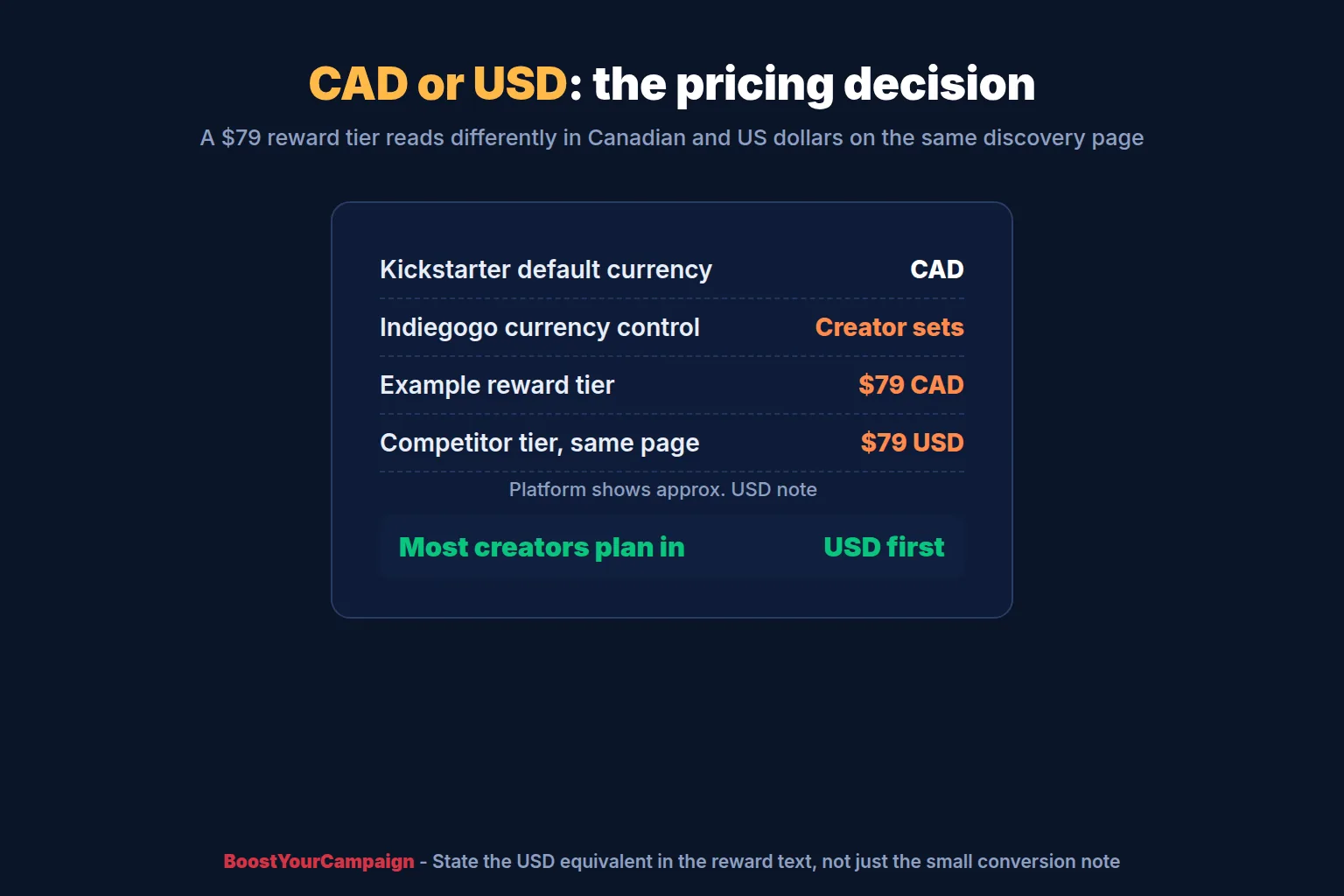
Kickstarter runs a campaign in the currency tied to the creator's account, which defaults to CAD for a Canada-based creator. Indiegogo gives a creator more direct control over which currency the campaign displays. Either way, a reward priced at $79 CAD sits next to competitor campaigns priced at $79 USD on the same discovery page, and a backer scrolling quickly does not always register that the two numbers aren't the same amount of money.
That mismatch cuts both ways. A Canadian creator who prices generously in CAD terms can look expensive to a US backer doing fast mental math, while a creator who prices tightly against USD competitors can end up with thinner margin once the CAD payout is converted back. Kickstarter shows an approximate USD conversion next to CAD-listed rewards, which helps, but it's still worth stating the US-dollar equivalent explicitly in the reward description rather than relying on backers to notice the platform's small conversion note.
Most experienced Canadian creators end up thinking in USD terms from the start, since that's the currency the bulk of their pledges are effectively priced against, and then work backward to a CAD number that converts cleanly rather than picking a CAD figure first and hoping it lands well once converted. It's a small planning step, but it avoids a reward tier that looks like an odd, oddly-specific number to the audience actually deciding whether to pledge.
3) Building a campaign for an audience that's mostly south of the border
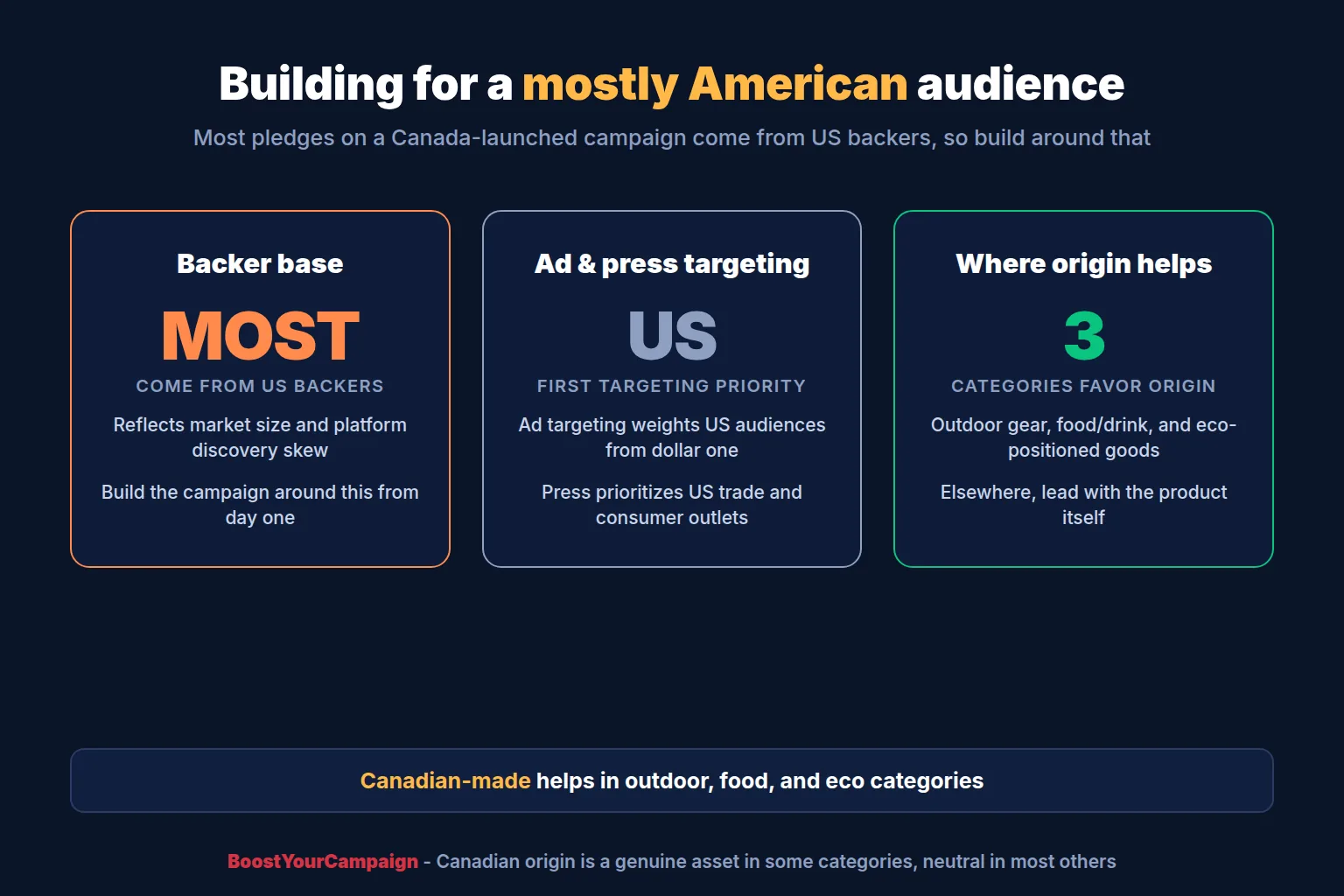
For most Canadian consumer product campaigns, a large majority of backers end up US-based, simply because of the relative size of the two markets and how each platform's discovery and paid-traffic audiences skew. That has real implications for how a campaign should be built, not just where the ads point once it's live.
Paid ad targeting should weight US audiences from the first dollar spent rather than defaulting to a Canada-first buy that gets adjusted later. Lifestyle imagery and copy should read naturally to an American audience without erasing the fact that the product is Canadian, since origin can still be an asset in specific categories. Press outreach should prioritize US trade and consumer outlets that cover the product's category, with Canadian press treated as a secondary, supporting layer rather than the primary target.
Canadian origin genuinely helps in some categories - outdoor gear, certain food and beverage products, and anything positioned around environmental stewardship tend to benefit from a clearly stated Canadian identity, since US backers associate those categories with Canada in a mostly positive way. Outside those categories, origin matters less, and the campaign's job is to lead with the product rather than lean on "Canadian-made" as the pitch.
4) Southbound shipping: duties, de minimis, and what changed in 2025
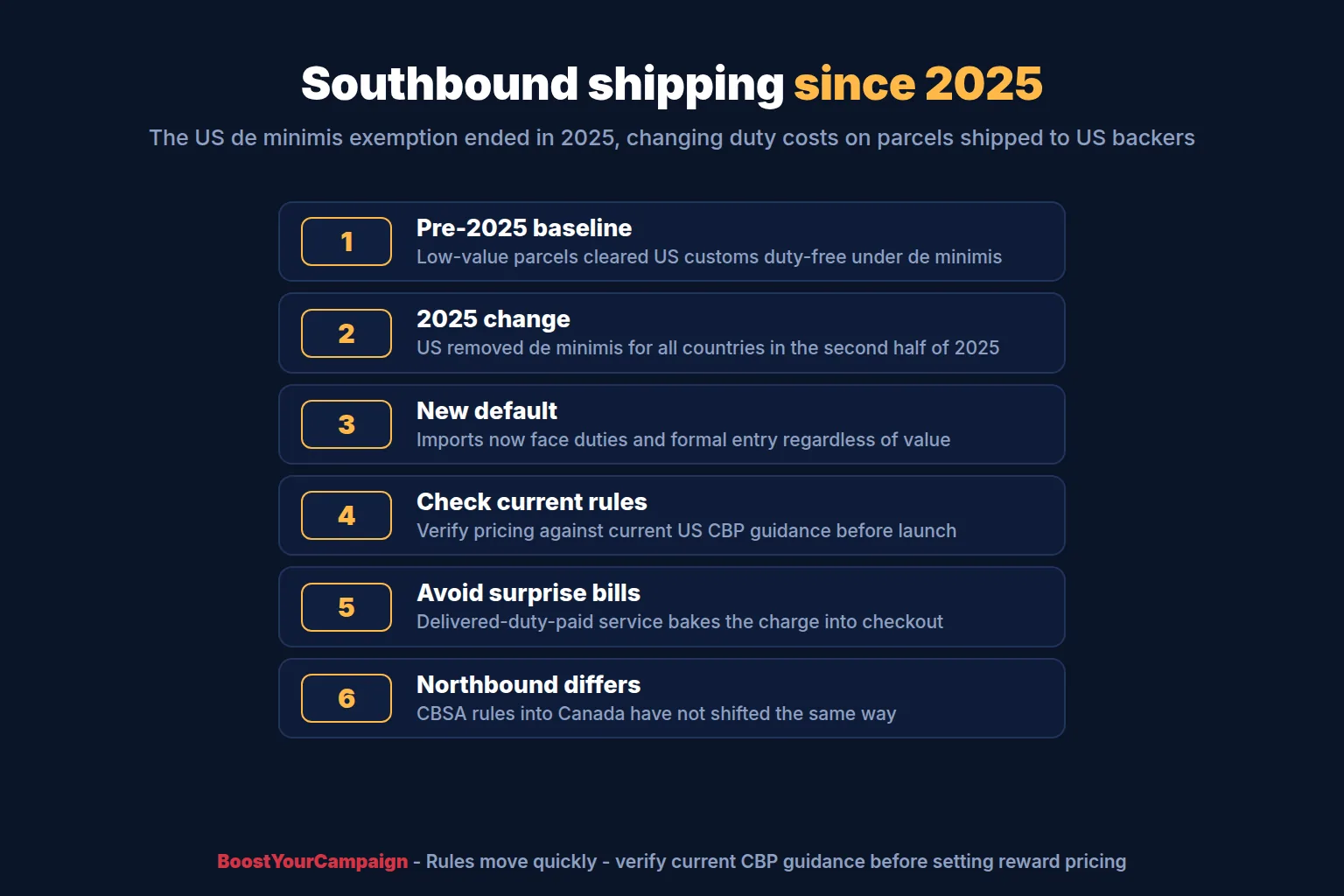
Through most of the last decade, a Canadian creator shipping individual rewards south into the US could generally rely on the US de minimis exemption, which let low-value parcels clear duty-free with minimal paperwork. That exemption was removed for shipments from all countries in the second half of 2025, and imports into the US are now generally subject to applicable duties and formal entry requirements regardless of declared value. Rules and transitional provisions in this area have moved quickly and can keep moving, so it's worth checking current US Customs and Border Protection guidance directly before finalizing reward pricing rather than relying on older advice, including this paragraph, as the final word.
The practical effect for a Canada-based campaign is straightforward: the shipping estimate a backer sees at checkout, or the duty charge that shows up on delivery, needs to reflect actual current cost rather than an assumption carried over from a pre-2025 mental model. Some carriers and fulfillment partners offer delivered-duty-paid service that builds the charge into the upfront price instead of surprising a backer with a bill at the door, which tends to generate far fewer support tickets and unhappy comments during fulfillment.
Duties on goods moving the other direction, into Canada, follow separate Canada Border Services Agency rules and thresholds that haven't shifted in the same way. That asymmetry is worth naming explicitly if a campaign has any Canadian backers alongside its mostly American audience, since the two groups can end up facing genuinely different landed costs for the same reward.
5) Should fulfillment stay in Canada or move to a US warehouse?
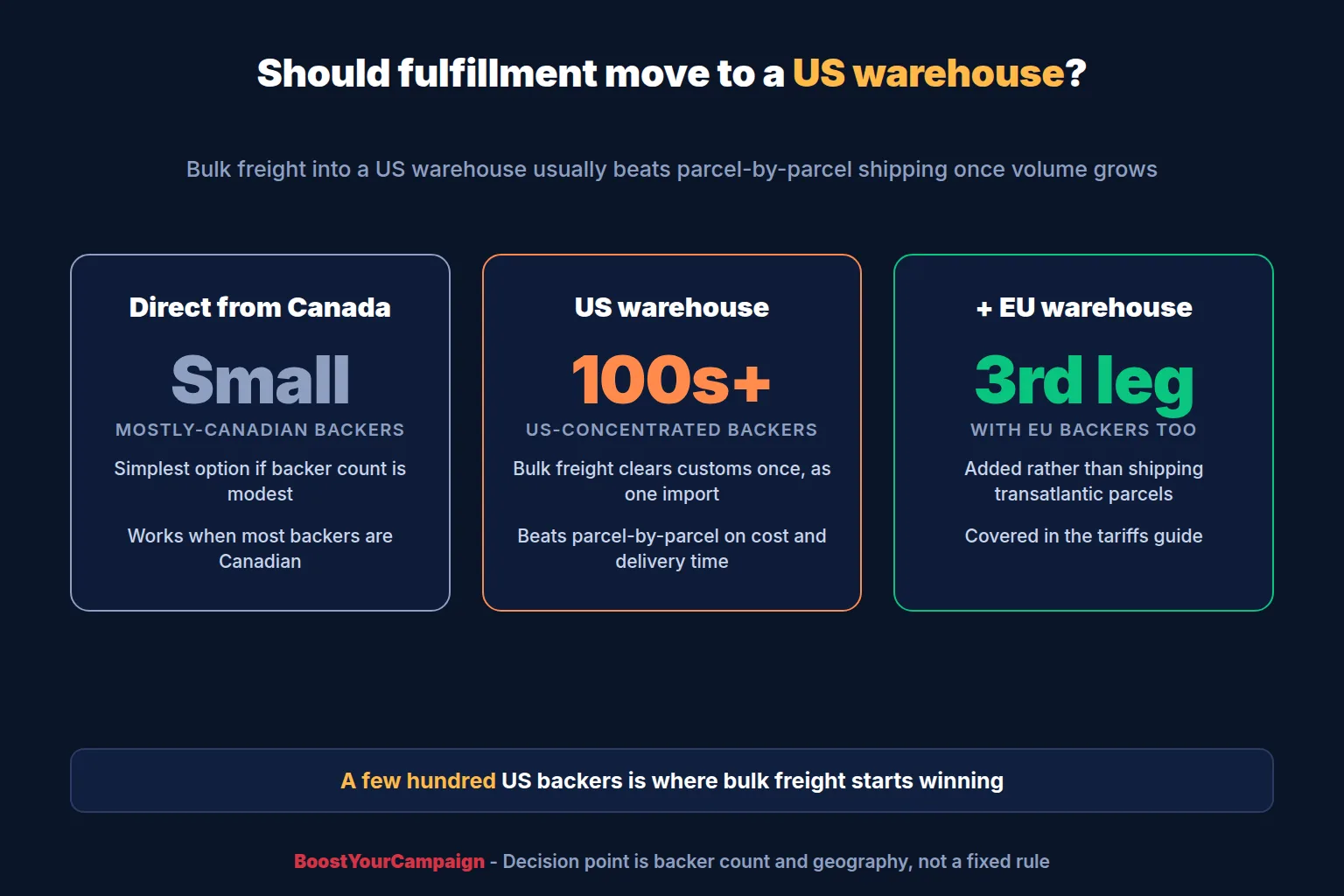
Shipping individually from Canada to each US backer used to be a reasonably painless option given the short distance and the old de minimis exemption. With that exemption gone, the math shifts toward bulk freight: moving inventory into a single US warehouse as one commercial import that clears customs once, then fulfilling individual backer orders from local US stock, the same model covered in more depth in our fulfillment companies guide.
The volume at which that switch pays off depends on the product's size, weight, and unit cost, but for most campaigns with a few hundred backers or more concentrated in the US, pre-positioned warehouse stock now beats parcel-by-parcel shipping on both cost and delivery time. Campaigns with a meaningful EU backer count on top of the US base often add a third leg, an EU warehouse, rather than shipping transatlantic parcels individually; our tariffs guide covers how to price reward tiers around that decision before launch instead of after.
Smaller campaigns, or ones expecting most backers to be Canadian, may find direct fulfillment from a Canadian address remains the simplest option. The decision point is backer count and geography split rather than a fixed rule, and it's worth actually running the numbers on projected volume before committing to one approach.
6) A real advantage: your live campaign hours already line up
Our guides for Japanese and Australian creators both spend real space on a genuine structural problem: the highest-leverage hours for a US/EU-targeted campaign, meaning ad optimization, backer questions, and press outreach, fall overnight in the creator's home time zone, which forces either an overnight shift or a partner already staffed for those hours. A Canada-based creator mostly avoids that problem outright. Eastern and Central Canadian time zones sit directly inside a normal US workday, and even Mountain and Pacific-based Canadian creators overlap significantly with US Eastern backers during standard business hours.
That means the first 48 to 72 hours after launch, which typically set the trajectory for the rest of the funding period, can be actively managed on a normal daytime schedule rather than requiring dedicated overnight coverage. It's a small thing to name explicitly, but it's a genuine advantage worth building the launch-day staffing plan around rather than assuming the same overnight-coverage problem other country guides describe.
7) Canada's crowdfunding track record, and why it's not the whole story
Several industry write-ups over the years have pointed to Canada as one of the more active countries on Kickstarter on a per-capita basis, and Canadian creators have put together some genuinely well-known campaigns in board games, outdoor gear, and tech hardware. That history is worth knowing, but it's worth treating carefully rather than as a reason to expect an easier path.
Per-capita activity reflects how many Canadians use the platform relative to population size, not how easily the average Canadian campaign funds. A Canadian creator competes for the same US and European backer attention as everyone else launching that week, and the fundamentals that separate a funded campaign from an unfunded one, a clear pitch, credible production plan, and a pre-launch audience, matter exactly as much for a Canadian creator as for anyone else, which is exactly where an experienced marketing and production partner earns its keep.
8) GST/HST and what to sort out with an accountant before funds land
Crowdfunding proceeds raise real tax questions for a Canadian creator, and the specific treatment depends on how the campaign is structured. Reward-based crowdfunding, where backers receive a product in exchange for their pledge, is generally treated differently from a pure donation, and the Canada Revenue Agency's guidance on GST/HST registration and collection can depend on factors like projected revenue and whether the creator crosses the small-supplier threshold during the campaign.
This is not a place to guess. The right move is a conversation with an accountant who has actually handled crowdfunding income before the campaign funds, not after, since retroactively fixing a registration or collection issue is considerably more work than setting it up correctly from the start. Platform fees, payment processor charges, and the treatment of funds that get spent directly on production and fulfillment all factor into what a creator actually owes, and none of it is intuitive without someone who has seen this specific situation before.
How BoostYourCampaign fits
BoostYourCampaign has run full-stack, done-for-you crowdfunding campaigns since 2010, with marketing, video production, and fulfillment handled under one roof rather than stitched together across separate vendors. For a Canadian creator specifically, that means live-campaign ad management already covers US daytime hours as standard practice, and owned fulfillment warehouses in the US and EU give a direct path to pre-positioned stock instead of parcel-by-parcel southbound shipping once a campaign's backer count justifies the switch.
The agency's ad model puts its own money into the campaign budget alongside the client's spend, with fixed fees rather than a cut of what the campaign raises, which keeps the incentive aligned with actually growing the campaign rather than just billing against it. BYC holds Indiegogo Approved Agency status, is a Google Premier Partner, a Facebook Marketing Partner, an official Shopify Partner, and an Amazon Partner, and has worked across more than 4,600 campaigns raising over $734 million combined, with a 4.9 out of 5 rating across more than 300 verified reviews on the reviews page.
Beyond the campaign itself, BYC offers in-house MVP development for products still being finalized (/services/mvp-development) and has helped clients secure retail introductions to major retailers including Best Buy after a successful launch. Some client products have gone on to Shark Tank coverage documented on the press page, and Kevin O'Leary has recorded a video testimonial about the agency, also on the reviews page. For cost context while comparing agencies, see this pricing guide.
Before you launch from Canada: a quick checklist
| Question | Why it matters |
|---|---|
| Is the campaign priced in CAD or USD, and is the difference explained on the page? | A CAD price can look confusing or costly to a US backer scanning quickly without a stated USD equivalent. |
| Does paid ad targeting weight US audiences from day one? | Most pledges on a Canada-launched campaign typically come from US backers. |
| Does the shipping estimate reflect current US import duty rules? | The US de minimis exemption ended in 2025, changing landed cost on southbound parcels. |
| Is fulfillment planned as direct-ship from Canada or bulk stock in a US warehouse? | Pre-positioned US stock usually beats parcel-by-parcel shipping once backer volume justifies bulk freight. |
| Has an accountant reviewed GST/HST treatment of campaign proceeds? | Reward-based crowdfunding income has tax and registration questions worth settling before funds land. |
| Who is covering the first 48 to 72 hours of live campaign hours? | Canada's time zones already overlap US daytime, so this is a staffing plan, not an overnight-shift problem. |
The US import rules after the de minimis change are detailed in customs documentation for crowdfunding shipments, and the shipping math in Kickstarter shipping costs.
Frequently Asked Questions
Can a Canadian creator launch directly on Kickstarter or Indiegogo?
Yes. Canada is a fully supported country on both platforms, with no third-country entity or workaround required. Payouts settle into a Canadian bank account the same way US payouts settle into a US one.
Should a Canadian campaign be priced in CAD or USD?
Kickstarter defaults to the creator's account currency, usually CAD, while Indiegogo allows more direct control. Either way, it's worth stating a USD equivalent clearly in the reward description, since most backers on a Canada-launched campaign are typically American.
Did shipping to US backers get more expensive in 2025?
For many campaigns, yes. The US removed its de minimis exemption for low-value imports from all countries in the second half of 2025, which means parcels that previously cleared duty-free now generally face applicable duties. Rules in this area have moved quickly, so it's worth checking current US Customs and Border Protection guidance directly before setting reward pricing.
Is it worth setting up a US warehouse for a Canadian campaign?
Usually yes, once backer count reaches a few hundred concentrated in the US. Bulk freight into a single US warehouse that clears customs once, followed by domestic fulfillment to backers, typically beats individual parcel shipping on both cost and delivery time.
How does Indiegogo's Late Pledge phase work for Canadian creators?
Late Pledge, formerly called InDemand, keeps the sales window open once the main campaign ends. For a Canadian creator, that extra runway can be enough to justify a larger production batch or push the volume needed to make a bulk shipment into a US warehouse worthwhile.
Do Canadian creators need to register for GST/HST on campaign proceeds?
It depends on how the campaign is structured and projected revenue, among other factors. This is genuinely worth a conversation with an accountant familiar with crowdfunding income before the campaign funds, since the right treatment isn't always intuitive.
Does launching from Canada mean running an overnight shift for US ad hours?
Generally no. Canadian time zones largely overlap the US workday, so live campaign management during the first 48 to 72 hours can happen on a normal daytime schedule rather than requiring dedicated overnight coverage.
For a direct read on whether your pricing, shipping, and fulfillment plan are ready for launch, reach out through /contact.
Want results like these for your campaign?
We've helped 4,600+ creators raise over $734M. Let's pressure-test your launch plan and find the highest-leverage fixes before you go live.
Book a free strategy call →Get the free 87-step launch checklist
The exact pre-launch, live-campaign and fulfillment steps we use across 4,600+ launches. Free PDF, emailed instantly.
You're in - check your inbox. Open the checklist now ->