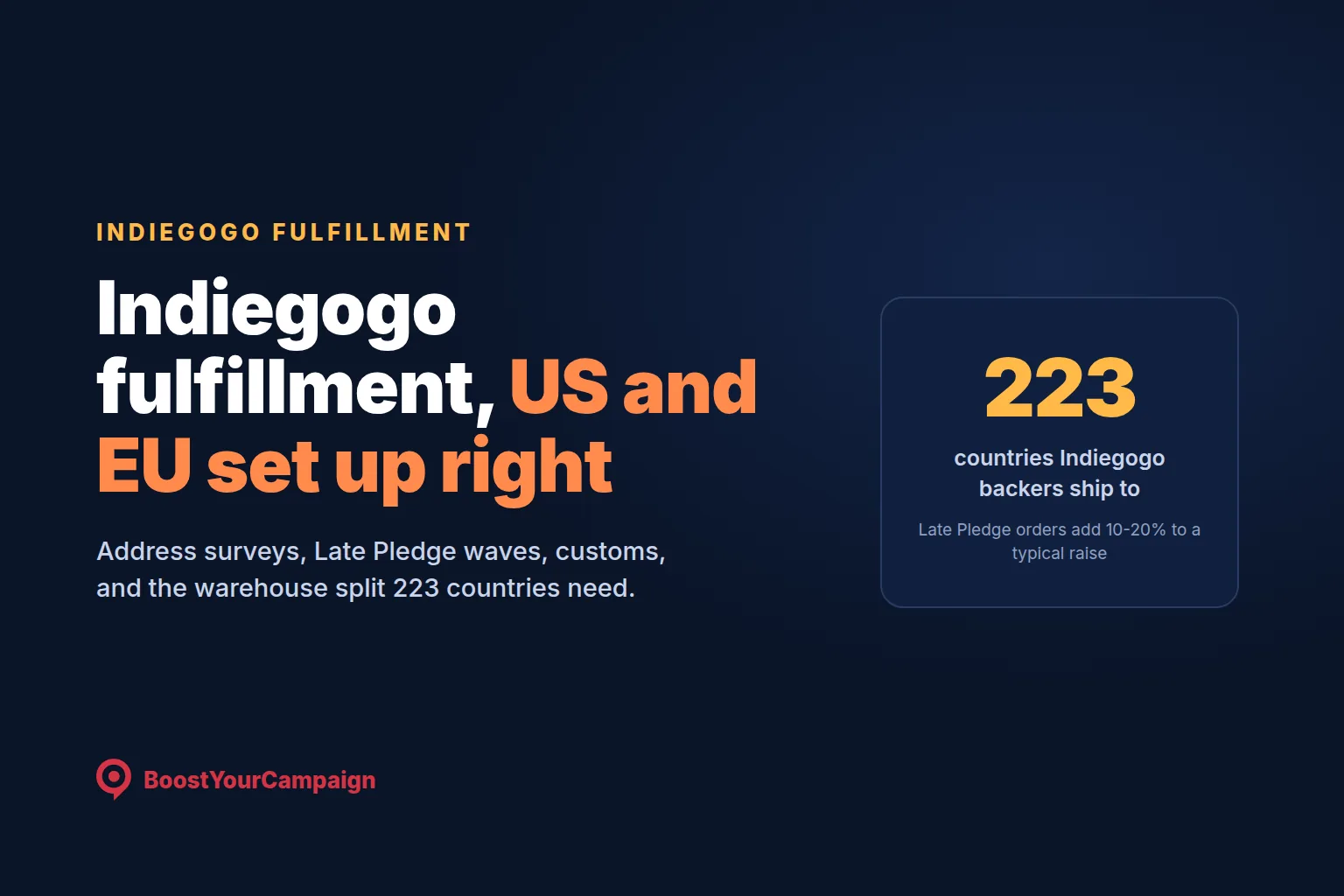
Indiegogo collects the order and takes the payment, but it never touches the physical product. Shipping the reward to a backer's door is the creator's job from the moment the campaign closes to the moment tracking shows delivered, and Indiegogo's backer base skews more international than most other platforms, which makes that job harder than it looks at launch. If you want fulfillment costed correctly before you set reward prices, talk with BoostYourCampaign about your reward mix and backer map.
Indiegogo fulfillment is the process of collecting final backer addresses through an Indiegogo survey or a pledge manager, producing the reward, freighting it to one or more regional warehouses, and picking, packing, and shipping each order with tracking, since Indiegogo itself never handles the physical product. Indiegogo draws backers from 223 countries, a wider spread than most crowdfunding platforms, so international shipping cost and customs planning matter from day one rather than as an afterthought. Late Pledge orders - what Indiegogo called InDemand before 2025 - arrive in ongoing waves after the main campaign and typically add 10-20% to a raise, which means fulfillment has to keep running well past the original delivery date. Creators who split inventory between a US and an EU warehouse instead of shipping everything from one country cut per-parcel cost sharply for that international backer base.
- Indiegogo never ships anything - every reward moves through a creator-run fulfillment process from factory to backer's door.
- Backers are spread across 223 countries - Indiegogo's international share is typically larger than Kickstarter's, so customs planning carries more weight.
- Late Pledge orders keep arriving after the campaign - fulfillment has to handle a second and third wave of orders beyond the original backer list.
- Indiegogo now runs on Gamefound's fee structure - Gamefound acquired Indiegogo in 2025, and the underlying fee model changed with it.
- Flexible funding is gone for new campaigns - Indiegogo retired it in October 2025, so every new campaign is fixed funding.
- A single warehouse punishes the international backer base most - a US-EU split turns most orders back into domestic-style shipments.
1) How Indiegogo fulfillment actually works, start to finish
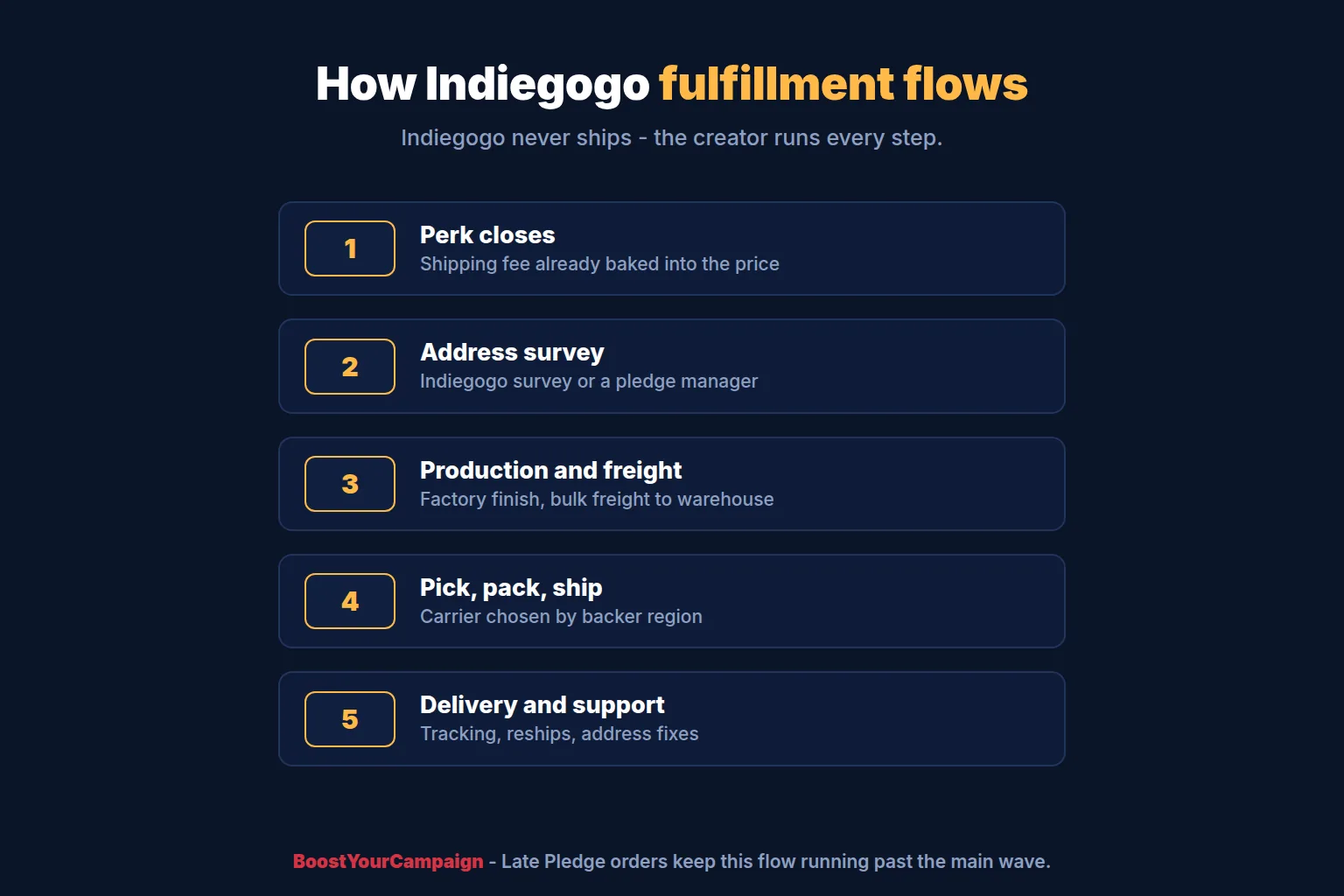
Indiegogo's checkout collects the payment and, in most cases, a shipping fee that's baked directly into the perk price rather than calculated separately at the end. That's a meaningful difference from platforms where shipping gets calculated after the campaign closes - on Indiegogo, a creator has to estimate shipping cost by region before the campaign launches and build it into each perk, then reconcile the real cost later. Address collection happens either through Indiegogo's own post-campaign survey tool or through a dedicated pledge manager layered on top, which is the more common setup for campaigns with several reward tiers, add-ons, or shipping regions to track.
From there the process runs the same core steps as any crowdfunding fulfillment project: production finishes at the factory, finished goods move by freight to a regional warehouse, inventory gets received and counted against SKU, and a fulfillment team picks, packs, and ships each order with a carrier suited to that region and weight class. Tracking gets pushed back to the backer, and support handles delivery questions, address corrections, and the occasional lost or delayed parcel. The one structural difference worth planning for up front is that Indiegogo orders don't stop coming in on a fixed date the way many Kickstarter reward lists do - see section 4 on Late Pledge waves for what that means for a fulfillment schedule. Our pledge manager and late pledges guide covers the survey and order-collection side of this in more depth.
2) What fulfillment actually costs per unit
The cost math is the same structure as any crowdfunding campaign: a pick/pack fee, typically $2-4 per order, plus a per-item fee for extra SKUs bundled into one order, packaging materials, and postage, which scales the most with weight and destination. A 1 lb reward typically lands around $9-11 per order shipped domestically once pick/pack, packaging, and postage are added together. A 3 lb reward typically lands around $15-18 domestic, and an 8 lb reward typically lands around $25-32 domestic.
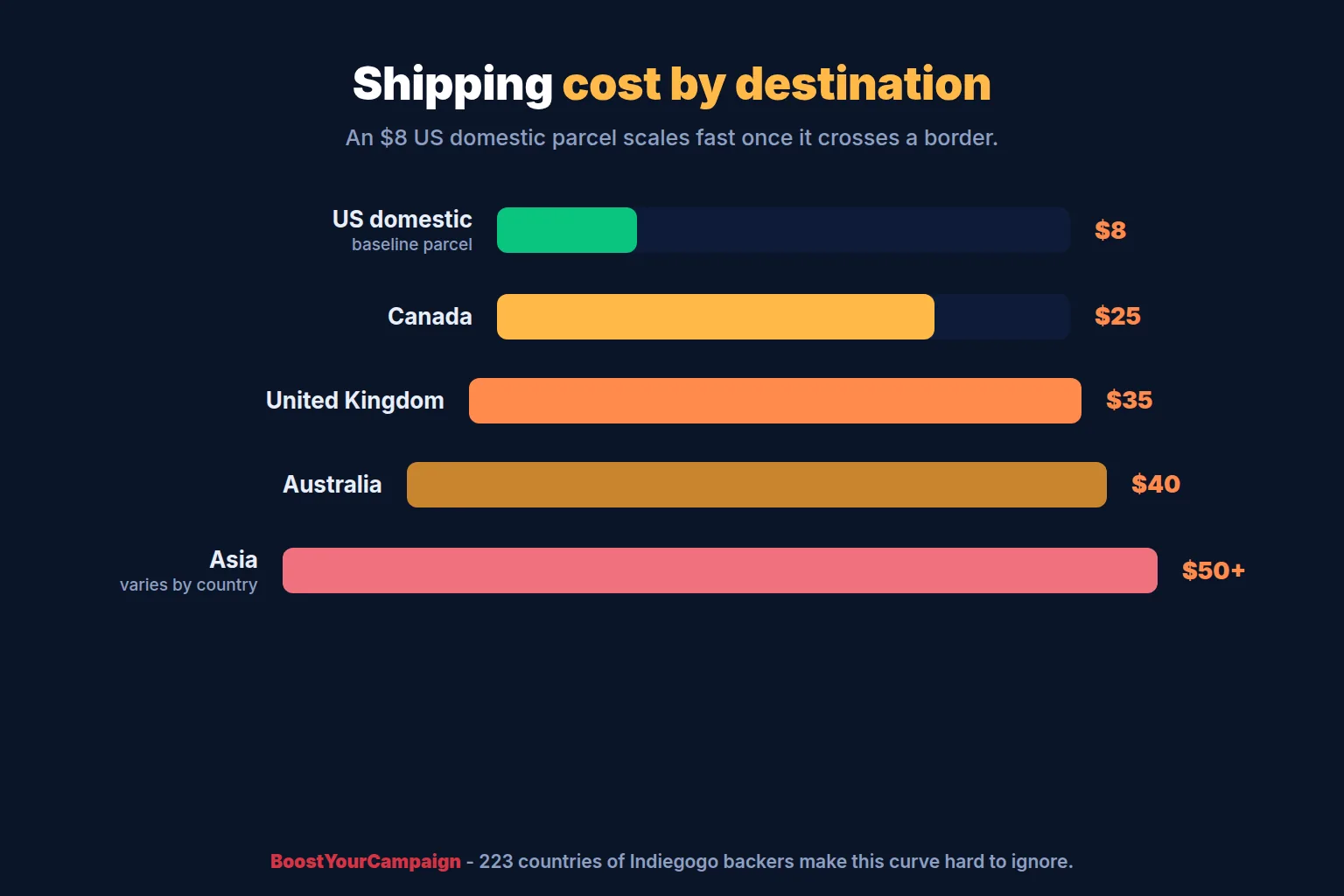
International shipping is where Indiegogo campaigns feel the cost gap more than most, because of the wider backer spread covered in section 3. An $8 domestic parcel commonly runs roughly $25 to Canada, $35 to the UK, $40 to Australia, and $50 or more to parts of Asia, once postage, handling, and customs fees are added - that's the 3-5x international multiplier that shows up on almost every crowdfunding fulfillment budget once a campaign ships outside its home country. Because Indiegogo backers arrive from a genuinely wide set of countries rather than clustering in one or two nearby regions, that multiplier applies to a larger share of total orders than it typically does on a more US-concentrated campaign. Our shipping cost breakdown and fulfillment services guide cover the carrier and provider side of this pricing in more detail.
3) Indiegogo's international backer base and why customs planning matters more here
Indiegogo draws backers from 223 countries, a wider geographic spread than most other crowdfunding platforms manage, which is part of why hardware and gadget campaigns often choose it specifically. That reach is an advantage for total raise size, but it means a much larger share of orders are international by default compared to a platform with a more domestically concentrated backer list. A fulfillment plan built around a single home-country warehouse punishes a bigger slice of the backer base on an Indiegogo campaign than it would on most other platforms.
This is where the US/EU warehouse split earns its cost fastest. Bulk-freighting roughly 500 units to a UK or EU warehouse typically costs around $2,000, and that one shipment saves roughly $15-25 per parcel versus shipping each of those units internationally, one at a time, from a single US warehouse. Given how quickly international orders accumulate on a typical Indiegogo campaign, that freight cost tends to pay for itself faster than it would on a platform with a smaller non-domestic backer share. Splitting inventory also simplifies customs at the parcel level, since most EU orders clear as domestic-style shipments from regional stock rather than as individual international imports - our EU VAT and customs guide covers the mechanics of that regional clearance in full, and it applies the same way regardless of which platform the campaign ran on.
Commercial invoices, correct HS codes, and - for US-bound freight - a formal customs entry now that the $800 de minimis exemption largely ended in 2025, all apply the same way to Indiegogo fulfillment as to any other crowdfunding project. On the EU side, IOSS covers parcels valued at 150 EUR or less by collecting VAT at checkout and remitting it through one return, and an EORI number is required for any business importing into or exporting from the EU. Given how international an Indiegogo backer base typically is, getting IOSS and EORI registration sorted before the first freight shipment moves matters more here than it does for a campaign with a smaller international share. Our customs documentation guide walks through the full paperwork list.
4) Late Pledge orders and how they change the fulfillment schedule
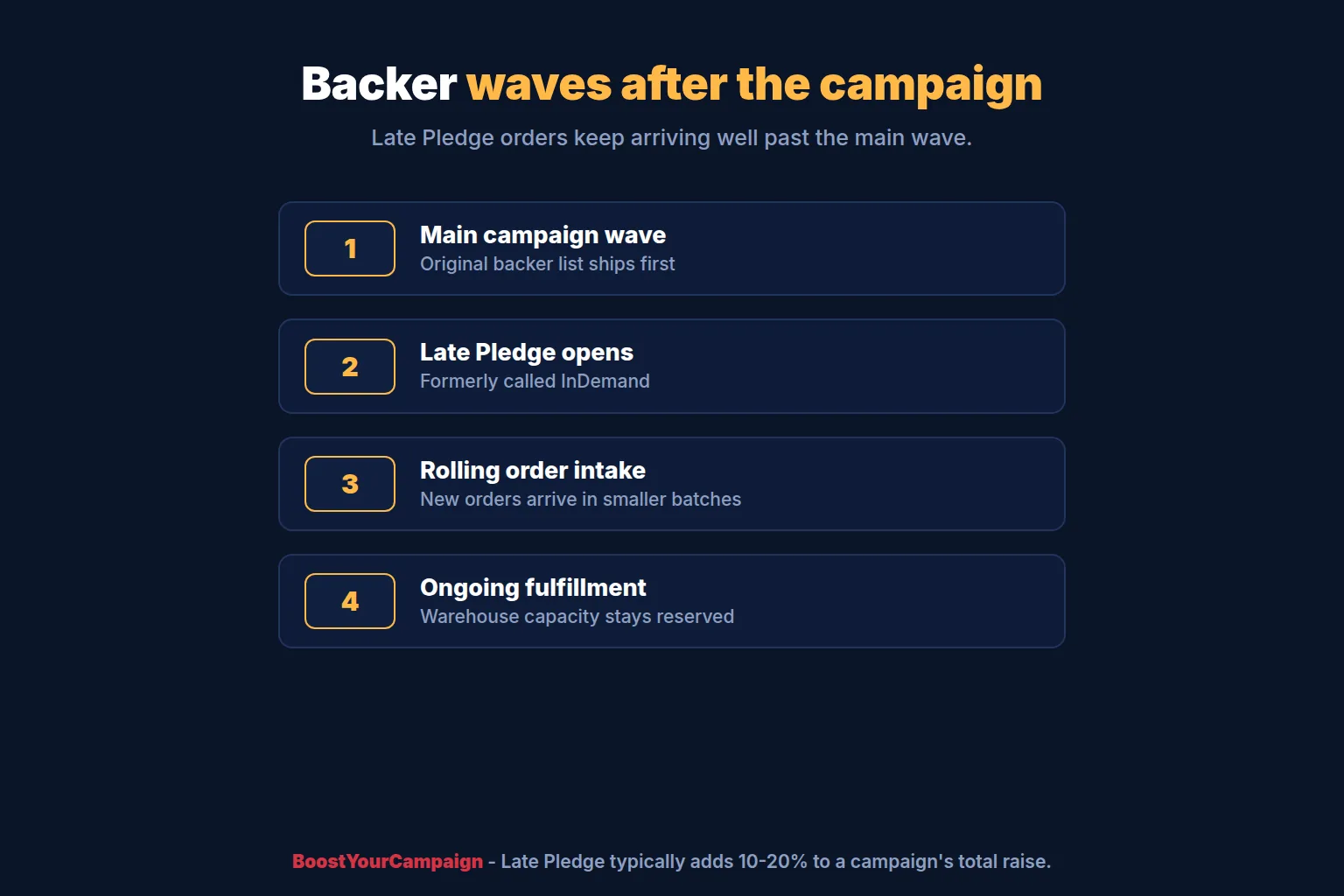
Late Pledge (formerly called InDemand) is Indiegogo's mechanism for continuing to sell a campaign's rewards after the main funding window closes, and it typically adds 10-20% to a campaign's total raise. That's real revenue, but it means fulfillment doesn't stop when the original backer list ships - it keeps running in waves as new Late Pledge orders come in, sometimes for months after the initial delivery date.
The practical effect on a fulfillment plan is that inventory and warehouse capacity need to be modeled for an ongoing tail of orders, not a single fixed batch. A creator who orders exactly enough units for the original backer count, then sees a strong Late Pledge run, ends up either back-ordering new production or scrambling for a second freight shipment on a compressed timeline - both more expensive than planning for a Late Pledge buffer from the start. The fix is straightforward: build a modest overage into the initial production run, and set expectations with the fulfillment warehouse that orders will keep arriving in smaller batches after the first big wave rather than assuming the job is done once the original backer list ships.
Late Pledge orders also interact with the address and survey process differently than the original campaign does, since each new order needs its own address collection rather than arriving all at once through a single survey close. A pledge manager that handles rolling order intake, rather than one built only for a single fixed survey window, makes this meaningfully easier to manage. Our pledge manager and late pledges guide covers the order-intake side of running Late Pledge alongside active fulfillment.
5) Gamefound's acquisition of Indiegogo and the new fee structure
Gamefound acquired Indiegogo in 2025, and the platform now runs on Gamefound's underlying fee structure rather than its previous standalone pricing. That shift changes the math creators need to run when comparing platform fees against fulfillment and shipping cost - platform fees, payment processing, and fulfillment cost all have to be modeled together as one total cost of goods, not evaluated one at a time in isolation. Our Kickstarter and Indiegogo fees guide breaks down the current fee structure in full, including how it compares to Kickstarter's.
Flexible funding, which used to let a campaign keep whatever it raised even if it missed its goal, was retired for new campaigns in October 2025 - every new Indiegogo campaign now runs on fixed funding, where the campaign only collects if it hits its goal. That change matters for fulfillment planning specifically because fixed funding removes the scenario where a creator has to fulfill a partial, under-goal raise with a thinner margin than planned. Campaigns that launched under the old flexible funding model before the change are still bound by whatever terms they launched under.
6) Direct-ship vs. splitting inventory between a US and EU warehouse
Direct-ship fulfillment ships every order from one warehouse, wherever it happens to be located. It works for a small, geographically concentrated backer list, and it becomes expensive fast once a meaningful share of orders cross a border - which, given Indiegogo's 223-country reach, tends to happen on more campaigns than creators expect going in. Splitting inventory between a US warehouse and an EU warehouse, via two bulk freight shipments instead of one, turns most of those international orders back into domestic-style shipments on each side of the split.
The tradeoff is the same one every crowdfunding campaign weighs: splitting one freight shipment into two adds a planning step and a small per-unit cost increase versus a single larger container, but the postage and customs savings on the international side typically outweigh that added complexity once order volume gets past a few hundred international parcels. Ocean freight for either shipment typically takes 30-45 days port to port, so both warehouse legs need to be booked with that timeline in mind rather than assumed to run in parallel with zero friction. Our board game fulfillment guide covers a category where this split matters even more due to box weight, and our crowdfunding fulfillment companies guide compares how different providers handle a two-warehouse setup. The same regional logic applies to ongoing sales after the campaign - it's why we run ecommerce fulfillment out of the same US and EU warehouses once a brand moves into a Shopify store.
7) Common failure modes in Indiegogo fulfillment
A handful of mistakes show up repeatedly on Indiegogo campaigns specifically. Baking a flat, single shipping fee into every perk regardless of region is the most common - it overcharges nearby backers and undercharges distant ones, and given how international an Indiegogo backer list usually is, that mispricing erodes margin faster here than on a more domestically concentrated campaign. Underestimating Late Pledge volume and running out of production buffer is the second, since it forces a rushed second production run or freight shipment on a compressed timeline.
Shipping everything from a single warehouse to a genuinely global backer base is the third, and it's the mistake this guide keeps returning to because it's the single biggest lever on total fulfillment cost. Missing IOSS or EORI registration before EU-bound freight or orders start moving is the fourth, and it stalls parcels in customs at the worst possible moment - right after a backer's tracking shows movement and then goes quiet. Treating an Indiegogo survey or pledge manager export as final without an address-verification pass rounds out the list; a bad address on an international parcel is an expensive problem to fix after postage has already been spent.
| Approach | Backer cost/experience | Customs risk | Best for |
|---|---|---|---|
| Direct-ship, single warehouse | Cheapest to set up, expensive on most international orders | High - every non-domestic parcel is its own customs event | Small, geographically concentrated backer lists only |
| Direct-ship with prepaid duty (DDP) | Clean for the backer, costly per international parcel | Medium - duty is prepaid but volume stays high | Moderate international share, lower total order count |
| US + EU warehouse split | Domestic-style cost and speed for most backers | Low - most orders clear as regional shipments | Any Indiegogo campaign, given the 223-country reach |
| Agency with owned US/EU warehouses | Same as the split, run alongside campaign marketing | Low, one team handles both regions end to end | Creators who want fulfillment planned with the campaign |
How BoostYourCampaign fits
BoostYourCampaign owns fulfillment warehouses in both the US and the EU, which matters more for Indiegogo campaigns than most, given the 223-country backer reach covered in section 3. Reward pricing, the shipping fee baked into each perk, and the US/EU split get planned together before launch instead of being handed off after the campaign funds, and our in-house team manages the customs paperwork, IOSS and EORI registration, pick/pack, and carrier selection described throughout this guide - including ongoing fulfillment for Late Pledge waves as they arrive.
On the marketing side, BYC uses a skin-in-the-game ad model, investing its own money alongside the client's ad budget with fixed fees rather than a percentage-of-raise commission. The agency has been active since 2010 across 4,600+ campaigns with $734M+ raised and a 4.9/5 score across 300+ verified reviews. It's an Indiegogo Approved Agency, a Google Premier Partner, a Facebook Marketing Partner, an official Shopify Partner, and an Amazon Partner. Once a campaign delivers, the same warehouses carry into ongoing Shopify and ecommerce fulfillment, so a brand keeps one logistics relationship instead of finding a new one once the campaign updates page goes quiet. See our full services overview for how marketing, video, and fulfillment work together under one roof, and our Kickstarter fulfillment guide if you're running or planning a campaign on both platforms.
Pre-launch checklist for Indiegogo fulfillment
| Question | Why it matters |
|---|---|
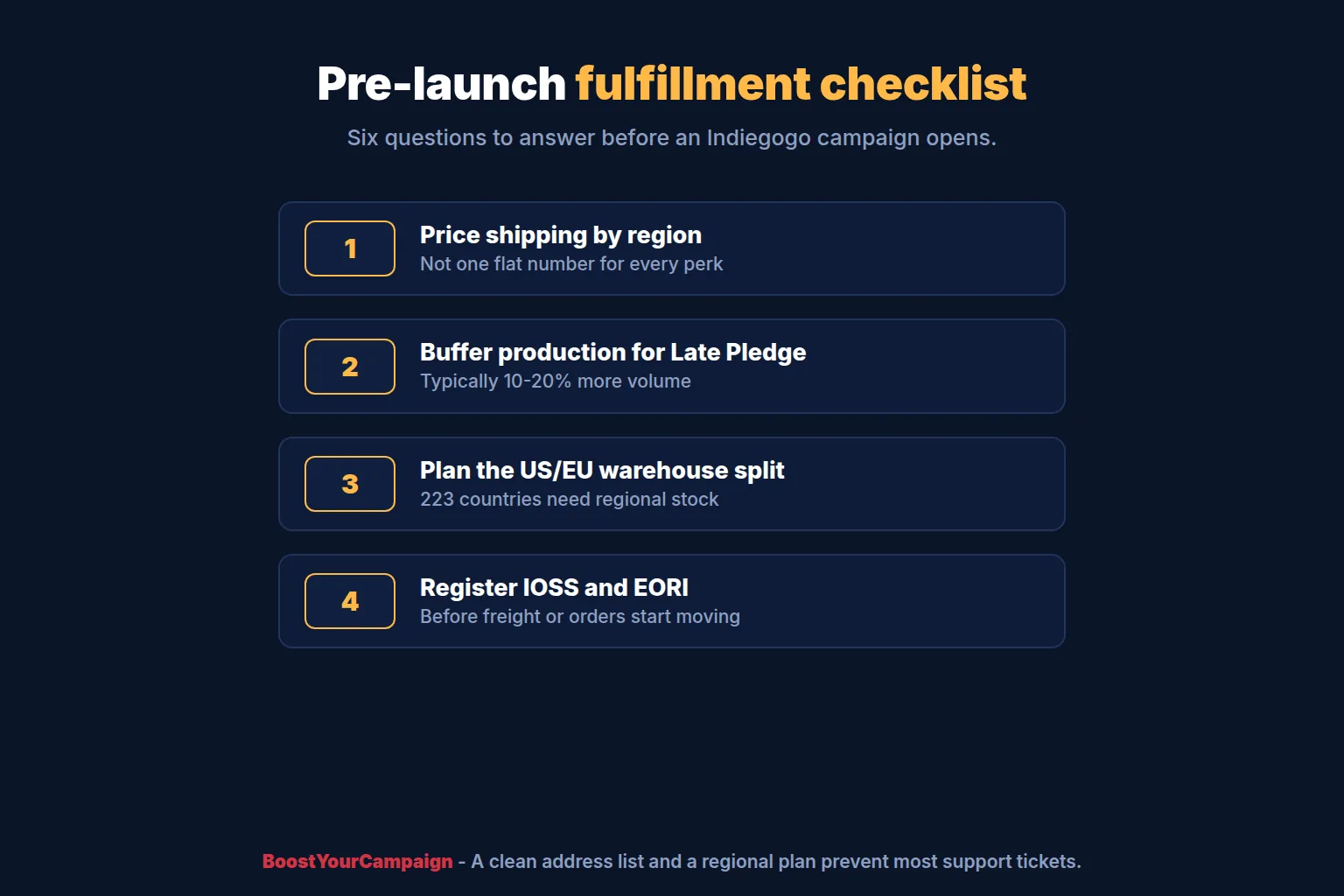
| Is the shipping fee baked into each perk priced by region, not a flat global number? | A flat fee overcharges nearby backers and undercharges distant ones on a 223-country backer base. |
| Is production sized with a buffer for Late Pledge volume? | Late Pledge orders typically add 10-20% to a raise and keep arriving after the main wave ships. |
| Is the plan a single warehouse or a US/EU split? | A split turns most international orders into domestic-style shipments, which matters more here given Indiegogo's reach. |
| Are IOSS and EORI registration handled before freight moves? | Missing registration stalls parcels in EU customs right as backers start checking tracking. |
| Does the fulfillment plan account for orders arriving after the original delivery date? | Late Pledge orders don't stop on a fixed date, so warehouse capacity has to stay available. |
| Has survey or pledge manager address data been through a verification pass? | A bad address on an international parcel is expensive to fix once postage is already spent. |
Since Gamefound now owns Indiegogo, the Gamefound guide explains what changed for creators after the acquisition.
Frequently Asked Questions
Does Indiegogo handle shipping for backers?
No. Indiegogo collects the pledge and payment, but the creator is responsible for producing, warehousing, and shipping every reward. Fulfillment is entirely separate from the platform itself.
How much does Indiegogo fulfillment cost per unit?
The cost structure is the same as any crowdfunding fulfillment project: pick/pack around $2-4 per order plus packaging and postage. A 1 lb reward typically runs $9-11 domestic, a 3 lb reward roughly $15-18, and an 8 lb reward roughly $25-32. International shipping commonly runs 3-5x those domestic figures.
What is Late Pledge on Indiegogo?
Late Pledge (formerly called InDemand) lets a creator keep selling a campaign's rewards after the main funding window closes. It typically adds 10-20% to a campaign's total raise, and those orders need to be fulfilled in ongoing waves alongside, or after, the original backer shipment.
Did Indiegogo change ownership or fee structure recently?
Yes. Gamefound acquired Indiegogo in 2025, and the platform now runs on Gamefound's fee structure. Our fees guide covers the current numbers in detail.
Is flexible funding still available on Indiegogo?
No. Indiegogo retired flexible funding for new campaigns in October 2025. Every new campaign now runs on fixed funding, which only collects the raise if the campaign hits its goal.
Why does customs planning matter more for Indiegogo than other platforms?
Indiegogo draws backers from 223 countries, a wider geographic spread than most crowdfunding platforms see, so a larger share of orders are international by default. Getting IOSS, EORI, and HS code planning right before launch matters more here because more of the backer base is affected by it.
Should I split inventory between a US and EU warehouse for an Indiegogo campaign?
In most cases, yes. Bulk-freighting roughly 500 units to a UK or EU warehouse typically costs around $2,000 but saves roughly $15-25 per parcel versus shipping each one internationally, and Indiegogo's wide backer base tends to make that math pay off faster than on a more domestically concentrated campaign.
If you're planning an Indiegogo launch and want fulfillment and Late Pledge capacity priced correctly before you set reward tiers, reach out through /contact.
Want results like these for your campaign?
We've helped 4,600+ creators raise over $734M. Let's pressure-test your launch plan and find the highest-leverage fixes before you go live.
Talk to an expert →Get the free 87-step launch checklist
The exact pre-launch, live-campaign and fulfillment steps we use across 4,600+ launches. Free PDF, emailed instantly.
You're in - check your inbox. Open the checklist now ->