Trying to figure out which crowdfunding route actually fits a startup you're trying to build, not just a single product you want to sell? Talk with BoostYourCampaign about your product, your funding goal, and where you are in building the company around it.
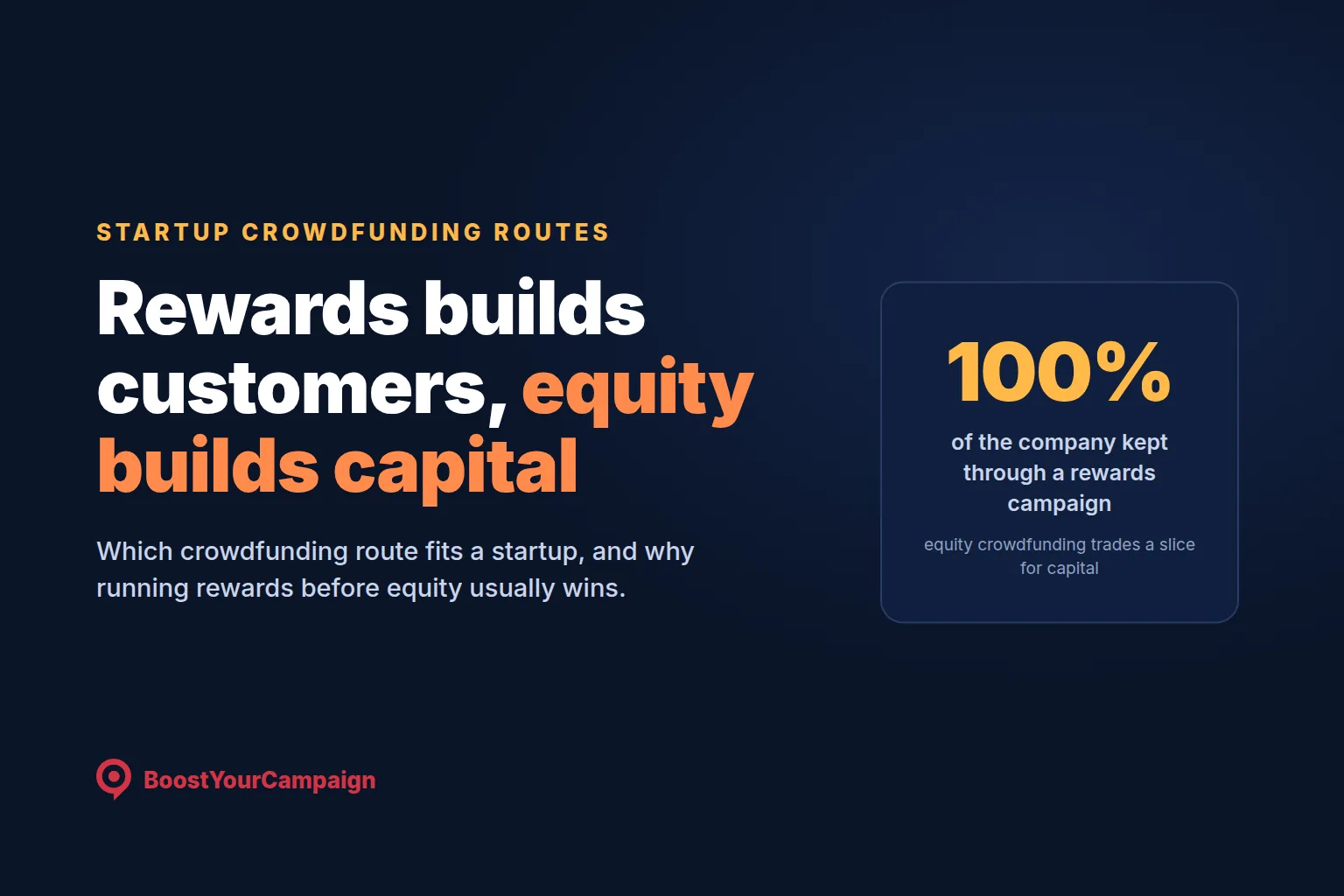
For a general platform-by-platform ranking, see our crowdfunding platforms guide. This article looks at a narrower question startup founders actually face: rewards crowdfunding (Kickstarter, Indiegogo) proves demand and builds a customer list without giving up equity, while equity crowdfunding (Wefunder, StartEngine, Republic) raises real capital in exchange for a cap table entry and real regulatory obligations. Most startups building a physical or consumer product are better served running rewards crowdfunding first to prove demand, then raising equity capital later once that traction exists to show investors.
- Rewards and equity crowdfunding solve different problems - one gets you customers and validation, the other gets you capital and a cap table.
- A successful rewards campaign is evidence, not just cash - investors read a funded Kickstarter or Indiegogo campaign as real proof that demand exists.
- Equity crowdfunding carries real regulatory weight - Regulation Crowdfunding in the US involves disclosure requirements that rewards platforms don't have.
- Rewards campaigns create a fulfillment obligation - the money isn't free once it's raised; it comes with a production and shipping commitment attached.
- Sequencing usually beats picking one - rewards first for proof, equity later once there's traction to point to.
- The right route depends on product type - physical consumer goods, software, and services each fit these platforms differently.
1) Two different roads, and what each one actually gets a startup beyond money
Founders often ask "which crowdfunding platform is best" as if there's one answer, but rewards crowdfunding and equity crowdfunding are structurally different tools solving different problems, and the more useful question is what you actually need beyond the dollar amount on the goal bar.
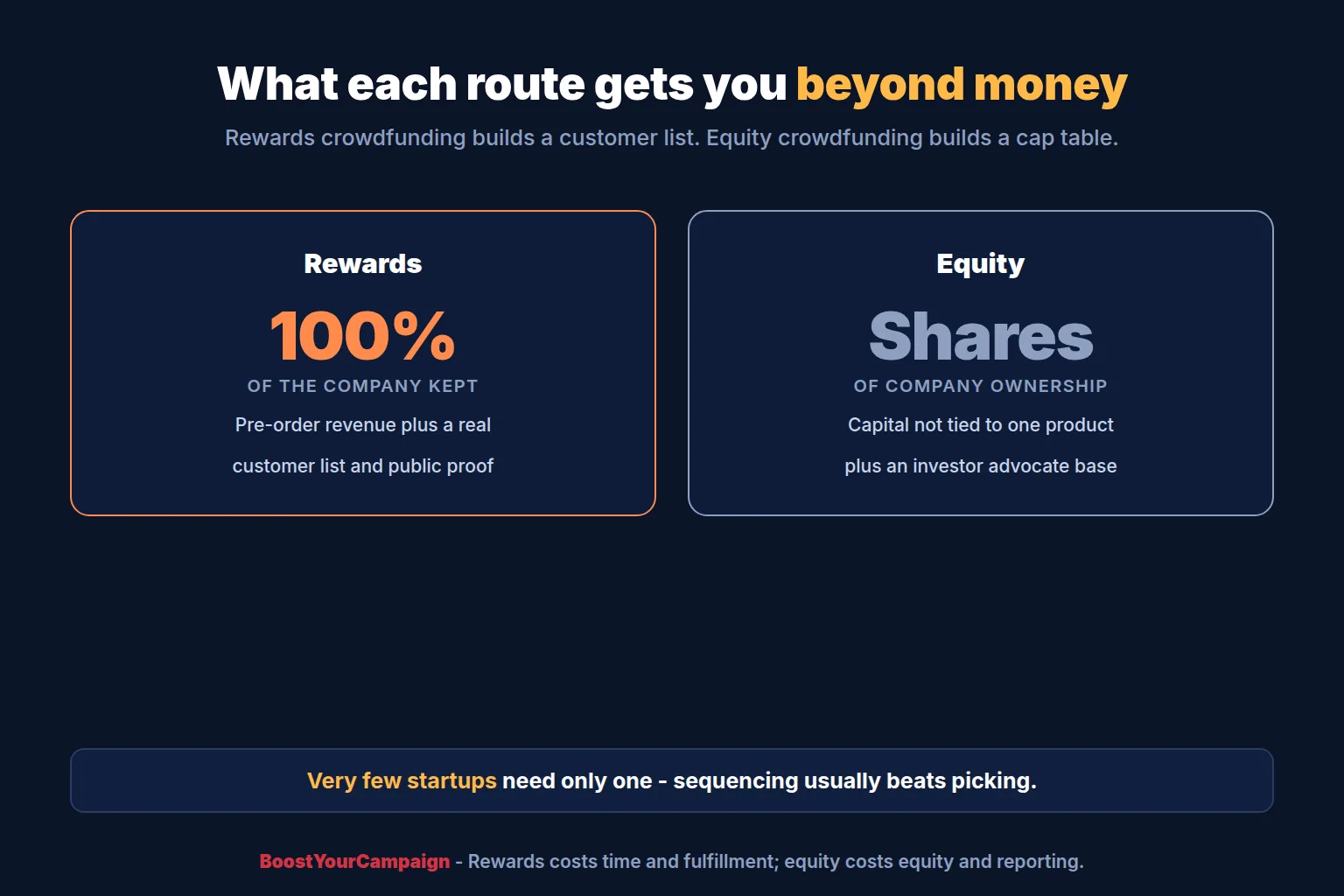
Rewards crowdfunding on Kickstarter or Indiegogo gets you three things at once: pre-order revenue to fund production, a real customer list of people who paid money for your product before it existed at scale, and public proof that demand is real. You keep 100 percent of the company. What you give up is time (running a campaign properly takes months of preparation) and the operational commitment to actually manufacture and ship what you sold, which is a business obligation, not a fundraising event that ends when the goal bar fills.
Equity crowdfunding on a platform like Wefunder, StartEngine, or Republic gets you capital in exchange for company ownership, spread across potentially hundreds or thousands of small investors instead of a handful of venture firms. What you give up is a slice of the company, ongoing reporting obligations to those investors, and in the US, real securities-law compliance that a rewards campaign never has to think about. What you get that rewards crowdfunding can't give you is capital that isn't tied to a specific product's production cost, plus a shareholder base that can turn into an active promotional and referral network.
The short version: rewards crowdfunding builds a customer list. Equity crowdfunding builds a cap table. Very few startups actually need to choose only one, but almost every startup benefits from being clear about which one solves the problem they have right now.
2) Rewards crowdfunding for a startup: validation and customers, no dilution
For a startup with a physical or clearly demonstrable product, Kickstarter and Indiegogo do something venture capital and equity crowdfunding can't do as directly: they prove, in public, with real transactions, that strangers will pay for what you're building. A funded goal isn't a survey response or a landing-page email signup, it's a completed purchase, and that distinction matters enormously to anyone evaluating the business later, including investors.
The mechanics are straightforward relative to equity crowdfunding: no securities filing, no accredited-investor rules, no ongoing reporting obligation to backers beyond delivering what you promised and keeping them updated. Backers become customers, not shareholders, and the money raised is revenue against a product, not investment capital with strings attached. That simplicity is a real advantage for a first-time founder who isn't ready to take on cap-table complexity before the product even exists at scale.
The tradeoff is real too: a rewards campaign only works if there's something to actually deliver, on a timeline backers will hold you to, at a cost structure that leaves margin after platform fees, payment processing, manufacturing, and shipping. It's a genuine operating commitment, not a fundraising mechanism you can walk away from once the money lands. Our Kickstarter and Indiegogo fees guide breaks down what actually gets taken out of a successful raise before you see it.
3) Equity crowdfunding for a startup: capital and investors, with real regulatory weight
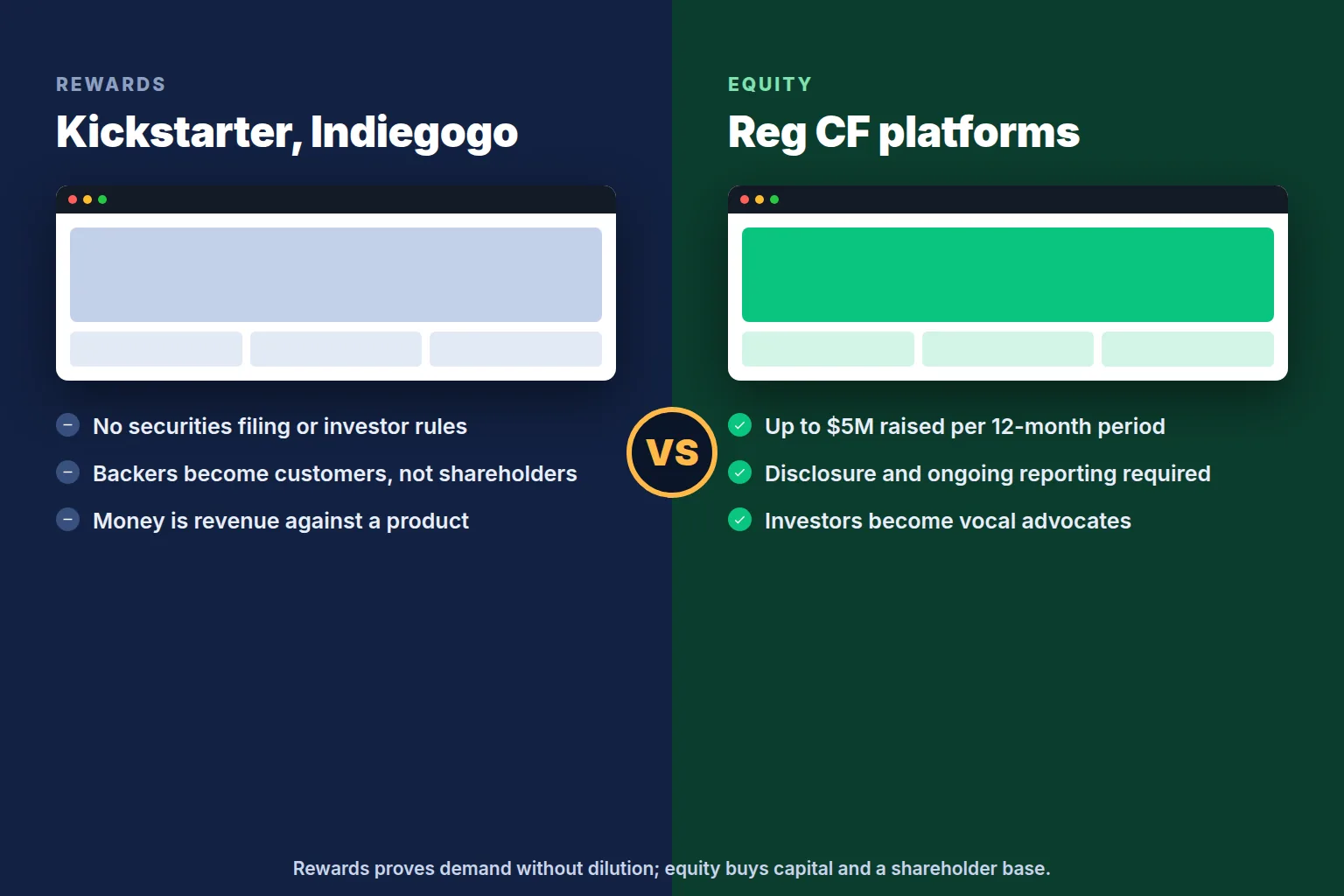
Equity crowdfunding platforms let a startup raise capital from a large pool of investors, including non-accredited individuals in many cases, in exchange for actual equity or a debt instrument, rather than a product reward. Wefunder, StartEngine, and Republic are the platforms most commonly used for this in the US, and each has processed meaningful volume through Regulation Crowdfunding (Reg CF) in recent years, though relative market share between them shifts year to year, so it's worth checking current standing directly rather than assuming last year's numbers still hold.
In the US, Reg CF currently permits a company to raise up to $5 million in a twelve-month period through this route, a limit that has changed before and could change again, so confirm the current cap directly with a securities attorney or the platform before finalizing a raise target. Running a Reg CF raise means disclosure obligations, ongoing annual reporting once you cross certain thresholds, and a compliance process that a Kickstarter campaign simply doesn't have. None of this is a reason to avoid equity crowdfunding, it's a reason to bring in a securities attorney before setting up a raise rather than after, since the paperwork and structure need to be right from the start.
What equity crowdfunding gets you that rewards crowdfunding structurally can't: capital that isn't tied to producing and shipping a specific product, and a base of investor-backers who often become vocal advocates precisely because they now have financial skin in the outcome. It's a genuinely different relationship than a customer who bought a discounted unit. Our equity vs rewards crowdfunding guide goes deeper on the mechanics of each model.
4) How investors read a successful rewards campaign as traction evidence
A funded Kickstarter or Indiegogo campaign is one of the cleanest pieces of early traction evidence a startup can hand an investor, rewards or equity. It answers the question every investor asks before anything else: does anyone actually want this? A campaign that hit its goal, especially one that beat it meaningfully, is a public, third-party-verifiable answer to that question, backed by real payment transactions instead of a founder's projection.
Investors evaluating a startup after a rewards campaign will typically look past the headline number and into the details: how much of the raise came from paid traffic versus organic and pre-launch list conversion, what the average pledge size was, how many backers came back for a second product if there's been one, and whether fulfillment actually happened on time. A campaign that funded on the back of a founder's own paid ad spend with no organic pickup tells a different story than one that funded from an audience that found it and shared it. Both can be real traction, but investors read them differently, so it's worth being ready to speak to that distinction rather than just citing the final number.
This is also why sequencing rewards before equity tends to work well: a rewards campaign generates exactly the kind of concrete, quantifiable evidence that makes an equity round easier to close later, on better terms than a pre-revenue pitch deck alone would get.
5) The fulfillment and operations obligation rewards crowdfunding creates
It's worth stating plainly: a successful rewards campaign is not free money. Every dollar raised comes with a matching obligation to manufacture, quality-check, package, and ship a real product to every backer who paid for one, on a timeline you set publicly and that backers will hold you to. Startups that treat a Kickstarter raise purely as a funding event, without planning the operational side as seriously as the fundraising side, are the ones that end up with delayed shipments, frustrated backers, and a public comment section that hurts the next raise more than it helps this one - which is exactly the risk an experienced, full-stack partner is built to absorb, since fulfillment gets planned alongside the campaign strategy instead of after it.
This obligation is also where a lot of founders underestimate cost. Platform and payment processing fees, manufacturing at whatever volume the raise actually produced, packaging, customs and duties for international backers, and shipping all come out of the raised total before any of it becomes usable capital for the business. A startup planning to use crowdfunding proceeds as working capital for the company beyond fulfillment needs to budget conservatively, because the margin left over after fulfillment is often much smaller than the headline raised amount suggests.
None of this is a reason to avoid rewards crowdfunding. It's a reason to treat it as what it actually is: launching a real product business with real customers, not a fundraising round with a product attached as an incentive.
6) Sequencing: rewards first for proof, equity later on traction

The pattern that tends to work best for startups with a physical or clearly demonstrable product: run rewards crowdfunding first, when the goal is proving demand and generating early revenue without giving up equity, then raise equity capital later once there's real traction, whether that's a funded campaign, repeat sales, or early revenue, to point to.
This sequencing works because it solves each stage's actual problem in order. Early on, the biggest risk is usually "does anyone want this," which rewards crowdfunding answers directly and publicly. Later, once demand is proven, the bigger constraint is usually capital to scale production, build a team, or expand into new markets, which is exactly what equity capital is built for. Trying to raise equity capital before proving demand means pitching mostly on the strength of a deck and a prototype. Trying to fund scale-up purely through repeated rewards campaigns means giving up none of the company but also capping growth at whatever a single crowdfunding audience can support.
Some startups run both routes closer together, or even the same year, particularly when a rewards campaign is explicitly framed from the start as a proof point ahead of a planned equity raise. That's a reasonable strategy too, as long as the rewards campaign is executed as a real product launch first, not staged purely for investor optics, since backers can tell the difference and it affects how the campaign actually performs.
7) Picking the right route by product type
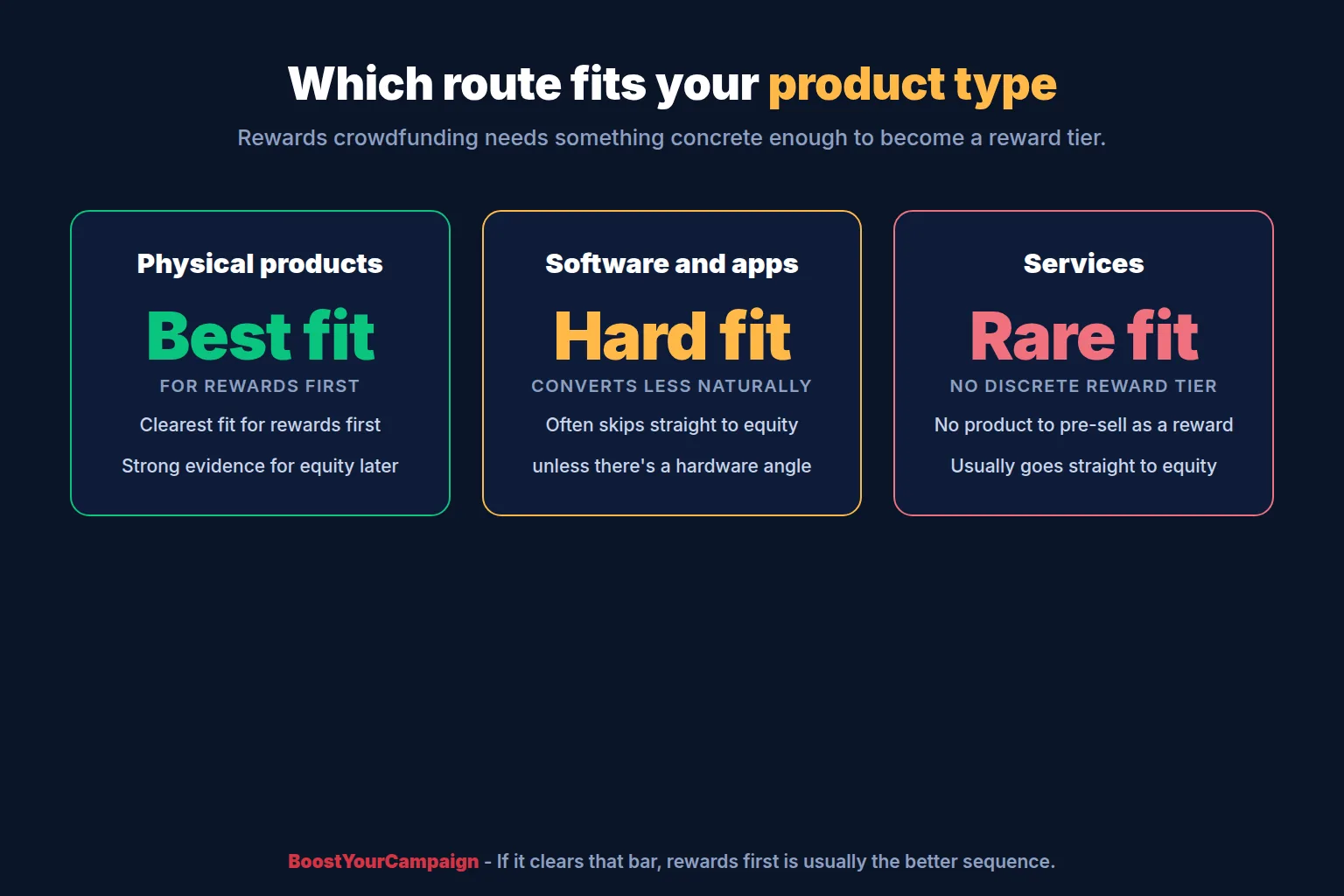
Physical consumer products. This is the clearest fit for rewards crowdfunding first. A physical good gives backers a real reason to pledge for the product itself, and a funded campaign becomes strong evidence for an equity raise later if the startup wants to scale beyond one product.
Software and apps. Rewards crowdfunding is a harder fit here, since digital rewards convert less naturally than physical ones (our guide to Kickstarter for apps and software covers this in depth). Software startups with real growth potential often skip the rewards stage entirely and go straight to equity crowdfunding or venture capital, unless there's a hardware or physical component to anchor a campaign.
Services. Rewards crowdfunding rarely fits a pure service business well, since there's no discrete product to pre-sell as a reward. Service-based startups looking for public capital typically go straight to equity crowdfunding, where the pitch is the business model and growth plan rather than a specific deliverable.
The through-line: rewards crowdfunding needs something concrete enough to become a reward tier. If your product clears that bar, rewards first is usually the better sequence. If it doesn't, equity crowdfunding or another capital route is probably the more direct path.
Rewards, equity, and sequencing both, compared for a startup
| Route | Capital raised | What you give up | Timeline | Best for |
|---|---|---|---|---|
| Rewards (Kickstarter/Indiegogo) | Typically limited to what the product's pre-order volume supports | Nothing in equity - a fulfillment obligation instead | Months of prep, 30-60 day live campaign | Physical or demonstrable products needing proof of demand |
| Equity (Wefunder, StartEngine, Republic) | Up to the current Reg CF cap per 12-month period, or more via other exemptions | Company equity and ongoing investor reporting | Months of legal prep plus an active raise period | Startups needing capital not tied to a single product's production cost |
| Both, sequenced | Rewards proceeds plus a larger equity round on stronger terms | Equity later, but on better terms than a pre-traction pitch | Rewards campaign first, equity raise months to a year later | Physical-product startups planning to scale past one product |
How BoostYourCampaign fits
BoostYourCampaign has run full-stack, done-for-you rewards crowdfunding campaigns since 2010, across 4,600+ launches and $734M+ raised, with a 4.9/5 score across 300+ verified reviews visible on the reviews page. For startups planning to sequence a rewards campaign ahead of an equity raise, the goal isn't just hitting a funding number, it's building the kind of clean, well-documented traction (organic pickup, repeat backers, on-time fulfillment) that actually strengthens the story told to investors afterward.
BYC's model is built around that full lifecycle: marketing, video production, and fulfillment under one roof, with owned video studios in the US and EU and owned fulfillment warehouses in both regions, so the operational side of a rewards campaign doesn't become the thing that undermines the traction story a founder is trying to build. The agency runs a skin-in-the-game ad model, investing its own money alongside the client's ad budget with fixed fees rather than a percentage-of-raise commission, and is an Indiegogo Approved Agency, a Google Premier Partner, a Facebook Marketing Partner, an official Shopify Partner, and an Amazon Partner. For startups still finalizing a product ahead of a campaign, BYC also has in-house MVP development (/services/mvp-development), and client campaigns have gone on to Shark Tank coverage and retail introductions including Best Buy, documented on the press page.
Before running any rewards campaign as part of a fundraising sequence, it's worth mapping the pre-launch audience-building plan against the timeline, since a rushed rewards campaign produces weaker traction evidence than one built properly from the start. See our pre-launch audience building tactics guide for that groundwork.
For the equity side in detail, see Wefunder vs StartEngine vs Republic, and for the rewards platforms beyond Kickstarter, Kickstarter vs Gamefound vs BackerKit.
Frequently Asked Questions
Should a startup use rewards or equity crowdfunding first?
For a startup with a physical or clearly demonstrable product, rewards crowdfunding first is usually the better sequence. It proves demand, generates a customer list, and creates traction evidence that makes a later equity raise easier to close, all without giving up any equity in the process.
Can a startup run both rewards and equity crowdfunding?
Yes, and doing so in sequence, rewards campaign first, equity raise once there's traction to show, tends to work better than running both at once or reversing the order. A funded rewards campaign gives investors concrete evidence a pitch deck alone can't provide.
What is the current Reg CF fundraising limit for equity crowdfunding?
As of this writing, Regulation Crowdfunding permits raising up to $5 million in a twelve-month period, though this limit has changed before and platform-specific rules and other securities exemptions can affect the actual number available to a specific raise. Confirm the current limit directly with a securities attorney or the platform before setting a target.
Do I need a lawyer for equity crowdfunding?
Yes. Equity crowdfunding under Regulation Crowdfunding involves disclosure and reporting obligations that rewards platforms don't have, and getting the structure wrong at the outset is far more costly to fix later. A securities attorney should be involved before the raise is set up, not after.
Does a successful Kickstarter campaign actually help with a later fundraising round?
Generally yes. Investors treat a funded rewards campaign as real evidence that demand exists, since it's backed by actual purchases rather than survey responses or projections. Details like organic traffic share, repeat backers, and on-time fulfillment matter to how strong that evidence looks.
What obligations come with a successful rewards crowdfunding raise?
A completed rewards campaign creates a real obligation to manufacture, quality-check, and ship the product to every backer on the promised timeline. It should be treated as launching a product business, not simply as a fundraising event that ends once the goal bar fills.
Is rewards crowdfunding a good fit for a software startup?
Usually not on its own. Digital rewards convert less naturally than physical ones, and software with real growth potential often goes straight to equity crowdfunding or venture funding instead, unless there's a physical or hardware component that gives a rewards campaign something concrete to sell.
How much equity does a startup typically give up through equity crowdfunding?
It varies widely by company valuation, raise size, and platform, and there's no standard figure to cite responsibly without knowing the specifics of a raise. A securities attorney or the platform's own guidance is the right source for modeling this against your specific company and target raise.
If you're weighing whether a rewards campaign fits into your startup's funding sequence, reach out through /contact and we'll help you think through the timeline.
Want results like these for your campaign?
We've helped 4,600+ creators raise over $734M. Let's pressure-test your launch plan and find the highest-leverage fixes before you go live.
Book a free strategy call →Get the free 87-step launch checklist
The exact pre-launch, live-campaign and fulfillment steps we use across 4,600+ launches. Free PDF, emailed instantly.
You're in - check your inbox. Open the checklist now ->